
Fast Sim Studies Status Estel Perez 27 Oct


- Slides: 26
Fast Sim Studies Status Estel Perez 27 Oct 2016
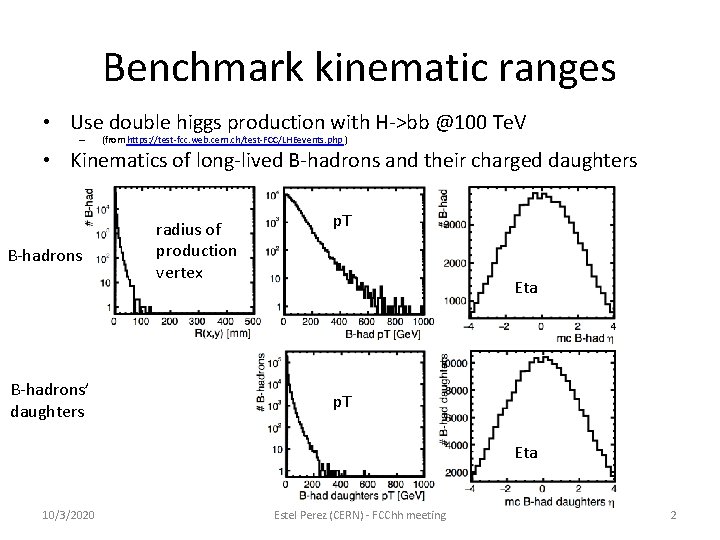
Benchmark kinematic ranges • Use double higgs production with H->bb @100 Te. V – (from https: //test-fcc. web. cern. ch/test-FCC/LHEevents. php ) • Kinematics of long-lived B-hadrons and their charged daughters B-hadrons’ daughters radius of production vertex p. T Eta 10/3/2020 Estel Perez (CERN) - FCChh meeting 2
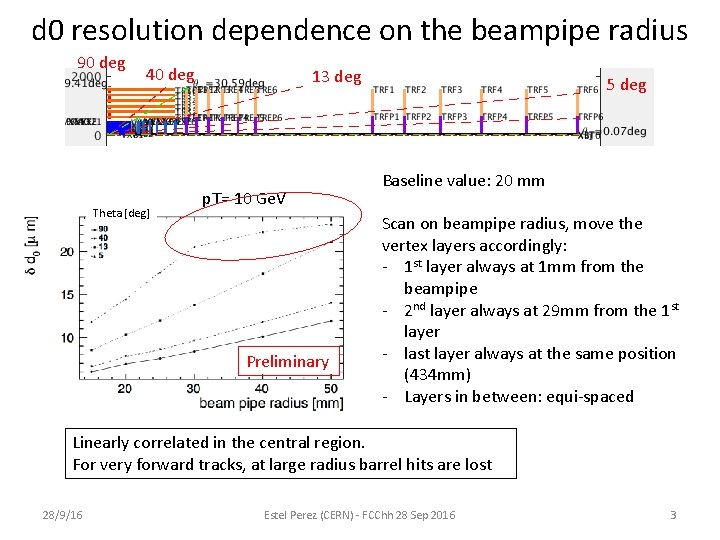
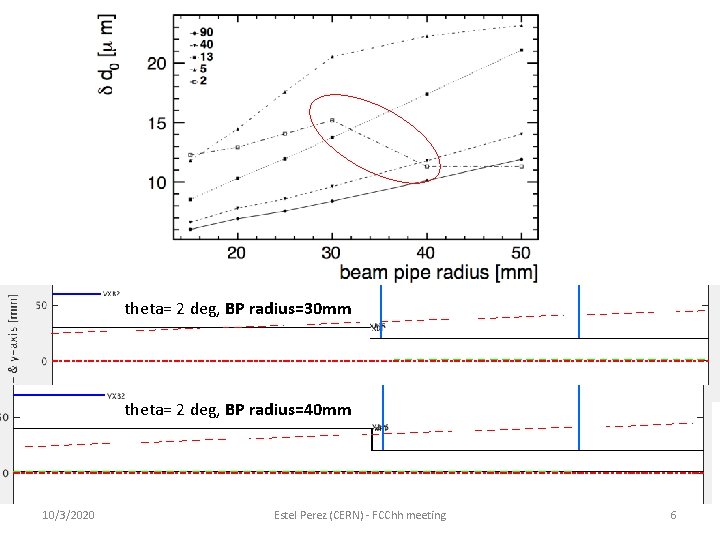
d 0 resolution dependence on the beampipe radius 90 deg 40 deg Theta [deg] 13 deg p. T= 10 Ge. V Preliminary 5 deg Baseline value: 20 mm Scan on beampipe radius, move the vertex layers accordingly: - 1 st layer always at 1 mm from the beampipe - 2 nd layer always at 29 mm from the 1 st layer - last layer always at the same position (434 mm) - Layers in between: equi-spaced Linearly correlated in the central region. For very forward tracks, at large radius barrel hits are lost 28/9/16 Estel Perez (CERN) - FCChh 28 Sep 2016 3
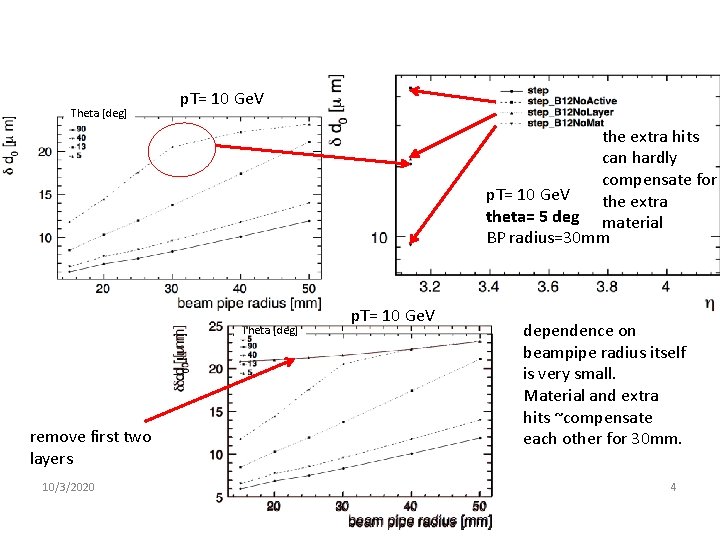
Theta [deg] p. T= 10 Ge. V the extra hits can hardly compensate for p. T= 10 Ge. V the extra theta= 5 deg material BP radius=30 mm Theta [deg] p. T= 10 Ge. V remove first two layers 10/3/2020 Estel Perez (CERN) - FCChh meeting dependence on beampipe radius itself is very small. Material and extra hits ~compensate each other for 30 mm. 4
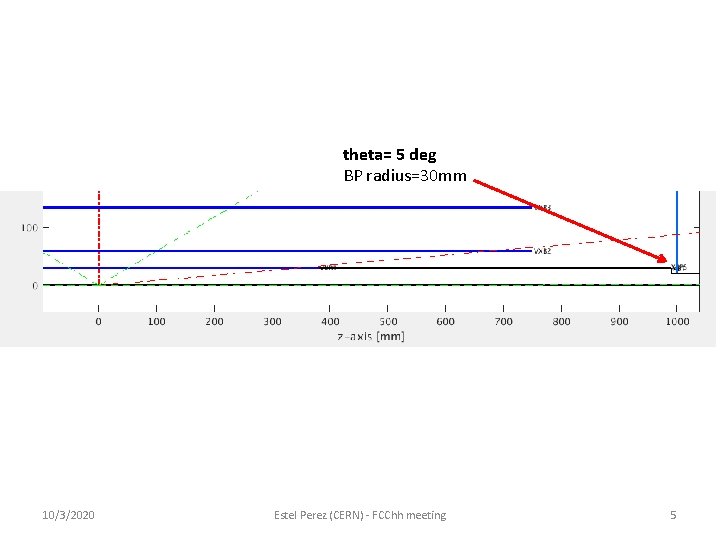
theta= 5 deg BP radius=30 mm 10/3/2020 Estel Perez (CERN) - FCChh meeting 5
theta= 2 deg, BP radius=30 mm theta= 2 deg, BP radius=40 mm 10/3/2020 Estel Perez (CERN) - FCChh meeting 6
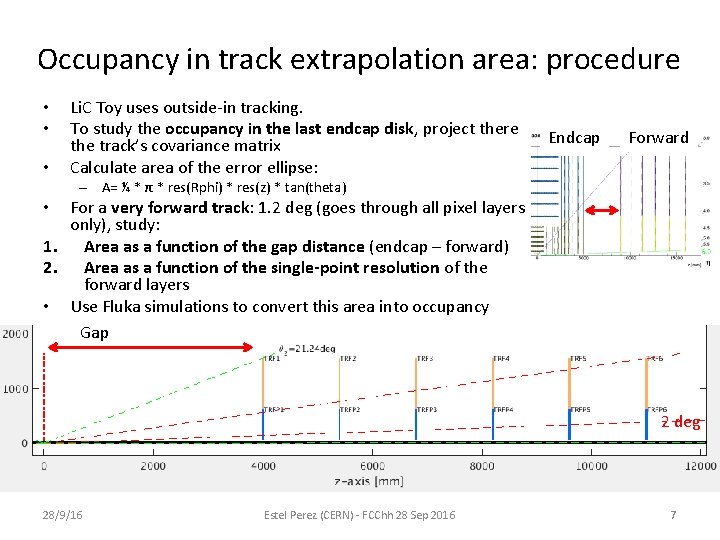
Occupancy in track extrapolation area: procedure • • • Li. C Toy uses outside-in tracking. To study the occupancy in the last endcap disk, project there the track’s covariance matrix Calculate area of the error ellipse: Endcap Forward – A= ¼ * π * res(Rphi) * res(z) * tan(theta) For a very forward track: 1. 2 deg (goes through all pixel layers only), study: 1. Area as a function of the gap distance (endcap – forward) 2. Area as a function of the single-point resolution of the forward layers • Use Fluka simulations to convert this area into occupancy Gap • 2 deg 28/9/16 Estel Perez (CERN) - FCChh 28 Sep 2016 7
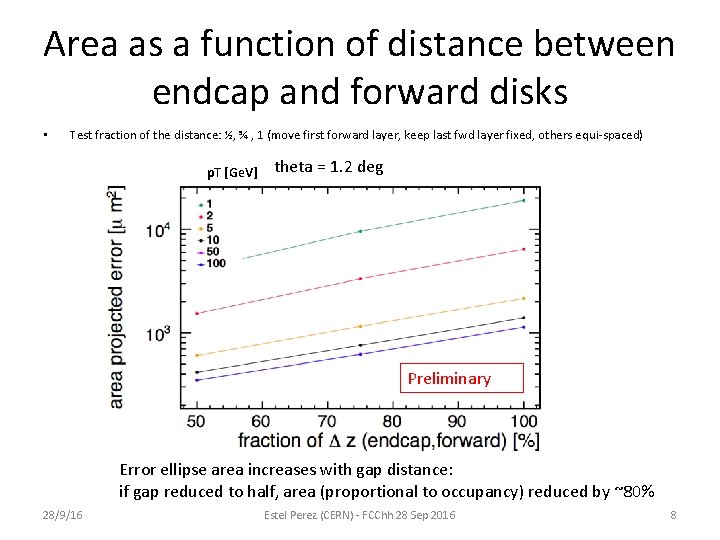
Area as a function of distance between endcap and forward disks • Test fraction of the distance: ½, ¾ , 1 (move first forward layer, keep last fwd layer fixed, others equi-spaced) p. T [Ge. V] theta = 1. 2 deg Preliminary Error ellipse area increases with gap distance: if gap reduced to half, area (proportional to occupancy) reduced by ~80% 28/9/16 Estel Perez (CERN) - FCChh 28 Sep 2016 8
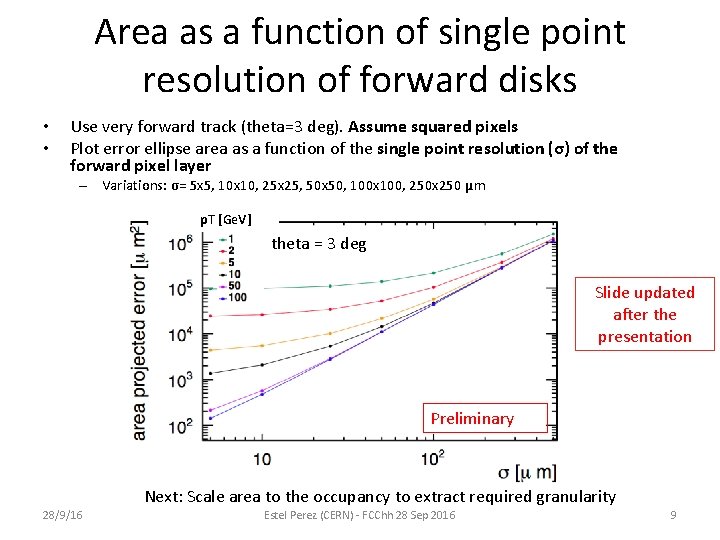
Area as a function of single point resolution of forward disks • • Use very forward track (theta=3 deg). Assume squared pixels Plot error ellipse area as a function of the single point resolution (σ) of the forward pixel layer – Variations: σ= 5 x 5, 10 x 10, 25 x 25, 50 x 50, 100 x 100, 250 x 250 μm p. T [Ge. V] theta = 3 deg Slide updated after the presentation Preliminary Next: Scale area to the occupancy to extract required granularity 28/9/16 Estel Perez (CERN) - FCChh 28 Sep 2016 9
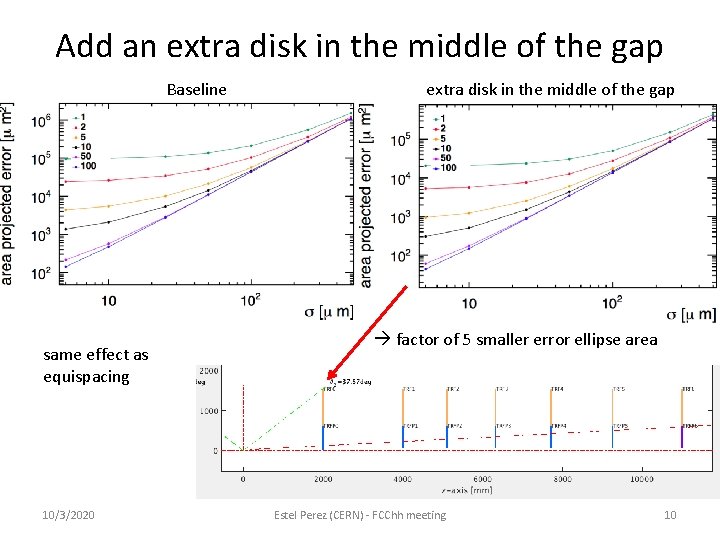
Add an extra disk in the middle of the gap Baseline same effect as equispacing 10/3/2020 extra disk in the middle of the gap factor of 5 smaller error ellipse area Estel Perez (CERN) - FCChh meeting 10
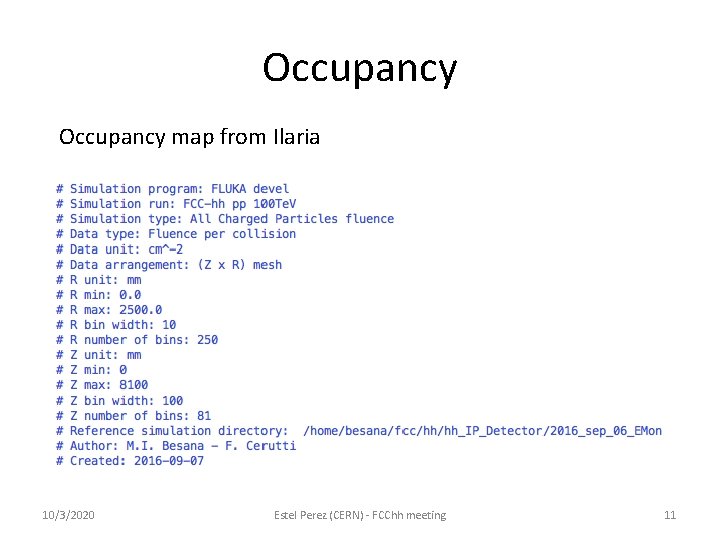
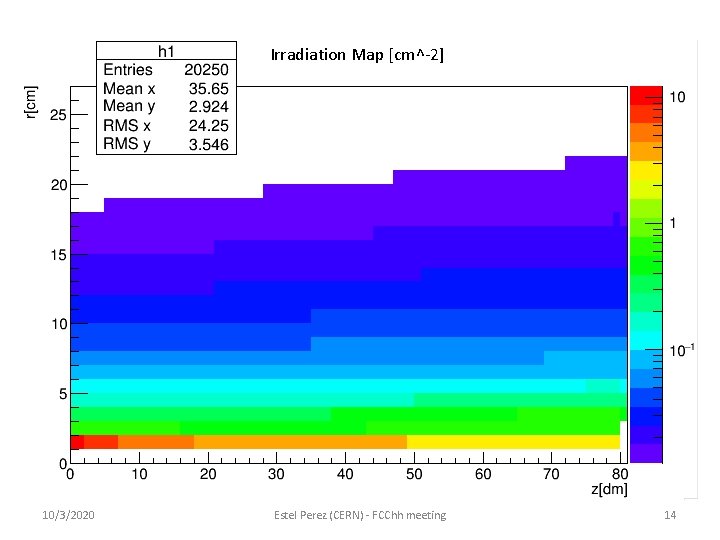
Occupancy map from Ilaria 10/3/2020 Estel Perez (CERN) - FCChh meeting 11
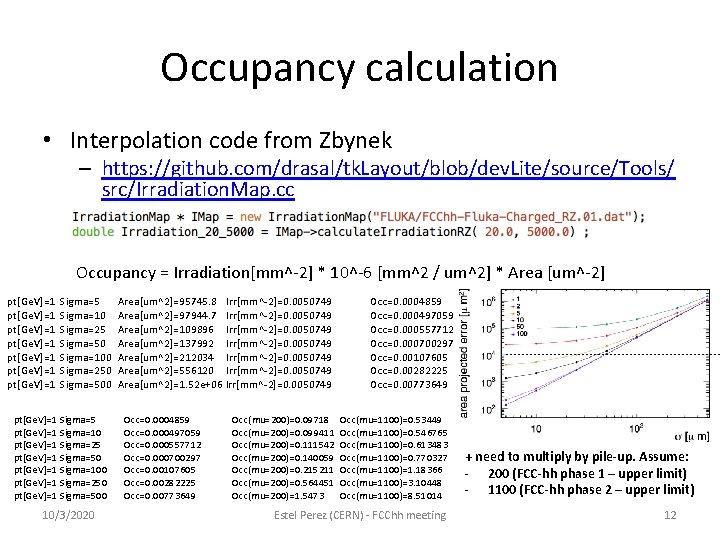
Occupancy calculation • Interpolation code from Zbynek – https: //github. com/drasal/tk. Layout/blob/dev. Lite/source/Tools/ src/Irradiation. Map. cc Occupancy = Irradiation[mm^-2] * 10^-6 [mm^2 / um^2] * Area [um^-2] pt[Ge. V]=1 pt[Ge. V]=1 Sigma=5 Sigma=10 Sigma=25 Sigma=50 Sigma=100 Sigma=250 Sigma=500 pt[Ge. V]=1 Sigma=5 pt[Ge. V]=1 Sigma=10 pt[Ge. V]=1 Sigma=25 pt[Ge. V]=1 Sigma=50 pt[Ge. V]=1 Sigma=100 pt[Ge. V]=1 Sigma=250 pt[Ge. V]=1 Sigma=500 10/3/2020 Area[um^2]=95745. 8 Irr[mm^-2]=0. 0050749 Area[um^2]=97944. 7 Irr[mm^-2]=0. 0050749 Area[um^2]=109896 Irr[mm^-2]=0. 0050749 Area[um^2]=137992 Irr[mm^-2]=0. 0050749 Area[um^2]=212034 Irr[mm^-2]=0. 0050749 Area[um^2]=556120 Irr[mm^-2]=0. 0050749 Area[um^2]=1. 52 e+06 Irr[mm^-2]=0. 0050749 Occ=0. 0004859 Occ=0. 000497059 Occ=0. 000557712 Occ=0. 000700297 Occ=0. 00107605 Occ=0. 00282225 Occ=0. 00773649 Occ(mu=200)=0. 09718 Occ(mu=200)=0. 099411 Occ(mu=200)=0. 111542 Occ(mu=200)=0. 140059 Occ(mu=200)=0. 215211 Occ(mu=200)=0. 564451 Occ(mu=200)=1. 5473 Occ=0. 0004859 Occ=0. 000497059 Occ=0. 000557712 Occ=0. 000700297 Occ=0. 00107605 Occ=0. 00282225 Occ=0. 00773649 Occ(mu=1100)=0. 53449 Occ(mu=1100)=0. 546765 Occ(mu=1100)=0. 613483 Occ(mu=1100)=0. 770327 Occ(mu=1100)=1. 18366 Occ(mu=1100)=3. 10448 Occ(mu=1100)=8. 51014 Estel Perez (CERN) - FCChh meeting + need to multiply by pile-up. Assume: - 200 (FCC-hh phase 1 – upper limit) - 1100 (FCC-hh phase 2 – upper limit) 12
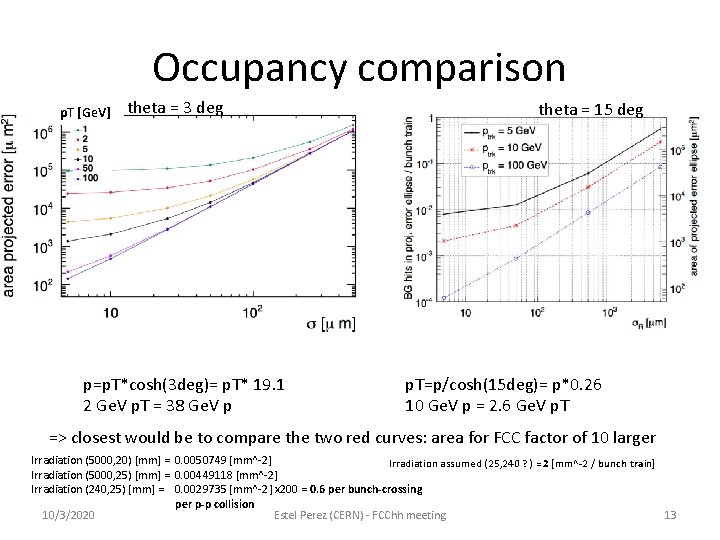
Occupancy comparison p. T [Ge. V] theta = 3 deg theta = 15 deg • comparison to clic p=p. T*cosh(3 deg)= p. T* 19. 1 2 Ge. V p. T = 38 Ge. V p p. T=p/cosh(15 deg)= p*0. 26 10 Ge. V p = 2. 6 Ge. V p. T => closest would be to compare the two red curves: area for FCC factor of 10 larger Irradiation (5000, 20) [mm] = 0. 0050749 [mm^-2] Irradiation assumed (25, 240 ? ) =2 [mm^-2 / bunch train] Irradiation (5000, 25) [mm] = 0. 00449118 [mm^-2] Irradiation (240, 25) [mm] = 0. 0029735 [mm^-2] x 200 = 0. 6 per bunch-crossing per p-p collision 10/3/2020 Estel Perez (CERN) - FCChh meeting 13
Irradiation Map [cm^-2] 10/3/2020 Estel Perez (CERN) - FCChh meeting 14
Next steps on fast simulation studies • Finish occupancy studies – Extract required granularity • Include cables (& supports) (? ) – Optimize barrel length 10/3/2020 Estel Perez (CERN) - FCChh meeting 15
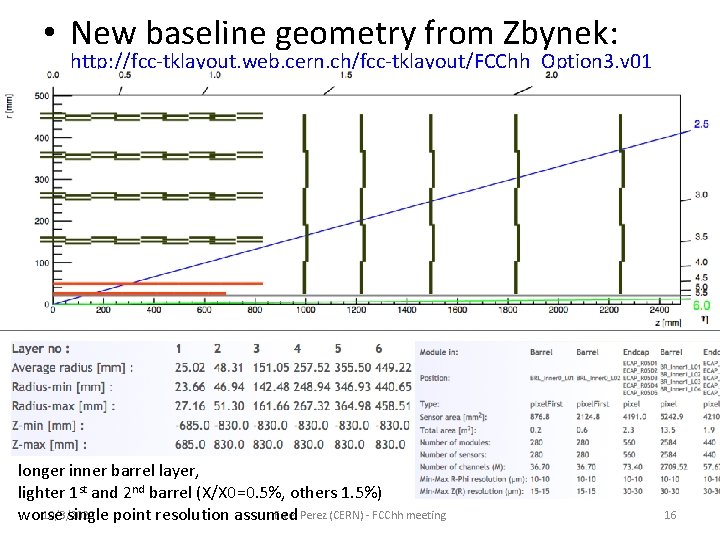
• New baseline geometry from Zbynek: http: //fcc-tklayout. web. cern. ch/fcc-tklayout/FCChh_Option 3. v 01 longer inner barrel layer, lighter 1 st and 2 nd barrel (X/X 0=0. 5%, others 1. 5%) 10/3/2020 Estel Perez (CERN) - FCChh meeting worse single point resolution assumed 16
Plan • Reproduce some of the studies done for CLIC: • https: //cds. cern. ch/record/1443503/files/LCD-2011 -031. pdf • Start with geometry & material variations – – vertex layers radius -> shown last FCChh meeting single point resolution -> shown last FCChh meeting beampipe radius -> done beampipe & layers material -> done • Calculate occupancies -> ongoing – Variation of the distance between endcap and fwd disks -> done – Variation of single point resolution -> done • Implement Zbynek newer geometry in Lic Toy? • Implement it in full sim? • Implement Cables & supports (? ) – Variation on barrel layers length (and therefore on material –cablesbetween the barrel and the endcap) 10/3/2020 Estel Perez (CERN) - FCChh meeting 17
Backup 10/3/2020 Estel Perez (CERN) - FCChh meeting 18
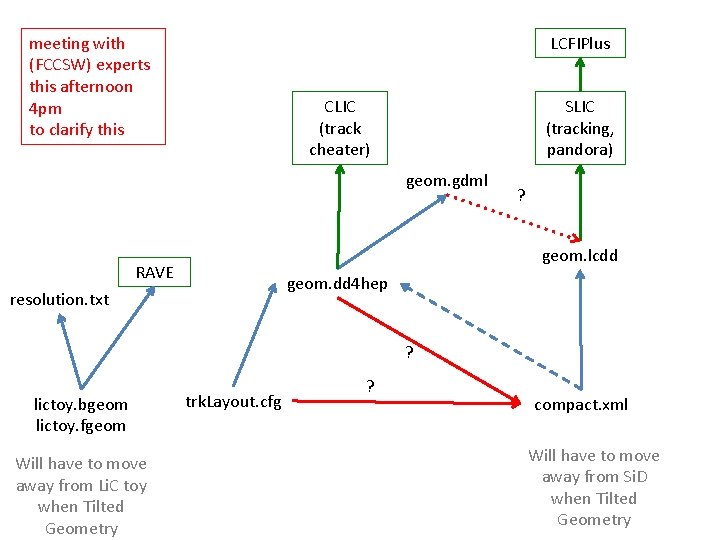
LCFIPlus meeting with (FCCSW) experts this afternoon 4 pm to clarify this CLIC (track cheater) SLIC (tracking, pandora) geom. gdml ? geom. lcdd RAVE geom. dd 4 hep resolution. txt ? lictoy. bgeom lictoy. fgeom Will have to move away from Li. C toy when Tilted Geometry trk. Layout. cfg ? compact. xml Will have to move away from Si. D when Tilted Geometry
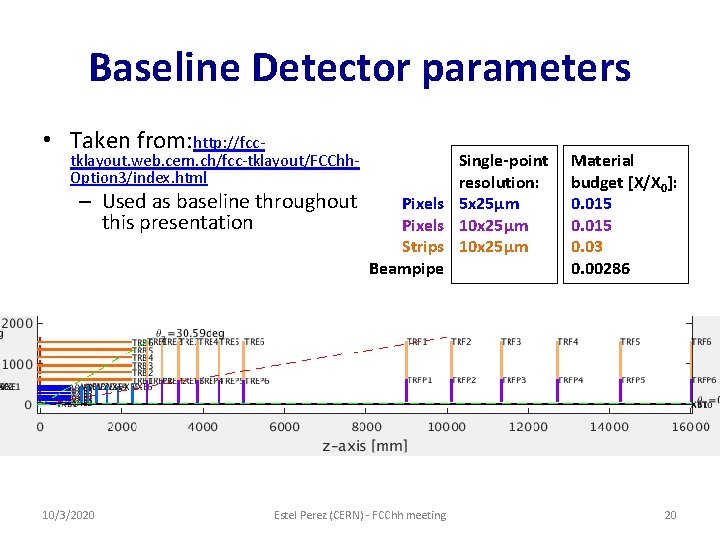
Baseline Detector parameters • Taken from: http: //fcc- tklayout. web. cern. ch/fcc-tklayout/FCChh. Option 3/index. html – Used as baseline throughout this presentation 10/3/2020 Single-point resolution: Pixels 5 x 25µm Pixels 10 x 25µm Strips 10 x 25µm Beampipe Estel Perez (CERN) - FCChh meeting Material budget [X/X 0]: 0. 015 0. 03 0. 00286 20
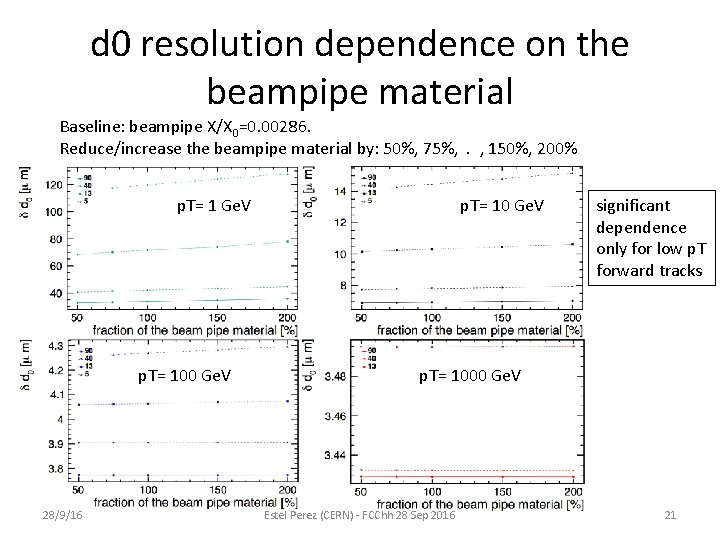
d 0 resolution dependence on the beampipe material Baseline: beampipe X/X 0=0. 00286. Reduce/increase the beampipe material by: 50%, 75%, . , 150%, 200% p. T= 1 Ge. V p. T= 100 Ge. V 28/9/16 p. T= 10 Ge. V significant dependence only for low p. T forward tracks p. T= 1000 Ge. V Estel Perez (CERN) - FCChh 28 Sep 2016 21
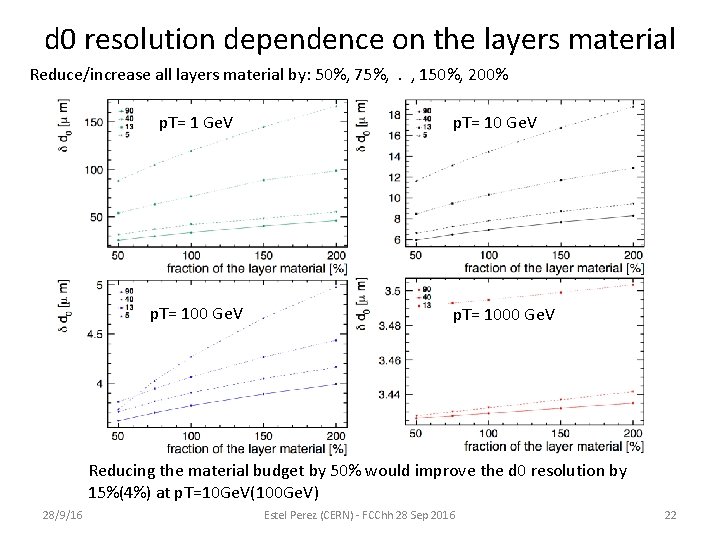
d 0 resolution dependence on the layers material Reduce/increase all layers material by: 50%, 75%, . , 150%, 200% p. T= 1 Ge. V p. T= 1000 Ge. V Reducing the material budget by 50% would improve the d 0 resolution by 15%(4%) at p. T=10 Ge. V(100 Ge. V) 28/9/16 Estel Perez (CERN) - FCChh 28 Sep 2016 22
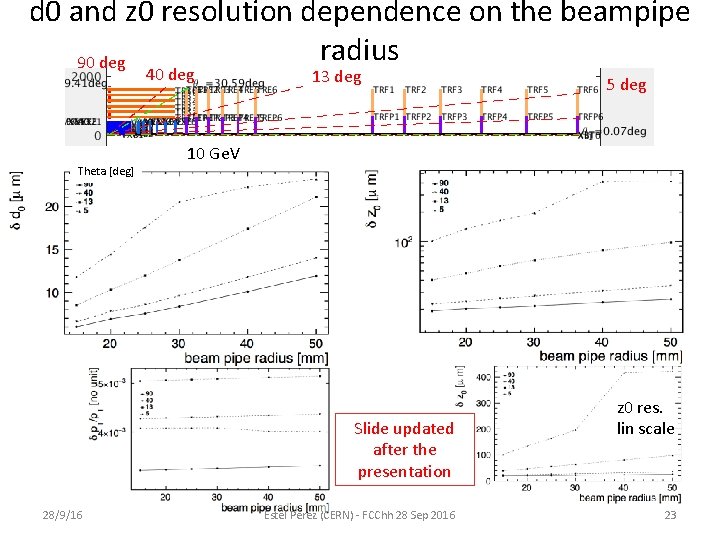
d 0 and z 0 resolution dependence on the beampipe radius 90 deg 40 deg Theta [deg] 13 deg 10 Ge. V Slide updated after the presentation 28/9/16 5 deg Estel Perez (CERN) - FCChh 28 Sep 2016 z 0 res. lin scale 23
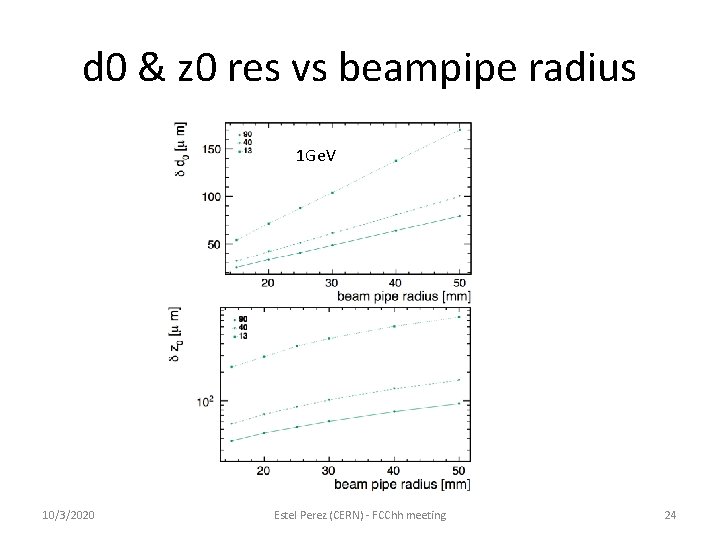
d 0 & z 0 res vs beampipe radius 1 Ge. V 10/3/2020 Estel Perez (CERN) - FCChh meeting 24
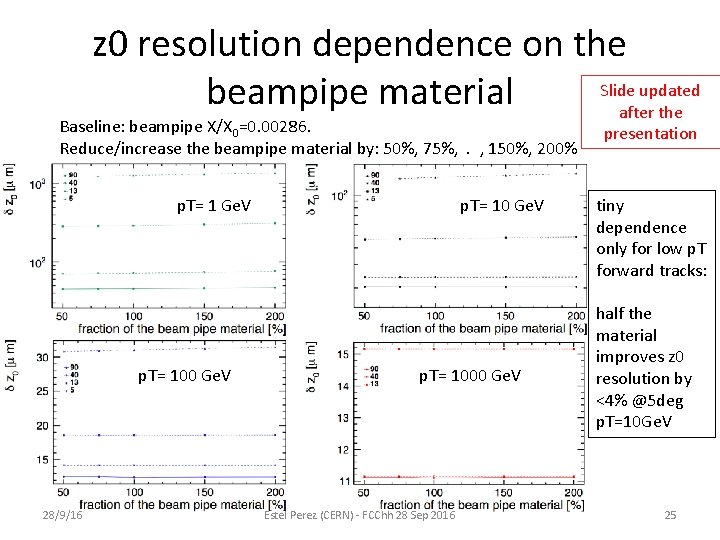
z 0 resolution dependence on the Slide updated beampipe material after the Baseline: beampipe X/X 0=0. 00286. Reduce/increase the beampipe material by: 50%, 75%, . , 150%, 200% p. T= 1 Ge. V p. T= 100 Ge. V 28/9/16 p. T= 10 Ge. V p. T= 1000 Ge. V Estel Perez (CERN) - FCChh 28 Sep 2016 presentation tiny dependence only for low p. T forward tracks: half the material improves z 0 resolution by <4% @5 deg p. T=10 Ge. V 25
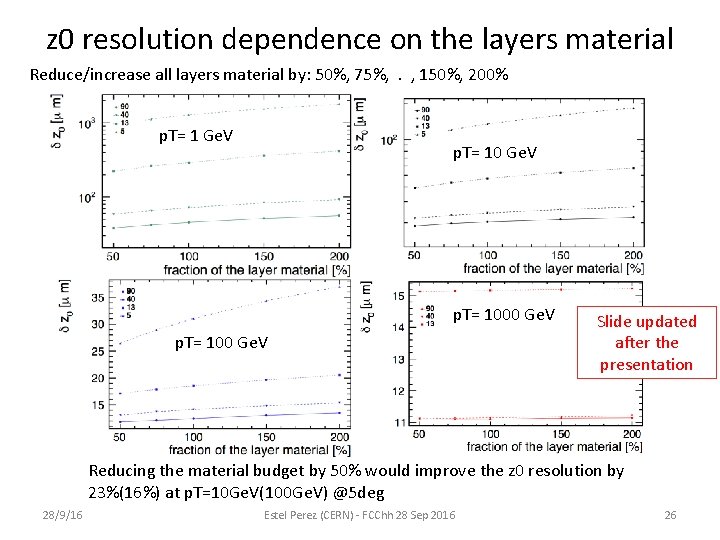
z 0 resolution dependence on the layers material Reduce/increase all layers material by: 50%, 75%, . , 150%, 200% p. T= 1 Ge. V p. T= 1000 Ge. V p. T= 100 Ge. V Slide updated after the presentation Reducing the material budget by 50% would improve the z 0 resolution by 23%(16%) at p. T=10 Ge. V(100 Ge. V) @5 deg 28/9/16 Estel Perez (CERN) - FCChh 28 Sep 2016 26