
Fast Retransmit 4 Problem coarsegrain TCP timeouts lead
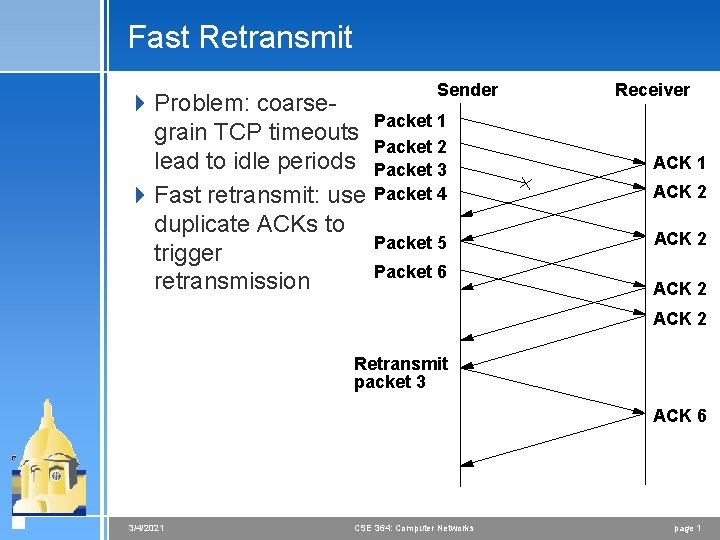
Fast Retransmit 4 Problem: coarsegrain TCP timeouts lead to idle periods 4 Fast retransmit: use duplicate ACKs to trigger retransmission Sender Receiver Packet 1 Packet 2 Packet 3 Packet 4 ACK 1 Packet 5 ACK 2 Packet 6 ACK 2 Retransmit packet 3 ACK 6 3/4/2021 CSE 364: Computer Networks page 1
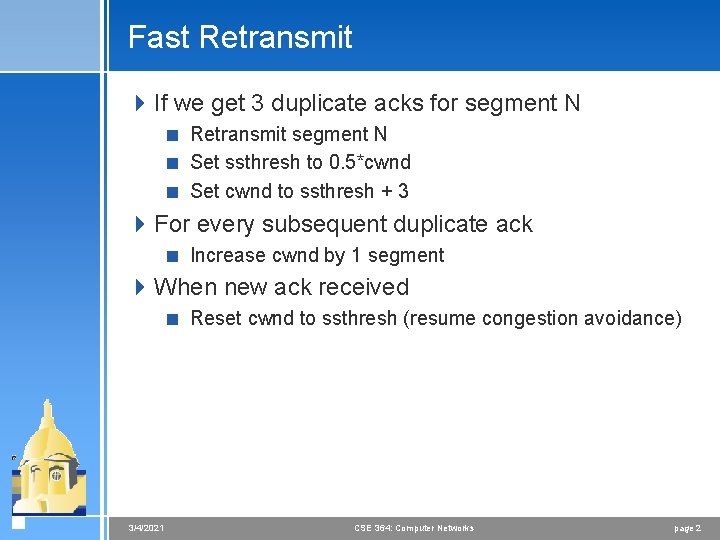
Fast Retransmit 4 If we get 3 duplicate acks for segment N < Retransmit segment N < Set ssthresh to 0. 5*cwnd < Set cwnd to ssthresh + 3 4 For every subsequent duplicate ack < Increase cwnd by 1 segment 4 When new ack received < Reset cwnd to ssthresh (resume congestion avoidance) 3/4/2021 CSE 364: Computer Networks page 2
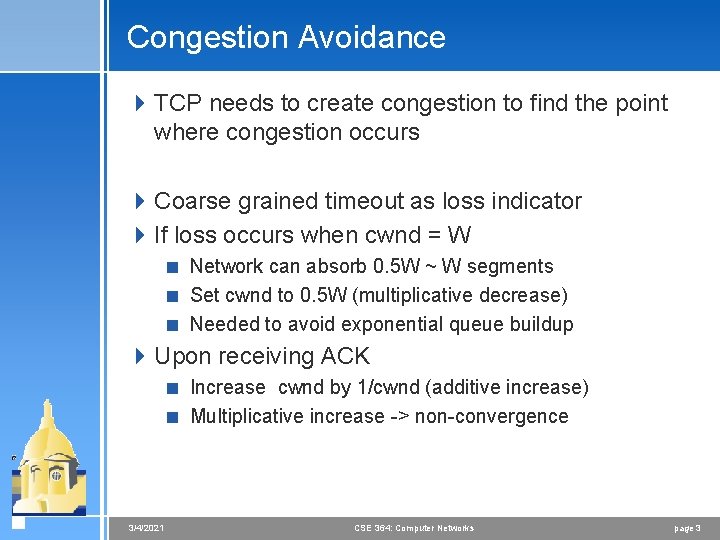
Congestion Avoidance 4 TCP needs to create congestion to find the point where congestion occurs 4 Coarse grained timeout as loss indicator 4 If loss occurs when cwnd = W < Network can absorb 0. 5 W ~ W segments < Set cwnd to 0. 5 W (multiplicative decrease) < Needed to avoid exponential queue buildup 4 Upon receiving ACK < Increase cwnd by 1/cwnd (additive increase) < Multiplicative increase -> non-convergence 3/4/2021 CSE 364: Computer Networks page 3
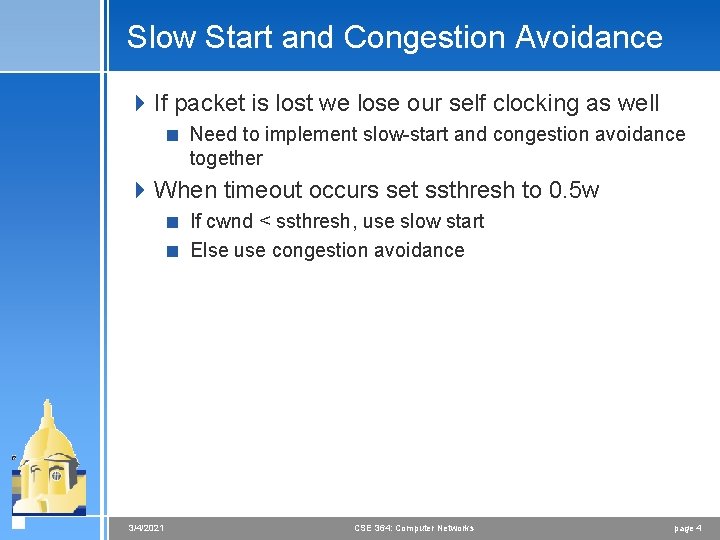
Slow Start and Congestion Avoidance 4 If packet is lost we lose our self clocking as well < Need to implement slow-start and congestion avoidance together 4 When timeout occurs set ssthresh to 0. 5 w < If cwnd < ssthresh, use slow start < Else use congestion avoidance 3/4/2021 CSE 364: Computer Networks page 4
Fast Recovery 4 In congestion avoidance mode, if duplicate acks are received, reduce cwnd to half 4 If n successive duplicate acks are received, we know that receiver got n segments after lost segment: < Advance cwnd by that number 3/4/2021 CSE 364: Computer Networks page 5
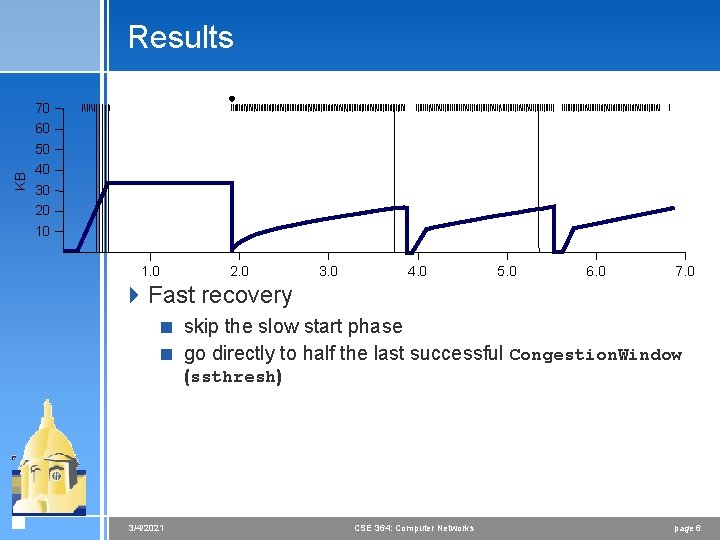
KB Results 70 60 50 40 30 20 10 1. 0 2. 0 3. 0 4. 0 5. 0 6. 0 7. 0 4 Fast recovery < skip the slow start phase < go directly to half the last successful Congestion. Window (ssthresh) 3/4/2021 CSE 364: Computer Networks page 6
Impact of Timeouts 4 Timeouts can cause sender to < Slow start < Retransmit a possibly large portion of the window 4 Bad for lossy high bandwidth-delay paths 4 Can leverage duplicate acks to: < Retransmit fewer segments (fast retransmit) < Advance cwnd more aggressively (fast recovery) 3/4/2021 CSE 364: Computer Networks page 7
Summary 4 Three way handshake to initiate TCP. Either side can tear down connection using FIN sequence. 4 Initial sequence number chosen to avoid packets from earlier incarnations 4 AIMD to slowly probe network. Slow start to speed up the probing process (at the expense of hard congestion for the last step). Use ssthresh to decide whether to restart slow start or AIMD after loss 4 Fast retransmit by inferring duplicate ACKs = lost packet, Fast recovery by inferring duplicate ACKs = increasing CWND 3/4/2021 CSE 364: Computer Networks page 8
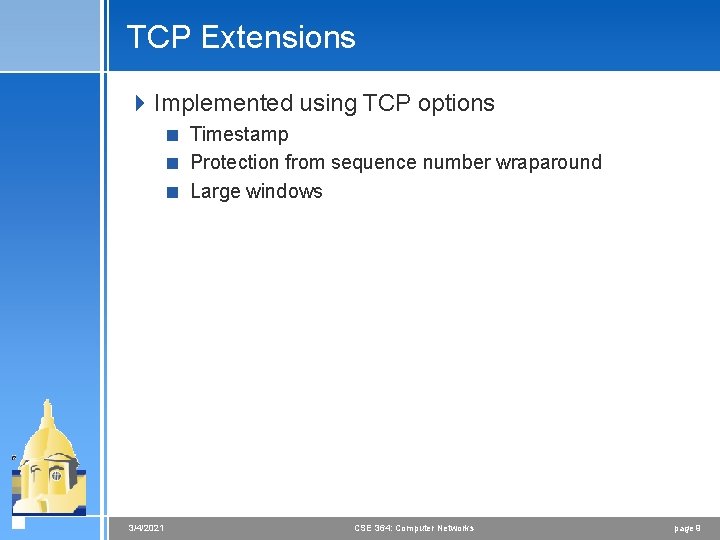
TCP Extensions 4 Implemented using TCP options < Timestamp < Protection from sequence number wraparound < Large windows 3/4/2021 CSE 364: Computer Networks page 9
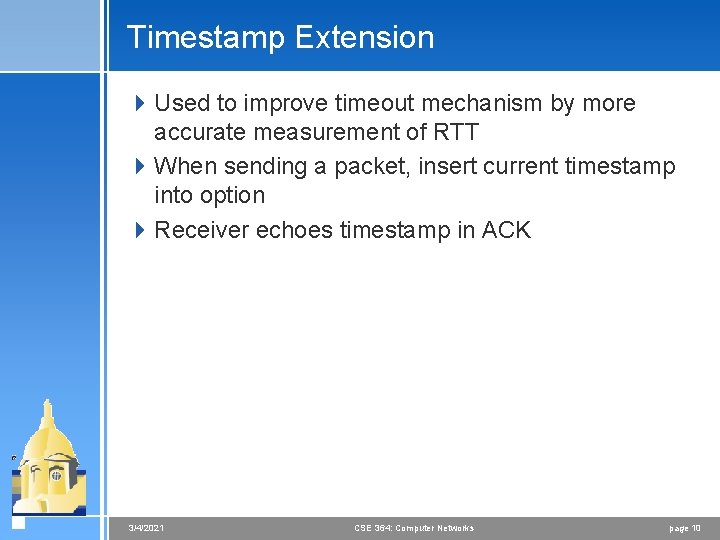
Timestamp Extension 4 Used to improve timeout mechanism by more accurate measurement of RTT 4 When sending a packet, insert current timestamp into option 4 Receiver echoes timestamp in ACK 3/4/2021 CSE 364: Computer Networks page 10
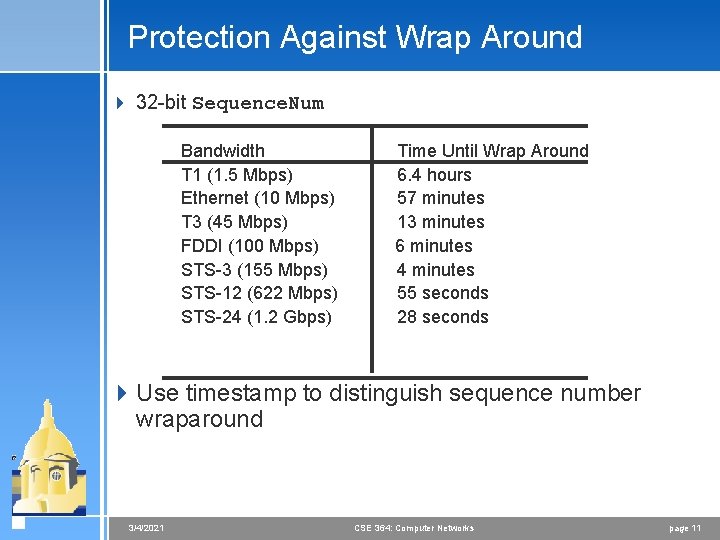
Protection Against Wrap Around 4 32 -bit Sequence. Num Bandwidth T 1 (1. 5 Mbps) Ethernet (10 Mbps) T 3 (45 Mbps) FDDI (100 Mbps) STS-3 (155 Mbps) STS-12 (622 Mbps) STS-24 (1. 2 Gbps) Time Until Wrap Around 6. 4 hours 57 minutes 13 minutes 6 minutes 4 minutes 55 seconds 28 seconds 4 Use timestamp to distinguish sequence number wraparound 3/4/2021 CSE 364: Computer Networks page 11
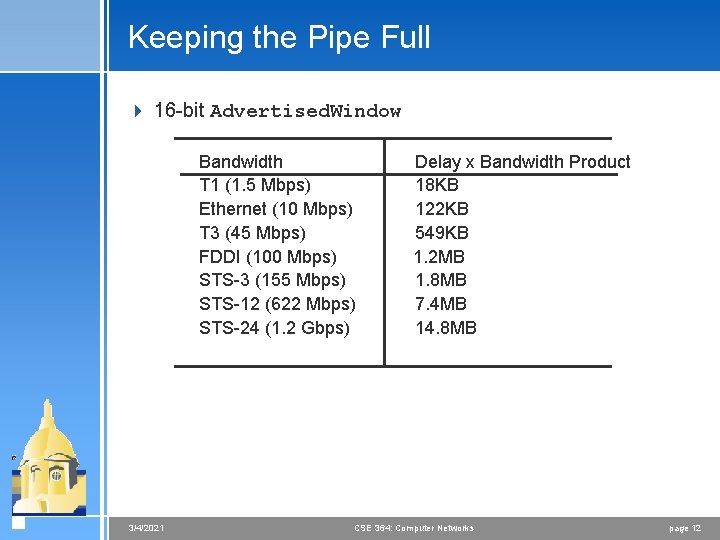
Keeping the Pipe Full 4 16 -bit Advertised. Window Bandwidth T 1 (1. 5 Mbps) Ethernet (10 Mbps) T 3 (45 Mbps) FDDI (100 Mbps) STS-3 (155 Mbps) STS-12 (622 Mbps) STS-24 (1. 2 Gbps) 3/4/2021 Delay x Bandwidth Product 18 KB 122 KB 549 KB 1. 2 MB 1. 8 MB 7. 4 MB 14. 8 MB CSE 364: Computer Networks page 12
Large Windows 4 Apply scaling factor to advertised window < Specifies how many bits window must be shifted to the left 4 Scaling factor exchanged during connection setup 3/4/2021 CSE 364: Computer Networks page 13
TCP Flavors 4 Tahoe, Reno, Vegas 4 TCP Tahoe (distributed with 4. 3 BSD Unix) < Original implementation of van Jacobson’s mechanisms (VJ paper) < Includes: = Slow start (exponential increase of initial window) = Congestion avoidance (additive increase of window) = Fast retransmit (3 duplicate acks) 3/4/2021 CSE 364: Computer Networks page 14
TCP Reno 4 1990: includes: < All mechanisms in Tahoe < Addition of fast-recovery (opening up window after fast retransmit) < Delayed acks (to avoid silly window syndrome) = Silly window syndrome is when one byte is ack’d causing advertisedwindow=1 < Header prediction (to improve performance) 3/4/2021 CSE 364: Computer Networks page 15
SACK TCP (RFC 2018)
What’s Wrong with Current TCP? 4 TCP uses a cumulative acknowledgment scheme, in which the receiver identifies the last byte of data successfully received. 4 Received segments that are not at the left window edge are not acknowledged. 4 This scheme forces the sender to either wait a roundtrip time to find out a segment was lost, or unnecessarily retransmit segments which have been correctly received. 4 Results in significantly reduced overall throughput. 3/4/2021 CSE 364: Computer Networks page 17
Selective Acknowledgment TCP 4 Selective Acknowledgment (SACK) allows the receiver to inform the sender about all segments that have been successfully received. 4 Allows the sender to retransmit only those segments that have been lost. 4 SACK is implemented using two different TCP options. 3/4/2021 CSE 364: Computer Networks page 18
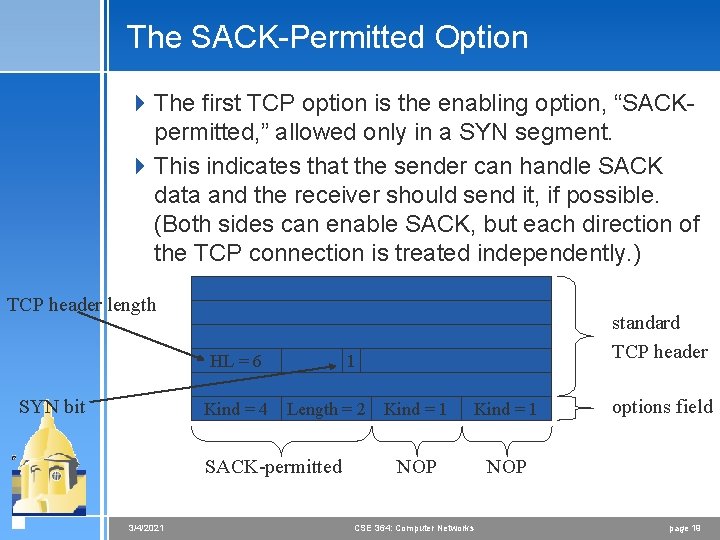
The SACK-Permitted Option 4 The first TCP option is the enabling option, “SACKpermitted, ” allowed only in a SYN segment. 4 This indicates that the sender can handle SACK data and the receiver should send it, if possible. (Both sides can enable SACK, but each direction of the TCP connection is treated independently. ) TCP header length HL = 6 SYN bit Kind = 4 1 Length = 2 SACK-permitted 3/4/2021 standard TCP header Kind = 1 NOP CSE 364: Computer Networks options field page 19
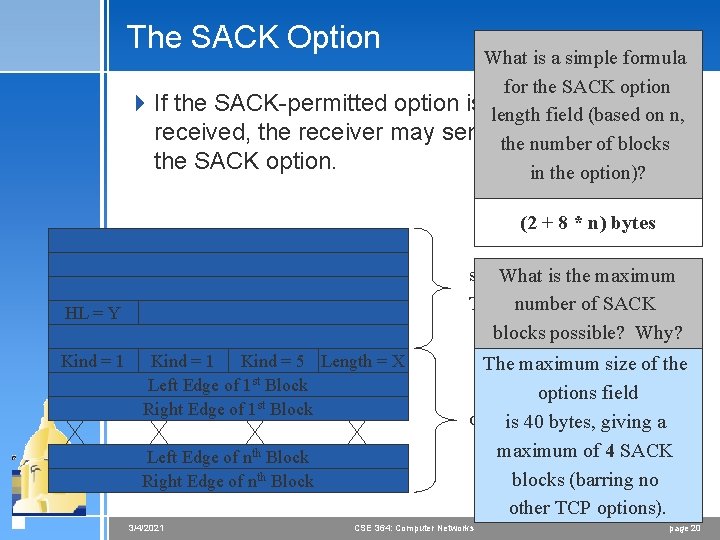
The SACK Option What is a simple formula for the SACK option 4 If the SACK-permitted option is length field (based on n, received, the receiver may send the number of blocks the SACK option. in the option)? (2 + 8 * n) bytes standard What is the maximum TCP header number of SACK blocks possible? Why? HL = Y Kind = 1 Kind = 5 Length = X Left Edge of 1 st Block Right Edge of 1 st Block Left Edge of nth Block Right Edge of nth Block 3/4/2021 The maximum size of the options field is 40 bytes, giving a maximum of 4 SACK blocks (barring no other TCP options). CSE 364: Computer Networks page 20
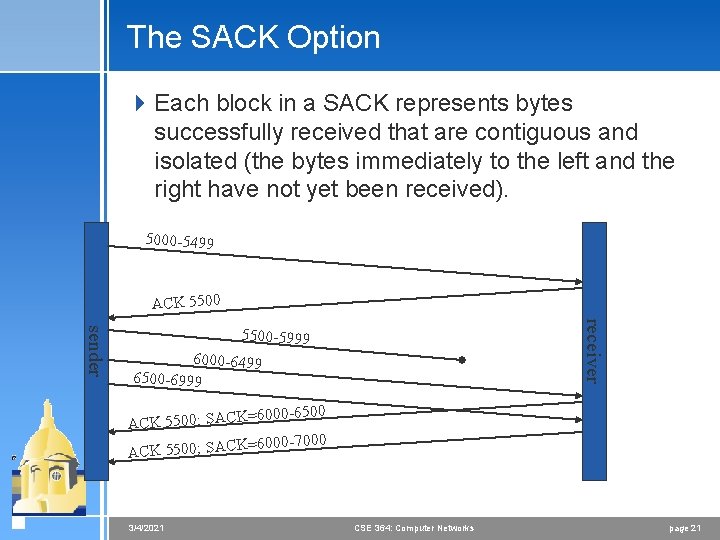
The SACK Option 4 Each block in a SACK represents bytes successfully received that are contiguous and isolated (the bytes immediately to the left and the right have not yet been received). 5000 -5499 ACK 5500 receiver sender 5500 -5999 6000 -6499 6500 -6999 =6000 -6500 ACK 5500; SACK =6000 -7000 ACK 5500; SACK 3/4/2021 CSE 364: Computer Networks page 21
SACK TCP Rules 4 A SACK cannot be sent unless the SACK-permitted option has been received (in the SYN). 4 If a receiver has chosen to send SACKs, it must send them whenever it has data to SACK at the time of an ACK. 4 The receiver should send an ACK for every valid segment it receives containing new data (standard TCP behavior), and each of these ACKs should contain a SACK, assuming there is data to SACK. 3/4/2021 CSE 364: Computer Networks page 22
SACK TCP Rules 4 The first SACK block must contain the most recently received segment that is to be SACKed. 4 The second block must contain the second most recently received segment that is to be SACKed, and so forth. 4 Notice this can result in some data in the receiver’s buffers which should be SACKed but is not (if there are more segments to SACK than available space in the TCP header). 3/4/2021 CSE 364: Computer Networks page 23
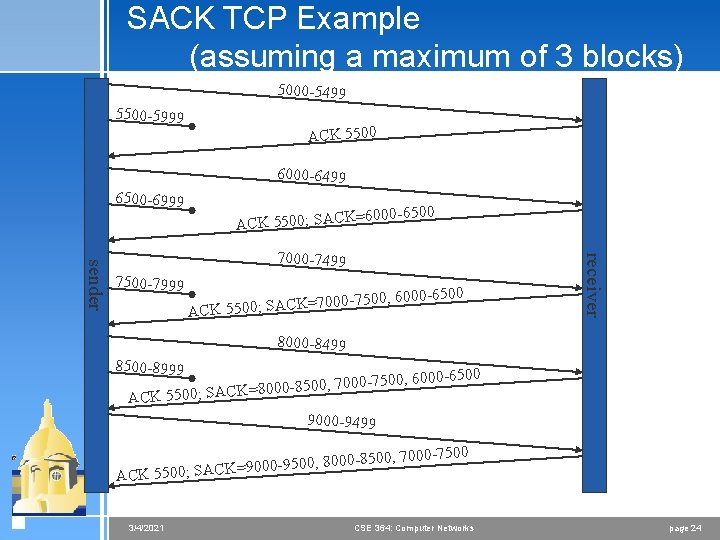
SACK TCP Example (assuming a maximum of 3 blocks) 5000 -5499 5500 -5999 ACK 5500 6000 -6499 6500 -6999 =6000 -6500 ACK 5500; SACK 7500 -7999 0, 6000 -6500 =7000 -750 K C A S ; 0 0 5 5 K C A receiver sender 7000 -7499 8000 -8499 8500 -8999 6000 -6500 , 0 0 5 -7 0 0 0 7 , 0 0 5 =8000 -8 ACK 5500; SACK 9000 -9499 00, 7000 -7500 0, 8000 -85 0 5 -9 0 0 0 9 = K C A S ACK 5500; 3/4/2021 CSE 364: Computer Networks page 24
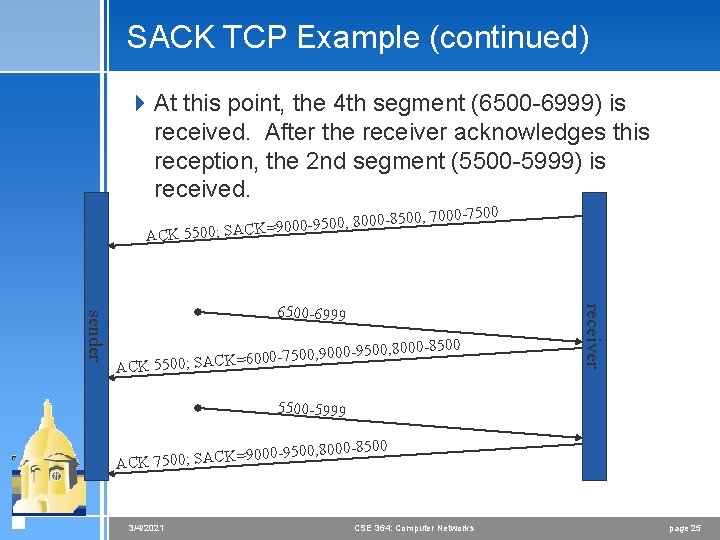
SACK TCP Example (continued) 4 At this point, the 4 th segment (6500 -6999) is received. After the receiver acknowledges this reception, the 2 nd segment (5500 -5999) is received. 00, 7000 -7500 0, 8000 -85 0 5 -9 0 0 0 9 = K C A S ACK 5500; 500, 8000 -8500 -9 0 0 0 , 9 0 0 5 -7 0 0 0 =6 ACK 5500; SACK receiver sender 6500 -6999 5500 -5999 9000 -9500 = K C A S ; 0 0 5 7 K AC 3/4/2021 , 8000 -8500 CSE 364: Computer Networks page 25
What Should the Sender do? 4 The sender must keep a buffer of unacknowledged data. When it receives a SACK option, it should turn on a SACK-flag bit for all segments in the transmit buffer that are wholly contained within one of the SACK blocks. 4 After this SACK flag bit has been turned on, the sender should skip that segment during any later retransmission. 3/4/2021 CSE 364: Computer Networks page 26
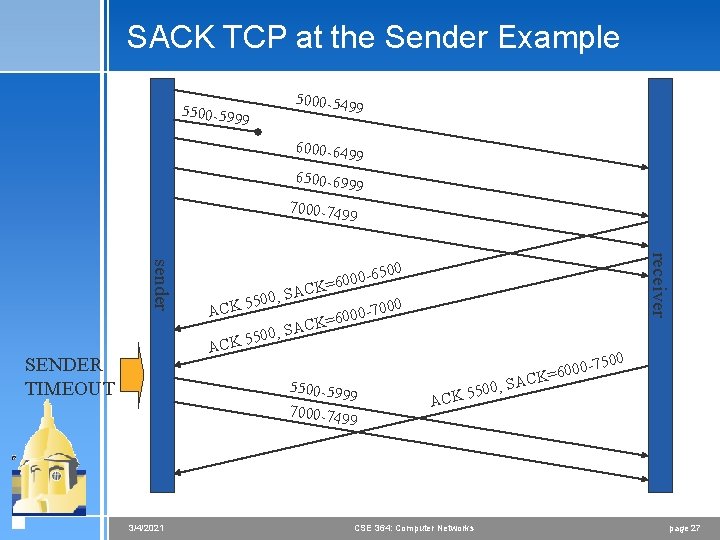
SACK TCP at the Sender Example 5000 -549 9 5500 -599 9 6000 -649 9 6500 -699 9 7000 -74 99 A 7500 5500 -599 9 7000 -74 99 3/4/2021 000 00 -7 0 6 = K SAC ; 0 0 5 5 ACK SENDER TIMEOUT receiver sender AC 0; S 0 5 5 CK 500 00 -6 0 6 = K ACK 55 CSE 364: Computer Networks 0006 = K C 00; SA page 27
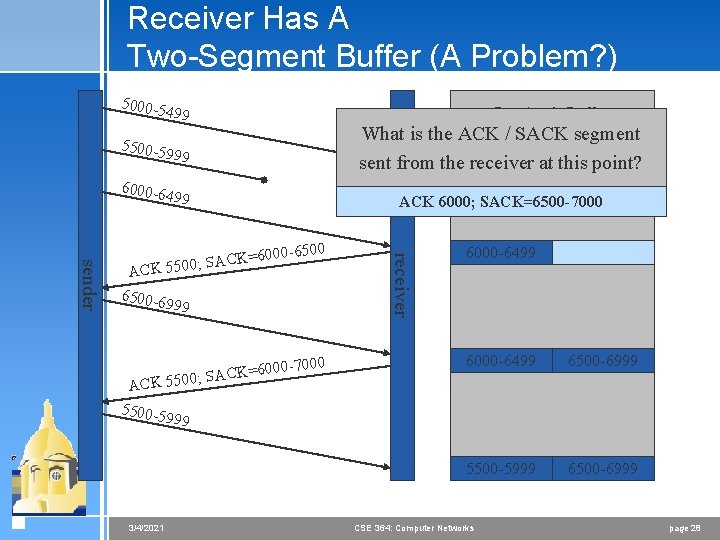
Receiver Has A Two-Segment Buffer (A Problem? ) 5000 -5 499 Receiver’s Buffer 5500 -5 999 What is the ACK / SACK segment sent from the 5000 -5499 receiver at this point? 6000 -6 499 ACK 6000; SACK=6500 -7000 AC 6500 -6 999 7000 =6000 K C A S ; 0 K 550 receiver sender 00 -6500 CK=60 K 5500; SA 6000 -6499 6500 -6999 5500 -5999 6500 -6999 AC 5500 -5 3/4/2021 999 CSE 364: Computer Networks page 28
Reneging in SACK TCP 4 It is possible for the receiver to SACK some data and then later discard it. This is referred to as reneging. This is discouraged, but permitted if the receiver runs out of buffer space. 4 If this occurs, < The first SACK block must still reflect the newest segment, i. e. contain the left and right edges of the newest segment, even if that segment is going to be discarded. < Except for the newest segment, all SACK blocks must not report any old data that has been discarded. 3/4/2021 CSE 364: Computer Networks page 29
Reneging in SACK TCP 4 Therefore, the sender must maintain normal TCP timeouts. A segment cannot be considered received until an ACK is received for it. The sender must retransmit the segment at the left window edge after a retransmit timeout, even if the SACK bit is on for that segment. 4 A segment cannot be removed from the transmit buffer until the left window edge is advanced over it, via the receiving of an ACK. 3/4/2021 CSE 364: Computer Networks page 30
SACK TCP Observations 4 SACK TCP follows standard TCP congestion control; it should not damage the network. 4 SACK TCP has an advantage over other implementations (Reno, Tahoe, Vegas, and New. Reno) as it has added information due to the SACK data. 4 This information allows the sender to better decide what it needs to retransmit and what it does not. This can only serve to help the sender, and should not adversely affect other TCPs. 3/4/2021 CSE 364: Computer Networks page 31
SACK TCP Observations 4 While it is still possible for a SACK TCP to needlessly retransmit segments, the number of these retransmissions has been shown to be quite low in simulations, relative to Reno and Tahoe TCP. 4 In any case, the number of needless retransmissions must be strictly less than Reno/Tahoe TCP. As the sender has additional information from which to devise its retransmission scheme, worse performance is not possible (barring a flawed implementation). 3/4/2021 CSE 364: Computer Networks page 32
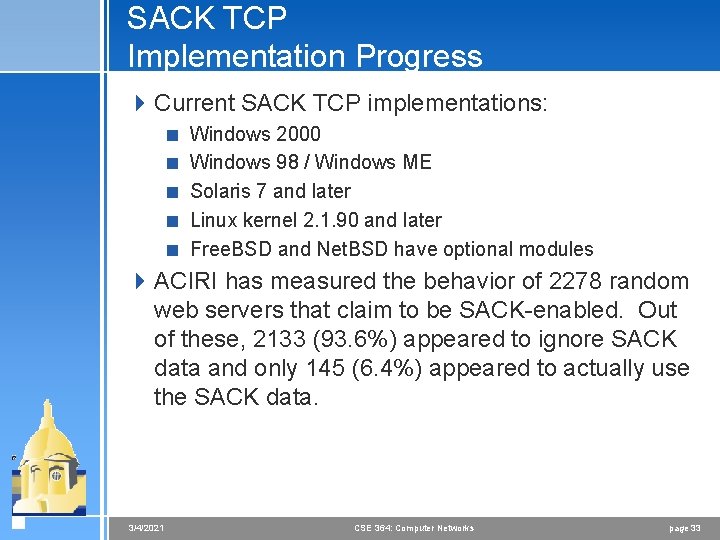
SACK TCP Implementation Progress 4 Current SACK TCP implementations: < Windows 2000 < Windows 98 / Windows ME < Solaris 7 and later < Linux kernel 2. 1. 90 and later < Free. BSD and Net. BSD have optional modules 4 ACIRI has measured the behavior of 2278 random web servers that claim to be SACK-enabled. Out of these, 2133 (93. 6%) appeared to ignore SACK data and only 145 (6. 4%) appeared to actually use the SACK data. 3/4/2021 CSE 364: Computer Networks page 33
D-SACK TCP (RFC 2883)
One Step Further: D-SACK TCP 4 Duplicate-SACK, or D-SACK is an extension to SACK TCP which uses the first block of a SACK option is used to report duplicate segments that have been received. 4 A D-SACK block is only used to report a duplicate contiguous sequence of data received by the receiver in the most recent segment. 4 Each duplicate is reported at most once. 4 This allows the sender TCP to determine when a retransmission was not necessary. It may not have been necessary due to the retransmit timer expiring prematurely or due to a false Fast Retransmit (3 duplicate ACKs received due to network reordering). 3/4/2021 CSE 364: Computer Networks page 35
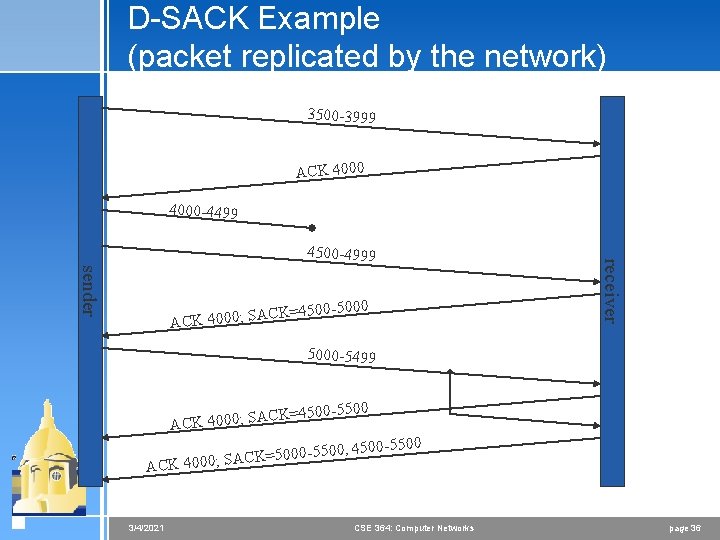
D-SACK Example (packet replicated by the network) 3500 -3999 ACK 4000 -4499 sender 4500 -5000 = K C A S ; 0 0 0 ACK 4 receiver 4500 -4999 5000 -5499 =4500 -5500 CK ACK 4000; SA 0, 4500 -5500 5000 -550 = K C A S ; 0 0 0 CK 4 A 3/4/2021 CSE 364: Computer Networks page 36
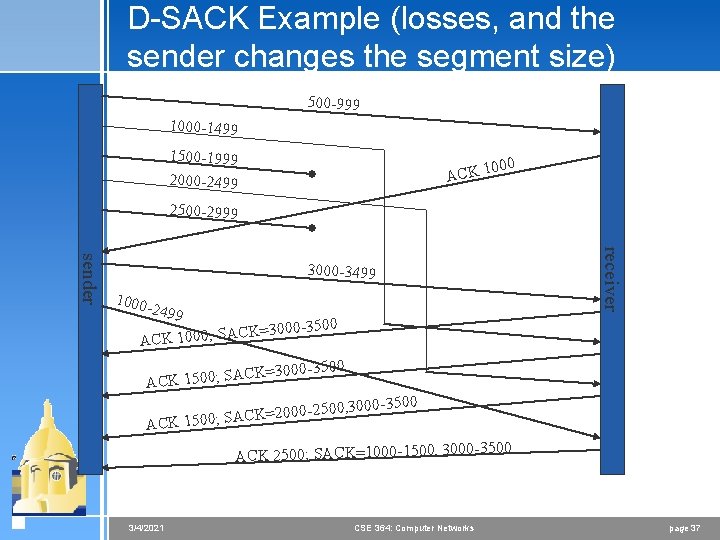
D-SACK Example (losses, and the sender changes the segment size) 500 -999 1000 -1499 1500 -1999 000 ACK 1 2000 -2499 2500 -2999 receiver sender 3000 -3499 1000 -2499 3000 -3500 CK= ACK 1000; SA CK=3 ACK 1500; SA ACK 000 -3500 0 -2500, 30 0 0 2 = K C A S ; 1500 -3500 ACK 2500; SACK=1000 -1500, 3000 3/4/2021 CSE 364: Computer Networks page 37
D-SACK TCP Rules 4 If the D-SACK block reports a duplicate sequence from a (possibly larger) block of data in the receiver buffer above the cumulative acknowledgement, the second SACK block (the first non D-SACK block) should specify this block. 4 As only the first SACK block is considered to be a D-SACK block, if multiple sequences are duplicated, only the first is contained in the DSACK block. 3/4/2021 CSE 364: Computer Networks page 38
D-SACK TCP and Retransmissions 4 D-SACK allows TCP to determine when a retransmission was not necessary (it receives a D-SACK after it retransmitted a segment). When this determination is made, the sender can “undo” the halving of the congestion window, as it will do when a segment is retransmitted (as it assumes net congestion). 4 D-SACK also allows TCP to determine if the network is duplicating packets (it will receive a D-SACK for a segment it only sent once). 4 D-SACK’s weakness is that is does not allow a sender to determine if both the original and retransmitted segment are received, or the original is lost and the retransmitted segment is duplicated by the network. 3/4/2021 CSE 364: Computer Networks page 39
SACK and D-SACK Interaction 4 There is no difference between SACK and DSACK, except that the first SACK block is used to report a duplicate segment in D-SACK. 4 There is no separate negotiation/options for DSACK. 4 There are no inherit problems with having the receiver use D-SACK and having the sender use traditional SACK. As the duplicate that is being reported is still being SACKed (for the second or greater time), there is no problem with a SACK TCP using this extension with a D-SACK TCP (although the D-SACK specific data is not used). 3/4/2021 CSE 364: Computer Networks page 40
Increasing the Maximum TCP Initial Window Size (RFC 2414)
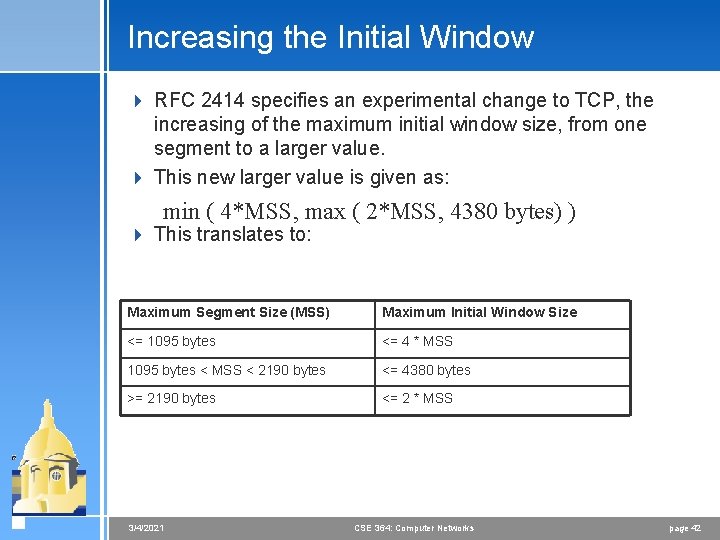
Increasing the Initial Window 4 RFC 2414 specifies an experimental change to TCP, the increasing of the maximum initial window size, from one segment to a larger value. 4 This new larger value is given as: min ( 4*MSS, max ( 2*MSS, 4380 bytes) ) 4 This translates to: Maximum Segment Size (MSS) Maximum Initial Window Size <= 1095 bytes <= 4 * MSS 1095 bytes < MSS < 2190 bytes <= 4380 bytes >= 2190 bytes <= 2 * MSS 3/4/2021 CSE 364: Computer Networks page 42
Increasing the Initial Window Slow-Start TCP RFC 2414 TCP …PROCESSING DELAY… CSE 364: Computer Networks receiver sender …PROCESSING DELAY… receiver sender 3/4/2021 page 43
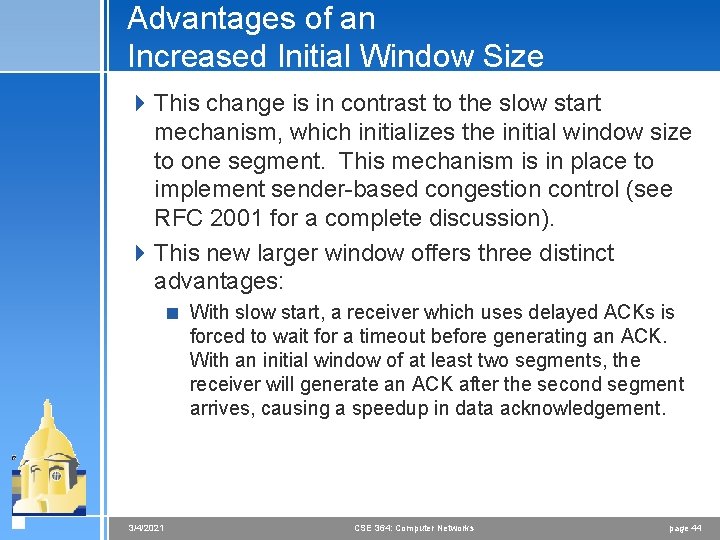
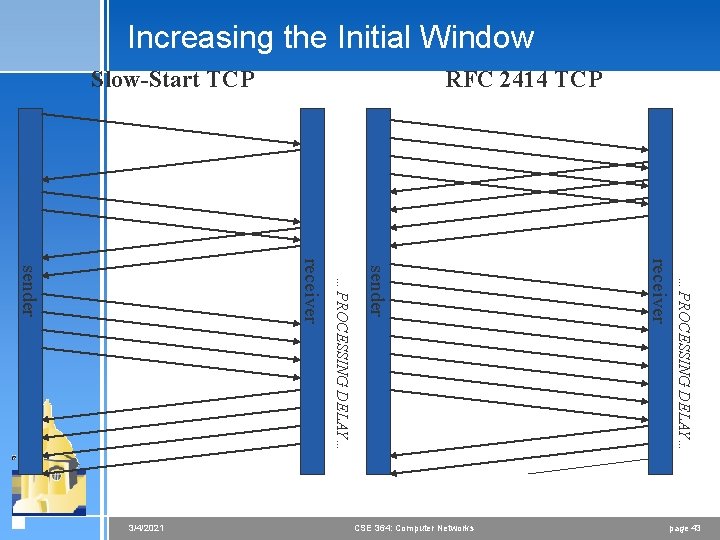
Advantages of an Increased Initial Window Size 4 This change is in contrast to the slow start mechanism, which initializes the initial window size to one segment. This mechanism is in place to implement sender-based congestion control (see RFC 2001 for a complete discussion). 4 This new larger window offers three distinct advantages: < With slow start, a receiver which uses delayed ACKs is forced to wait for a timeout before generating an ACK. With an initial window of at least two segments, the receiver will generate an ACK after the second segment arrives, causing a speedup in data acknowledgement. 3/4/2021 CSE 364: Computer Networks page 44
Advantages of an Increased Initial Window Size < For TCP connections transferring a small amount of data (such as SMTP and HTTP requests), the larger initial window will reduce the transmission time, as more data can be outstanding at once. < For TCP connections transferring a large amount of data with high propagation delays (long haul pipes; such as backbone connects and satellite links), this change eliminates up to three round-trip times (RTTs) and a delayed ACK timeout during the initial slow start. 3/4/2021 CSE 364: Computer Networks page 45
Disadvantages of an Increased Initial Window Size 4 This approach also has disadvantages: < This approach could cause increased congestion, as multiple segments are transmitted at once, at the beginning of the connection. As modern routers tend to not handle bursty traffic well (Drop Tail queue management), this could increase the drop rate. 4 ACIRI research on this topic concludes that there is no more danger from increasing the initial TCP window size to a maximum of 4 KB than the presence of UDP communications (that do not have end-to-end congestion control). 3/4/2021 CSE 364: Computer Networks page 46
Increased Initial Window Size Implementation Progress 4 Looking at ACIRI observations, current web servers use a wide range of initial TCP window sizes, ranging from one segment (slow start) to seventeen segments. 4 This is a clear violation of RFC 2414, not to mention RFC 2001 (the currently approved IETF/ISOC standard). 4 Such large initial window sizes seem to indicate a greedy TCP, not conforming to the required sender -side congestion control window (even if the experimental higher initial window is considered). 3/4/2021 CSE 364: Computer Networks page 47
Summary 4 SACK TCP provides additional information to the sender, allowing the reduction of needless retransmissions. There is no danger in providing this information, it simply serves to make a “smarter” TCP sender. 4 D-SACK TCP allows the sender to determine when it has needlessly resent segments. This will allow the sender to continuously refine its retransmission strategy and undo unnecessary and incorrect congestion control mechanisms. 4 Increasing the initial TCP window is a slight change that has advantages for both small and large data transfers, without significantly affecting the congestion control a smaller window provides. 3/4/2021 CSE 364: Computer Networks page 48
- Slides: 48