
Fast Packet Classification on Open Flow Switches Using

- Slides: 23
Fast Packet Classification on Open. Flow Switches Using Multiple R*-Tree Based Bitmap Intersection Author: Ding-Fong Huang and Chien Chen Publisher/Conf. : NOMS 2018 - 2018 IEEE/IFIP Network Operations and Management Symposium Presenter: 林鈺航 Date: 2018/09/12 Department of Computer Science and Information Engineering National Cheng Kung University, Taiwan R. O. C.
Outline l l l Introduction Related Works R* -Tree Based Bitmap Intersection Enhanced R*-Tree Based Bitmap Intersection Performance Evaluation National Cheng Kung University CSIE Computer & Internet Architecture Lab 2
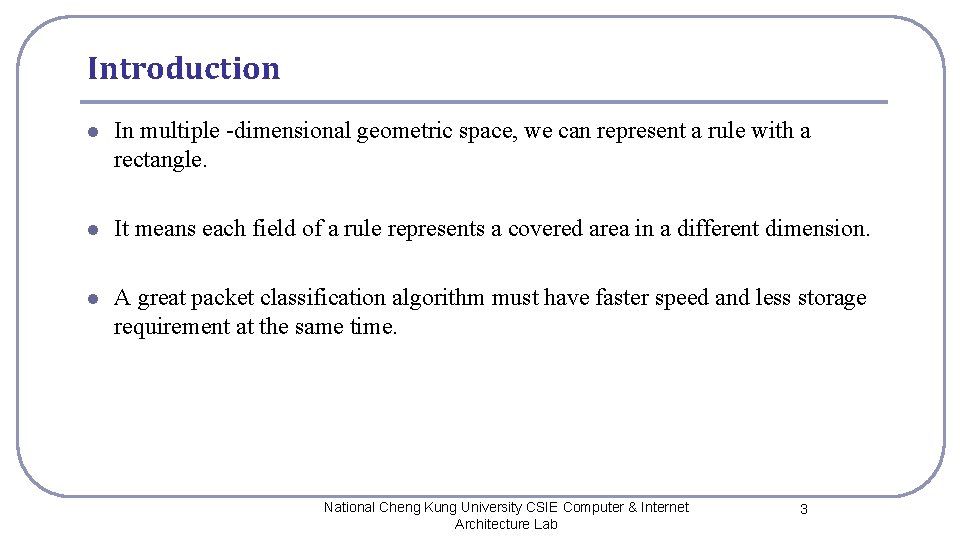
Introduction l In multiple -dimensional geometric space, we can represent a rule with a rectangle. l It means each field of a rule represents a covered area in a different dimension. l A great packet classification algorithm must have faster speed and less storage requirement at the same time. National Cheng Kung University CSIE Computer & Internet Architecture Lab 3
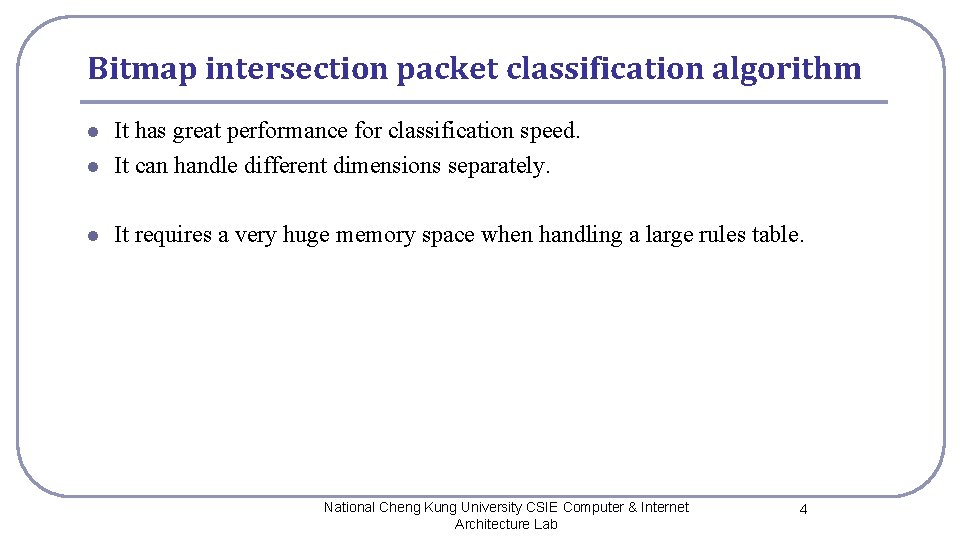
Bitmap intersection packet classification algorithm l It has great performance for classification speed. It can handle different dimensions separately. l It requires a very huge memory space when handling a large rules table. l National Cheng Kung University CSIE Computer & Internet Architecture Lab 4
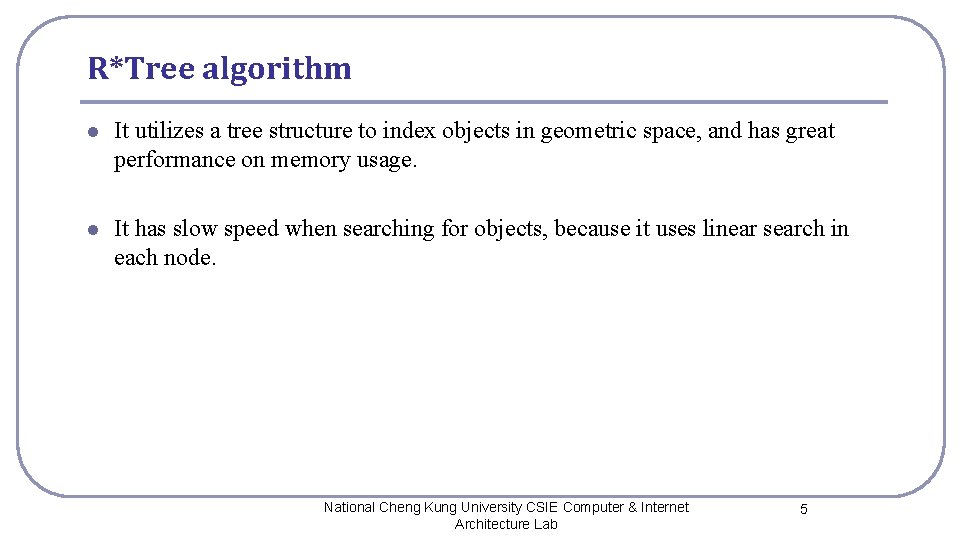
R*Tree algorithm l It utilizes a tree structure to index objects in geometric space, and has great performance on memory usage. l It has slow speed when searching for objects, because it uses linear search in each node. National Cheng Kung University CSIE Computer & Internet Architecture Lab 5
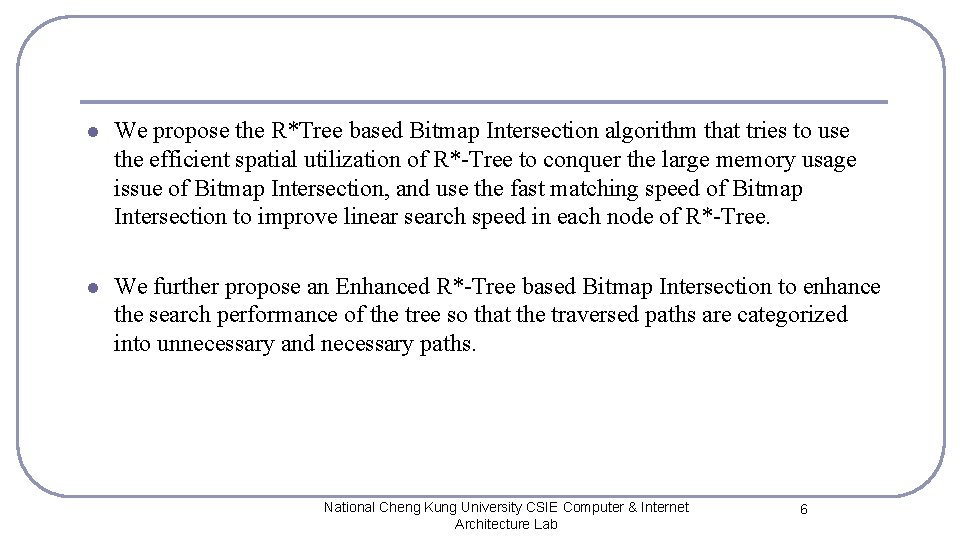
l We propose the R*Tree based Bitmap Intersection algorithm that tries to use the efficient spatial utilization of R*-Tree to conquer the large memory usage issue of Bitmap Intersection, and use the fast matching speed of Bitmap Intersection to improve linear search speed in each node of R*-Tree. l We further propose an Enhanced R*-Tree based Bitmap Intersection to enhance the search performance of the tree so that the traversed paths are categorized into unnecessary and necessary paths. National Cheng Kung University CSIE Computer & Internet Architecture Lab 6
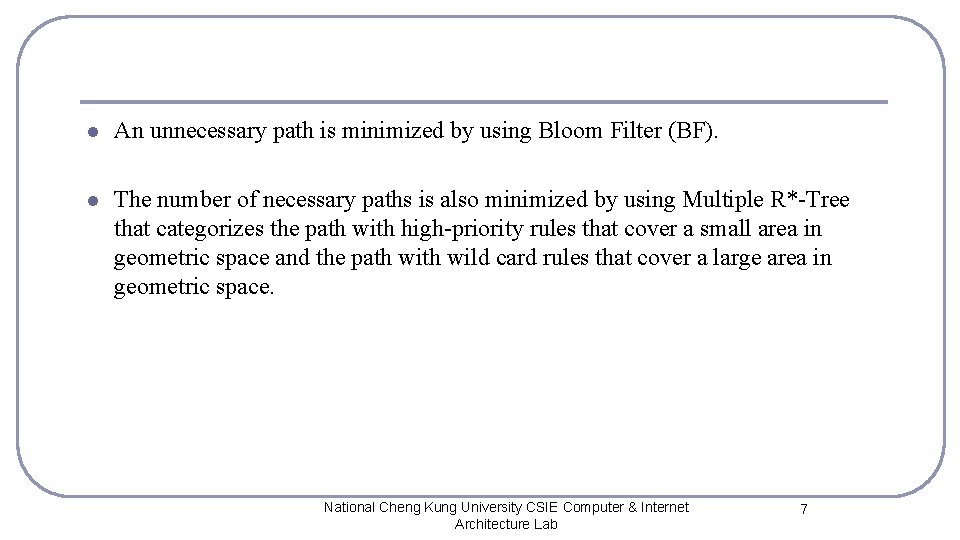
l An unnecessary path is minimized by using Bloom Filter (BF). l The number of necessary paths is also minimized by using Multiple R*-Tree that categorizes the path with high-priority rules that cover a small area in geometric space and the path wild card rules that cover a large area in geometric space. National Cheng Kung University CSIE Computer & Internet Architecture Lab 7
Outline l l l Introduction Related Works R* -Tree Based Bitmap Intersection Enhanced R*-Tree Based Bitmap Intersection Performance Evaluation National Cheng Kung University CSIE Computer & Internet Architecture Lab 8
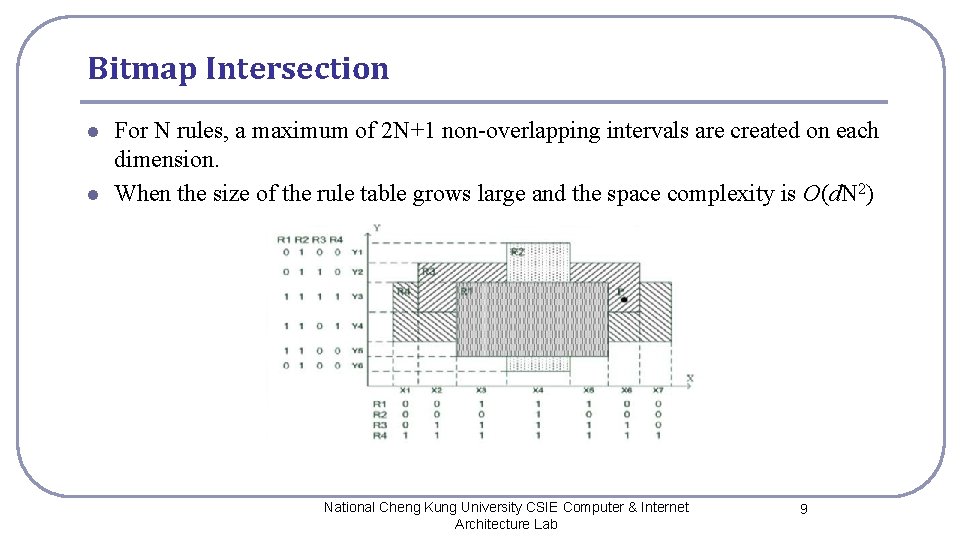
Bitmap Intersection l l For N rules, a maximum of 2 N+1 non-overlapping intervals are created on each dimension. When the size of the rule table grows large and the space complexity is O(d. N 2) National Cheng Kung University CSIE Computer & Internet Architecture Lab 9
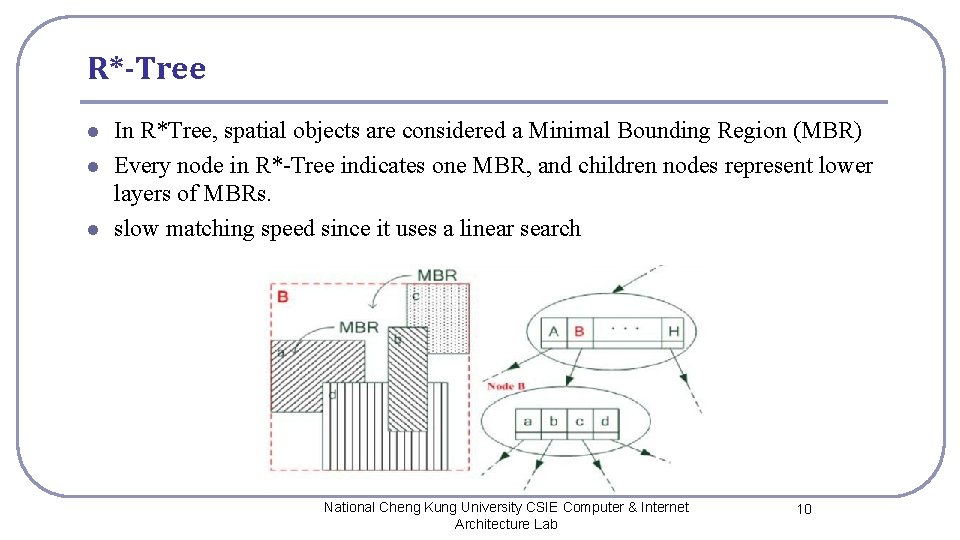
R*-Tree l l l In R*Tree, spatial objects are considered a Minimal Bounding Region (MBR) Every node in R*-Tree indicates one MBR, and children nodes represent lower layers of MBRs. slow matching speed since it uses a linear search National Cheng Kung University CSIE Computer & Internet Architecture Lab 10
Outline l l l Introduction Related Works R* -Tree Based Bitmap Intersection Enhanced R*-Tree Based Bitmap Intersection Performance Evaluation National Cheng Kung University CSIE Computer & Internet Architecture Lab 11
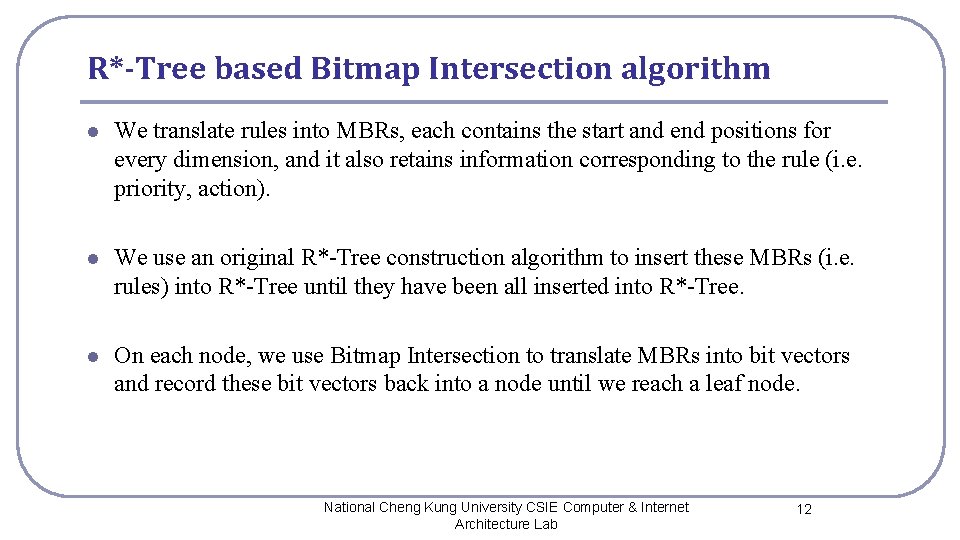
R*-Tree based Bitmap Intersection algorithm l We translate rules into MBRs, each contains the start and end positions for every dimension, and it also retains information corresponding to the rule (i. e. priority, action). l We use an original R*-Tree construction algorithm to insert these MBRs (i. e. rules) into R*-Tree until they have been all inserted into R*-Tree. l On each node, we use Bitmap Intersection to translate MBRs into bit vectors and record these bit vectors back into a node until we reach a leaf node. National Cheng Kung University CSIE Computer & Internet Architecture Lab 12
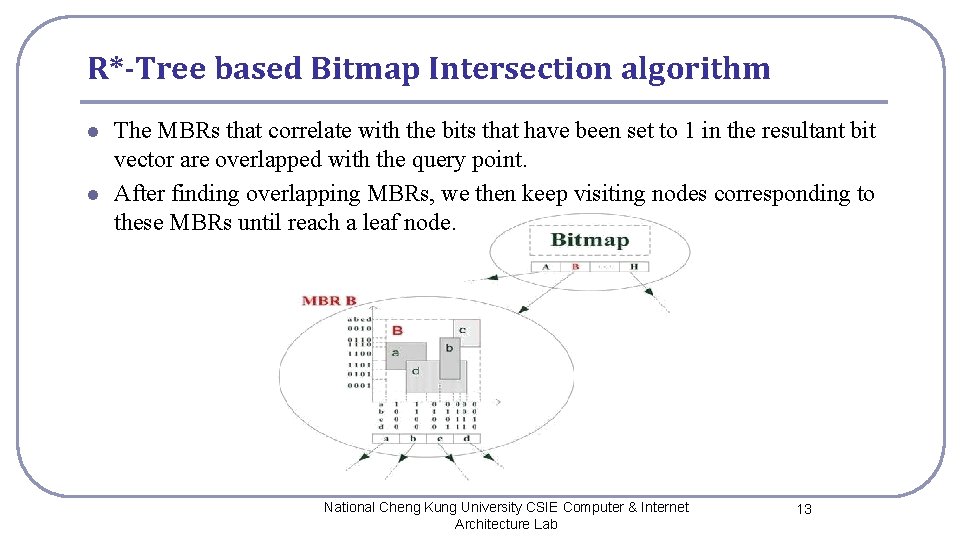
R*-Tree based Bitmap Intersection algorithm l l The MBRs that correlate with the bits that have been set to 1 in the resultant bit vector are overlapped with the query point. After finding overlapping MBRs, we then keep visiting nodes corresponding to these MBRs until reach a leaf node. National Cheng Kung University CSIE Computer & Internet Architecture Lab 13
Outline l l l Introduction Related Works R* -Tree Based Bitmap Intersection Enhanced R*-Tree Based Bitmap Intersection Performance Evaluation National Cheng Kung University CSIE Computer & Internet Architecture Lab 14
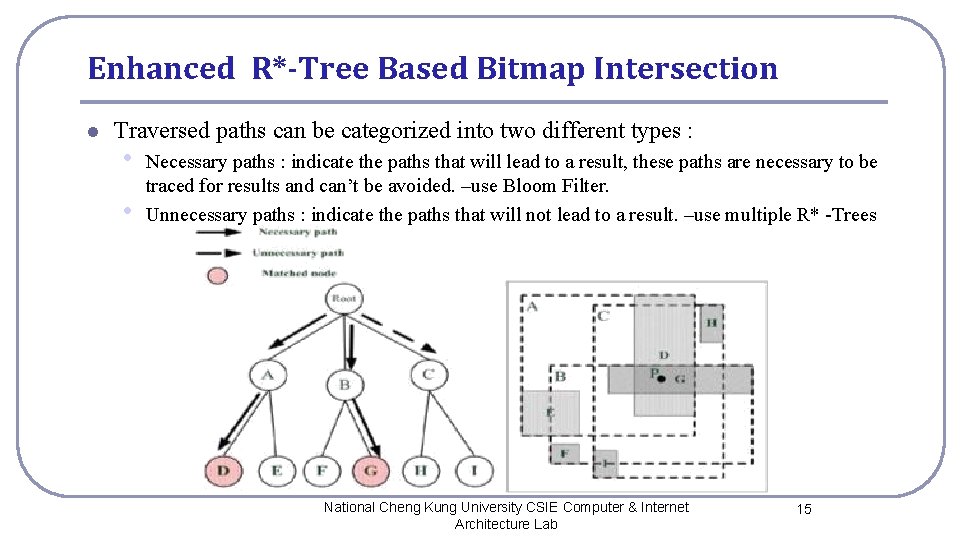
Enhanced R*-Tree Based Bitmap Intersection l Traversed paths can be categorized into two different types : • • Necessary paths : indicate the paths that will lead to a result, these paths are necessary to be traced for results and can’t be avoided. –use Bloom Filter. Unnecessary paths : indicate the paths that will not lead to a result. –use multiple R* -Trees National Cheng Kung University CSIE Computer & Internet Architecture Lab 15
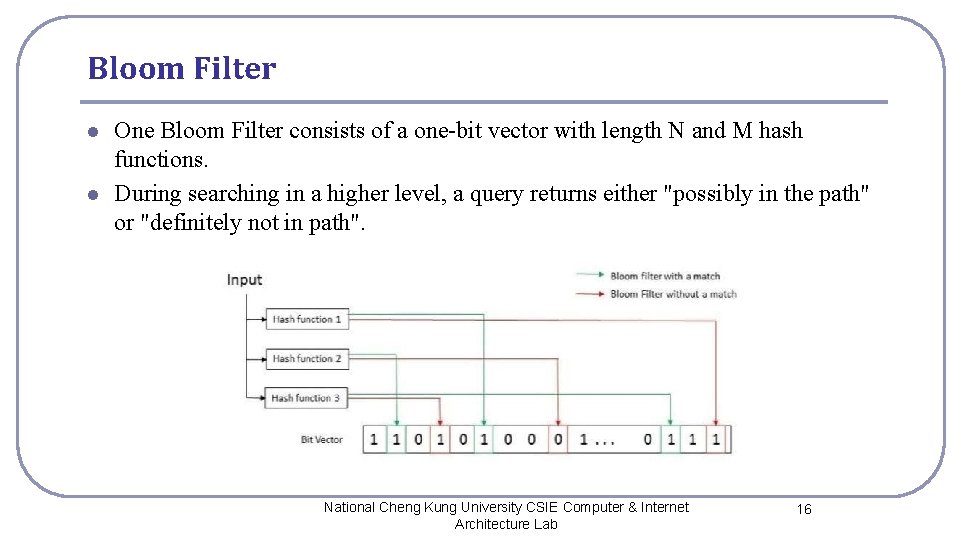
Bloom Filter l l One Bloom Filter consists of a one-bit vector with length N and M hash functions. During searching in a higher level, a query returns either "possibly in the path" or "definitely not in path". National Cheng Kung University CSIE Computer & Internet Architecture Lab 16
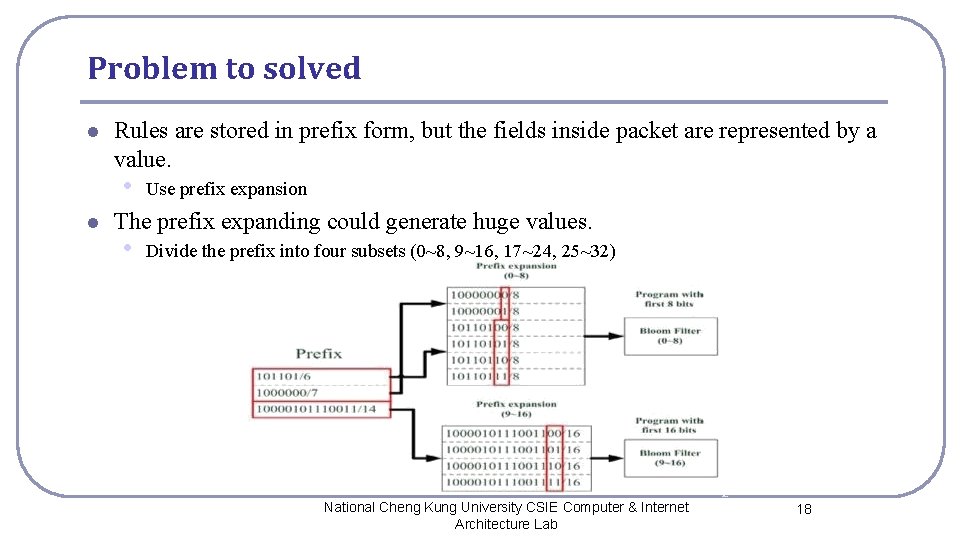
Bloom Filter l When traversing a higher level node, it first utilizes the Bloom Filter which is stored in this node to check whether the searching packet belongs to the rules that are below this node. l For implement, we first gather all the rules below this node, these rules located at leaf nodes below this node, then program a Bloom Filter with these rules in each field. National Cheng Kung University CSIE Computer & Internet Architecture Lab 17
Problem to solved l Rules are stored in prefix form, but the fields inside packet are represented by a value. • l Use prefix expansion The prefix expanding could generate huge values. • Divide the prefix into four subsets (0~8, 9~16, 17~24, 25~32) National Cheng Kung University CSIE Computer & Internet Architecture Lab 18
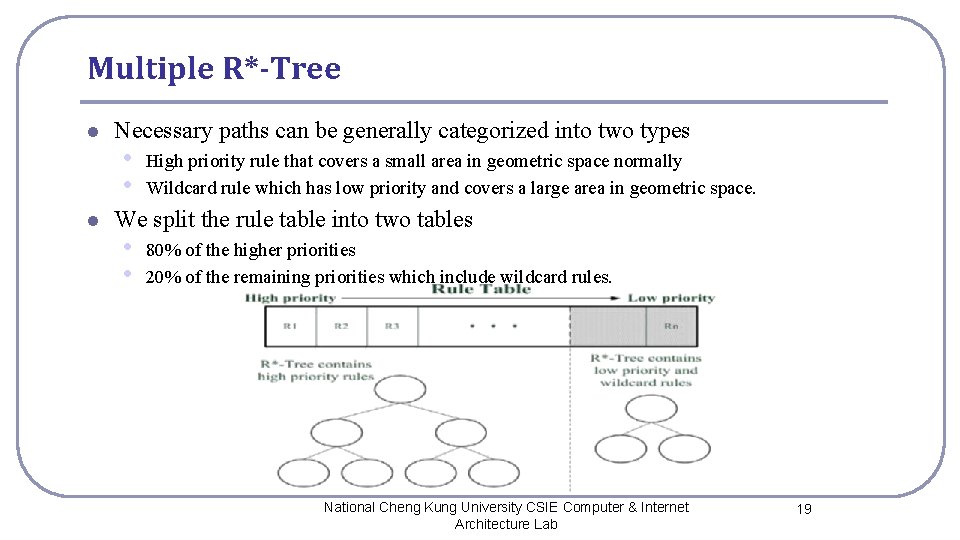
Multiple R*-Tree l l Necessary paths can be generally categorized into two types • • High priority rule that covers a small area in geometric space normally Wildcard rule which has low priority and covers a large area in geometric space. We split the rule table into two tables • • 80% of the higher priorities 20% of the remaining priorities which include wildcard rules. National Cheng Kung University CSIE Computer & Internet Architecture Lab 19
Outline l l l Introduction Related Works R* -Tree Based Bitmap Intersection Enhanced R*-Tree Based Bitmap Intersection Performance Evaluation National Cheng Kung University CSIE Computer & Internet Architecture Lab 20
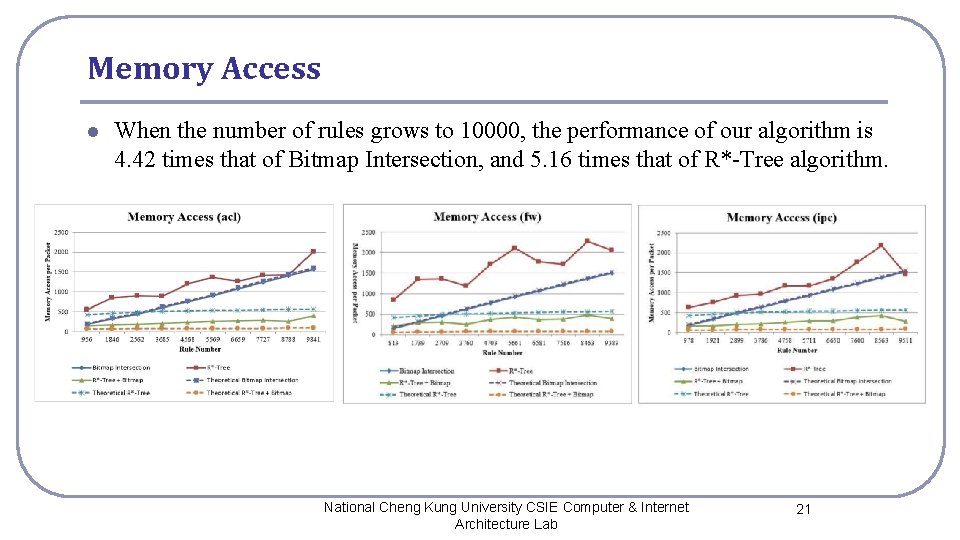
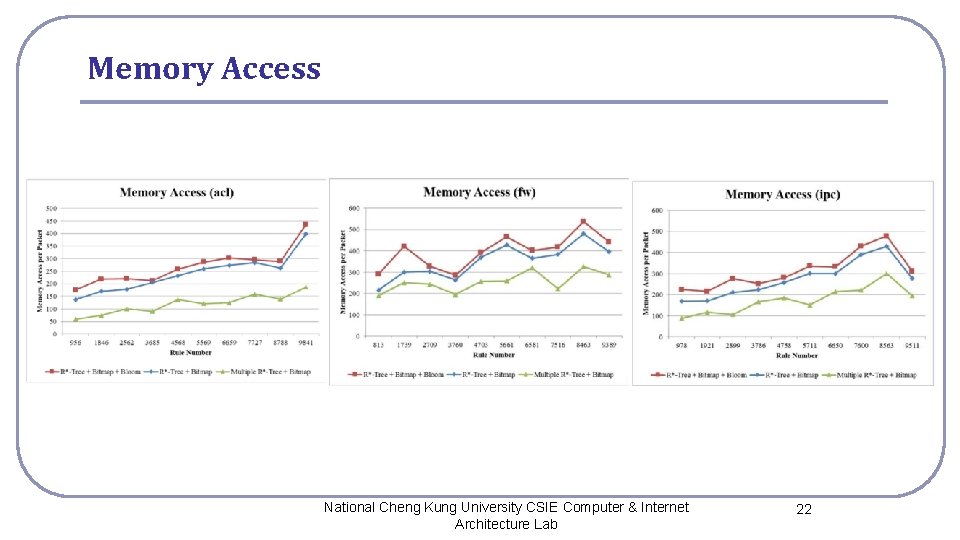
Memory Access l When the number of rules grows to 10000, the performance of our algorithm is 4. 42 times that of Bitmap Intersection, and 5. 16 times that of R*-Tree algorithm. National Cheng Kung University CSIE Computer & Internet Architecture Lab 21
Memory Access National Cheng Kung University CSIE Computer & Internet Architecture Lab 22
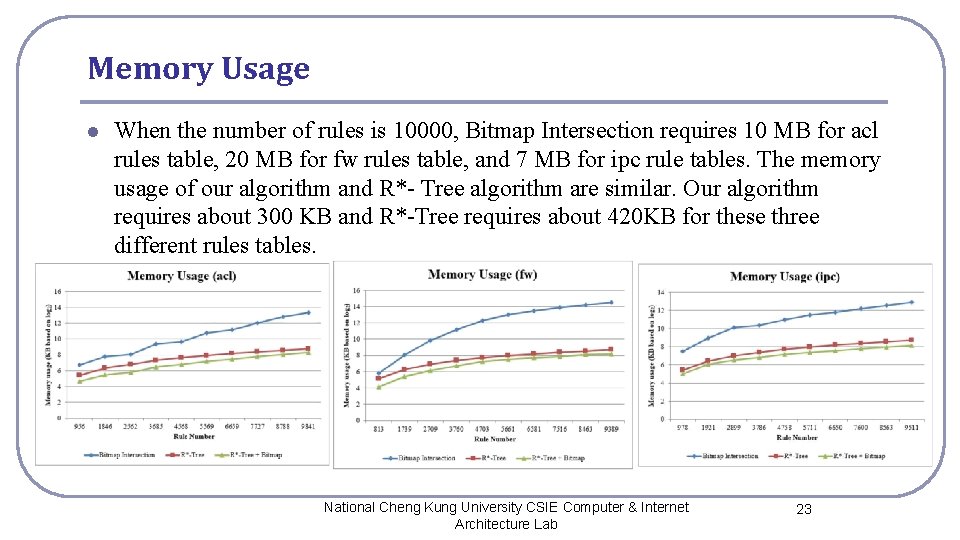
Memory Usage l When the number of rules is 10000, Bitmap Intersection requires 10 MB for acl rules table, 20 MB for fw rules table, and 7 MB for ipc rule tables. The memory usage of our algorithm and R*- Tree algorithm are similar. Our algorithm requires about 300 KB and R*-Tree requires about 420 KB for these three different rules tables. National Cheng Kung University CSIE Computer & Internet Architecture Lab 23