
Fast Methods for Kernelbased Text Analysis Taku Kudo

Fast Methods for Kernel-based Text Analysis Taku Kudo 藤 拓 Yuji Matsumoto 松本 裕治 NAIST (Nara Institute of Science and Technology) 41 st Annual Meeting of the Association for Computational Linguistics , Sapporo JAPAN 1
Background Kernel methods (e. g. , SVM) become popular Can incorporate prior knowledge independently from the machine learning algorithms by giving task dependent kernel (generalized dot-product) High accuracy 2
Problem Too slow to use kernel-based text analyzers to the real NL applications (e. g. , QA or text mining) because of their inefficiency in testing Some kernel-based parsers run only at 2 - 3 seconds/sentence 3
Goals Build fast but still accurate kernelbased text analyzers Make it possible to use them to wider range of NL applications 4

Outline Polynomial Kernel of degree d Fast Methods for Polynomial kernel n n PKI PKE Experiments Conclusions and Future Work 5

Outline Polynomial Kernel of degree d Fast Methods for Polynomial kernels n n PKI PKE Experiments Conclusions and Future Work 6
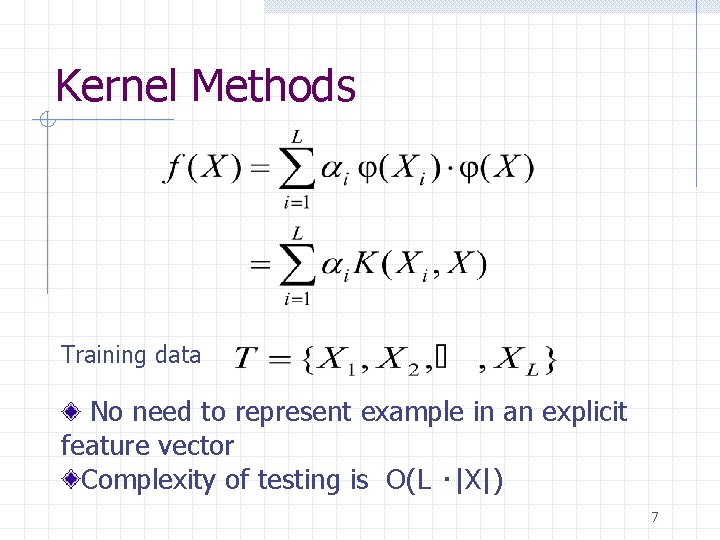
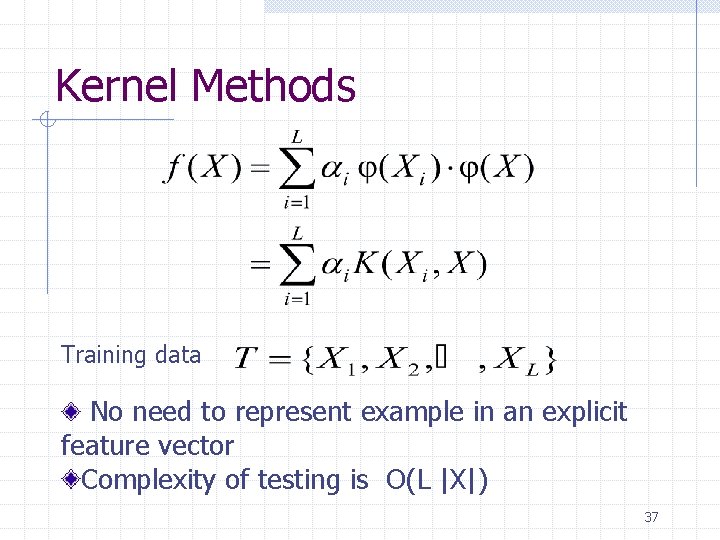
Kernel Methods Training data No need to represent example in an explicit feature vector Complexity of testing is O(L ・|X|) 7
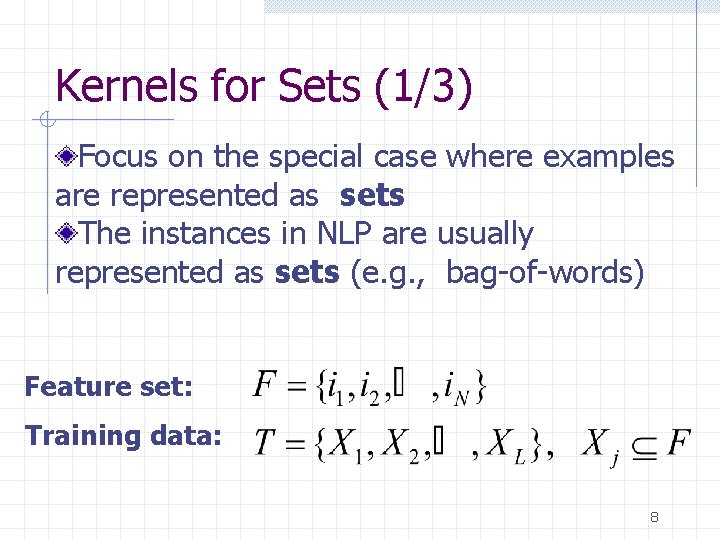
Kernels for Sets (1/3) Focus on the special case where examples are represented as sets The instances in NLP are usually represented as sets (e. g. , bag-of-words) Feature set: Training data: 8
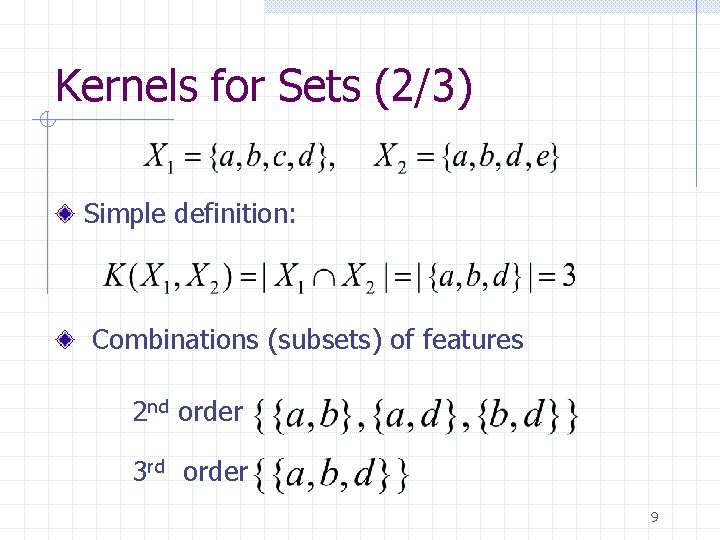
Kernels for Sets (2/3) Simple definition: Combinations (subsets) of features 2 nd order 3 rd order 9
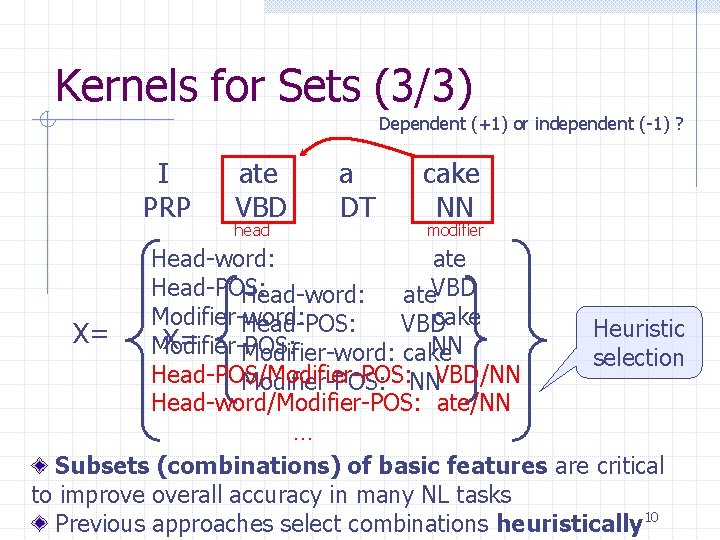
Kernels for Sets (3/3) Dependent (+1) or independent (-1) ? I PRP ate VBD head a DT cake NN modifier Head-word: ate Head-POS: Head-word: ate. VBD Modifier-word: cake Head-POS: VBD Heuristic X= Modifier-POS: X= Modifier-word: cake NN selection Head-POS/Modifier-POS: NNVBD/NN Head-word/Modifier-POS: ate/NN … Subsets (combinations) of basic features are critical to improve overall accuracy in many NL tasks Previous approaches select combinations heuristically 10
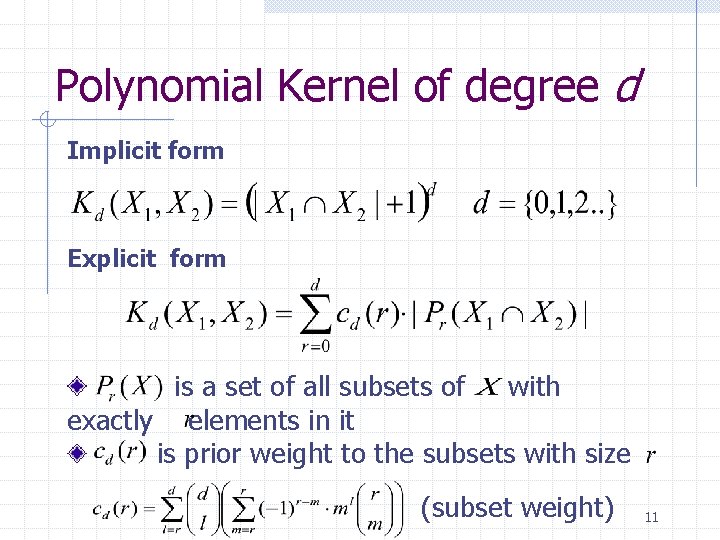
Polynomial Kernel of degree d Implicit form Explicit form is a set of all subsets of with exactly elements in it is prior weight to the subsets with size (subset weight) 11
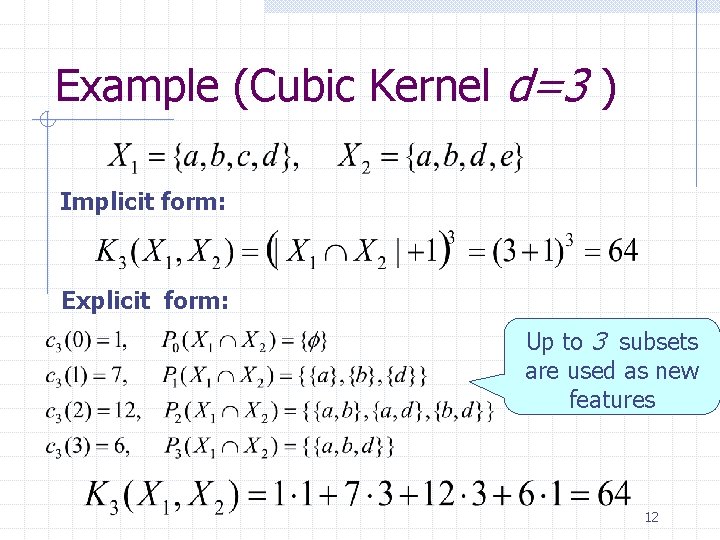
Example (Cubic Kernel d=3 ) Implicit form: Explicit form: Up to 3 subsets are used as new features 12

Outline Polynomial Kernel of degree d Fast Methods for Polynomial kernel n n PKI PKE Experiments Conclusions and Future Work 13
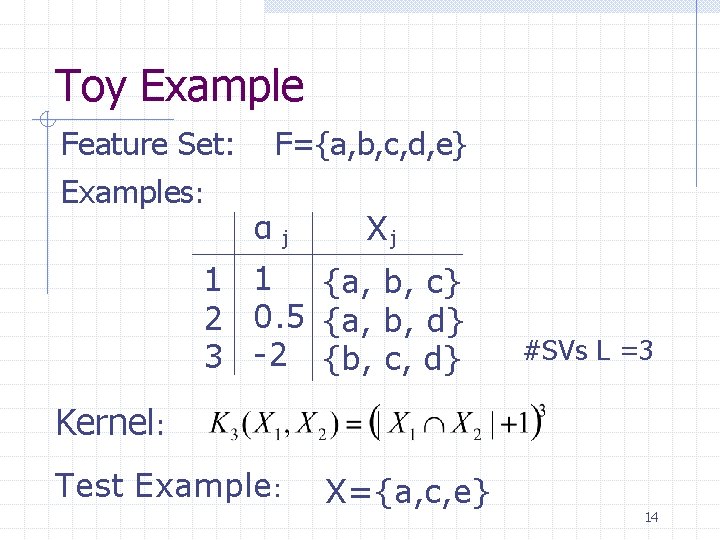
Toy Example Feature Set: Examples: F={a, b, c, d, e} α j Xj 1 1 {a, b, c} 2 0. 5 {a, b, d} 3 -2 {b, c, d} #SVs L =3 Kernel: Test Example: X={a, c, e} 14
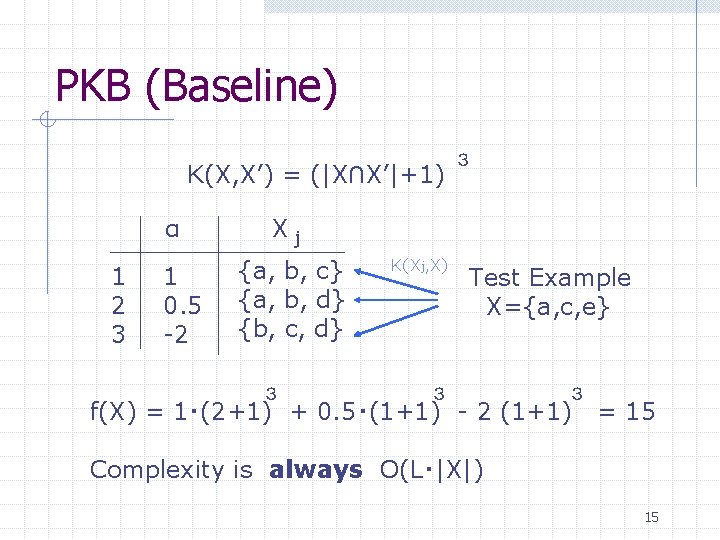
PKB (Baseline) K(X, X’) = (|X∩X’|+1) α 1 2 3 1 0. 5 -2 3 Xj {a, b, c} {a, b, d} {b, c, d} 3 K(Xj, X) Test Example X={a, c, e} 3 3 f(X) = 1・(2+1) + 0. 5・(1+1) - 2 (1+1) = 15 Complexity is always O(L・|X|) 15
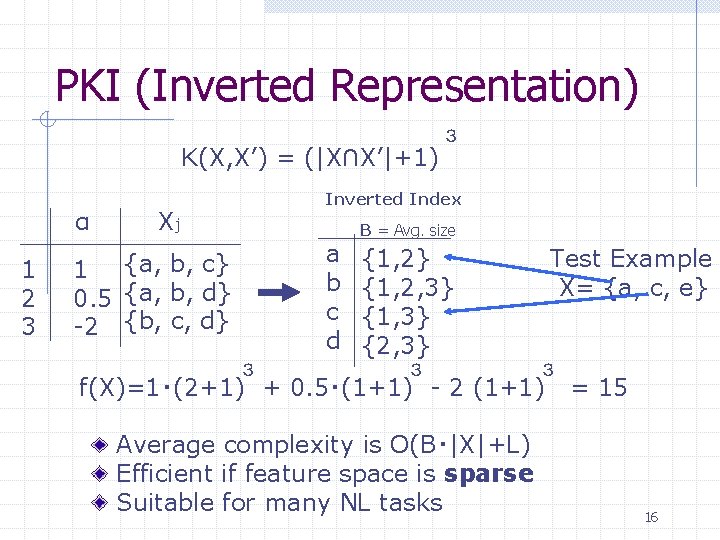
PKI (Inverted Representation) K(X, X’) = (|X∩X’|+1) α 1 2 3 3 Inverted Index Xj a b c d 1 {a, b, c} 0. 5 {a, b, d} -2 {b, c, d} 3 B = Avg. size {1, 2} {1, 2, 3} {1, 3} {2, 3} 3 Test Example X= {a, c, e} 3 f(X)=1・(2+1) + 0. 5・(1+1) - 2 (1+1) Average complexity is O(B・|X|+L) Efficient if feature space is sparse Suitable for many NL tasks = 15 16
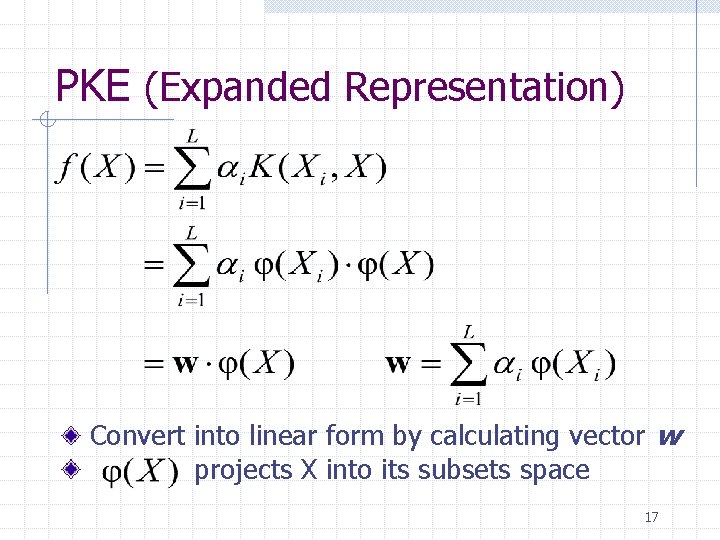
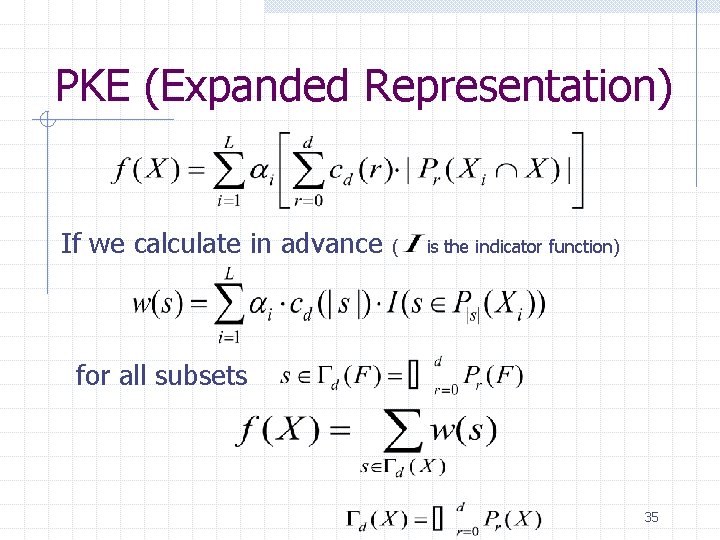
PKE (Expanded Representation) Convert into linear form by calculating vector w projects X into its subsets space 17
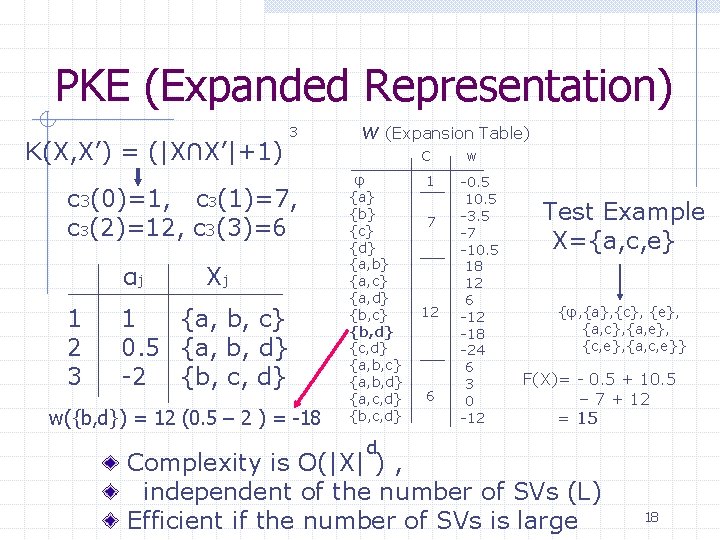
PKE (Expanded Representation) K(X, X’) = (|X∩X’|+1) 3 c 3(0)=1, c 3(1)=7, c 3(2)=12, c 3(3)=6 αj 1 2 3 Xj 1 {a, b, c} 0. 5 {a, b, d} -2 {b, c, d} w({b, d}) = 12 (0. 5 – 2 ) = -18 W (Expansion Table) C φ {a} {b} {c} {d} {a, b} {a, c} {a, d} {b, c} {b, d} {c, d} {a, b, c} {a, b, d} {a, c, d} {b, c, d} 1 7 12 6 w -0. 5 10. 5 -3. 5 -7 -10. 5 18 12 6 -12 -18 -24 6 3 0 -12 Test Example X={a, c, e} {φ, {a}, {c}, {e}, {a, c}, {a, e}, {c, e}, {a, c, e}} F(X)= - 0. 5 + 10. 5 – 7 + 12 = 15 d Complexity is O(|X| ) , independent of the number of SVs (L) Efficient if the number of SVs is large 18
PKE in Practice Hard to calculate Expansion Table exactly Use Approximated Expansion Table Subsets with smaller |w| can be removed, since |w| represents a contribution to the final classification Use subset mining (a. k. a. basket mining) algorithm for efficient calculation 19
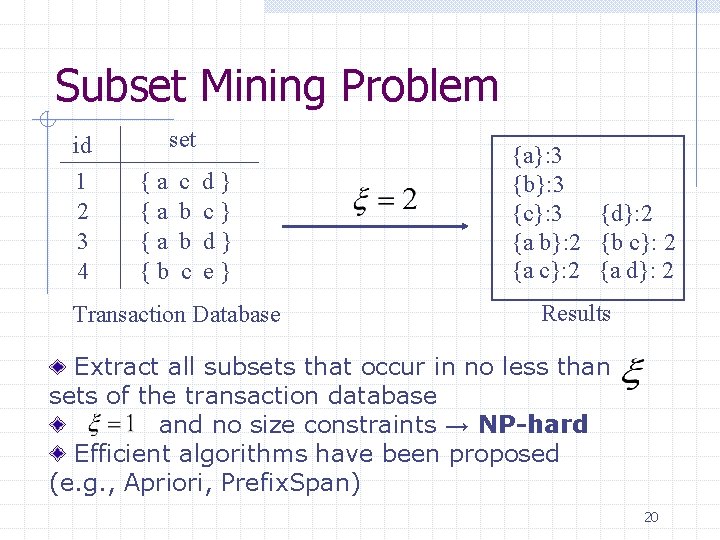
Subset Mining Problem id 1 2 3 4 set {a {a {a {b c b b c d} c} d} e} Transaction Database {a}: 3 {b}: 3 {c}: 3 {d}: 2 {a b}: 2 {b c}: 2 {a d}: 2 Results Extract all subsets that occur in no less than sets of the transaction database and no size constraints → NP-hard Efficient algorithms have been proposed (e. g. , Apriori, Prefix. Span) 20
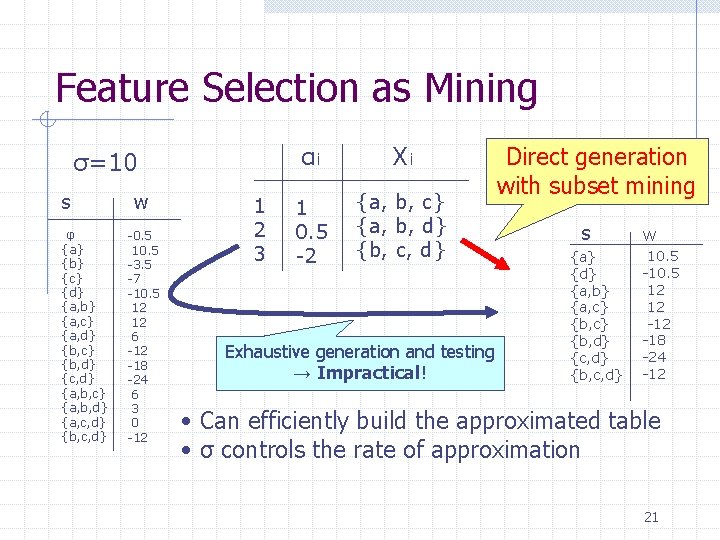
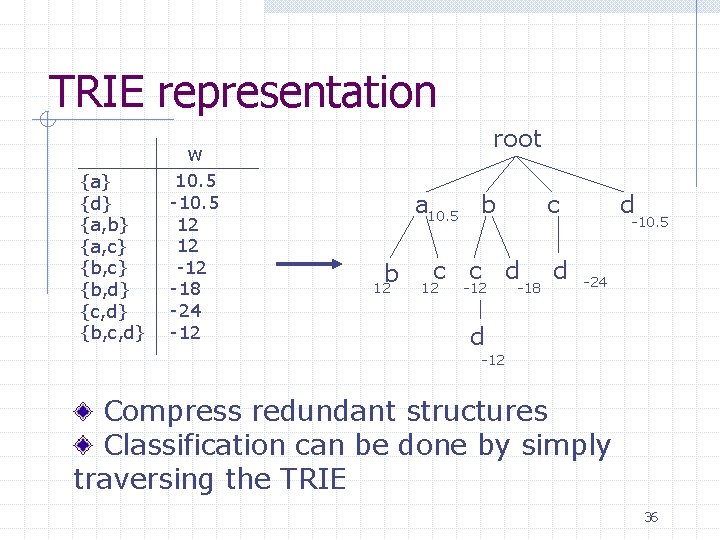
Feature Selection as Mining σ=10 s φ {a} {b} {c} {d} {a, b} {a, c} {a, d} {b, c} {b, d} {c, d} {a, b, c} {a, b, d} {a, c, d} {b, c, d} w -0. 5 10. 5 -3. 5 -7 -10. 5 12 12 6 -12 -18 -24 6 3 0 -12 1 2 3 αi Xi 1 0. 5 -2 {a, b, c} {a, b, d} {b, c, d} Exhaustive generation and testing → Impractical! Direct generation with subset mining s {a} {d} {a, b} {a, c} {b, d} {c, d} {b, c, d} W 10. 5 -10. 5 12 12 -18 -24 -12 • Can efficiently build the approximated table • σ controls the rate of approximation 21
Outline Polynomial Kernel of degree d Fast Methods for Polynomial kernel n n PKI PKE Experiments Conclusions and Future Work 22
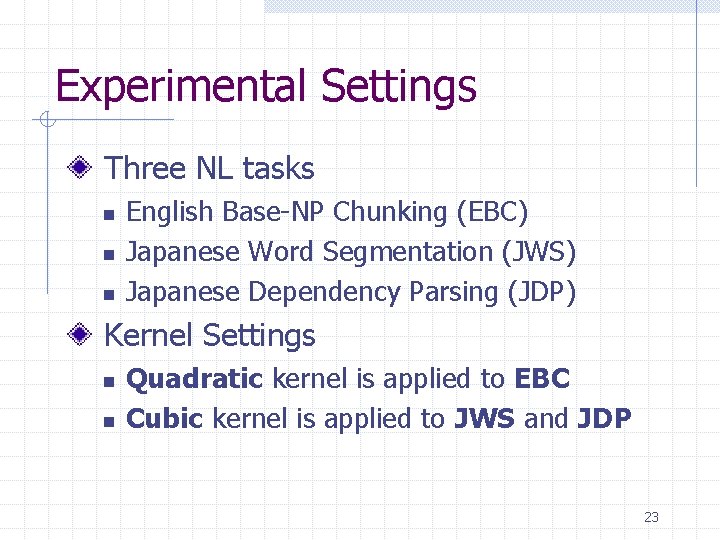
Experimental Settings Three NL tasks n n n English Base-NP Chunking (EBC) Japanese Word Segmentation (JWS) Japanese Dependency Parsing (JDP) Kernel Settings n n Quadratic kernel is applied to EBC Cubic kernel is applied to JWS and JDP 23
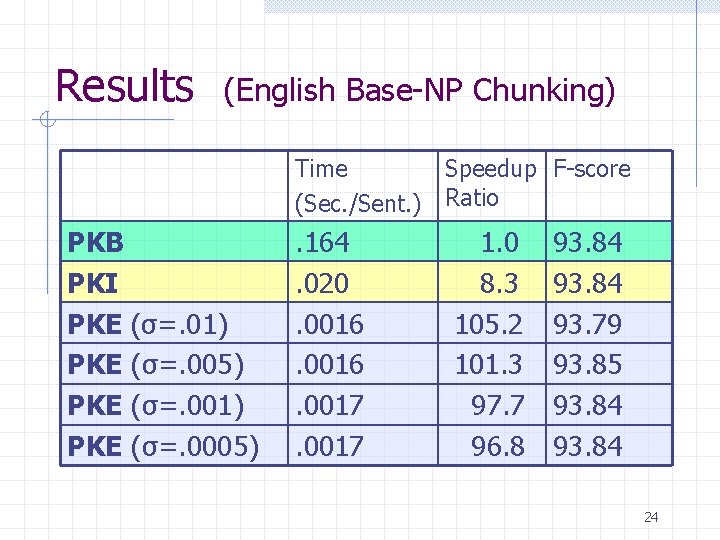
Results (English Base-NP Chunking) Time Speedup F-score (Sec. /Sent. ) Ratio PKB PKI PKE (σ=. 01) PKE (σ=. 005) PKE (σ=. 001) PKE (σ=. 0005) . 164. 020. 0016. 0017 1. 0 8. 3 105. 2 101. 3 97. 7 96. 8 93. 84 93. 79 93. 85 93. 84 24
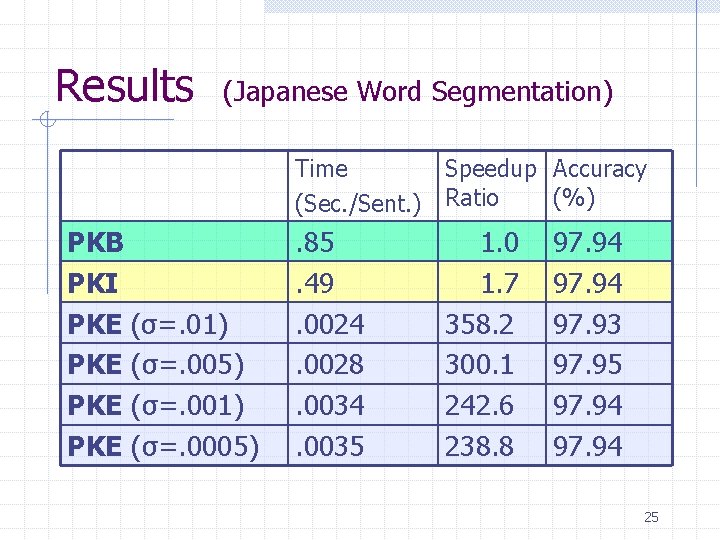
Results (Japanese Word Segmentation) Time Speedup Accuracy (%) (Sec. /Sent. ) Ratio PKB PKI PKE (σ=. 01) PKE (σ=. 005) PKE (σ=. 001) PKE (σ=. 0005) . 85. 49. 0024. 0028. 0034. 0035 1. 0 1. 7 358. 2 300. 1 242. 6 238. 8 97. 94 97. 93 97. 95 97. 94 25
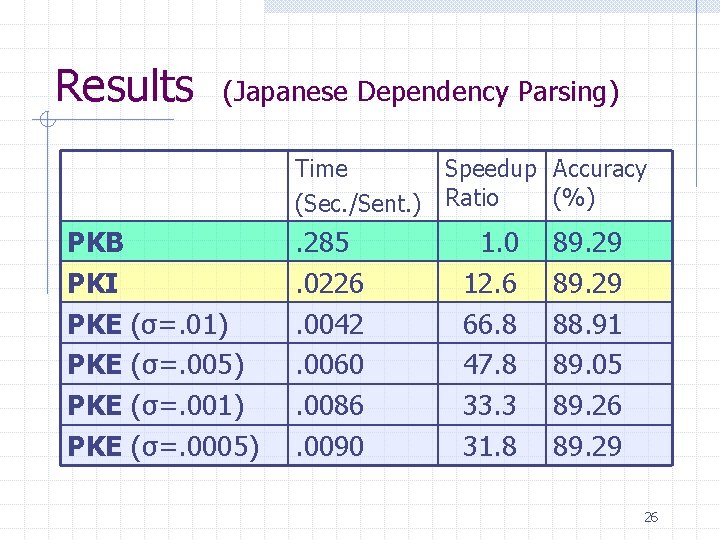
Results (Japanese Dependency Parsing) Time Speedup Accuracy (%) (Sec. /Sent. ) Ratio PKB PKI PKE (σ=. 01) PKE (σ=. 005) PKE (σ=. 001) PKE (σ=. 0005) . 285. 0226. 0042. 0060. 0086. 0090 1. 0 12. 6 66. 8 47. 8 33. 3 31. 8 89. 29 88. 91 89. 05 89. 26 89. 29 26
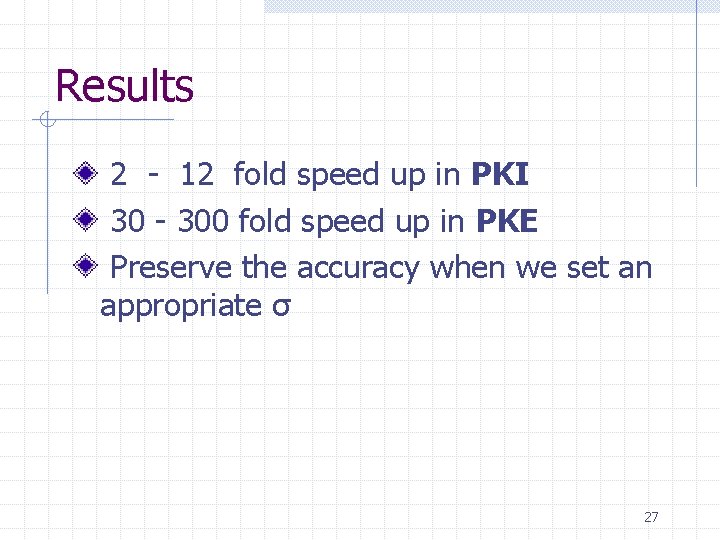
Results 2 - 12 fold speed up in PKI 30 - 300 fold speed up in PKE Preserve the accuracy when we set an appropriate σ 27
![Comparison with related work XQK [Isozaki et al. 02] n n n Same concept](http://slidetodoc.com/presentation_image_h2/637ddf588562ae58810a69b2735fb2aa/image-28.jpg "Comparison with related work XQK [Isozaki et al. 02] n n n Same concept")
Comparison with related work XQK [Isozaki et al. 02] n n n Same concept as PKE Designed only for the Quadratic Kernel Exhaustively creates the expansion table PKE n n Designed for general Polynomial Kernels Uses subset mining algorithms to create the expansion table 28
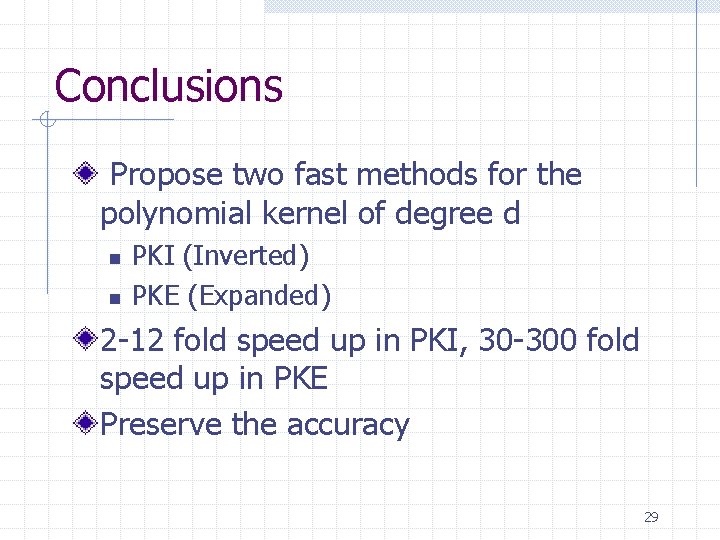
Conclusions Propose two fast methods for the polynomial kernel of degree d n n PKI (Inverted) PKE (Expanded) 2 -12 fold speed up in PKI, 30 -300 fold speed up in PKE Preserve the accuracy 29
Future Work Examine the effectiveness in a general machine learning dataset Apply PKE to other convolution kernels n Tree Kernel [Collins 00] w Dot-product between trees w Feature space is all sub-tree w Apply sub-tree mining algorithm [Zaki 02] 30
![English Base-NP Chunking Extract Non-overlapping Noun Phrase from text [NP He ] reckons [NP](http://slidetodoc.com/presentation_image_h2/637ddf588562ae58810a69b2735fb2aa/image-31.jpg "English Base-NP Chunking Extract Non-overlapping Noun Phrase from text [NP He ] reckons [NP")
English Base-NP Chunking Extract Non-overlapping Noun Phrase from text [NP He ] reckons [NP the current account deficit ] will narrow to [NP only # 1. 8 billion ] in [NP September ]. BIO representation (seeing as a tagging task) B: beginning of chunk I: non-initial chunk O: outside Pair-wise method to 3 -class problem training: wsj 15 -18, test: wsj 20 (standard set) 31
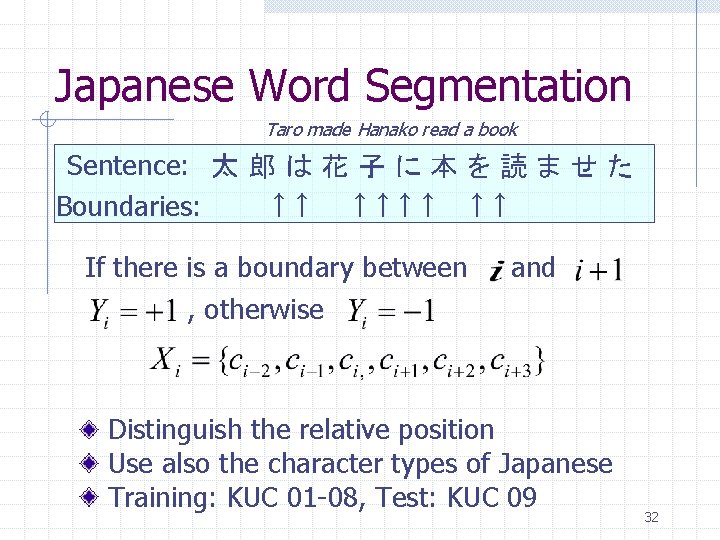
Japanese Word Segmentation Taro made Hanako read a book Sentence: 太 郎 は 花 子 に 本 を 読 ま せ た ↑↑ ↑↑ Boundaries: If there is a boundary between and , otherwise Distinguish the relative position Use also the character types of Japanese Training: KUC 01 -08, Test: KUC 09 32
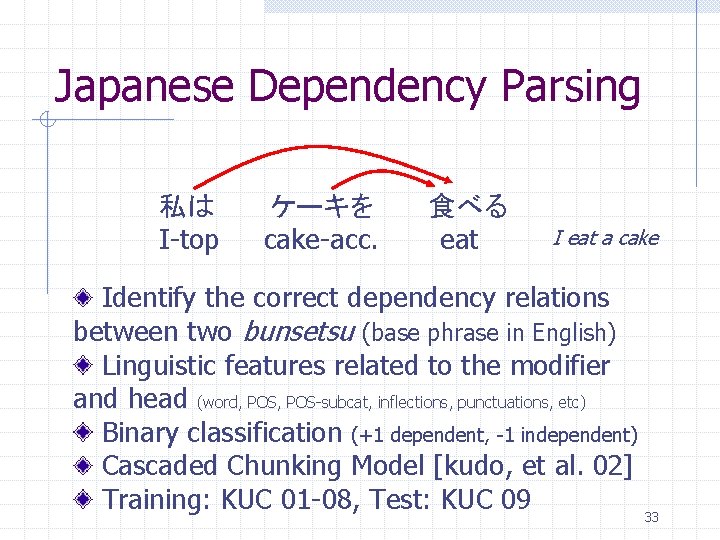
Japanese Dependency Parsing 私は I-top ケーキを cake-acc. 食べる eat I eat a cake Identify the correct dependency relations between two bunsetsu (base phrase in English) Linguistic features related to the modifier and head (word, POS-subcat, inflections, punctuations, etc) Binary classification (+1 dependent, -1 independent) Cascaded Chunking Model [kudo, et al. 02] Training: KUC 01 -08, Test: KUC 09 33
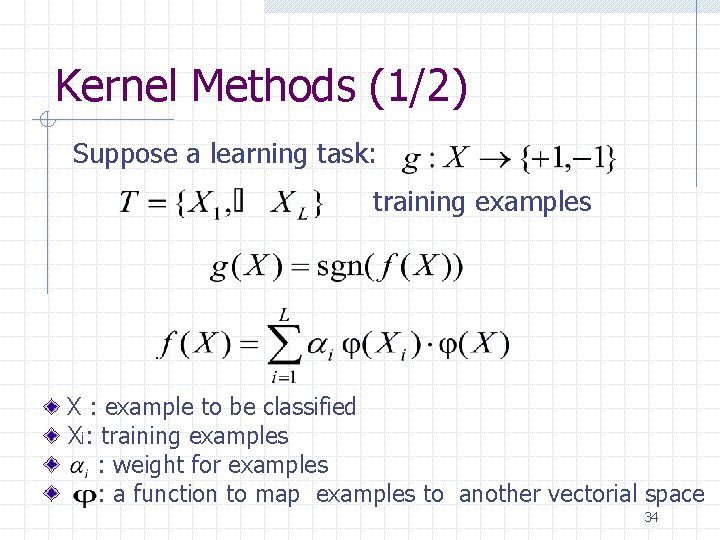
Kernel Methods (1/2) Suppose a learning task: training examples X : example to be classified Xi: training examples : weight for examples : a function to map examples to another vectorial space 34
PKE (Expanded Representation) If we calculate in advance ( is the indicator function) for all subsets 35
TRIE representation root w {a} {d} {a, b} {a, c} {b, d} {c, d} {b, c, d} 10. 5 -10. 5 12 12 -18 -24 -12 a 10. 5 b b 12 c c c d 12 -18 d d -10. 5 -24 d -12 Compress redundant structures Classification can be done by simply traversing the TRIE 36
Kernel Methods Training data No need to represent example in an explicit feature vector Complexity of testing is O(L |X|) 37
- Slides: 37