
Fast Fourier Transform FFT Problem we need an
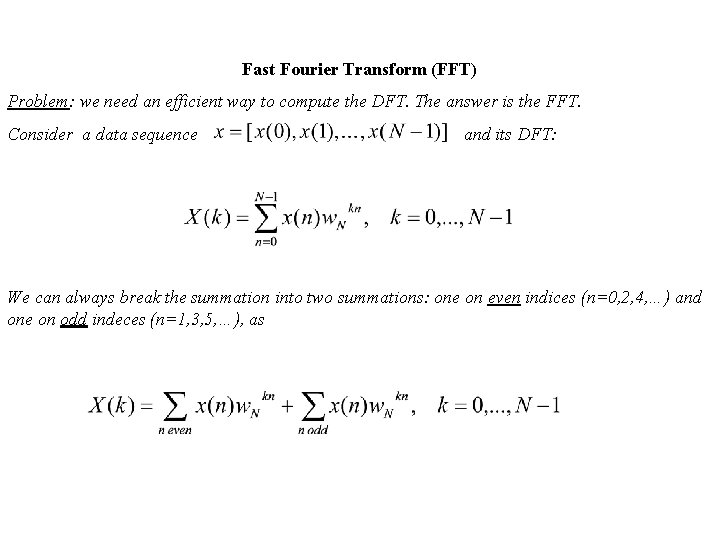
Fast Fourier Transform (FFT) Problem: we need an efficient way to compute the DFT. The answer is the FFT. Consider a data sequence and its DFT: We can always break the summation into two summations: one on even indices (n=0, 2, 4, …) and one on odd indeces (n=1, 3, 5, …), as
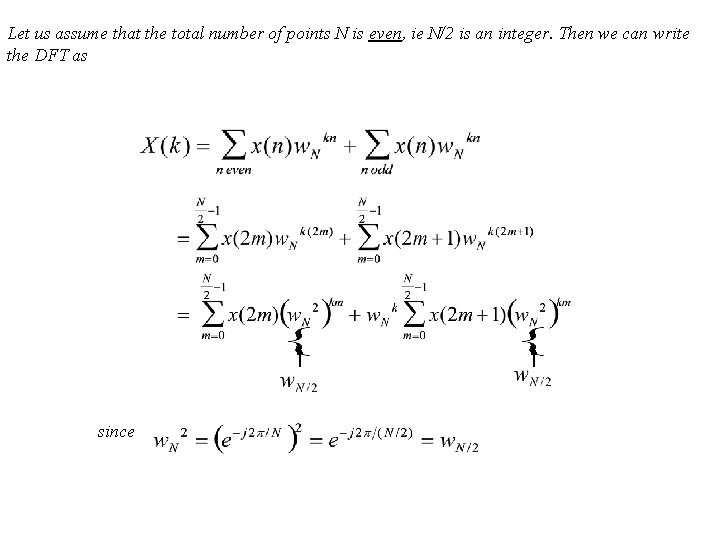
Let us assume that the total number of points N is even, ie N/2 is an integer. Then we can write the DFT as since

The two summations are two distinct DFT’s, as we can see below N-point DFT for k=0, …N-1, where N/2 -point DFT

The problem is that in the expression the N-point DFT and the N/2 point DFT’s have different lengths, since we define them as For example if N=4 we need to compute from two 2 -point DFT’s So how do we compute and ?

We use the periodicity of the DFT, and relate the N-point DFT with the two N/2 -point DFT’s as follows where we used the facts that • the DFT is periodic and in particular •
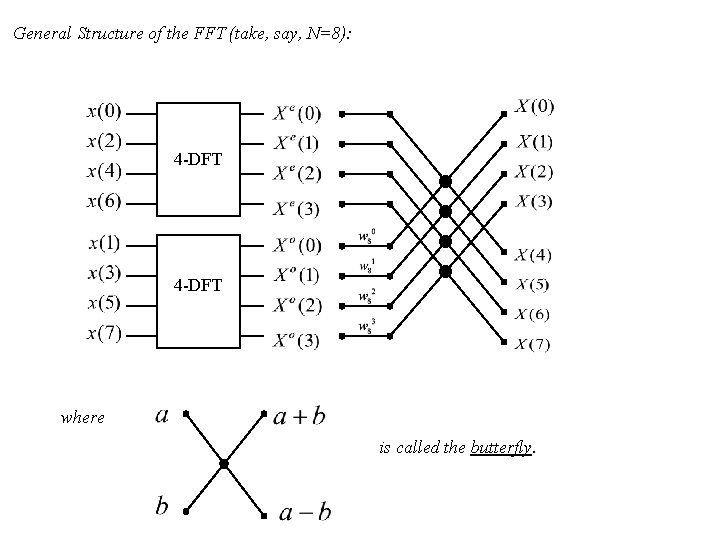
General Structure of the FFT (take, say, N=8): 4 -DFT where is called the butterfly.
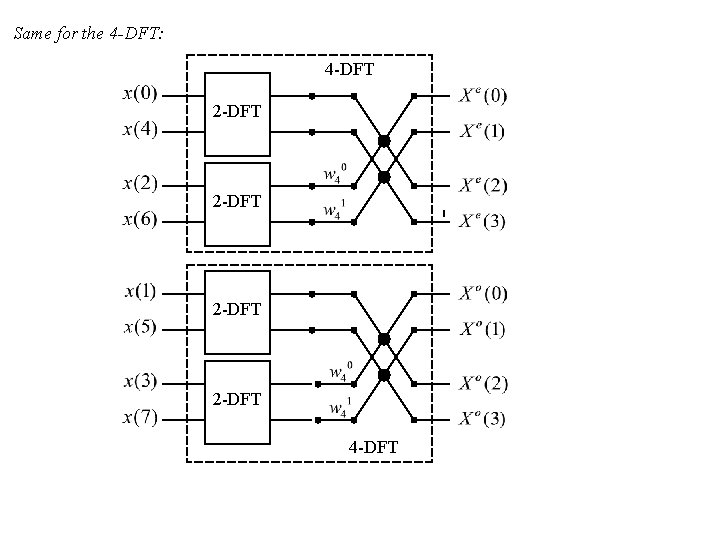
Same for the 4 -DFT: 4 -DFT 2 -DFT 4 -DFT
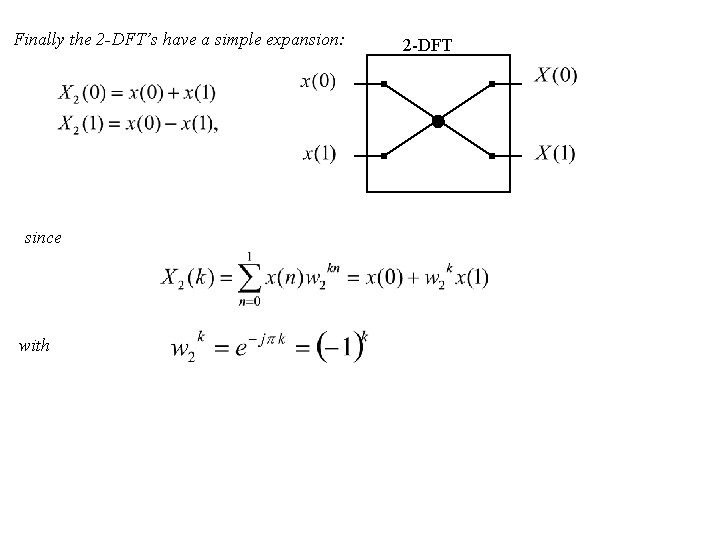
Finally the 2 -DFT’s have a simple expansion: since with 2 -DFT
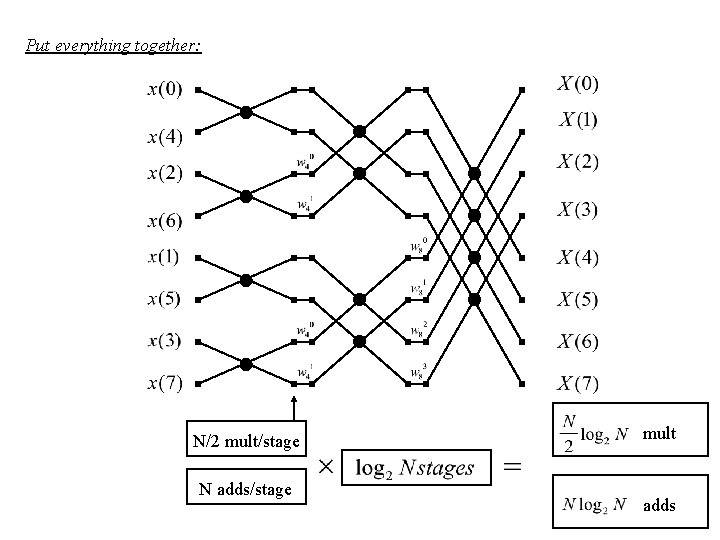
Put everything together: N/2 mult/stage N adds/stage mult adds

We say that, for a data set of length , complexity of the FFT is for some constants a, b. On the other hand, for the same data of length N , complexity of the DFT is Since, from the formula, N ops/term N terms N ops
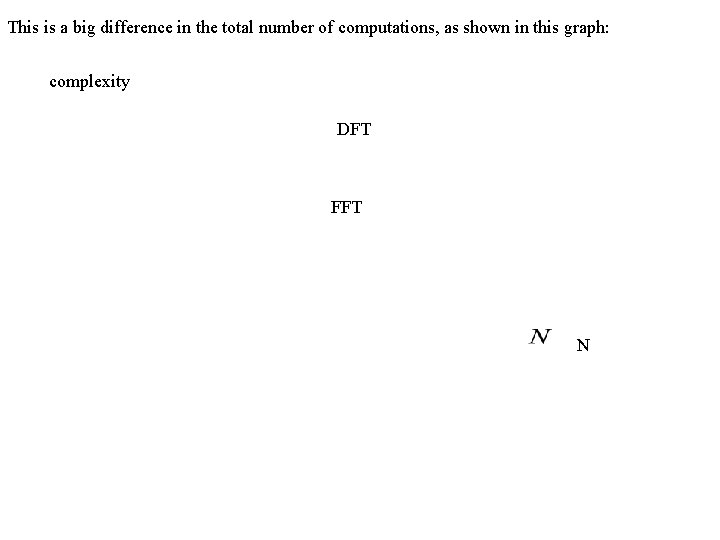
This is a big difference in the total number of computations, as shown in this graph: complexity DFT FFT N
- Slides: 11