
Fast Coupled Sequence Labeling on Heterogeneous Annotations via

Fast Coupled Sequence Labeling on Heterogeneous Annotations via Context-aware Pruning Zhenghua Li, Jiayuan Chao, Min Zhang, Jiwen Yang {zhli 13, minzhang, jwyang}@suda. edu. cn; china_cjy@163. com; Soochow University, China
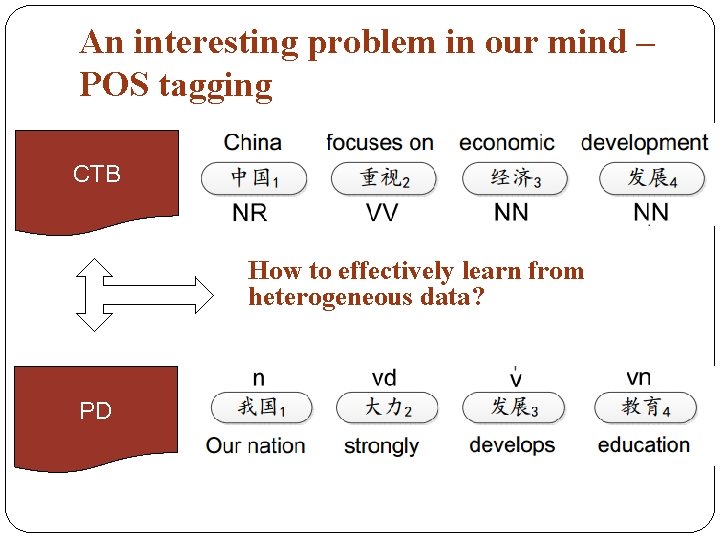
An interesting problem in our mind – POS tagging CTB How to effectively learn from heterogeneous data? PD
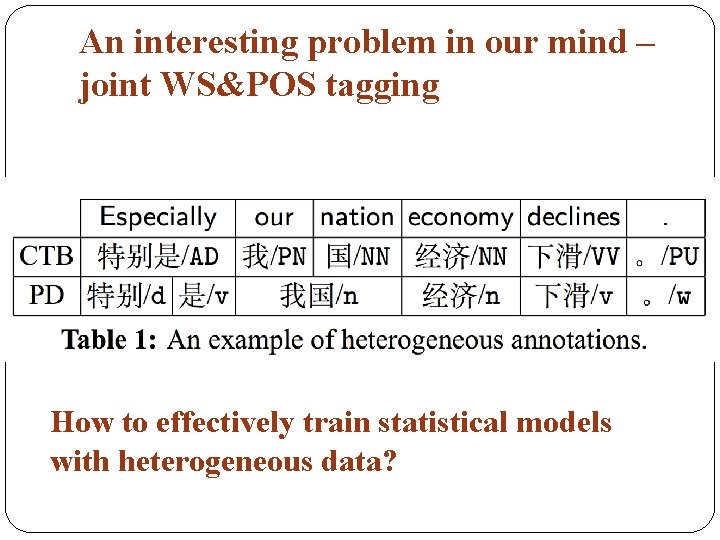
An interesting problem in our mind – joint WS&POS tagging How to effectively train statistical models with heterogeneous data?
Challenges �How to capture the structure/tag correspondences between two guidelines? �Usually context-sensitive. �The datasets (CTB/PD) are typically nonoverlapping. Thus it is difficult to build a model to automatically learn the correspondences.
Previous work �Guide-feature based method (indirectly use one data to produce automatic guide labels on another data) �Word segmentation, POS tagging (Jiang+ 09; Sun & Wan 12; Jiang+12; Gao+ 14) �Dependency parsing (Li+ 12) �Constituent treebank conversion (Zhu+ 11; Jiang+ 13) �…
Previous work �Coupled sequence labeling: directly learn from heterogeneous data �Joint word segmentation and POS tagging (Qiu+ 13) �POS tagging (Li+ 15, Chen+ 16)
Two drawbacks of the coupled approach of Li+ 15 �Manually design tag-to-tag mapping rules to constrain the search space �Very difficult for POS tagging �Impossible for joint WS&POS tagging �Hurt accuracy �Still very inefficient This work solves the efficiency problem, making the coupled approach more elegant and general.
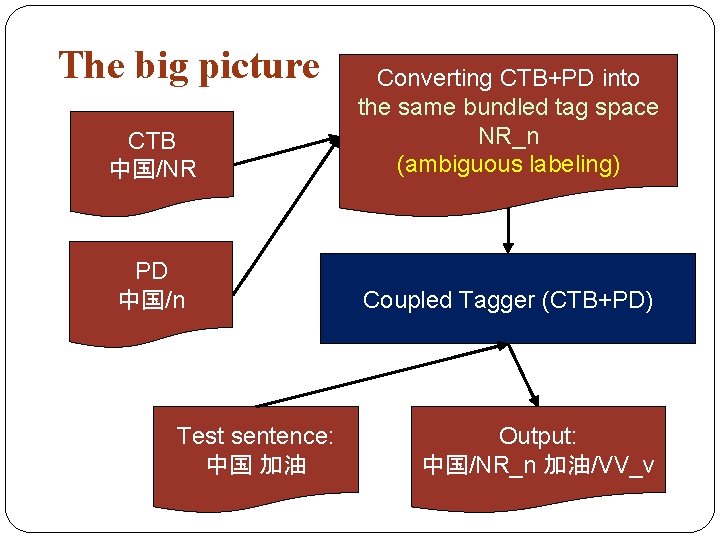
The big picture CTB 中国/NR Converting CTB+PD into the same bundled tag space NR_n (ambiguous labeling) PD 中国/n Coupled Tagger (CTB+PD) Test sentence: 中国 加油 Output: 中国/NR_n 加油/VV_v
Step 1: Convert CTB+PD into the same bundled tag space NR_n (ambiguous labeling)
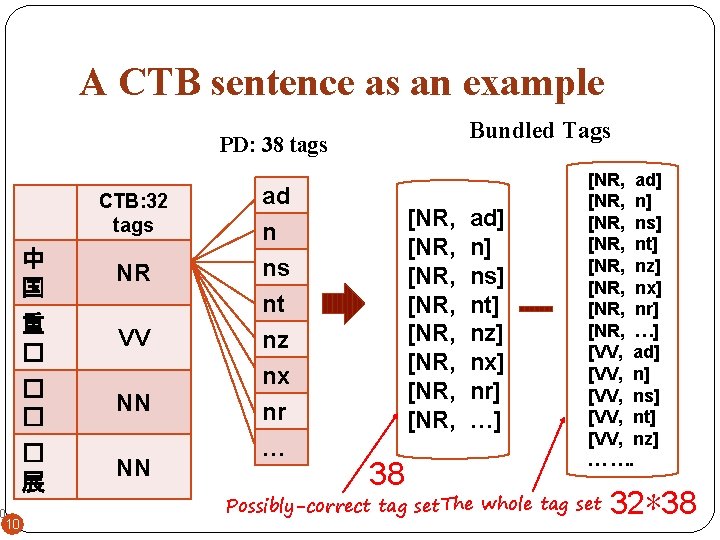
A CTB sentence as an example Bundled Tags PD: 38 tags CTB: 32 tags 中 国 NR 重 � VV � � � 展 10 10 NN NN ad n ns nt nz nx nr … [NR, [NR, 38 ad] n] ns] nt] nz] nx] nr] …] [NR, ad] [NR, ns] [NR, nt] [NR, nz] [NR, nx] [NR, nr] [NR, …] [VV, ad] [VV, ns] [VV, nt] [VV, nz] … …. Possibly-correct tag set The whole tag set 32*38
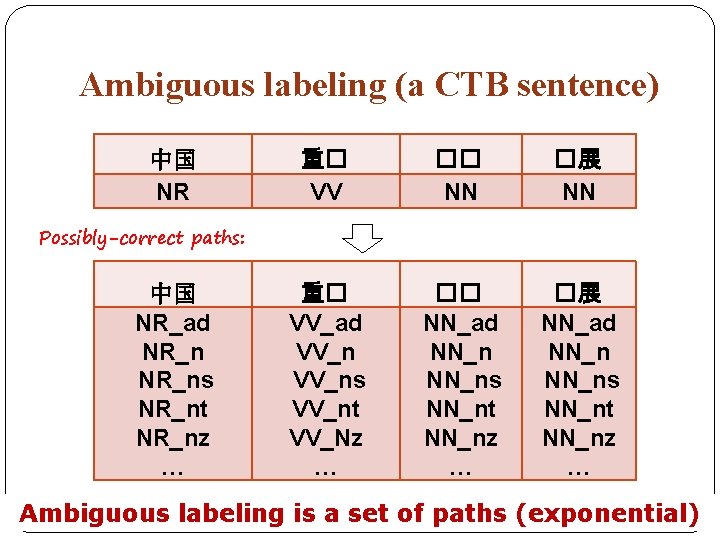
Ambiguous labeling (a CTB sentence) 中国 NR 重� VV �� NN �展 NN 重� VV_ad VV_ns VV_nt VV_Nz … �� NN_ad NN_ns NN_nt NN_nz … �展 NN_ad NN_ns NN_nt NN_nz … Possibly-correct paths: 中国 NR_ad NR_ns NR_nt NR_nz … Ambiguous labeling is a set of paths (exponential)
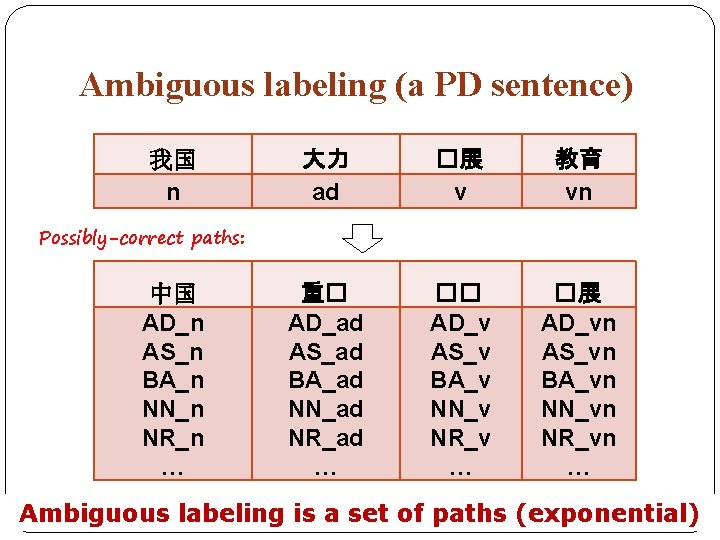
Ambiguous labeling (a PD sentence) 我国 n 大力 ad �展 v 教育 vn 重� AD_ad AS_ad BA_ad NN_ad NR_ad … �� AD_v AS_v BA_v NN_v NR_v … �展 AD_vn AS_vn BA_vn NN_vn NR_vn … Possibly-correct paths: 中国 AD_n AS_n BA_n NN_n NR_n … Ambiguous labeling is a set of paths (exponential)
Step 2: Train the coupled model on CTB+PD with ambiguous labeling
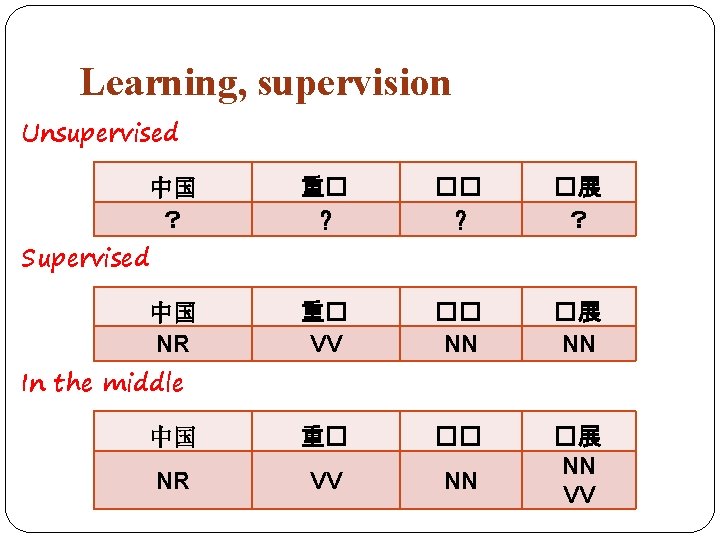
Learning, supervision Unsupervised 重� ? �展 ? 重� VV �� NN �展 NN 中国 重� �� NR VV NN �展 NN VV 中国 ? Supervised 中国 NR In the middle
Ambiguous labeling (partial annotation, natural annotation) �Relaxed/weak supervision �Multilingual transfer on dependency parsing (Tackstrom+ 13) �Semi-supervised dependency parsing (Li+ 14) �Active learning with partial annotation (Li + 12, Li + 16) �Word segmentation (Jiang+ 13; Liu+14; Yang and Vozila 14)
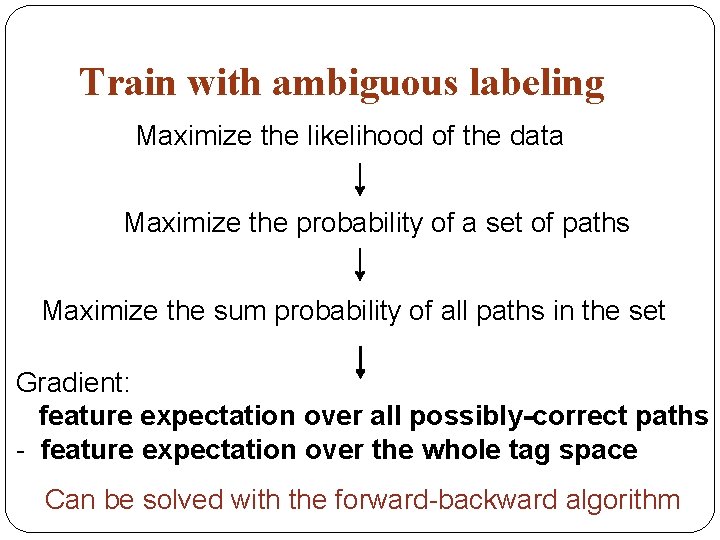
Train with ambiguous labeling Maximize the likelihood of the data Maximize the probability of a set of paths Maximize the sum probability of all paths in the set Gradient: feature expectation over all possibly-correct paths - feature expectation over the whole tag space Can be solved with the forward-backward algorithm
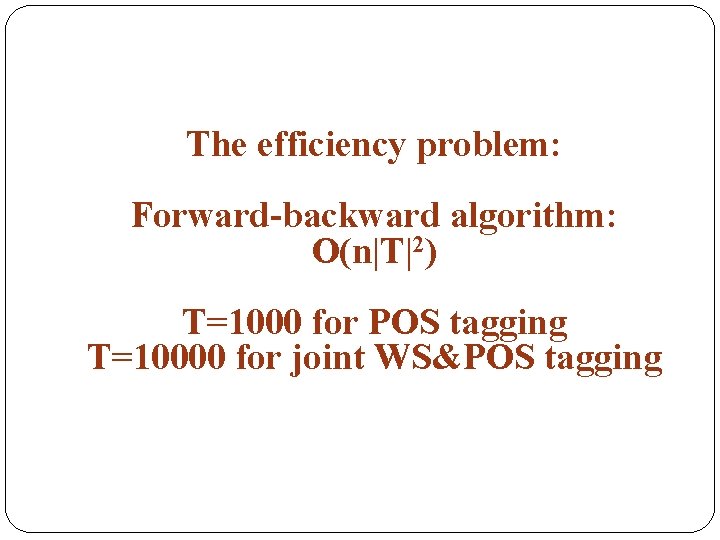
The efficiency problem: Forward-backward algorithm: O(n|T|2) T=1000 for POS tagging T=10000 for joint WS&POS tagging
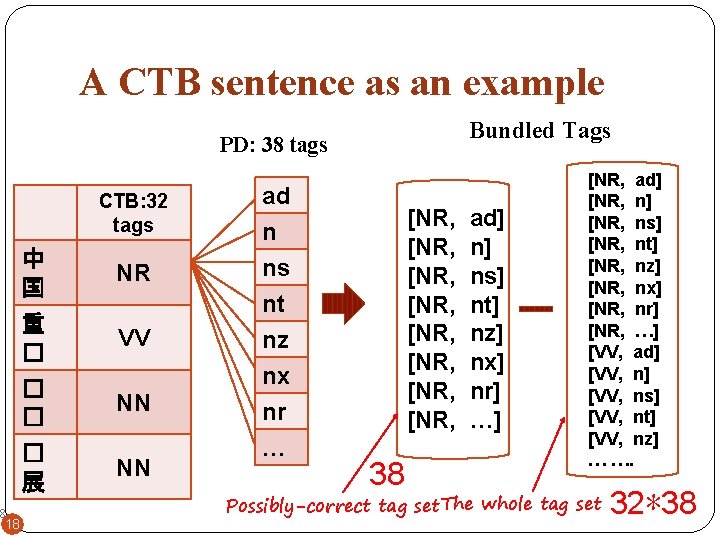
A CTB sentence as an example Bundled Tags PD: 38 tags CTB: 32 tags 中 国 NR 重 � VV � � � 展 18 18 NN NN ad n ns nt nz nx nr … [NR, [NR, 38 ad] n] ns] nt] nz] nx] nr] …] [NR, ad] [NR, ns] [NR, nt] [NR, nz] [NR, nx] [NR, nr] [NR, …] [VV, ad] [VV, ns] [VV, nt] [VV, nz] … …. Possibly-correct tag set The whole tag set 32*38
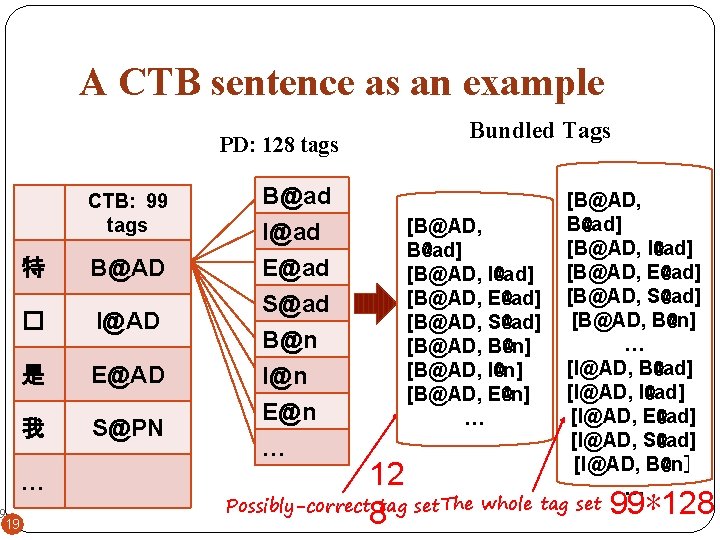
A CTB sentence as an example PD: 128 tags CTB: 99 tags 特 B@AD � I@AD 是 E@AD 我 S@PN … 19 19 B@ad I@ad E@ad S@ad B@n I@n E@n … Bundled Tags [B@AD, B@ad] [B@AD, I@ad] [B@AD, E@ad] [B@AD, S@ad] [B@AD, B@n] [B@AD, I@n] [B@AD, E@n] … [B@AD, B@ad] [B@AD, I@ad] [B@AD, E@ad] [B@AD, S@ad] [B@AD, B@n] … [I@AD, B@ad] [I@AD, I@ad] [I@AD, E@ad] [I@AD, S@ad] [I@AD, B@n] … 12 Possibly-correct tag set The whole tag set 99*128 8
Let’s solve the efficiency problem
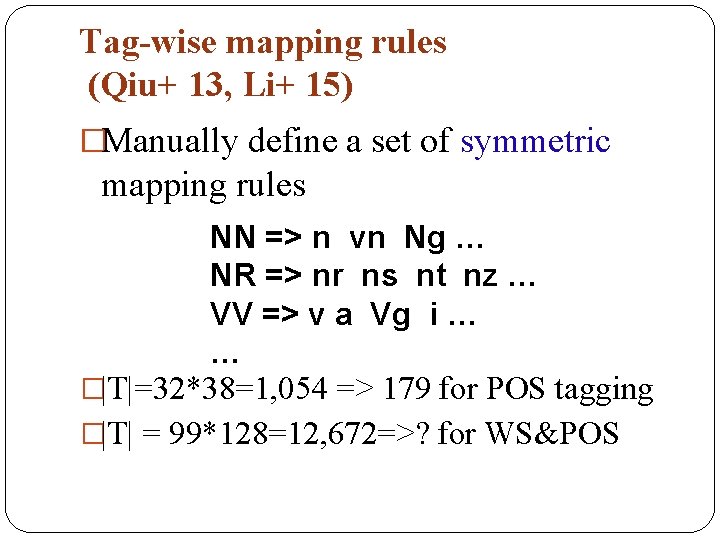
Tag-wise mapping rules (Qiu+ 13, Li+ 15) �Manually define a set of symmetric mapping rules NN => n vn Ng … NR => nr ns nt nz … VV => v a Vg i … … �|T|=32*38=1, 054 => 179 for POS tagging �|T| = 99*128=12, 672=>? for WS&POS
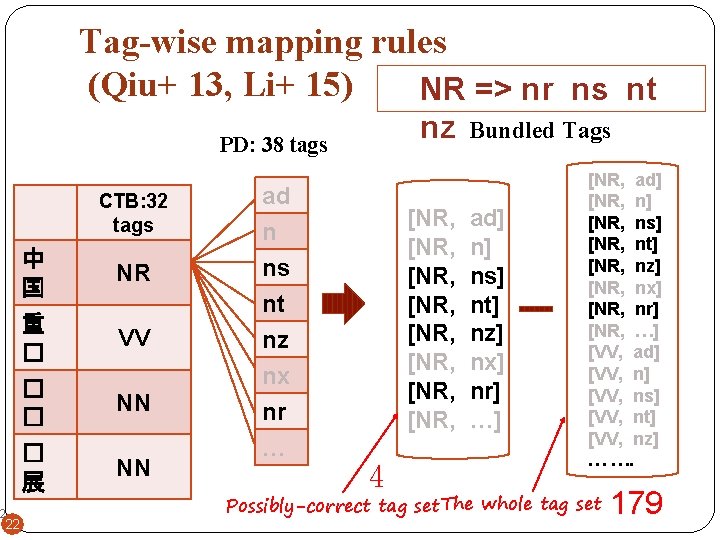
Tag-wise mapping rules (Qiu+ 13, Li+ 15) NR => nr ns nt nz PD: 38 tags CTB: 32 tags 中 国 NR 重 � VV � � � 展 22 22 NN NN ad n ns nt nz nx nr … [NR, [NR, 4 Bundled Tags ad] n] ns] nt] nz] nx] nr] …] [NR, ad] [NR, ns] [NR, nt] [NR, nz] [NR, nx] [NR, nr] [NR, …] [VV, ad] [VV, ns] [VV, nt] [VV, nz] … …. Possibly-correct tag set The whole tag set 179
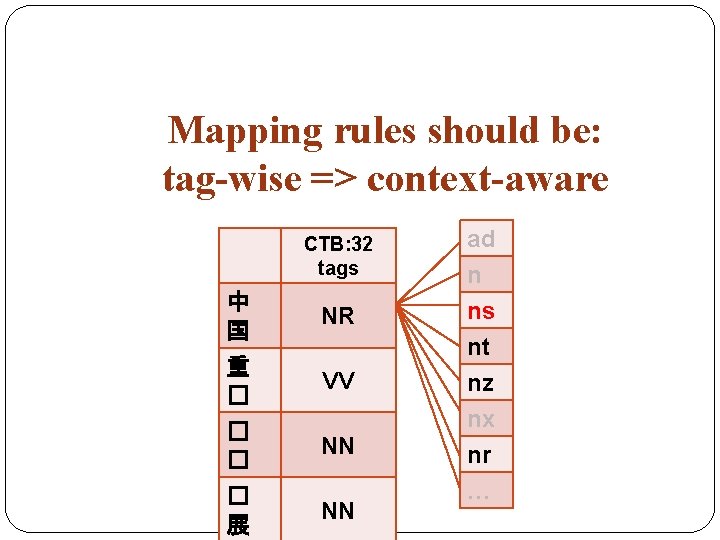
Mapping rules should be: tag-wise => context-aware CTB: 32 tags 中 国 NR 重 � VV � � � 展 NN NN ad n ns nt nz nx nr …
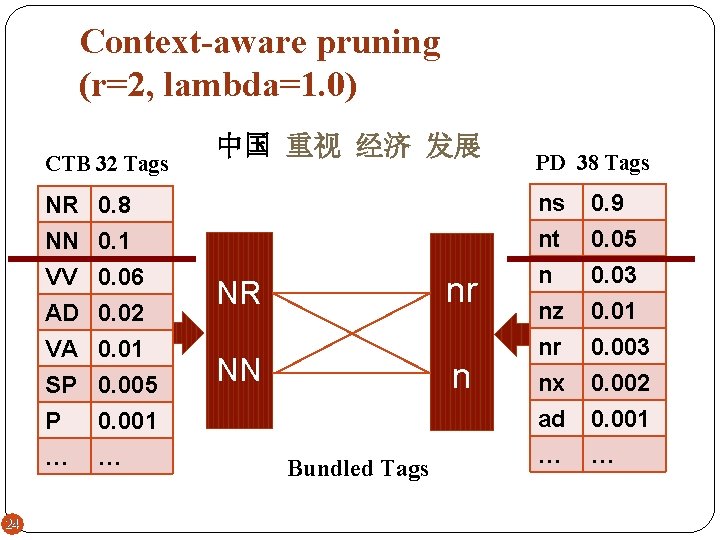
Context-aware pruning (r=2, lambda=1. 0) CTB 32 Tags 24 24 NR NN VV AD 0. 8 0. 1 0. 06 0. 02 VA SP P … 0. 01 0. 005 0. 001 … 中国 重视 经济 发展 nr NR NN n Bundled Tags PD 38 Tags ns nt n nz 0. 9 0. 05 0. 03 0. 01 nr nx ad … 0. 003 0. 002 0. 001 …
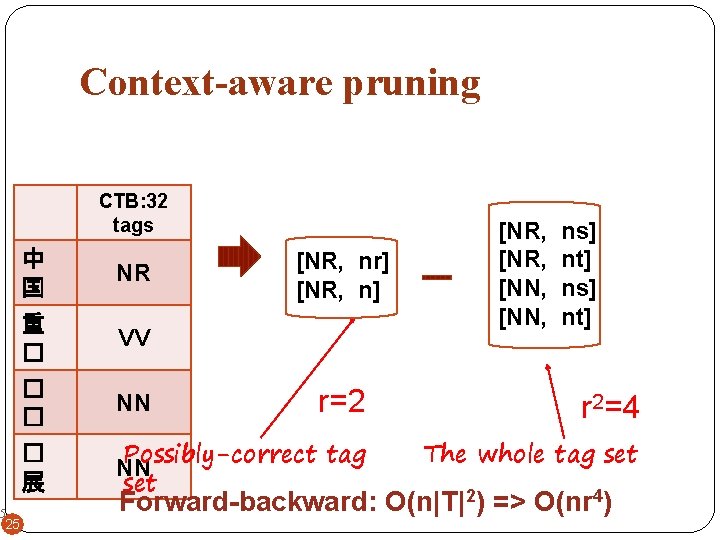
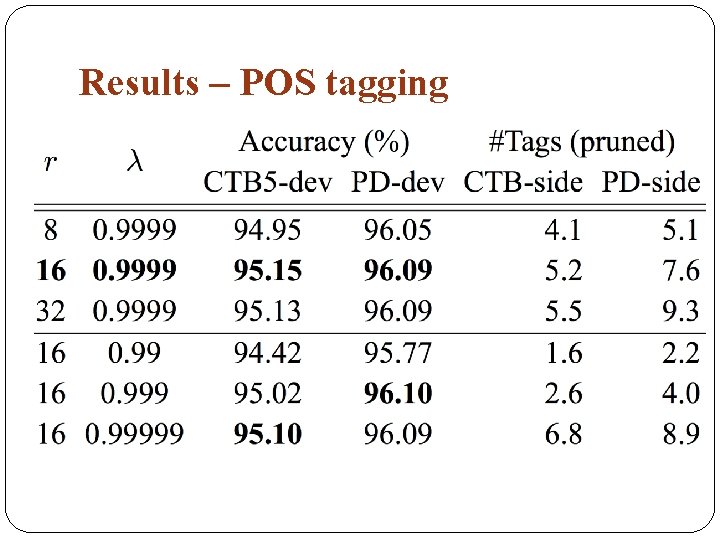
Context-aware pruning CTB: 32 tags 中 国 NR 重 � VV � � � 展 25 25 [NR, nr] [NR, n] [NR, [NN, ns] nt] r=2 r 2=4 Possibly-correct tag NN set The whole tag set NN Forward-backward: O(n|T|2) => O(nr 4)
How to perform context-aware pruning? Online vs. offline
Offline context-aware pruning
Results – POS tagging
Results – POS tagging
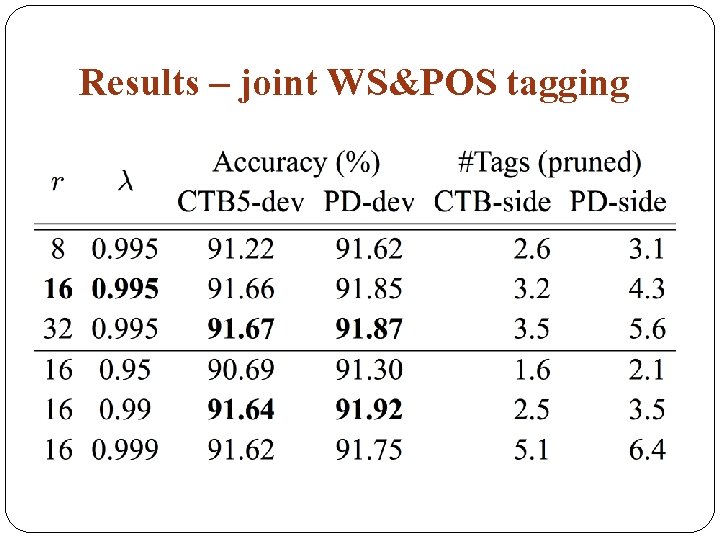
Results – joint WS&POS tagging
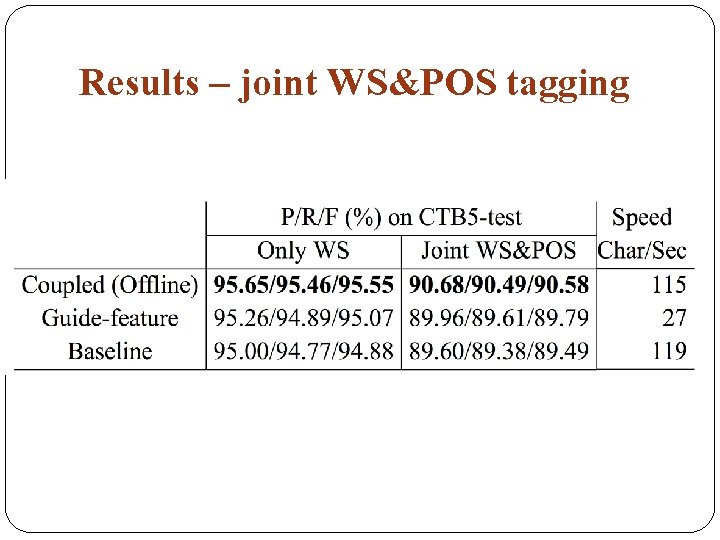
Results – joint WS&POS tagging
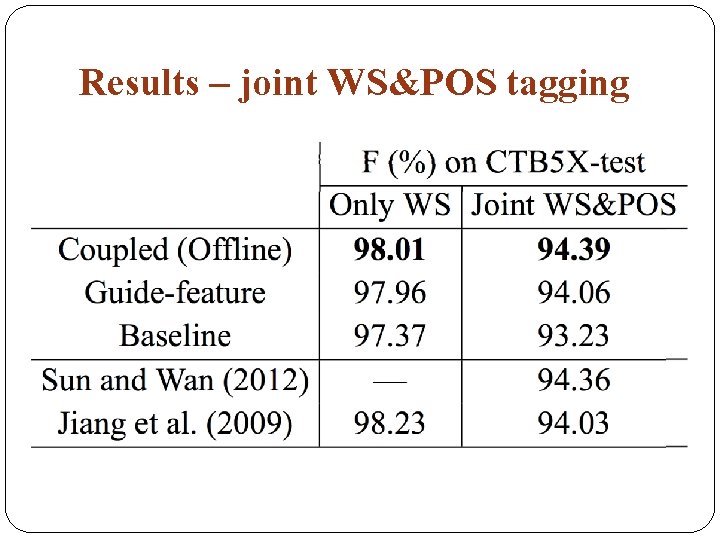
Results – joint WS&POS tagging
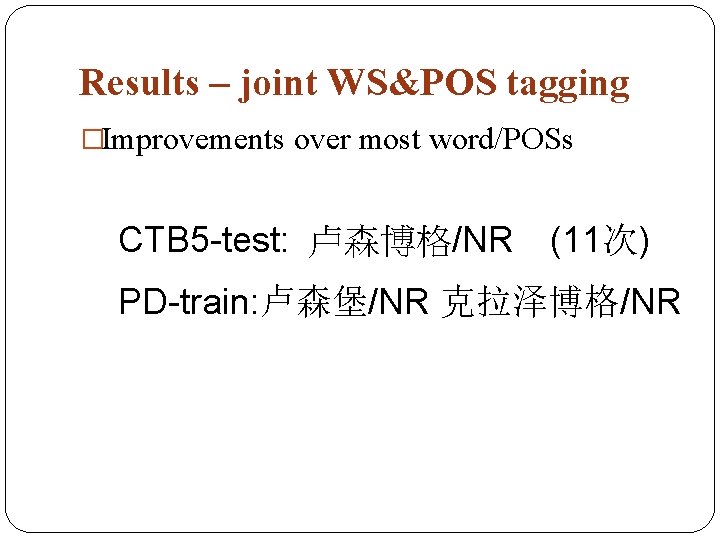
Results – joint WS&POS tagging �Improvements over most word/POSs CTB 5 -test: 卢森博格/NR (11次) PD-train: 卢森堡/NR 克拉泽博格/NR
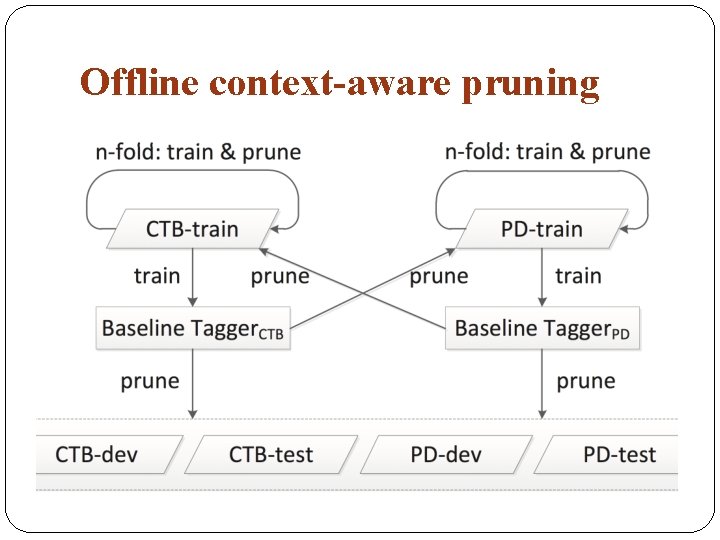
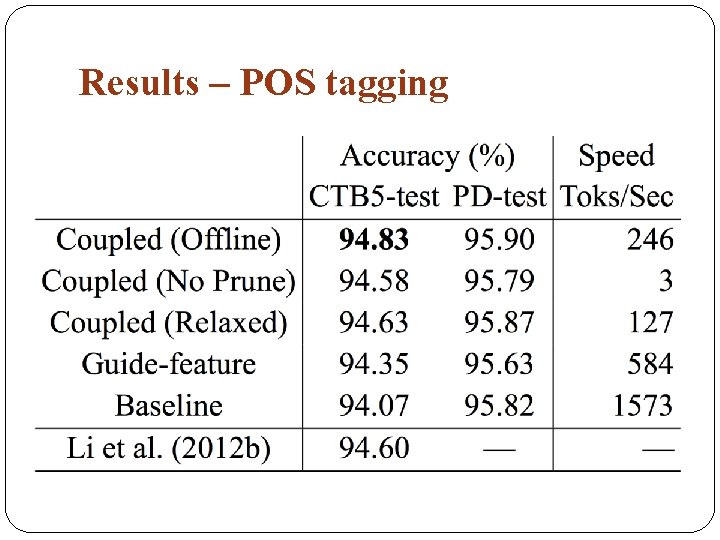
Conclusions �Propose context-aware pruning for coupled sequence labeling �Solve the efficiency �No need for manual mapping rules �The coupled approach is more generally applicable. �Empirical comparison of online vs. offline pruning, leading to very interesting findings
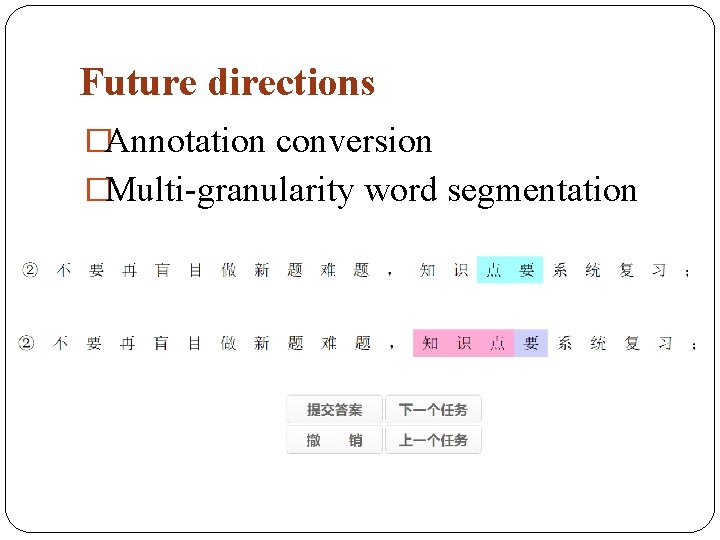
Future directions �Annotation conversion �Multi-granularity word segmentation
Acknowledgement �Meishan Zhang �Wenliang Chen �My students: Wei Chen, Ziwei Fan, Yue Zhang, …

Thanks for your time! Questions? Codes and all experimental settings are released at http: //hlt. suda. edu. cn/~zhli
The coupled model
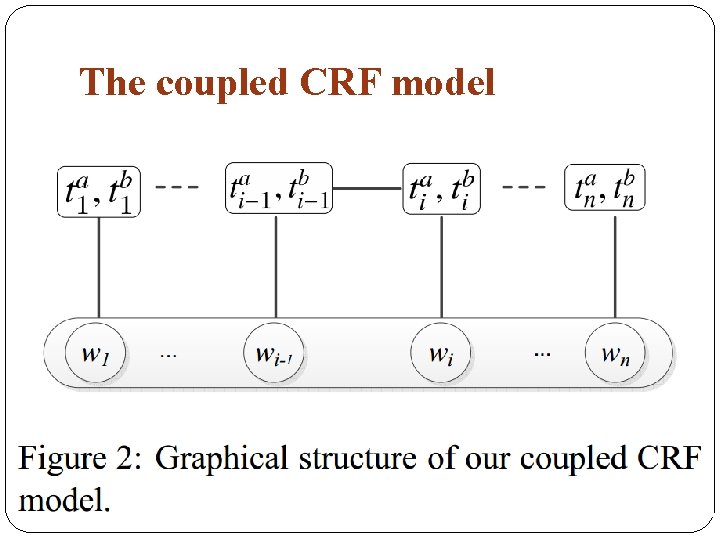
The coupled CRF model
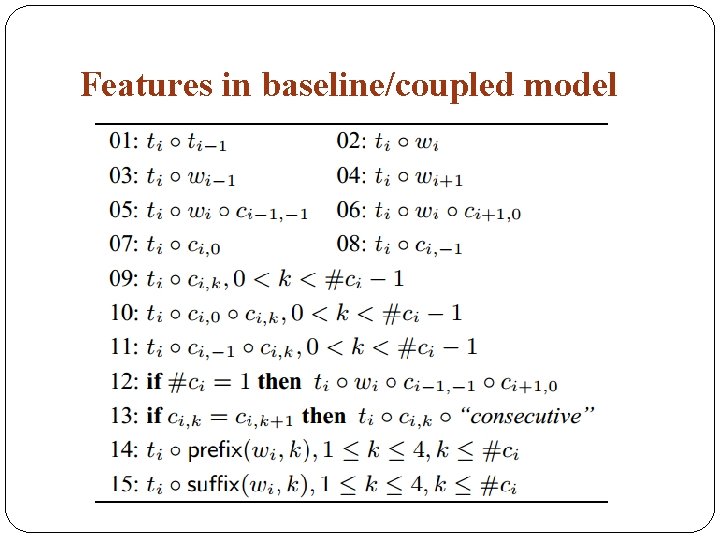
Features in baseline/coupled model
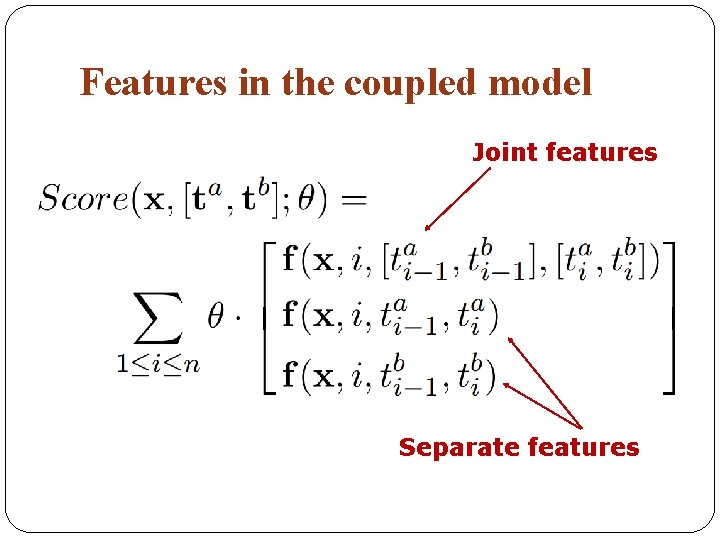
Features in the coupled model Joint features Separate features
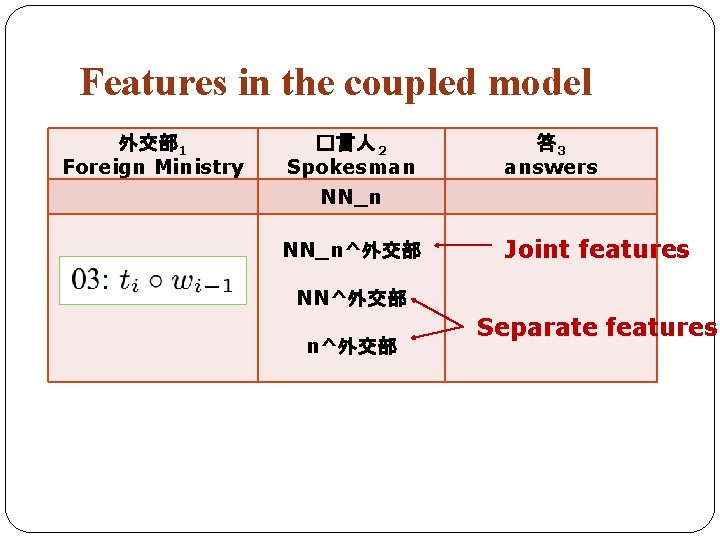
Features in the coupled model 外交部 1 Foreign Ministry �言人 2 Spokesman 答 3 answers NN_n^外交部 Joint features NN^外交部 n^外交部 Separate features
Advantages of our coupled model? �Both datasets are directly used for training. �Can use both joint and separate features. �Joint features capture the implicit correspondences between annotations. �Separate features function as back-off/base features.
Previous work (Qiu+ 13) �We are directly inspired by their work. �Differences from our work �Joint word segmentation and POS tagging �Linear model with perceptron-like training �Only explore separate features �Approximate decoding �Rely on manually designed mapping functions
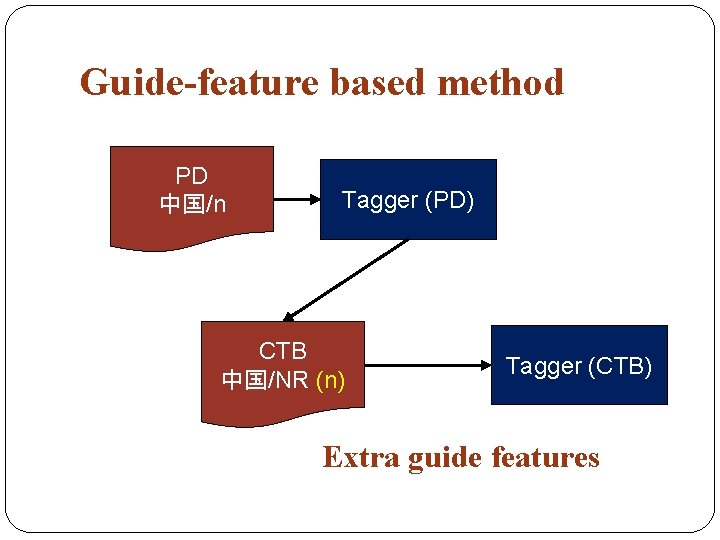
Guide-feature based method PD 中国/n Tagger (PD) CTB 中国/NR (n) Tagger (CTB) Extra guide features
The problem with guide-feature based method �The methodology is not elegant: twice training/decoding �The source data does not directly contribute to the training of the target tagger, and thus seems not fully exploited. The final target model does not directly learn from the source sentences.
- Slides: 46