
Fast and Furious Therapeutic Modular Mobility William Holder
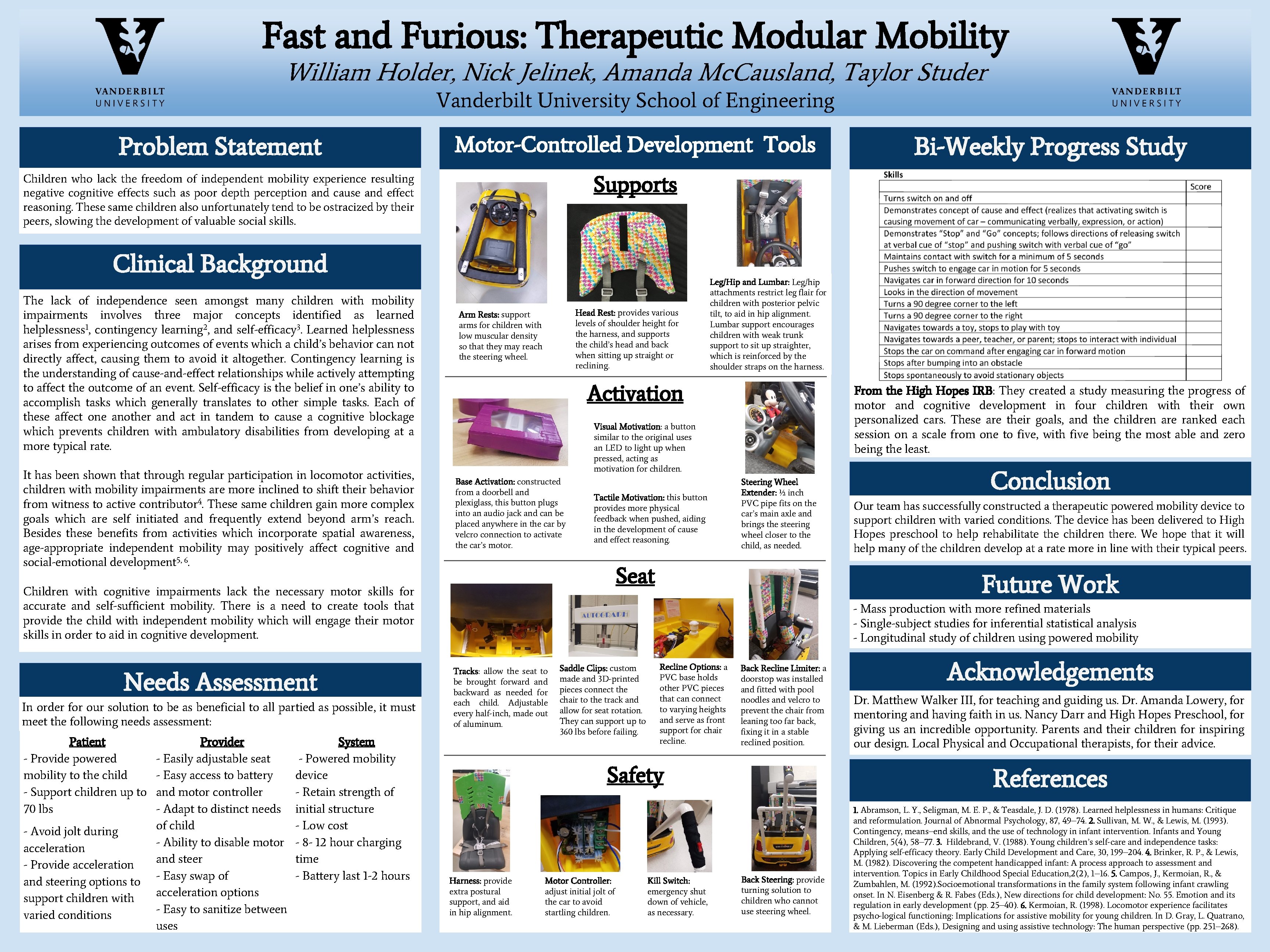
Fast and Furious: Therapeutic Modular Mobility William Holder, Nick Jelinek, Amanda Mc. Causland, Taylor Studer Vanderbilt University School of Engineering Problem Statement Motor-Controlled Development Tools Children who lack the freedom of independent mobility experience resulting negative cognitive effects such as poor depth perception and cause and effect reasoning. These same children also unfortunately tend to be ostracized by their peers, slowing the development of valuable social skills. Supports Clinical Background The lack of independence seen amongst many children with mobility impairments involves three major concepts identified as learned helplessness 1, contingency learning 2, and self-efficacy 3. Learned helplessness arises from experiencing outcomes of events which a child’s behavior can not directly affect, causing them to avoid it altogether. Contingency learning is the understanding of cause-and-effect relationships while actively attempting to affect the outcome of an event. Self-efficacy is the belief in one’s ability to accomplish tasks which generally translates to other simple tasks. Each of these affect one another and act in tandem to cause a cognitive blockage which prevents children with ambulatory disabilities from developing at a more typical rate. It has been shown that through regular participation in locomotor activities, children with mobility impairments are more inclined to shift their behavior from witness to active contributor 4. These same children gain more complex goals which are self initiated and frequently extend beyond arm’s reach. Besides these benefits from activities which incorporate spatial awareness, age-appropriate independent mobility may positively affect cognitive and social-emotional development 5, 6. Head Rest: provides various levels of shoulder height for the harness, and supports the child’s head and back when sitting up straight or reclining. Arm Rests: support arms for children with low muscular density so that they may reach the steering wheel. In order for our solution to be as beneficial to all partied as possible, it must meet the following needs assessment: Patient - Provide powered mobility to the child - Support children up to 70 lbs - Avoid jolt during acceleration - Provide acceleration and steering options to support children with varied conditions Provider - Easily adjustable seat - Easy access to battery and motor controller - Adapt to distinct needs of child - Ability to disable motor and steer - Easy swap of acceleration options - Easy to sanitize between uses System - Powered mobility device - Retain strength of initial structure - Low cost - 8 - 12 hour charging time - Battery last 1 -2 hours From the High Hopes IRB: They created a study measuring the progress of motor and cognitive development in four children with their own personalized cars. These are their goals, and the children are ranked each session on a scale from one to five, with five being the most able and zero being the least. Visual Motivation: a button similar to the original uses an LED to light up when pressed, acting as motivation for children. Tactile Motivation: this button provides more physical feedback when pushed, aiding in the development of cause and effect reasoning. Steering Wheel Extender: ½ inch PVC pipe fits on the car’s main axle and brings the steering wheel closer to the child, as needed. Seat Children with cognitive impairments lack the necessary motor skills for accurate and self-sufficient mobility. There is a need to create tools that provide the child with independent mobility which will engage their motor skills in order to aid in cognitive development. Needs Assessment Leg/Hip and Lumbar: Leg/hip attachments restrict leg flair for children with posterior pelvic tilt, to aid in hip alignment. Lumbar support encourages children with weak trunk support to sit up straighter, which is reinforced by the shoulder straps on the harness. Activation Base Activation: constructed from a doorbell and plexiglass, this button plugs into an audio jack and can be placed anywhere in the car by velcro connection to activate the car’s motor. Bi-Weekly Progress Study Conclusion Our team has successfully constructed a therapeutic powered mobility device to support children with varied conditions. The device has been delivered to High Hopes preschool to help rehabilitate the children there. We hope that it will help many of the children develop at a rate more in line with their typical peers. Future Work - Mass production with more refined materials - Single-subject studies for inferential statistical analysis - Longitudinal study of children using powered mobility Tracks: allow the seat to be brought forward and backward as needed for each child. Adjustable every half-inch, made out of aluminum. Saddle Clips: custom made and 3 D-printed pieces connect the chair to the track and allow for seat rotation. They can support up to 360 lbs before failing. Recline Options: a PVC base holds other PVC pieces that can connect to varying heights and serve as front support for chair recline. Back Recline Limiter: a doorstop was installed and fitted with pool noodles and velcro to prevent the chair from leaning too far back, fixing it in a stable reclined position. Safety Harness: provide extra postural support, and aid in hip alignment. Motor Controller: adjust initial jolt of the car to avoid startling children. Kill Switch: emergency shut down of vehicle, as necessary. Acknowledgements Dr. Matthew Walker III, for teaching and guiding us. Dr. Amanda Lowery, for mentoring and having faith in us. Nancy Darr and High Hopes Preschool, for giving us an incredible opportunity. Parents and their children for inspiring our design. Local Physical and Occupational therapists, for their advice. References Back Steering: provide turning solution to children who cannot use steering wheel. 1. Abramson, L. Y. , Seligman, M. E. P. , & Teasdale, J. D. (1978). Learned helplessness in humans: Critique and reformulation. Journal of Abnormal Psychology, 87, 49– 74. 2. Sullivan, M. W. , & Lewis, M. (1993). Contingency, means–end skills, and the use of technology in infant intervention. Infants and Young Children, 5(4), 58– 77. 3. Hildebrand, V. (1988). Young children’s self-care and independence tasks: Applying self-efficacy theory. Early Child Development and Care, 30, 199– 204. 4. Brinker, R. P. , & Lewis, M. (1982). Discovering the competent handicapped infant: A process approach to assessment and intervention. Topics in Early Childhood Special Education, 2(2), 1– 16. 5. Campos, J. , Kermoian, R. , & Zumbahlen, M. (1992). Socioemotional transformations in the family system following infant crawling onset. In N. Eisenberg & R. Fabes (Eds. ), New directions for child development: No. 55. Emotion and its regulation in early development (pp. 25– 40). 6. Kermoian, R. (1998). Locomotor experience facilitates psycho-logical functioning: Implications for assistive mobility for young children. In D. Gray, L. Quatrano, & M. Lieberman (Eds. ), Designing and using assistive technology: The human perspective (pp. 251– 268).
- Slides: 1