
Fast and Compact Retrieval Methods in Computer Vision


![Hierarchical K-Means [Nistér et al, CVPR’ 06] • K – branching factor • Time](https://slidetodoc.com/presentation_image_h2/a23c09616cb7342ddd32f8baf478aab6/image-27.jpg "Hierarchical K-Means [Nistér et al, CVPR’ 06] • K – branching factor • Time")
![Approximate k-means [Philbin et al, CVPR’ 07] • • HKM: 1. not the best](https://slidetodoc.com/presentation_image_h2/a23c09616cb7342ddd32f8baf478aab6/image-29.jpg "Approximate k-means [Philbin et al, CVPR’ 07] • • HKM: 1. not the best")

![Query expansion [Chum et al, ICCV’ 07] • What if augment the initialthe results](https://slidetodoc.com/presentation_image_h2/a23c09616cb7342ddd32f8baf478aab6/image-37.jpg "Query expansion [Chum et al, ICCV’ 07] • What if augment the initialthe results")
![Soft Assignment [Philbin et al, CVPR’ 08] • Try to capture the information for](https://slidetodoc.com/presentation_image_h2/a23c09616cb7342ddd32f8baf478aab6/image-41.jpg "Soft Assignment [Philbin et al, CVPR’ 08] • Try to capture the information for")
![Spatial Consistency Constraints [Chum et al, ICCV’ 07] T’ (6 dof) scale 1 T](https://slidetodoc.com/presentation_image_h2/a23c09616cb7342ddd32f8baf478aab6/image-47.jpg "Spatial Consistency Constraints [Chum et al, ICCV’ 07] T’ (6 dof) scale 1 T")
- Slides: 50
Fast and Compact Retrieval Methods in Computer Vision Rahul Garg Xiao Ling
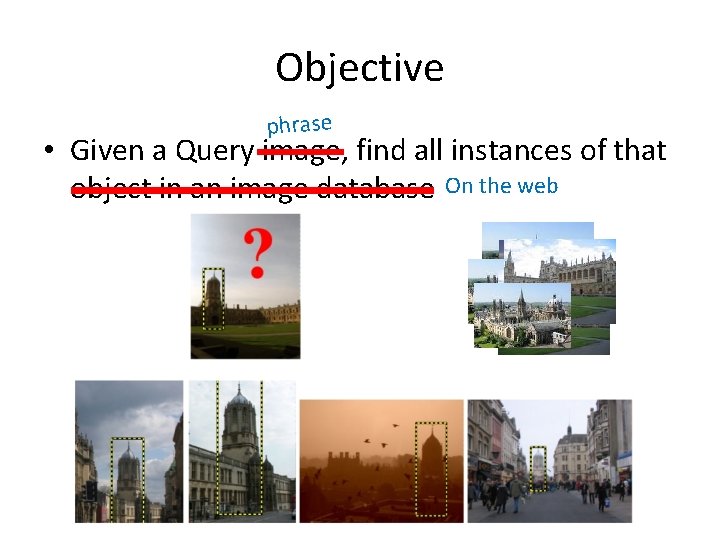
Objective phrase • Given a Query image, find all instances of that object in an image database On the web
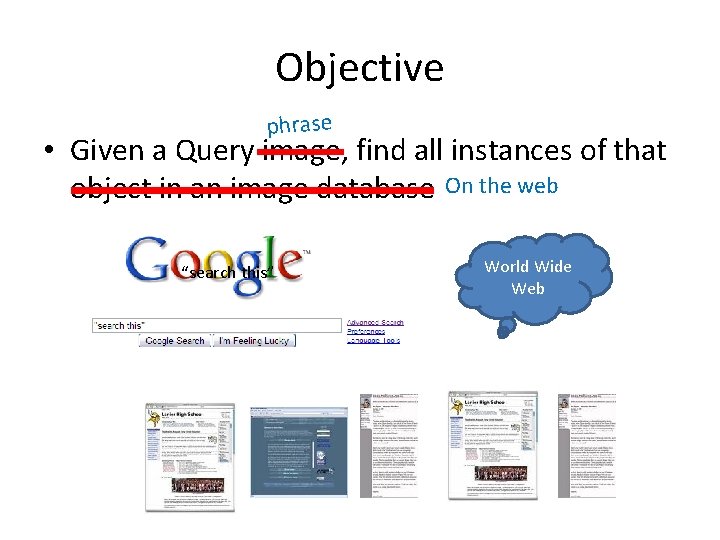
Objective phrase • Given a Query image, find all instances of that object in an image database On the web “search this” World Wide Web
Text Search Overview
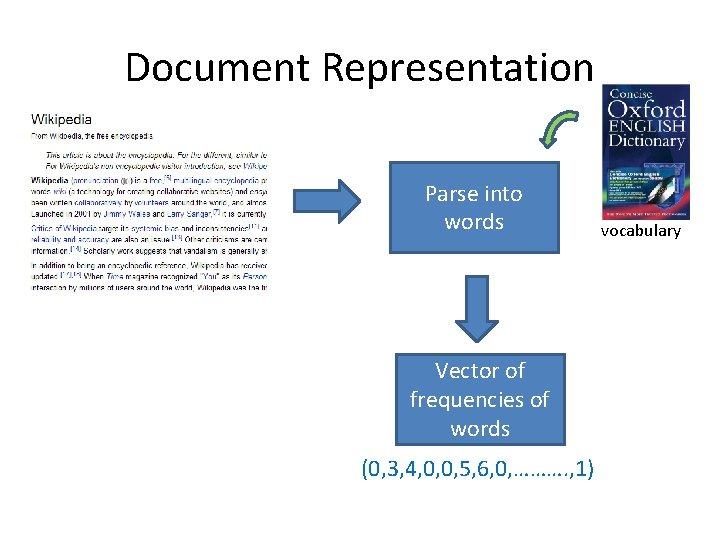
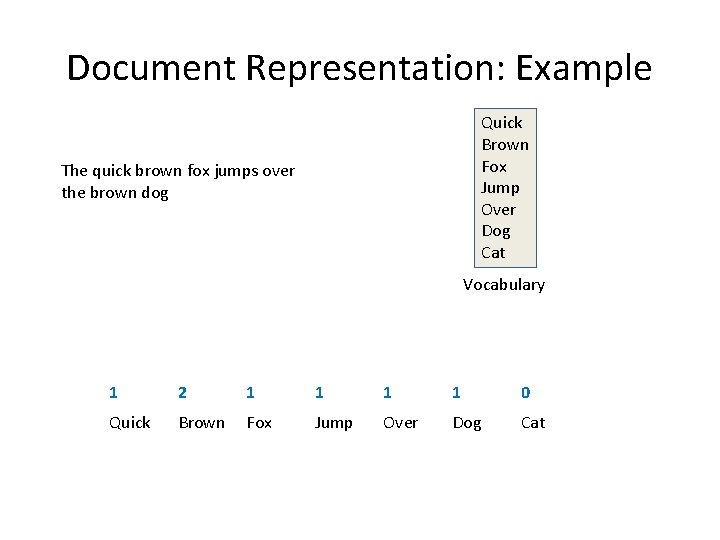
Document Representation Parse into words Vector of frequencies of words (0, 3, 4, 0, 0, 5, 6, 0, ………. , 1) vocabulary
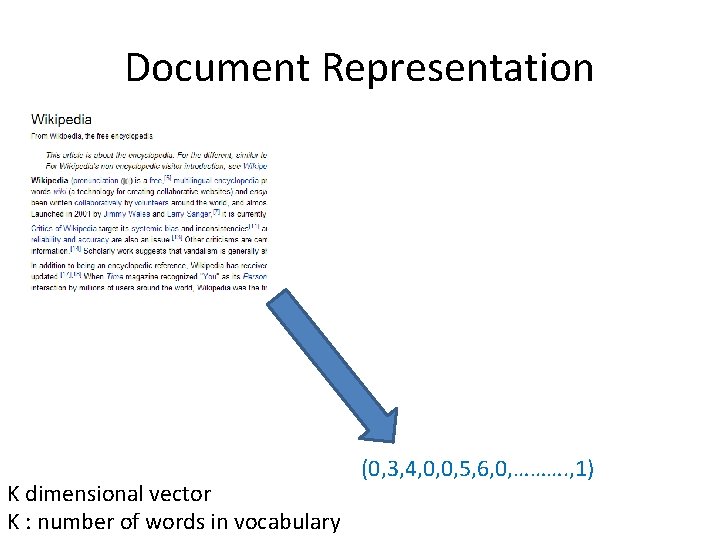
Document Representation K dimensional vector K : number of words in vocabulary (0, 3, 4, 0, 0, 5, 6, 0, ………. , 1)
Document Representation: Example Quick Brown Fox Jump Over Dog Cat The quick brown fox jumps over the brown dog Vocabulary 1 2 1 1 0 Quick Brown Fox Jump Over Dog Cat
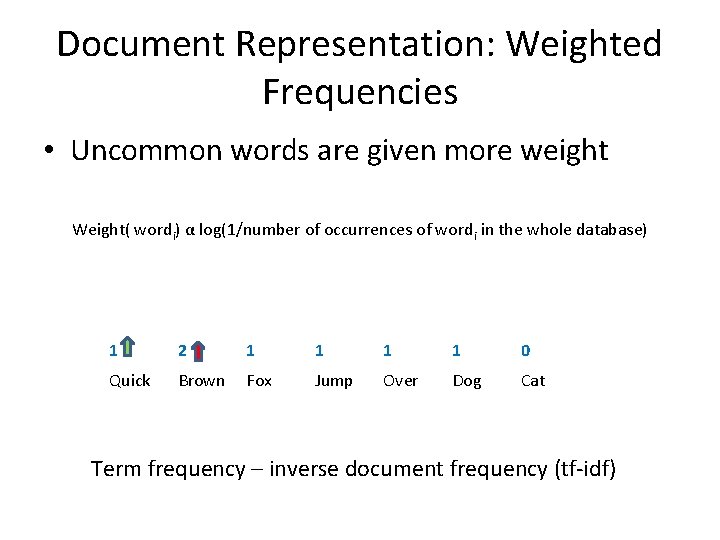
Document Representation: Weighted Frequencies • Uncommon words are given more weight Weight( wordi) α log(1/number of occurrences of wordi in the whole database) 1 2 1 1 0 Quick Brown Fox Jump Over Dog Cat Term frequency – inverse document frequency (tf-idf)
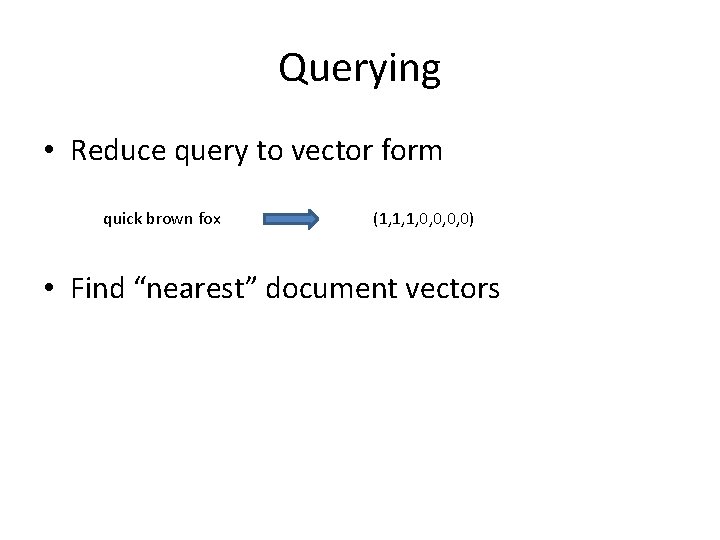
Querying • Reduce query to vector form quick brown fox (1, 1, 1, 0, 0) • Find “nearest” document vectors
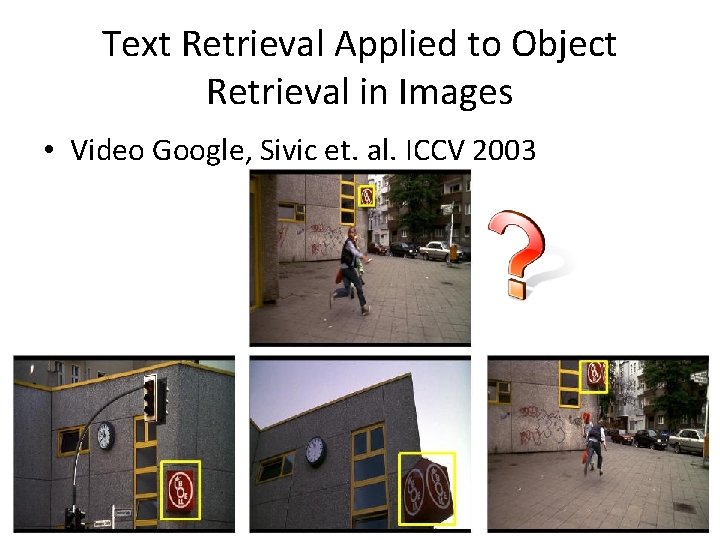
Text Retrieval Applied to Object Retrieval in Images • Video Google, Sivic et. al. ICCV 2003
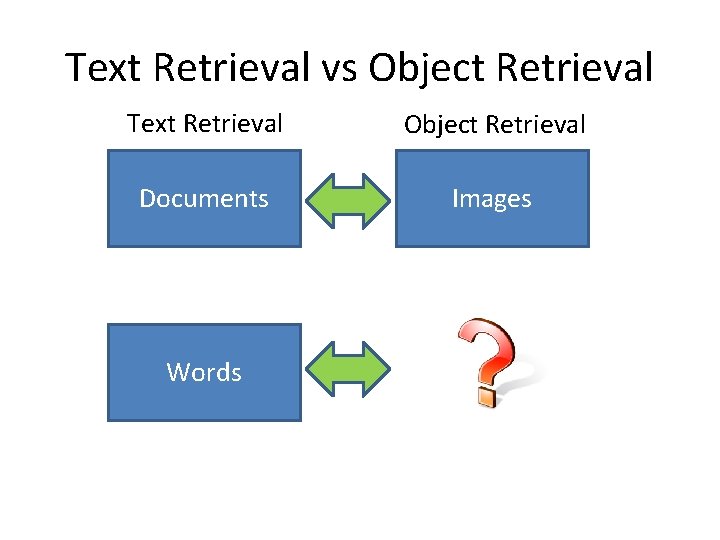
Text Retrieval vs Object Retrieval Text Retrieval Object Retrieval Documents Images Words
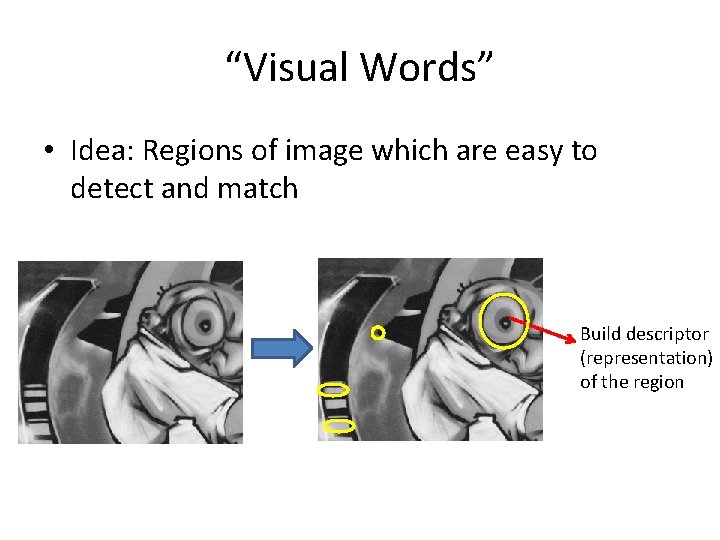
“Visual Words” • Idea: Regions of image which are easy to detect and match Build descriptor (representation) of the region
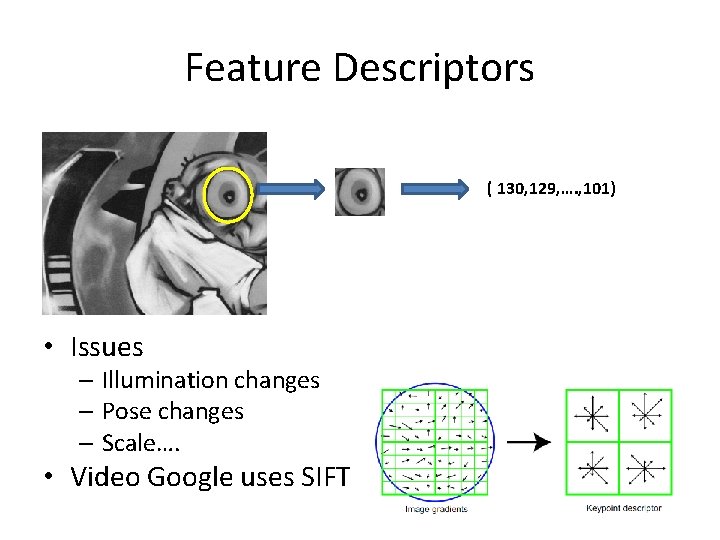
Feature Descriptors ( 130, 129, …. , 101) • Issues – Illumination changes – Pose changes – Scale…. • Video Google uses SIFT
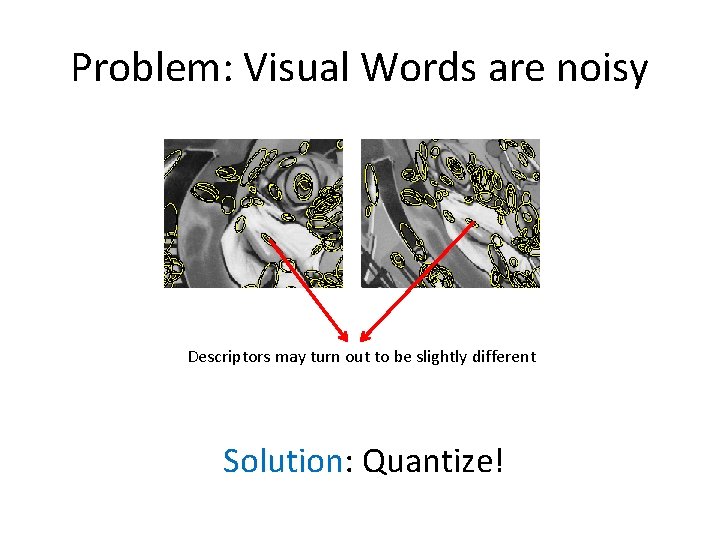
Problem: Visual Words are noisy Descriptors may turn out to be slightly different Solution: Quantize!
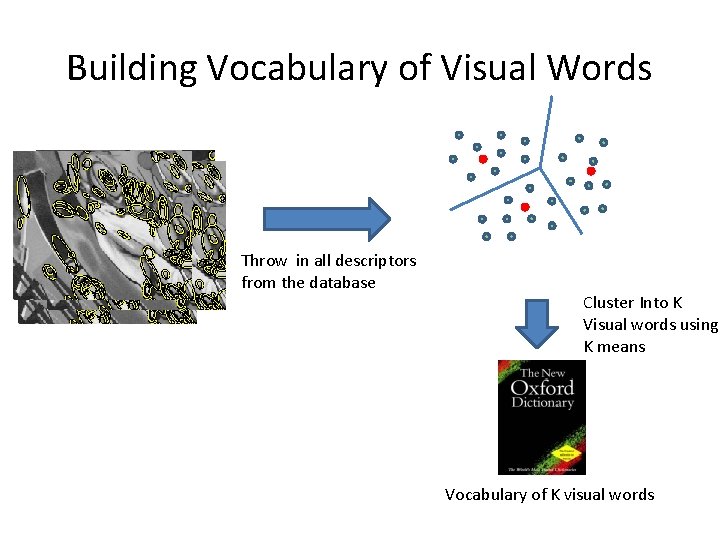
Building Vocabulary of Visual Words Throw in all descriptors from the database Cluster Into K Visual words using K means Vocabulary of K visual words
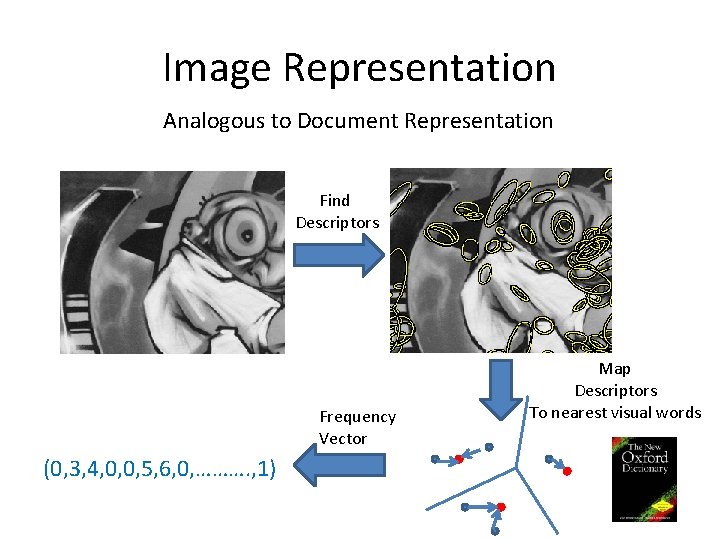
Image Representation Analogous to Document Representation Find Descriptors Frequency Vector (0, 3, 4, 0, 0, 5, 6, 0, ………. , 1) Map Descriptors To nearest visual words
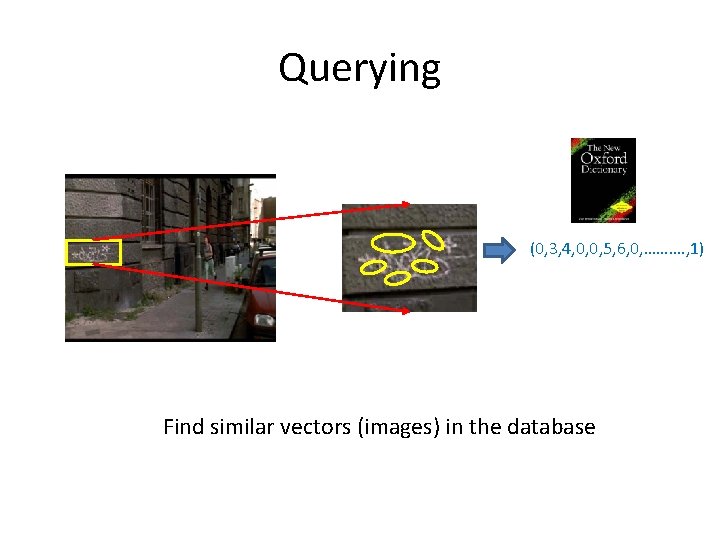
Querying (0, 3, 4, 0, 0, 5, 6, 0, ………. , 1) Find similar vectors (images) in the database
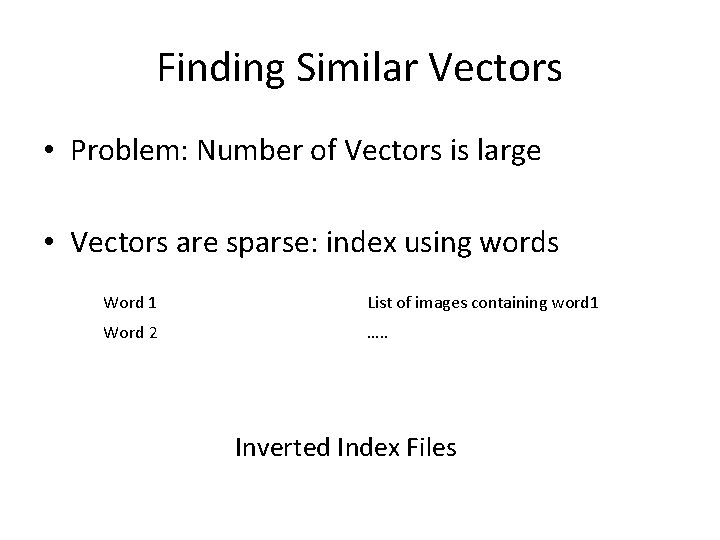
Finding Similar Vectors • Problem: Number of Vectors is large • Vectors are sparse: index using words Word 1 List of images containing word 1 Word 2 …. . Inverted Index Files
Stop Lists • Text Retrieval: Remove common words from vocabulary is, are, that, … • Analogy: Remove common visual words from vocabulary
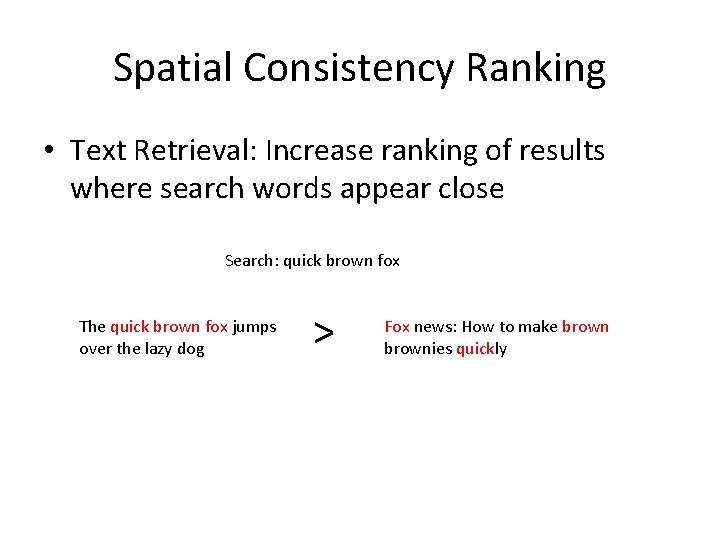
Spatial Consistency Ranking • Text Retrieval: Increase ranking of results where search words appear close Search: quick brown fox The quick brown fox jumps over the lazy dog > Fox news: How to make brownies quickly
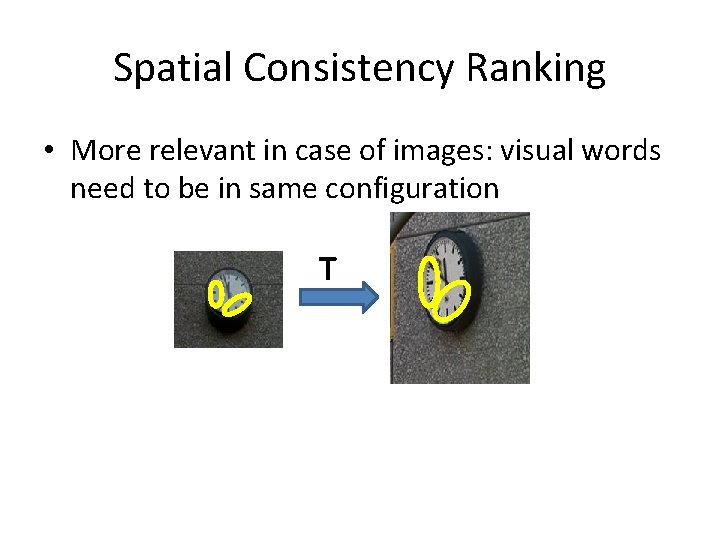
Spatial Consistency Ranking • More relevant in case of images: visual words need to be in same configuration T
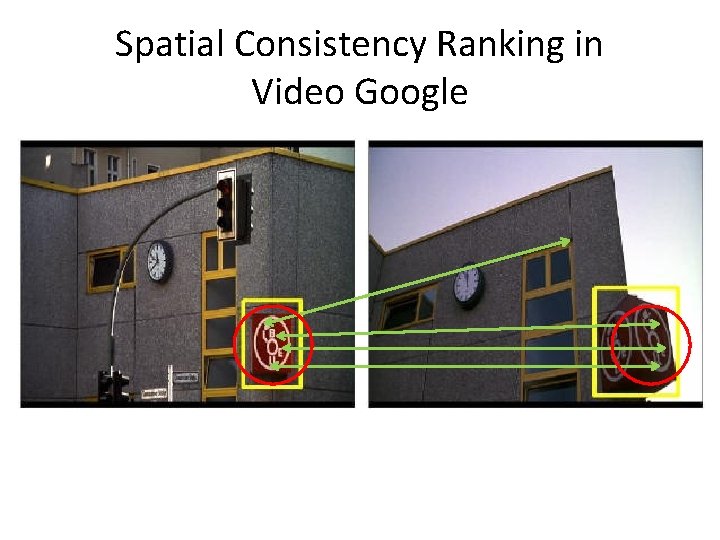
Spatial Consistency Ranking in Video Google
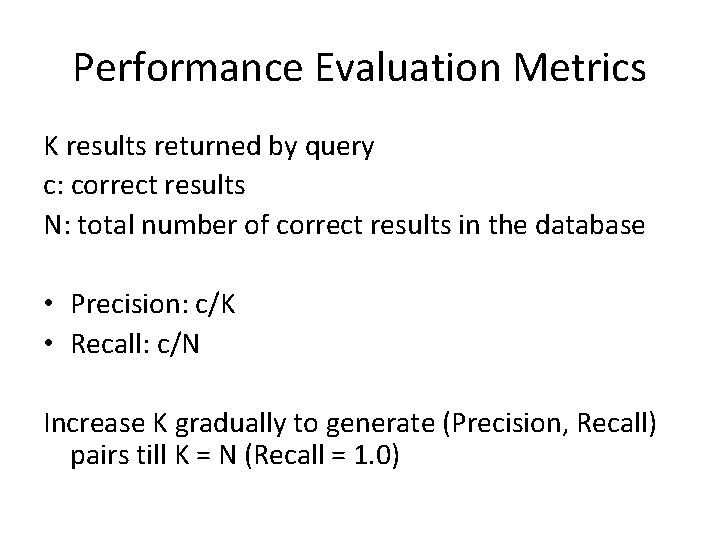
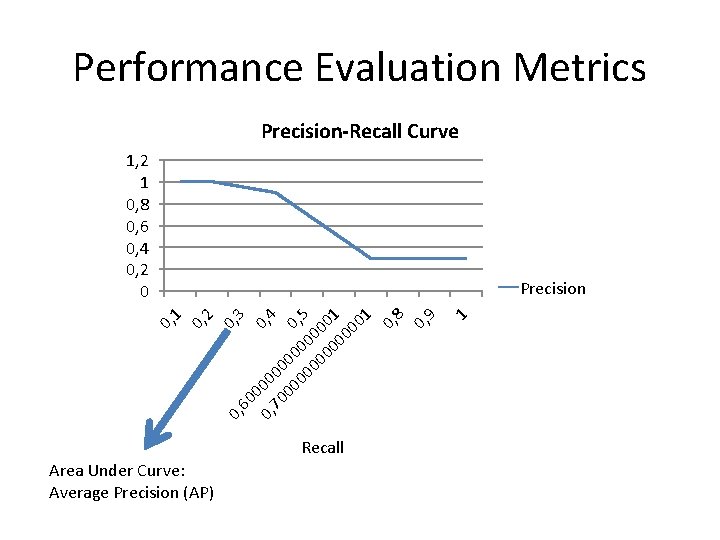
Performance Evaluation Metrics K results returned by query c: correct results N: total number of correct results in the database • Precision: c/K • Recall: c/N Increase K gradually to generate (Precision, Recall) pairs till K = N (Recall = 1. 0)
Performance Evaluation Metrics Precision-Recall Curve 1, 2 1 0, 8 0, 6 0, 4 0, 2 0 0, Recall Area Under Curve: Average Precision (AP) 9 0, 1 8 0, 3 0, 00 0, 0 4 70 00 00 , 5 00 00 00 01 00 00 1 2 0, 60 1 0, Precision
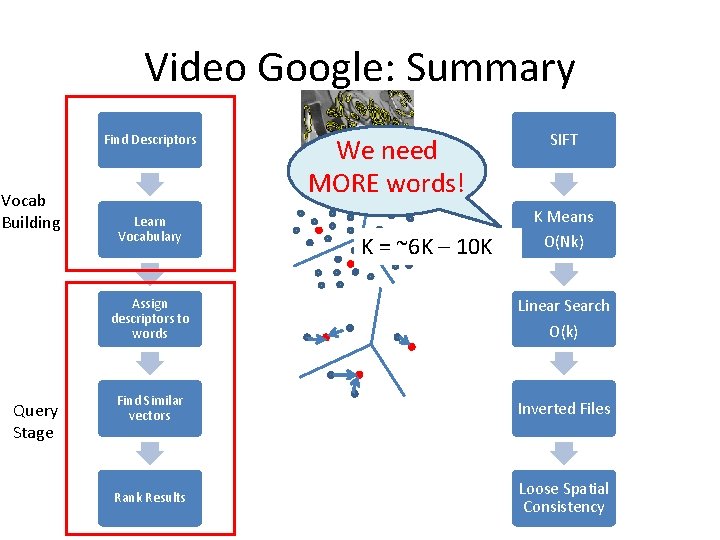
Video Google: Summary Find Descriptors Vocab Building Query Stage Learn Vocabulary We need MORE words! K = ~6 K – 10 K SIFT K Means O(Nk) Assign descriptors to words Linear Search O(k) Find Similar vectors Inverted Files Rank Results Loose Spatial Consistency
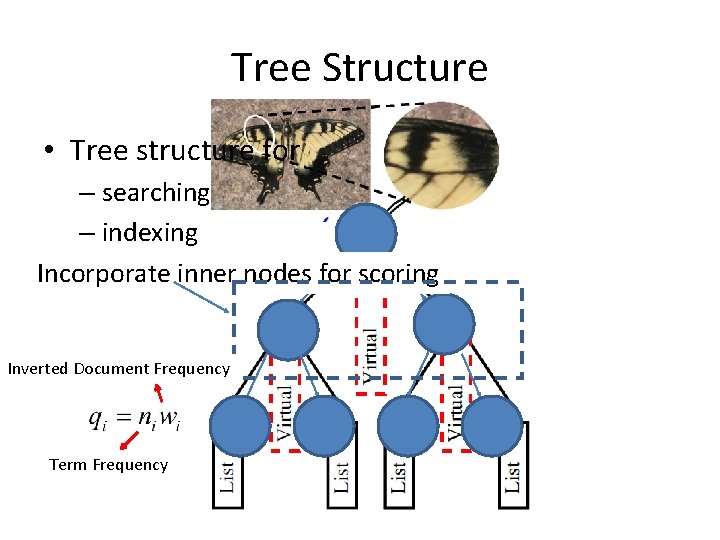
Tree Structure • Tree structure for – searching – indexing Incorporate inner nodes for scoring Inverted Document Frequency Term Frequency
Hierarchical K-Means [Nistér et al, CVPR’ 06] • K – branching factor • Time complexity: – O(N log (# of leaves)) for construction – O(log (# of leaves)) for searching • Cons: – Wrong nearest neighbors assignment – Suffer from bad initial clusters
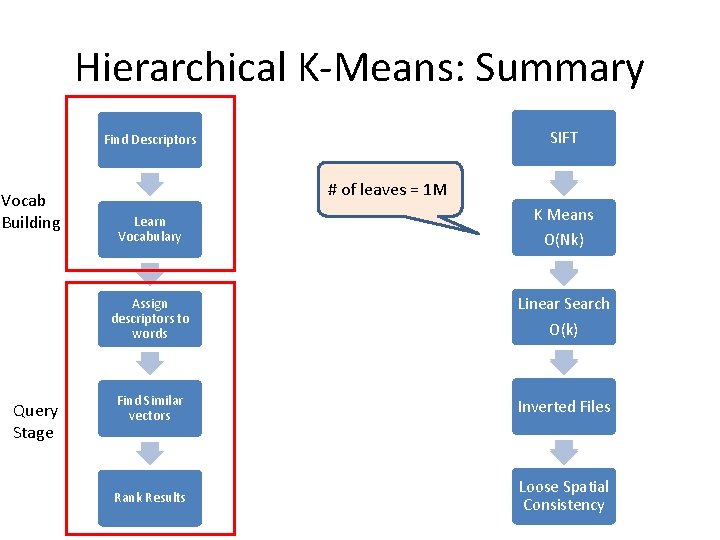
Hierarchical K-Means: Summary SIFT MSER. Find Descriptors Vocab Building Query Stage # of leaves = 1 M Learn Vocabulary K Means Hierarchical K Means O(N log(# of leaves)) O(Nk) Assign descriptors to words Linear Search along the path O(k log(# of leaves)) O(k) Find Similar vectors Each node has a Inverted Files Inverted File list Rank Results Loose Spatial No Spatial Consistency
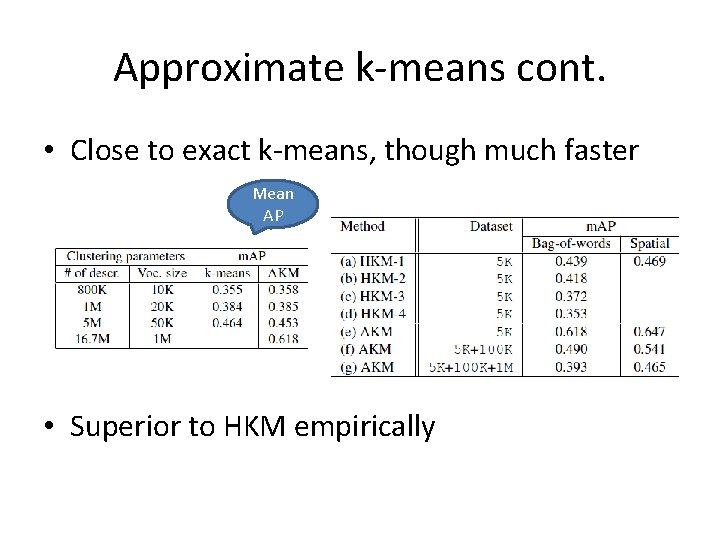
Approximate k-means [Philbin et al, CVPR’ 07] • • HKM: 1. not the best NN 2. error propagation Go back to flat vocabulary, but much faster Nearest neighbor search is the bottleneck Use kd-tree to speed up
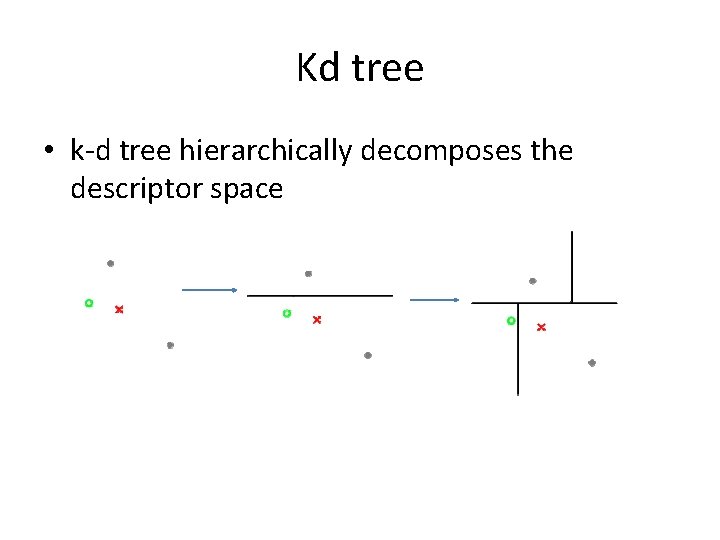
Kd tree • k-d tree hierarchically decomposes the descriptor space
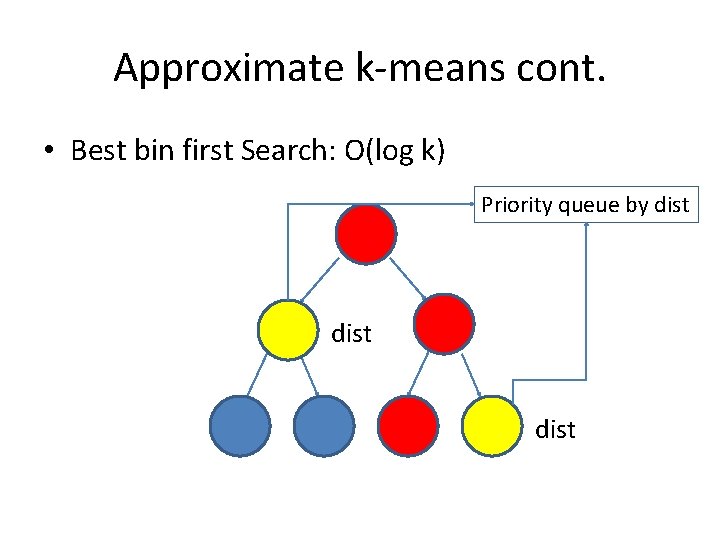
Approximate k-means cont. • Best bin first Search: O(log k) Priority queue by dist
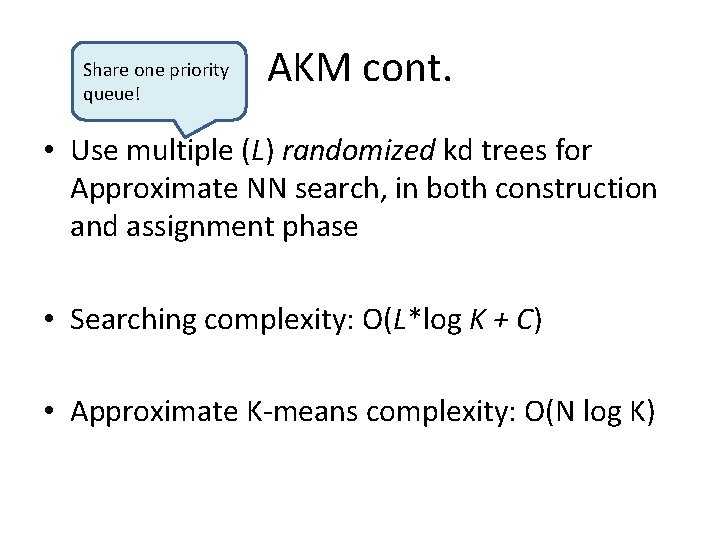
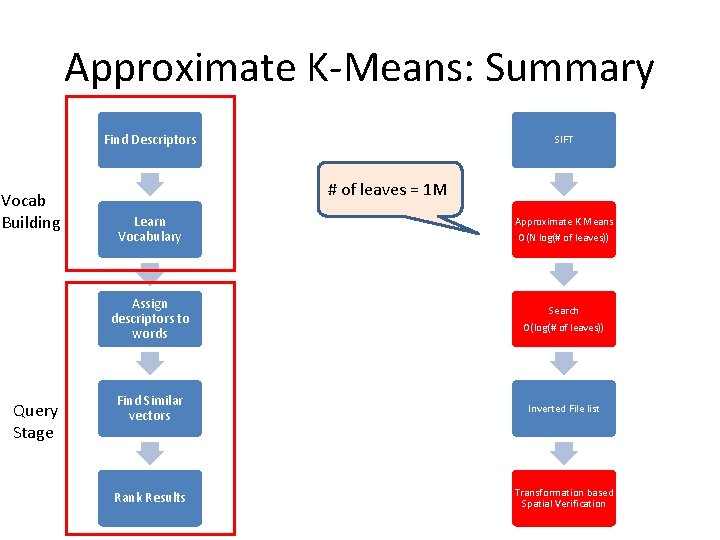
Share one priority queue! AKM cont. • Use multiple (L) randomized kd trees for Approximate NN search, in both construction and assignment phase • Searching complexity: O(L*log K + C) • Approximate K-means complexity: O(N log K)
Approximate k-means cont. • Close to exact k-means, though much faster Mean AP • Superior to HKM empirically
Approximate K-Means: Summary Find Descriptors Vocab Building Query Stage SIFT # of leaves = 1 M Learn Vocabulary Approximate K Means O(N log(# of leaves)) Assign descriptors to words Search O(log(# of leaves)) Find Similar vectors Inverted File list Rank Results Transformation based Spatial Verification
Low Recall • Feature detection and quantization – Even for the same object, different visual words! – Query region may not contain enough features NOISY! • Two possible solutions – Query expansion [Chum et al, ICCV’ 07] – Soft Assignment [Philbin et al, CVPR’ 08]
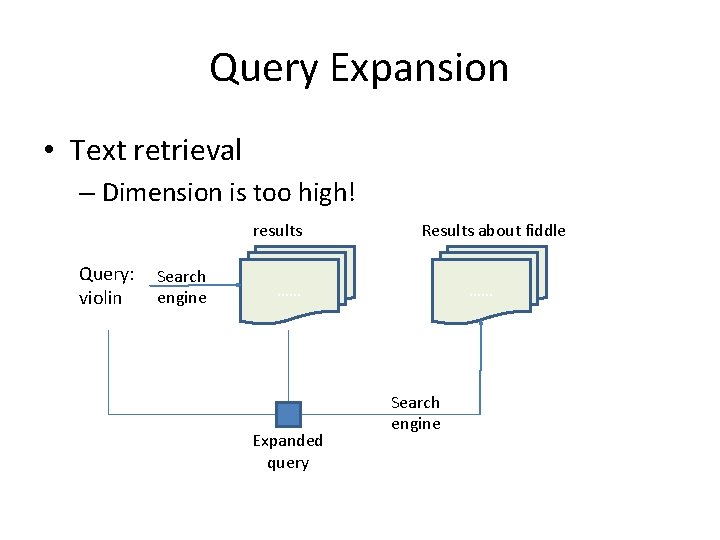
Query Expansion • Text retrieval – Dimension is too high! results Query: violin Search engine Results about fiddle …… Expanded query …… Search engine
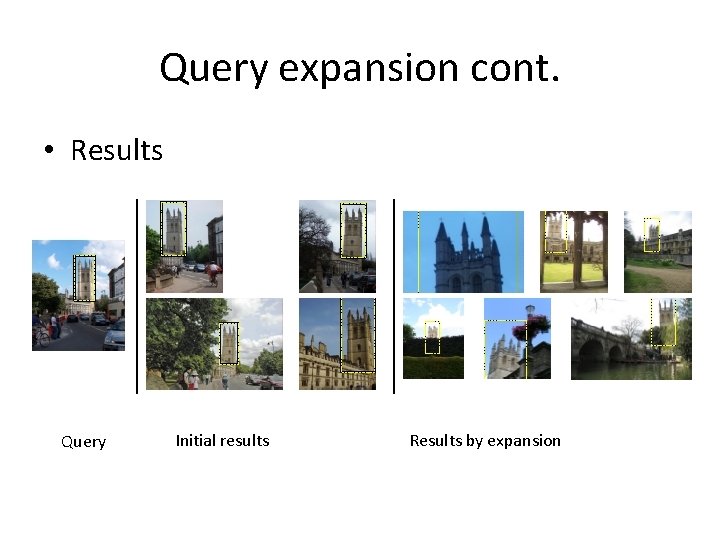
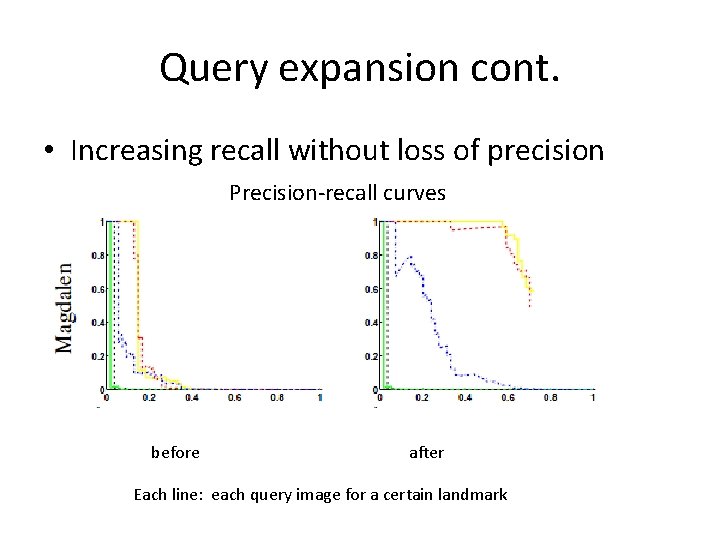
Query expansion [Chum et al, ICCV’ 07] • What if augment the initialthe results arewith poor? • Basic idea: query visual – Filter spatialmatching constraintsregion words frombyinitial Query initial result list … expanded query by new results averaging the results
Query expansion cont. • Results Query Initial results Results by expansion
Query expansion cont. • Increasing recall without loss of precision Precision-recall curves before after Each line: each query image for a certain landmark
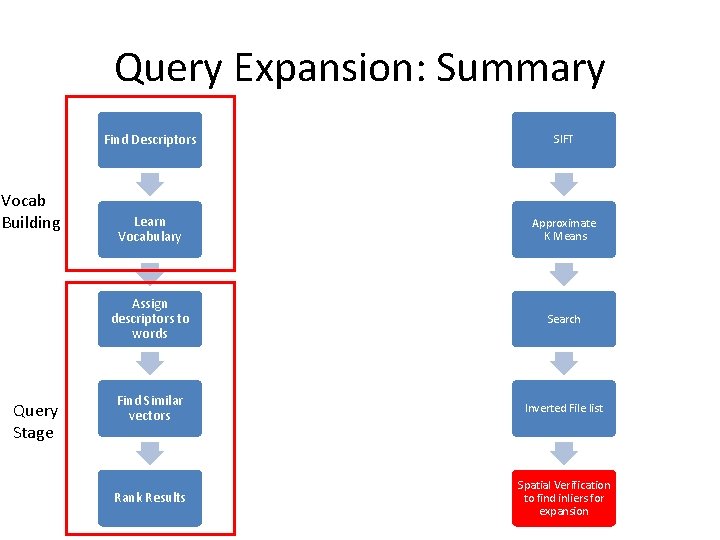
Query Expansion: Summary Vocab Building Query Stage Find Descriptors SIFT Learn Vocabulary Approximate K Means Assign descriptors to words Search Find Similar vectors Inverted File list Rank Results Spatial Verification to find inliers for expansion
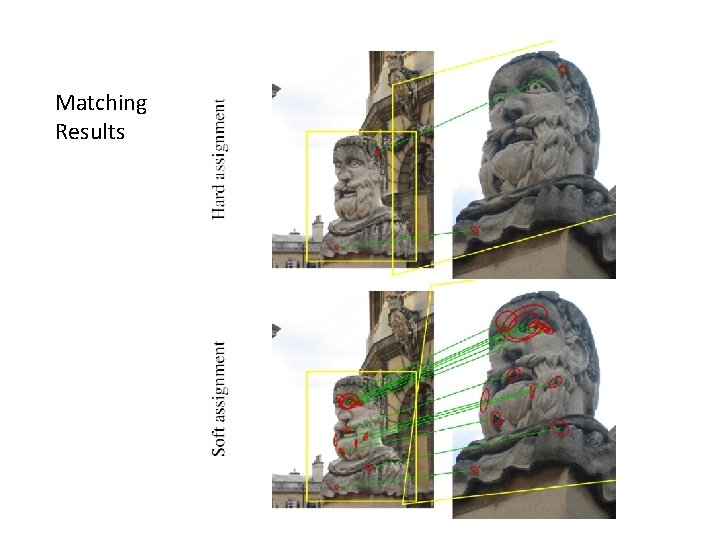
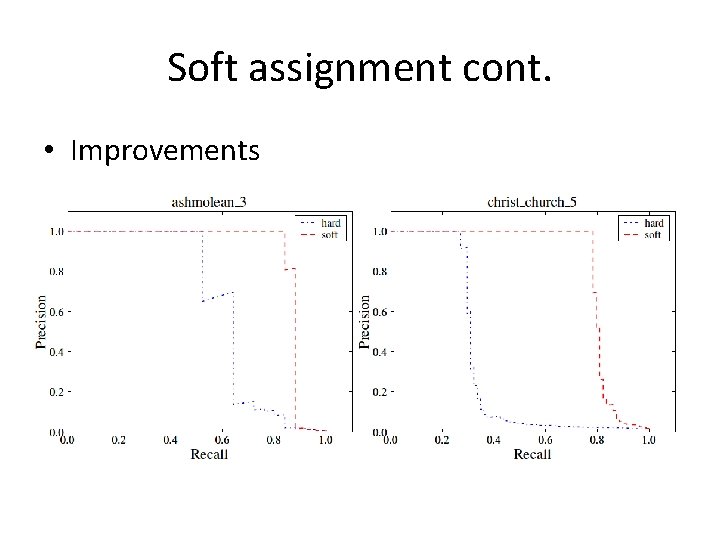
Soft Assignment [Philbin et al, CVPR’ 08] • Try to capture the information for the nearboundary features by associating one feature to several words • Intuition: includes “semantically” similar variants in the context of text retrieval • with denser image representation (thus more storage) tradeoff! • Can be applied to existing methods
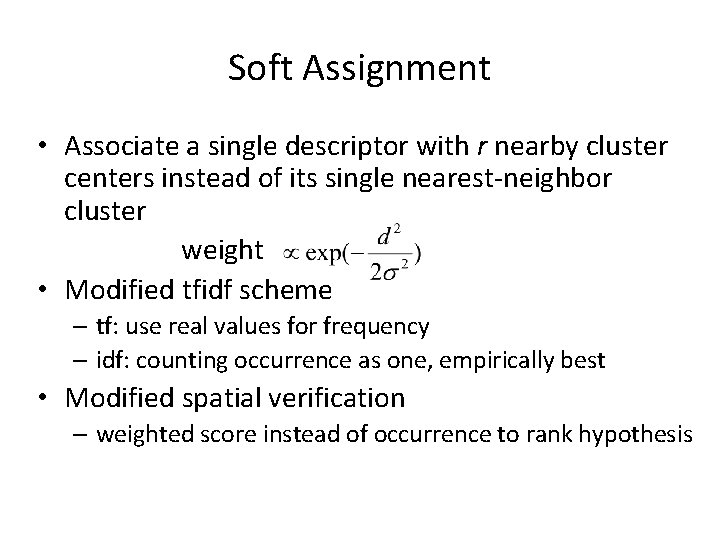
Soft Assignment • Associate a single descriptor with r nearby cluster centers instead of its single nearest-neighbor cluster weight • Modified tfidf scheme – tf: use real values for frequency – idf: counting occurrence as one, empirically best • Modified spatial verification – weighted score instead of occurrence to rank hypothesis
Matching Results
Soft assignment cont. • Improvements
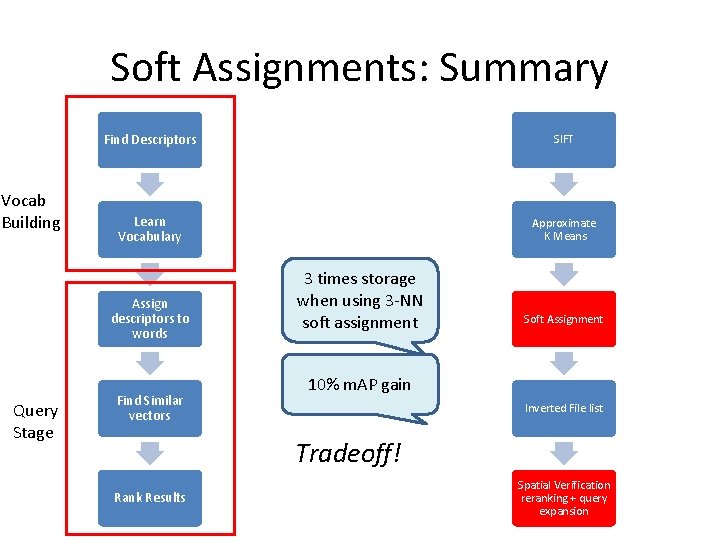
Soft Assignments: Summary Vocab Building Find Descriptors SIFT Learn Vocabulary Approximate K Means Assign descriptors to words Query Stage Find Similar vectors 3 times storage when using 3 -NN soft assignment Soft Assignment 10% m. AP gain Inverted File list Tradeoff! Rank Results Spatial Verification reranking + query expansion
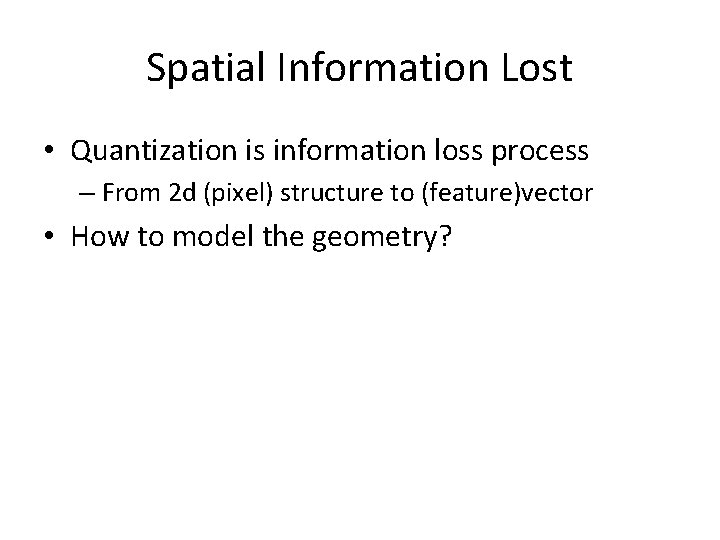
Spatial Information Lost • Quantization is information loss process – From 2 d (pixel) structure to (feature)vector • How to model the geometry?
Spatial Consistency Constraints [Chum et al, ICCV’ 07] T’ (6 dof) scale 1 T (3 dof) scale 2
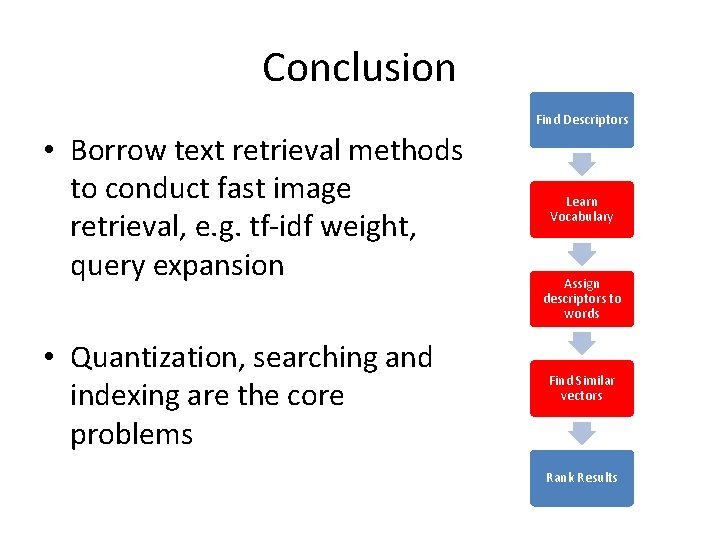
Conclusion Find Descriptors • Borrow text retrieval methods to conduct fast image retrieval, e. g. tf-idf weight, query expansion • Quantization, searching and indexing are the core problems Learn Vocabulary Assign descriptors to words Find Similar vectors Rank Results
Future Work • Goal: Web-scale retrieval system • Vocabulary to span the space of all images? • Spatial information in Indexing instead of Ranking
QA and comments?