
FASR Flare Science Lessons from the Nobeyama Radioheliograph
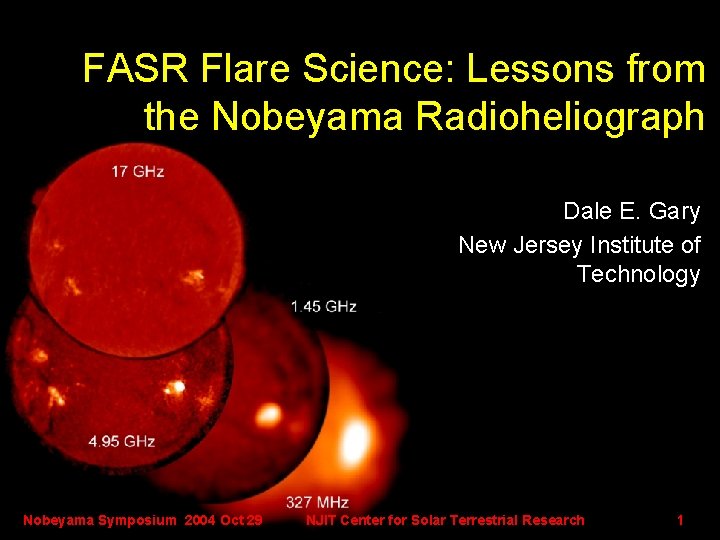
FASR Flare Science: Lessons from the Nobeyama Radioheliograph Dale E. Gary New Jersey Institute of Technology Nobeyama Symposium 2004 Oct 29 NJIT Center for Solar Terrestrial Research 1
Outline • The FASR concept • The No. RH specifications that are important for flare research • What we have learned about flares from Nobeyama • How FASR will use these lessons Nobeyama Symposium 2004 Oct 29 NJIT Center for Solar Terrestrial Research 2
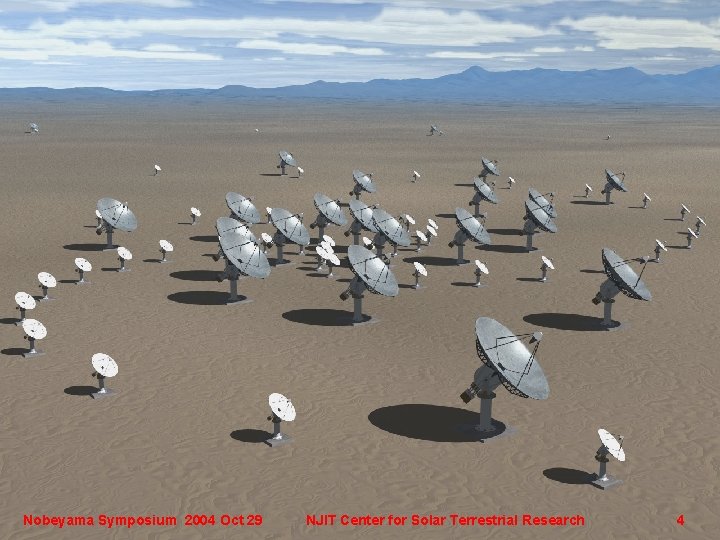
FASR Instrument (Antennas) Three arrays, 6 km baselines (<1” at 20 GHz) Array Designation Number of Antennas Frequency Range Antenna Size FASR-A ~100 2 -24 GHz 2 m ~60 0. 2 -3 GHz 6 m 20 -300 MHz Logdipole High Frequency Array FASR-B Low Frequency Array FASR-C Log-Periodic Dipole Array Nobeyama Symposium 2004 Oct 29 ~40 NJIT Center for Solar Terrestrial Research 3
Nobeyama Symposium 2004 Oct 29 NJIT Center for Solar Terrestrial Research 4
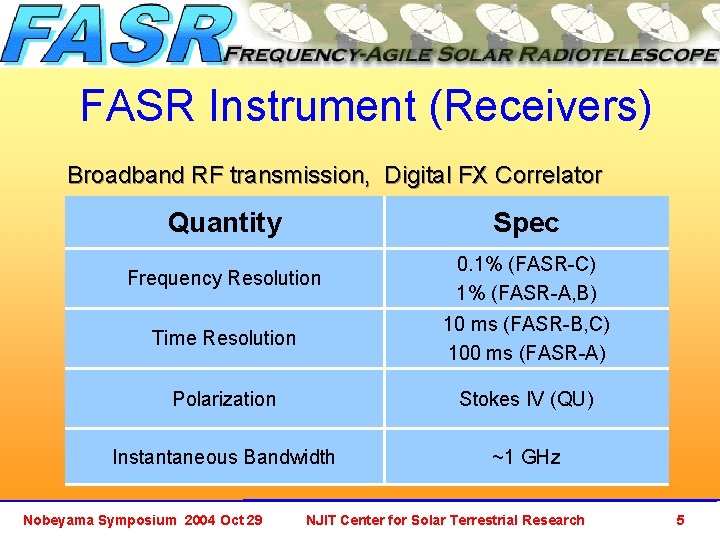
FASR Instrument (Receivers) Broadband RF transmission, Digital FX Correlator Quantity Spec Frequency Resolution 0. 1% (FASR-C) 1% (FASR-A, B) Time Resolution 10 ms (FASR-B, C) 100 ms (FASR-A) Polarization Stokes IV (QU) Instantaneous Bandwidth ~1 GHz Nobeyama Symposium 2004 Oct 29 NJIT Center for Solar Terrestrial Research 5
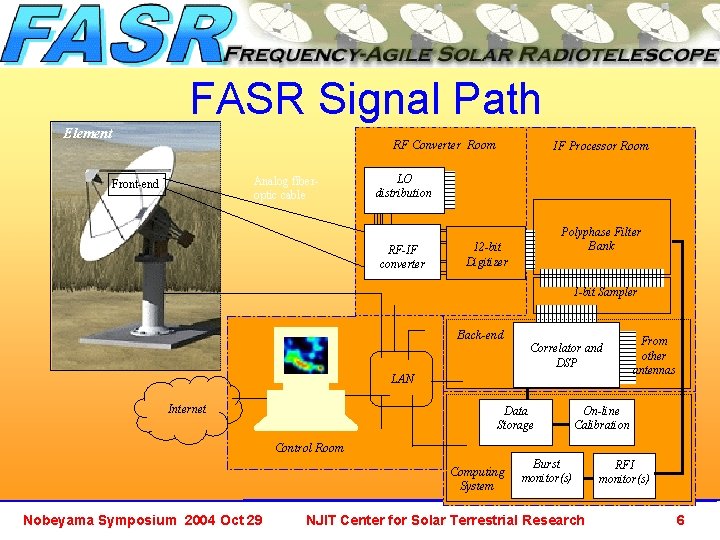
FASR Signal Path Element RF Converter Room Analog fiberoptic cable Front-end IF Processor Room LO distribution RF-IF converter Polyphase Filter Bank 12 -bit Digitizer 1 -bit Sampler Back-end Correlator and DSP LAN Internet Data Storage From other antennas On-line Calibration Control Room Computing System Nobeyama Symposium 2004 Oct 29 Burst monitor(s) NJIT Center for Solar Terrestrial Research RFI monitor(s) 6
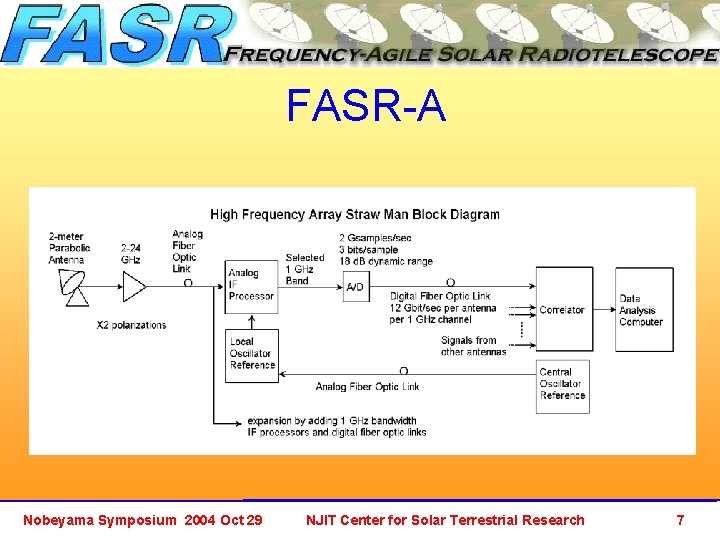
FASR-A Nobeyama Symposium 2004 Oct 29 NJIT Center for Solar Terrestrial Research 7
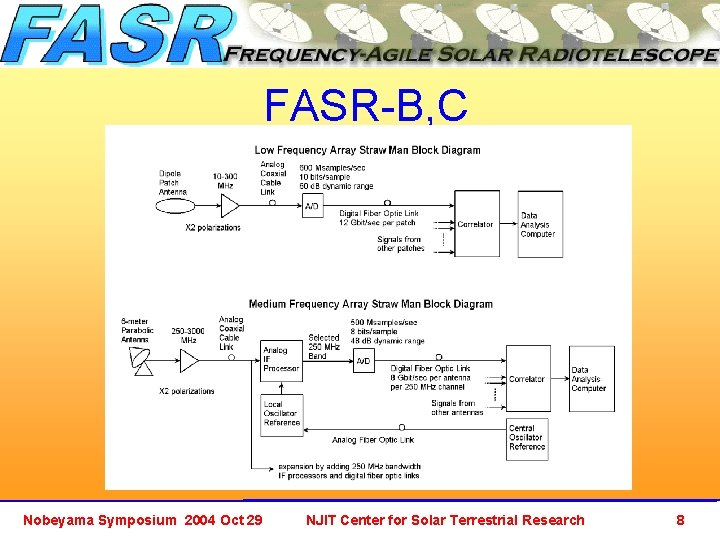
FASR-B, C Nobeyama Symposium 2004 Oct 29 NJIT Center for Solar Terrestrial Research 8
FASR Calibration • Must calibrate for ¡ ¡ ¡ Instrumental/environmental changes (e. g. temperature) Troposphere (weather) Ionosphere • Design will emphasize instrumental stability (no rapid secular changes) • Use satellite signals for initial instrument calibrations • Use cosmic sources for antenna (amp/phase) calibration before sunrise and after sunset • Use self-cal (plus noise cal source) during the day (FASR-A, B) • Use GPS measurements of TEC tip-tilt (FASR-B, C) Nobeyama Symposium 2004 Oct 29 NJIT Center for Solar Terrestrial Research 9
FASR Science Community Input • International Science Workshop, 2002 May, Green Bank, WV • Special session, 2002 American Astronomical Society meeting • Kluwer/Springer Astrophysics and Space Science Library Book: Solar & Space-Weather Radiophysics (17 chapters on all aspects of radiophysics of the Sun and inner heliosphere) Nobeyama Symposium 2004 Oct 29 NJIT Center for Solar Terrestrial Research 10
FASR Science Goals Designed to be the world’s premier solar radio facility for at least two decades after completion. Full capability to address a broad range of solar science: 1. Directly measure coronal magnetic fields 2. Image Coronal Mass Ejections (CMEs) 3. Obtain radio spectral diagnostics of particle acceleration / energy release, with excellent spatial and temporal resolution 4. Image radio emission from shocks (type II), electron beams (type III), and other bursts over heights 1 -2. 5 Rs 5. Construct 3 D solar atmospheric structure (T, B, ne) over a wide range of heights Nobeyama Symposium 2004 Oct 29 NJIT Center for Solar Terrestrial Research 11
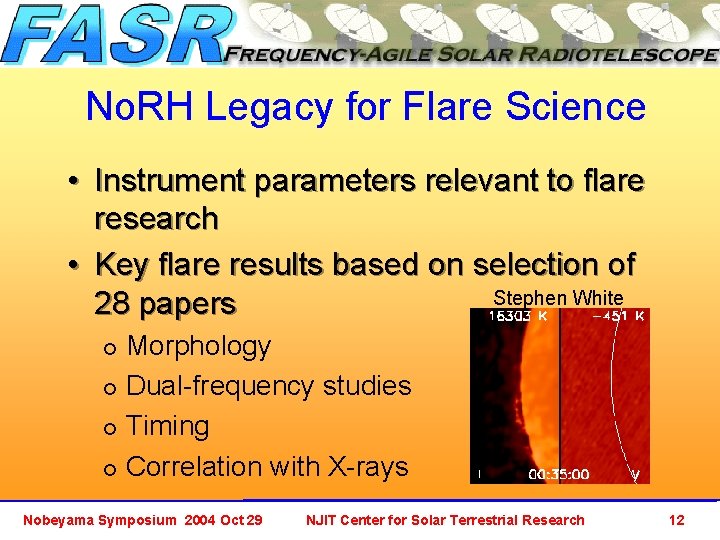
No. RH Legacy for Flare Science • Instrument parameters relevant to flare research • Key flare results based on selection of Stephen White 28 papers Morphology ¡ Dual-frequency studies ¡ Timing ¡ Correlation with X-rays ¡ Nobeyama Symposium 2004 Oct 29 NJIT Center for Solar Terrestrial Research 12
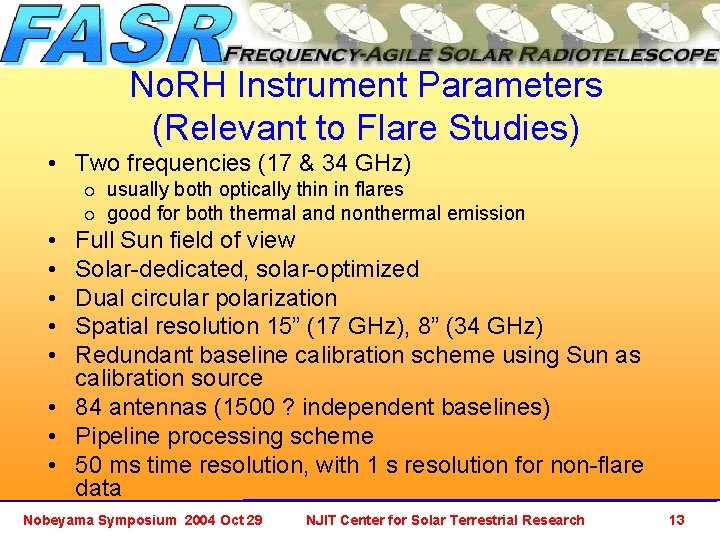
No. RH Instrument Parameters (Relevant to Flare Studies) • Two frequencies (17 & 34 GHz) ¡ ¡ usually both optically thin in flares good for both thermal and nonthermal emission • • • Full Sun field of view Solar-dedicated, solar-optimized Dual circular polarization Spatial resolution 15” (17 GHz), 8” (34 GHz) Redundant baseline calibration scheme using Sun as calibration source • 84 antennas (1500 ? independent baselines) • Pipeline processing scheme • 50 ms time resolution, with 1 s resolution for non-flare data Nobeyama Symposium 2004 Oct 29 NJIT Center for Solar Terrestrial Research 13
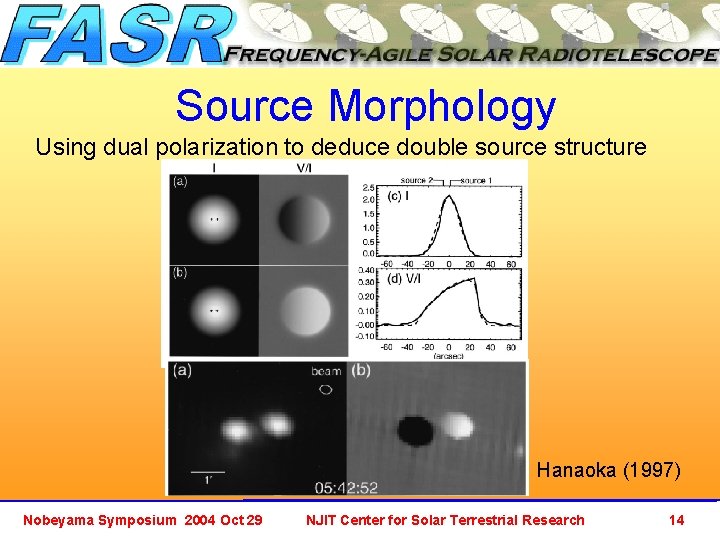
Source Morphology Using dual polarization to deduce double source structure Hanaoka (1997) Nobeyama Symposium 2004 Oct 29 NJIT Center for Solar Terrestrial Research 14
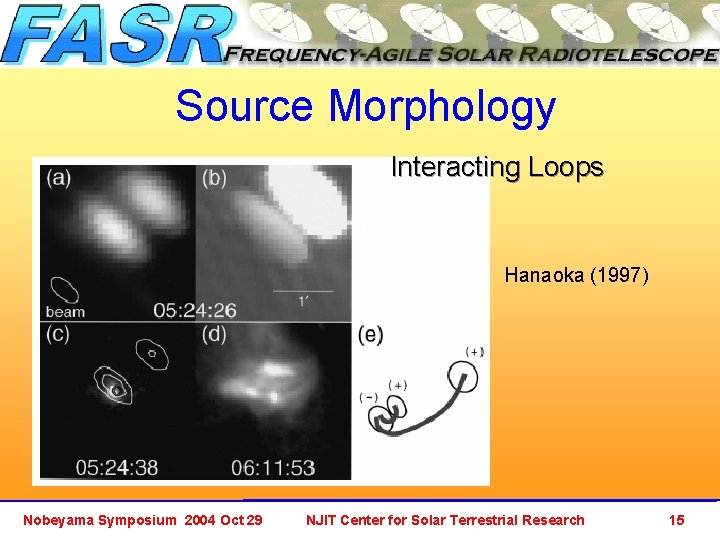
Source Morphology Interacting Loops Hanaoka (1997) Nobeyama Symposium 2004 Oct 29 NJIT Center for Solar Terrestrial Research 15
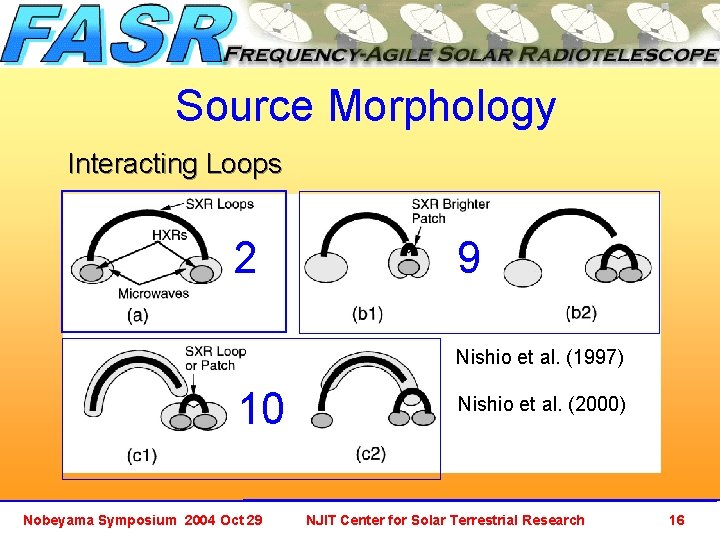
Source Morphology Interacting Loops 2 9 Nishio et al. (1997) 10 Nobeyama Symposium 2004 Oct 29 Nishio et al. (2000) NJIT Center for Solar Terrestrial Research 16
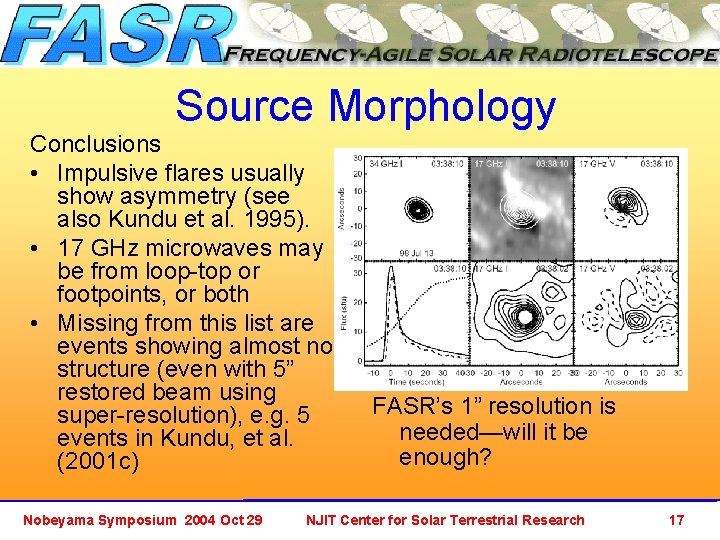
Source Morphology Conclusions • Impulsive flares usually show asymmetry (see also Kundu et al. 1995). • 17 GHz microwaves may be from loop-top or footpoints, or both • Missing from this list are events showing almost no structure (even with 5” restored beam using super-resolution), e. g. 5 events in Kundu, et al. (2001 c) Nobeyama Symposium 2004 Oct 29 FASR’s 1” resolution is needed—will it be enough? NJIT Center for Solar Terrestrial Research 17
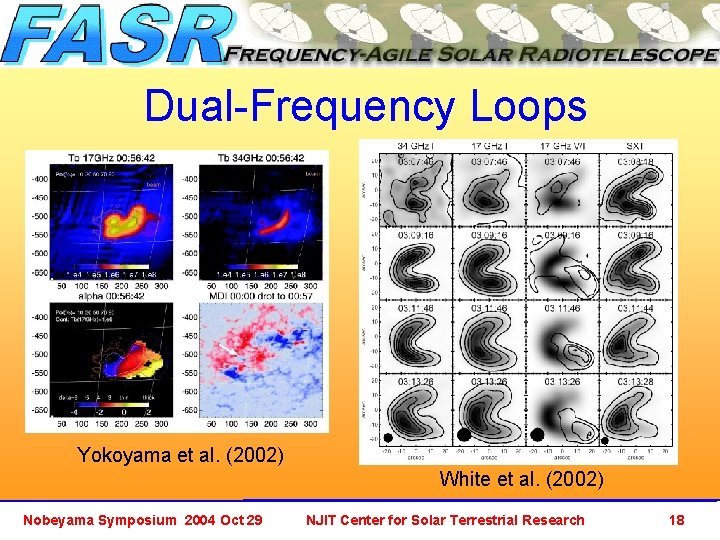
Dual-Frequency Loops Yokoyama et al. (2002) White et al. (2002) Nobeyama Symposium 2004 Oct 29 NJIT Center for Solar Terrestrial Research 18
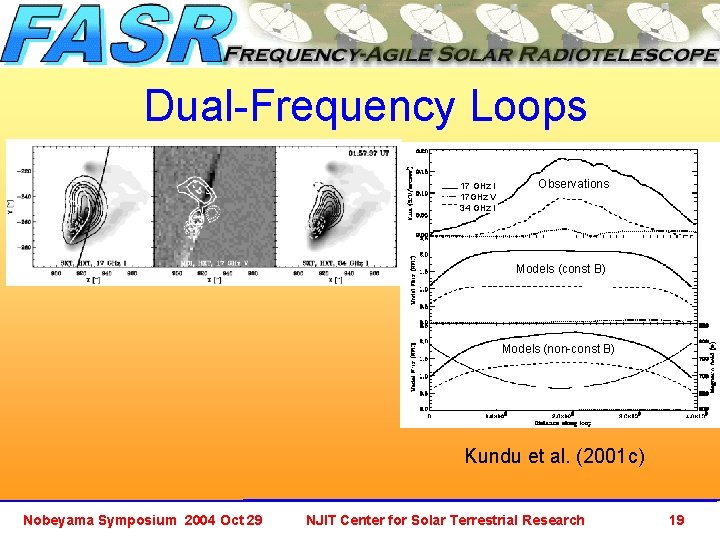
Dual-Frequency Loops 17 GHz I 17 GHz V 34 GHz I Observations Models (const B) Models (non-const B) Kundu et al. (2001 c) Nobeyama Symposium 2004 Oct 29 NJIT Center for Solar Terrestrial Research 19
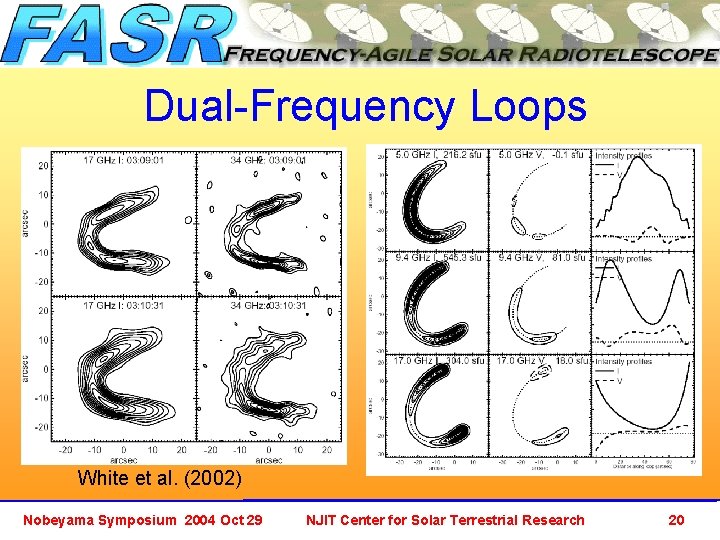
Dual-Frequency Loops White et al. (2002) Nobeyama Symposium 2004 Oct 29 NJIT Center for Solar Terrestrial Research 20
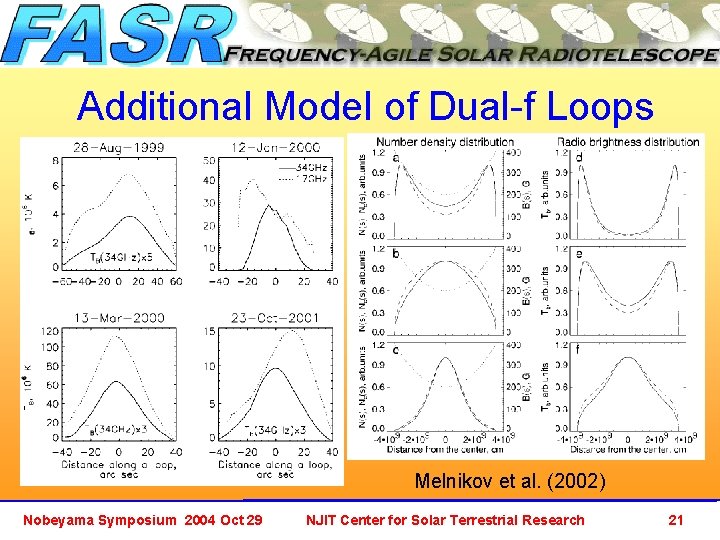
Additional Model of Dual-f Loops Melnikov et al. (2002) Nobeyama Symposium 2004 Oct 29 NJIT Center for Solar Terrestrial Research 21
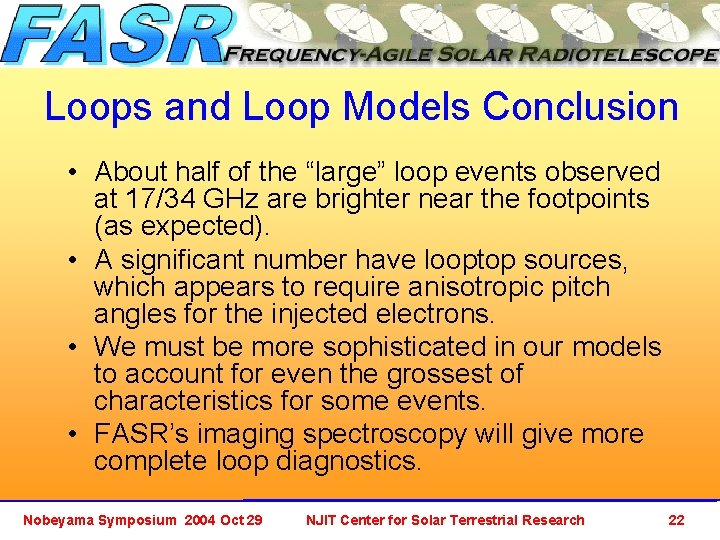
Loops and Loop Models Conclusion • About half of the “large” loop events observed at 17/34 GHz are brighter near the footpoints (as expected). • A significant number have looptop sources, which appears to require anisotropic pitch angles for the injected electrons. • We must be more sophisticated in our models to account for even the grossest of characteristics for some events. • FASR’s imaging spectroscopy will give more complete loop diagnostics. Nobeyama Symposium 2004 Oct 29 NJIT Center for Solar Terrestrial Research 22
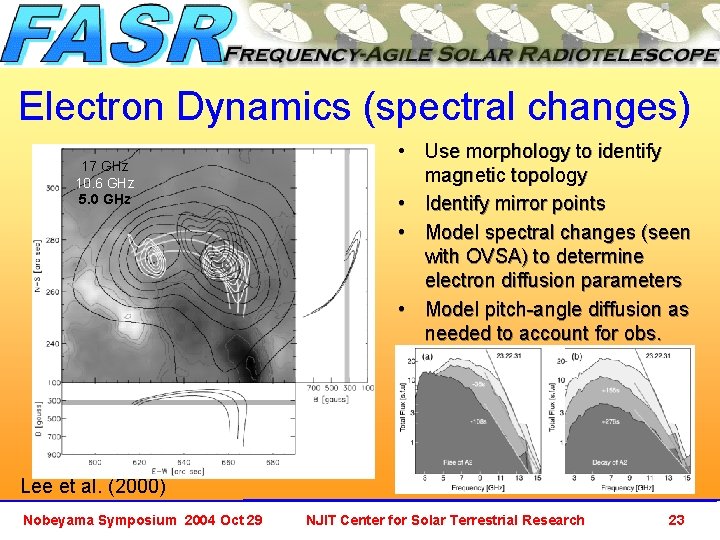
Electron Dynamics (spectral changes) 17 GHz 10. 6 GHz 5. 0 GHz • Use morphology to identify magnetic topology • Identify mirror points • Model spectral changes (seen with OVSA) to determine electron diffusion parameters • Model pitch-angle diffusion as needed to account for obs. Lee et al. (2000) Nobeyama Symposium 2004 Oct 29 NJIT Center for Solar Terrestrial Research 23
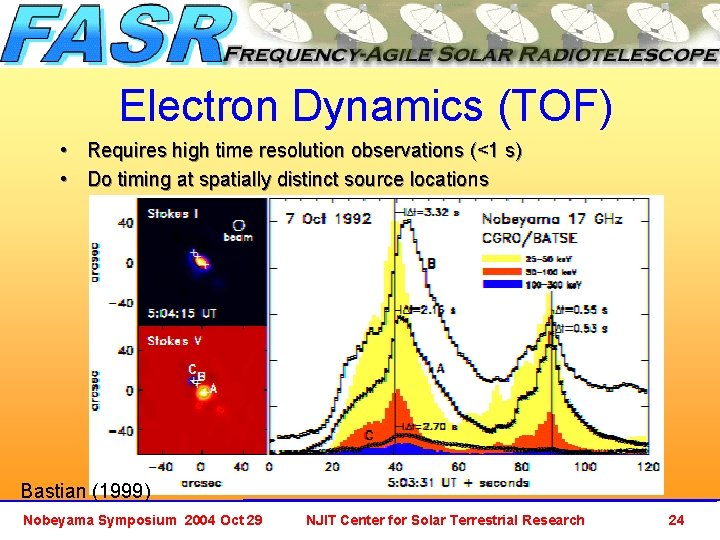
Electron Dynamics (TOF) • Requires high time resolution observations (<1 s) • Do timing at spatially distinct source locations Bastian (1999) Nobeyama Symposium 2004 Oct 29 NJIT Center for Solar Terrestrial Research 24
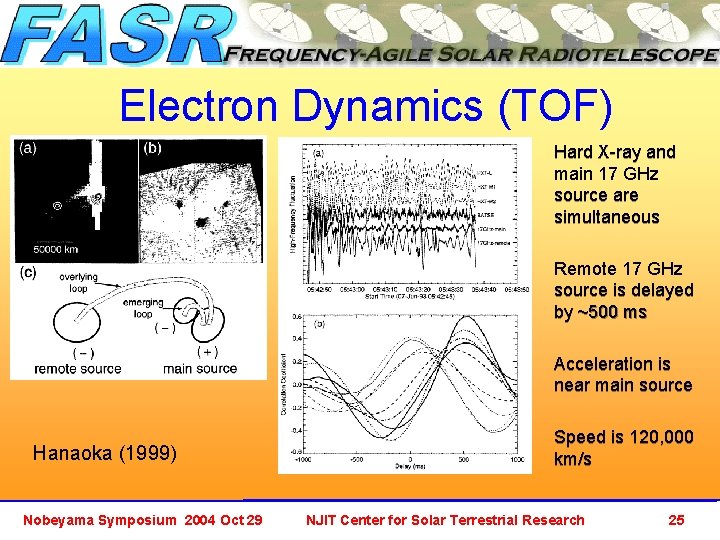
Electron Dynamics (TOF) Hanaoka (1999) Nobeyama Symposium 2004 Oct 29 • Hard X-ray and main 17 GHz source are simultaneous • Remote 17 GHz source is delayed by ~500 ms • Acceleration is near main source • Speed is 120, 000 km/s NJIT Center for Solar Terrestrial Research 25
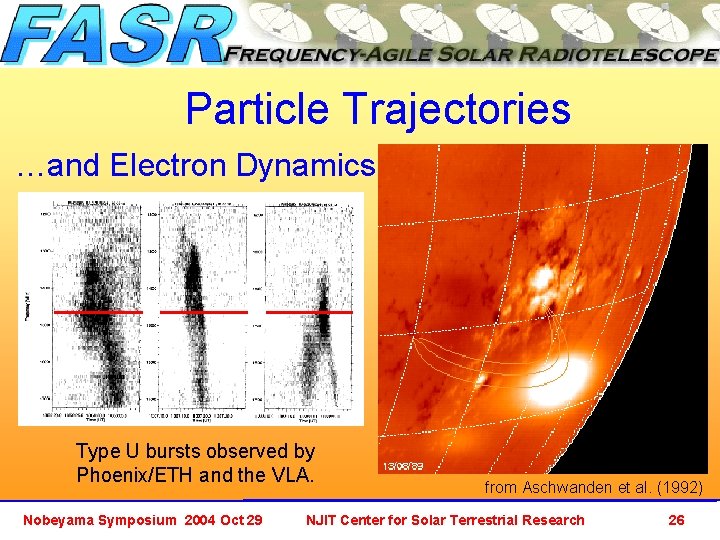
Particle Trajectories …and Electron Dynamics Type U bursts observed by Phoenix/ETH and the VLA. Nobeyama Symposium 2004 Oct 29 from Aschwanden et al. (1992) NJIT Center for Solar Terrestrial Research 26
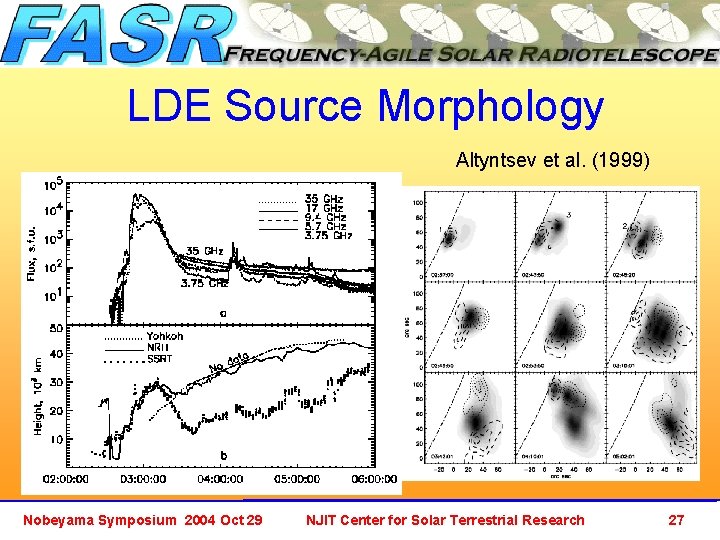
LDE Source Morphology Altyntsev et al. (1999) Nobeyama Symposium 2004 Oct 29 NJIT Center for Solar Terrestrial Research 27
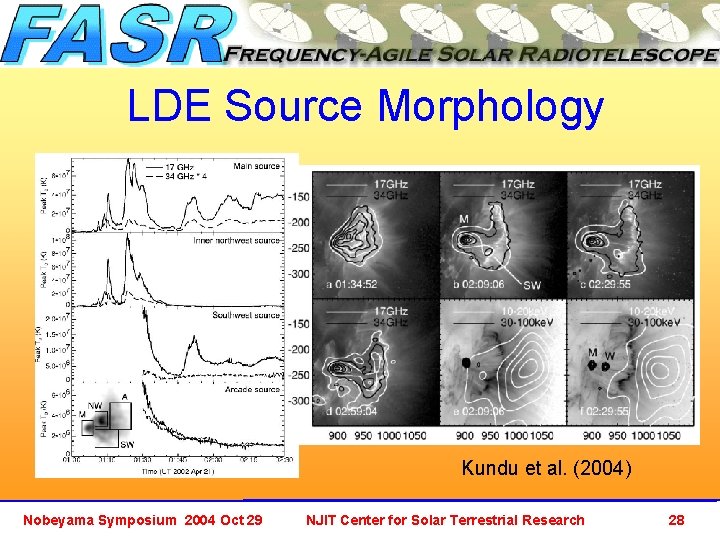
LDE Source Morphology Kundu et al. (2004) Nobeyama Symposium 2004 Oct 29 NJIT Center for Solar Terrestrial Research 28
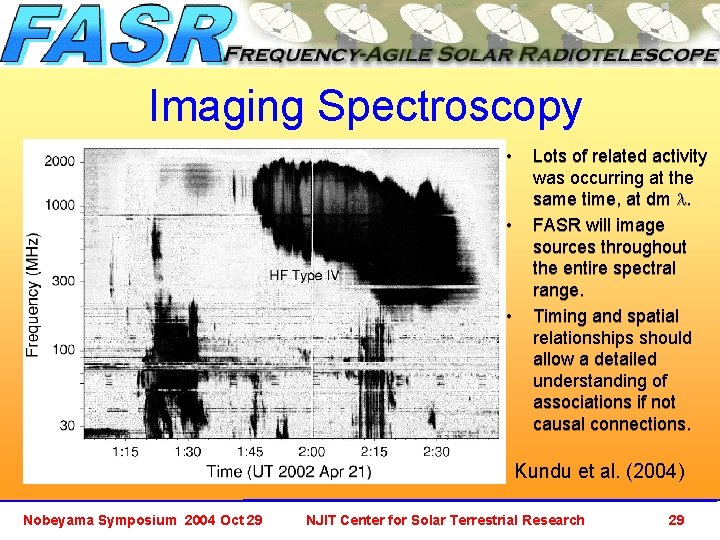
Imaging Spectroscopy • • • Lots of related activity was occurring at the same time, at dm l. FASR will image sources throughout the entire spectral range. Timing and spatial relationships should allow a detailed understanding of associations if not causal connections. Kundu et al. (2004) Nobeyama Symposium 2004 Oct 29 NJIT Center for Solar Terrestrial Research 29
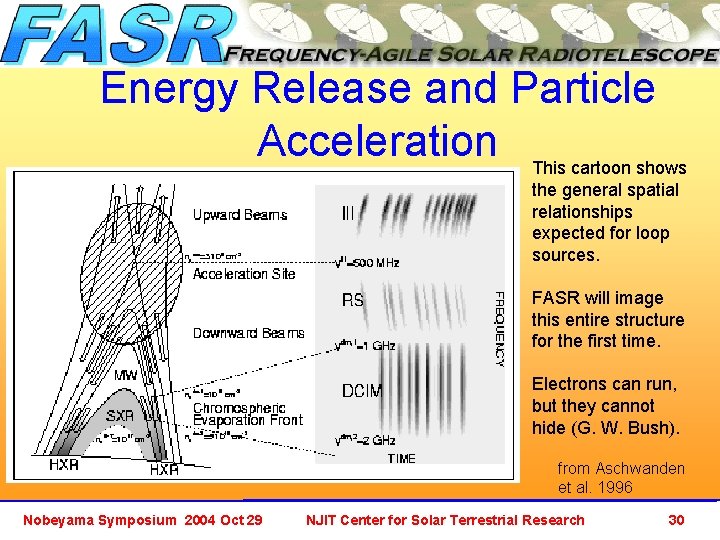
Energy Release and Particle Acceleration This cartoon shows the general spatial relationships expected for loop sources. FASR will image this entire structure for the first time. Electrons can run, but they cannot hide (G. W. Bush). from Aschwanden et al. 1996 Nobeyama Symposium 2004 Oct 29 NJIT Center for Solar Terrestrial Research 30
Flare Productivity/Space Weather • Long-term observations (Kundu et al. 2001 b) • Coronal Heating (White et al. 1995) • Eruptive events (Hori et al. 2000) • Relation to type II, type III (Nakajima & Yokohama 2002; Aurass et al. 2002) Nobeyama Symposium 2004 Oct 29 NJIT Center for Solar Terrestrial Research 31
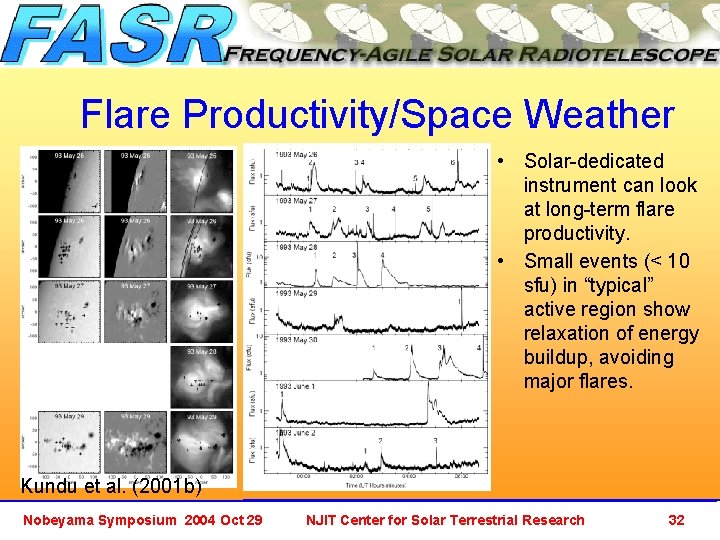
Flare Productivity/Space Weather • Solar-dedicated instrument can look at long-term flare productivity. • Small events (< 10 sfu) in “typical” active region show relaxation of energy buildup, avoiding major flares. Kundu et al. (2001 b) Nobeyama Symposium 2004 Oct 29 NJIT Center for Solar Terrestrial Research 32
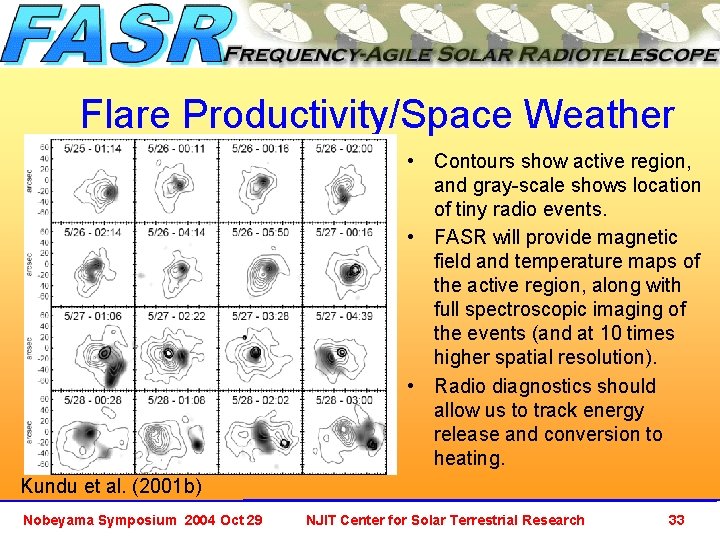
Flare Productivity/Space Weather • Contours show active region, and gray-scale shows location of tiny radio events. • FASR will provide magnetic field and temperature maps of the active region, along with full spectroscopic imaging of the events (and at 10 times higher spatial resolution). • Radio diagnostics should allow us to track energy release and conversion to heating. Kundu et al. (2001 b) Nobeyama Symposium 2004 Oct 29 NJIT Center for Solar Terrestrial Research 33
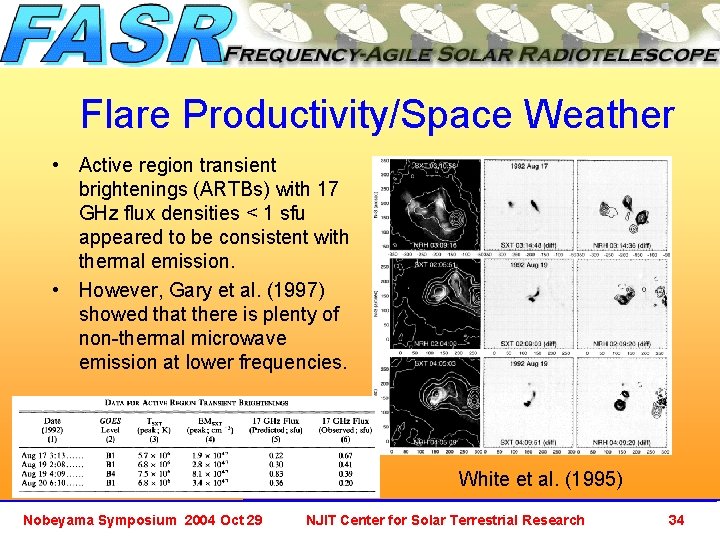
Flare Productivity/Space Weather • Active region transient brightenings (ARTBs) with 17 GHz flux densities < 1 sfu appeared to be consistent with thermal emission. • However, Gary et al. (1997) showed that there is plenty of non-thermal microwave emission at lower frequencies. White et al. (1995) Nobeyama Symposium 2004 Oct 29 NJIT Center for Solar Terrestrial Research 34
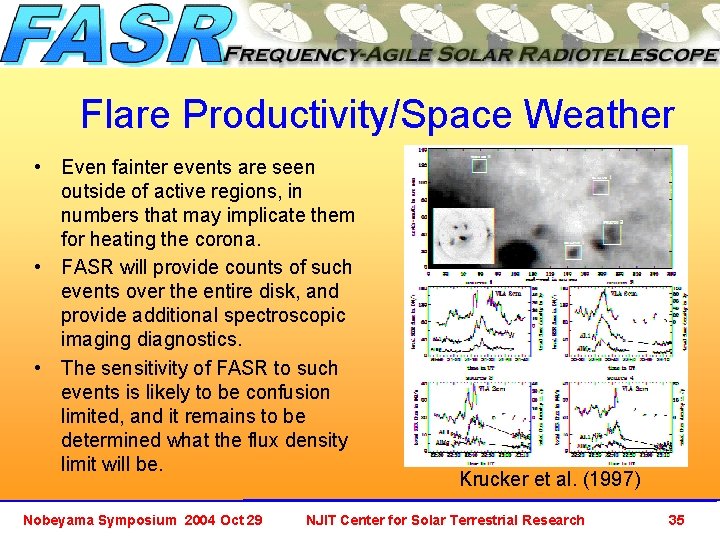
Flare Productivity/Space Weather • Even fainter events are seen outside of active regions, in numbers that may implicate them for heating the corona. • FASR will provide counts of such events over the entire disk, and provide additional spectroscopic imaging diagnostics. • The sensitivity of FASR to such events is likely to be confusion limited, and it remains to be determined what the flux density limit will be. Nobeyama Symposium 2004 Oct 29 Krucker et al. (1997) NJIT Center for Solar Terrestrial Research 35
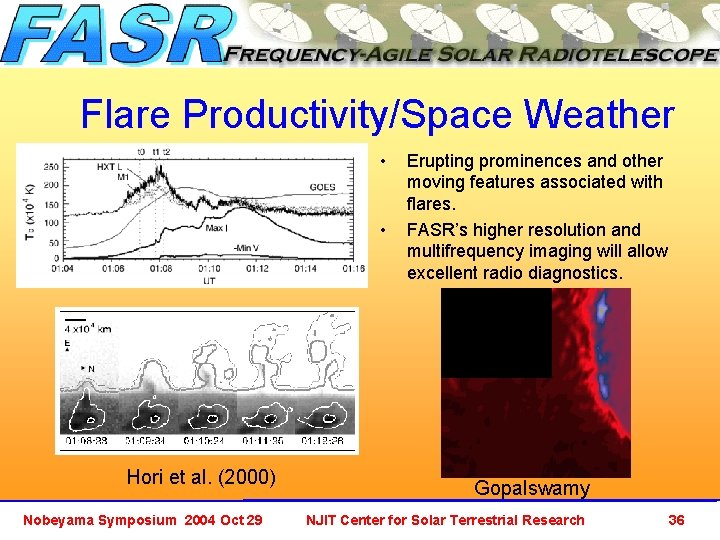
Flare Productivity/Space Weather • • Hori et al. (2000) Nobeyama Symposium 2004 Oct 29 Erupting prominences and other moving features associated with flares. FASR’s higher resolution and multifrequency imaging will allow excellent radio diagnostics. Gopalswamy NJIT Center for Solar Terrestrial Research 36
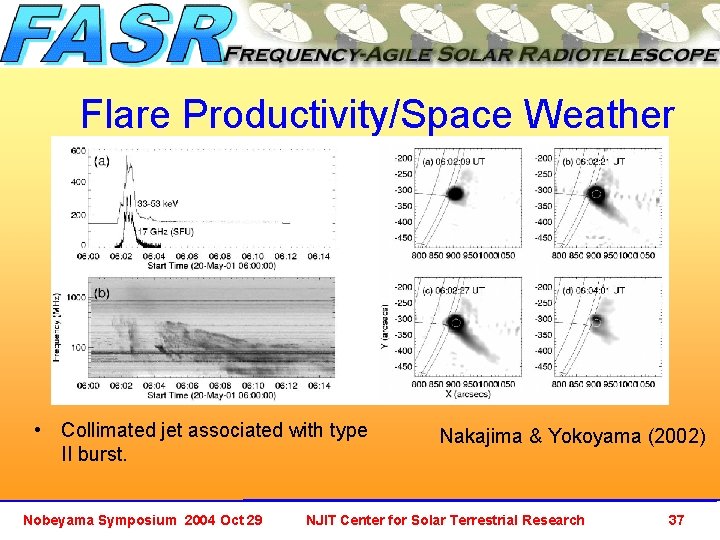
Flare Productivity/Space Weather • Collimated jet associated with type II burst. Nobeyama Symposium 2004 Oct 29 Nakajima & Yokoyama (2002) NJIT Center for Solar Terrestrial Research 37
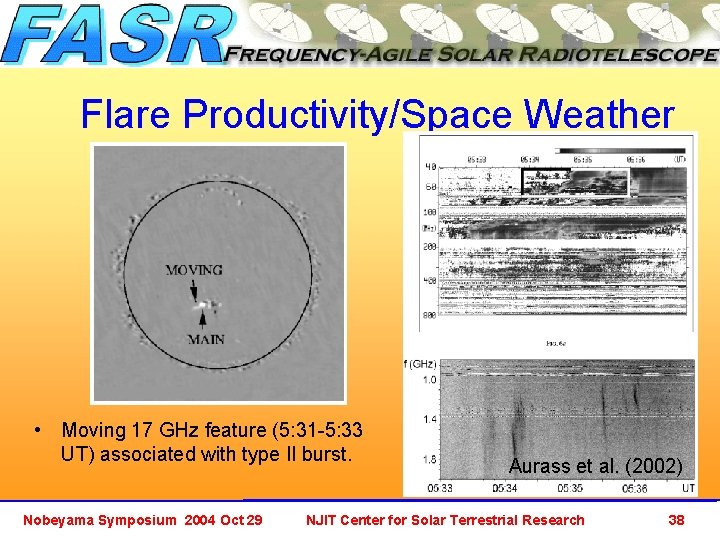
Flare Productivity/Space Weather • Moving 17 GHz feature (5: 31 -5: 33 UT) associated with type II burst. Nobeyama Symposium 2004 Oct 29 Aurass et al. (2002) NJIT Center for Solar Terrestrial Research 38
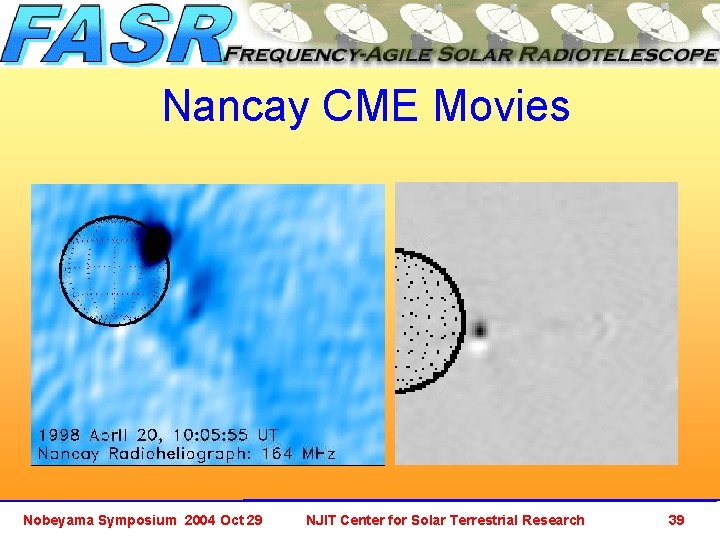
Nancay CME Movies Nobeyama Symposium 2004 Oct 29 NJIT Center for Solar Terrestrial Research 39
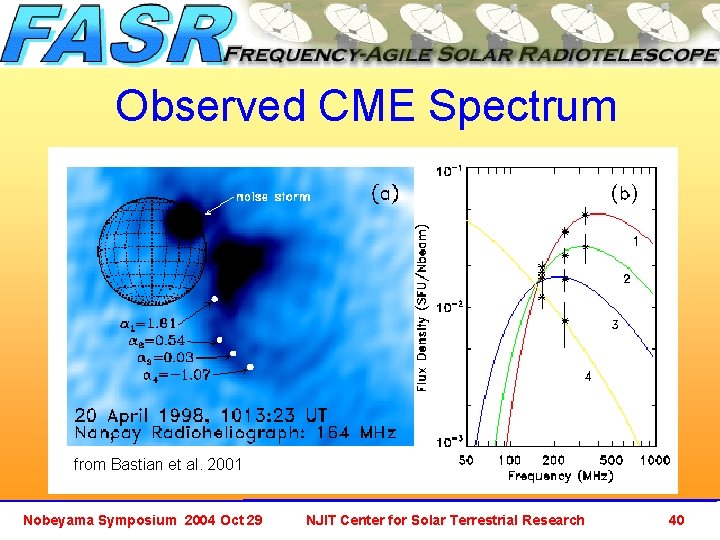
Observed CME Spectrum from Bastian et al. 2001 Nobeyama Symposium 2004 Oct 29 NJIT Center for Solar Terrestrial Research 40
How FASR Will Use These Lessons • • Full Sun (to 17 GHz) Solar-dedicated, solar-optimized 1” resolution (at 20 GHz) Excellent imaging/dynamic range (5000 baselines) • High time resolution (100 ms) • Wide, densely sampled frequency range Nobeyama Symposium 2004 Oct 29 NJIT Center for Solar Terrestrial Research 41
Conclusion • FASR is being designed to address an extremely rich range of solar science, utilizing state-of-the-art technology. • Some aspects of the instrument have yet to be defined, and help is sought in the design, simulations, and software effort. • Please help to make FASR an international effort. By working together we can make FASR a truly remarkable facility. Nobeyama Symposium 2004 Oct 29 NJIT Center for Solar Terrestrial Research 42
FASR Contacts • FASR web page: http: /www. ovsa. njit. edu/fasr/ • FASR U. S. : Tim Bastian, Dale Gary, Stephen White, Gordon Hurford • FASR France: Monique Pick, Alain Kerdraon Nobeyama Symposium 2004 Oct 29 NJIT Center for Solar Terrestrial Research 43
FASR Endorsements 2001 Astronomy & Astrophysics Survey Committee • Ranked as one of 17 priority projects for this decade • one of 3 solar projects, with ATST and SDO 2003 Solar and Space Physics Survey Committee • Ranked as top priority in small (<$150 M) projects 2002 -2004: Design Study (NSF/ATI) • 3 workshops for community input • Science consensus, hardware and software design options, and development of management plan. 2004 -2006: FASR Long-Lead Prototyping Proposal (NSF/ATI) Nobeyama Symposium 2004 Oct 29 NJIT Center for Solar Terrestrial Research 44
Nobeyama Symposium 2004 Oct 29 NJIT Center for Solar Terrestrial Research 45
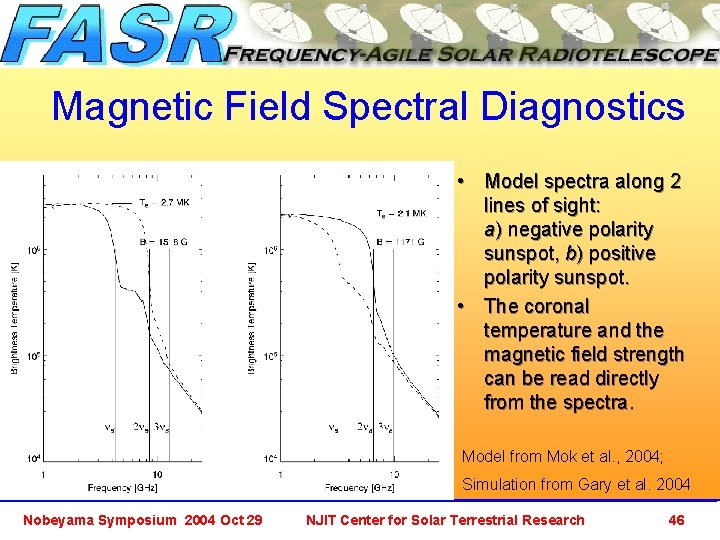
Magnetic Field Spectral Diagnostics • Model spectra along 2 lines of sight: a) negative polarity sunspot, b) positive polarity sunspot. • The coronal temperature and the magnetic field strength can be read directly from the spectra. Model from Mok et al. , 2004; Simulation from Gary et al. 2004 Nobeyama Symposium 2004 Oct 29 NJIT Center for Solar Terrestrial Research 46
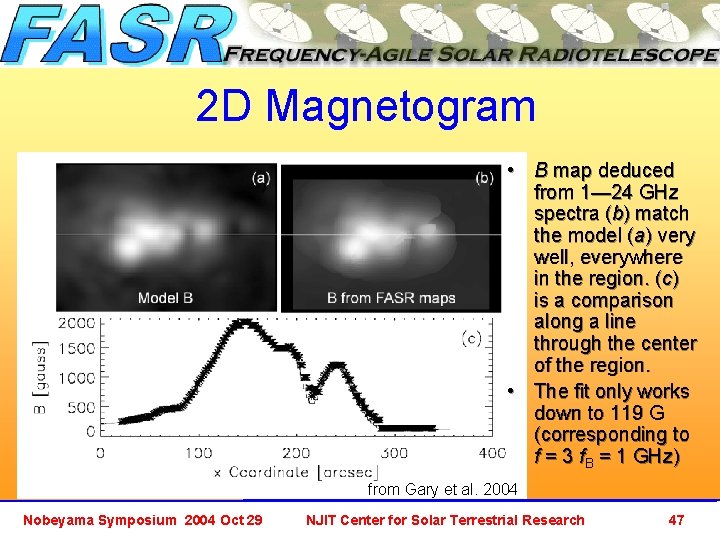
2 D Magnetogram • B map deduced from 1— 24 GHz spectra (b) match the model (a) very well, everywhere in the region. (c) is a comparison along a line through the center of the region. • The fit only works down to 119 G (corresponding to f = 3 f. B = 1 GHz) from Gary et al. 2004 Nobeyama Symposium 2004 Oct 29 NJIT Center for Solar Terrestrial Research 47
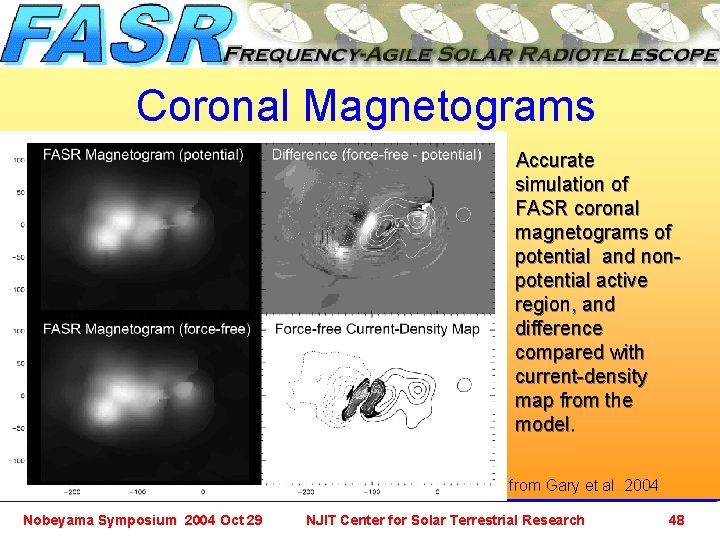
Coronal Magnetograms Accurate simulation of FASR coronal magnetograms of potential and nonpotential active region, and difference compared with current-density map from the model. from Gary et al. 2004 Nobeyama Symposium 2004 Oct 29 NJIT Center for Solar Terrestrial Research 48
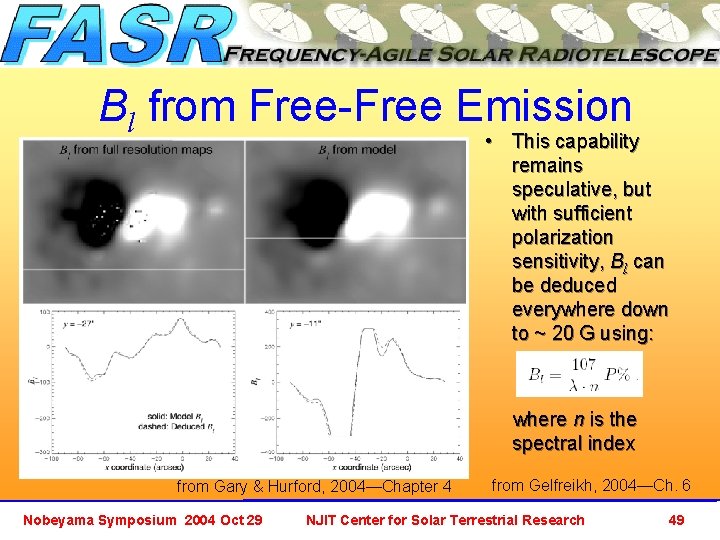
Bl from Free-Free Emission • This capability remains speculative, but with sufficient polarization sensitivity, Bl can be deduced everywhere down to ~ 20 G using: where n is the spectral index from Gary & Hurford, 2004—Chapter 4 Nobeyama Symposium 2004 Oct 29 from Gelfreikh, 2004—Ch. 6 NJIT Center for Solar Terrestrial Research 49
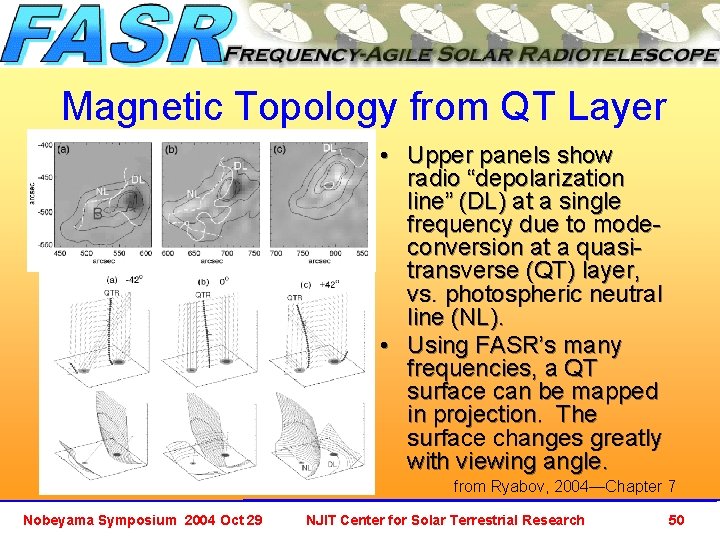
Magnetic Topology from QT Layer • Upper panels show radio “depolarization line” (DL) at a single frequency due to modeconversion at a quasitransverse (QT) layer, vs. photospheric neutral line (NL). • Using FASR’s many frequencies, a QT surface can be mapped in projection. The surface changes greatly with viewing angle. from Ryabov, 2004—Chapter 7 Nobeyama Symposium 2004 Oct 29 NJIT Center for Solar Terrestrial Research 50
FASR Science Goals (2) • Image CMEs both on the disk and off the limb ¡ ¡ ¡ Observe non-thermal electrons in CMEs easily Possibly detect free-free emission in some CMEs Relate other forms of activity (both thermal and nonthermal) that take place simultaneously, with perfect co-registration Observe analog of EIT/Moreton waves/coronal dimmings, filaments, type II bursts, and CMEs all in one panoramic view! No occulting disk! Nobeyama Symposium 2004 Oct 29 NJIT Center for Solar Terrestrial Research 51
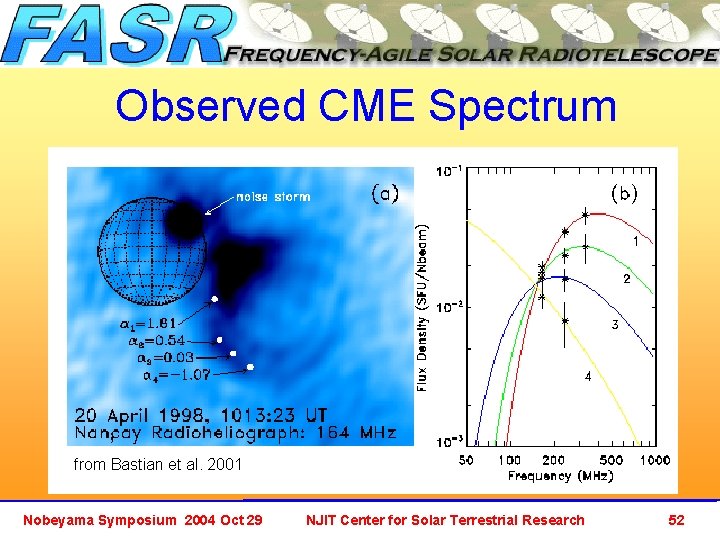
Observed CME Spectrum from Bastian et al. 2001 Nobeyama Symposium 2004 Oct 29 NJIT Center for Solar Terrestrial Research 52
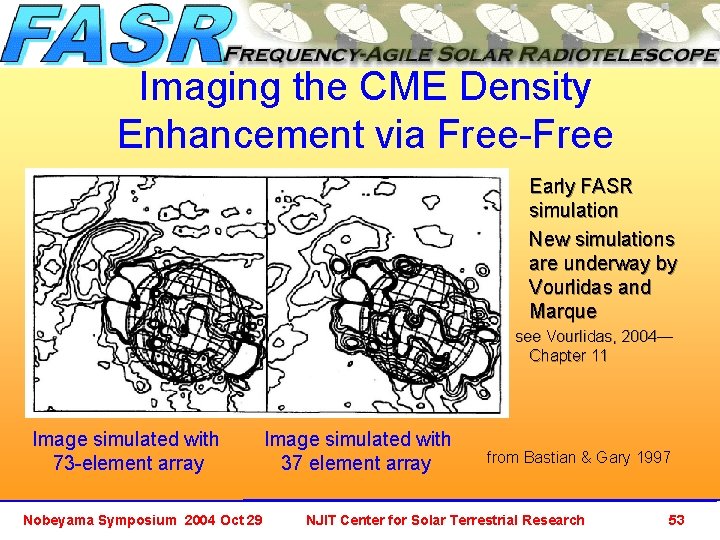
Imaging the CME Density Enhancement via Free-Free • Early FASR simulation • New simulations are underway by Vourlidas and Marque see Vourlidas, 2004— Chapter 11 Image simulated with 73 -element array Nobeyama Symposium 2004 Oct 29 Image simulated with 37 element array from Bastian & Gary 1997 NJIT Center for Solar Terrestrial Research 53
FASR Science Goals (3) • Radio spectral diagnostics of particle acceleration & energy release, with excellent spatial and temporal resolution Directly image energy release region ¡ Follow evolution of electrons from acceleration, through transport, and escape or thermalization ¡ Obtain spectral diagnostics of energy/pitch angle distributions* *see tomorrow’s poster by Lee et al. ¡ Nobeyama Symposium 2004 Oct 29 NJIT Center for Solar Terrestrial Research 54
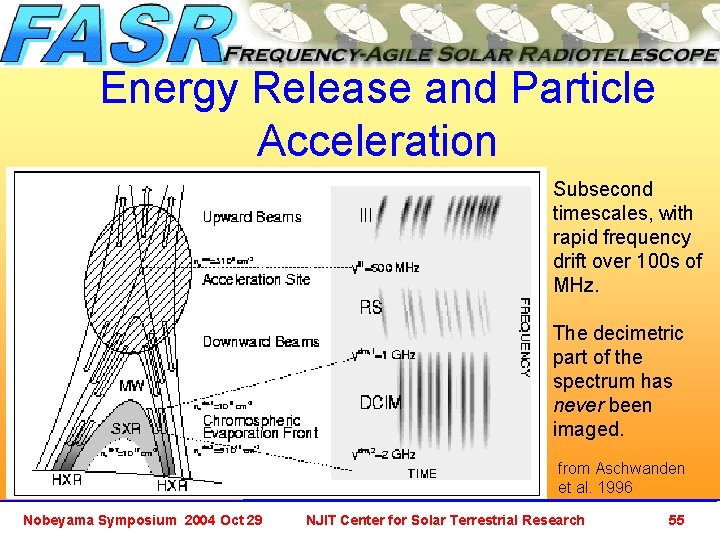
Energy Release and Particle Acceleration Subsecond timescales, with rapid frequency drift over 100 s of MHz. The decimetric part of the spectrum has never been imaged. from Aschwanden et al. 1996 Nobeyama Symposium 2004 Oct 29 NJIT Center for Solar Terrestrial Research 55
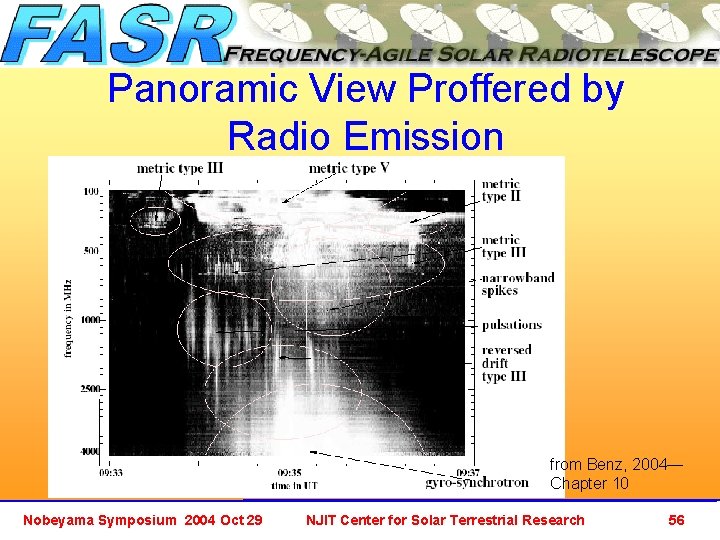
Panoramic View Proffered by Radio Emission from Benz, 2004— Chapter 10 Nobeyama Symposium 2004 Oct 29 NJIT Center for Solar Terrestrial Research 56
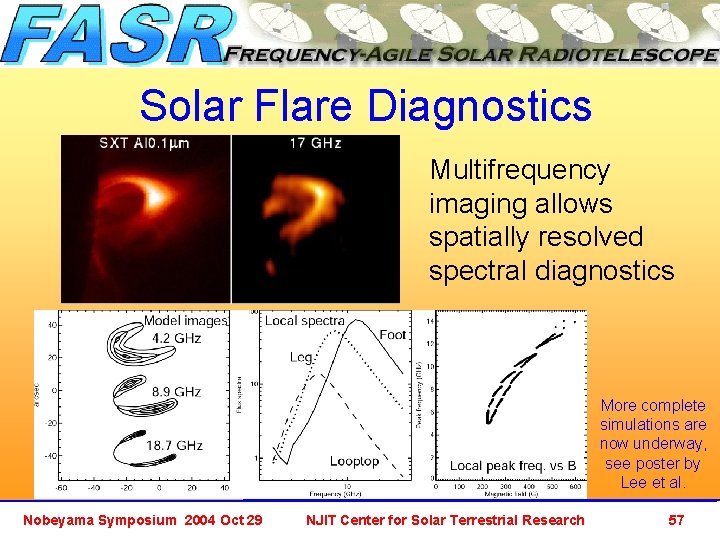
Solar Flare Diagnostics Multifrequency imaging allows spatially resolved spectral diagnostics More complete simulations are now underway, see poster by Lee et al. Nobeyama Symposium 2004 Oct 29 NJIT Center for Solar Terrestrial Research 57
FASR Science Goals (4) • Image radio emission from shocks (type II), electron beams (type III), and other bursts over heights 1 -2. 5 Rs Global view of type II emission (multifrequency gives multiple plasma layers) ¡ Relate type II to CME, waves, accelerated particles ¡ Follow type III (and U-burst) trajectories throughout frequency, and hence height ¡ Nobeyama Symposium 2004 Oct 29 NJIT Center for Solar Terrestrial Research 58
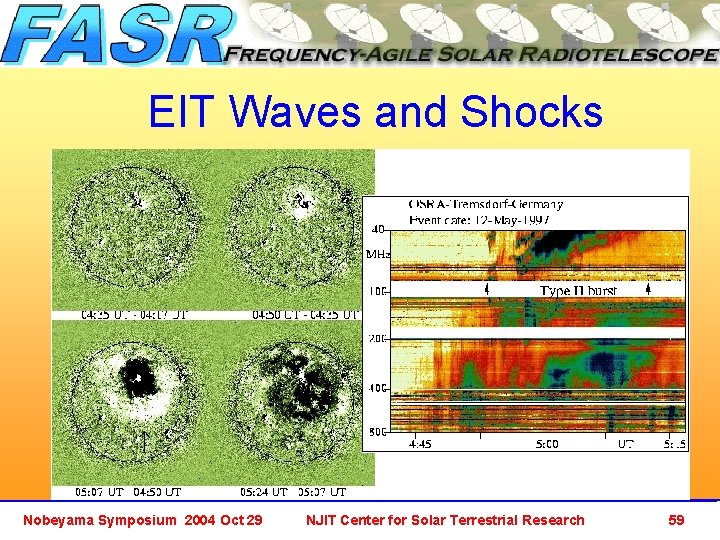
EIT Waves and Shocks Nobeyama Symposium 2004 Oct 29 NJIT Center for Solar Terrestrial Research 59
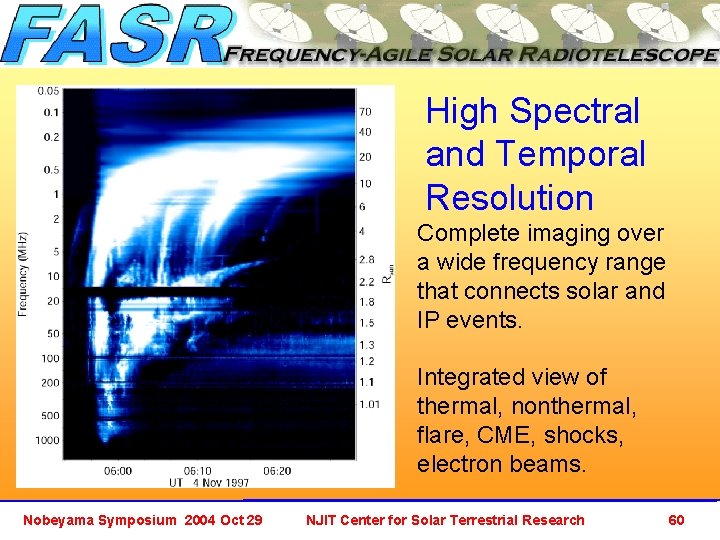
High Spectral and Temporal Resolution Complete imaging over a wide frequency range that connects solar and IP events. Integrated view of thermal, nonthermal, flare, CME, shocks, electron beams. Nobeyama Symposium 2004 Oct 29 NJIT Center for Solar Terrestrial Research 60
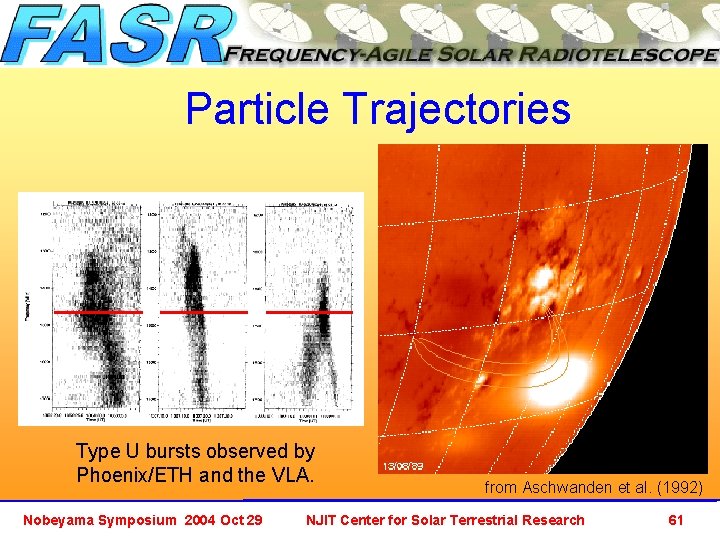
Particle Trajectories Type U bursts observed by Phoenix/ETH and the VLA. Nobeyama Symposium 2004 Oct 29 from Aschwanden et al. (1992) NJIT Center for Solar Terrestrial Research 61
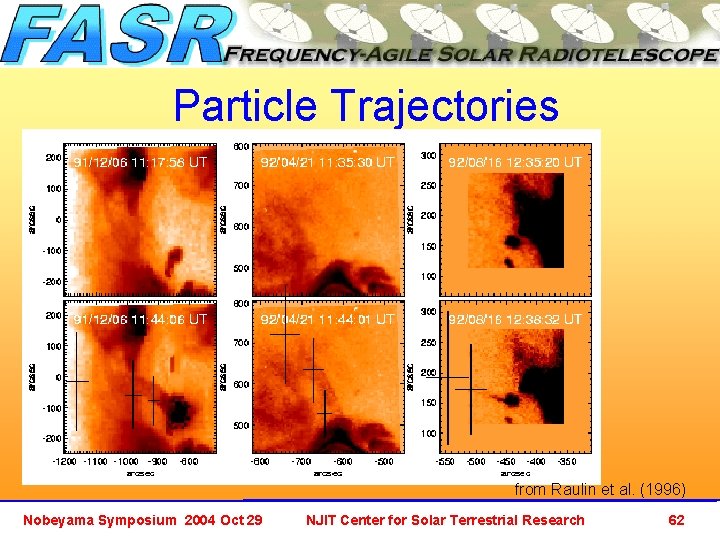
Particle Trajectories from Raulin et al. (1996) Nobeyama Symposium 2004 Oct 29 NJIT Center for Solar Terrestrial Research 62
FASR Science Goals (5) • Construct 3 D solar atmospheric structure (T, B, ne) over a wide range of heights Image individual heated loops ¡ Image filaments, filament channels, eruptions, with spectral diagnostics ¡ Combine radio, EUV, X-ray diagnostics for complete model of 3 D structure ¡ Nobeyama Symposium 2004 Oct 29 NJIT Center for Solar Terrestrial Research 63
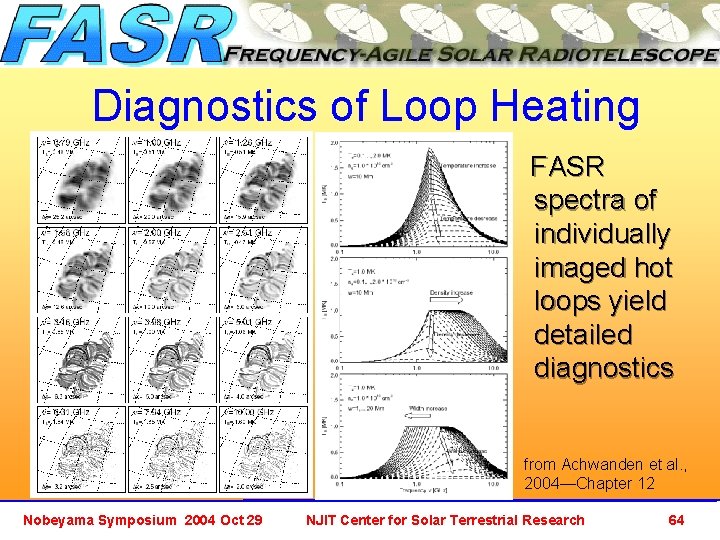
Diagnostics of Loop Heating FASR spectra of individually imaged hot loops yield detailed diagnostics from Achwanden et al. , 2004—Chapter 12 Nobeyama Symposium 2004 Oct 29 NJIT Center for Solar Terrestrial Research 64
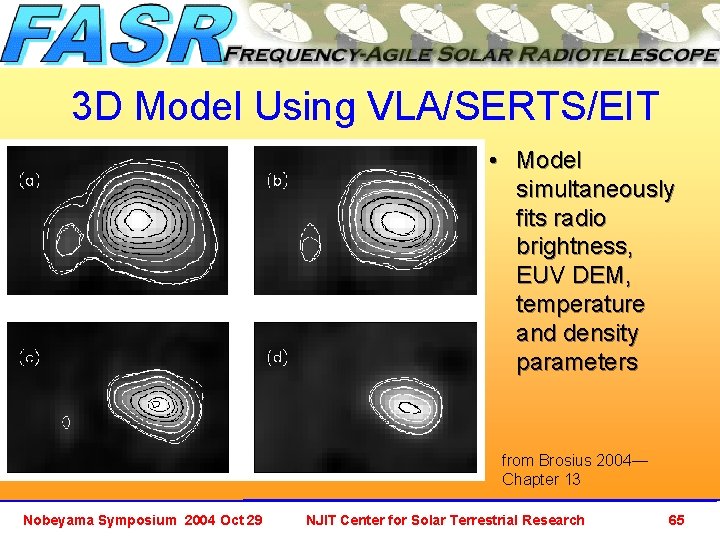
3 D Model Using VLA/SERTS/EIT • Model simultaneously fits radio brightness, EUV DEM, temperature and density parameters from Brosius 2004— Chapter 13 Nobeyama Symposium 2004 Oct 29 NJIT Center for Solar Terrestrial Research 65
- Slides: 65