
FAS Express Program Business Process Improvement Effort Findings
FAS Express Program Business Process Improvement Effort Findings Improving Enterprise Performance using a Business Process Improvement Discipline 10/2/2020 Federal Acquisition Service GSA 1
Presentation Agenda o o o Background Program Near-term Timeline Key Products Approach and Timeline Success Factors Lean Production – Six Sigma Techniques – Analysis and Quantifying Results BPMN Overview BPMS as an EA enabler Outcomes of a Good Process Design Summary of Results Lessons Learned To-Date 10/2/2020 Federal Acquisition Service GSA 2
Background Presenters: Chuck Popelka: Director of Systems Management Center – FAS charles. popelka@gsa. gov Mark Nelson: Contractor – The Mercator Group mark@epmgnet. org Federal Acquisition Service (FAS): GSA Federal Acquisition Service (FAS) provides federal customers with the products, services, and programs to meet their supply, service, procurement, vehicle purchasing and leasing, travel and transportation, and personal property management requirements. Project: 30 -Day Challenge or Express Program Objective: Reduce the time it takes to process a vendor proposal against the Multiple Award Schedules (MAS) from an average of 120 calendar days to 30 calendar days 10/2/2020 Federal Acquisition Service GSA 3
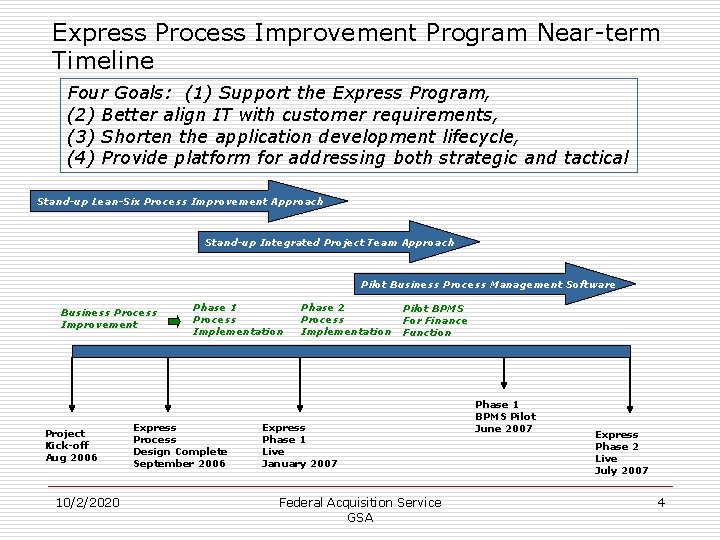
Express Process Improvement Program Near-term Timeline Four Goals: (1) Support the Express Program, (2) Better align IT with customer requirements, (3) Shorten the application development lifecycle, (4) Provide platform for addressing both strategic and tactical Stand-up Lean-Six Process Improvement Approach Stand-up Integrated Project Team Approach Pilot Business Process Management Software Business Process Improvement Project Kick-off Aug 2006 10/2/2020 Phase 1 Process Implementation Express Process Design Complete September 2006 Phase 2 Process Implementation Pilot BPMS For Finance Function Express Phase 1 Live January 2007 Federal Acquisition Service GSA Phase 1 BPMS Pilot June 2007 Express Phase 2 Live July 2007 4
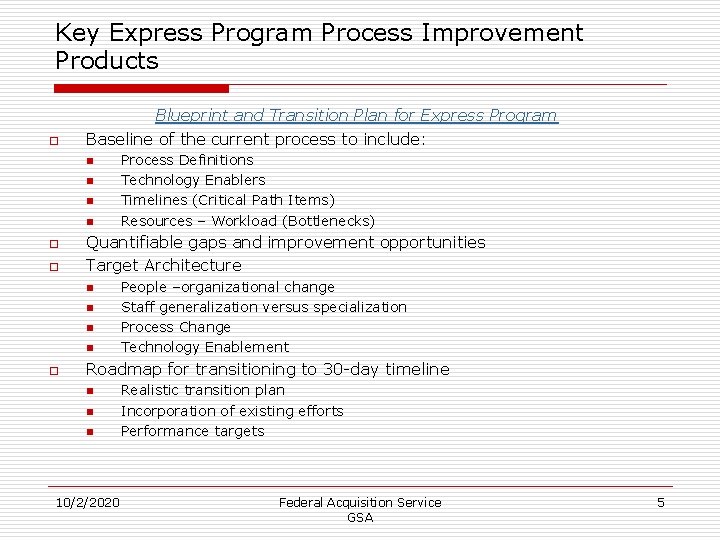
Key Express Program Process Improvement Products o Blueprint and Transition Plan for Express Program Baseline of the current process to include: n n o o Quantifiable gaps and improvement opportunities Target Architecture n n o Process Definitions Technology Enablers Timelines (Critical Path Items) Resources – Workload (Bottlenecks) People –organizational change Staff generalization versus specialization Process Change Technology Enablement Roadmap for transitioning to 30 -day timeline n n n 10/2/2020 Realistic transition plan Incorporation of existing efforts Performance targets Federal Acquisition Service GSA 5
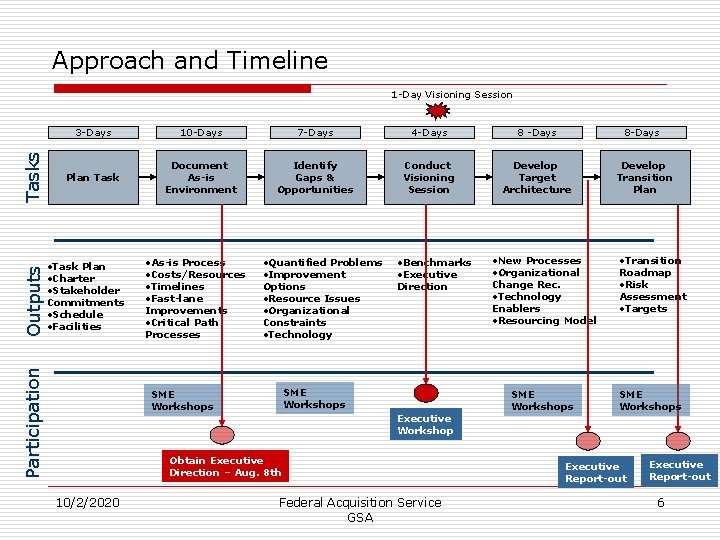
Approach and Timeline 3 -Days 10 -Days 7 -Days 4 -Days 8 -Days Plan Task Document As-is Environment Identify Gaps & Opportunities Conduct Visioning Session Develop Target Architecture • Task Plan • Charter • Stakeholder Commitments • Schedule • Facilities Participation Outputs Tasks 1 -Day Visioning Session • As-is Process • Costs/Resources • Timelines • Fast-lane Improvements • Critical Path Processes • Quantified Problems • Improvement Options • Resource Issues • Organizational Constraints • Technology • Benchmarks • Executive Direction SME Workshops Executive Workshop Obtain Executive Direction – Aug. 8 th 10/2/2020 Federal Acquisition Service GSA 8 -Days Develop Transition Plan • New Processes • Organizational Change Rec. • Technology Enablers • Resourcing Model • Transition Roadmap • Risk Assessment • Targets SME Workshops Executive Report-out 6
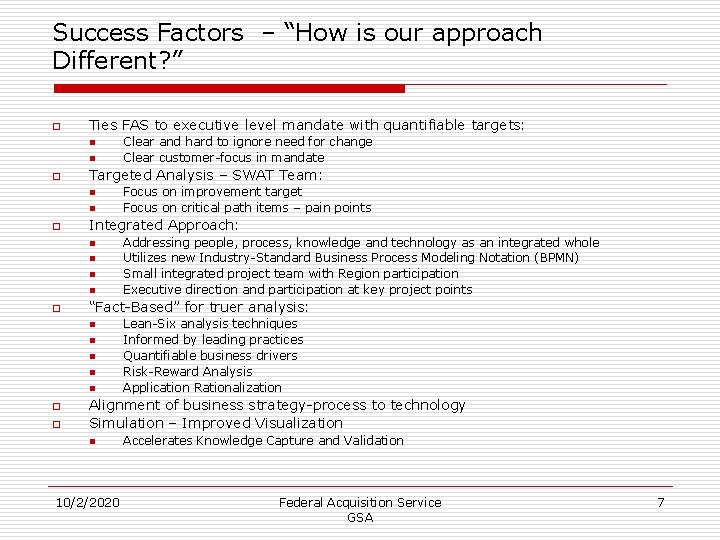
Success Factors – “How is our approach Different? ” o Ties FAS to executive level mandate with quantifiable targets: n n o Targeted Analysis – SWAT Team: n n o n n n n o Addressing people, process, knowledge and technology as an integrated whole Utilizes new Industry-Standard Business Process Modeling Notation (BPMN) Small integrated project team with Region participation Executive direction and participation at key project points “Fact-Based” for truer analysis: n o Focus on improvement target Focus on critical path items – pain points Integrated Approach: n o Clear and hard to ignore need for change Clear customer-focus in mandate Lean-Six analysis techniques Informed by leading practices Quantifiable business drivers Risk-Reward Analysis Application Rationalization Alignment of business strategy-process to technology Simulation – Improved Visualization n 10/2/2020 Accelerates Knowledge Capture and Validation Federal Acquisition Service GSA 7
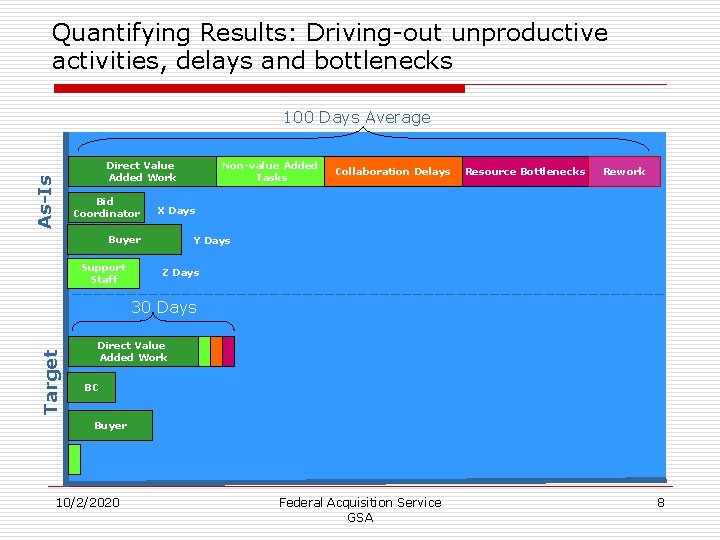
Quantifying Results: Driving-out unproductive activities, delays and bottlenecks As-Is 100 Days Average Direct Value Added Work Bid Coordinator Collaboration Delays Resource Bottlenecks Rework X Days Buyer Support Staff Non-value Added Tasks Y Days Z Days Target 30 Days Direct Value Added Work BC Buyer 10/2/2020 Federal Acquisition Service GSA 8
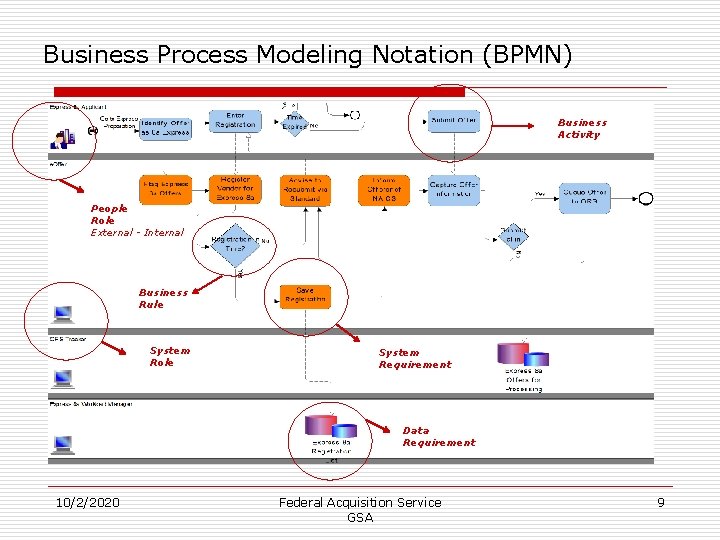
Business Process Modeling Notation (BPMN) Business Activity People Role External - Internal Business Rule System Role System Requirement Data Requirement 10/2/2020 Federal Acquisition Service GSA 9
Outcomes of a Good Process Design o Clear articulation of steps required to achieve the planned output of the process (the process model itself) n n o Exposure of performance gaps and improvement opportunities n n o o Ability to build a business case Quantifiable evidence Definition of current baseline performance capabilities and achievable targeted objectives Identification of Roles and Responsibilities (People and System) n n o Sequence of activities Business rules Collaborations (people-people, people-system, system-system) Identification of inputs and events that cause the process to kick-off People roles independent of job function Roles of IT support systems, their activities and collaborations with people Key data objects and their flows through the process model 10/2/2020 Federal Acquisition Service GSA 10
Creating “Facts on the ground” – The promise of BPMS o o Many BPR and EA efforts fail because of their long lead-times before quantifiable results are realized Business Process Management Software (BPMS) provides a mechanism for quickly implementing process change and SOA n n o Proven quicker, cheaper and better solution to implementing process oriented applications Provides for a more interactive experience with the end users as solutions are iterated in an integrated project team environment Experience at GSA has been very positive n n n 10/2/2020 Initial process based Express implementation followed up with pilot of BPMS Decision made by management to go-forward with BPMS as the orchestration engine for mission-critical SOA environment Currently evolving existing workflow based applications to BPMS/SOA environment. Federal Acquisition Service GSA 11
Summary of Results to Date 10/2/2020 Federal Acquisition Service GSA 12
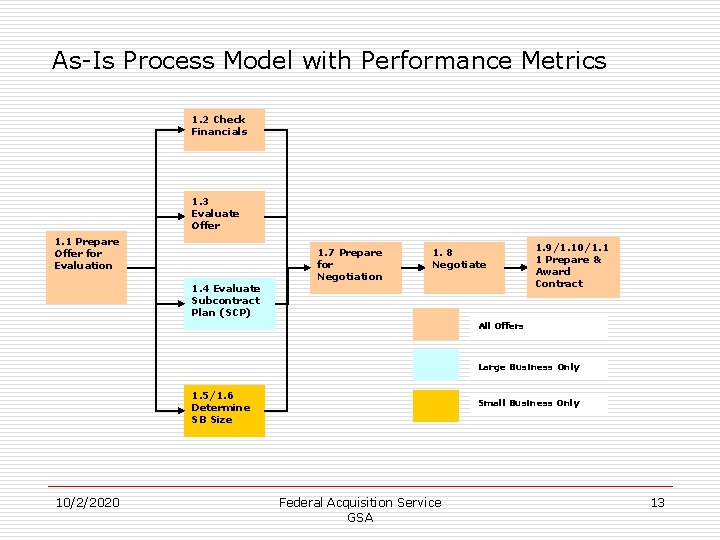
As-Is Process Model with Performance Metrics 1. 2 Check Financials 1. 3 Evaluate Offer 1. 1 Prepare Offer for Evaluation 1. 4 Evaluate Subcontract Plan (SCP) 1. 7 Prepare for Negotiation 1. 8 Negotiate 1. 9/1. 10/1. 1 1 Prepare & Award Contract All Offers Large Business Only 1. 5/1. 6 Determine SB Size 10/2/2020 Small Business Only Federal Acquisition Service GSA 13
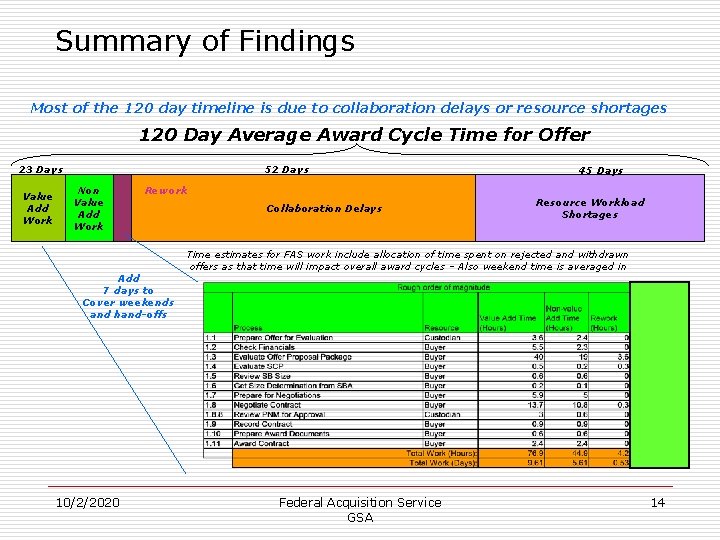
Summary of Findings Most of the 120 day timeline is due to collaboration delays or resource shortages 120 Day Average Award Cycle Time for Offer 23 Days Value Add Work 52 Days Non Value Add Work Rework Add 7 days to Cover weekends and hand-offs 10/2/2020 45 Days Collaboration Delays Resource Workload Shortages Time estimates for FAS work include allocation of time spent on rejected and withdrawn offers as that time will impact overall award cycles – Also weekend time is averaged in Federal Acquisition Service GSA 14
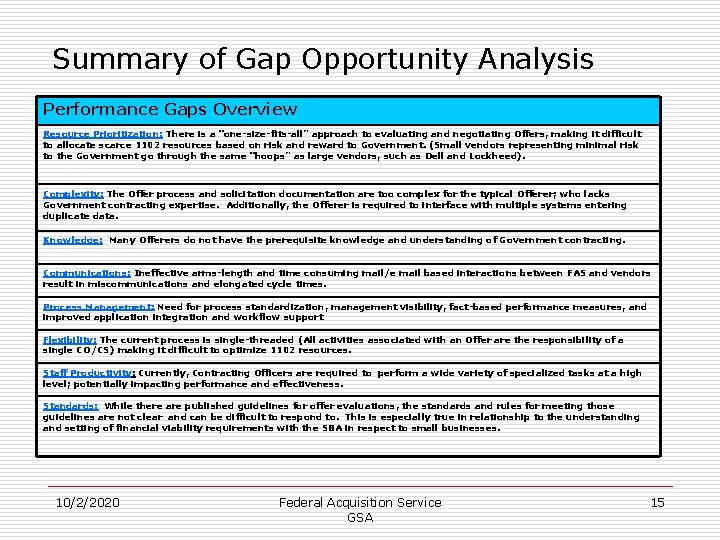
Summary of Gap Opportunity Analysis Performance Gaps Overview Resource Prioritization: There is a “one-size-fits-all” approach to evaluating and negotiating Offers, making it difficult to allocate scarce 1102 resources based on risk and reward to Government. (Small vendors representing minimal risk to the Government go through the same “hoops” as large vendors, such as Dell and Lockheed). Complexity: The Offer process and solicitation documentation are too complex for the typical Offerer; who lacks Government contracting expertise. Additionally, the Offerer is required to interface with multiple systems entering duplicate data. Knowledge: Many Offerers do not have the prerequisite knowledge and understanding of Government contracting. Communications: Ineffective arms-length and time consuming mail/e mail based interactions between FAS and vendors result in miscommunications and elongated cycle times. Process Management: Need for process standardization, management visibility, fact-based performance measures, and improved application integration and workflow support Flexibility: The current process is single-threaded (All activities associated with an Offer are the responsibility of a single CO/CS) making it difficult to optimize 1102 resources. Staff Productivity: Currently, Contracting Officers are required to perform a wide variety of specialized tasks at a high level; potentially impacting performance and effectiveness. Standards: While there are published guidelines for offer evaluations, the standards and rules for meeting those guidelines are not clear and can be difficult to respond to. This is especially true in relationship to the understanding and setting of financial viability requirements with the SBA in respect to small businesses. 10/2/2020 Federal Acquisition Service GSA 15
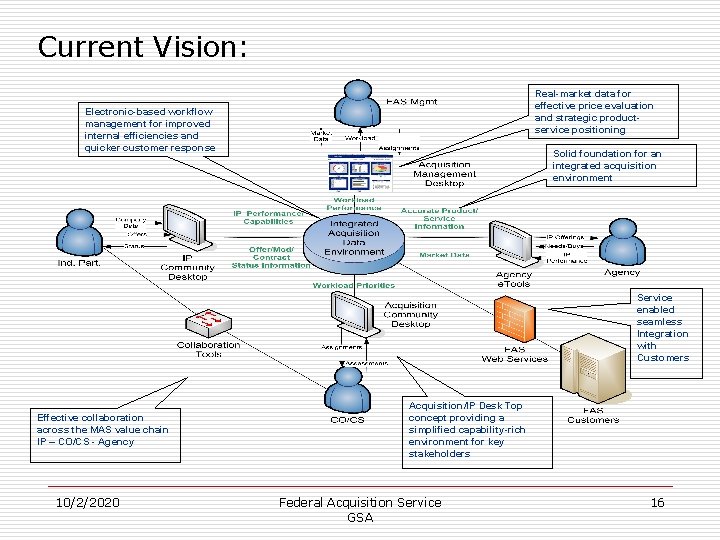
Current Vision: Real-market data for effective price evaluation and strategic productservice positioning Electronic-based workflow management for improved internal efficiencies and quicker customer response Solid foundation for an integrated acquisition environment Service enabled seamless Integration with Customers Effective collaboration across the MAS value chain IP – CO/CS - Agency 10/2/2020 Acquisition/IP Desk Top concept providing a simplified capability-rich environment for key stakeholders Federal Acquisition Service GSA 16
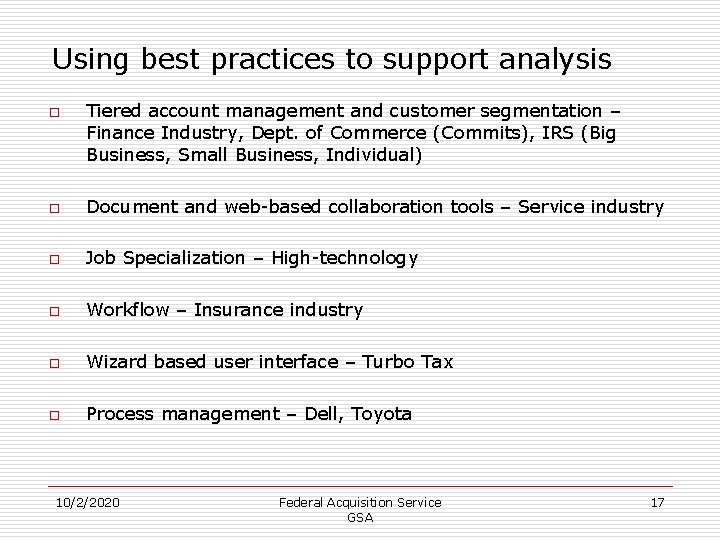
Using best practices to support analysis o Tiered account management and customer segmentation – Finance Industry, Dept. of Commerce (Commits), IRS (Big Business, Small Business, Individual) o Document and web-based collaboration tools – Service industry o Job Specialization – High-technology o Workflow – Insurance industry o Wizard based user interface – Turbo Tax o Process management – Dell, Toyota 10/2/2020 Federal Acquisition Service GSA 17
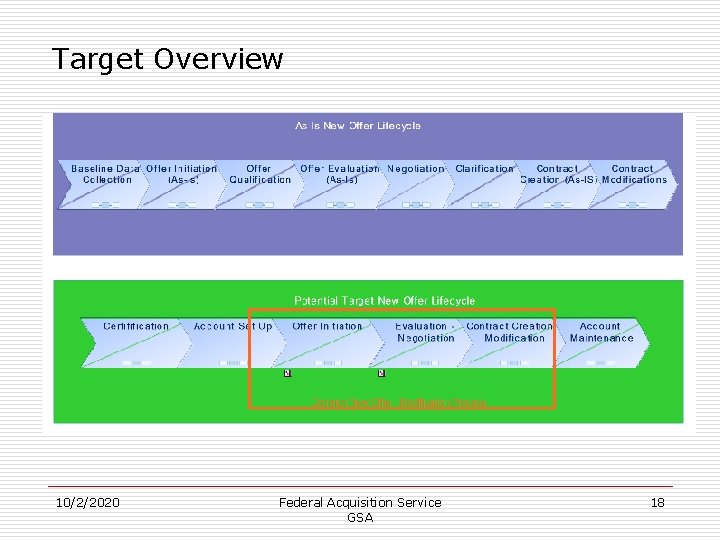
Target Overview 10/2/2020 Federal Acquisition Service GSA 18
Lessons Learned – To Date o o o o o In some ways shooting for major transformation can be easier than pursuing incremental improvement; providing there is strong executive sponsorship Having the process metrics to support change is critical Definite “fear of technology” in FAS Web conferencing worked well as a substitute to flying people in for face-to-face time BPMN proved to be a “natural language” for communicating with the stakeholders, and is the key linchpin between business requirements and technology enablement Business process analysis also exposed weaknesses in the overall way business is performed Use a tool – we used Proforma Provision Have a methodology (EPMG Workbook Approach) Break-down the stove-pipes with integrated project teams 10/2/2020 Federal Acquisition Service GSA 19
Thank you for the opportunity to present here today and please contact either one of us if you would like to continue the discussion! Chuck Popelka: Director of Systems Management Center – FAS charles. popelka@gsa. gov 703 605 2637 Mark Nelson: Contractor – The Mercator Group mark@epmgnet. org 703 304 9578 10/2/2020 Federal Acquisition Service GSA 20
- Slides: 20