
Farm to ECE and the Spectrum of Opportunities
- Slides: 20
Farm to ECE and the Spectrum of Opportunities Carrie Dooyema, MPH, MSN, RN Obesity Prevention and Control Branch Division of Nutrition, Physical Activity, and Obesity National Center for Chronic Disease Prevention and Health Promotion Centers for Disease Control and Prevention 1
Why is the Early Care and Education Setting So Important? • Most young children spend time in care outside of their home, making the ECE setting one of the best places to reach young children with obesity prevention efforts • The ECE setting includes: child care centers, family child care homes, preschool programs, Head Start and pre-kindergarten programs • Currently 1 in 5 U. S. children ages 2 – 5 years are overweight or have obesity Division of Nutrition, Physical Activity, and Obesity
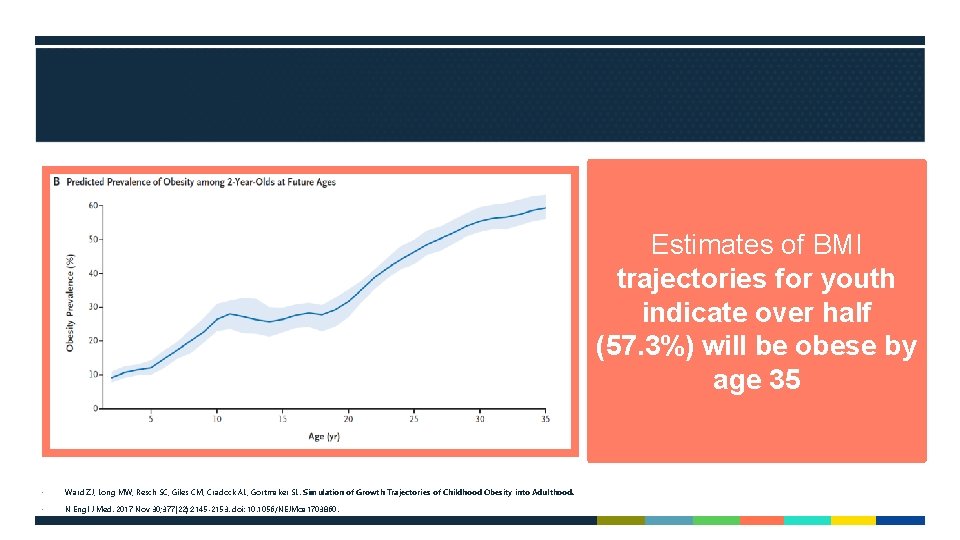
Estimates of BMI trajectories for youth indicate over half (57. 3%) will be obese by age 35 • Ward ZJ, Long MW, Resch SC, Giles CM, Cradock AL, Gortmaker SL. Simulation of Growth Trajectories of Childhood Obesity into Adulthood. • N Engl J Med. 2017 Nov 30; 377(22): 2145 -2153. doi: 10. 1056/NEJMoa 1703860.
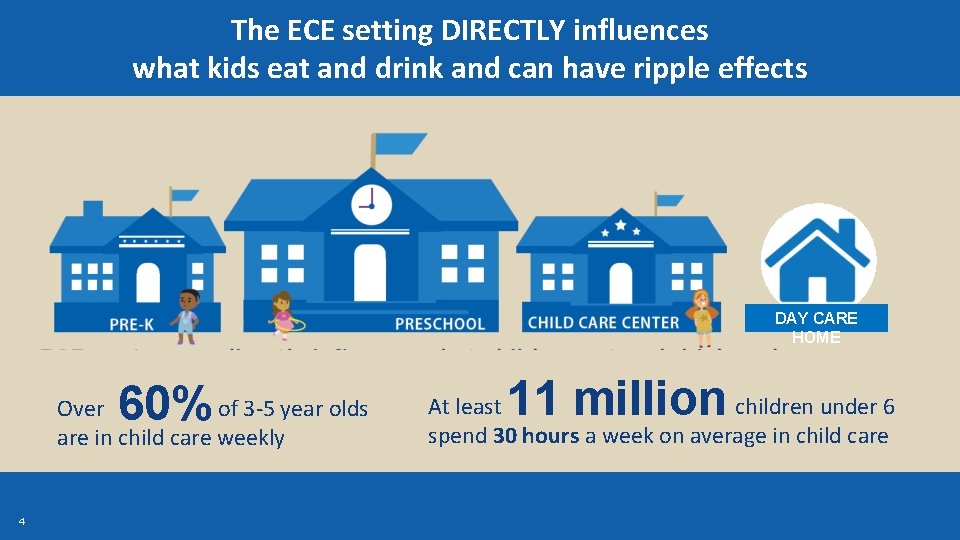
The ECE setting DIRECTLY influences what kids eat and drink and can have ripple effects DAY CARE HOME 60% Over of 3 -5 year olds are in child care weekly 4 11 million At least children under 6 spend 30 hours a week on average in child care
What are we trying to do? § Approaches for ECE setting • • Implement and integrate nutrition, physical activity, breastfeeding, and screentime standards into statewide ECE systems Improve ECE facility level policies, practices, and environments related to nutrition, breastfeeding support, physical activity and screen time Implement best practices related to nutrition, physical activity, breastfeeding support and screentime Comprehensive national standards contained in Caring for Our Children: National Health and Safety Performance Standards (CFOC), 3 rd ed.
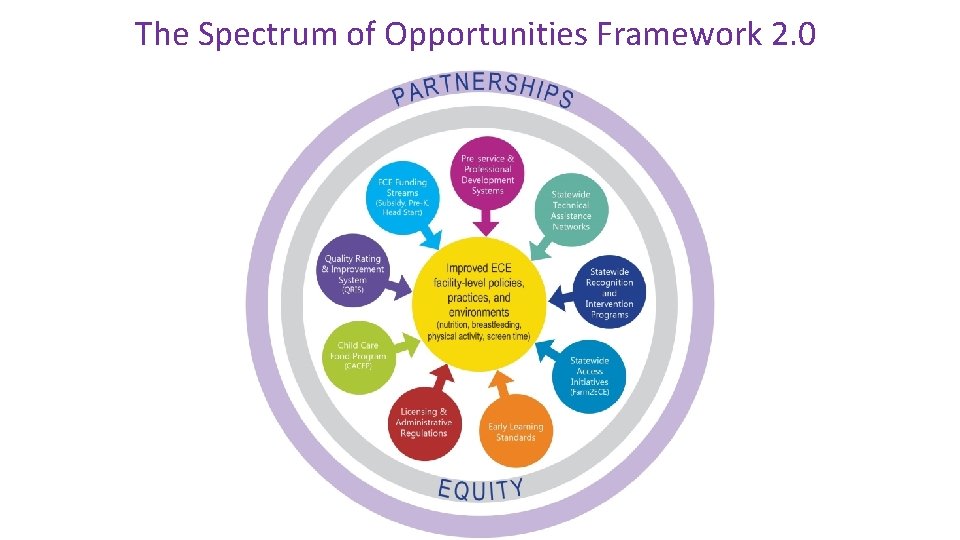
The Spectrum of Opportunities Framework 2. 0
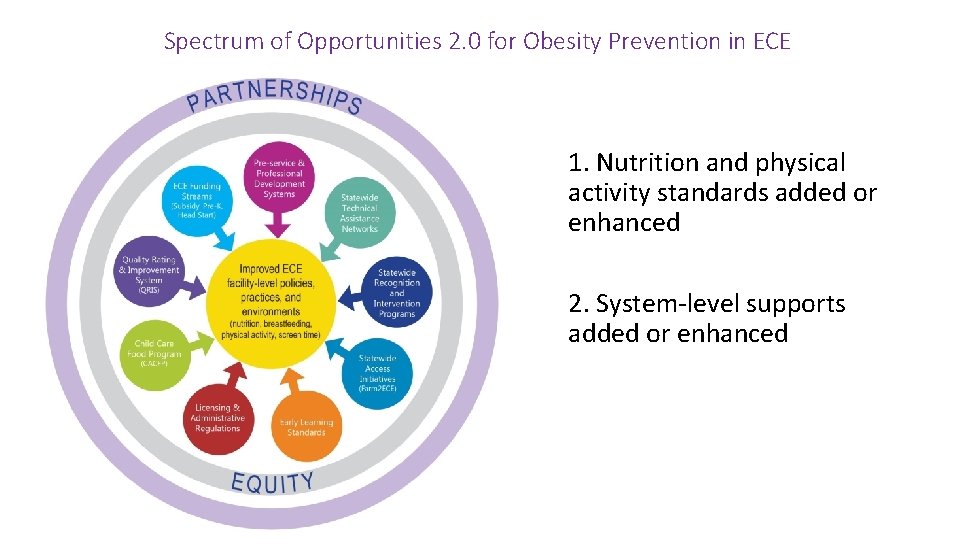
Framework for Obesity Prevention in ECE § CDC’s Spectrum of Opportunities 2. 0 • • • Serves as a framework for states/communities to help ECE facilities to meet national obesity prevention standards Identifies 9 avenues states/communities can pursue to embed obesity prevention standards/supports into ECE system New addition – suboptions! Gives ideas within each avenue how to actually make change § Guidance materials and worksheets accompany the Spectrum • • Assess the ECE landscape and build partnerships Identify avenues to pursue and plan implementation
Spectrum of Opportunities 2. 0 for Obesity Prevention in ECE 1. Nutrition and physical activity standards added or enhanced 2. System-level supports added or enhanced
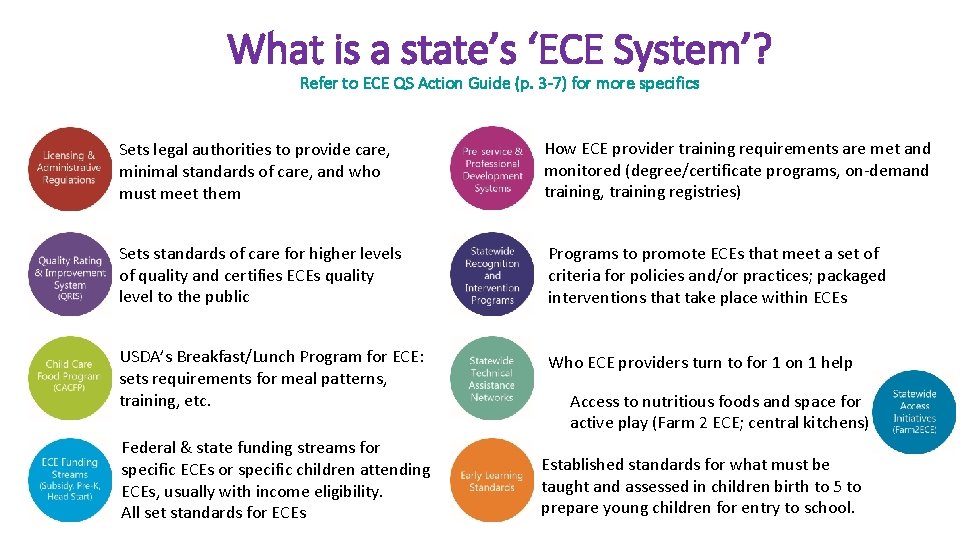
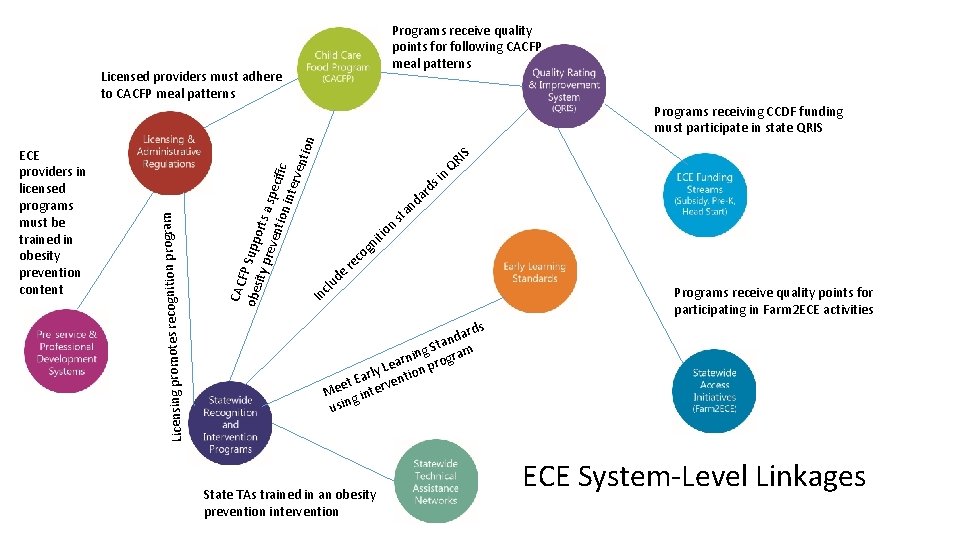
What is a state’s ‘ECE System’? Refer to ECE QS Action Guide (p. 3 -7) for more specifics Sets legal authorities to provide care, minimal standards of care, and who must meet them How ECE provider training requirements are met and monitored (degree/certificate programs, on-demand training, training registries) Sets standards of care for higher levels of quality and certifies ECEs quality level to the public Programs to promote ECEs that meet a set of criteria for policies and/or practices; packaged interventions that take place within ECEs USDA’s Breakfast/Lunch Program for ECE: sets requirements for meal patterns, training, etc. Who ECE providers turn to for 1 on 1 help Federal & state funding streams for specific ECEs or specific children attending ECEs, usually with income eligibility. All set standards for ECEs Access to nutritious foods and space for active play (Farm 2 ECE; central kitchens) Established standards for what must be taught and assessed in children birth to 5 to prepare young children for entry to school.
Farm to ECE and the SOO Ø Georgia Farm To ECE Overview and Strategy Report uses the SOO framework to outline the extent to which farm to ECE is already being supported within the state and to identify where stakeholders can work to enhance support Ø http: //georgiaorganics. org/wp-content/uploads/2013/08/FINALGAF 2 ECE-Strategic-Plan. pdf 10
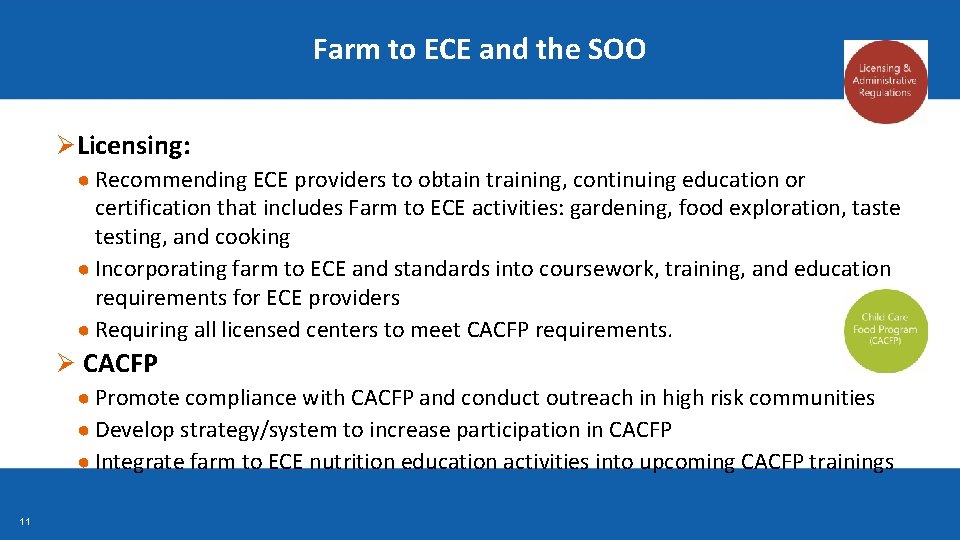
Farm to ECE and the SOO Ø Licensing: ● Recommending ECE providers to obtain training, continuing education or certification that includes Farm to ECE activities: gardening, food exploration, taste testing, and cooking ● Incorporating farm to ECE and standards into coursework, training, and education requirements for ECE providers ● Requiring all licensed centers to meet CACFP requirements. Ø CACFP ● Promote compliance with CACFP and conduct outreach in high risk communities ● Develop strategy/system to increase participation in CACFP ● Integrate farm to ECE nutrition education activities into upcoming CACFP trainings 11
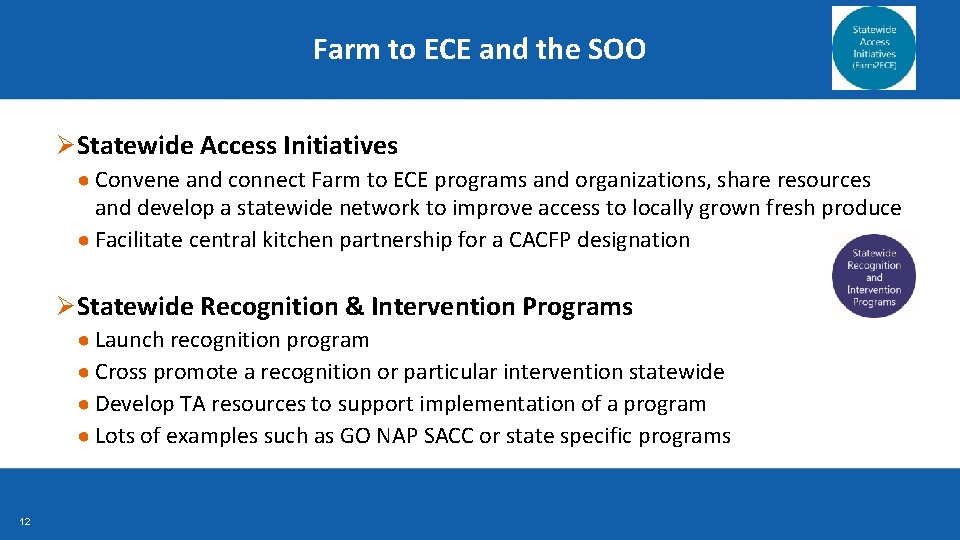
Farm to ECE and the SOO Ø Statewide Access Initiatives ● Convene and connect Farm to ECE programs and organizations, share resources and develop a statewide network to improve access to locally grown fresh produce ● Facilitate central kitchen partnership for a CACFP designation Ø Statewide Recognition & Intervention Programs ● Launch recognition program ● Cross promote a recognition or particular intervention statewide ● Develop TA resources to support implementation of a program ● Lots of examples such as GO NAP SACC or state specific programs 12
Farm to ECE and the SOO Ø Quality Rating and Improvement Systems (QRIS) ● FTECE standards could be imbedded into the Quality Rated program standards Ø Statewide Technical Assistance Networks ● Nutrition professionals/TA providers can provide technical assistance on menu planning, nutritional assessment of meals and snacks, training for foodservice personnel, and nutrition education for ECE providers, children, and families. ● Farm to ECE “train the trainer” sessions could target TA providers to help centers with gardening, cooking, introducing lessons, taste testing, and sourcing local foods. 13
Farm to ECE and the SOO Ø Pre-Service and Professional Development ● Develop, promote or use in person or on-line modules related to farm to ECE. ● Example in GA “Early Sprouts” is approved for 10 professional development hours in Georgia and costs $50 ● partner with academic institutions to provide specific farm to ECE-service opportunities for their students. ● Example: North Carolina’s The Appalachian Sustainable Agriculture Project (ASAP) created a “Learning Lab” with at a Head Start Center where university and college students can observe farm to school in practice 14
Farm to ECE and the SOO Ø Early Learning Standards ● Early Standards can be incorporated into farm to ECE initiatives or vice versa. Centers could have specific training on how lessons and activities can support a states Early Learning Standards ● A simple toolkit or website with lessons connected to state’s Early Learning Standards could help people understand the possible connections ● GA offers sample of free FTECE lessons connected to their states ELS 15
Farm to ECE and the SOO Ø Funding and Finance ● examples of funding sources that could potentially support farm to ECE sources that could support FTECE trainings, curriculums, or supplies ● USDA: Farm to school grant program q Team Nutrition Grants q Specialty Crop Grants q CACFP, WIC q CCDF and Preschool Development Grants q 16
Programs receive quality points for following CACFP meal patterns Licensed providers must adhere to CACFP meal patterns CAC F obe P Supp o sity prev rts a sp e enti on i cific nter vent ion Licensing promotes recogniti ECE providers in licensed programs must be trained in obesity prevention content on program Programs receiving CCDF funding must participate in state QRIS IS on og de c re ti ni ar d n i ds n QR a st clu In Programs receive quality points for participating in Farm 2 ECE activities s d dar n a g St ram n i n ear n prog L y l Ear rventio t e Me g inte usin State TAs trained in an obesity prevention intervention ECE System-Level Linkages
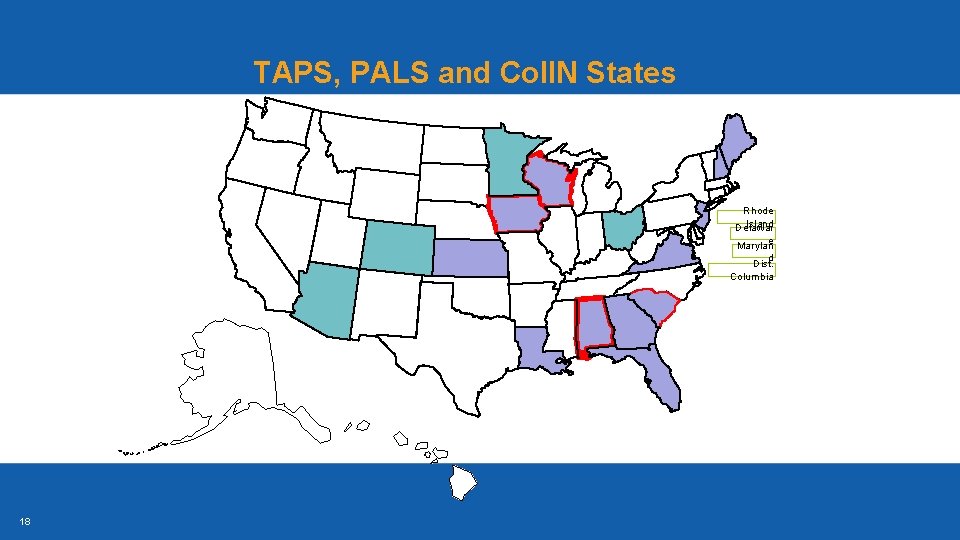
TAPS, PALS and Co. IIN States Rhode Island Delawar e Marylan d Dist. Columbia 18
Networking and Sharing Time Ø Networking activities and discussion time ● Spectrum of Opportunities Farm to ECE BINGO ● Find a Match 19
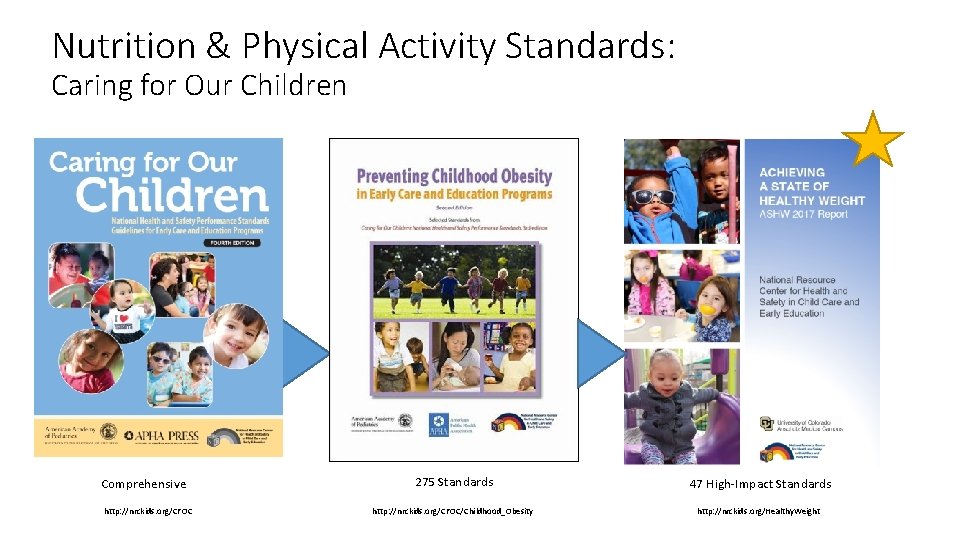
Nutrition & Physical Activity Standards: Caring for Our Children Comprehensive http: //nrckids. org/CFOC 275 Standards 47 High-Impact Standards http: //nrckids. org/CFOC/Childhood_Obesity http: //nrckids. org/Healthy. Weight