
Farm Bill Williamson The Agricultural Act of 2014
Farm Bill Williamson
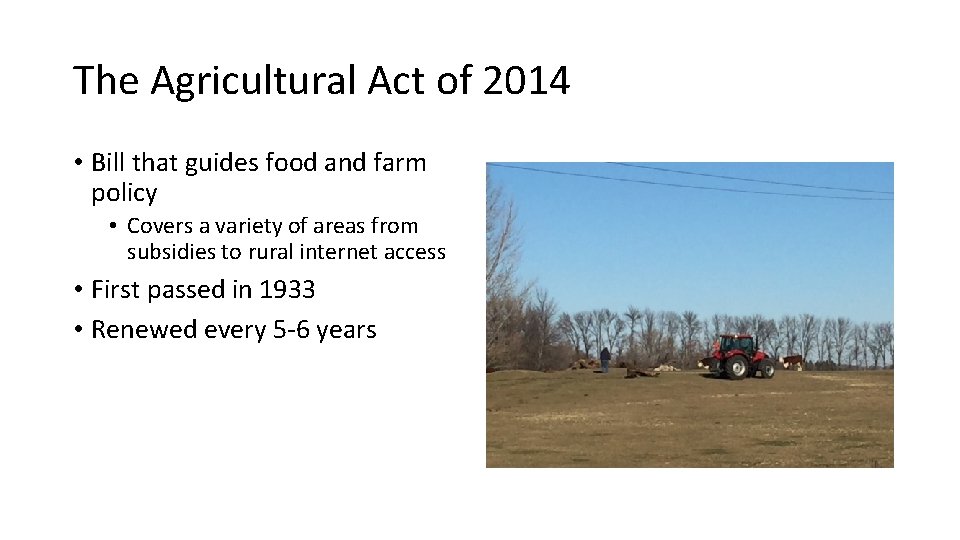
The Agricultural Act of 2014 • Bill that guides food and farm policy • Covers a variety of areas from subsidies to rural internet access • First passed in 1933 • Renewed every 5 -6 years
What does the farm bill cover? • Commodity (crops) • Conservation (wetlands) • Nutrition (School Lunch, Food Stamps) • Rural Development (Electricity, Internet) • Research (Extension Programs) • Forestry (Forest Restoration) • Energy (Ethanol) • Horticulture (Organic and specialty crops) • Crop Insurance (Reduces Costs) • Miscellaneous (Beginning Farmer Programs)

Crop Commodity Programs • The Agriculture Act of 2014 (AKA Farm Bill) provides benefits based on price or revenue targets for producers of corn and other feed grains, wheat, rice, soybeans and other oilseeds, peanuts, and pulses. These are called “covered commodities” in the Farm Bill. • Farm Bill also provides marketing assistance loans for covered commodities, cotton, wool, mohair, and honey producers. Nonrecourse loans, marketing allotments, and other provisions are provided for sugar producers.
Dairy and Livestock The 2014 Farm Bill provides support to dairy producers through two new programs and to livestock operations through disaster assistance programs. Highlights ● ● ● The Margin Protection Program (MPP) for dairy producers introduces an insurance program that provides benefits to dairy producers when the difference between milk prices and feed costs falls below a target margin. The Dairy Product Donation Program (DPDP) requires the Secretary of Agriculture to purchase dairy products at market prices for donation to nutrition programs whenever the margin between milk prices and feed prices falls below the minimum margin specified under the MPP. The Livestock Indemnity Program (LIP), Livestock Forage Disaster Program (LFP), and Emergency Assistance for Livestock, Honeybees, and Farm-Raised Fish Program (ELAP)—providing protection against losses from natural disasters, including disease
Conservation The Farm Bill provides assistance to producers and landowners to adopt conservation activities on agricultural and forest lands to protect and improve water quality and quantity, soil health, wildlife habitat and air quality. Highlights ● Emphasis on conservation on working lands ● Gradually reduces Conservation Reserve Program (CRP) cap from 32 million acres to 24 million acres by 2017. ● Consolidates many conservation programs into new programs or merges them into existing programs, reducing the number of USDA conservation programs from 23 to 13. ● Re-links crop insurance premium subsidies to Conservation Compliance (conservation of highly erodible land wetlands) for the first time since 1996.
Nutrition Reauthorizes the Supplemental Nutrition Assistance Program (SNAP), the Nation’s largest food and nutrition assistance program. Provides additional SNAP funding for enhanced employment and training activities, increased healthy food options, and expanded anti-fraud efforts. Highlights ● ● ● Provides funding to develop and test methods to increase employment of SNAP recipients, and imposes new requirements to evaluate and regularly report on outcomes of State SNAP Employment and Training Programs. Increases healthy food options of SNAP participants by requiring a larger variety of food options at authorized retailers and establishing a grant program to provide incentives for the purchase of fruits and vegetables by SNAP recipients. Enhances SNAP integrity by using improved information technologies to expand efforts to combat fraud and verify participant eligibility and income.
Rural Development • Provides for rural community and economic development program planning, coordination, and implementation • covers rural broadband investments, including distance learning and telemedicine • water and waste water treatment facilities • value-added agricultural activities, including renewable energy and locally and regionally produced agricultural products • General business assistance; chronically underserved rural communities • financing for essential community facilities, including schools, hospitals, and public safety.
Research, Extension and Related Matters 2014 Farm BIll authorizes funding for research, extension, and education—including competitive grants and capacity funding (i. e. , awarded by formula) to Land Grant institutions and State agricultural experiment stations, and intramural funding for USDA research agencies; identifies high-priority research areas and new research initiatives. Highlights ● ● The Foundation for Food and Agriculture Research is a new nonprofit institution to foster research and technology transfer through public-private collaborations. The 2014 Farm Act broadens support for animal health and disease research and veterinary services. Mandatory funding for specialty crops research and extension will increase High-priority research areas include pulses, coffee plants, corn and soy meal and other grain byproducts, and food safety training. Pollinator research is expanded to include health and population surveillance and a broader definition of pollinator disorders.
Energy The 2014 Farm Bill encourages investments in alternative energy technology and production of renewable biomass for biofuels through education, research, and financial assistance programs; encourages the manufacture and production of other renewable biochemical and biobased products through Federal procurement and financial assistance programs.
Crop Insurance The 2014 Farm Bill provides new and continuing insurance products to protect producers against losses resulting from price and yield risks. Under the Federal crop insurance program, private-sector insurance companies sell and service the policies, and USDA’s Risk Management Agency develops and/or approves the premium rate, administers premium and expense subsidies, approves and supports products, and reinsures the companies.
Specialty Crops The 2014 Farm Bill provides incentives for marketing and promotion of horticulture crops, data and information collection, plant pest and disease management, food safety education, and programs to facilitate the inclusion of fruits and vegetables in school feeding programs. Highlights ● ● ● Reauthorizes specialty crop block grants with increased funding and extends to include authorization for multi-State projects, with the amount of grants to a State based on production value and acreage. Expands the Specialty Crop Research Initiative (SCRI) and the Farmers Market and Local Foods Promotion programs. Expands the Fresh Fruit and Vegetable Program for schools; a pilot program will evaluate inclusion of canned, frozen, or dried fruits and vegetables in the program.
Organic Agriculture The 2014 Farm Bill aims to support the organic sector by expanding cost-share assistance for organic certification, maintaining the organic agricultural research initiative, and improving organic crop insurance and marketing programs. Highlights ● ● Substantially expands funding to assist organic producers and handlers with the cost of organic certification. Requires improvements in crop insurance for organic producers and strengthens enforcement of organic regulations.
Local and Regional Foods 2014 Farm Bill provides support across several titles of the farm bill for increased consumer access to and marketing of locally and regionally produced food. Highlights ● ● Expands the scope, funding, and name of the Farmers’ Market and Local Food Promotion Program to include local and regional food business enterprises. Creates a new program to provide grants to organizations that encourage fruit and vegetable consumption by SNAP recipients through increasing their purchasing power. Includes a preference for projects involving local food and direct-to-consumer sales venues.
Beginning Farmers and Ranchers 2014 Farm Bill provides support to beginning farmers and ranchers in agriculture by increasing funding for beginning farmer development, facilitating farmland transition to the next generation of farmers, and improving outreach and communication to military veterans about farming and ranching opportunities.
Socially Disadvantaged and Veteran Farmers and Ranchers 2014 Farm Bill provides support to socially disadvantaged and veteran farmers through increased funding for beginning farmer development; incentives for retiring farmers to sell or lease land coming out of the Conservation Reserve Program (CRP) to veteran farmers and ranchers; and improved outreach and communication to military veterans about farming and ranching opportunities.
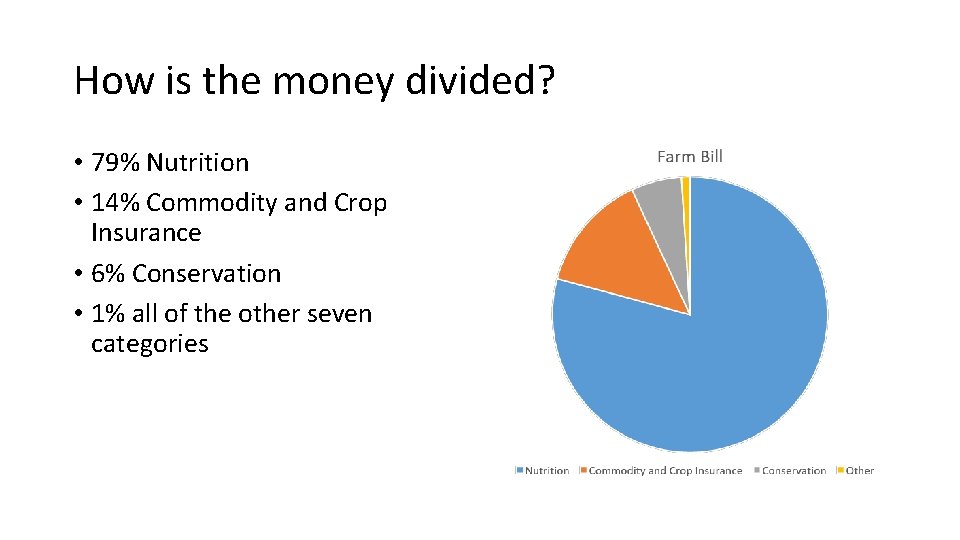
How is the money divided? • 79% Nutrition • 14% Commodity and Crop Insurance • 6% Conservation • 1% all of the other seven categories
Sources • http: //www. taxpayer. net/images/uploads/downloads/Farm_Bill_101 _FINAL_updated. pdf • https: //www. fsa. usda. gov/programs-and-services/farm-bill/index
- Slides: 18