
FAREBOX RECOVERY RATIO STATE PERSPECTIVE CALACT 2018 Spring
FAREBOX RECOVERY RATIO STATE PERSPECTIVE CALACT 2018 Spring Conference April 5 th, 2018
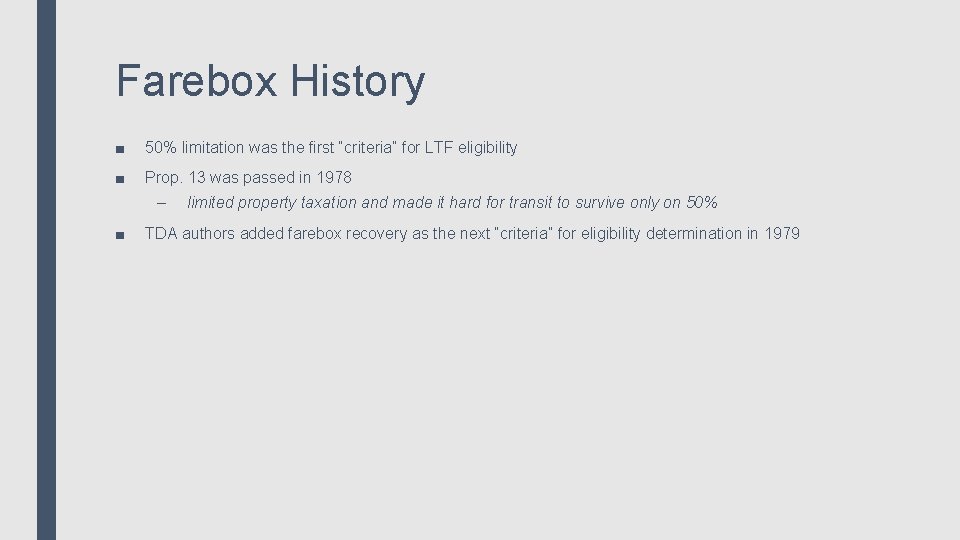
Farebox History ■ 50% limitation was the first “criteria” for LTF eligibility ■ Prop. 13 was passed in 1978 – ■ limited property taxation and made it hard for transit to survive only on 50% TDA authors added farebox recovery as the next “criteria” for eligibility determination in 1979
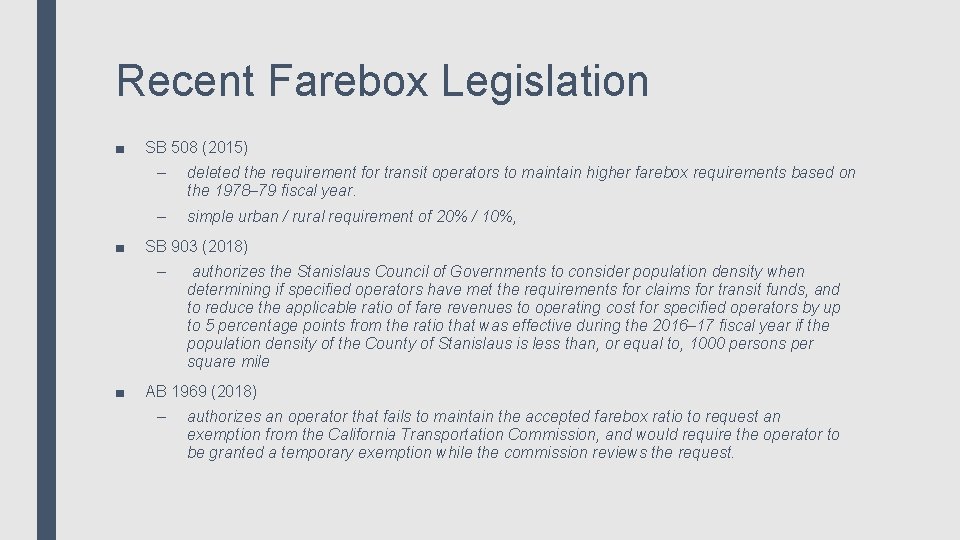
Recent Farebox Legislation ■ ■ SB 508 (2015) – deleted the requirement for transit operators to maintain higher farebox requirements based on the 1978– 79 fiscal year. – simple urban / rural requirement of 20% / 10%, SB 903 (2018) – ■ authorizes the Stanislaus Council of Governments to consider population density when determining if specified operators have met the requirements for claims for transit funds, and to reduce the applicable ratio of fare revenues to operating cost for specified operators by up to 5 percentage points from the ratio that was effective during the 2016– 17 fiscal year if the population density of the County of Stanislaus is less than, or equal to, 1000 persons per square mile AB 1969 (2018) – authorizes an operator that fails to maintain the accepted farebox ratio to request an exemption from the California Transportation Commission, and would require the operator to be granted a temporary exemption while the commission reviews the request.

SB 508 – Key Changes ■ New definition of local revenue to supplement fare revenues ■ Exemptions to calculation of operating expense ■ Relief from STA Performance Measure requirements

SB 508 – Key Changes SB 508 changed the definition of local revenue that can supplement fare revenues. Prior to SB 508 ■ Fare revenue was limited to local option sales tax. SB 508 as Chaptered: ■ Local funds, counted toward the farebox recovery ratio requirement, include any nonfederal or nonstate grants or other revenues generated by, or distributed to the operator. – advertising, package express revenue, transient occupancy tax, or other local revenue sources.
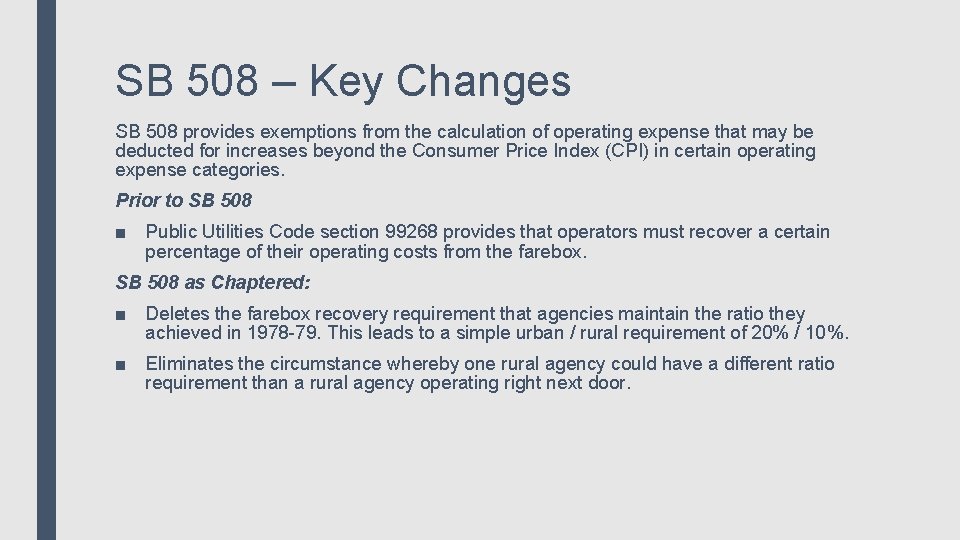
SB 508 – Key Changes SB 508 provides exemptions from the calculation of operating expense that may be deducted for increases beyond the Consumer Price Index (CPI) in certain operating expense categories. Prior to SB 508 ■ Public Utilities Code section 99268 provides that operators must recover a certain percentage of their operating costs from the farebox. SB 508 as Chaptered: ■ Deletes the farebox recovery requirement that agencies maintain the ratio they achieved in 1978 -79. This leads to a simple urban / rural requirement of 20% / 10%. ■ Eliminates the circumstance whereby one rural agency could have a different ratio requirement than a rural agency operating right next door.
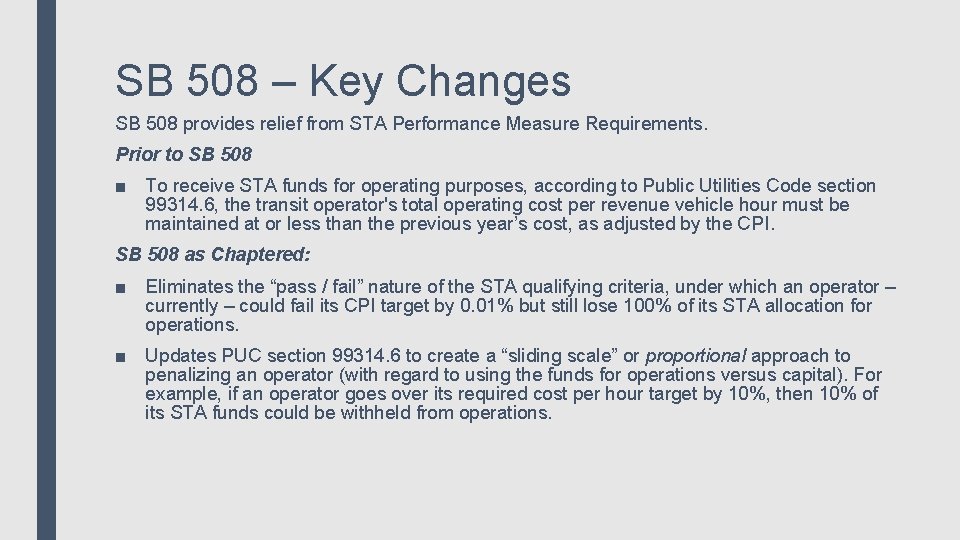
SB 508 – Key Changes SB 508 provides relief from STA Performance Measure Requirements. Prior to SB 508 ■ To receive STA funds for operating purposes, according to Public Utilities Code section 99314. 6, the transit operator's total operating cost per revenue vehicle hour must be maintained at or less than the previous year’s cost, as adjusted by the CPI. SB 508 as Chaptered: ■ Eliminates the “pass / fail” nature of the STA qualifying criteria, under which an operator – currently – could fail its CPI target by 0. 01% but still lose 100% of its STA allocation for operations. ■ Updates PUC section 99314. 6 to create a “sliding scale” or proportional approach to penalizing an operator (with regard to using the funds for operations versus capital). For example, if an operator goes over its required cost per hour target by 10%, then 10% of its STA funds could be withheld from operations.
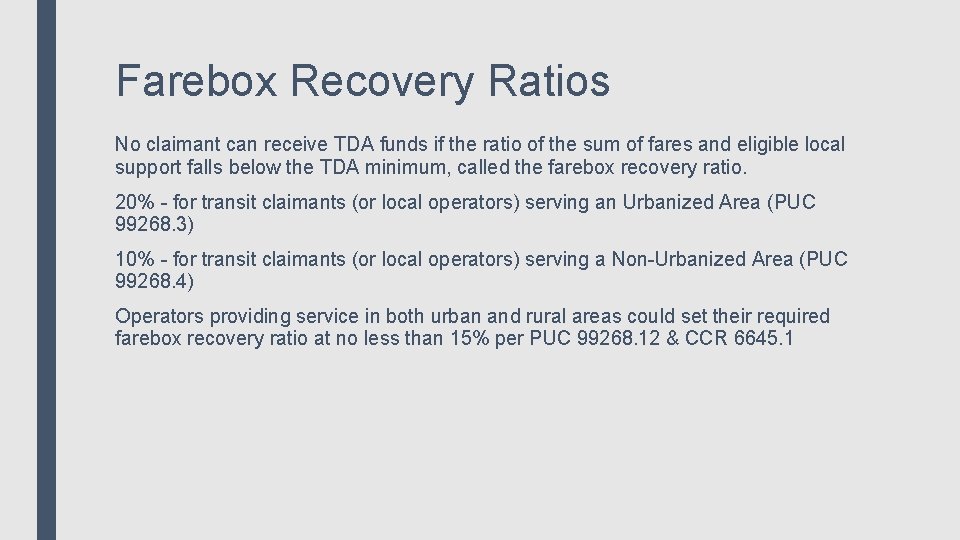
Farebox Recovery Ratios No claimant can receive TDA funds if the ratio of the sum of fares and eligible local support falls below the TDA minimum, called the farebox recovery ratio. 20% - for transit claimants (or local operators) serving an Urbanized Area (PUC 99268. 3) 10% - for transit claimants (or local operators) serving a Non-Urbanized Area (PUC 99268. 4) Operators providing service in both urban and rural areas could set their required farebox recovery ratio at no less than 15% per PUC 99268. 12 & CCR 6645. 1
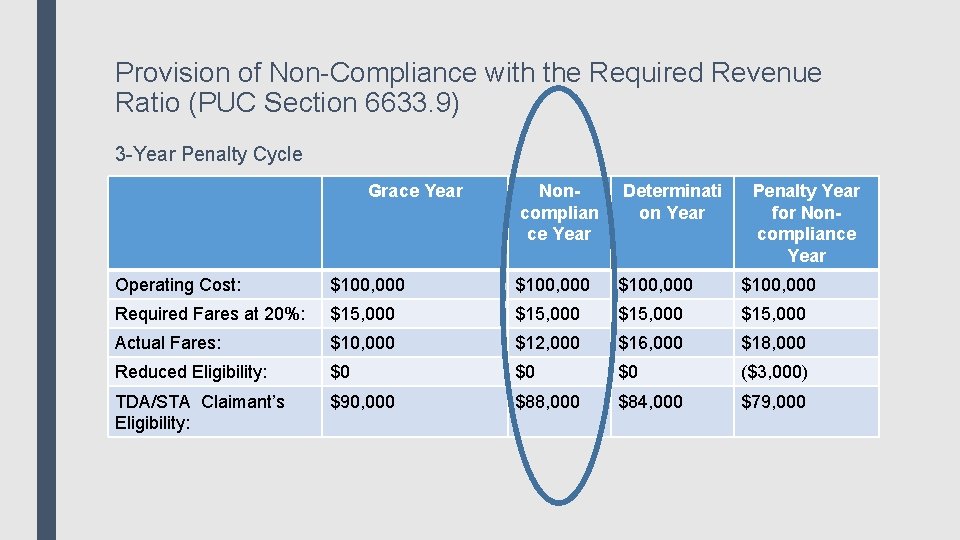
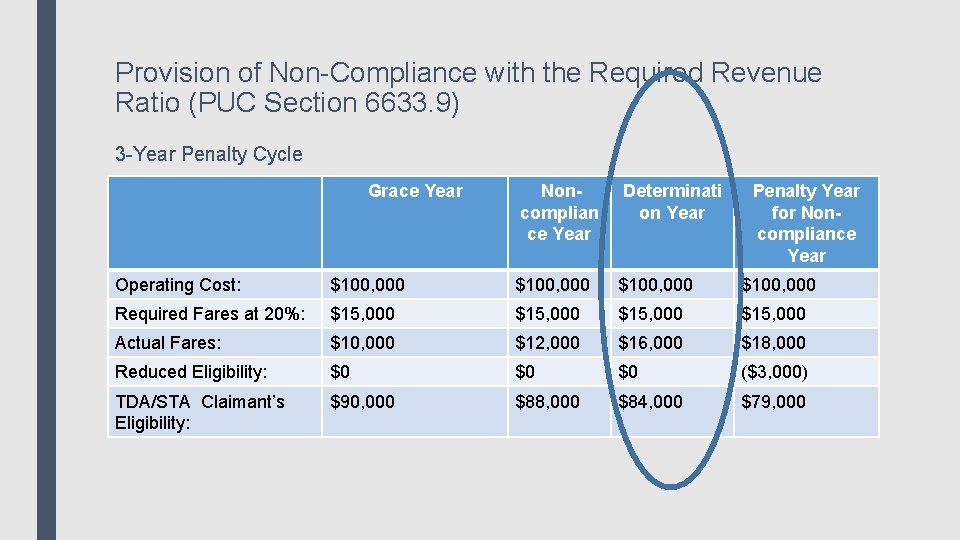
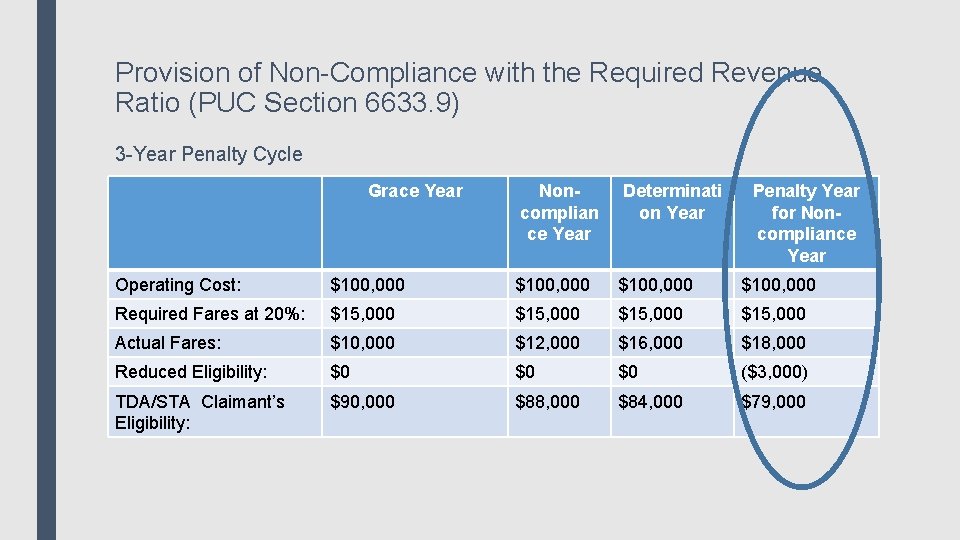
What happens when you don’t meet the Farebox Recovery Ratio? In the event that a transit claimant does not meet the required farebox recovery ratio they must comply with the provision of Non-Compliance with the Required Revenue Ratio (PUC Section 99268. 9 & CCR Section 6633. 9)
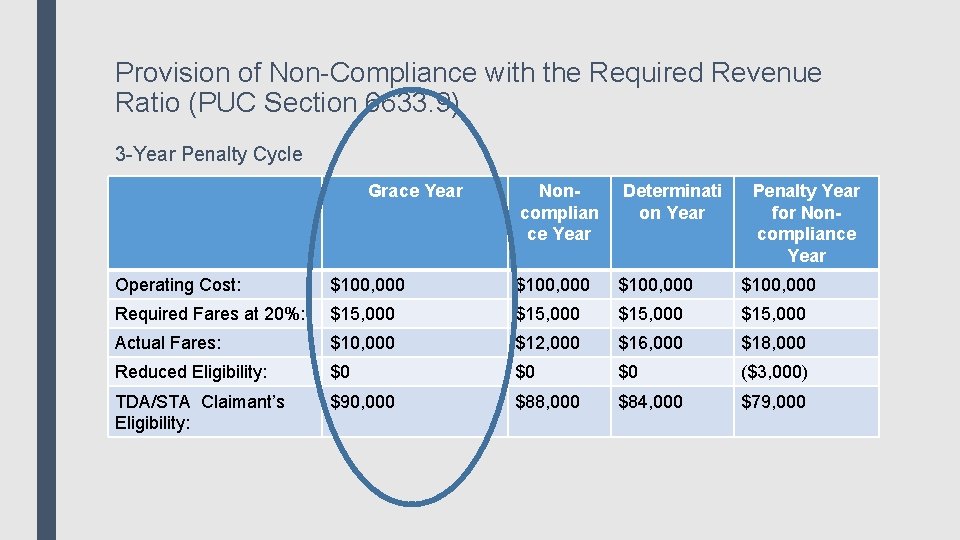
Provision of Non-Compliance with the Required Revenue Ratio (PUC Section 6633. 9) 3 -Year Penalty Cycle Grace Year Noncomplian ce Year Determinati on Year Penalty Year for Noncompliance Year Operating Cost: $100, 000 Required Fares at 20%: $15, 000 Actual Fares: $10, 000 $12, 000 $16, 000 $18, 000 Reduced Eligibility: $0 $0 $0 ($3, 000) TDA/STA Claimant’s Eligibility: $90, 000 $88, 000 $84, 000 $79, 000
Provision of Non-Compliance with the Required Revenue Ratio (PUC Section 6633. 9) 3 -Year Penalty Cycle Grace Year Noncomplian ce Year Determinati on Year Penalty Year for Noncompliance Year Operating Cost: $100, 000 Required Fares at 20%: $15, 000 Actual Fares: $10, 000 $12, 000 $16, 000 $18, 000 Reduced Eligibility: $0 $0 $0 ($3, 000) TDA/STA Claimant’s Eligibility: $90, 000 $88, 000 $84, 000 $79, 000
Provision of Non-Compliance with the Required Revenue Ratio (PUC Section 6633. 9) 3 -Year Penalty Cycle Grace Year Noncomplian ce Year Determinati on Year Penalty Year for Noncompliance Year Operating Cost: $100, 000 Required Fares at 20%: $15, 000 Actual Fares: $10, 000 $12, 000 $16, 000 $18, 000 Reduced Eligibility: $0 $0 $0 ($3, 000) TDA/STA Claimant’s Eligibility: $90, 000 $88, 000 $84, 000 $79, 000
Provision of Non-Compliance with the Required Revenue Ratio (PUC Section 6633. 9) 3 -Year Penalty Cycle Grace Year Noncomplian ce Year Determinati on Year Penalty Year for Noncompliance Year Operating Cost: $100, 000 Required Fares at 20%: $15, 000 Actual Fares: $10, 000 $12, 000 $16, 000 $18, 000 Reduced Eligibility: $0 $0 $0 ($3, 000) TDA/STA Claimant’s Eligibility: $90, 000 $88, 000 $84, 000 $79, 000
If an issue exists we can fix it… *PUC 99241, authorizes Caltrans to adopt or amend proposed regulations in the California Code of Regulations (CCR).
Contact Information: Joshua Pulverman Senior Transportation Planner Caltrans, Division of Rail and Mass Transportation (916) 657 -3863 josh. pulverman@dot. ca. gov
- Slides: 15