Fandom Jenkins Five patterns of fan engagement identification
- Slides: 37
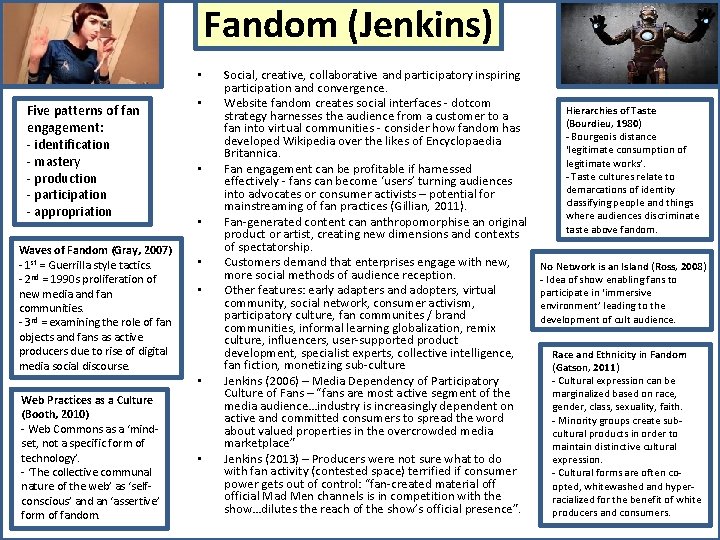
Fandom (Jenkins) • Five patterns of fan engagement: - identification - mastery - production - participation - appropriation Waves of Fandom (Gray, 2007) - 1 st = Guerrilla style tactics. - 2 nd = 1990 s proliferation of new media and fan communities. - 3 rd = examining the role of fan objects and fans as active producers due to rise of digital media social discourse. Web Practices as a Culture (Booth, 2010) - Web Commons as a ‘mindset, not a specific form of technology’. - ‘The collective communal nature of the web’ as ‘selfconscious’ and an ‘assertive’ form of fandom. • • Social, creative, collaborative and participatory inspiring participation and convergence. Website fandom creates social interfaces - dotcom strategy harnesses the audience from a customer to a fan into virtual communities - consider how fandom has developed Wikipedia over the likes of Encyclopaedia Britannica. Fan engagement can be profitable if harnessed effectively - fans can become ‘users’ turning audiences into advocates or consumer activists – potential for mainstreaming of fan practices (Gillian, 2011). Fan-generated content can anthropomorphise an original product or artist, creating new dimensions and contexts of spectatorship. Customers demand that enterprises engage with new, more social methods of audience reception. Other features: early adapters and adopters, virtual community, social network, consumer activism, participatory culture, fan communites / brand communities, informal learning globalization, remix culture, influencers, user-supported product development, specialist experts, collective intelligence, fan fiction, monetizing sub-culture Jenkins (2006) – Media Dependency of Participatory Culture of Fans – “fans are most active segment of the media audience…industry is increasingly dependent on active and committed consumers to spread the word about valued properties in the overcrowded media marketplace” Jenkins (2013) – Producers were not sure what to do with fan activity (contested space) terrified if consumer power gets out of control: “fan-created material official Mad Men channels is in competition with the show…dilutes the reach of the show’s official presence”. Hierarchies of Taste (Bourdieu, 1980) - Bourgeois distance ‘legitimate consumption of legitimate works’. - Taste cultures relate to demarcations of identity classifying people and things where audiences discriminate taste above fandom. No Network is an Island (Ross, 2008) - Idea of show enabling fans to participate in ‘immersive environment’ leading to the development of cult audience. Race and Ethnicity in Fandom (Gatson, 2011) - Cultural expression can be marginalized based on race, gender, class, sexuality, faith. - Minority groups create subcultural products in order to maintain distinctive cultural expression. - Cultural forms are often coopted, whitewashed and hyperracialized for the benefit of white producers and consumers.
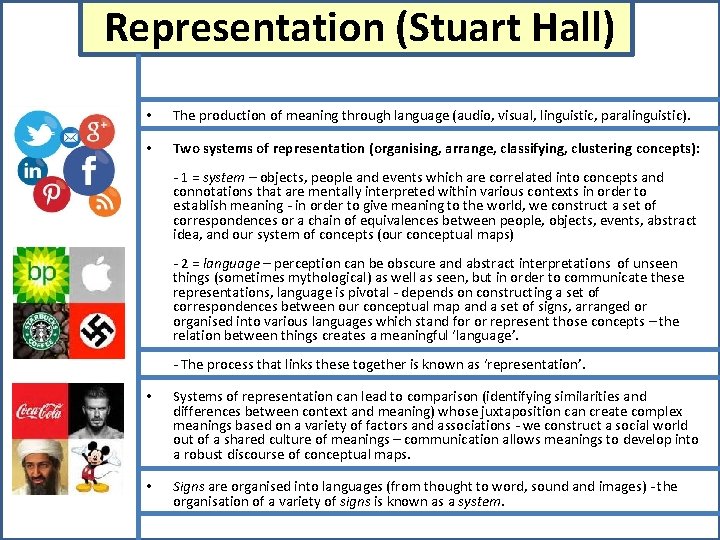
Representation (Stuart Hall) • The production of meaning through language (audio, visual, linguistic, paralinguistic). • Two systems of representation (organising, arrange, classifying, clustering concepts): - 1 = system – objects, people and events which are correlated into concepts and connotations that are mentally interpreted within various contexts in order to establish meaning - in order to give meaning to the world, we construct a set of correspondences or a chain of equivalences between people, objects, events, abstract idea, and our system of concepts (our conceptual maps) - 2 = language – perception can be obscure and abstract interpretations of unseen things (sometimes mythological) as well as seen, but in order to communicate these representations, language is pivotal - depends on constructing a set of correspondences between our conceptual map and a set of signs, arranged or organised into various languages which stand for or represent those concepts – the relation between things creates a meaningful ‘language’. - The process that links these together is known as ‘representation’. • Systems of representation can lead to comparison (identifying similarities and differences between context and meaning) whose juxtaposition can create complex meanings based on a variety of factors and associations - we construct a social world out of a shared culture of meanings – communication allows meanings to develop into a robust discourse of conceptual maps. • Signs are organised into languages (from thought to word, sound and images) - the organisation of a variety of signs is known as a system.
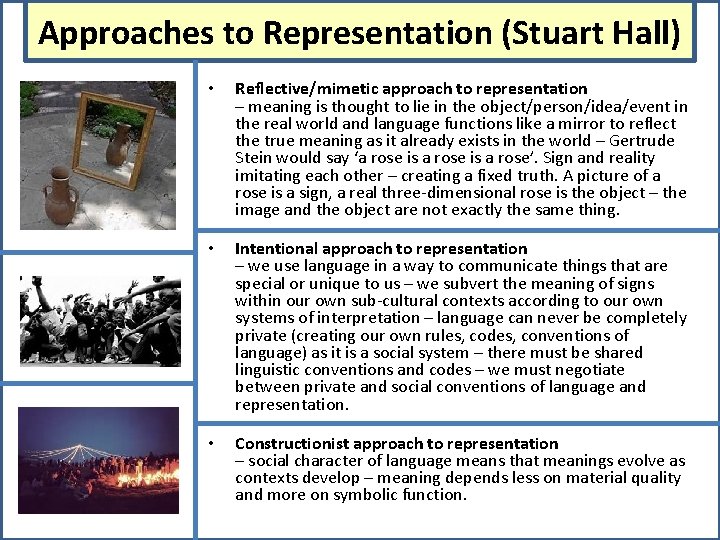
Approaches to Representation (Stuart Hall) • Reflective/mimetic approach to representation – meaning is thought to lie in the object/person/idea/event in the real world and language functions like a mirror to reflect the true meaning as it already exists in the world – Gertrude Stein would say ‘a rose is a rose’. Sign and reality imitating each other – creating a fixed truth. A picture of a rose is a sign, a real three-dimensional rose is the object – the image and the object are not exactly the same thing. • Intentional approach to representation – we use language in a way to communicate things that are special or unique to us – we subvert the meaning of signs within our own sub-cultural contexts according to our own systems of interpretation – language can never be completely private (creating our own rules, codes, conventions of language) as it is a social system – there must be shared linguistic conventions and codes – we must negotiate between private and social conventions of language and representation. • Constructionist approach to representation – social character of language means that meanings evolve as contexts develop – meaning depends less on material quality and more on symbolic function.
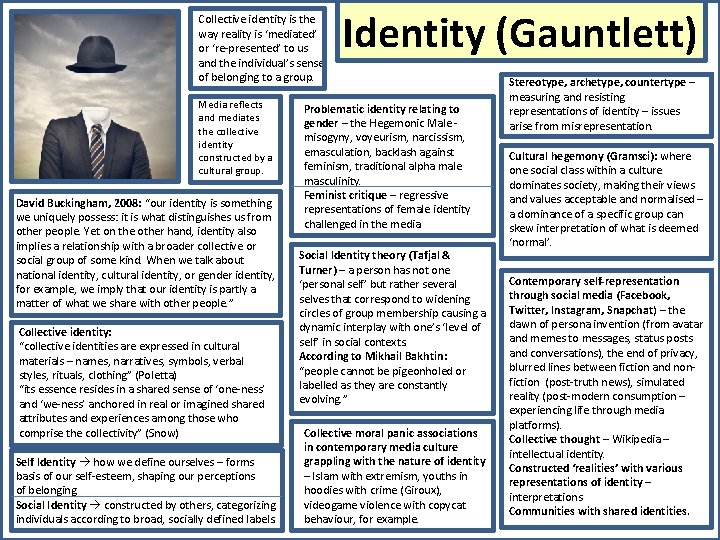
Collective identity is the way reality is ‘mediated’ or ‘re-presented’ to us and the individual’s sense of belonging to a group. Media reflects and mediates the collective identity constructed by a cultural group. David Buckingham, 2008: “our identity is something we uniquely possess: it is what distinguishes us from other people. Yet on the other hand, identity also implies a relationship with a broader collective or social group of some kind. When we talk about national identity, cultural identity, or gender identity, for example, we imply that our identity is partly a matter of what we share with other people. ” Collective identity: “collective identities are expressed in cultural materials – names, narratives, symbols, verbal styles, rituals, clothing” (Poletta) “its essence resides in a shared sense of ‘one-ness’ and ‘we-ness’ anchored in real or imagined shared attributes and experiences among those who comprise the collectivity” (Snow) Self Identity how we define ourselves – forms basis of our self-esteem, shaping our perceptions of belonging. Social Identity constructed by others, categorizing individuals according to broad, socially defined labels. Identity (Gauntlett) Problematic identity relating to gender – the Hegemonic Male - misogyny, voyeurism, narcissism, emasculation, backlash against feminism, traditional alpha male masculinity. Feminist critique – regressive representations of female identity challenged in the media. Social Identity theory (Tafjal & Turner) – a person has not one ‘personal self’ but rather several selves that correspond to widening circles of group membership causing a dynamic interplay with one’s ‘level of self’ in social contexts. According to Mikhail Bakhtin: “people cannot be pigeonholed or labelled as they are constantly evolving. ” Collective moral panic associations in contemporary media culture grappling with the nature of identity – Islam with extremism, youths in hoodies with crime (Giroux), videogame violence with copycat behaviour, for example. Stereotype, archetype, countertype – measuring and resisting representations of identity – issues arise from misrepresentation. Cultural hegemony (Gramsci): where one social class within a culture dominates society, making their views and values acceptable and normalised – a dominance of a specific group can skew interpretation of what is deemed ‘normal’. Contemporary self-representation through social media (Facebook, Twitter, Instagram, Snapchat) – the dawn of persona invention (from avatar and memes to messages, status posts and conversations), the end of privacy, blurred lines between fiction and nonfiction (post-truth news), simulated reality (post-modern consumption – experiencing life through media platforms). Collective thought – Wikipedia – intellectual identity. Constructed ‘realities’ with various representations of identity – interpretations Communities with shared identities.
The Byron Review (2008) – Media may have some influence on negative behaviour in children but should not be singled out as a cause. – Sociocultural and psychological contexts are also crucial. - There is no evidence of ‘desensitisation’ from playing video games – The idea that games are addictive is based on prejudice. - However, the BBFC’s steady liberalisation since late 1990 s and creation of Ofcom has led to more emphasis on ‘self-regulation’ (parents not institutions). - The relatively unregulated internet is contentious. Media regulation key words Media regulation = the control or guidance of mass media by governments and other bodies. Gatekeeping = the process through which information is filtered for dissemination, whether for publication, broadcasting, the Internet, or some other mode of communication. Classification = preventing people from accessing material that is deemed unsuitable for their age. Censorship = removing material from public material altogether. Moralists = believe that people need to be protected from the harmful effects of the media. e. g. parents believe children need to be controlled in using video games. Pluralists = believe that people should choose what they watch. Press regulation Media Regulation Normative Theory - Press should be mirroring public opinion and interest whilst be fully inclusive of any apparent, important or impending affairs. - It is argued that, this along with a free press, is the ideal situation. - However, a free press often leads to press abuse, ideological radicalisation and an infringement on the human rights of the subject of journalistic investigation. Super Injunctions - A super injunction is a means in which a body can submit a block of all media coverage regarding an event. - This prevents UK papers and news sources from reporting any information on the event, even if in ‘the public interest’. - Super injunctions are often used to hide embarrassing personal stories, for instance, celebrities who have had affairs or have solicited prostitutes. - The problem with a super injunction is the ability to fully hide a story in this social media era is impossible. - The Leveson Report – a government initiated inquiry into press abuses that included hacking scandals and examples of defamation, slander and libel by newspapers such as the News Corporation (Rupert Murdoch) owned ‘News of the World’, as well as ‘The Mirror’ and ‘Daily Mail’. - Press Complaints Commission (PCC) – non-government voluntary organisation and has no statutory or legal powers. Newspapers would use a ‘publish and be damned’ ethos because damages if sued would be worth the hassle. - Big, rich newspaper organisations that can afford the occasional defamation/libel/slander case. The PCC was a form of self-regulation as many on the board were ex-news editors. After The Leveson Inquiry revealed the PCC’s incompetence, it disbanded in 2012. - Independent Press Standards Organisation (IPSO) is a new press regulator set up after the Leveson Inquiry.
Media Regulation BBFC - Key Legislation 1959 – Obscene publications act – The law that defines obscenity and separates it from serious works of art 1978 – Protection act of children – Legislation governing indecent images of children 1984 – Video recording act – Legislation that introduced compulsory video act 1988 – Copyright act – The key British copyright legislation 1994 – Criminal justice act – Wide ranging legislation that also extended film and video censorship 2006 – Animal welfare act - It is illegal to supply, publish, show or possess with intent to supply a video recording of an ‘animal fight’ that has taken place within Great Britain For Against Protect vulnerable members of out society from harm Freedom of speech – everyone should have the right to say what they want, and watch/read what they want. Children in particular need protecting – Bobo Doll experiment proves the Hypodermic Syringe Theory to be of some truth, that children will be influenced by what they see. O’Davey – Critic – Violence plays a vital part in our lives; it is often the catalyst for other emotions that lead to films being made that express these. Douglas Gentile – Media effects researcher – Offers a range of scientific proof that dangerous behaviour increases due to playing violent video games. Martin Baker – Media effects researcher – We need to see violence as it is a part of real life and helps us to understand the world we live in. Protect privacy of celebrities or families of victims. Press has been guilty of intrusion, hacking, lying, and intimidating. Celebrities have put themselves in the spotlight, they should learn to expect the press to do what they do. Protect animals from harm If the government regulates the press, this wouldn't’t be democratic. Barker and Petley – There is an obsession with trying to prove that the media are responsible for a range of social problems and the researchers who want to find this link carry on without any evidence. Gauntlett – Argues that web 2. 0 media erodes boundaries between producer and audience – media 2. 0 Douglas Gentile - Media Effects Researcher - Offers a range of scientific ‘proof’ that antisocial and dangerous behaviour increases due to playing violent video games. Mark Kermode – media and film critic -The public has a responsibility to look after itself and they are giving this up to the regulators. Accuses the BBFC of being more liberal in their classification of ‘Arthouse’ cinema; taking into account assumptions about the white, middle-class, middle-aged audience. O Davey – Critic - Violence plays a vital part in all our lives; it is often the catalyst for other emotions that lead to films being made that express these. Violence cannot be distinguished from film as we cannot distinguish violence from life. Martin Barker - Media Effects Researcher. - We need to see violence as it is part of real life and helps us to understand the world we live in. We are able to make a distinction between real and onscreen violence; it is the content, not the amount of violence that matters Owen Jones – Political commentator – We need to challenge the way the media has been monopolized by the small number of oligarchs – we should restrict ownership so you can only have 1 outlet per owner.
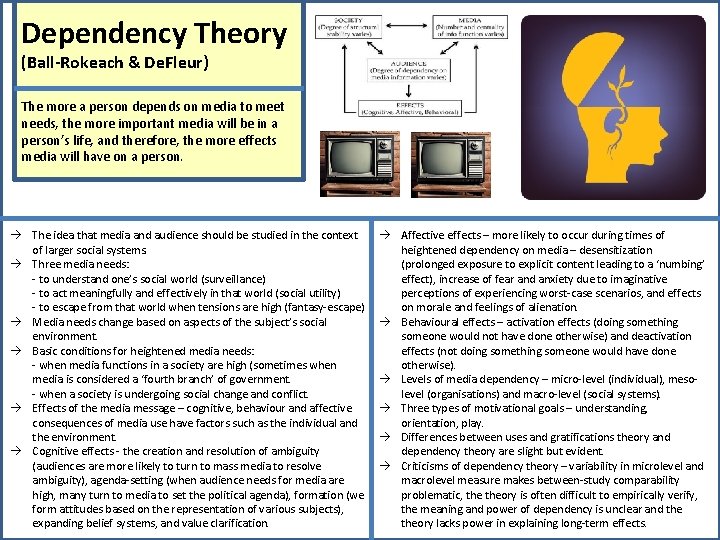
Dependency Theory (Ball-Rokeach & De. Fleur) The more a person depends on media to meet needs, the more important media will be in a person’s life, and therefore, the more effects media will have on a person. The idea that media and audience should be studied in the context of larger social systems. Three media needs: - to understand one’s social world (surveillance) - to act meaningfully and effectively in that world (social utility) - to escape from that world when tensions are high (fantasy-escape) Media needs change based on aspects of the subject’s social environment. Basic conditions for heightened media needs: - when media functions in a society are high (sometimes when media is considered a ‘fourth branch’ of government. - when a society is undergoing social change and conflict. Effects of the media message – cognitive, behaviour and affective consequences of media use have factors such as the individual and the environment. Cognitive effects - the creation and resolution of ambiguity (audiences are more likely to turn to mass media to resolve ambiguity), agenda-setting (when audience needs for media are high, many turn to media to set the political agenda), formation (we form attitudes based on the representation of various subjects), expanding belief systems, and value clarification. Affective effects – more likely to occur during times of heightened dependency on media – desensitization (prolonged exposure to explicit content leading to a ‘numbing’ effect), increase of fear and anxiety due to imaginative perceptions of experiencing worst-case scenarios, and effects on morale and feelings of alienation. Behavioural effects – activation effects (doing something someone would not have done otherwise) and deactivation effects (not doing something someone would have done otherwise). Levels of media dependency – micro-level (individual), mesolevel (organisations) and macro-level (social systems). Three types of motivational goals – understanding, orientation, play. Differences between uses and gratifications theory and dependency theory are slight but evident. Criticisms of dependency theory – variability in microlevel and macrolevel measure makes between-study comparability problematic, theory is often difficult to empirically verify, the meaning and power of dependency is unclear and theory lacks power in explaining long-term effects.
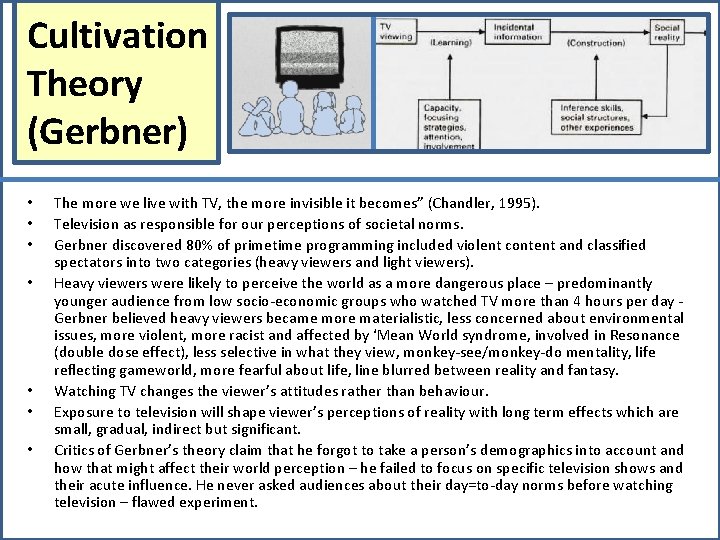
Cultivation Theory (Gerbner) • • The more we live with TV, the more invisible it becomes” (Chandler, 1995). Television as responsible for our perceptions of societal norms. Gerbner discovered 80% of primetime programming included violent content and classified spectators into two categories (heavy viewers and light viewers). Heavy viewers were likely to perceive the world as a more dangerous place – predominantly younger audience from low socio-economic groups who watched TV more than 4 hours per day - Gerbner believed heavy viewers became more materialistic, less concerned about environmental issues, more violent, more racist and affected by ‘Mean World syndrome, involved in Resonance (double dose effect), less selective in what they view, monkey-see/monkey-do mentality, life reflecting gameworld, more fearful about life, line blurred between reality and fantasy. Watching TV changes the viewer’s attitudes rather than behaviour. Exposure to television will shape viewer’s perceptions of reality with long term effects which are small, gradual, indirect but significant. Critics of Gerbner’s theory claim that he forgot to take a person’s demographics into account and how that might affect their world perception – he failed to focus on specific television shows and their acute influence. He never asked audiences about their day=to-day norms before watching television – flawed experiment.
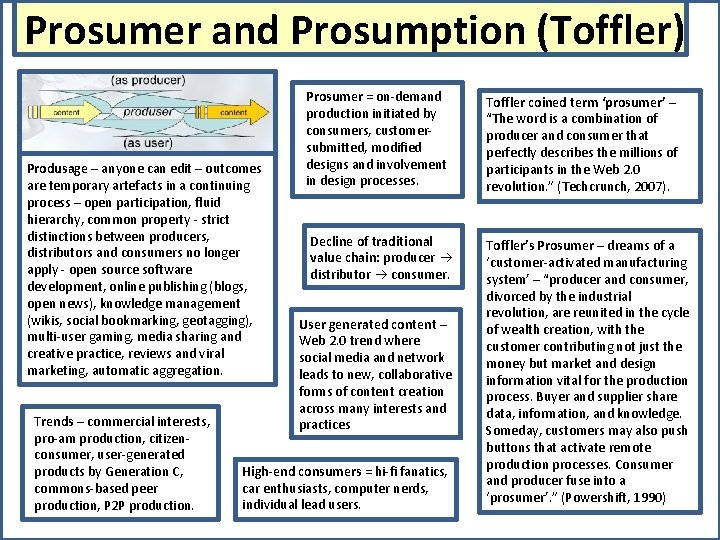
Prosumer and Prosumption (Toffler) Produsage – anyone can edit – outcomes are temporary artefacts in a continuing process – open participation, fluid hierarchy, common property - strict distinctions between producers, distributors and consumers no longer apply - open source software development, online publishing (blogs, open news), knowledge management (wikis, social bookmarking, geotagging), multi-user gaming, media sharing and creative practice, reviews and viral marketing, automatic aggregation. Trends – commercial interests, pro-am production, citizenconsumer, user-generated products by Generation C, commons-based peer production, P 2 P production. Prosumer = on-demand production initiated by consumers, customersubmitted, modified designs and involvement in design processes. Toffler coined term ‘prosumer’ – “The word is a combination of producer and consumer that perfectly describes the millions of participants in the Web 2. 0 revolution. ” (Techcrunch, 2007). Decline of traditional value chain: producer distributor consumer. Toffler’s Prosumer – dreams of a ‘customer-activated manufacturing system’ – “producer and consumer, divorced by the industrial revolution, are reunited in the cycle of wealth creation, with the customer contributing not just the money but market and design information vital for the production process. Buyer and supplier share data, information, and knowledge. Someday, customers may also push buttons that activate remote production processes. Consumer and producer fuse into a ‘prosumer’. ” (Powershift, 1990) User generated content – Web 2. 0 trend where social media and network leads to new, collaborative forms of content creation across many interests and practices High-end consumers = hi-fi fanatics, car enthusiasts, computer nerds, individual lead users.
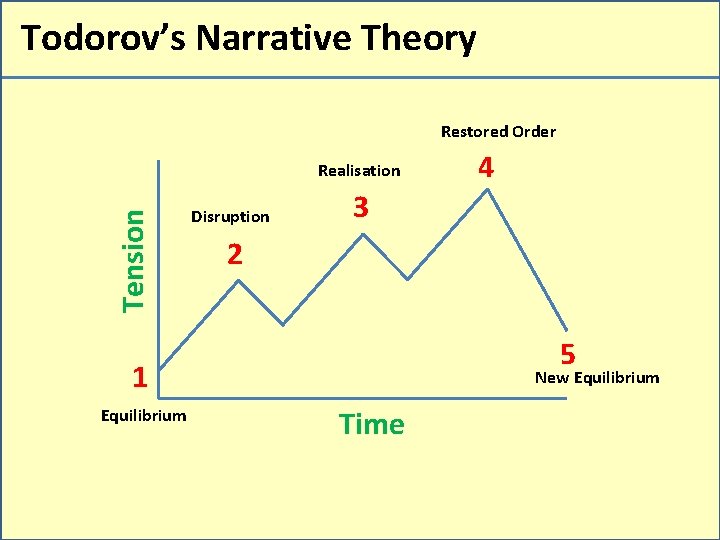
Todorov’s Narrative Theory Restored Order Tension Realisation Disruption 3 2 5 1 Equilibrium 4 New Equilibrium Time
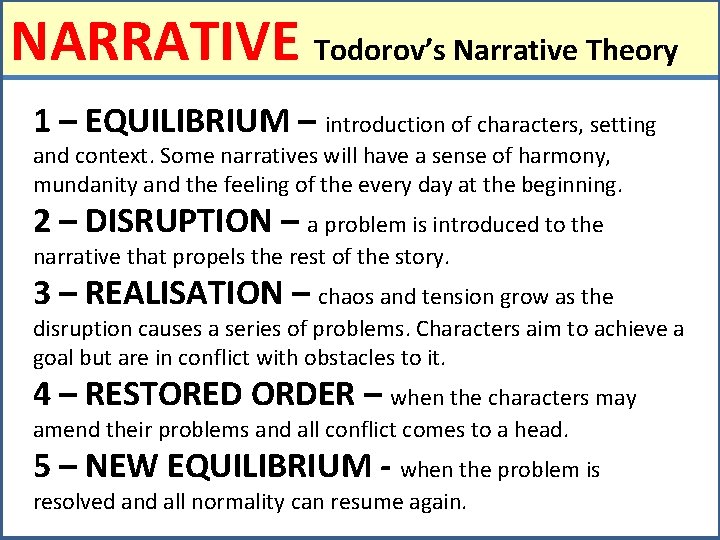
NARRATIVE Todorov’s Narrative Theory 1 – EQUILIBRIUM – introduction of characters, setting and context. Some narratives will have a sense of harmony, mundanity and the feeling of the every day at the beginning. 2 – DISRUPTION – a problem is introduced to the narrative that propels the rest of the story. 3 – REALISATION – chaos and tension grow as the disruption causes a series of problems. Characters aim to achieve a goal but are in conflict with obstacles to it. 4 – RESTORED ORDER – when the characters may amend their problems and all conflict comes to a head. 5 – NEW EQUILIBRIUM - when the problem is resolved and all normality can resume again.
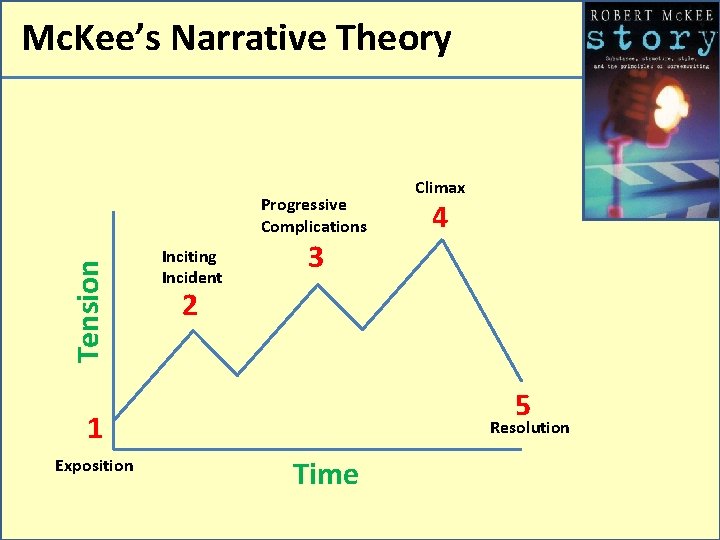
Mc. Kee’s Narrative Theory Tension Progressive Complications Inciting Incident 4 3 2 5 1 Exposition Climax Resolution Time
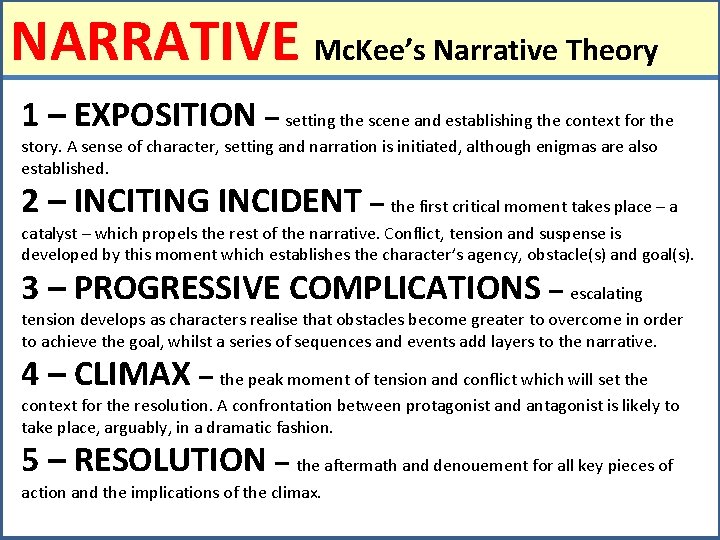
NARRATIVE Mc. Kee’s Narrative Theory 1 – EXPOSITION – setting the scene and establishing the context for the story. A sense of character, setting and narration is initiated, although enigmas are also established. 2 – INCITING INCIDENT – the first critical moment takes place – a catalyst – which propels the rest of the narrative. Conflict, tension and suspense is developed by this moment which establishes the character’s agency, obstacle(s) and goal(s). 3 – PROGRESSIVE COMPLICATIONS – escalating tension develops as characters realise that obstacles become greater to overcome in order to achieve the goal, whilst a series of sequences and events add layers to the narrative. 4 – CLIMAX – the peak moment of tension and conflict which will set the context for the resolution. A confrontation between protagonist and antagonist is likely to take place, arguably, in a dramatic fashion. 5 – RESOLUTION – the aftermath and denouement for all key pieces of action and the implications of the climax.
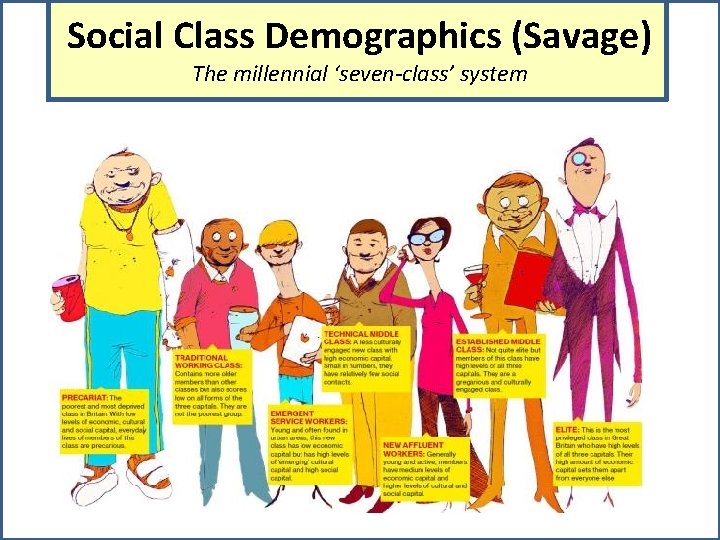
Social Class Demographics (Savage) The millennial ‘seven-class’ system
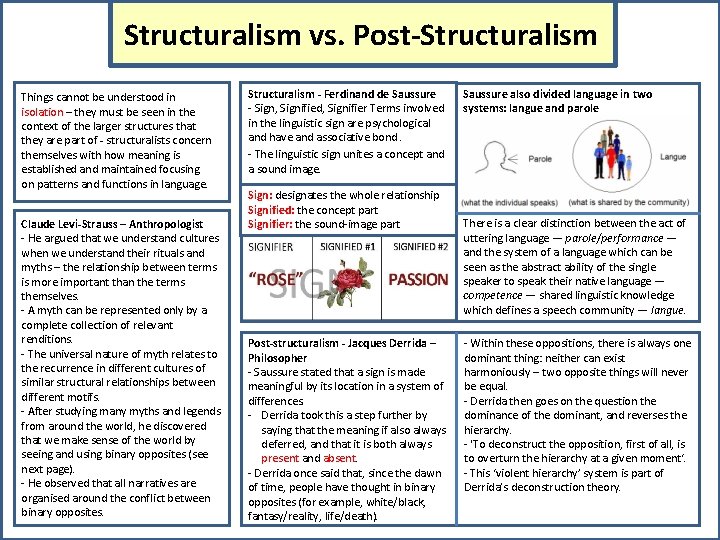
Structuralism vs. Post-Structuralism Things cannot be understood in isolation – they must be seen in the context of the larger structures that they are part of - structuralists concern themselves with how meaning is established and maintained focusing on patterns and functions in language. Claude Levi-Strauss – Anthropologist - He argued that we understand cultures when we understand their rituals and myths – the relationship between terms is more important than the terms themselves. - A myth can be represented only by a complete collection of relevant renditions. - The universal nature of myth relates to the recurrence in different cultures of similar structural relationships between different motifs. - After studying many myths and legends from around the world, he discovered that we make sense of the world by seeing and using binary opposites (see next page). - He observed that all narratives are organised around the conflict between binary opposites. Structuralism - Ferdinand de Saussure - Sign, Signified, Signifier Terms involved in the linguistic sign are psychological and have and associative bond. - The linguistic sign unites a concept and a sound image. Sign: designates the whole relationship Signified: the concept part Signifier: the sound-image part Post-structuralism - Jacques Derrida – Philosopher - Saussure stated that a sign is made meaningful by its location in a system of differences. - Derrida took this a step further by saying that the meaning if also always deferred, and that it is both always present and absent. - Derrida once said that, since the dawn of time, people have thought in binary opposites (for example, white/black, fantasy/reality, life/death). Saussure also divided language in two systems: langue and parole There is a clear distinction between the act of uttering language — parole/performance — and the system of a language which can be seen as the abstract ability of the single speaker to speak their native language — competence — shared linguistic knowledge which defines a speech community — langue. - Within these oppositions, there is always one dominant thing: neither can exist harmoniously – two opposite things will never be equal. - Derrida then goes on the question the dominance of the dominant, and reverses the hierarchy. - 'To deconstruct the opposition, first of all, is to overturn the hierarchy at a given moment‘. - This ‘violent hierarchy’ system is part of Derrida’s deconstruction theory.
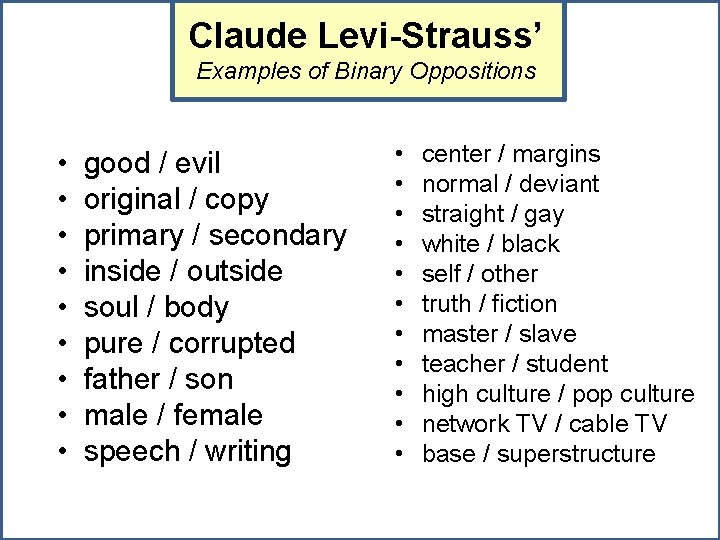
Claude Levi-Strauss’ Examples of Binary Oppositions • • • good / evil original / copy primary / secondary inside / outside soul / body pure / corrupted father / son male / female speech / writing • • • center / margins normal / deviant straight / gay white / black self / other truth / fiction master / slave teacher / student high culture / pop culture network TV / cable TV base / superstructure
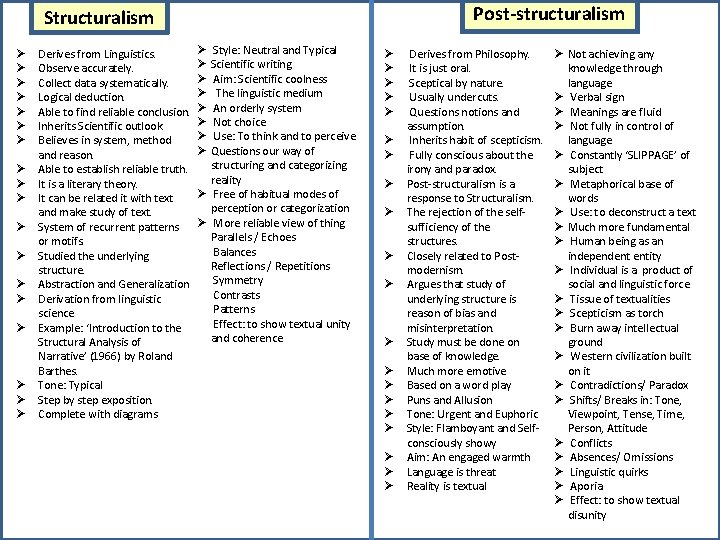
Post-structuralism Structuralism Ø Ø Ø Ø Ø Derives from Linguistics. Observe accurately. Collect data systematically. Logical deduction. Able to find reliable conclusion. Inherits Scientific outlook. Believes in system, method and reason. Able to establish reliable truth. It is a literary theory. It can be related it with text and make study of text. System of recurrent patterns or motifs. Studied the underlying structure. Abstraction and Generalization Derivation from linguistic science Example: ‘Introduction to the Structural Analysis of Narrative’ (1966) by Roland Barthes. Tone: Typical Step by step exposition. Complete with diagrams Ø Style: Neutral and Typical Ø Scientific writing Ø Aim: Scientific coolness Ø The linguistic medium Ø An orderly system Ø Not choice Ø Use: To think and to perceive Ø Questions our way of structuring and categorizing reality Ø Free of habitual modes of perception or categorization Ø More reliable view of thing Ø Parallels / Echoes Ø Balances Ø Reflections / Repetitions Ø Symmetry Ø Contrasts Ø Patterns Ø Effect: to show textual unity and coherence Ø Ø Ø Ø Ø Derives from Philosophy. It is just oral. Sceptical by nature. Usually undercuts. Questions notions and assumption. Inherits habit of scepticism. Fully conscious about the irony and paradox. Post-structuralism is a response to Structuralism. The rejection of the selfsufficiency of the structures. Closely related to Postmodernism. Argues that study of underlying structure is reason of bias and misinterpretation. Study must be done on base of knowledge. Much more emotive Based on a word play Puns and Allusion Tone: Urgent and Euphoric Style: Flamboyant and Selfconsciously showy Aim: An engaged warmth Language is threat Reality is textual Ø Not achieving any knowledge through language Ø Verbal sign Ø Meanings are fluid Ø Not fully in control of language Ø Constantly ‘SLIPPAGE’ of subject Ø Metaphorical base of words Ø Use: to deconstruct a text Ø Much more fundamental Ø Human being as an independent entity Ø Individual is a product of social and linguistic force Ø Tissue of textualities Ø Scepticism as torch Ø Burn away intellectual ground Ø Western civilization built on it Ø Contradictions/ Paradox Ø Shifts/ Breaks in: Tone, Viewpoint, Tense, Time, Person, Attitude Ø Conflicts Ø Absences/ Omissions Ø Linguistic quirks Ø Aporia Ø Effect: to show textual disunity
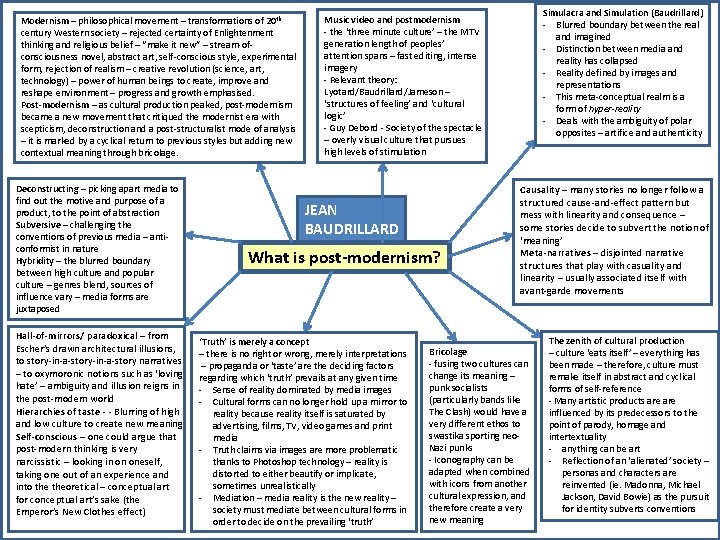
Modernism – philosophical movement – transformations of 20 th century Western society – rejected certainty of Enlightenment thinking and religious belief – “make it new” – stream-ofconsciousness novel, abstract art, self-conscious style, experimental form, rejection of realism – creative revolution (science, art, technology) – power of human beings to create, improve and reshape environment – progress and growth emphasised. Post-modernism – as cultural production peaked, post-modernism became a new movement that critiqued the modernist era with scepticism, deconstruction and a post-structuralist mode of analysis – it is marked by a cyclical return to previous styles but adding new contextual meaning through bricolage. Deconstructing – picking apart media to find out the motive and purpose of a product, to the point of abstraction Subversive – challenging the conventions of previous media – anticonformist in nature Hybridity – the blurred boundary between high culture and popular culture – genres blend, sources of influence vary – media forms are juxtaposed Hall-of-mirrors/ paradoxical – from Escher’s drawn architectural illusions, to story-in-a-story narratives – to oxymoronic notions such as ‘loving hate’ – ambiguity and illusion reigns in the post-modern world Hierarchies of taste - - Blurring of high and low culture to create new meaning Self-conscious – one could argue that post-modern thinking is very narcissistic – looking in on oneself, taking one out of an experience and into theoretical – conceptual art for conceptual art’s sake (the Emperor’s New Clothes effect) Simulacra and Simulation (Baudrillard) - Blurred boundary between the real and imagined - Distinction between media and reality has collapsed - Reality defined by images and representations - This meta-conceptual realm is a form of hyper-reality - Deals with the ambiguity of polar opposites – artifice and authenticity Music video and postmodernism - the ‘three minute culture’ – the MTV generation length of peoples’ attention spans – fast editing, intense imagery - Relevant theory: Lyotard/Baudrillard/Jameson – ‘structures of feeling’ and ‘cultural logic’ - Guy Debord - Society of the spectacle – overly visual culture that pursues high levels of stimulation JEAN BAUDRILLARD What is post-modernism? ‘Truth’ is merely a concept – there is no right or wrong, merely interpretations – propaganda or ‘taste’ are the deciding factors regarding which ‘truth’ prevails at any given time - Sense of reality dominated by media images - Cultural forms can no longer hold up a mirror to reality because reality itself is saturated by advertising, films, TV, video games and print media - Truth claims via images are more problematic thanks to Photoshop technology – reality is distorted to either beautify or implicate, sometimes unrealistically - Mediation – media reality is the new reality – society must mediate between cultural forms in order to decide on the prevailing ‘truth’ Causality – many stories no longer follow a structured cause-and-effect pattern but mess with linearity and consequence – some stories decide to subvert the notion of ‘meaning’ Meta-narratives – disjointed narrative structures that play with casuality and linearity – usually associated itself with avant-garde movements Bricolage - fusing two cultures can change its meaning – punk socialists (particularly bands like The Clash) would have a very different ethos to swastika sporting neo. Nazi punks - Iconography can be adapted when combined with icons from another cultural expression, and therefore create a very new meaning The zenith of cultural production – culture ‘eats itself’ – everything has been made – therefore, culture must remake itself in abstract and cyclical forms of self-reference - Many artistic products are influenced by its predecessors to the point of parody, homage and intertextuality - anything can be art - Reflection of an ‘alienated’ society – personas and characters are reinvented (ie. Madonna, Michael Jackson, David Bowie) as the pursuit for identity subverts conventions
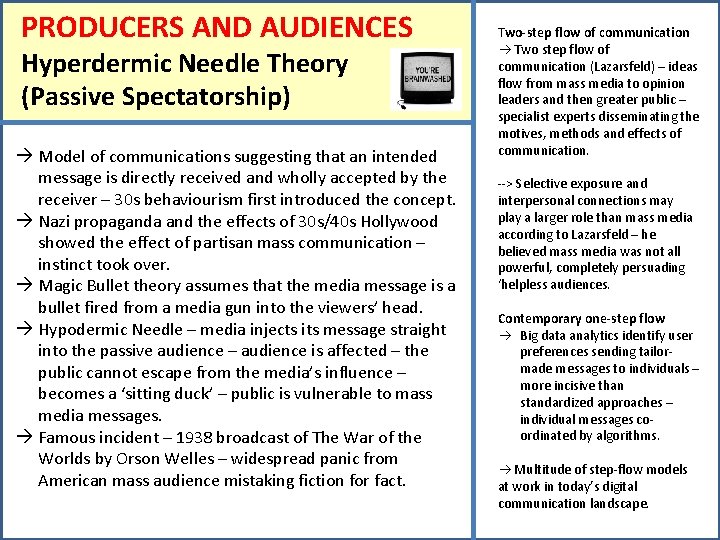
PRODUCERS AND AUDIENCES Hyperdermic Needle Theory (Passive Spectatorship) Model of communications suggesting that an intended message is directly received and wholly accepted by the receiver – 30 s behaviourism first introduced the concept. Nazi propaganda and the effects of 30 s/40 s Hollywood showed the effect of partisan mass communication – instinct took over. Magic Bullet theory assumes that the media message is a bullet fired from a media gun into the viewers’ head. Hypodermic Needle – media injects its message straight into the passive audience – audience is affected – the public cannot escape from the media’s influence – becomes a ‘sitting duck’ – public is vulnerable to mass media messages. Famous incident – 1938 broadcast of The War of the Worlds by Orson Welles – widespread panic from American mass audience mistaking fiction for fact. Two-step flow of communication Two step flow of communication (Lazarsfeld) – ideas flow from mass media to opinion leaders and then greater public – specialist experts disseminating the motives, methods and effects of communication. --> Selective exposure and interpersonal connections may play a larger role than mass media according to Lazarsfeld – he believed mass media was not all powerful, completely persuading ‘helpless audiences. Contemporary one-step flow Big data analytics identify user preferences sending tailormade messages to individuals – more incisive than standardized approaches – individual messages coordinated by algorithms. Multitude of step-flow models at work in today’s digital communication landscape.
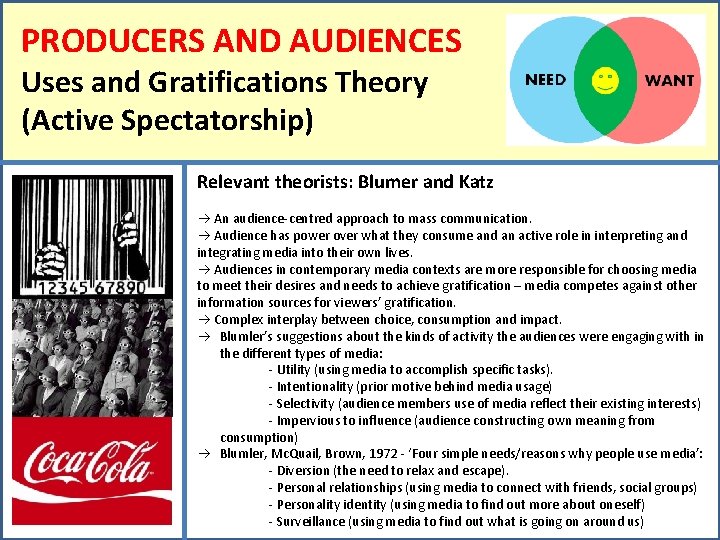
PRODUCERS AND AUDIENCES Uses and Gratifications Theory (Active Spectatorship) Relevant theorists: Blumer and Katz An audience-centred approach to mass communication. Audience has power over what they consume and an active role in interpreting and integrating media into their own lives. Audiences in contemporary media contexts are more responsible for choosing media to meet their desires and needs to achieve gratification – media competes against other information sources for viewers’ gratification. Complex interplay between choice, consumption and impact. Blumler’s suggestions about the kinds of activity the audiences were engaging with in the different types of media: - Utility (using media to accomplish specific tasks). - Intentionality (prior motive behind media usage) - Selectivity (audience members use of media reflect their existing interests) - Impervious to influence (audience constructing own meaning from consumption) Blumler, Mc. Quail, Brown, 1972 - ‘Four simple needs/reasons why people use media’: - Diversion (the need to relax and escape). - Personal relationships (using media to connect with friends, social groups) - Personality identity (using media to find out more about oneself) - Surveillance (using media to find out what is going on around us)
PRODUCERS AND AUDIENCES Uses & Gratifications Theory (Extended) • Katz, Gurevitch and Haas (1973) saw mass media as a means by which individuals connect or disconnect themselves with others. They developed 35 needs taken from the largely speculative literature on the social and psychological functions of the mass media and put them into five categories: • Cognitive Needs: Acquiring information, knowledge and understanding – Media Examples: Television (news), video (how-to), movies (documentaries or based on history) • Affective Needs: Emotion, pleasure, feelings – Media Examples: Movies, television (soap operas, sitcoms) • Personal Integrative Needs: Credibility, status – Media Examples: Video • Social Integrative Needs: Family and friends – Media Examples: Internet (e-mail, instant messaging, chat rooms, social media) • Tension Release Needs: Escape and diversion – Media Examples: Television, movies, video, radio, internet
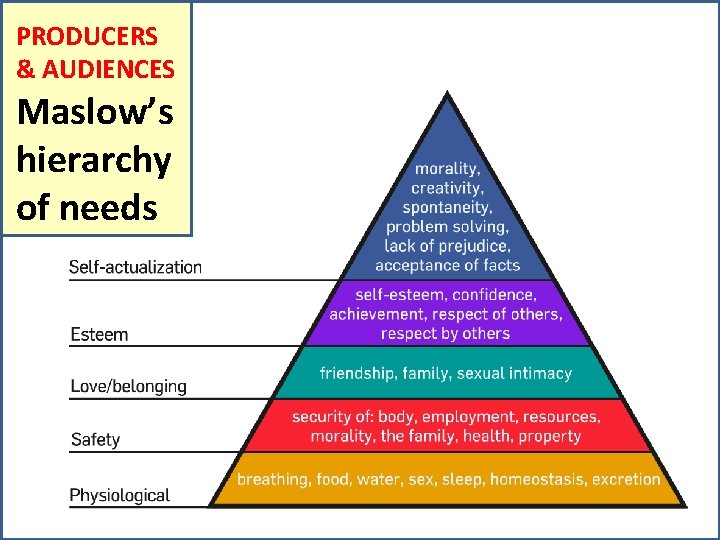
PRODUCERS & AUDIENCES Maslow’s hierarchy of needs
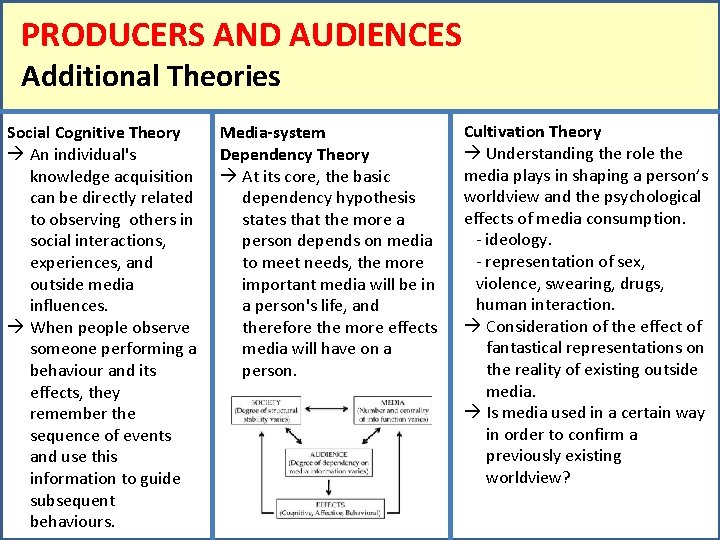
PRODUCERS AND AUDIENCES Additional Theories Social Cognitive Theory An individual's knowledge acquisition can be directly related to observing others in social interactions, experiences, and outside media influences. When people observe someone performing a behaviour and its effects, they remember the sequence of events and use this information to guide subsequent behaviours. Media-system Dependency Theory At its core, the basic dependency hypothesis states that the more a person depends on media to meet needs, the more important media will be in a person's life, and therefore the more effects media will have on a person. Cultivation Theory Understanding the role the media plays in shaping a person’s worldview and the psychological effects of media consumption. - ideology. - representation of sex, violence, swearing, drugs, human interaction. Consideration of the effect of fantastical representations on the reality of existing outside media. Is media used in a certain way in order to confirm a previously existing worldview?
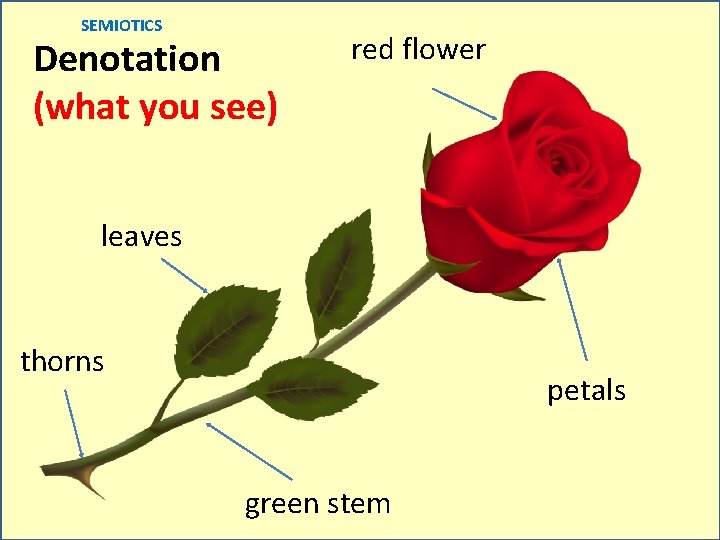
SEMIOTICS Denotation (what you see) red flower leaves thorns petals green stem
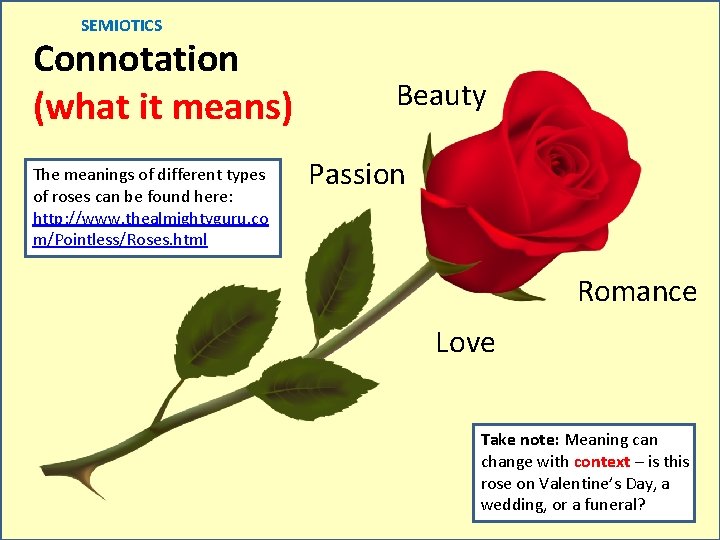
SEMIOTICS Connotation (what it means) The meanings of different types of roses can be found here: http: //www. thealmightyguru. co m/Pointless/Roses. html Beauty Passion Romance Love Take note: Meaning can change with context – is this rose on Valentine’s Day, a wedding, or a funeral?
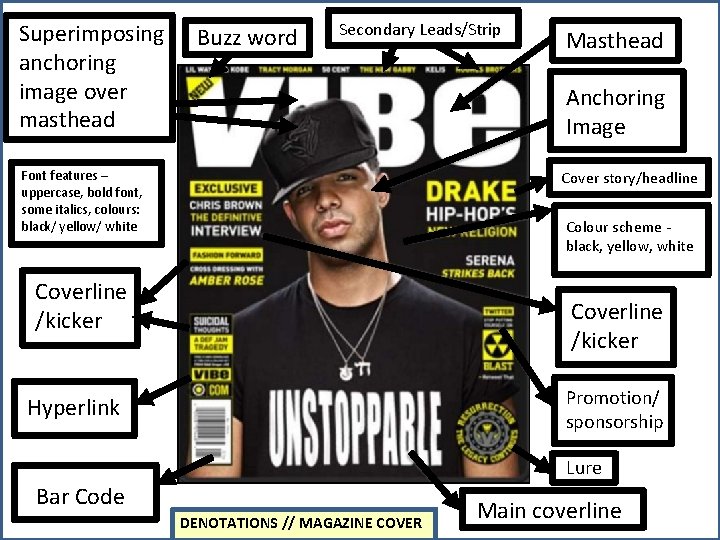
Superimposing anchoring image over masthead Buzz word Secondary Leads/Strip Masthead Anchoring Image Font features – uppercase, bold font, some italics, colours: black/ yellow/ white Cover story/headline Colour scheme - black, yellow, white Coverline /kicker Promotion/ sponsorship Hyperlink Lure Bar Code DENOTATIONS // MAGAZINE COVER Main coverline
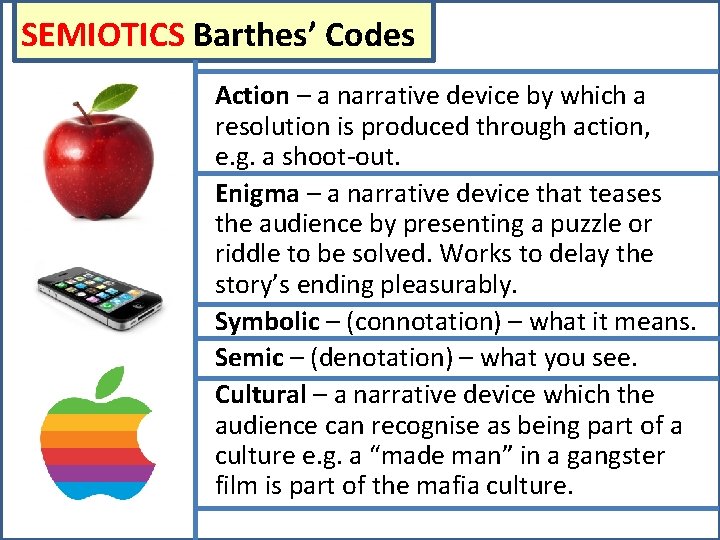
SEMIOTICS Barthes’ Codes Action – a narrative device by which a resolution is produced through action, e. g. a shoot-out. Enigma – a narrative device that teases the audience by presenting a puzzle or riddle to be solved. Works to delay the story’s ending pleasurably. Symbolic – (connotation) – what it means. Semic – (denotation) – what you see. Cultural – a narrative device which the audience can recognise as being part of a culture e. g. a “made man” in a gangster film is part of the mafia culture.
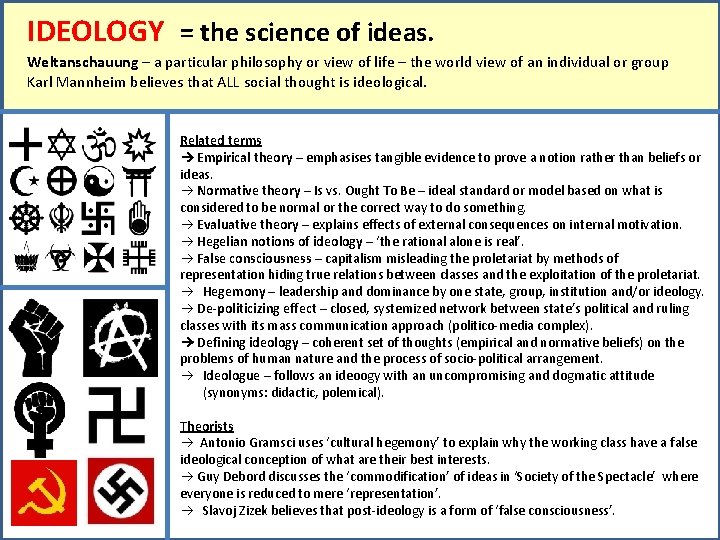
IDEOLOGY = the science of ideas. Weltanschauung – a particular philosophy or view of life – the world view of an individual or group Karl Mannheim believes that ALL social thought is ideological. Related terms Empirical theory – emphasises tangible evidence to prove a notion rather than beliefs or ideas. Normative theory – Is vs. Ought To Be – ideal standard or model based on what is considered to be normal or the correct way to do something. Evaluative theory – explains effects of external consequences on internal motivation. Hegelian notions of ideology – ‘the rational alone is real’. False consciousness – capitalism misleading the proletariat by methods of representation hiding true relations between classes and the exploitation of the proletariat. Hegemony – leadership and dominance by one state, group, institution and/or ideology. De-politicizing effect – closed, systemized network between state’s political and ruling classes with its mass communication approach (politico-media complex). Defining ideology – coherent set of thoughts (empirical and normative beliefs) on the problems of human nature and the process of socio-political arrangement. Ideologue – follows an ideoogy with an uncompromising and dogmatic attitude (synonyms: didactic, polemical). Theorists Antonio Gramsci uses ‘cultural hegemony’ to explain why the working class have a false ideological conception of what are their best interests. Guy Debord discusses the ‘commodification’ of ideas in ‘Society of the Spectacle’ where everyone is reduced to mere ‘representation’. Slavoj Zizek believes that post-ideology is a form of ‘false consciousness’.
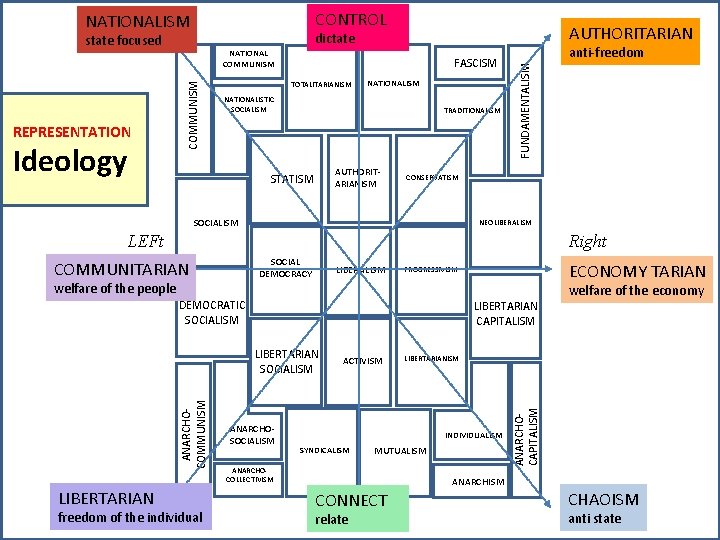
CONTROL NATIONALISM FASCISM TOTALITARIANISM NATIONALISTIC SOCIALISM TRADITIONALISM AUTHORITARIANISM STATISM anti-freedom FUNDAMENTALISM Ideology NATIONAL COMMUNISM REPRESENTATION AUTHORITARIAN dictate state focused CONSERVATISM SOCIALISM NEOLIBERALISM Right LEFt SOCIAL DEMOCRACY COMMUNITARIAN LIBERALISM ECONOMY TARIAN PROGRESSIVISM welfare of the people welfare of the economy DEMOCRATIC SOCIALISM LIBERTARIAN CAPITALISM LIBERTARIAN freedom of the individual ANARCHOSOCIALISM ACTIVISM LIBERTARIANISM INDIVIDUALISM SYNDICALISM MUTUALISM ANARCHOCOLLECTIVISM ANARCHOCAPITALISM ANARCHOCOMMUNISM LIBERTARIAN SOCIALISM ANARCHISM CONNECT relate CHAOISM anti state
IDEOLOGY Marxism – nuances of a left-wing philosophy. Identifies the inequality between the middle and upper classes (the haves - bourgeois society) with the working classes (the have nots - the proletariat). Marx’s agenda was to see greater equality in society with an emphasis on the welfare of the community (socialism)over the welfare of the economy (capitalism). Moderate Marxism – socialism – seeks to peacefully bridge the gap between the rich and the poor by democratic means with an emphasis on public sector provision and a ‘there is no such thing as the undeserving poor’ ethos towards the unemployed, the benefits claimants, the homeless and the marginalised. Extreme Marxism – communism - seeks to overthrow the bourgeois government by violent means and replace it with a proletariat led system of state control. Karl Marx wrote ‘The Communist Manifesto’ which set out the idea that the proletariat needed to overthrow the bourgeoisie by means of a revolution. Marx is a strong critic of capitalism and the free-market equality of opportunity and not equality of outcome ethos.
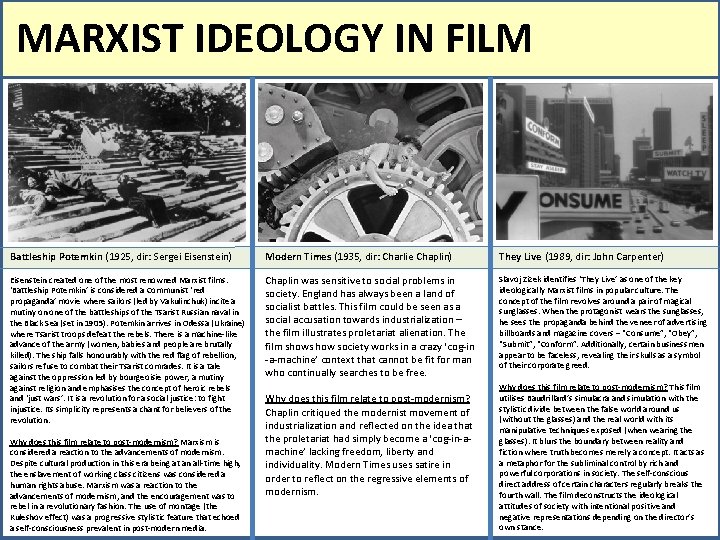
MARXIST IDEOLOGY IN FILM Battleship Potemkin (1925, dir: Sergei Eisenstein) Modern Times (1935, dir: Charlie Chaplin) They Live (1989, dir: John Carpenter) Eisenstein created one of the most renowned Marxist films. ‘Battleship Potemkin’ is considered a Communist ‘red propaganda’ movie where sailors (led by Vakulinchuk) incite a mutiny on one of the battleships of the Tsarist Russian naval in the Black Sea (set in 1905). Potemkin arrives in Odessa (Ukraine) where Tsarist troops defeat the rebels. There is a machine-like advance of the army (women, babies and people are brutally killed). The ship falls honourably with the red flag of rebellion, sailors refuse to combat their Tsarist comrades. It is a tale against the oppression led by bourgeoisie power, a mutiny against religion and emphasises the concept of heroic rebels and ‘just wars’. It is a revolution for a social justice: to fight injustice. Its simplicity represents a chant for believers of the revolution. Chaplin was sensitive to social problems in society. England has always been a land of socialist battles. This film could be seen as a social accusation towards industrialization – the film illustrates proletariat alienation. The film shows how society works in a crazy ‘cog-in -a-machine’ context that cannot be fit for man who continually searches to be free. Slavoj Zizek identifies ‘They Live’ as one of the key ideologically Marxist films in popular culture. The concept of the film revolves around a pair of magical sunglasses. When the protagonist wears the sunglasses, he sees the propaganda behind the veneer of advertising billboards and magazine covers – “Consume”, “Obey”, “Submit”, “Conform”. Additionally, certain businessmen appear to be faceless, revealing their skulls as a symbol of their corporate greed. Why does this film relate to post-modernism? Marxism is considered a reaction to the advancements of modernism. Despite cultural production in this era being at an all-time high, the enslavement of working class citizens was considered a human rights abuse. Marxism was a reaction to the advancements of modernism, and the encouragement was to rebel in a revolutionary fashion. The use of montage (the Kuleshov effect) was a progressive stylistic feature that echoed a self-consciousness prevalent in post-modern media. Why does this film relate to post-modernism? Chaplin critiqued the modernist movement of industrialization and reflected on the idea that the proletariat had simply become a ‘cog-in-amachine’ lacking freedom, liberty and individuality. Modern Times uses satire in order to reflect on the regressive elements of modernism. Why does this film relate to post-modernism? This film utilises Baudrillard’s simulacra and simulation with the stylistic divide between the false world around us (without the glasses) and the real world with its manipulative techniques exposed (when wearing the glasses). It blurs the boundary between reality and fiction where truth becomes merely a concept. It acts as a metaphor for the subliminal control by rich and powerful corporations in society. The self-conscious direct address of certain characters regularly breaks the fourth wall. The film deconstructs the ideological attitudes of society with intentional positive and negative representations depending on the director’s own stance.
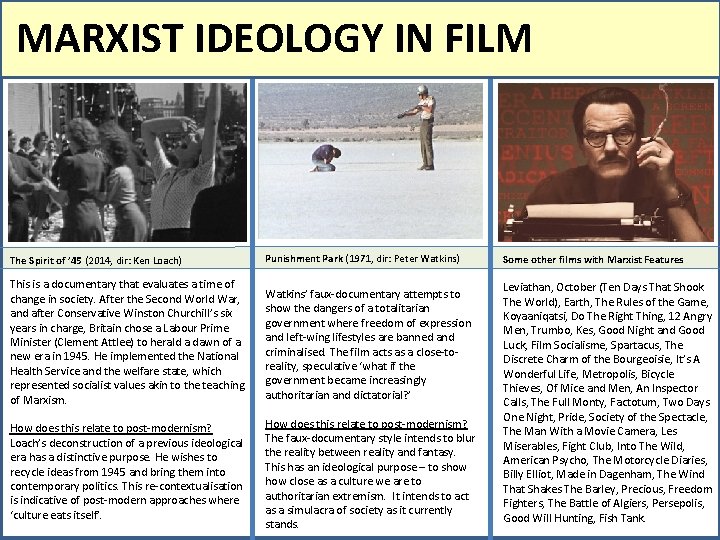
MARXIST IDEOLOGY IN FILM The Spirit of ’ 45 (2014, dir: Ken Loach) Punishment Park (1971, dir: Peter Watkins) This is a documentary that evaluates a time of change in society. After the Second World War, and after Conservative Winston Churchill’s six years in charge, Britain chose a Labour Prime Minister (Clement Attlee) to herald a dawn of a new era in 1945. He implemented the National Health Service and the welfare state, which represented socialist values akin to the teaching of Marxism. Watkins’ faux-documentary attempts to show the dangers of a totalitarian government where freedom of expression and left-wing lifestyles are banned and criminalised. The film acts as a close-toreality, speculative ‘what if the government became increasingly authoritarian and dictatorial? ’ How does this relate to post-modernism? Loach’s deconstruction of a previous ideological era has a distinctive purpose. He wishes to recycle ideas from 1945 and bring them into contemporary politics. This re-contextualisation is indicative of post-modern approaches where ‘culture eats itself’. How does this relate to post-modernism? The faux-documentary style intends to blur the reality between reality and fantasy. This has an ideological purpose – to show close as a culture we are to authoritarian extremism. It intends to act as a simulacra of society as it currently stands. Some other films with Marxist Features Leviathan, October (Ten Days That Shook The World), Earth, The Rules of the Game, Koyaaniqatsi, Do The Right Thing, 12 Angry Men, Trumbo, Kes, Good Night and Good Luck, Film Socialisme, Spartacus, The Discrete Charm of the Bourgeoisie, It’s A Wonderful Life, Metropolis, Bicycle Thieves, Of Mice and Men, An Inspector Calls, The Full Monty, Factotum, Two Days One Night, Pride, Society of the Spectacle, The Man With a Movie Camera, Les Miserables, Fight Club, Into The Wild, American Psycho, The Motorcycle Diaries, Billy Elliot, Made in Dagenham, The Wind That Shakes The Barley, Precious, Freedom Fighters, The Battle of Algiers, Persepolis, Good Will Hunting, Fish Tank.
IDEOLOGY Feminism – Mulvey’s Object of the Male Gaze The ‘male gaze’ can be traced back to Laura Mulvey’s essay ‘Visual Pleasure and Narrative Cinema’ published in 1975. In this essay, Mulvey states that women in film are typically objects of the gaze – meaning women on screen are seen as the objects of desire. Mulvey believes that film audiences have to view characters from the perspective of a heterosexual male and this is the reason women are seen more as objects. In the era of classical Hollywood cinema, audiences were encouraged to identify with the protagonist of the film – who was usually male. Whereas, Hollywood female characters of the 1950 s and 60 s were, according to Mulvey, coded with ‘to-be-looked-at-ness’.
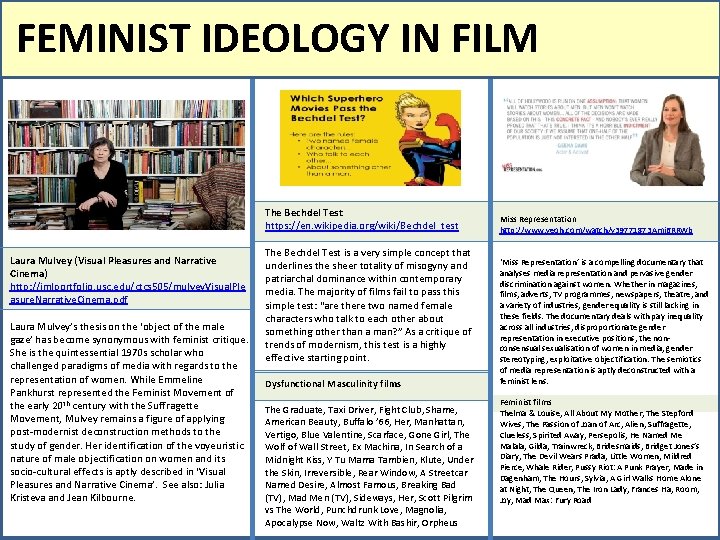
FEMINIST IDEOLOGY IN FILM The Bechdel Test https: //en. wikipedia. org/wiki/Bechdel_test Laura Mulvey (Visual Pleasures and Narrative Cinema) http: //imlportfolio. usc. edu/ctcs 505/mulvey. Visual. Ple asure. Narrative. Cinema. pdf Laura Mulvey’s thesis on the ‘object of the male gaze’ has become synonymous with feminist critique. She is the quintessential 1970 s scholar who challenged paradigms of media with regards to the representation of women. While Emmeline Pankhurst represented the Feminist Movement of the early 20 th century with the Suffragette Movement, Mulvey remains a figure of applying post-modernist deconstruction methods to the study of gender. Her identification of the voyeuristic nature of male objectification on women and its socio-cultural effects is aptly described in ‘Visual Pleasures and Narrative Cinema’. See also: Julia Kristeva and Jean Kilbourne. The Bechdel Test is a very simple concept that underlines the sheer totality of misogyny and patriarchal dominance within contemporary media. The majority of films fail to pass this simple test: “are there two named female characters who talk to each other about something other than a man? ” As a critique of trends of modernism, this test is a highly effective starting point. Dysfunctional Masculinity films The Graduate, Taxi Driver, Fight Club, Shame, American Beauty, Buffalo ’ 66, Her, Manhattan, Vertigo, Blue Valentine, Scarface, Gone Girl, The Wolf of Wall Street, Ex Machina, In Search of a Midnight Kiss, Y Tu Mama Tambien, Klute, Under the Skin, Irreversible, Rear Window, A Streetcar Named Desire, Almost Famous, Breaking Bad (TV), Mad Men (TV), Sideways, Her, Scott Pilgrim vs The World, Punchdrunk Love, Magnolia, Apocalypse Now, Waltz With Bashir, Orpheus Miss Representation http: //www. veoh. com/watch/v 39771873 Amj 6 RRWb ‘Miss Representation’ is a compelling documentary that analyses media representation and pervasive gender discrimination against women. Whether in magazines, films, adverts, TV programmes, newspapers, theatre, and a variety of industries, gender equality is still lacking in these fields. The documentary deals with pay inequality across all industries, disproportionate gender representation in executive positions, the nonconsensual sexualisation of women in media, gender stereotyping, exploitative objectification. The semiotics of media representation is aptly deconstructed with a feminist lens. Feminist films Thelma & Louise, All About My Mother, The Stepford Wives, The Passion of Joan of Arc, Alien, Suffragette, Clueless, Spirited Away, Persepolis, He Named Me Malala, Gilda, Trainwreck, Bridesmaids, Bridget Jones’s Diary, The Devil Wears Prada, Little Women, Mildred Pierce, Whale Rider, Pussy Riot: A Punk Prayer, Made in Dagenham, The Hours, Sylvia, A Girl Walks Home Alone at Night, The Queen, The Iron Lady, Frances Ha, Room, Joy, Mad Max: Fury Road
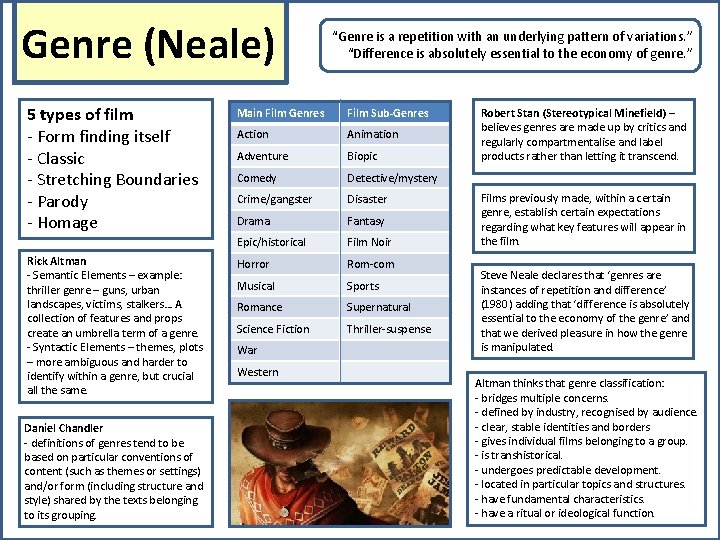
Genre (Neale) 5 types of film - Form finding itself - Classic - Stretching Boundaries - Parody - Homage Rick Altman - Semantic Elements – example: thriller genre – guns, urban landscapes, victims, stalkers… A collection of features and props create an umbrella term of a genre. - Syntactic Elements – themes, plots – more ambiguous and harder to identify within a genre, but crucial all the same. Daniel Chandler - definitions of genres tend to be based on particular conventions of content (such as themes or settings) and/or form (including structure and style) shared by the texts belonging to its grouping. “Genre is a repetition with an underlying pattern of variations. ” “Difference is absolutely essential to the economy of genre. ” Main Film Genres Film Sub-Genres Action Animation Adventure Biopic Comedy Detective/mystery Crime/gangster Disaster Drama Fantasy Epic/historical Film Noir Horror Rom-com Musical Sports Romance Supernatural Science Fiction Thriller-suspense War Western Robert Stan (Stereotypical Minefield) – believes genres are made up by critics and regularly compartmentalise and label products rather than letting it transcend. Films previously made, within a certain genre, establish certain expectations regarding what key features will appear in the film. Steve Neale declares that ‘genres are instances of repetition and difference’ (1980) adding that ‘difference is absolutely essential to the economy of the genre’ and that we derived pleasure in how the genre is manipulated. Altman thinks that genre classification: - bridges multiple concerns. - defined by industry, recognised by audience. - clear, stable identities and borders - gives individual films belonging to a group. - is transhistorical. - undergoes predictable development. - located in particular topics and structures. - have fundamental characteristics. - have a ritual or ideological function.
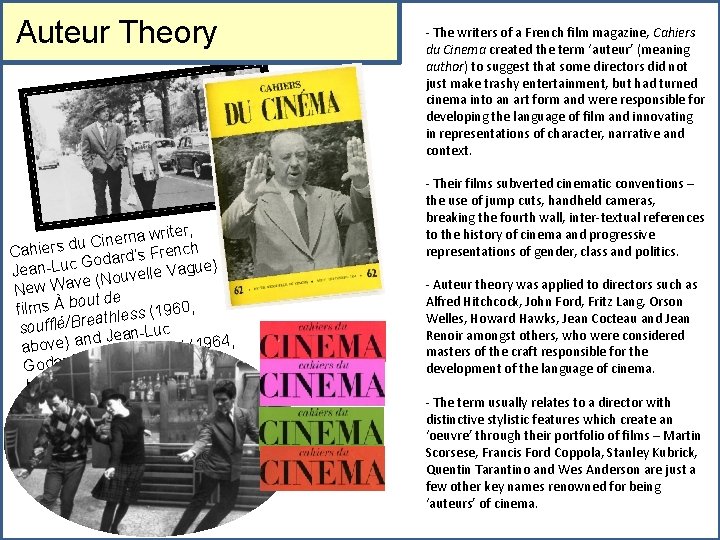
Auteur Theory writer, a m e in C u Cahiers d French ’s d r a d o G Vague) Jean-Luc e ll e v u o e (N New Wav de ut films À bo hless (1960, eat soufflé/Br an-Luc e J d n a ) rt (1964, above a P à e d Ban Godard’s below). - The writers of a French film magazine, Cahiers du Cinema created the term ‘auteur’ (meaning author) to suggest that some directors did not just make trashy entertainment, but had turned cinema into an art form and were responsible for developing the language of film and innovating in representations of character, narrative and context. - Their films subverted cinematic conventions – the use of jump cuts, handheld cameras, breaking the fourth wall, inter-textual references to the history of cinema and progressive representations of gender, class and politics. - Auteur theory was applied to directors such as Alfred Hitchcock, John Ford, Fritz Lang, Orson Welles, Howard Hawks, Jean Cocteau and Jean Renoir amongst others, who were considered masters of the craft responsible for the development of the language of cinema. - The term usually relates to a director with distinctive stylistic features which create an ‘oeuvre’ through their portfolio of films – Martin Scorsese, Francis Ford Coppola, Stanley Kubrick, Quentin Tarantino and Wes Anderson are just a few other key names renowned for being ‘auteurs’ of cinema.
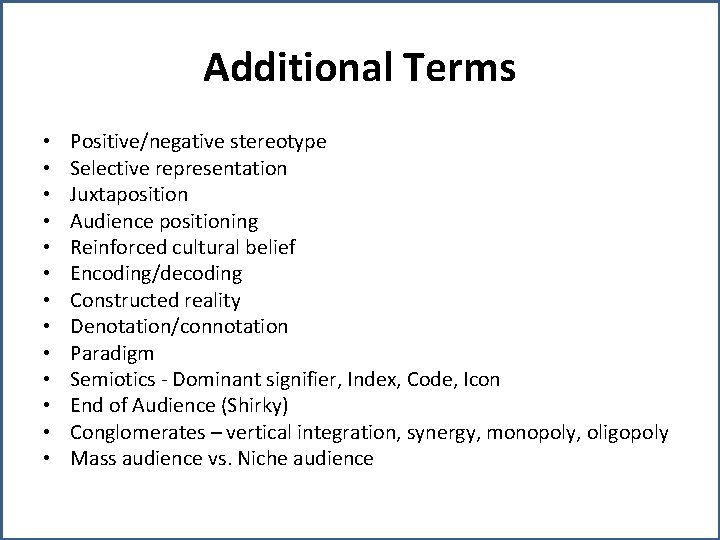
Additional Terms • • • • Positive/negative stereotype Selective representation Juxtaposition Audience positioning Reinforced cultural belief Encoding/decoding Constructed reality Denotation/connotation Paradigm Semiotics - Dominant signifier, Index, Code, Icon End of Audience (Shirky) Conglomerates – vertical integration, synergy, monopoly, oligopoly Mass audience vs. Niche audience