
Fan Chung Graham University of California San Diego

- Slides: 76
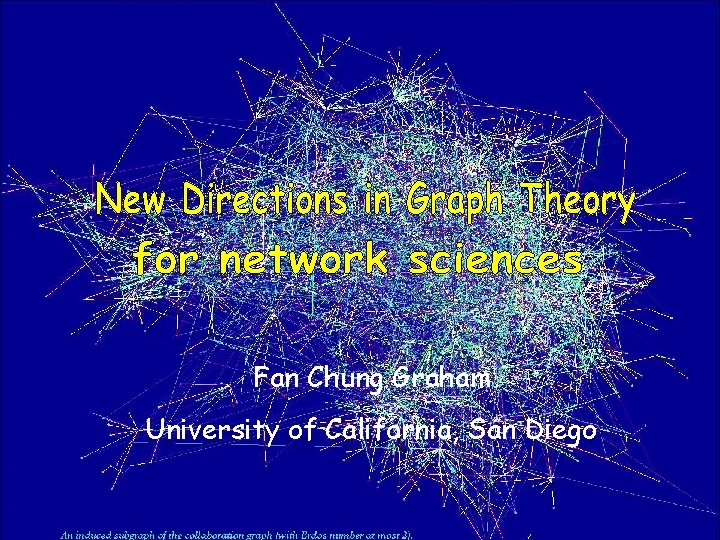
Fan Chung Graham University of California, San Diego
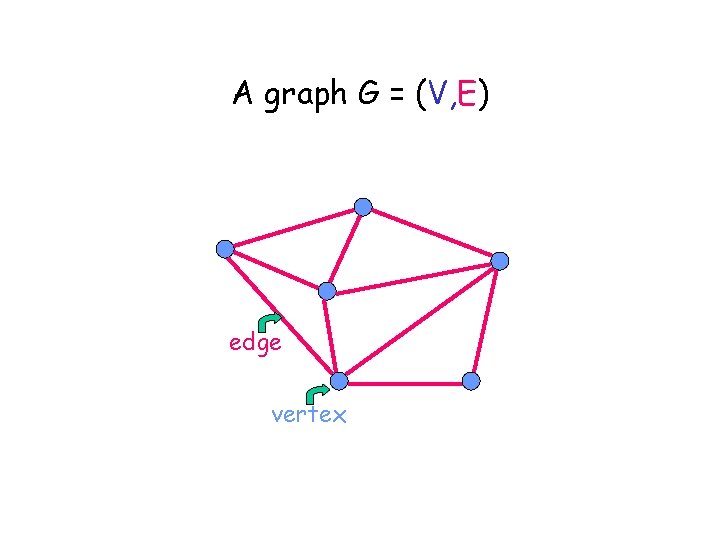
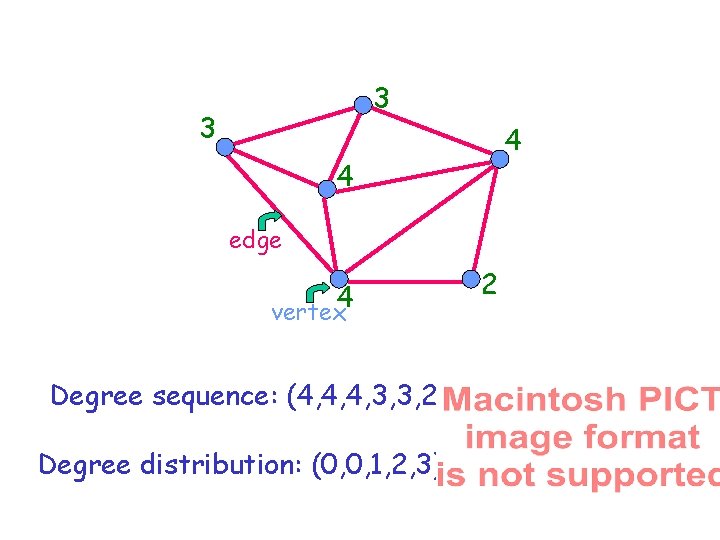
A graph G = (V, E) edge vertex
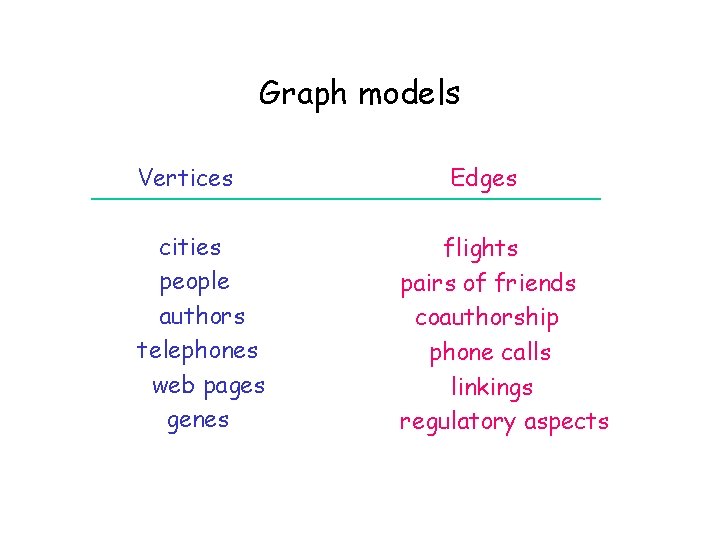
Graph models Vertices Edges _______________ cities people authors telephones web pages genes flights pairs of friends coauthorship phone calls linkings regulatory aspects
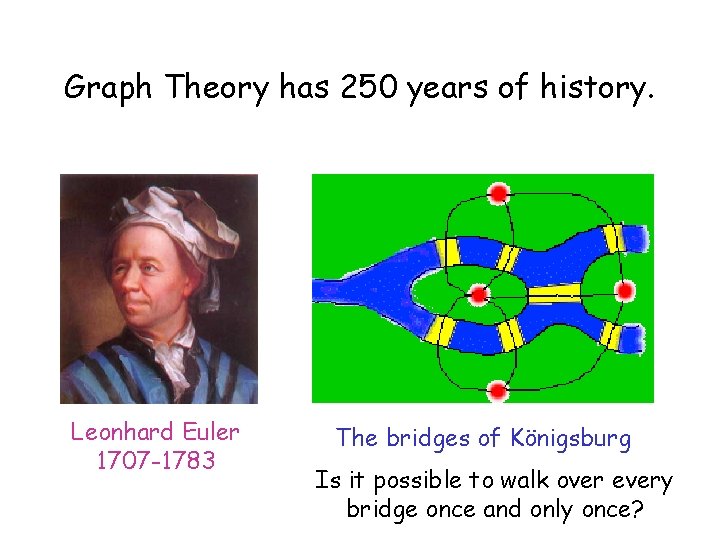
Graph Theory has 250 years of history. Leonhard Euler 1707 -1783 The bridges of Königsburg Is it possible to walk over every bridge once and only once?
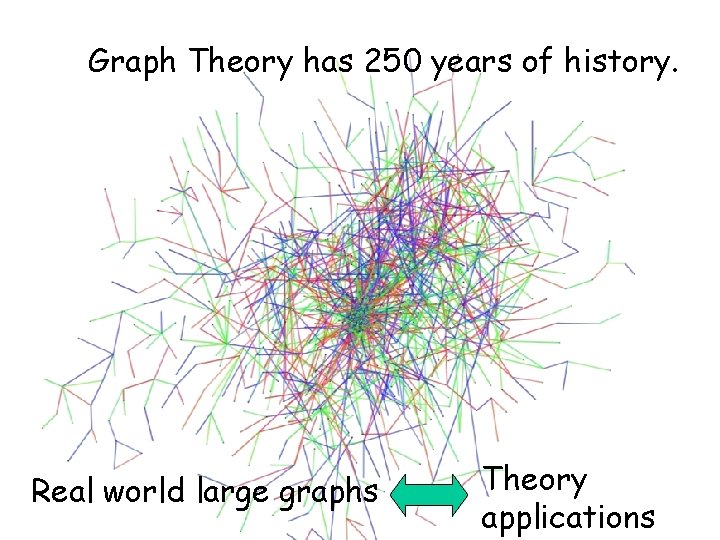
Graph Theory has 250 years of history. Real world large graphs Theory applications
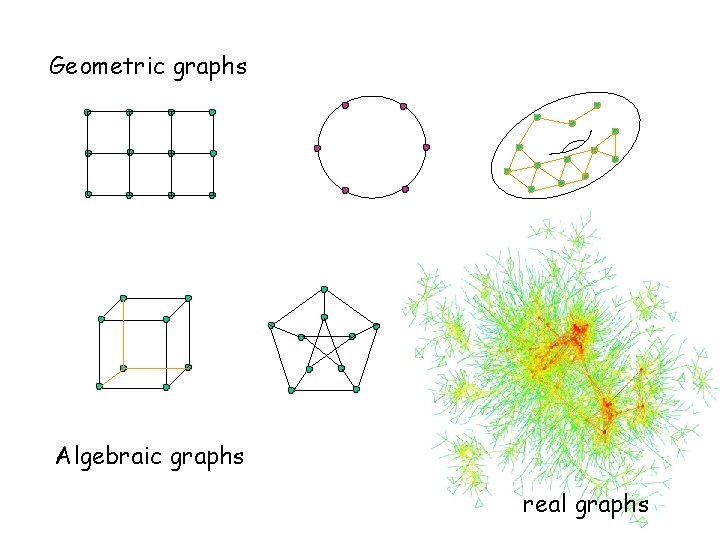
Geometric graphs Algebraic graphs real graphs
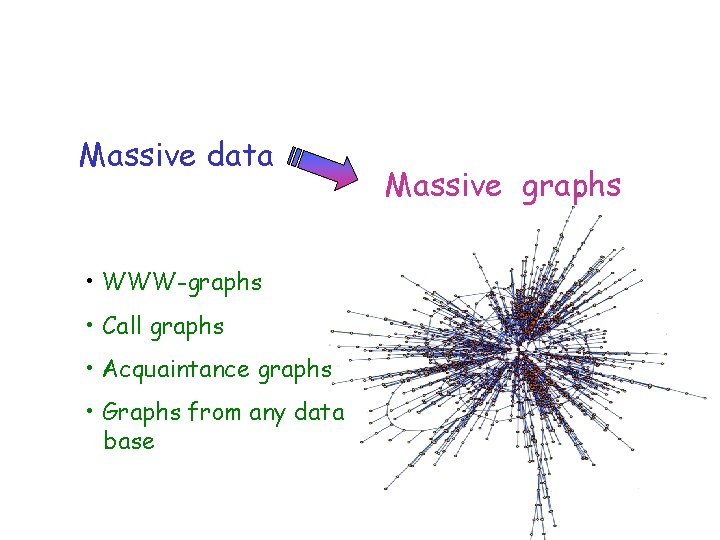
Massive data • WWW-graphs • Call graphs • Acquaintance graphs • Graphs from any data a. base Massive graphs
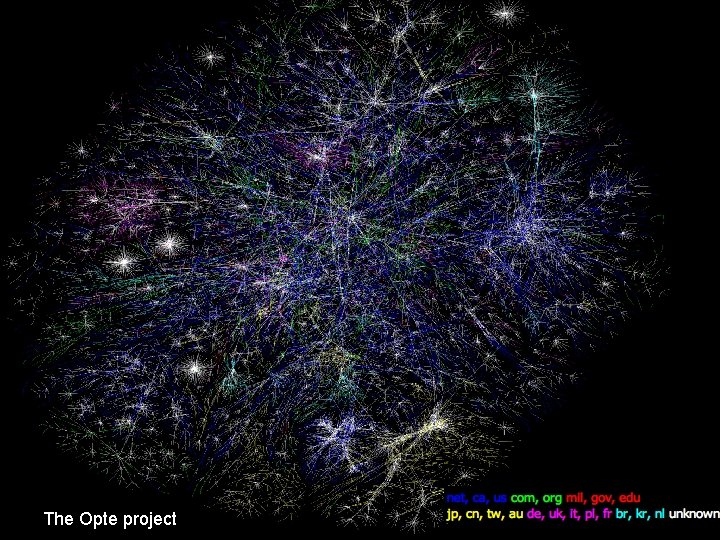
The Opte project
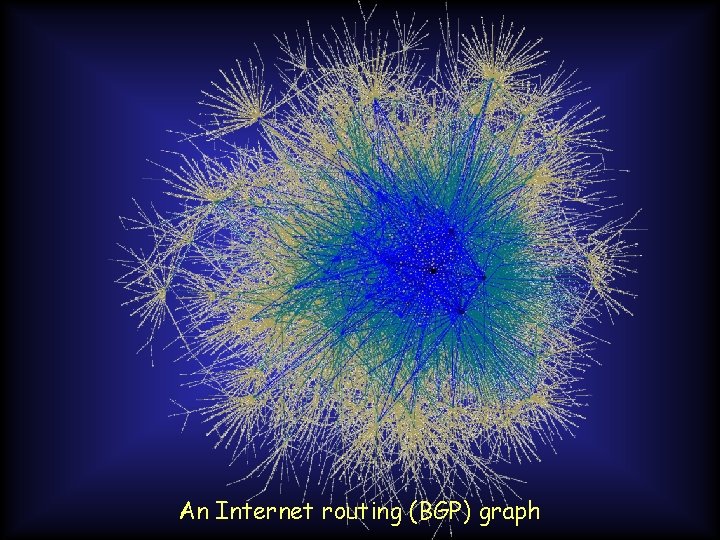
An Internet routing (BGP) graph
A subgraph of the Hollywood graph.
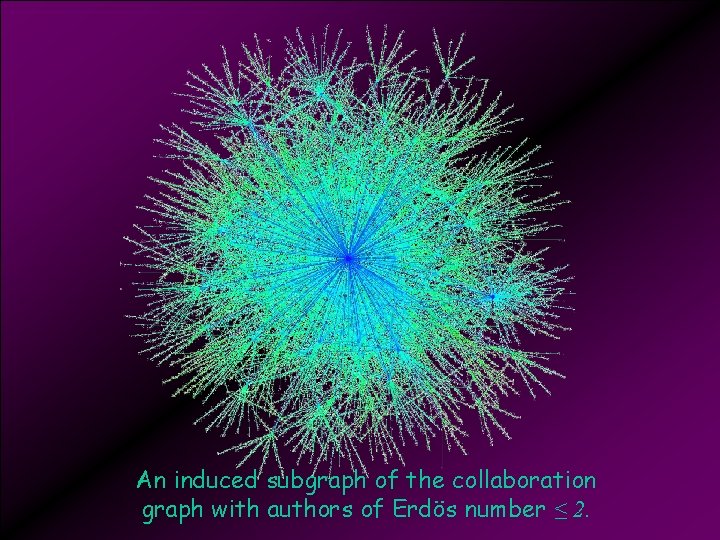
An induced subgraph of the collaboration graph with authors of Erdös number ≤ 2.
Numerous questions arise in dealing with large realistic networks • How are these graphs formed? • What are the basic structures of such xxgraphs? • What principles dictate their behavior? • How are subgraphs related to the large xxhost graph? • What are the main graph invariants xxcapturing the properties of such graphs?
New problems and directions • Classical random graph theory Random graphs with any given degrees • Percolation on special graphs Percolation on general graphs • Correlation among vertices Pagerank of a graph • Graph coloring/routing Network games
Several examples • Random graphs with specified degrees Diameter of random power law graphs • Diameter of random trees of a given graph • Percolation and giant components in a graph • Correlation between vertices xxxxxx. The pagerank of a graph • Graph coloring and network games
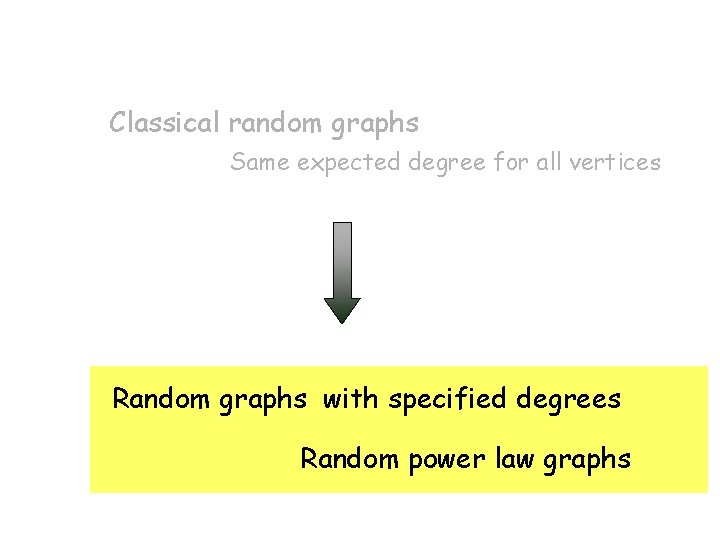
Classical random graphs Same expected degree for all vertices Random graphs with specified degrees Random power law graphs
Some prevailing characteristics of large realistic networks • Sparse • Small world phenomenon Small diameter/average distance Clustering • Power law degree distribution
3 3 4 4 edge 4 vertex Degree sequence: (4, 4, 4, 3, 3, 2) Degree distribution: (0, 0, 1, 2, 3) 2
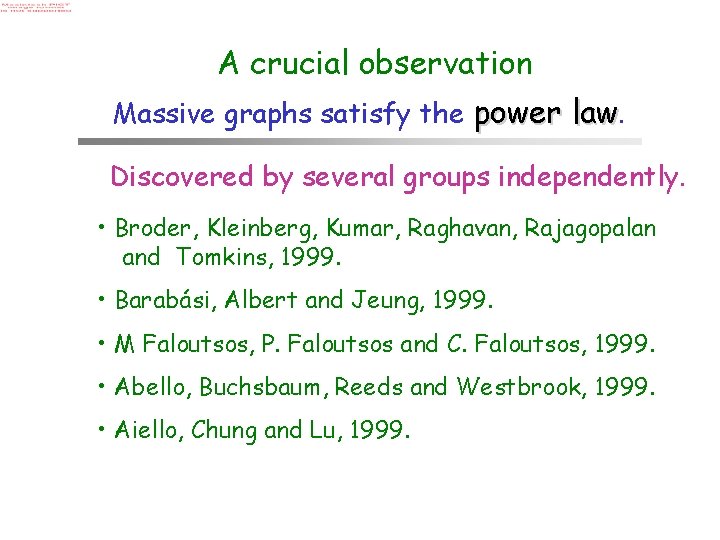
A crucial observation Massive graphs satisfy the power law. Discovered by several groups independently. • Broder, Kleinberg, Kumar, Raghavan, Rajagopalan aaand Tomkins, 1999. • Barabási, Albert and Jeung, 1999. • M Faloutsos, P. Faloutsos and C. Faloutsos, 1999. • Abello, Buchsbaum, Reeds and Westbrook, 1999. • Aiello, Chung and Lu, 1999.
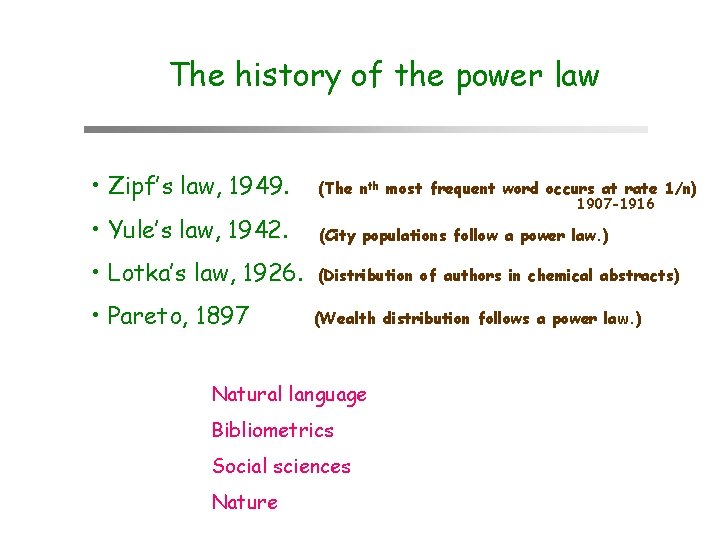
The history of the power law • Zipf’s law, 1949. (The nth most frequent word occurs at rate 1/n) • Yule’s law, 1942. (City populations follow a power law. ) • Lotka’s law, 1926. (Distribution of authors in chemical abstracts) • Pareto, 1897 (Wealth distribution follows a power law. ) 1907 -1916 Natural language Bibliometrics Social sciences Nature
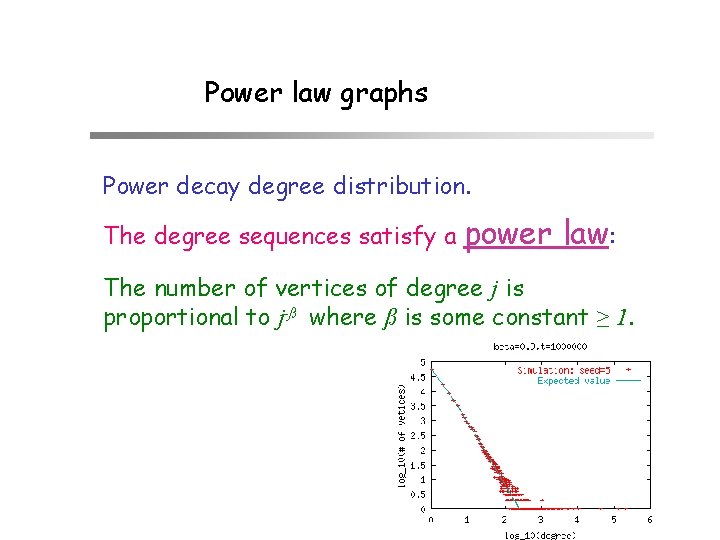
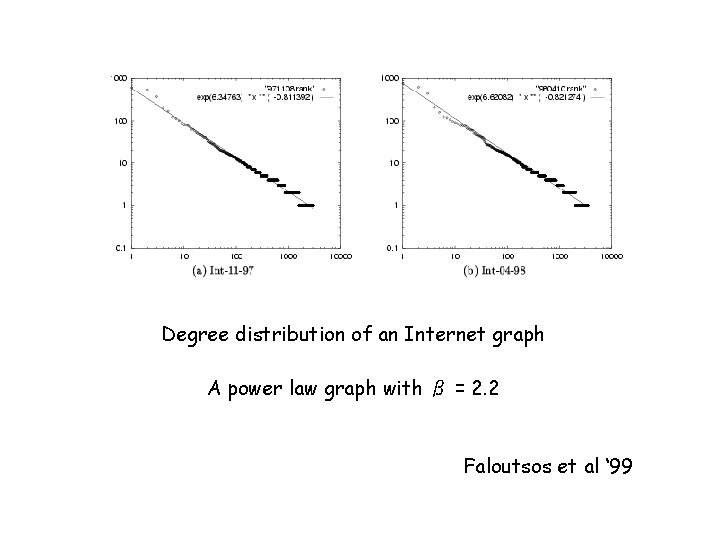
Power law graphs Power decay degree distribution. The degree sequences satisfy a power law: The number of vertices of degree j is proportional to j-ß where ß is some constant ≥ 1.
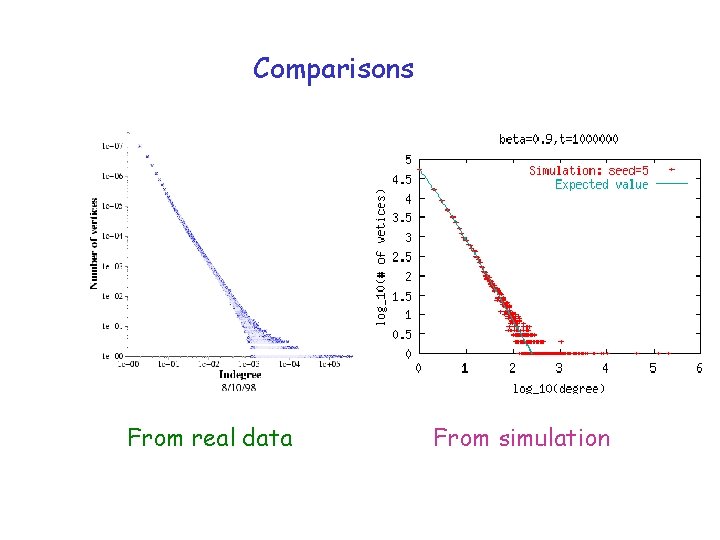
Comparisons From real data From simulation
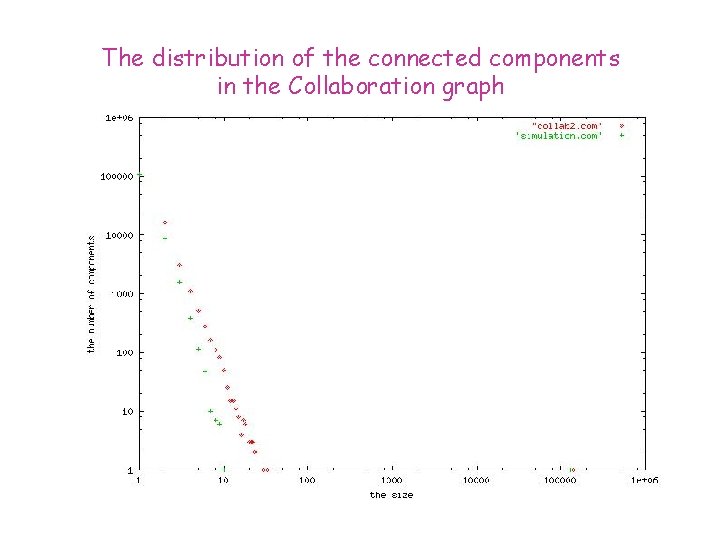
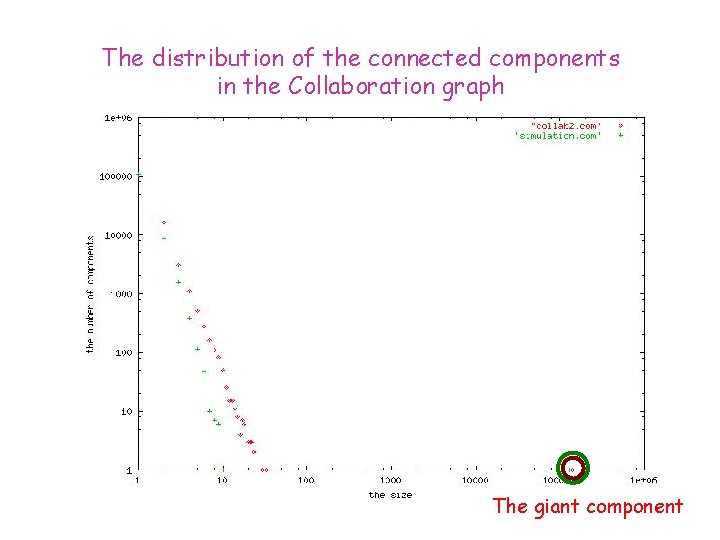
The distribution of the connected components in the Collaboration graph
The distribution of the connected components in the Collaboration graph The giant component
Examples of power law • Internet graphs. • Call graphs. • Collaboration graphs. • Acquaintance graphs. • Language usage • Transportation networks
Degree distribution of an Internet graph A power law graph with β = 2. 2 Faloutsos et al ‘ 99
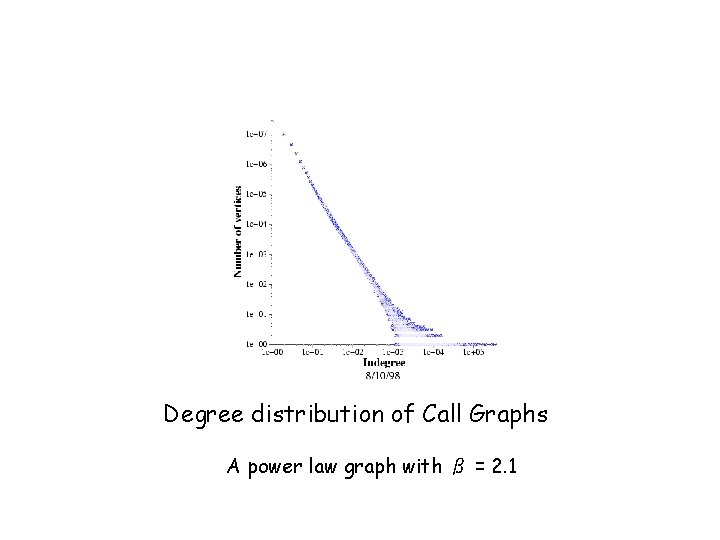
Degree distribution of Call Graphs A power law graph with β = 2. 1
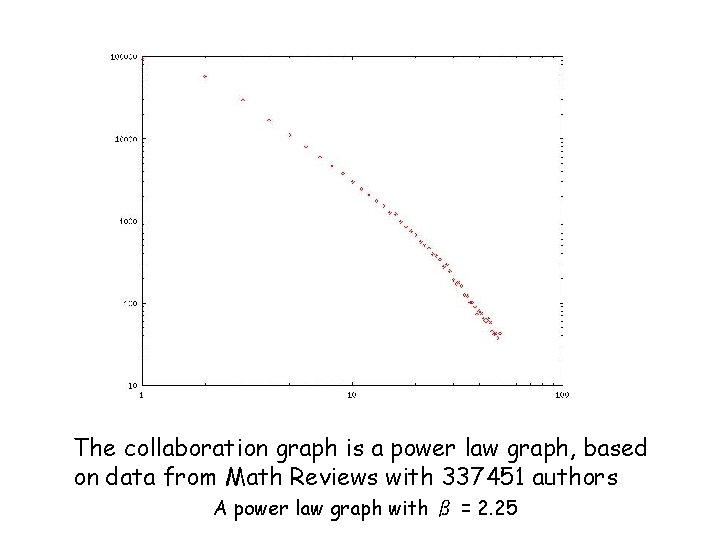
The collaboration graph is a power law graph, based on data from Math Reviews with 337451 authors A power law graph with β = 2. 25
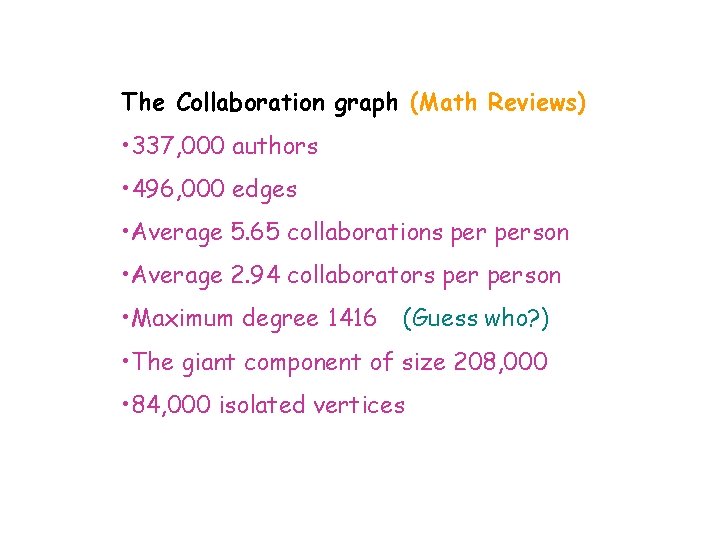
The Collaboration graph (Math Reviews) • 337, 000 authors • 496, 000 edges • Average 5. 65 collaborations person • Average 2. 94 collaborators person • Maximum degree 1416 (Guess who? ) • The giant component of size 208, 000 • 84, 000 isolated vertices
What is the `shape’ of a network ? experimental modeling
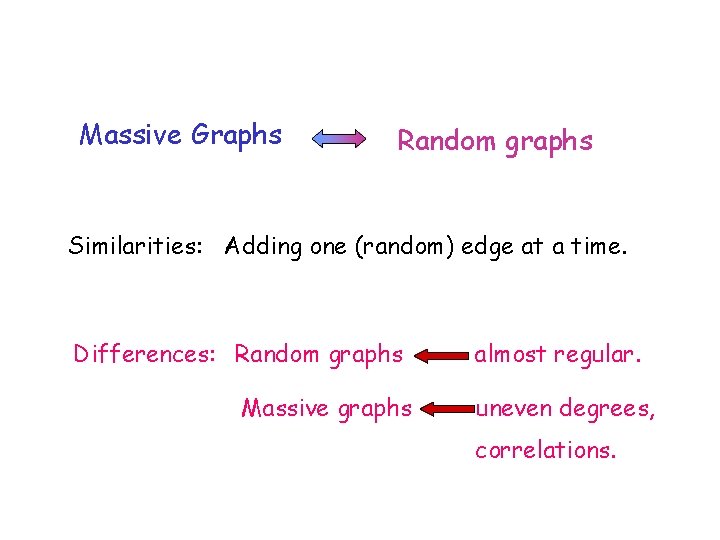
Massive Graphs Random graphs Similarities: Adding one (random) edge at a time. Differences: Random graphs Massive graphs almost regular. uneven degrees, correlations.
Random Graph Theory How does a random graph behave? Graph Ramsey Theory What are the unavoidable patterns?
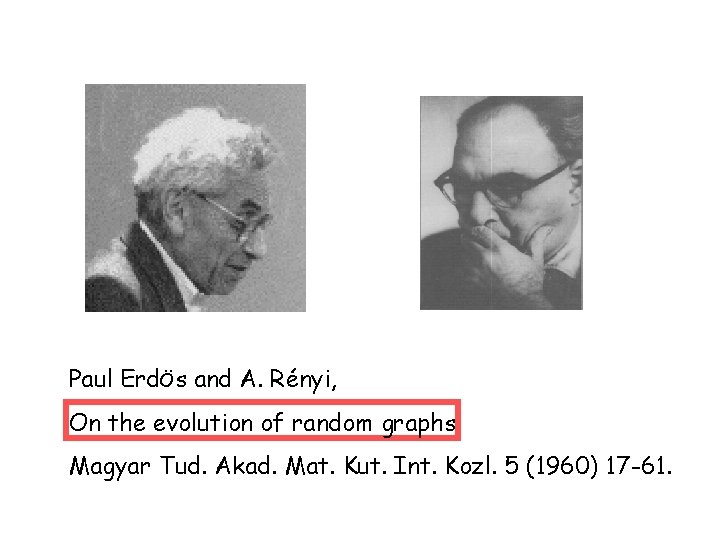
Paul ErdÖs and A. Rényi, On the evolution of random graphs Magyar Tud. Akad. Mat. Kut. Int. Kozl. 5 (1960) 17 -61.
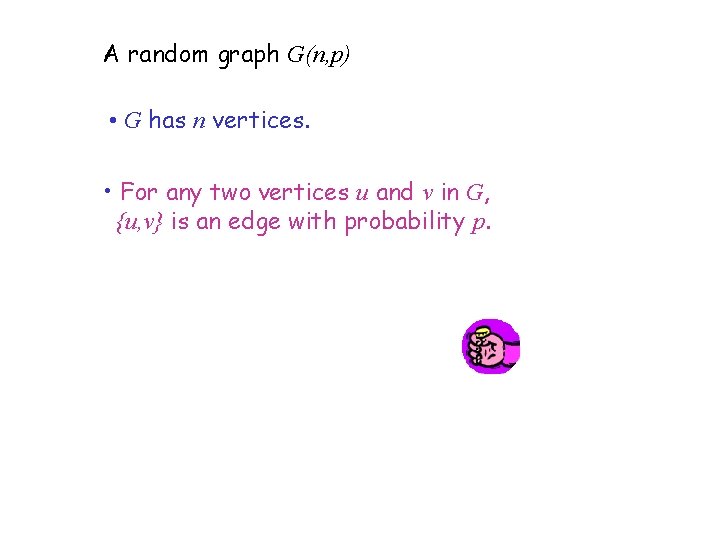
A random graph G(n, p) • G has n vertices. • For any two vertices u and v in G, a{u, v} is an edge with probability p.
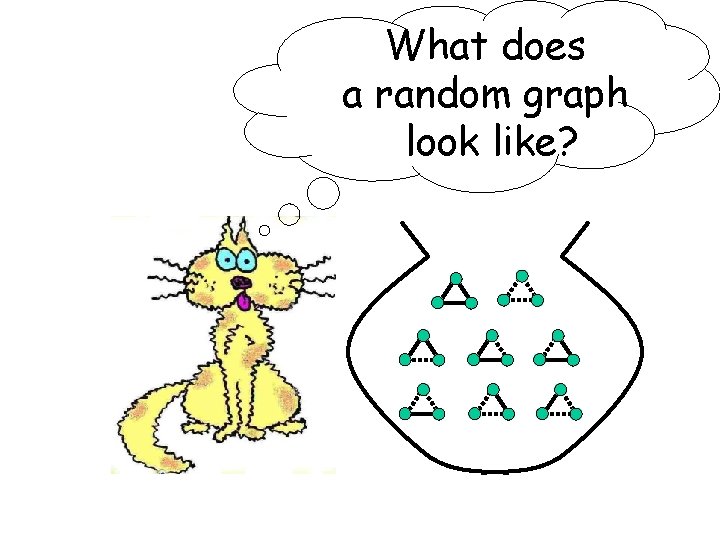
What does a random graph look like?
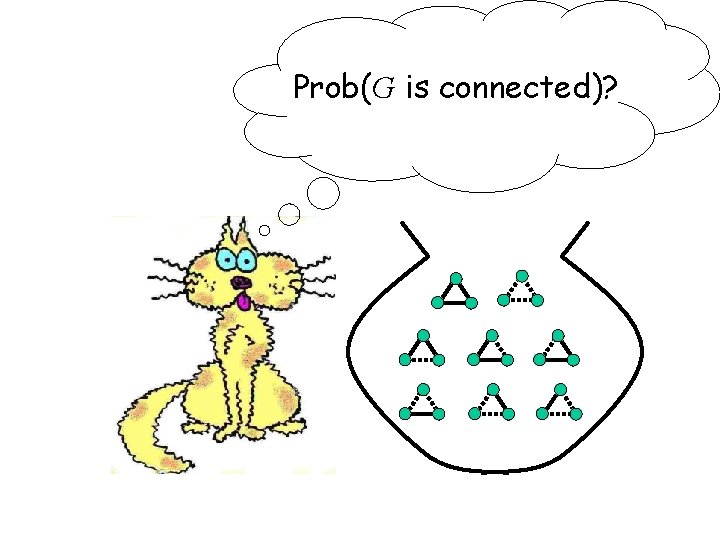
Prob(G is connected)?
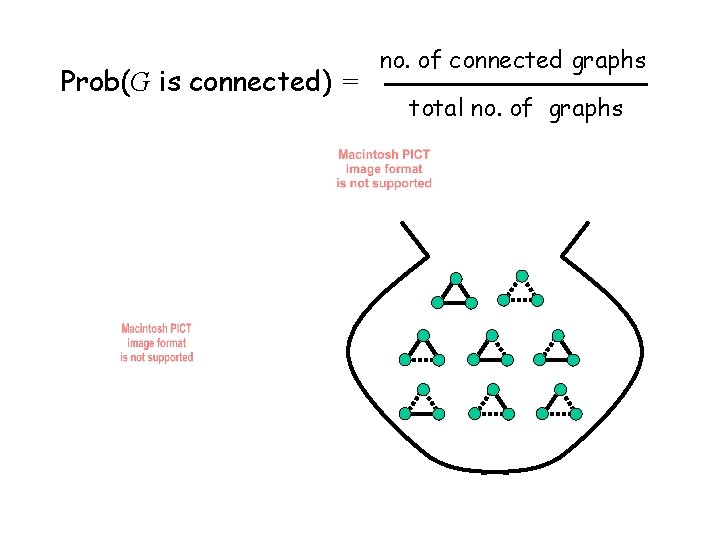
Prob(G is connected) = no. of connected graphs total no. of graphs
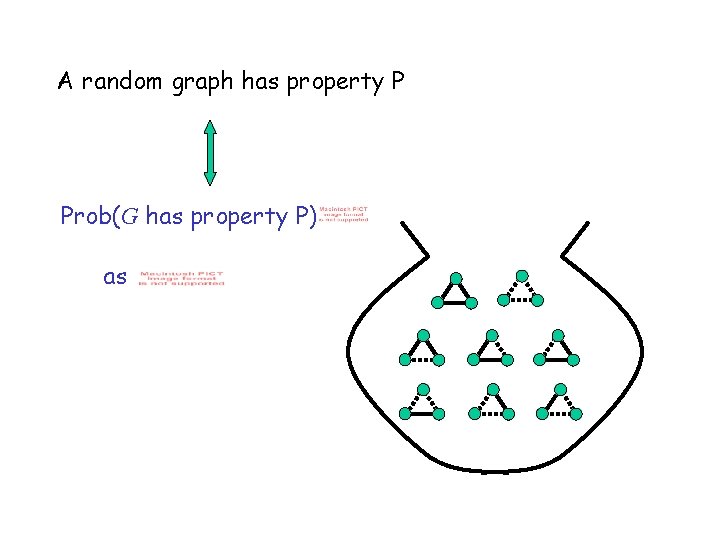
A random graph has property P Prob(G has property P) as
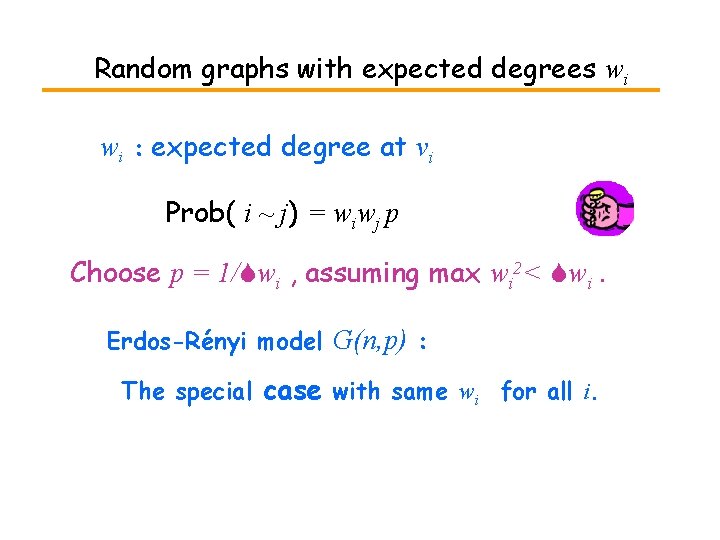
Random graphs with expected degrees wi wi : expected degree at vi Prob( i ~ j) = wiwj p Choose p = 1/ wi , assuming max wi 2< wi. Erdos-Rényi model G(n, p) : The special case with same wi for all i.
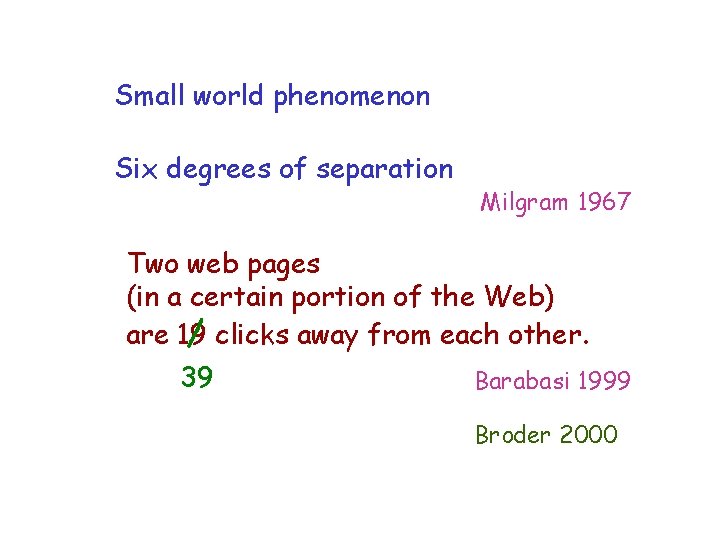
Small world phenomenon Six degrees of separation Milgram 1967 Two web pages (in a certain portion of the Web) are 19 / clicks away from each other. 39 Barabasi 1999 Broder 2000
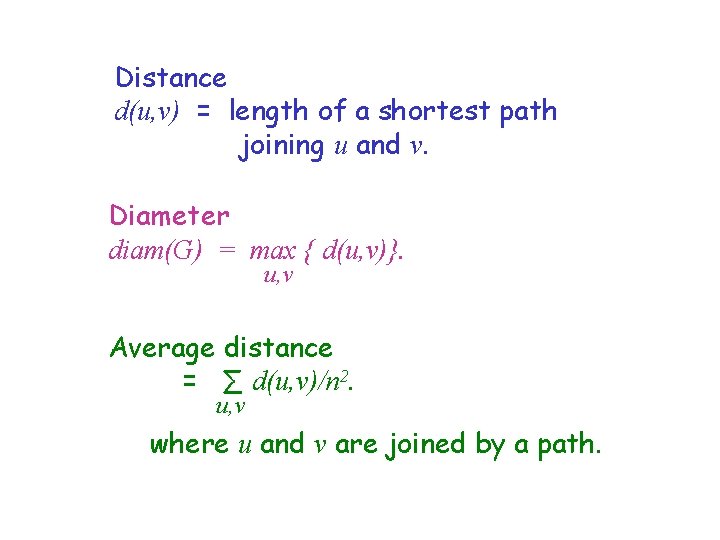
Distance d(u, v) = length of a shortest path joining u and v. Diameter diam(G) = max { d(u, v)}. u, v Average distance = ∑ d(u, v)/n 2. u, v where u and v are joined by a path.
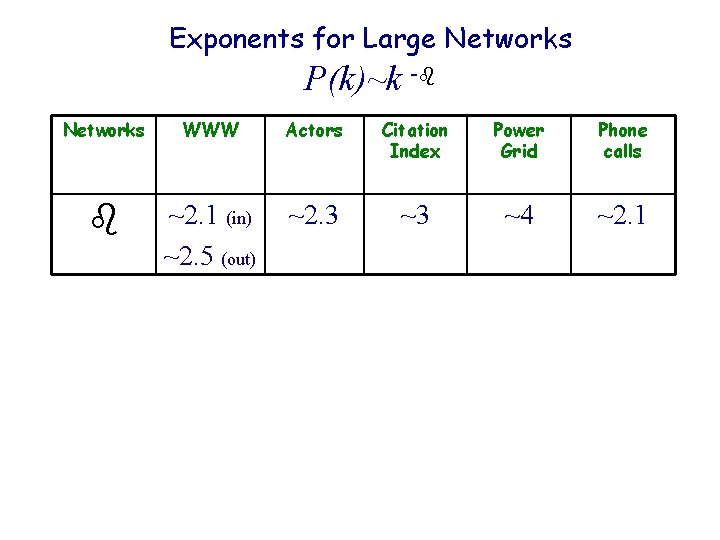
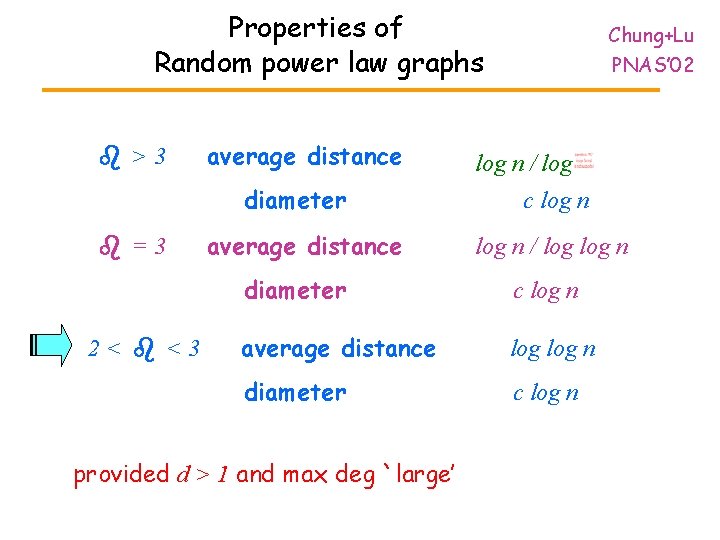
Exponents for Large Networks P(k)~k - Networks WWW Actors Citation Index Power Grid Phone calls ~2. 1 (in) ~2. 5 (out) ~2. 3 ~3 ~4 ~2. 1
Properties of Random power law graphs >3 average distance diameter =3 2< <3 average distance Chung+Lu PNAS’ 02 log n / log c log n / log n diameter c log n average distance log n diameter c log n provided d > 1 and max deg `large’
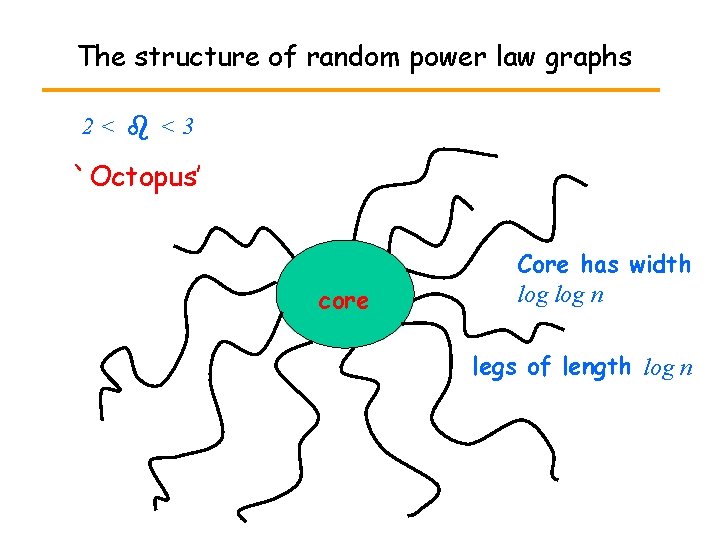
The structure of random power law graphs 2< <3 `Octopus’ core Core has width log n legs of length log n
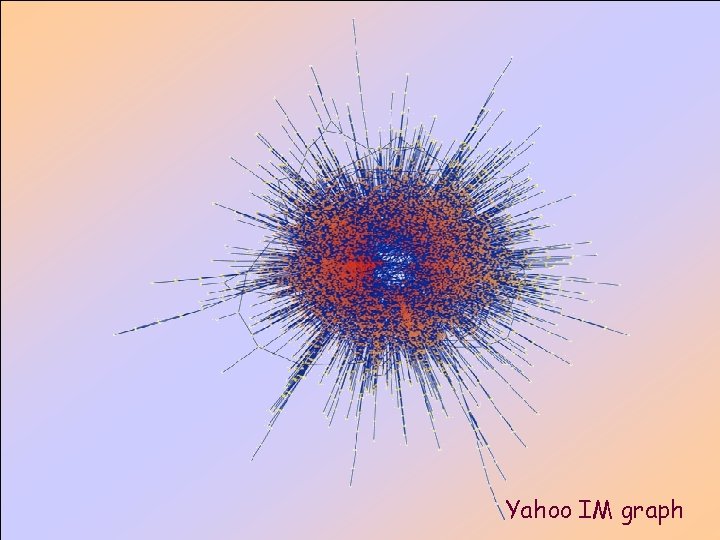
Yahoo IM graph
Several examples • Random graphs with any given degrees Diameter of random power law graphs • Diameter of random trees of a given graph • Percolation and giant components in a graph • Correlation between vertices xxx. The pagerank of a graphs • Graph coloring and network games
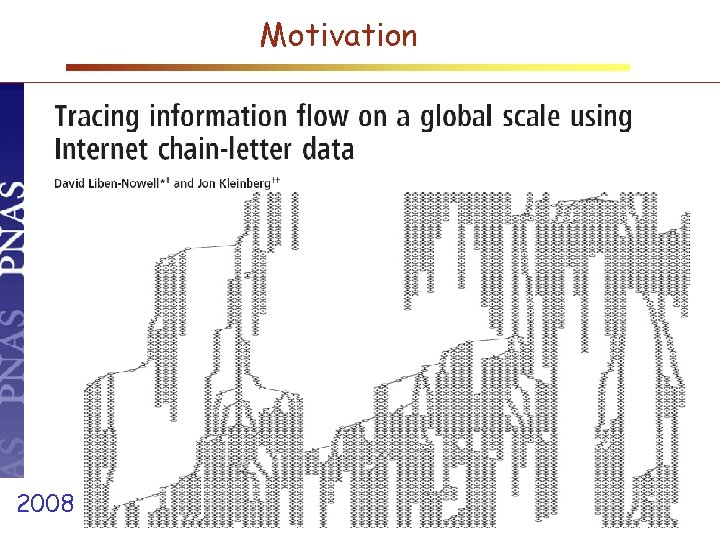
Motivation 2008
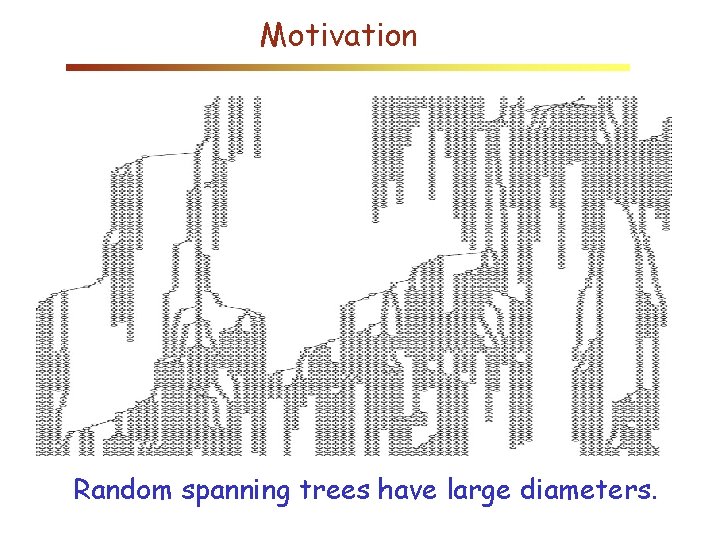
Motivation Random spanning trees have large diameters.
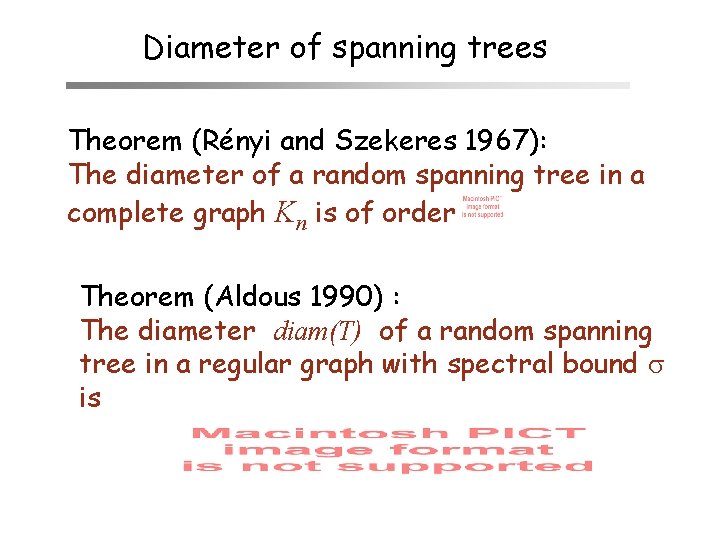
Diameter of spanning trees Theorem (Rényi and Szekeres 1967): The diameter of a random spanning tree in a complete graph Kn is of order. Theorem (Aldous 1990) : The diameter diam(T) of a random spanning tree in a regular graph with spectral bound is
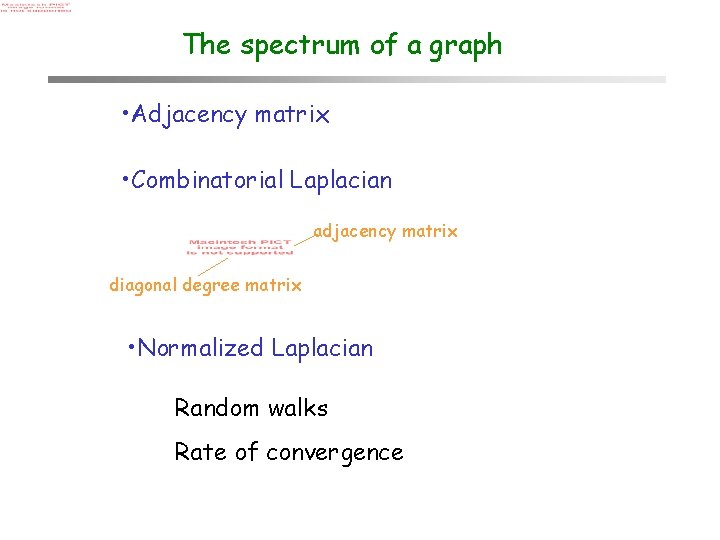
The spectrum of a graph Many ways Adjacency matrix to define the spectrum of a graph How are the eigenvalues related to properties of graphs?
The spectrum of a graph • Adjacency matrix • Combinatorial Laplacian adjacency matrix diagonal degree matrix • Normalized Laplacian Random walks Rate of convergence
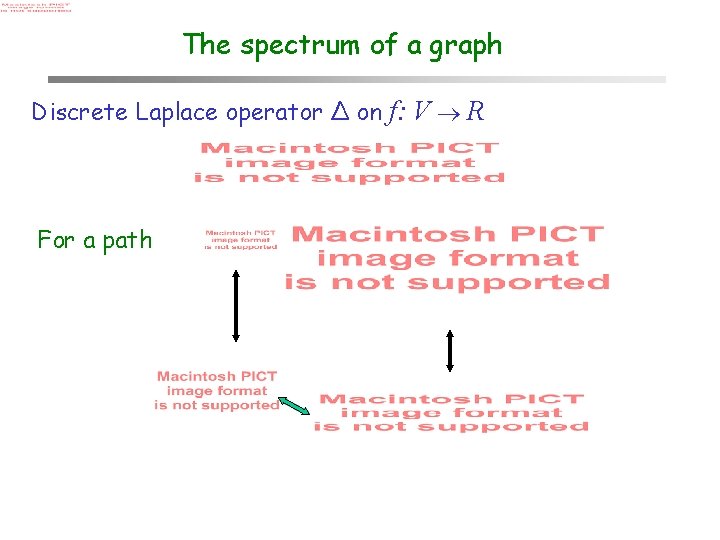
The spectrum of a graph Discrete Laplace operator ∆ on f: V R For a path
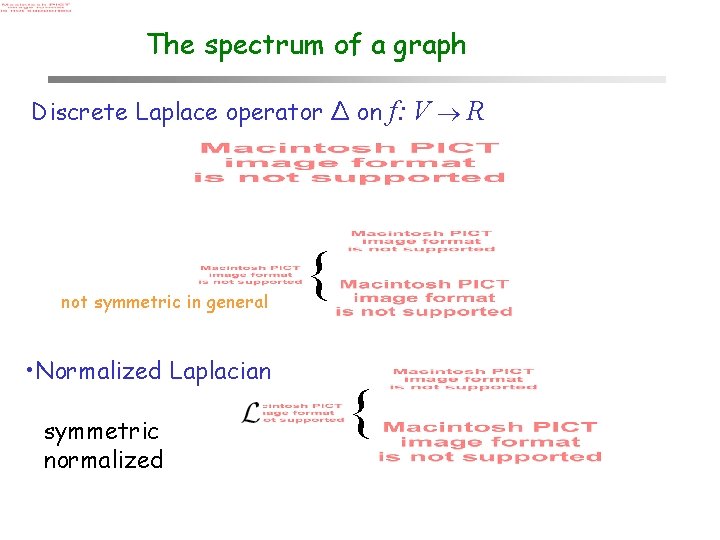
The spectrum of a graph Discrete Laplace operator ∆ on f: V R not symmetric in general • Normalized Laplacian symmetric normalized { {
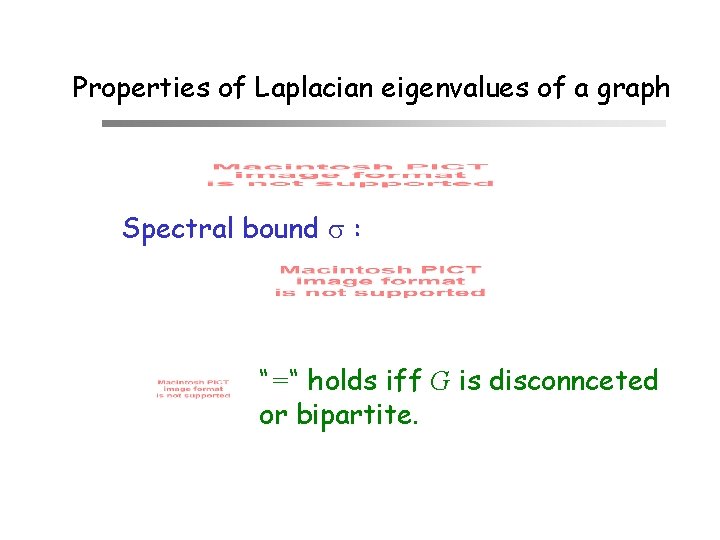
Properties of Laplacian eigenvalues of a graph Spectral bound : “=“ holds iff G is disconnceted or bipartite.
Question What is the diameter of a random spanning tree of a given graph G ?
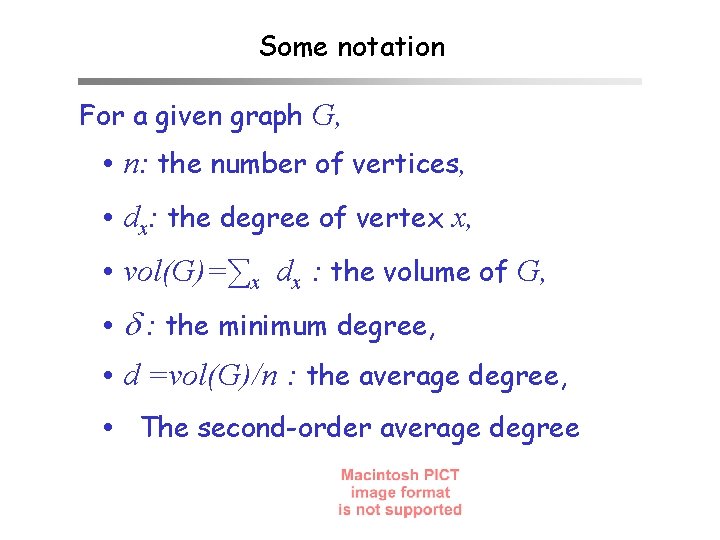
Some notation For a given graph G, • n: the number of vertices, • dx: the degree of vertex x, • vol(G)=∑x dx : the volume of G, • : the minimum degree, • d =vol(G)/n : the average degree, • The second-order average degree
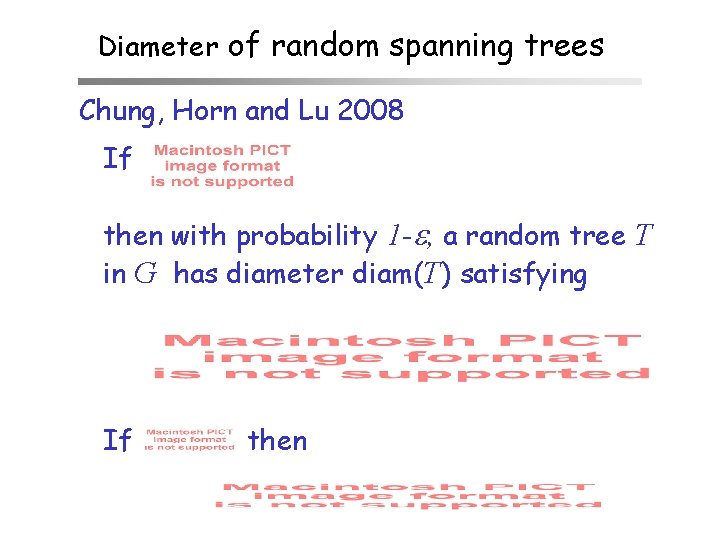
Diameter of random spanning trees Chung, Horn and Lu 2008 If then with probability 1 - , a random tree T in G has diameter diam(T) satisfying If then
Several examples • Random graphs with any given degrees Diameter of random power law graphs • Diameter of random trees of a given graph • Percolation and giant components in a graph • Correlation between vertices xxxxxx. The pagerank of a graph • Graph coloring and network games
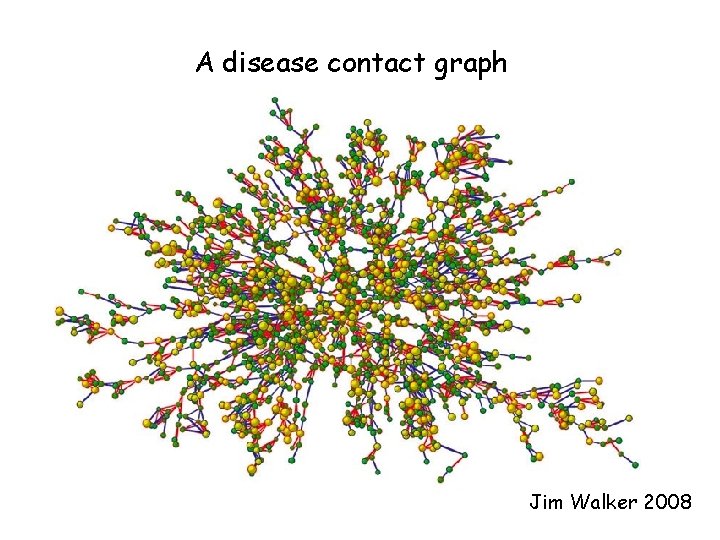
A disease contact graph Jim Walker 2008
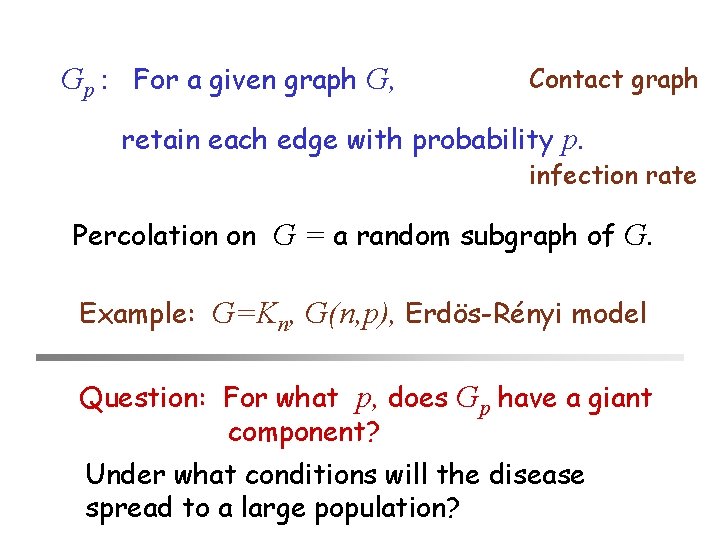
Gp : For a given graph G, Contact graph retain each edge with probability p. infection rate Percolation on G = a random subgraph of G. Example: G=Kn, G(n, p), Erdös-Rényi model Question: For what p, does Gp have a giant xxxxxcomponent? Under what conditions will the disease spread to a large population?
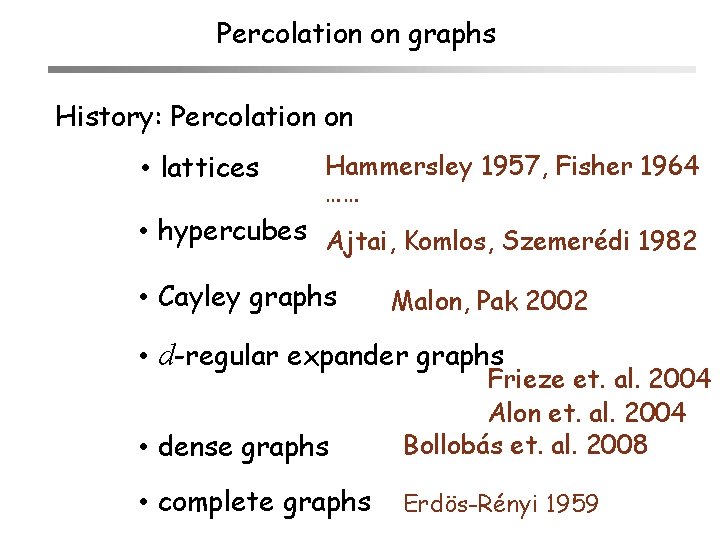
Percolation on graphs History: Percolation on • lattices Hammersley 1957, Fisher 1964 …… • hypercubes Ajtai, Komlos, Szemerédi 1982 • Cayley graphs Malon, Pak 2002 • d-regular expander graphs • dense graphs Frieze et. al. 2004 Alon et. al. 2004 Bollobás et. al. 2008 • complete graphs Erdös-Rényi 1959
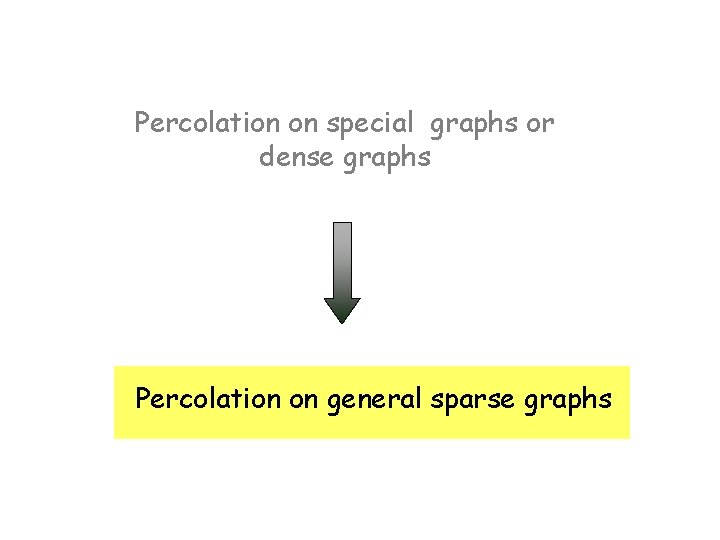
Percolation on special graphs or dense graphs Percolation on general sparse graphs
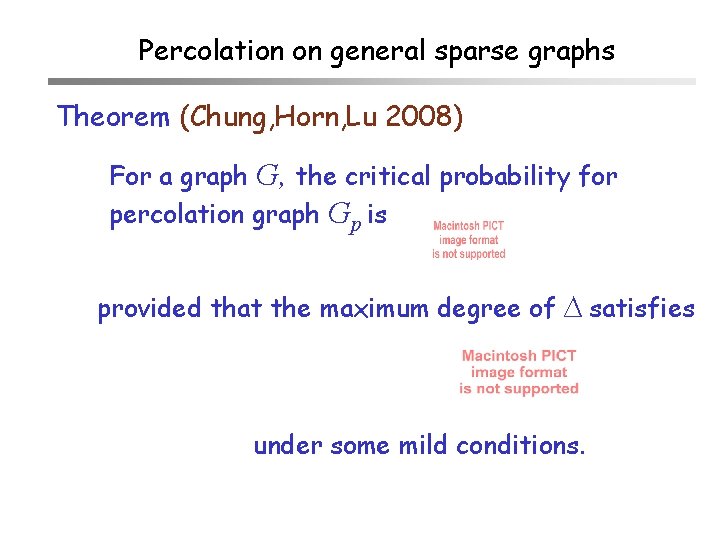
Percolation on general sparse graphs Theorem (Chung, Horn, Lu 2008) For a graph G, the critical probability for percolation graph Gp is provided that the maximum degree of ∆ satisfies under some mild conditions.
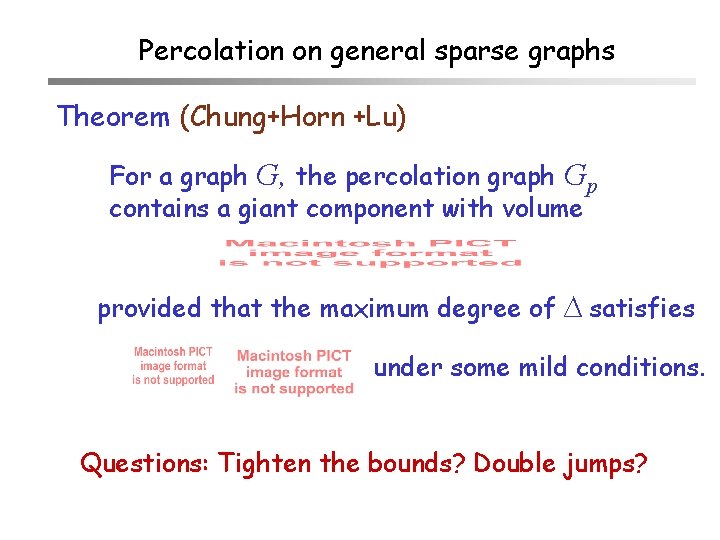
Percolation on general sparse graphs Theorem (Chung+Horn +Lu) For a graph G, the percolation graph Gp contains a giant component with volume provided that the maximum degree of ∆ satisfies under some mild conditions. Questions: Tighten the bounds? Double jumps?
Several examples • Random graphs with any given degrees Diameter of random power law graphs • Diameter of random trees of a given graph • Percolation and giant components in a graph • Correlation between vertices xxxxxxx. The pagerank of a graphs • Graph coloring and network games
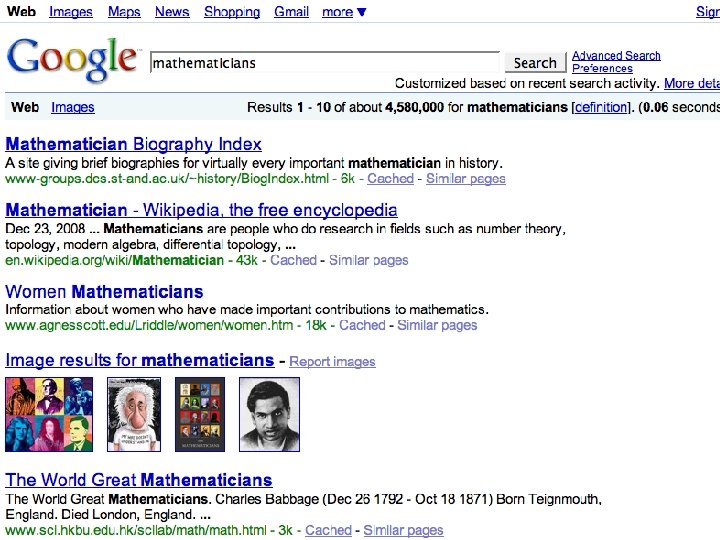
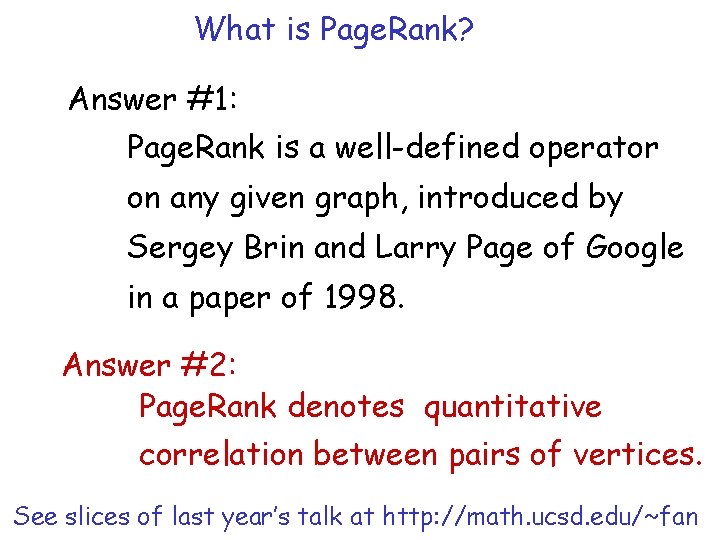
What is Page. Rank? Answer #1: Page. Rank is a well-defined operator on any given graph, introduced by Sergey Brin and Larry Page of Google in a paper of 1998. Answer #2: Page. Rank denotes quantitative correlation between pairs of vertices. See slices of last year’s talk at http: //math. ucsd. edu/~fan
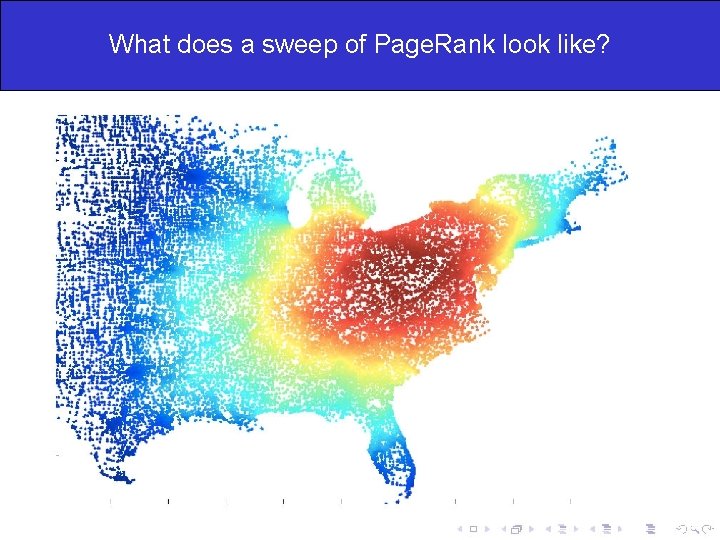
What does a sweep of Page. Rank look like?
Several examples • Random graphs with any given degrees Diameter of random power law graphs • Diameter of random trees of a given graph • Percolation and giant components in a graph • Correlation between vertices xxxxxxx. The pagerank of a graphs • Graph coloring and network games
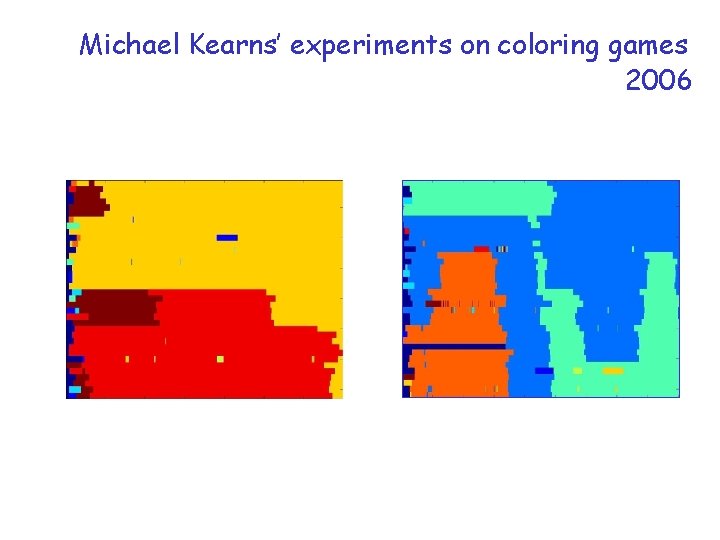
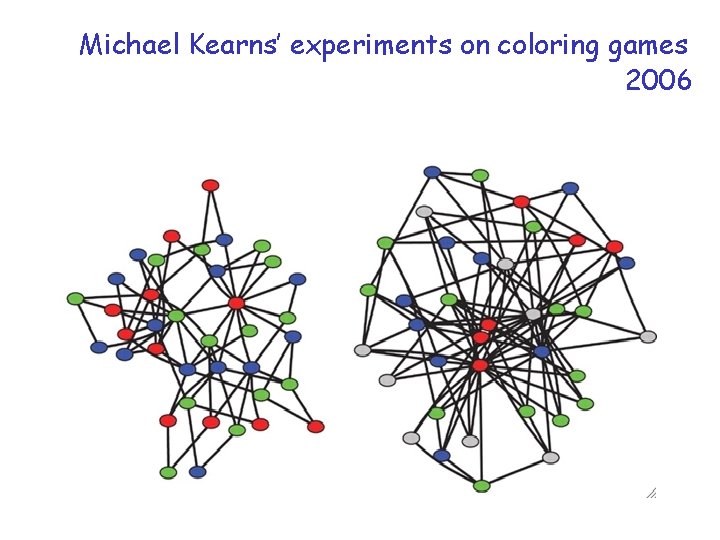
Michael Kearns’ experiments on coloring games 2006
Michael Kearns’ experiments on coloring games 2006
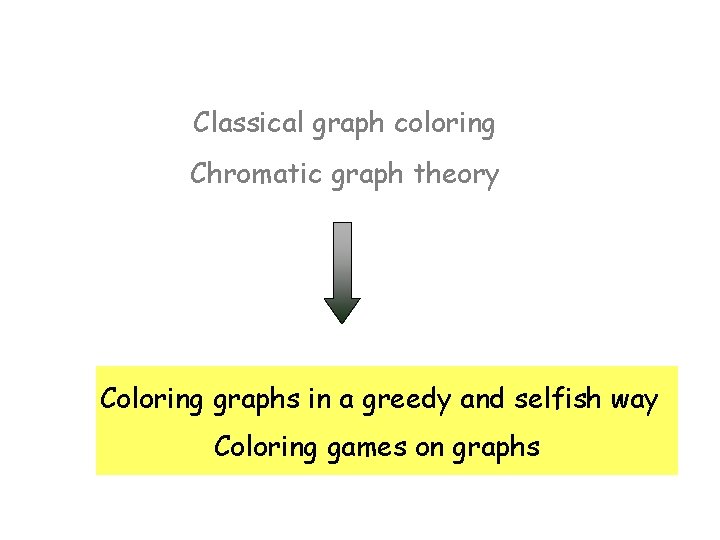
Classical graph coloring Chromatic graph theory Coloring graphs in a greedy and selfish way Coloring games on graphs
Applications of graph coloring games • dynamics of social networks • conflict resolution • Internet economics • on-line optimization + scheduling • • •
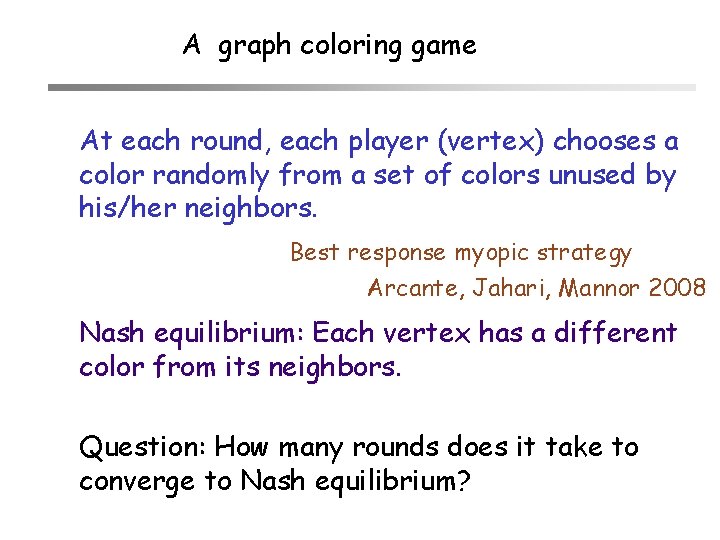
A graph coloring game At each round, each player (vertex) chooses a color randomly from a set of colors unused by his/her neighbors. Best response myopic strategy Arcante, Jahari, Mannor 2008 Nash equilibrium: Each vertex has a different color from its neighbors. Question: How many rounds does it take to converge to Nash equilibrium?
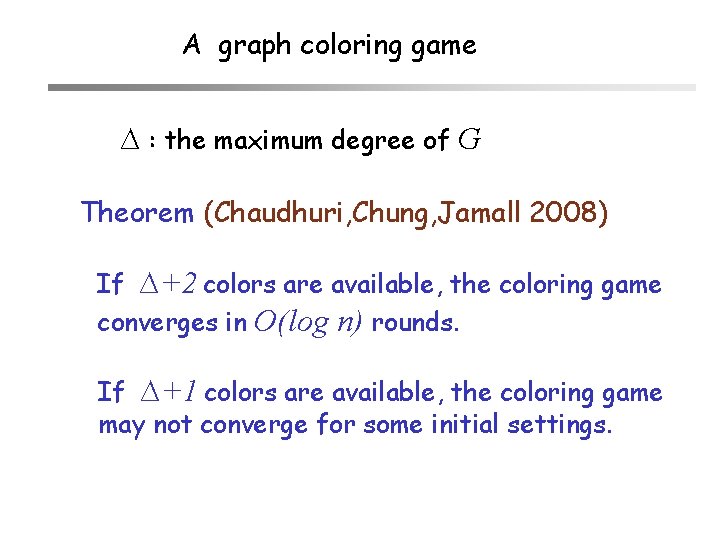
A graph coloring game ∆ : the maximum degree of G Theorem (Chaudhuri, Chung, Jamall 2008) If ∆+2 colors are available, the coloring game converges in O(log n) rounds. If ∆+1 colors are available, the coloring game may not converge for some initial settings.
Improving existing methods • Probabilistic methods, random graphs. • Random walks and the convergence rate • Lower bound techniques • General Martingale methods • Geometric methods • Spectral methods
New directions in graph theory • Random graphs with any given degrees Diameter of random power law graphs • Diameter of random trees of a given graph • Percolation and giant components in a graph • Correlation between vertices xxx. The pagerank of a graphs • Graph coloring and network games • Many new directions and tools ….