
FAMOUS CONJECTURES TOP FIVE A conjecture is a

- Slides: 8
FAMOUS CONJECTURES TOP FIVE
A conjecture is a proposition that is unproven but appears correct and has not been disproven. After demostrating the truth of a conjecture, this came to be considered a theorem and as such can be used to build other formal proofs.
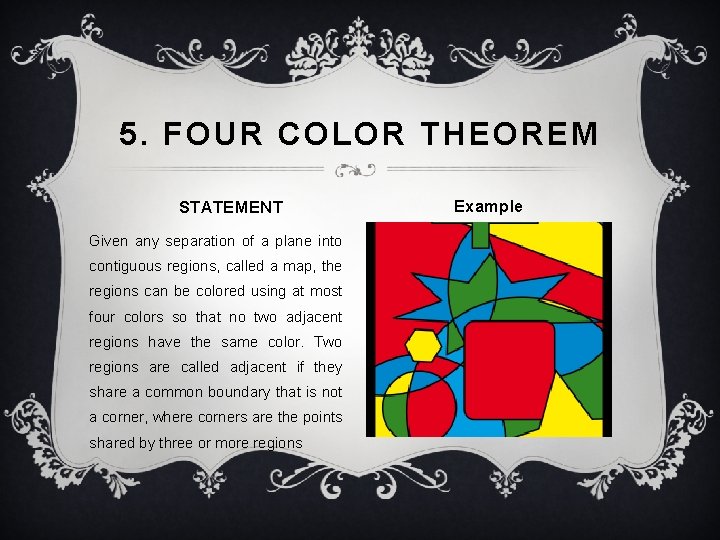
5. FOUR COLOR THEOREM STATEMENT Given any separation of a plane into contiguous regions, called a map, the regions can be colored using at most four colors so that no two adjacent regions have the same color. Two regions are called adjacent if they share a common boundary that is not a corner, where corners are the points shared by three or more regions Example
4. LEGENDRE’S CONJECTURE Examples STATEMENT There is a prime number between n 2 and (n + 1)2 for every positive integer n. v n=1 Between 1 and 4 are 2 and 3 v n=2 Between 4 and 9 are 5 and 7 v n=3 Between 9 and 16 are 11 and 13
3. CONJECTURE TWIN PRIME NUMBERS Examples STATEMENT There are infinitely many v p=3 and p+2 = 5 primes p such that p+2 is v p=5 and p+2 = 7 also prime. v p = 11 and p+2 = 13 v p = 29 and p+2 = 31
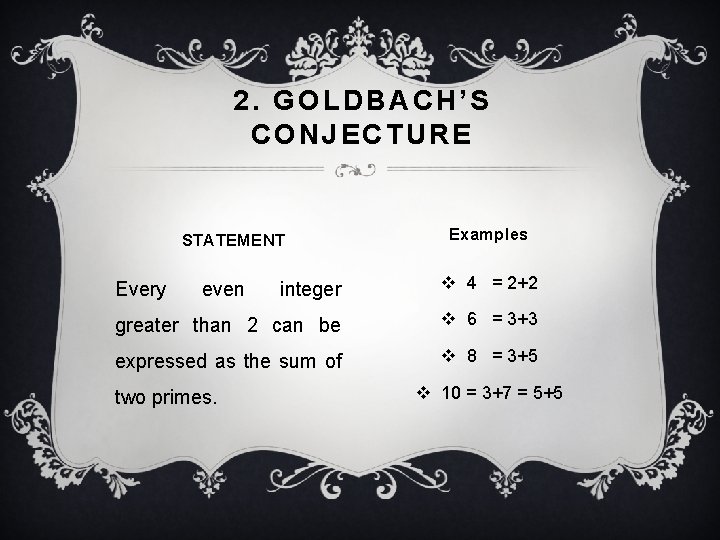
2. GOLDBACH’S CONJECTURE STATEMENT Examples integer v 4 = 2+2 greater than 2 can be v 6 = 3+3 expressed as the sum of v 8 = 3+5 Every even two primes. v 10 = 3+7 = 5+5
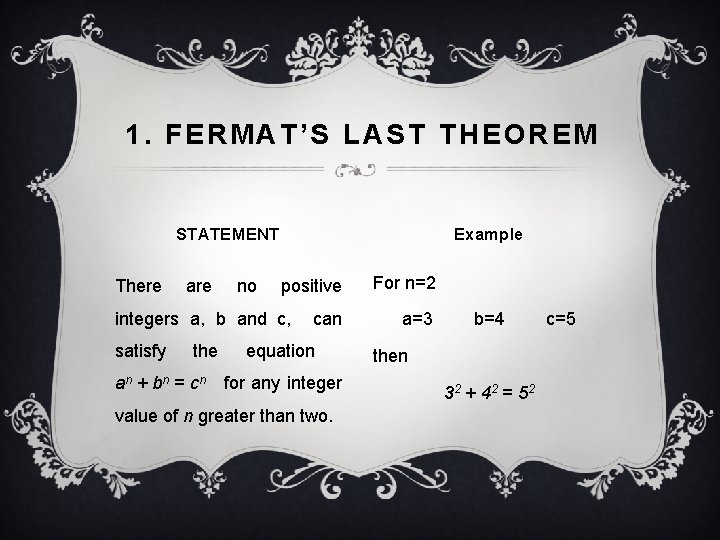
1. FERMAT’S LAST THEOREM Example STATEMENT There are no positive integers a, b and c, satisfy the an + bn = cn can equation for any integer value of n greater than two. For n=2 a=3 b=4 then 32 + 42 = 52 c=5
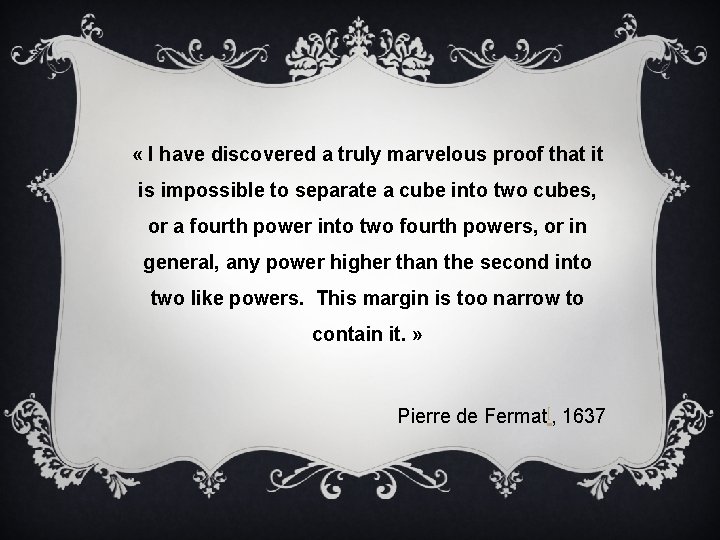
« I have discovered a truly marvelous proof that it is impossible to separate a cube into two cubes, or a fourth power into two fourth powers, or in general, any power higher than the second into two like powers. This margin is too narrow to contain it. » Pierre de Fermat[, 1637