
FamilyLed Care Training Day 2 This presentation is

- Slides: 39
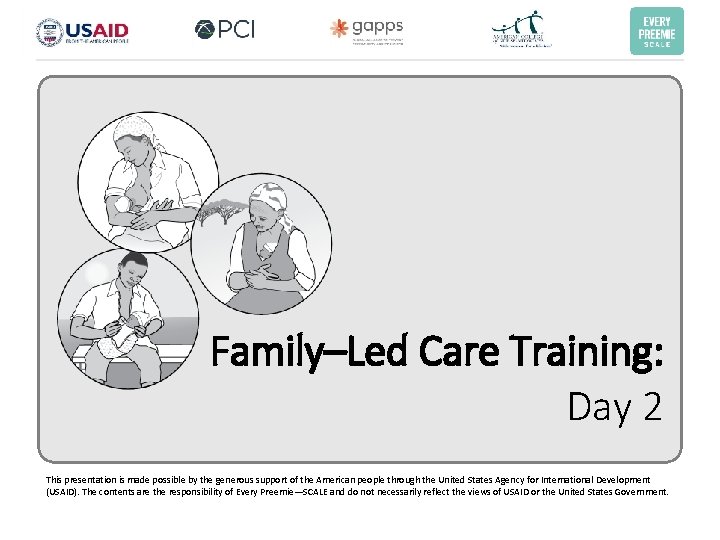
Family–Led Care Training: Day 2 This presentation is made possible by the generous support of the American people through the United States Agency for International Development (USAID). The contents are the responsibility of Every Preemie—SCALE and do not necessarily reflect the views of USAID or the United States Government.
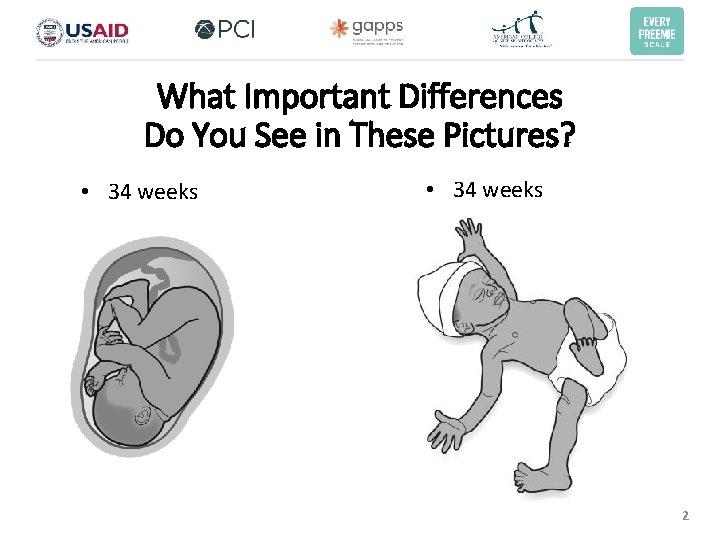
What Important Differences Do You See in These Pictures? • 34 weeks 2
Challenges for Preterm Newborn Babies Inside the uterus • Warm • Dark • Quiet • Clean • Soft • Gentle movement • Containment Outside the uterus • Cold • Light • Noisy • New exposures • Hard • Activities (breathing, keeping warm, feeding, being held, examined, weighed and moved) 3
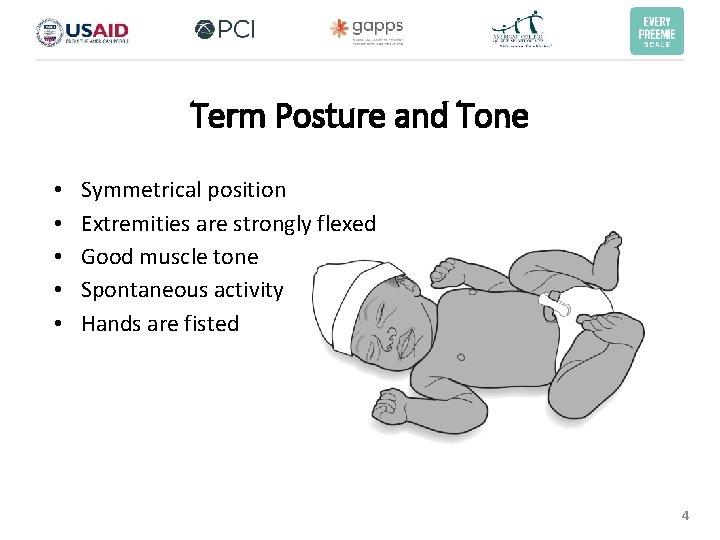
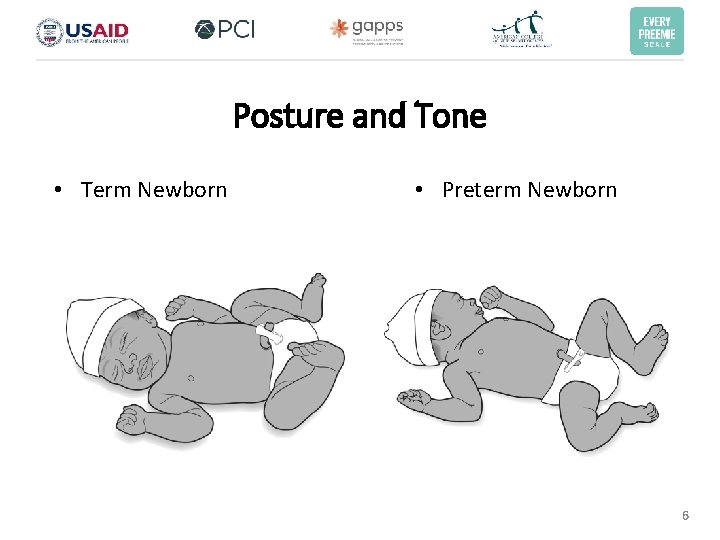
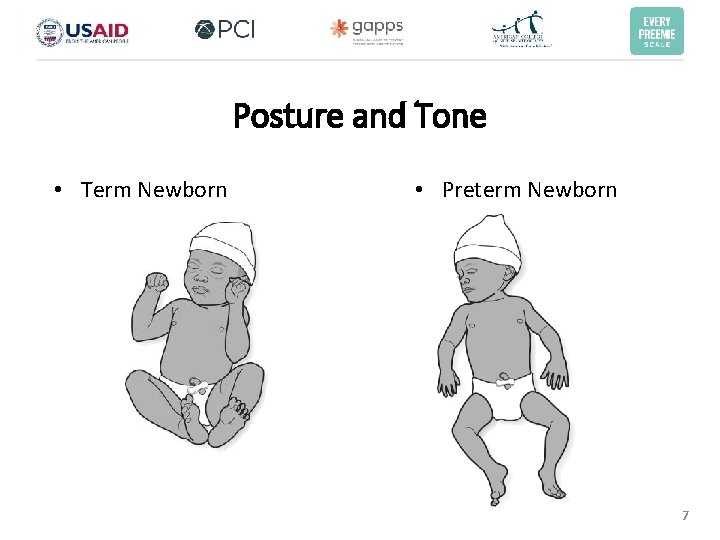
Term Posture and Tone • • • Symmetrical position Extremities are strongly flexed Good muscle tone Spontaneous activity Hands are fisted 4
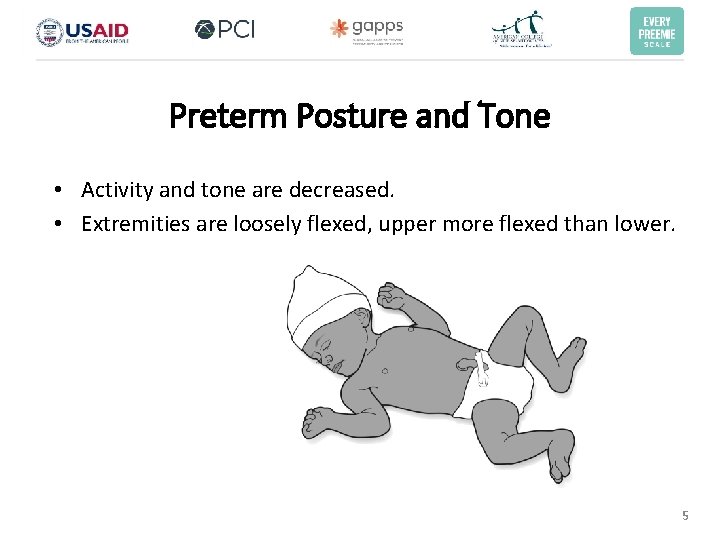
Preterm Posture and Tone • Activity and tone are decreased. • Extremities are loosely flexed, upper more flexed than lower. 5
Posture and Tone • Term Newborn • Preterm Newborn 6
Posture and Tone • Term Newborn • Preterm Newborn 7
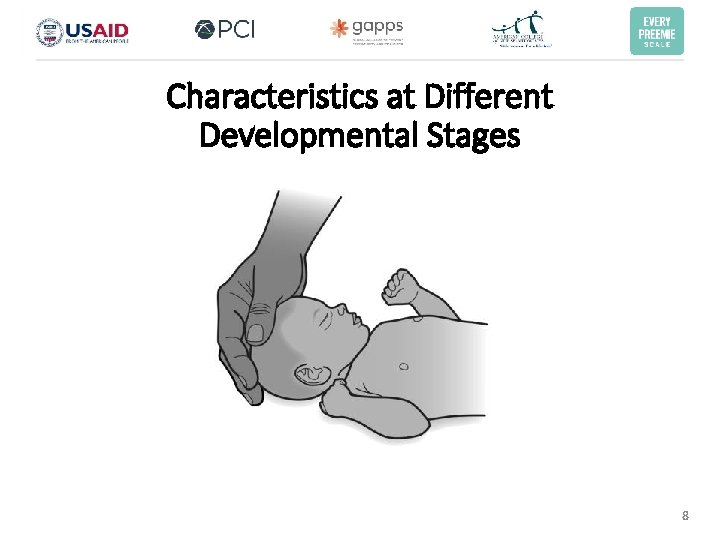
Characteristics at Different Developmental Stages 8
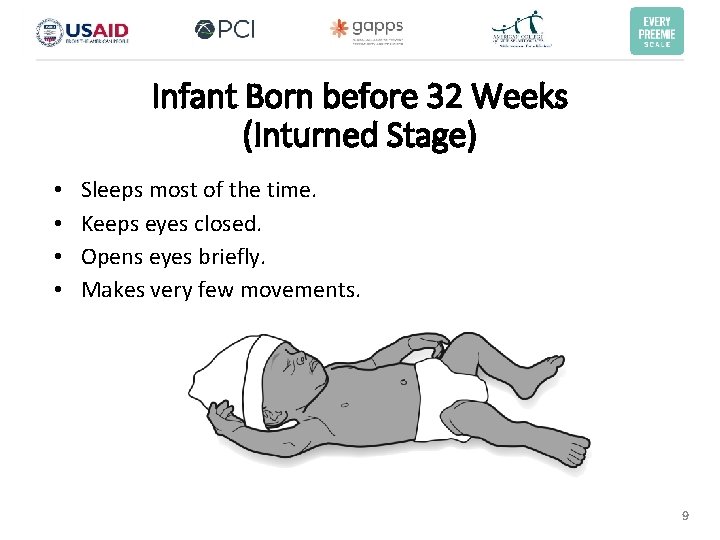
Infant Born before 32 Weeks (Inturned Stage) • • Sleeps most of the time. Keeps eyes closed. Opens eyes briefly. Makes very few movements. 9
How to Help • • Keep baby in skin-to-skin care at least 20 hours a day. Feed regularly and monitor weight. Allow to baby sleep uninterrupted between feedings. Keep noise levels low. Avoid direct light on the infant. Talk and sing softly. Respond to any stress signals. 10
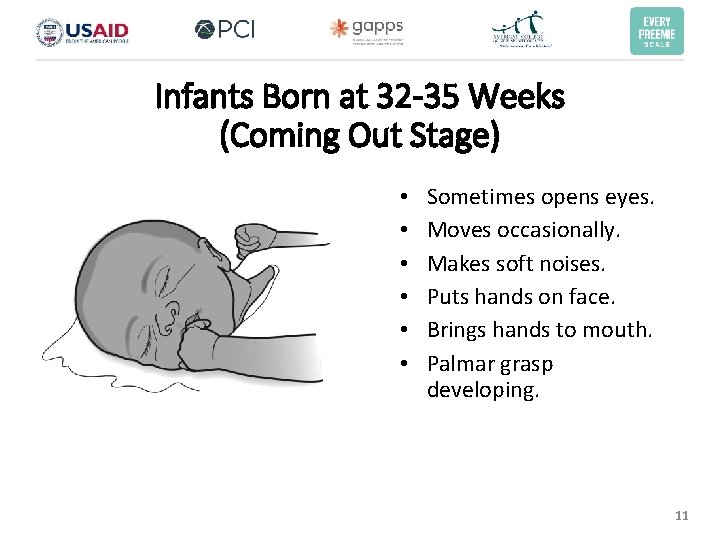
Infants Born at 32 -35 Weeks (Coming Out Stage) • • • Sometimes opens eyes. Moves occasionally. Makes soft noises. Puts hands on face. Brings hands to mouth. Palmar grasp developing. 11
How to Help • • • Keep baby in skin-to-skin position at least 20 hours a day. Feed regularly and monitor weight. Allow balance of interaction and sleep. When awake, position to encourage eye contact. Talk to the infant. Respond to stress signals. 12
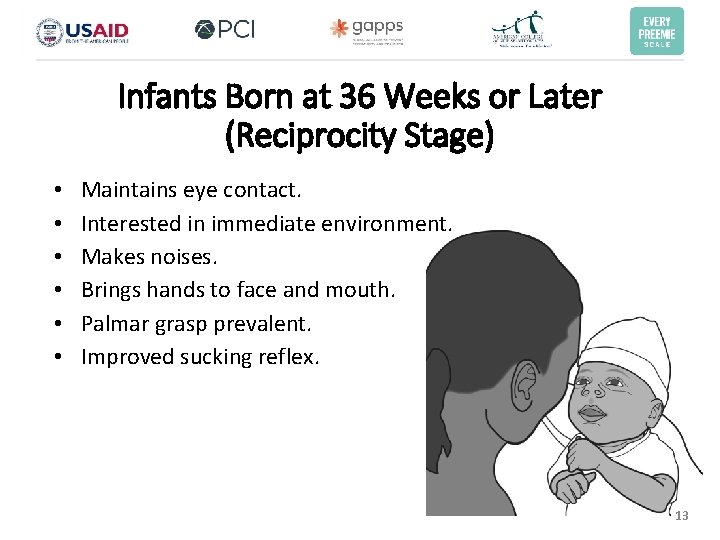
Infants Born at 36 Weeks or Later (Reciprocity Stage) • • • Maintains eye contact. Interested in immediate environment. Makes noises. Brings hands to face and mouth. Palmar grasp prevalent. Improved sucking reflex. 13
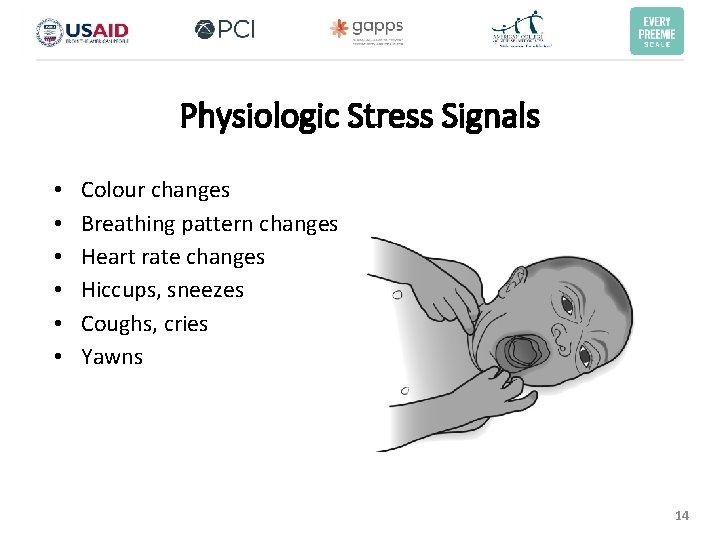
Physiologic Stress Signals • • • Colour changes Breathing pattern changes Heart rate changes Hiccups, sneezes Coughs, cries Yawns 14
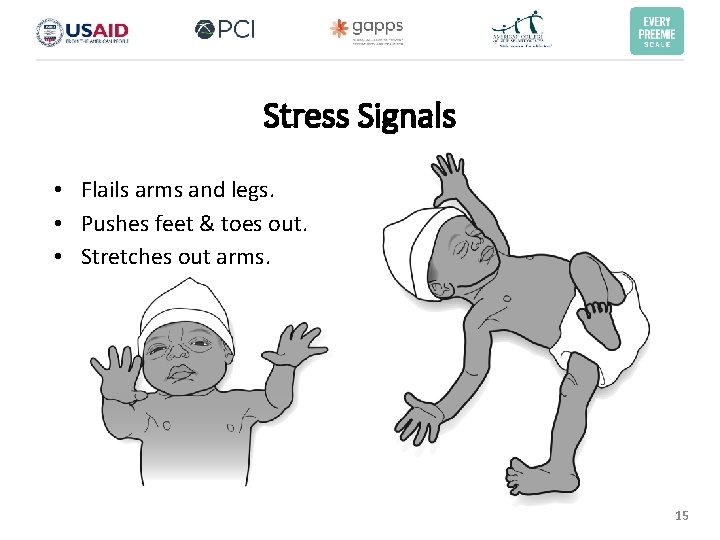
Stress Signals • Flails arms and legs. • Pushes feet & toes out. • Stretches out arms. 15
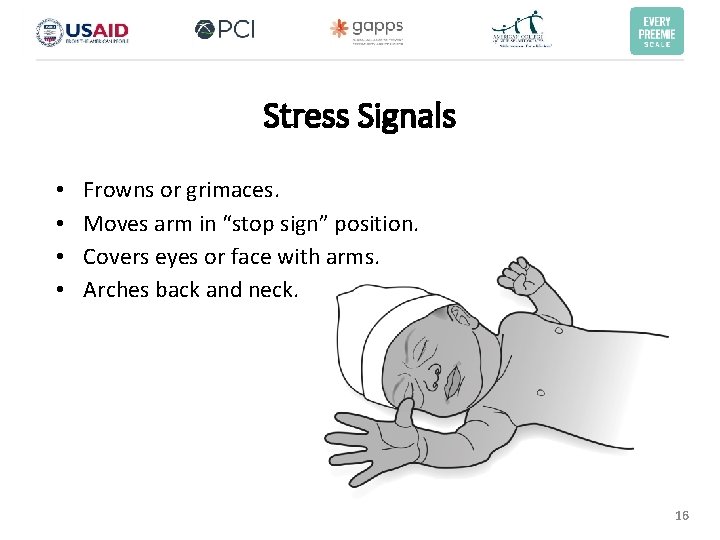
Stress Signals • • Frowns or grimaces. Moves arm in “stop sign” position. Covers eyes or face with arms. Arches back and neck. 16
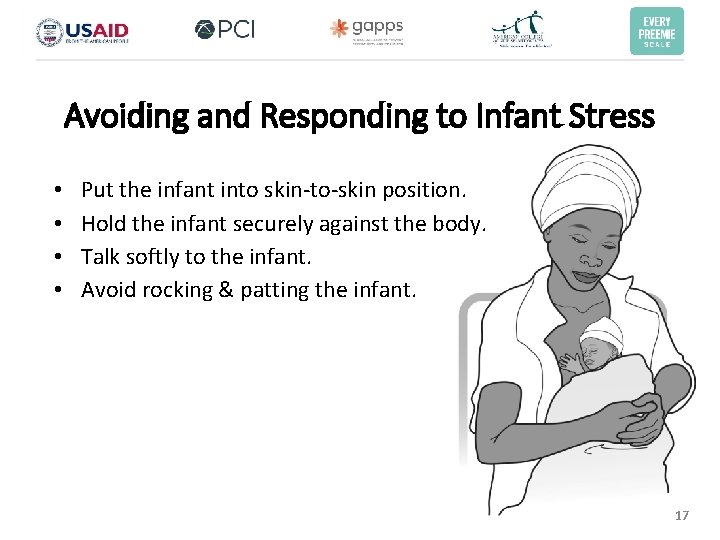
Avoiding and Responding to Infant Stress • • Put the infant into skin-to-skin position. Hold the infant securely against the body. Talk softly to the infant. Avoid rocking & patting the infant. 17
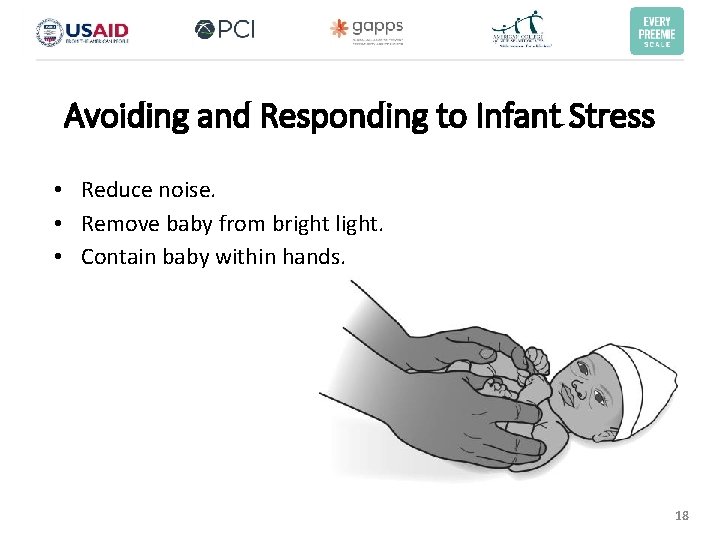
Avoiding and Responding to Infant Stress • Reduce noise. • Remove baby from bright light. • Contain baby within hands. 18
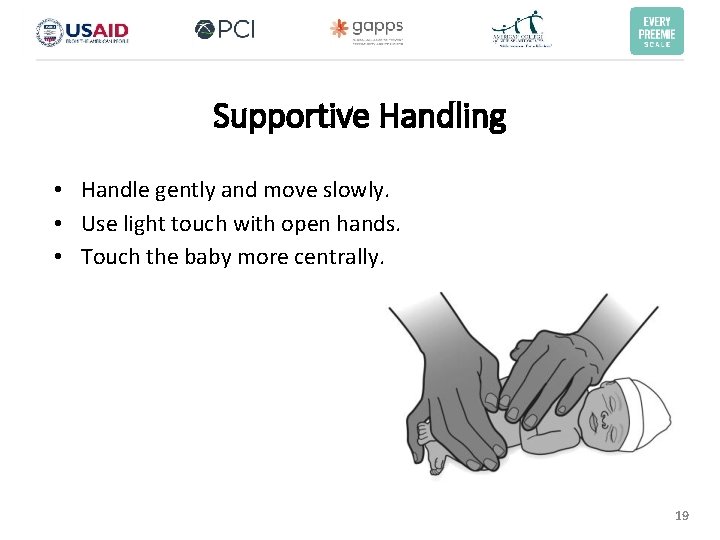
Supportive Handling • Handle gently and move slowly. • Use light touch with open hands. • Touch the baby more centrally. 19
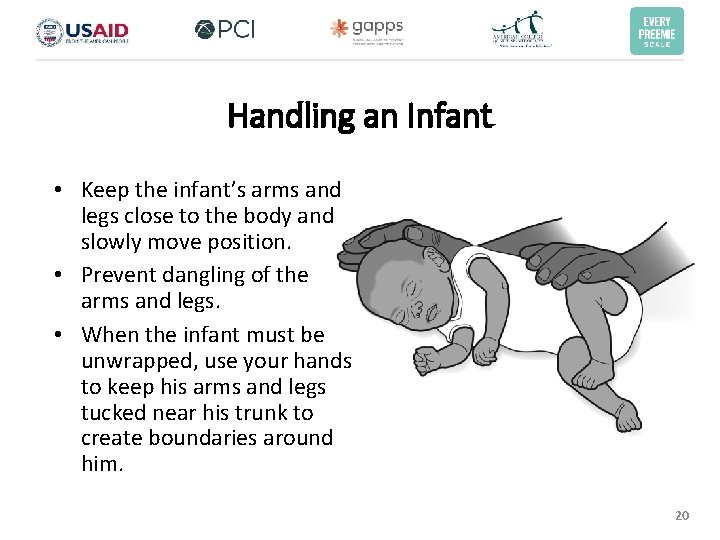
Handling an Infant • Keep the infant’s arms and legs close to the body and slowly move position. • Prevent dangling of the arms and legs. • When the infant must be unwrapped, use your hands to keep his arms and legs tucked near his trunk to create boundaries around him. 20
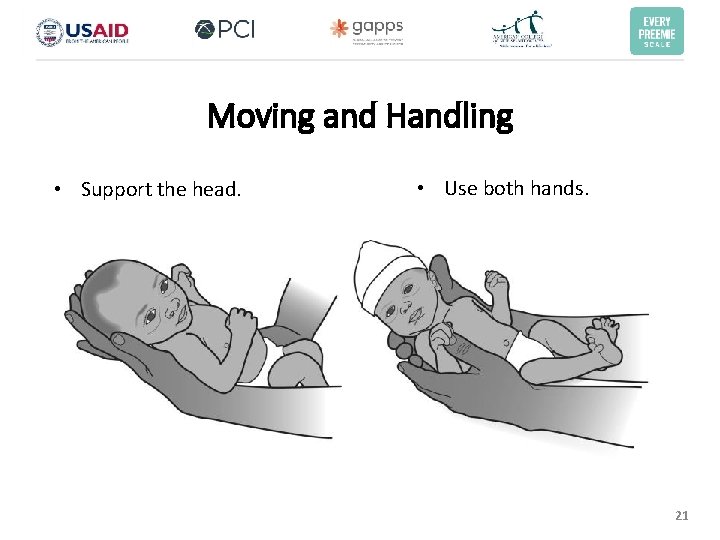
Moving and Handling • Support the head. • Use both hands. 21
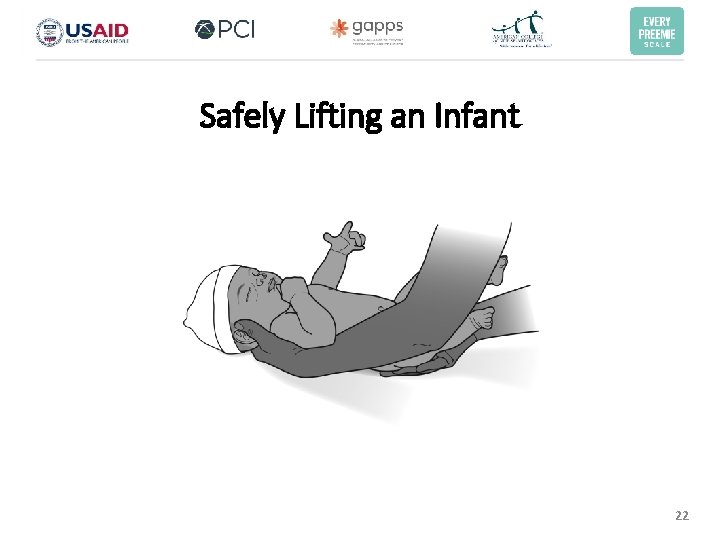
Safely Lifting an Infant 22
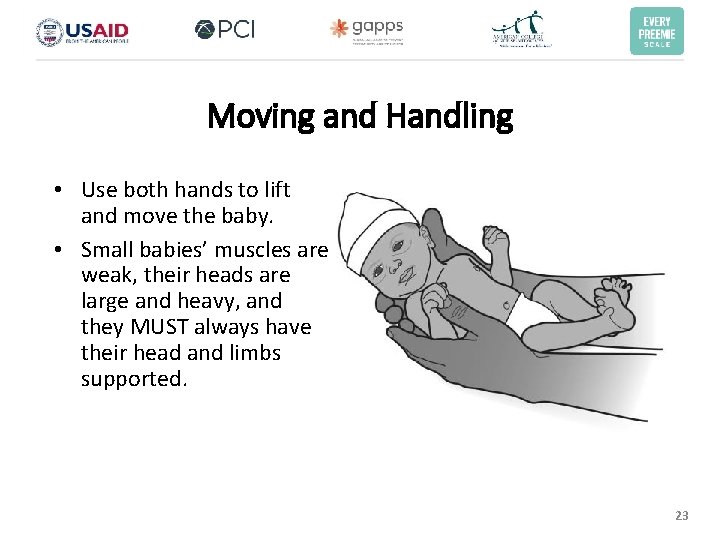
Moving and Handling • Use both hands to lift and move the baby. • Small babies’ muscles are weak, their heads are large and heavy, and they MUST always have their head and limbs supported. 23
Growth Monitoring: Weight the Baby Daily • Use accurate and precise scales and standardized weighing technique (at same time each day). • Analogue or digital scales with 10 gram tolerance intervals are good. • When advancing the feedings from tube to cup, or from cup to nipple, it is important to weigh the baby daily since it takes extra energy to lick from the cup or suckle at the breast. If the baby loses weight for 2 days in a row you may need to return to the previous feeding method. 24
Normal Newborn Weight Loss • Babies can lose up to 10% of their birth weight in the first days after birth and still be considered healthy. • This period of weight loss happens within the first 5 -7 days after birth. • They usually regain this weight by 7 -14 days after birth, but small babies may take up to 3 weeks to regain their birth weight. • NO weight loss after 7 days is ever normal. 25
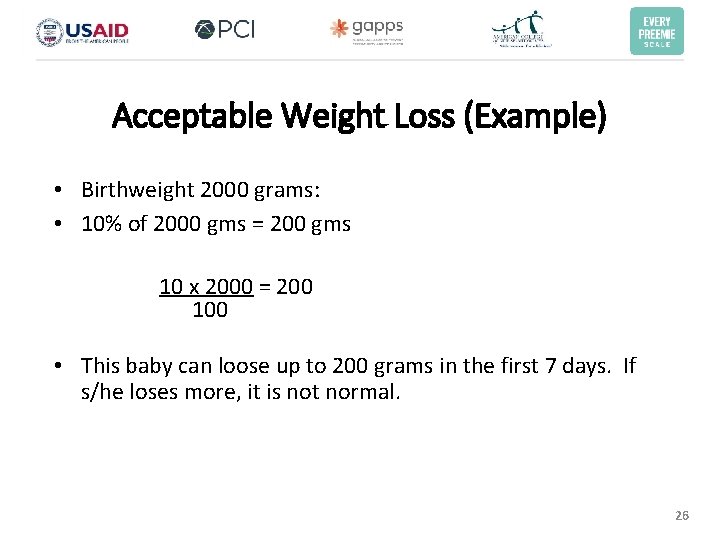
Acceptable Weight Loss (Example) • Birthweight 2000 grams: • 10% of 2000 gms = 200 gms 10 x 2000 = 200 100 • This baby can loose up to 200 grams in the first 7 days. If s/he loses more, it is not normal. 26
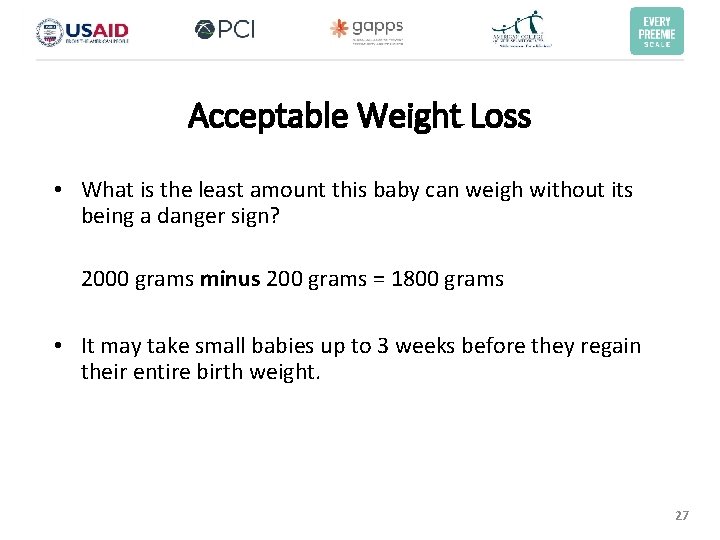
Acceptable Weight Loss • What is the least amount this baby can weigh without its being a danger sign? 2000 grams minus 200 grams = 1800 grams • It may take small babies up to 3 weeks before they regain their entire birth weight. 27
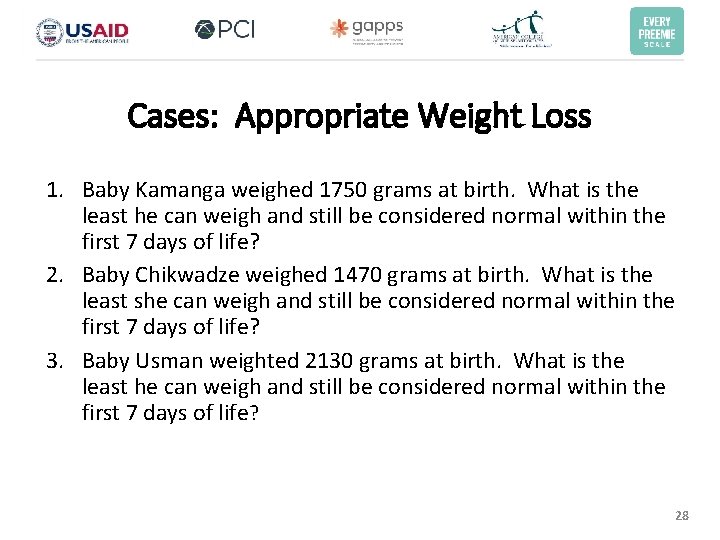
Cases: Appropriate Weight Loss 1. Baby Kamanga weighed 1750 grams at birth. What is the least he can weigh and still be considered normal within the first 7 days of life? 2. Baby Chikwadze weighed 1470 grams at birth. What is the least she can weigh and still be considered normal within the first 7 days of life? 3. Baby Usman weighted 2130 grams at birth. What is the least he can weigh and still be considered normal within the first 7 days of life? 28
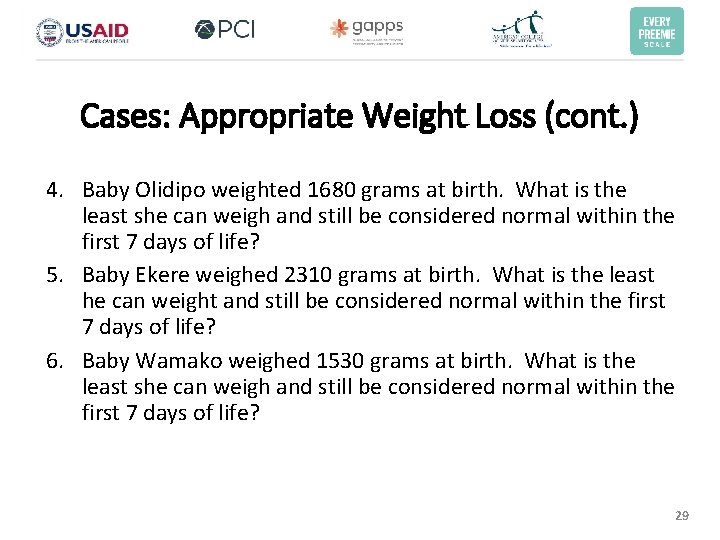
Cases: Appropriate Weight Loss (cont. ) 4. Baby Olidipo weighted 1680 grams at birth. What is the least she can weigh and still be considered normal within the first 7 days of life? 5. Baby Ekere weighed 2310 grams at birth. What is the least he can weight and still be considered normal within the first 7 days of life? 6. Baby Wamako weighed 1530 grams at birth. What is the least she can weigh and still be considered normal within the first 7 days of life? 29
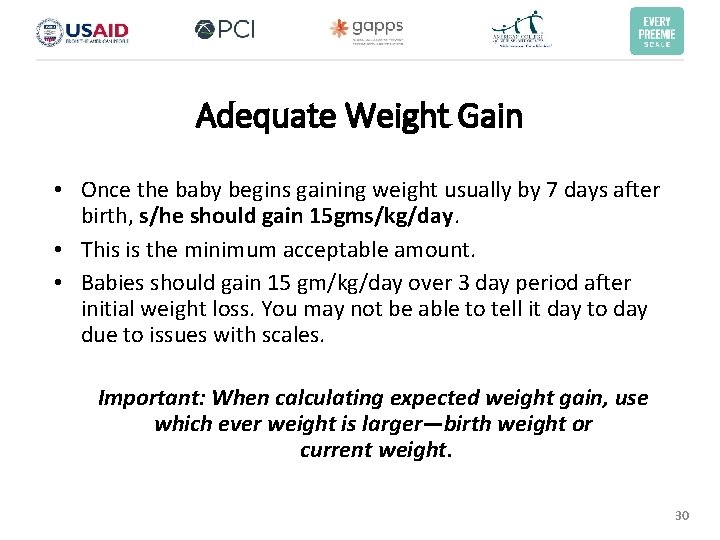
Adequate Weight Gain • Once the baby begins gaining weight usually by 7 days after birth, s/he should gain 15 gms/kg/day. • This is the minimum acceptable amount. • Babies should gain 15 gm/kg/day over 3 day period after initial weight loss. You may not be able to tell it day to day due to issues with scales. Important: When calculating expected weight gain, use which ever weight is larger—birth weight or current weight. 30
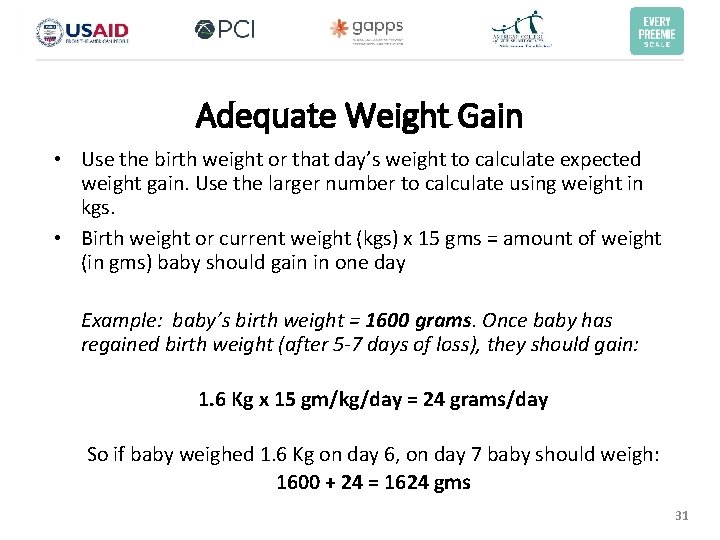
Adequate Weight Gain • Use the birth weight or that day’s weight to calculate expected weight gain. Use the larger number to calculate using weight in kgs. • Birth weight or current weight (kgs) x 15 gms = amount of weight (in gms) baby should gain in one day Example: baby’s birth weight = 1600 grams. Once baby has regained birth weight (after 5 -7 days of loss), they should gain: 1. 6 Kg x 15 gm/kg/day = 24 grams/day So if baby weighed 1. 6 Kg on day 6, on day 7 baby should weigh: 1600 + 24 = 1624 gms 31
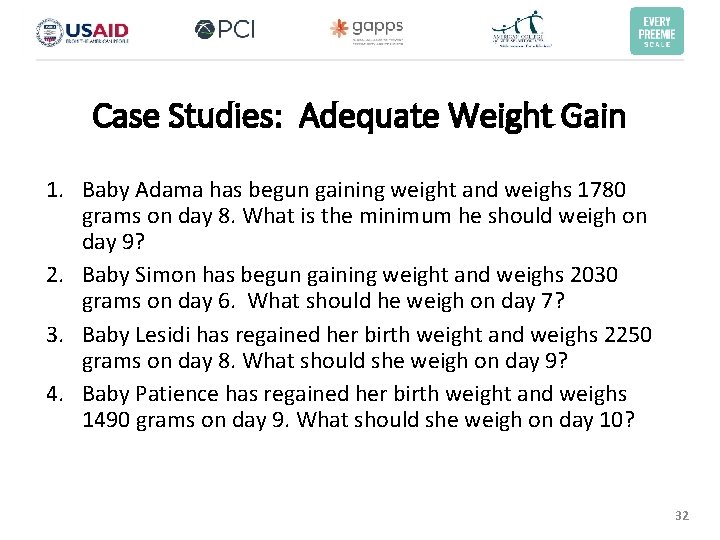
Case Studies: Adequate Weight Gain 1. Baby Adama has begun gaining weight and weighs 1780 grams on day 8. What is the minimum he should weigh on day 9? 2. Baby Simon has begun gaining weight and weighs 2030 grams on day 6. What should he weigh on day 7? 3. Baby Lesidi has regained her birth weight and weighs 2250 grams on day 8. What should she weigh on day 9? 4. Baby Patience has regained her birth weight and weighs 1490 grams on day 9. What should she weigh on day 10? 32
Case Studies: Adequate Weight Gain 5. Baby Gbenga has regained his birth weight and weighs 1580 grams on day 8. What should he weigh on day 9, 10, 11? 6. Baby Abah has begun gaining weight and weighs 2120 grams on day 6. What should she weigh on day 7, 8, 9? 7. Baby Nyasha has begun gaining weight and weighs 2380 grams on day 5. What should she weigh on day 6, 7, 8? 8. Baby Zawadi has regained her birth weight and weighs 1830 grams on day 7. What should she weigh on day 8, 9, 10? 33
Weight Loss or Inadequate Weight Gain You must assess: • If cup or tube feeding: Assess the 24 hour volume taken. Was it sufficient? Could the baby take more? • If breastfeeding: Assess if there are problems with the breast, position, or technique. • Ensure that the baby is being fed every 2 -3 hours around the clock—especially at night. • Every 2 hours for babies < 1500 gms • Every 3 hours for babies > 1500 gms • Make sure baby is in continuous skin-to-skin care. 34
Weight Loss or Inadequate Weight Gain (cont. ) • Advise the mother to increase the frequency of feeds (i. e. , if feeding every 3 hours, go to every 2 hours). • Check that the length of time feeding and volume are appropriate. • Consider mixing feeding methods (i. e. , giving a tube feeding every other feeding to conserve baby’s energy or if breastfed, consider alternating with cup feedings). • Look for danger signs or specific conditions that can cause poor weight gain such as poor suckling, poor thermal care (long periods of wet nappies, not enough time in skin-to-skin care), signs of infection. 35
Case Study: Daily Assessment in the Facility • Baby Mtewa is 12 days old and in the KMC unit with her mother. Birth weight was 1450 grams. She is being cup fed and spending 20 hours/day in STS care. • Her weight yesterday was 1420 grams. • Today she weighs 1435 grams. • Is this weight gain appropriate? • What further subjective or objective data do you need? 36
Additional Data • • Baby Mtewa’s temperature is 36. 7 Respirations are 50 Heart rate is 156 Baby took 32 ml every 2 hours yesterday and mom says baby spit up after most feedings • What is your Assessment? • What is your Plan? 37
Case Study: Follow-up Assessment • Baby Banda was discharged from the district hospital at 11 days of age weighing 1890 grams. You see him 10 days later, and he weighs 2050 grams. • Is this weight gain normal? • What further subjective or objective data do you need? 38
Additional Data • Baby Banda has normal vital signs. • He is breastfeeding every 3 -4 hours; he nurses well for 5 -7 minutes before falling asleep • He has 8 wet diapers and 2 dirty diapers a day • He has no danger signs • What is your Assessment? • What is your Plan? 39