
FamilyCentered Practices for Young Children with Visual Impairment
- Slides: 48
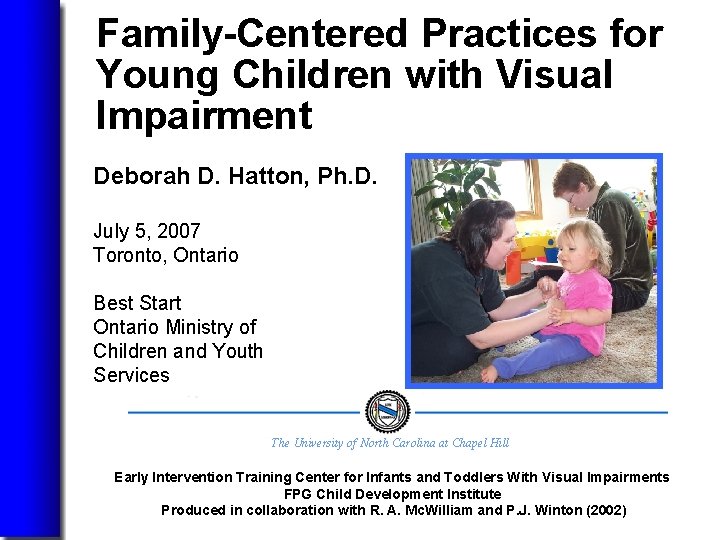
Family-Centered Practices for Young Children with Visual Impairment Deborah D. Hatton, Ph. D. July 5, 2007 Toronto, Ontario Best Start Ontario Ministry of Children and Youth Services The University of North Carolina at Chapel Hill Early Intervention Training Center for Infants and Toddlers With Visual Impairments FPG Child Development Institute Produced in collaboration with R. A. Mc. William and P. J. Winton (2002)
Objectives After completing this session, participants will 1. describe and implement strategies that can be used to build reliable alliances with families and other professionals and to implement familycentered practices. 2. describe and implement strategies to effectively communicate and collaborate with families and other professionals. 3. describe three types of support that are important for families of young children with visual impairments and explain the advantages of developing an ecomap (a graphic representation of a family’s existing supports). Early Intervention Training Center for Infants and Toddlers With Visual Impairments FPG Child Development Institute University of North Carolina at Chapel Hill
Objectives After completing this session, participants will 4. identify three key child outcomes and five key family outcomes that should be considered when providing intervention to young children with visual impairments and their families. 5. complete an ecomap to identify key features of the family ecology that might influence intervention/education. Early Intervention Training Center for Infants and Toddlers With Visual Impairments FPG Child Development Institute University of North Carolina at Chapel Hill
Objectives After completing this session, participants will 6. complete a routines based assessment to identify family concerns, priorities, and resources that describe the strategies that members of teams use to effectively communicate and collaborate with families and other professionals. 7. identify functional outcomes for intervention that are tied to sensory assessments, ecomaps, and routines based assessment. 8. describe and implement strategies for successful home visits and consultative visits to child care settings. Early Intervention Training Center for Infants and Toddlers With Visual Impairments FPG Child Development Institute University of North Carolina at Chapel Hill
Family-Centered Support • reflects a method of coordinating and delivering assistance, support, and services to the families of children with disabilities that enhances their capacity to care for their children. • is based upon an understanding of the complexity that exists within families and that decisions and services will influence each member of the family and the unit as a whole. Early Intervention Training Center for Infants and Toddlers With Visual Impairments FPG Child Development Institute University of North Carolina at Chapel Hill
Central Values of Family-Centered Approach • Emphasizing families’ strengths rather • • • than deficits Promoting family choice and control over desired resources Developing collaborative relationships between professionals and parents Viewing family from a holistic perspective Early Intervention Training Center for Infants and Toddlers With Visual Impairments FPG Child Development Institute University of North Carolina at Chapel Hill
Establishing Reliable Alliances The term reliable alliance has been used by Turnbull and Turnbull (2001) to describe a dynamic relationship between families and professionals in which they experience individual and collective empowerment by sharing their resources to make joint decisions. Turnbull & Turnbull, 2001 Early Intervention Training Center for Infants and Toddlers With Visual Impairments FPG Child Development Institute University of North Carolina at Chapel Hill
Eight Obligations Involved in Establishing Reliable Alliances Reliable alliances involve the following eight obligations (Turnbull & Turnbull, 2001, p. 58): 1. Knowing yourself 2. Knowing families 3. Honoring diversity 4. Affirming and building on family strengths 5. Promoting family choices 6. Affirming appropriate choices 7. Communicating positively 8. Warranting trust and respect Early Intervention Training Center for Infants and Toddlers With Visual Impairments FPG Child Development Institute University of North Carolina at Chapel Hill
Responses to Grief • Early models of the grieving process • included sequential stages of shock, denial, anger, depression, and acceptance. Today a broader understanding of responses to grief exists. Individuals may sporadically, randomly, or predictably experience sadness, guilt, regret, longing, disbelief, fear, irritability, hopelessness, and powerlessness. Early Intervention Training Center for Infants and Toddlers With Visual Impairments FPG Child Development Institute University of North Carolina at Chapel Hill
Diversity refers to differences in individuals and families across a variety of dimensions, including • culture, language, race, class, disability, age, and gender. • personal affiliations to religious and political groups or beliefs. • sexual orientation. Family culture can affect • treatment of medical issues. • primary language spoken within the home. • literacy activities. • interactive play (social skills). • daily routines. Early Intervention Training Center for Infants and Toddlers With Visual Impairments FPG Child Development Institute University of North Carolina at Chapel Hill Milian & Erin, 2001
Consider Variations Within Cultures Families vary in their adherence to cultural norms based on • primary language in home and community. • educational level. • religious affiliation. • country of origin, length of time in U. S. , degree of acculturation, or current residence. • income. Early Intervention Training Center for Infants and Toddlers With Visual Impairments FPG Child Development Institute University of North Carolina at Chapel Hill Santos & Reese, 1999
Cultural Diversity and Visual Impairment Some cultures • believe that caring for the child is more • • important than teaching independence. expect adults with blindness/VI to hold only certain jobs or not work at all. value oral communication over the written word. vary in their gender expectations. ascribe special meaning to particular types of visual impairment. Erin, 2002 Early Intervention Training Center for Infants and Toddlers With Visual Impairments FPG Child Development Institute University of North Carolina at Chapel Hill
Religious Diversity and Visual Impairment • Some individuals may think that having a • • visual impairment is retribution for sin. For some families, a religious leader or the head of the family may be the critical decision maker. Some families visit religious healers during their child’s early years. Erin, 2002 Early Intervention Training Center for Infants and Toddlers With Visual Impairments FPG Child Development Institute University of North Carolina at Chapel Hill
Importance of Collaborating with Families • Almost all child-level intervention occurs • • between home visit sessions. Almost all interventions can be implemented in the context of family routines and daily activities. Infants and toddlers cannot generalize skills that early interventionists model from one visit to the next. Early Intervention Training Center for Infants and Toddlers With Visual Impairments FPG Child Development Institute University of North Carolina at Chapel Hill R. A. Mc. William August 2004
Components of Collaboration • Empowering caregivers to meet children’s • • needs Treating caregivers with respect and as full members of the team Conferring with specialists and other service providers to develop and implement an integrated and comprehensive intervention plan that can be used across settings in daily routines and activities Early Intervention Training Center for Infants and Toddlers With Visual Impairments FPG Child Development Institute University of North Carolina at Chapel Hill
Coordinating Services for Young Children with Visual Impairment 1. Coordinating performance of evaluations and assessments 2. Facilitating and participating in development, review, and evaluation of intervention plans 3. Assisting families in identifying available service providers 4. Coordinating and monitoring delivery of available services Early Intervention Training Center for Infants and Toddlers With Visual Impairments FPG Child Development Institute University of North Carolina at Chapel Hill
Coordinating Services for Young Children with Visual Impairment 5. Informing families of availability of advocacy services 6. Coordinating with medical and health providers 7. Facilitating development of a transition plan to other programs, if appropriate Early Intervention Training Center for Infants and Toddlers With Visual Impairments FPG Child Development Institute University of North Carolina at Chapel Hill
Four Collaborative Roles for TVIs 1. Supportive - demonstrating concern and caring for others during new and difficult situations 2. Facilitative - assisting the professional development of other team members 3. Informative - providing information and support to other team members 4. Prescriptive - suggesting strategies or resources in response to a request for assistance Early Intervention Training Center for Infants and Toddlers With Visual Impairments FPG Child Development Institute University of North Carolina at Chapel Hill Topor, Holbrook, & Koenig, 2000
Support-Based Intervention An overarching feature of early intervention is the provision of supports, rather than the provision of services. Mc. William and Scott (2001) identified three primary types of support provided by early interventionists: • Emotional support • • Informational support Material support Early Intervention Training Center for Infants and Toddlers With Visual Impairments FPG Child Development Institute University of North Carolina at Chapel Hill
Emotional Support Emotionally supportive, family-centered practitioners have the following characteristics: • • Positiveness Responsiveness Orientation to the whole family Friendliness Sensitivity Competence with and about children Competence with and about communities Early Intervention Training Center for Infants and Toddlers With Visual Impairments FPG Child Development Institute University of North Carolina at Chapel Hill Mc. William, Tocci, & Harbin, 1998
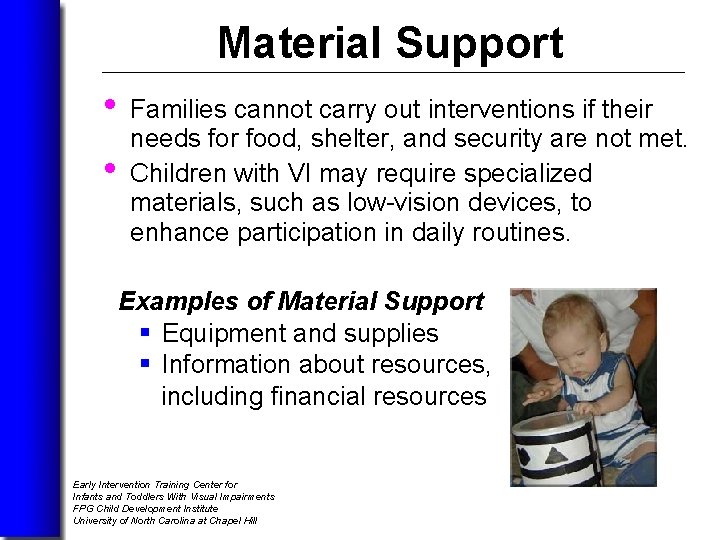
Material Support • • Families cannot carry out interventions if their needs for food, shelter, and security are not met. Children with VI may require specialized materials, such as low-vision devices, to enhance participation in daily routines. Examples of Material Support § Equipment and supplies § Information about resources, including financial resources Early Intervention Training Center for Infants and Toddlers With Visual Impairments FPG Child Development Institute University of North Carolina at Chapel Hill
Informational Support Families with children with visual impairments may report concerns about the future and express a need for information about • child development, • the child’s visual condition, • services and resources, and • specific strategies and skills. Leyser & Heinze, 2001 Early Intervention Training Center for Infants and Toddlers With Visual Impairments FPG Child Development Institute University of North Carolina at Chapel Hill
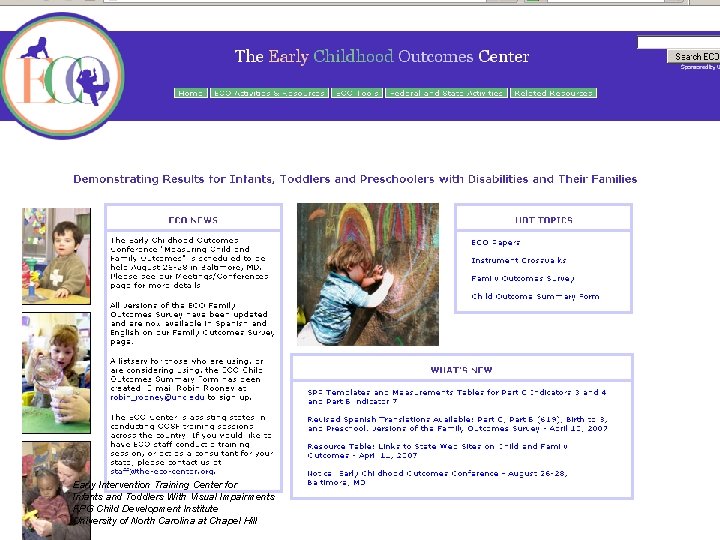
Child and Family Outcomes http: //www. fpg. unc. edu/~ECO/ Early Intervention Training Center for Infants and Toddlers With Visual Impairments FPG Child Development Institute University of North Carolina at Chapel Hill
Early Intervention Training Center for Infants and Toddlers With Visual Impairments FPG Child Development Institute University of North Carolina at Chapel Hill
Child Outcomes Overall goal is to enable children to be active and successful participants in their early childhood years and in the future. Three outcomes that reflect achievement of this goal are: 1. Children have positive social relationships. 2. Children acquire and use knowledge and skills. 3. Children take appropriate action to meet their needs. Early Intervention Training Center for Infants and Toddlers With Visual Impairments FPG Child Development Institute University of North Carolina at Chapel Hill ECO Center, 2005
Family Outcomes 1. Families understand their children’s strengths, abilities, and special needs. 2. Families know their rights and advocate effectively. 3. Families help their children develop and learn. 4. Families have support systems. 5. Families access desired services, programs, and activities in their communities. ECO Center, 2005 Early Intervention Training Center for Infants and Toddlers With Visual Impairments FPG Child Development Institute University of North Carolina at Chapel Hill
Responsibilities of Professionals who Provide Specialized Services for Young Children with VI • Functional sensory assessments • Adaptations/accommodations to assure • accessibility Functional and meaningful intervention that is tied to assessment results, family priorities, and standards and that can be continuously monitored Early Intervention Training Center for Infants and Toddlers With Visual Impairments FPG Child Development Institute University of North Carolina at Chapel Hill
Collaboration Between Professionals and Families • Families provide essential information about the assessment of their children. • Families who are involved in assessment are • more likely to understand the process and the results. Respect for family values, cultures, and priorities is essential in planning and implementing assessments and intervention. Smith & Levack, 1996 Hatton, Mc. William, & Winton, 2004 Early Intervention Training Center for Infants and Toddlers With Visual Impairments FPG Child Development Institute University of North Carolina at Chapel Hill Power. Point 7
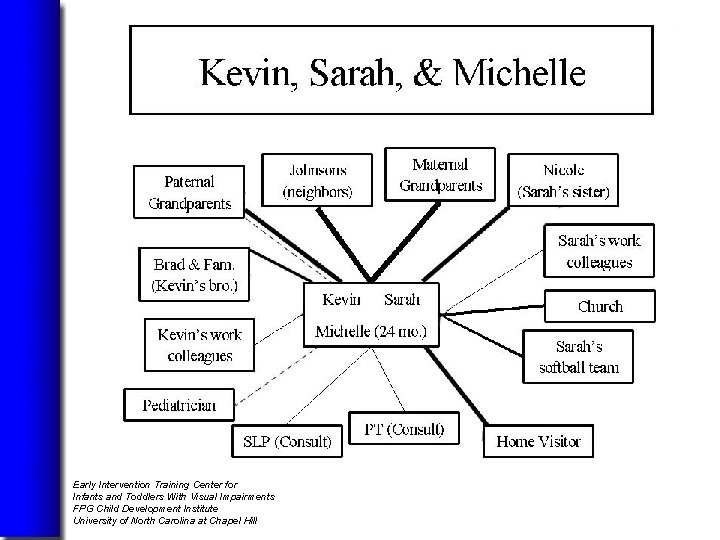
Family Ecology Family ecology refers to the system of informal supports available to the family that are depicted graphically by an ecomap. An ecomap is used to • identify existing supports, how duplication of efforts might be avoided, and possible gaps that need to be addressed, and • assist in identifying resources that will be required to achieve functional outcomes. Early Intervention Training Center for Infants and Toddlers With Visual Impairments FPG Child Development Institute University of North Carolina at Chapel Hill
Early Intervention Training Center for Infants and Toddlers With Visual Impairments FPG Child Development Institute University of North Carolina at Chapel Hill
Routines-Based Assessment The RBA is a process whereby families • share their concerns. • identify priorities for early intervention within the context of everyday activities and routines, thereby assuring that early intervention occurs within natural environments. Early Intervention Training Center for Infants and Toddlers With Visual Impairments FPG Child Development Institute University of North Carolina at Chapel Hill
Benefits of the RBA The routines-based assessment • emphasizes that intervention is familycentered. • provides a structure for families to have a meaningful role in planning. • generates a list of functional intervention outcomes. • aids in developing a positive relationship with the family. Early Intervention Training Center for Infants and Toddlers With Visual Impairments FPG Child Development Institute University of North Carolina at Chapel Hill
Role of the Professional Providing Specialized Services for Children with Visual Impairment • Organize an RBA and conduct the interview, if this hasn't already been done • Participate but not be the primary interviewer • • Train other team members to do RBAs Receive the information after the fact Early Intervention Training Center for Infants and Toddlers With Visual Impairments FPG Child Development Institute University of North Carolina at Chapel Hill
Components of Individual Child and Family Service Plans 1. Statement of current levels of functioning 2. Statement of the family’s resources, priorities, and concerns 3. Statement of the long term and short term goals, criteria, procedures, and timelines 4. Statement of early intervention services, including the frequency, intensity, and method of delivering services Early Intervention Training Center for Infants and Toddlers With Visual Impairments FPG Child Development Institute University of North Carolina at Chapel Hill
Components of Individual Child and Family Service Plans 5. Statement of the natural environments in which services will be provided 6. Statement of the projected dates for the initiation and duration of services 7. Identification of the service coordinator 8. Description of the plan for transition to preschool services Early Intervention Training Center for Infants and Toddlers With Visual Impairments FPG Child Development Institute University of North Carolina at Chapel Hill
Key Components of Intervention Plans • Family’s strengths, concerns, and • priorities as derived from the RBA Child’s current level of functioning, as determined by sensory assessments, routines based assessment, and transdisciplinary assessment of child Early Intervention Training Center for Infants and Toddlers With Visual Impairments FPG Child Development Institute University of North Carolina at Chapel Hill
Linking Assessment to Outcomes and Services • • • Services on the intervention plan should be related to needs identified during child and family assessment. The team should decide on services based upon outcomes—not upon the diagnosis. Children may have the same diagnosis, but their unique strengths and needs may prompt different outcomes, based on priorities of the family and team. Early Intervention Training Center for Infants and Toddlers With Visual Impairments FPG Child Development Institute University of North Carolina at Chapel Hill
Developing Intervention Plans Should be a Team Effort • Families are integral members of all teams. • The team agrees upon functional outcomes • • • and the strategies needed to achieve them. The team identifies the services and service providers that can provide the support needed to achieve the functional outcomes and to implement strategies. The team determines the timelines for achieving the outcomes. The team identifies the primary home visitor (and possibly the service coordinator). Early Intervention Training Center for Infants and Toddlers With Visual Impairments FPG Child Development Institute University of North Carolina at Chapel Hill
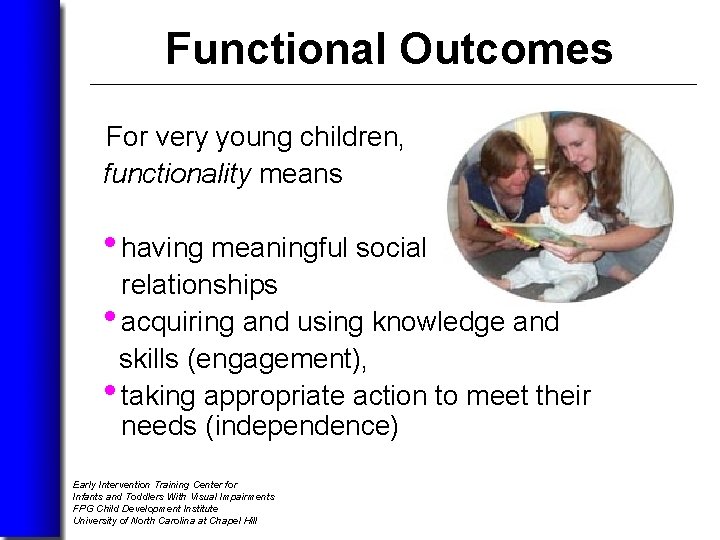
Functional Outcomes For very young children, functionality means • having meaningful social relationships • acquiring and using knowledge and skills (engagement), • taking appropriate action to meet their needs (independence) Early Intervention Training Center for Infants and Toddlers With Visual Impairments FPG Child Development Institute University of North Carolina at Chapel Hill
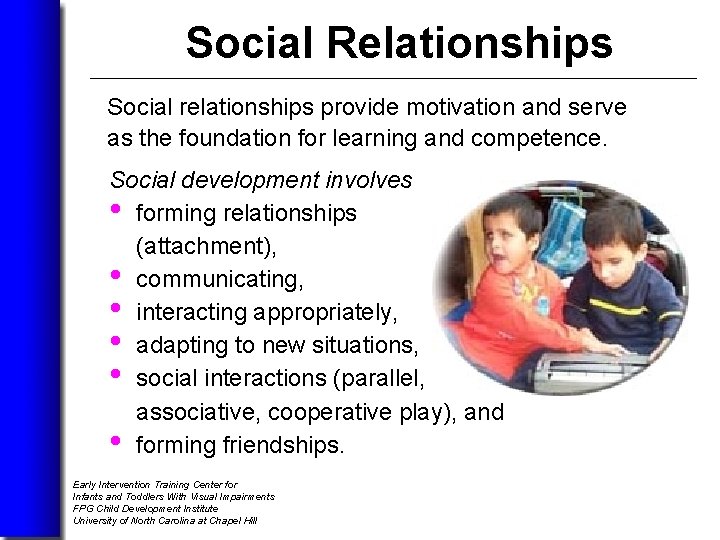
Social Relationships Social relationships provide motivation and serve as the foundation for learning and competence. Social development involves • forming relationships (attachment), • communicating, • interacting appropriately, • adapting to new situations, • social interactions (parallel, associative, cooperative play), and • forming friendships. Early Intervention Training Center for Infants and Toddlers With Visual Impairments FPG Child Development Institute University of North Carolina at Chapel Hill
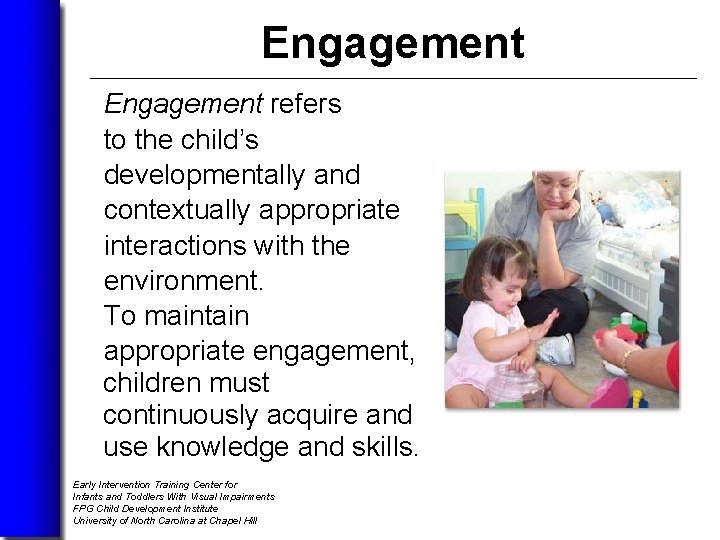
Engagement refers to the child’s developmentally and contextually appropriate interactions with the environment. To maintain appropriate engagement, children must continuously acquire and use knowledge and skills. Early Intervention Training Center for Infants and Toddlers With Visual Impairments FPG Child Development Institute University of North Carolina at Chapel Hill
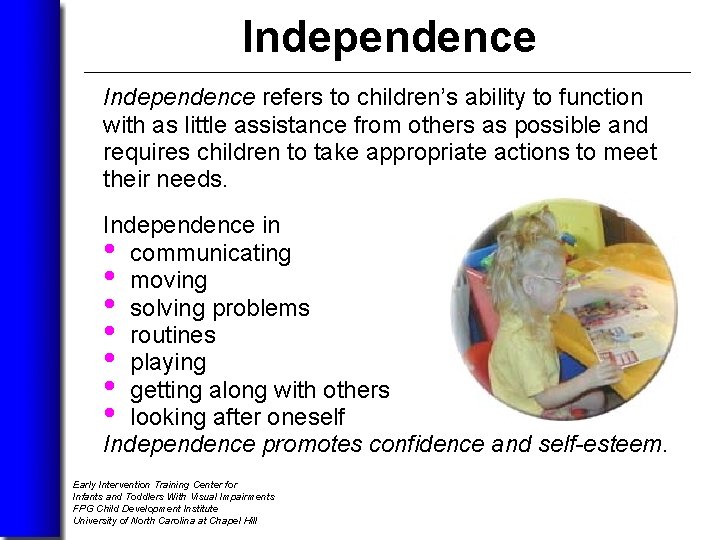
Independence refers to children’s ability to function with as little assistance from others as possible and requires children to take appropriate actions to meet their needs. Independence in • communicating • moving • solving problems • routines • playing • getting along with others • looking after oneself Independence promotes confidence and self-esteem. Early Intervention Training Center for Infants and Toddlers With Visual Impairments FPG Child Development Institute University of North Carolina at Chapel Hill
Natural Environments and Children with Visual Impairment Although provision of services within a child’s natural environments is the goal, children with visual impairment and their families may also benefit from specialized environments because • children with visual impairment have unique developmental needs (AER & AFB, 2003). • the presence of visual impairment can prevent an infant or toddler from accessing the same visual information available to sighted peers; therefore the environment may need to be adapted in order to meet specific needs (Chen, 1999). Early Intervention Training Center for Infants and Toddlers With Visual Impairments FPG Child Development Institute University of North Carolina at Chapel Hill
Support for Transitions • • Identify the possible future settings • Provide the primary interventionist in the new setting with information about the child • Key personnel who worked with the child before the transition should maintain contact with the new professionals Identify the skills of all people involved in the transition Early Intervention Training Center for Infants and Toddlers With Visual Impairments FPG Child Development Institute University of North Carolina at Chapel Hill
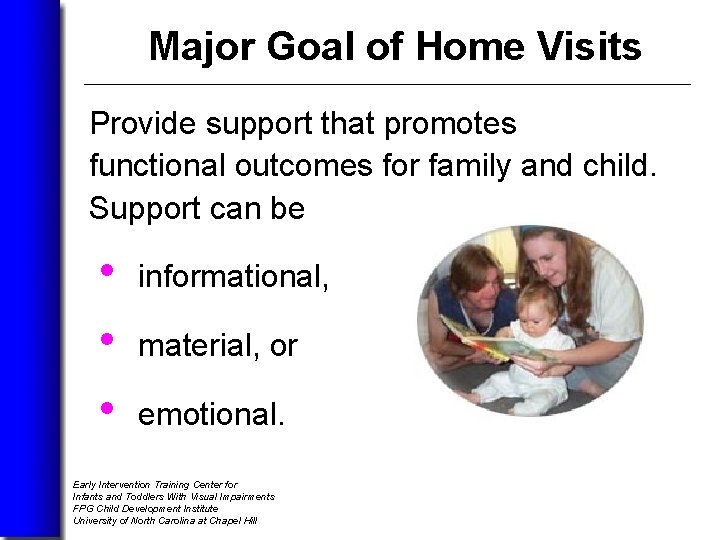
Major Goal of Home Visits Provide support that promotes functional outcomes for family and child. Support can be • • • informational, material, or emotional. Early Intervention Training Center for Infants and Toddlers With Visual Impairments FPG Child Development Institute University of North Carolina at Chapel Hill
Recommended Practice for Home Visits • Collaborate with families and with other specialists and service providers. • Use routines-based intervention to achieve functional outcomes. • Assure that a team approach with close collaboration is used to support families and children. Early Intervention Training Center for Infants and Toddlers With Visual Impairments FPG Child Development Institute University of North Carolina at Chapel Hill
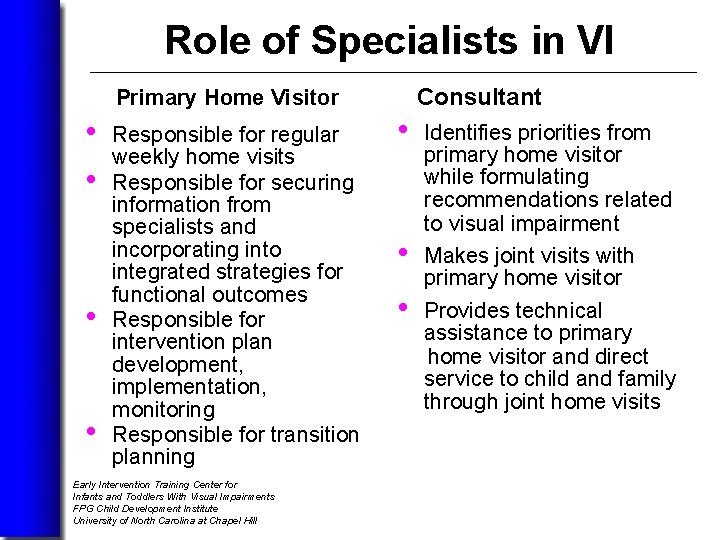
Role of Specialists in VI Primary Home Visitor • • Responsible for regular weekly home visits Responsible for securing information from specialists and incorporating into integrated strategies for functional outcomes Responsible for intervention plan development, implementation, monitoring Responsible for transition planning Early Intervention Training Center for Infants and Toddlers With Visual Impairments FPG Child Development Institute University of North Carolina at Chapel Hill • • • Consultant Identifies priorities from primary home visitor while formulating recommendations related to visual impairment Makes joint visits with primary home visitor Provides technical assistance to primary home visitor and direct service to child and family through joint home visits
Additional Resources For hundreds of resources on family-centered practices for young children with visual impairment, go to http: //www. fpg. unc. edu/~edin/Resources/modul es/index. cfm or see Resources section of the website for the Early Intervention Training Center for Infants and Toddlers with Visual Impairments at www. fpg. unc. edu/~edin Early Intervention Training Center for Infants and Toddlers With Visual Impairments FPG Child Development Institute University of North Carolina at Chapel Hill