
Family Theory Assessment Presentation Telana Fairchild SNP University
- Slides: 11
Family Theory & Assessment Presentation Telana Fairchild, SNP University of Massachusetts Worcester Graduate School of Nursing N NG 761 B 1 | Family Theory | 3/29/2014
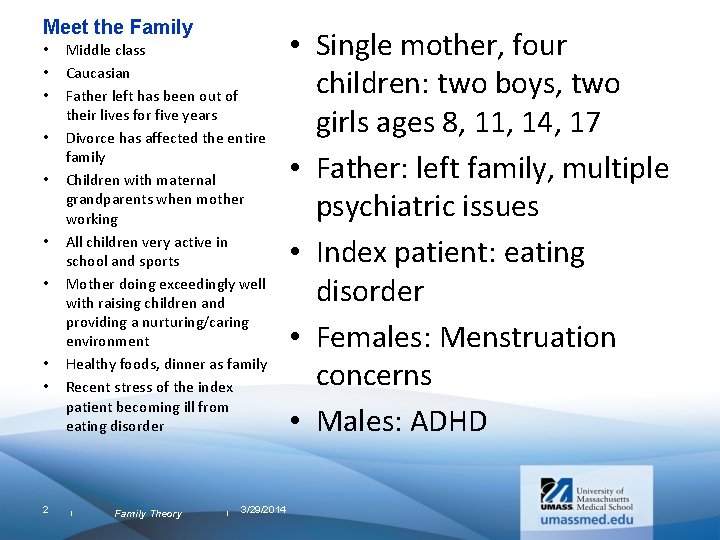
Meet the Family • • • 2 Middle class Caucasian Father left has been out of their lives for five years Divorce has affected the entire family Children with maternal grandparents when mother working All children very active in school and sports Mother doing exceedingly well with raising children and providing a nurturing/caring environment Healthy foods, dinner as family Recent stress of the index patient becoming ill from eating disorder | Family Theory | 3/29/2014 • Single mother, four children: two boys, two girls ages 8, 11, 14, 17 • Father: left family, multiple psychiatric issues • Index patient: eating disorder • Females: Menstruation concerns • Males: ADHD
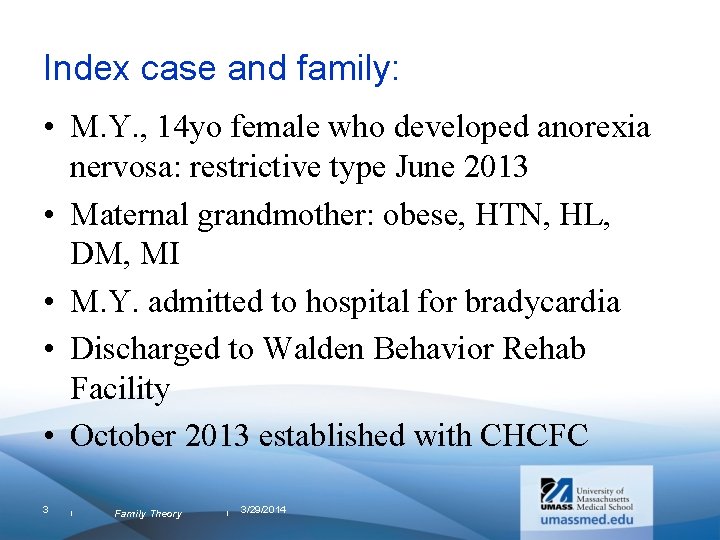
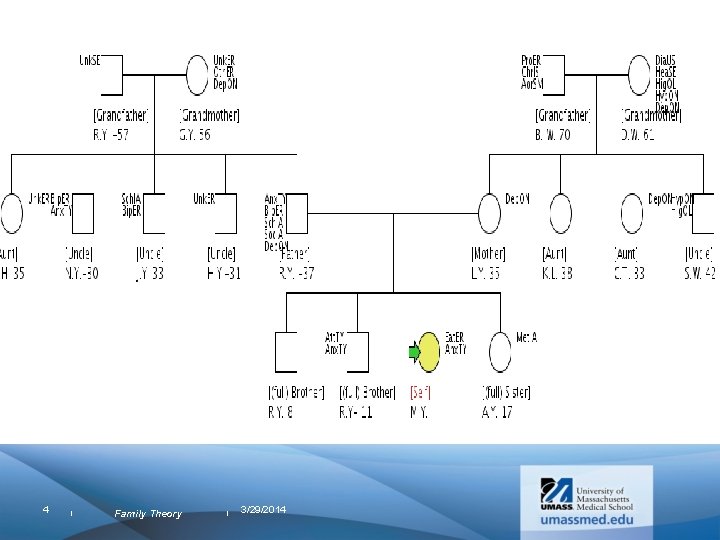
Index case and family: • M. Y. , 14 yo female who developed anorexia nervosa: restrictive type June 2013 • Maternal grandmother: obese, HTN, HL, DM, MI • M. Y. admitted to hospital for bradycardia • Discharged to Walden Behavior Rehab Facility • October 2013 established with CHCFC 3 | Family Theory | 3/29/2014
4 | Family Theory | 3/29/2014
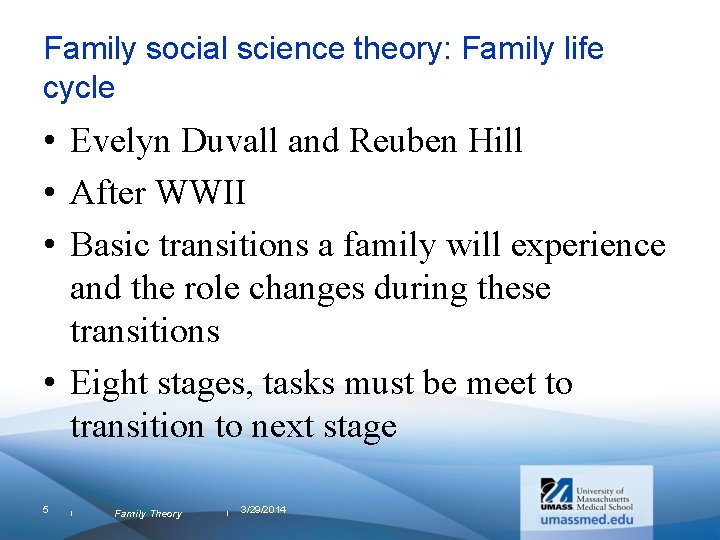
Family social science theory: Family life cycle • Evelyn Duvall and Reuben Hill • After WWII • Basic transitions a family will experience and the role changes during these transitions • Eight stages, tasks must be meet to transition to next stage 5 | Family Theory | 3/29/2014
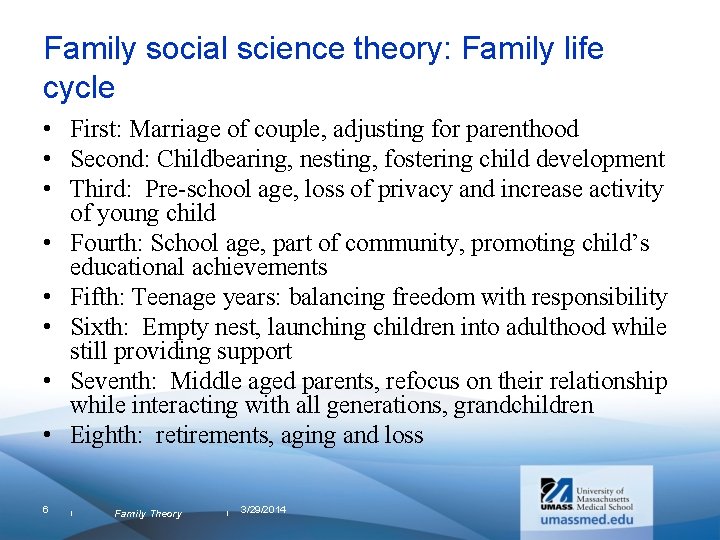
Family social science theory: Family life cycle • First: Marriage of couple, adjusting for parenthood • Second: Childbearing, nesting, fostering child development • Third: Pre-school age, loss of privacy and increase activity of young child • Fourth: School age, part of community, promoting child’s educational achievements • Fifth: Teenage years: balancing freedom with responsibility • Sixth: Empty nest, launching children into adulthood while still providing support • Seventh: Middle aged parents, refocus on their relationship while interacting with all generations, grandchildren • Eighth: retirements, aging and loss 6 | Family Theory | 3/29/2014
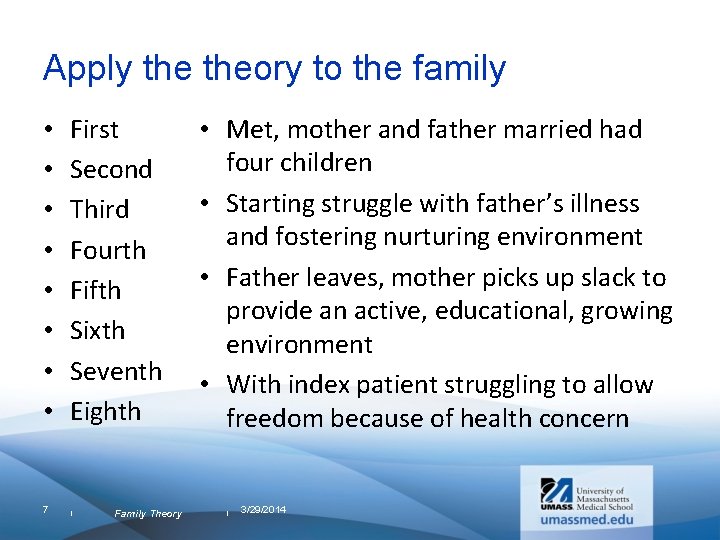
Apply theory to the family • • First Second Third Fourth Fifth Sixth Seventh Eighth 7 | Family Theory • Met, mother and father married had four children • Starting struggle with father’s illness and fostering nurturing environment • Father leaves, mother picks up slack to provide an active, educational, growing environment • With index patient struggling to allow freedom because of health concern | 3/29/2014
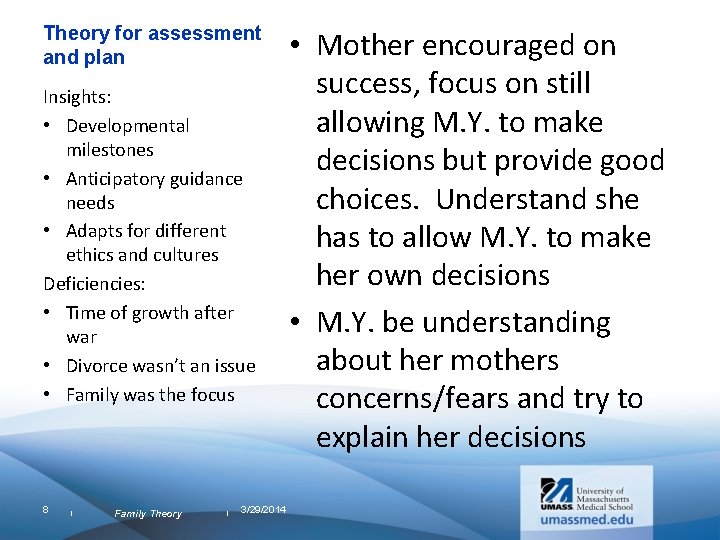
Theory for assessment and plan Insights: • Developmental milestones • Anticipatory guidance needs • Adapts for different ethics and cultures Deficiencies: • Time of growth after war • Divorce wasn’t an issue • Family was the focus 8 | Family Theory | 3/29/2014 • Mother encouraged on success, focus on still allowing M. Y. to make decisions but provide good choices. Understand she has to allow M. Y. to make her own decisions • M. Y. be understanding about her mothers concerns/fears and try to explain her decisions
Family’s culture • Health beliefs • Healthy nutrition and being active are very important to this family • Now understand the importance of paying attention to the effects the divorce has had on all the children. • Realize how much health impacts the development of the family. • Family • Illness 9 | Family Theory | 3/29/2014
Cultures impact on family • Divorce: focus on the psychosocial well being, involved with CHD, family therapy • Nutrition: that healthy choices are important • Growth: healthy weight gain improves development 10 | Family Theory | 3/29/2014
References: Aldous, J. (1990). Family development and the life course: Two perspectives on family change. Journal of Marriage and Family, 52 (3), 571 -583. Retrieved from http: //www. jstor. org/stable/352924 Bickley, L. (2012). Bates' guide to physical examination and history. Lippincot (Wolters Kluwer Health). Kindle Edition. Retrieved from amazon. com De. Frain, J. D. , Brand, G. L. , Burson, M. H. , Fenton, A. M. , Friesen, J. L, Hanna, J. S. , …Werth, L. A. (2012). Families across the lifespan: The normal, to-be-expected, satisfactions and challenges couples and families experience. Neb. Guide: The University of Nebraska at Lincoln, No. 2. Retrieved from http: //extension. unl. edu/publications Hagan, J. F. , Shaw, J. S. , & Duncan, P. M. (Eds. ). (2008). Bright futures: Guidelines for health supervision of infants, children, and adolescents (3 rd ed. ). Elk Grove Village, IL: American Academy of Pediatrics. Johnson, K. , Posner, S. F. , Biermann, J. , Cordero, J. F, Atrash, H. K. , Parker, C. S. , … Curtis, M. G. (2006). Recommendations to improve preconception health and health care MMWR 55(RR 06): 1 -23. Retrieved from http: //www. cdc. gov/mmwr/preview/mmwrhtml/rr 5506 a 1. htm Smith, R. P. , Beckmann, C. R. B. , Ling, F. W. , Barzansky, B. M. , Herbert, W. N. P. , & Laube, D. W. (2012). Obstetrics and gynecology. Lippincot (Wolters Kluwer Health). Kindle Edition. Retrieved from amazon. com Talley, R. C. , & Crews, J. E. (2007). Framing the public health of caregiving. American Journal of Public Health, 97 (2), 224 -228. doi: 10. 2105/AJPH. 2004. 059337 Thompson, M. K. (1984). Family development theory. The Nurse Practitioner: The American Journal of Primary Healthcare, 9 (6), 54 -58. 11 | Family Theory | 3/29/2014