
Family Sociology 13 h Edition by John Macionis
Family Sociology, 13 h Edition by John Macionis Copyright © 2010 Pearson Education, Inc. All rights reserved.
Basic Concepts • Family–A social institution found in all societies that unites people into cooperative groups to oversee the bearing and raising of children • Kinship–A social bond based on common ancestry, marriage, or adoption • Marriage–A legal relationship, usually involving economic cooperation, sexual activity, and childbearing • Families of affinity–People who think of themselves as a Sociology, 13 Edition by John Macionis family and wish others to see them that way Copyright © 2010 Pearson Education, Inc. All rights reserved. h

Families: Global Variations • Extended family–A family consisting of parents and children as well as other kin – Also called "consanguine families" • Nuclear family–A family composed of one or two parents and their children – Also called "conjugal family" – The predominant family form – http: //www. tvland. com/shows/leave-it-tobeaver/full-episodes/wally-s-track-meet Sociology, 13 h Edition by John Macionis Copyright © 2010 Pearson Education, Inc. All rights reserved.

Marriage Patterns • Endogamy–Marriage between people of the same social category • Exogamy–Marriage between people of different social categories • Monogamy–Marriage that unites two partners Sociology, 13 h Edition by John Macionis Copyright © 2010 Pearson Education, Inc. All rights reserved.

Marriage Patterns • Polygamy–Marriage that unites a person with two or more spouses – Polygyny–Marriage that unites one man and two or more women – Polyandry–Marriage that unites one woman and two or more men – http: //www. youtube. com/watch? v=h. OTtgkb ZBbg&feature=related Sociology, 13 h Edition by John Macionis Copyright © 2010 Pearson Education, Inc. All rights reserved.

Residential Patterns • Patrilocality – With or near the husband’s family • Matrilocality – With or near the wife’s family • Neolocality – Setting up house apart from both families Sociology, 13 h Edition by John Macionis Copyright © 2010 Pearson Education, Inc. All rights reserved.
Descent The system by which members of a society trace kinship over generations • Most preindustrial societies trace kinship through either the father's side or the mother's side of the family. • Three types to trace kinship: – Patrilineal descent–Through men – Matrilineal descent–Through women – Bilateral descent–Through both men and women Sociology, 13 h Edition by John Macionis Copyright © 2010 Pearson Education, Inc. All rights reserved.
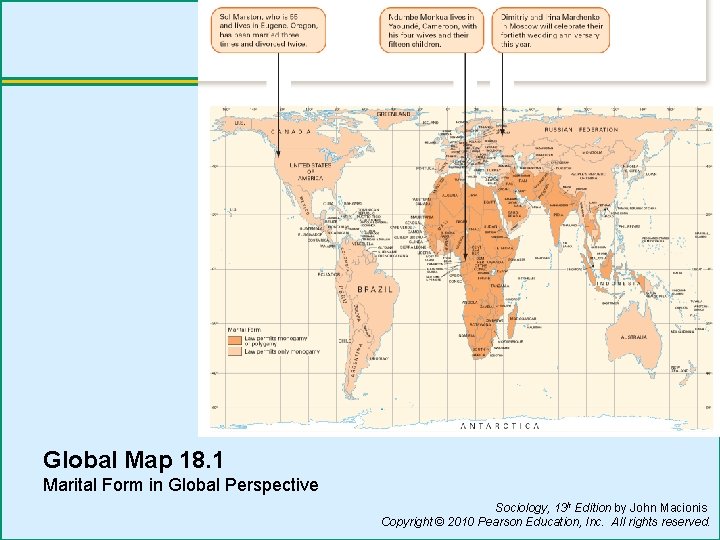
Global Map 18. 1 Marital Form in Global Perspective Sociology, 13 h Edition by John Macionis Copyright © 2010 Pearson Education, Inc. All rights reserved.
Structural-Functional Analysis • The family performs many vital tasks – Socialization–Creating well-integrated members of society – Regulation of sexual activity–Maintenance of kinship order and property rights, incest taboos – Social placement–Births to married couples are preferred. – Material and emotional security–Home can be a haven. – http: //www. youtube. com/watch? v=XDl. SWcx-Pk&feature=related Sociology, 13 Edition by John Macionis h Copyright © 2010 Pearson Education, Inc. All rights reserved.
Structural-Functional Analysis • Critical evaluation – Glosses over great diversity of family life, how other institutions are taking over its roles, and negative aspects like patriarchy and family violence Sociology, 13 h Edition by John Macionis Copyright © 2010 Pearson Education, Inc. All rights reserved.
Social-Conflict and Feminist Analysis • The family perpetuates social inequality. – Property and inheritance–Concentrates wealth and reproduces class structure – Patriarchy–To know theirs, men must control women’s sexuality. – Racial and ethnic inequality–Racial and ethnic categories persist over generations because most people marry others like themselves. • Critical evaluation – Ignores that families carry out functions not easily accomplished by other means Sociology, 13 h Edition by John Macionis Copyright © 2010 Pearson Education, Inc. All rights reserved.
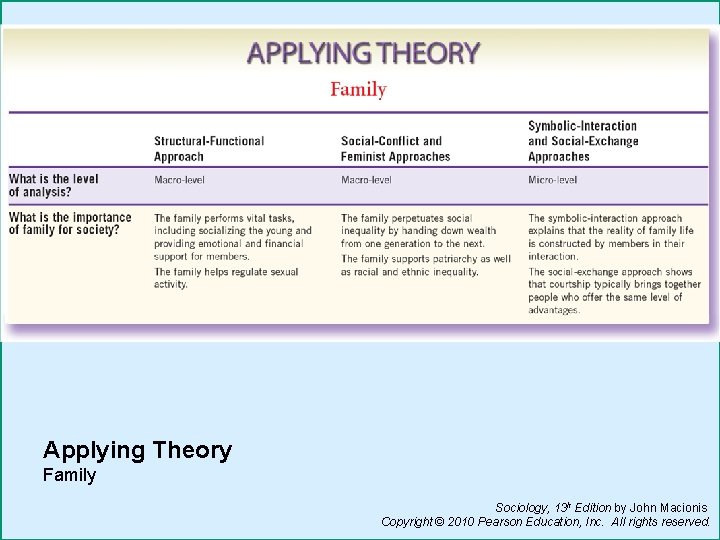
Applying Theory Family Sociology, 13 h Edition by John Macionis Copyright © 2010 Pearson Education, Inc. All rights reserved.
Micro-Level Analysis • Symbolic-Interaction – Opportunities for sharing activities helps build emotional bonds. • Social-Exchange – Courtship & marriage as a negotiation to make the “best deal” on a partner. • Critical evaluation – Misses the bigger picture; family life is similar for people in similar social backgrounds and varies in predictable ways Sociology, 13 h Edition by John Macionis Copyright © 2010 Pearson Education, Inc. All rights reserved.
Stages of Family Life • Courtship – Arranged marriages vs. romantic love – Homogamy–Marriage between people with same social characteristics • Settling in – Ideal vs. real marriage • Child rearing – Industrialization transformed children from assets to liabilities. • Later life – Empty nest Sociology, 13 h Edition by John Macionis Copyright © 2010 Pearson Education, Inc. All rights reserved.
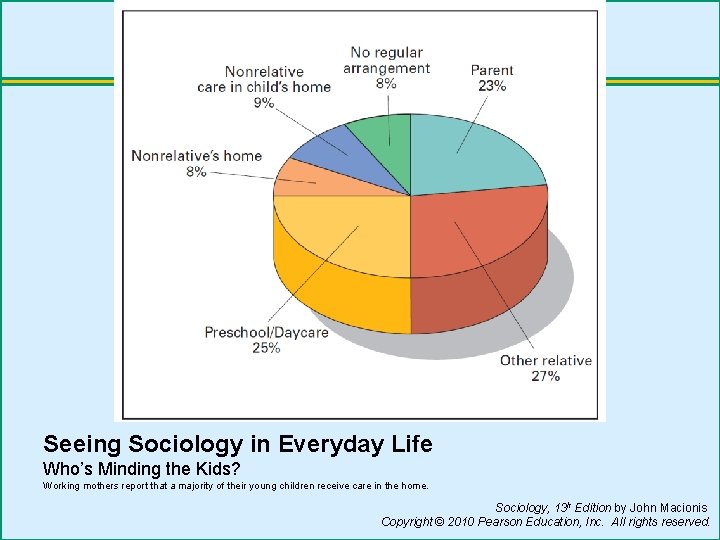
Seeing Sociology in Everyday Life Who’s Minding the Kids? Working mothers report that a majority of their young children receive care in the home. Sociology, 13 h Edition by John Macionis Copyright © 2010 Pearson Education, Inc. All rights reserved.
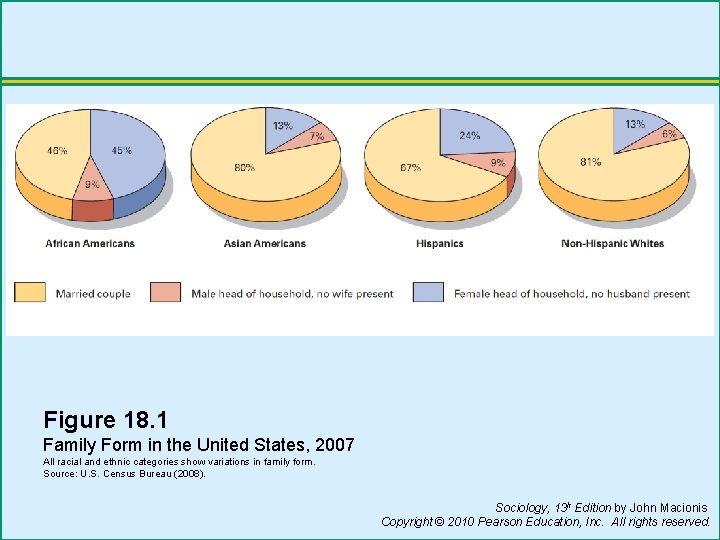
Figure 18. 1 Family Form in the United States, 2007 All racial and ethnic categories show variations in family form. Source: U. S. Census Bureau (2008). Sociology, 13 h Edition by John Macionis Copyright © 2010 Pearson Education, Inc. All rights reserved.
Class, Race, and Gender • Social class – Social class determines both a family’s financial security and its range of opportunities. • Ethnicity and race – – American Indian Families Latino Families African American Families Ethnically and racially mixed marriages • Gender – Bernard: Marriage benefits men more than women. – http: //www. youtube. com/watch? v=_wb. Bjt-5 w. G 4 Sociology, 13 h Edition by John Macionis Copyright © 2010 Pearson Education, Inc. All rights reserved.
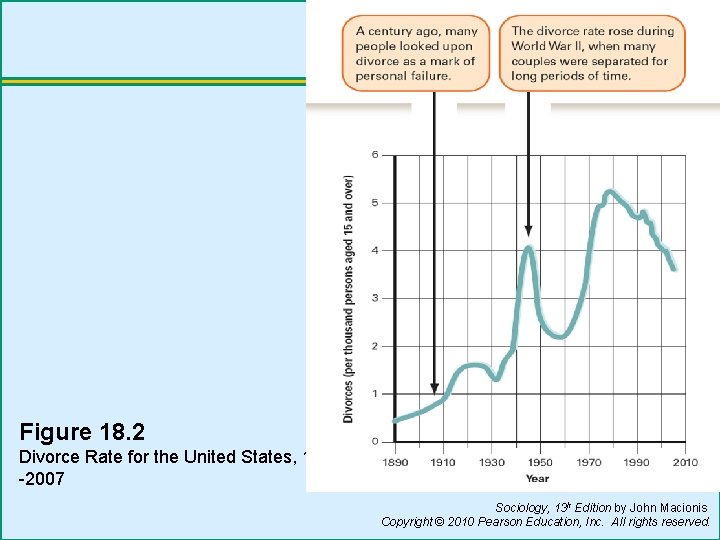
Figure 18. 2 Divorce Rate for the United States, 1890 -2007 Sociology, 13 h Edition by John Macionis Copyright © 2010 Pearson Education, Inc. All rights reserved.
Divorce • In the US, nine out of 10 people will marry. Four in 10 marriages end in divorce. Why? – – – Individualism on the rise Romantic love often subsides. Women are less dependent upon men. Many of today’s marriages are stressful. Divorce is socially acceptable. Legally, a divorce is easier to get. Sociology, 13 h Edition by John Macionis Copyright © 2010 Pearson Education, Inc. All rights reserved.
Remarriage • Four out of five people who divorce remarry, most within four years. • Remarriage often creates blended families. • Offers both young and old the chance to relax rigid family roles Sociology, 13 h Edition by John Macionis Copyright © 2010 Pearson Education, Inc. All rights reserved.
Family Violence Emotional, physical, or sexual abuse of one family member by another • Against women – Women are more likely to be injured by a family member than to be mugged or raped by a stranger or hurt in an automobile accident. – All states have marital rape laws; half have “stalking laws. ” • Against children – Child abuse and neglect are most common among the youngest and most vulnerable children. – Abusers are more likely to be women than men. Sociology, 13 h Edition by John Macionis Copyright © 2010 Pearson Education, Inc. All rights reserved.
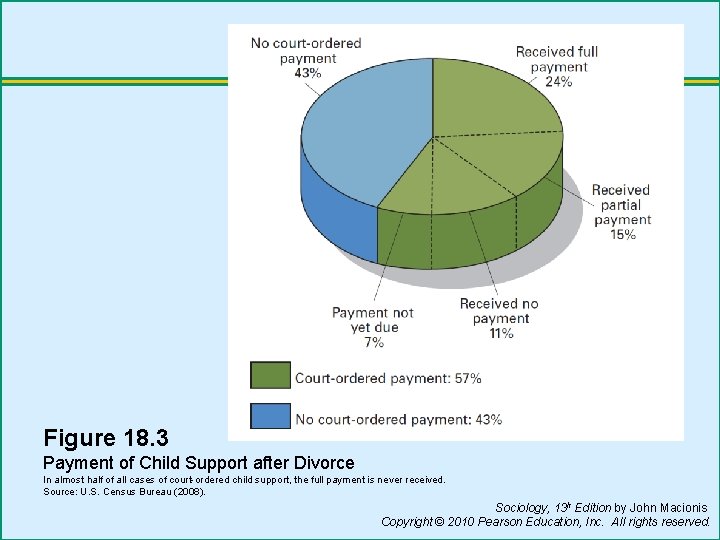
Figure 18. 3 Payment of Child Support after Divorce In almost half of all cases of court-ordered child support, the full payment is never received. Source: U. S. Census Bureau (2008). Sociology, 13 h Edition by John Macionis Copyright © 2010 Pearson Education, Inc. All rights reserved.
Alternative Family Forms • One-parent families – Single parenthood increases a woman’s risk of poverty because it limits work and education. – Poverty raises the odds that a young woman will be a single mother. • Cohabitation–The sharing of a household by an unmarried couple Sociology, 13 h Edition by John Macionis Copyright © 2010 Pearson Education, Inc. All rights reserved.
Alternative Family Forms • Gay and lesbian couples – The trend in public opinion is toward greater support for homosexual relationships. • Singlehood – Increasing numbers of people are choosing to live alone. – http: //www. youtube. com/watch? v=EJw. Sprk i. In. E&feature=player_embedded Sociology, 13 h Edition by John Macionis Copyright © 2010 Pearson Education, Inc. All rights reserved.
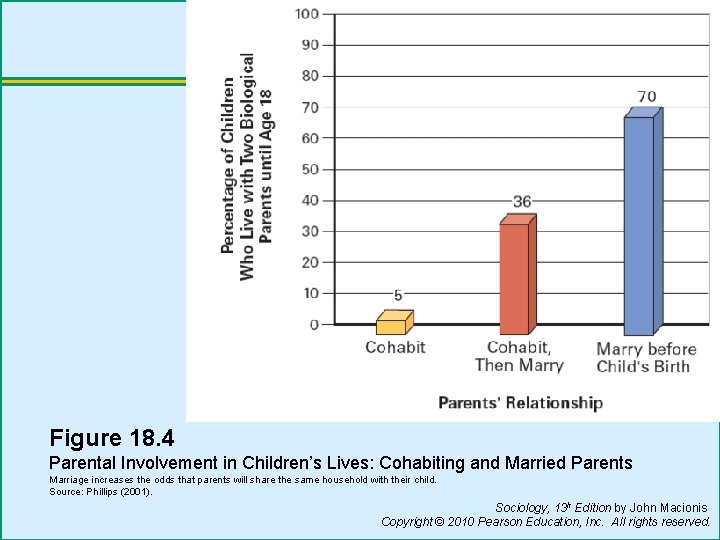
Figure 18. 4 Parental Involvement in Children’s Lives: Cohabiting and Married Parents Marriage increases the odds that parents will share the same household with their child. Source: Phillips (2001). Sociology, 13 h Edition by John Macionis Copyright © 2010 Pearson Education, Inc. All rights reserved.
New Reproductive Technologies • In vitro fertilization: An embryo is created outside the woman’s body then implanted. • Reproductive technologies have raised several ethical questions. • Have also helped some couples who cannot conceive by conventional means Sociology, 13 h Edition by John Macionis Copyright © 2010 Pearson Education, Inc. All rights reserved.
Looking Ahead • Divorce rates remain high. – More equality between sexes – http: //www. cbsnews. com/video/watch/? id= 7373173 n • All kinds of units will be called families. • Men will continue to play a limited role in child rearing. – Many will remain absent from household scenes. Sociology, 13 h Edition by John Macionis Copyright © 2010 Pearson Education, Inc. All rights reserved.
Looking Ahead • Economic changes will affect families and reform marriage. – Less quality time as work demands more from parents • New reproductive technologies – Ethical concerns about what can and what should be done Sociology, 13 h Edition by John Macionis Copyright © 2010 Pearson Education, Inc. All rights reserved.
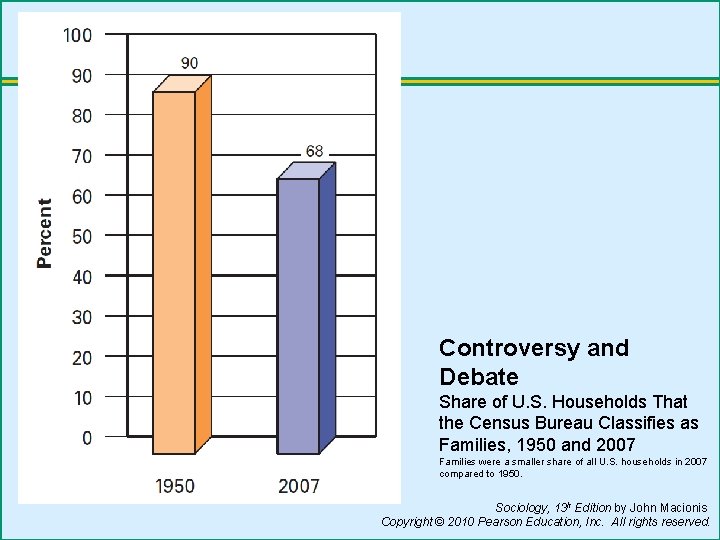
Controversy and Debate Share of U. S. Households That the Census Bureau Classifies as Families, 1950 and 2007 Families were a smaller share of all U. S. households in 2007 compared to 1950. Sociology, 13 h Edition by John Macionis Copyright © 2010 Pearson Education, Inc. All rights reserved.
- Slides: 29