
FAMILY SOCIAL CLASS FAMILY As a biological unit
FAMILY & SOCIAL CLASS
FAMILY… As a biological unit → share a common pool of genes As a social unit → share physical and social environment As a cultural unit → reflect culture of wider society & determine behavior & attitude of its members As an epidemiological unit → basic unit for study and comprehensive medical care
FAMILY IN CLINICO-SOCIAL CASE Type of family Family history Family table Socio-economic status Expenditure of family on health, food, housing and clothing Family inter relationships Opinion of family towards index case illness No of eligible couples in family Family spacing
DEFINITION Family ?
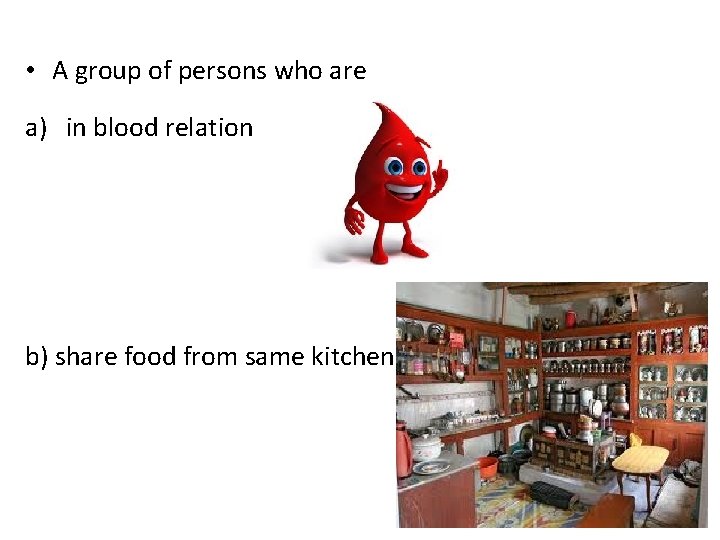
• A group of persons who are a) in blood relation b) share food from same kitchen
FAMILY Family is a group of persons united by the ties of marriage, blood or adoption; constituting a single household, interacting and inter-communicating with each other in their respective social roles of husband wife, mother and father, son and daughter, brother and sister creating a common culture – Burgess and Locke
ADOPTION Hindu Adoption and Maintenance Act Guardian Adoption and Ward Act Juvenile Justice Act Pre-Requisite: Age, Income, Education
TYPES OF FAMILY Based on the structure Nuclear family Joint family Three generation family
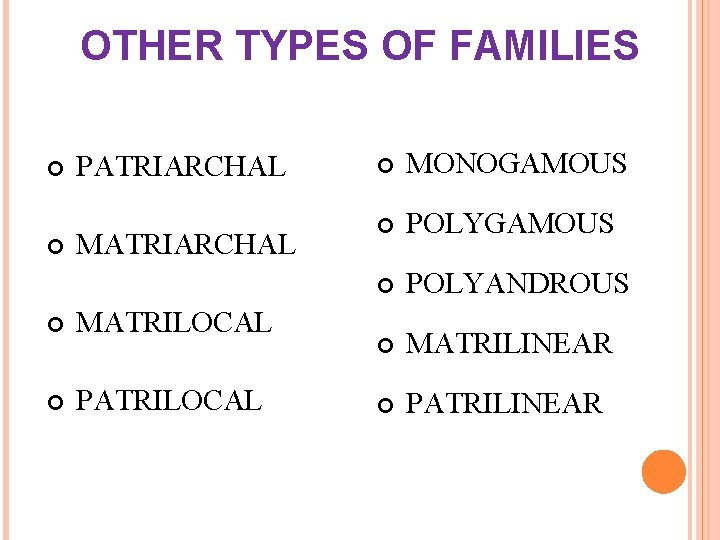
OTHER TYPES OF FAMILIES PATRIARCHAL MATRILOCAL PATRILOCAL MONOGAMOUS POLYANDROUS MATRILINEAR PATRILINEAR
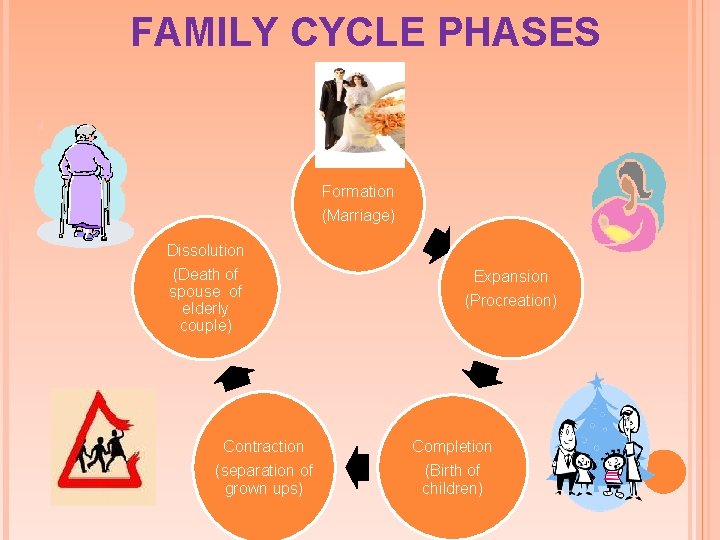
FAMILY CYCLE PHASES Formation (Marriage) Dissolution (Death of spouse of elderly couple) Contraction (separation of grown ups) Expansion (Procreation) Completion (Birth of children)
SOCIAL CLASS
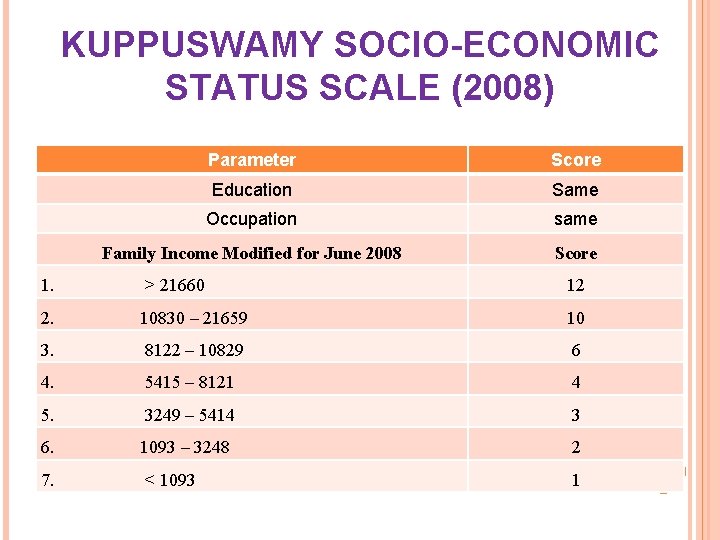
KUPPUSWAMY SOCIO-ECONOMIC STATUS SCALE (2008) Parameter Score Education Same Occupation same Family Income Modified for June 2008 Score 1. > 21660 12 2. 10830 – 21659 10 3. 8122 – 10829 6 4. 5415 – 8121 4 5. 3249 – 5414 3 6. 1093 – 3248 2 7. < 1093 1
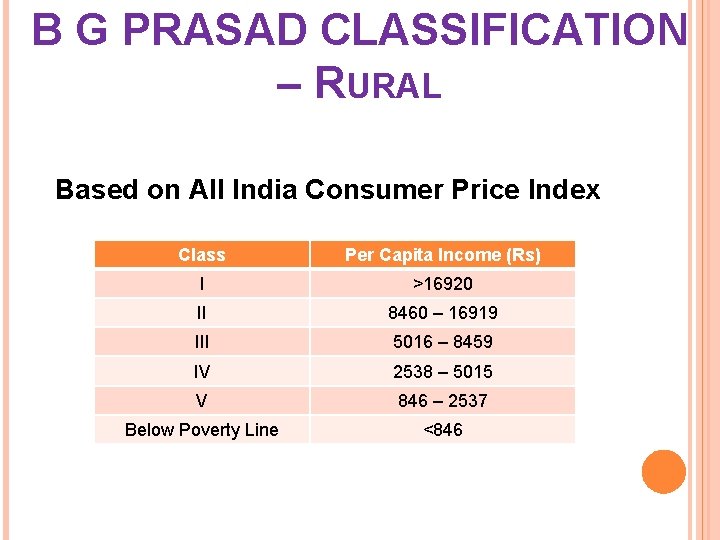
B G PRASAD CLASSIFICATION – RURAL Based on All India Consumer Price Index Class Per Capita Income (Rs) I >16920 II 8460 – 16919 III 5016 – 8459 IV 2538 – 5015 V 846 – 2537 Below Poverty Line <846
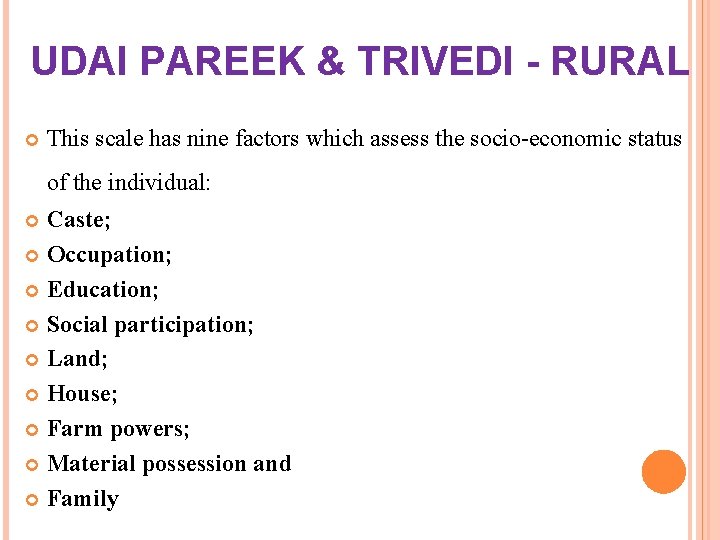
UDAI PAREEK & TRIVEDI - RURAL This scale has nine factors which assess the socio-economic status of the individual: Caste; Occupation; Education; Social participation; Land; House; Farm powers; Material possession and Family
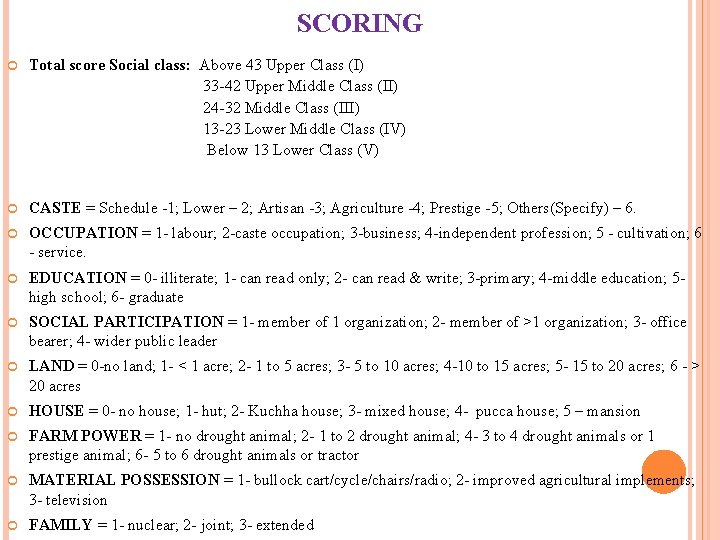
SCORING Total score Social class: Above 43 Upper Class (I) 33 -42 Upper Middle Class (II) 24 -32 Middle Class (III) 13 -23 Lower Middle Class (IV) Below 13 Lower Class (V) CASTE = Schedule -1; Lower – 2; Artisan -3; Agriculture -4; Prestige -5; Others(Specify) – 6. OCCUPATION = 1 - labour; 2 -caste occupation; 3 -business; 4 -independent profession; 5 - cultivation; 6 - service. EDUCATION = 0 - illiterate; 1 - can read only; 2 - can read & write; 3 -primary; 4 -middle education; 5 high school; 6 - graduate SOCIAL PARTICIPATION = 1 - member of 1 organization; 2 - member of >1 organization; 3 - office bearer; 4 - wider public leader LAND = 0 -no land; 1 - < 1 acre; 2 - 1 to 5 acres; 3 - 5 to 10 acres; 4 -10 to 15 acres; 5 - 15 to 20 acres; 6 - > 20 acres HOUSE = 0 - no house; 1 - hut; 2 - Kuchha house; 3 - mixed house; 4 - pucca house; 5 – mansion FARM POWER = 1 - no drought animal; 2 - 1 to 2 drought animal; 4 - 3 to 4 drought animals or 1 prestige animal; 6 - 5 to 6 drought animals or tractor MATERIAL POSSESSION = 1 - bullock cart/cycle/chairs/radio; 2 - improved agricultural implements; 3 - television FAMILY = 1 - nuclear; 2 - joint; 3 - extended

THANKS
- Slides: 16