
Family Self Sufficiency Basics and Beyond Resources for
Family Self Sufficiency Basics and Beyond + Resources for Supportive Services ANICE CHENAULT, FSS PROGRAM MANAGER PENNSYLVANIA ASSOCIATION OF HOUSING AND REDEVELOPMENT OFFICIALS – FEBRUARY 11, 2020 1

WHO ARE YOU? 2

FSS Best Practices Update on Composite Score What Are We Doing Today? HUD Supportive Services Updates & Other Resources Update on New FSS Regulations 3

4

FSS Program Guidance FSS Resource Library - https: //www. hudexchange. info/programs/fss/#1 introduction ◦ Administering an Effective Family Self-Sufficiency Program: A Guidebook Based on Evidence and Promising Practices ◦ FSS Online Training ◦ Sample FSS Action Plans ◦ 25 Years of the Family Self-Sufficiency Program (good tool to use with potential partners) ◦ https: //www. hudexchange. info/programs/fss/25 -years/ ◦ FSS Basic Forms ◦ Regulations, relevant notices, relevant guidance 5

FSS Information & Technical Assistance FSS@hud. gov – for all FSS questions (after your field office) FSS website http: //portal. hud. gov/hudportal/HUD? src=/program_offices/public_ind ian_housing/programs/hcv/fss Sign up for the FSS listserve http: //portal. hud. gov/hudportal/HUD? src=/subscribe/signup&listname =Family%20 Self-Sufficiency%20(FSS)%20 Program%20 Listserv&list=FSS-L (or, Google “HUD listserves”)
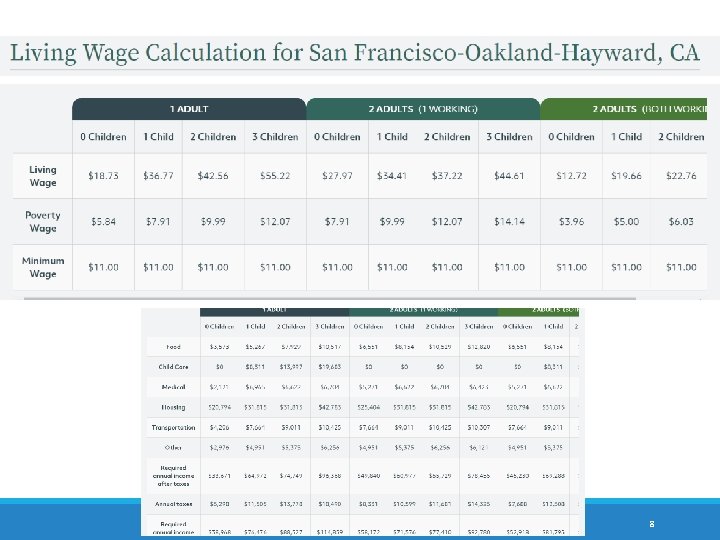
What is Self-Sufficiency? Living Wage ◦ http: //livingwage. mit. edu/ What’s the gap between the maximum a family will pay while on housing assistance and what it REALLY costs to rent on the market? What benefits will they lose as they start to increase earned income? How will they make up for that “benefits cliff”? 7
8
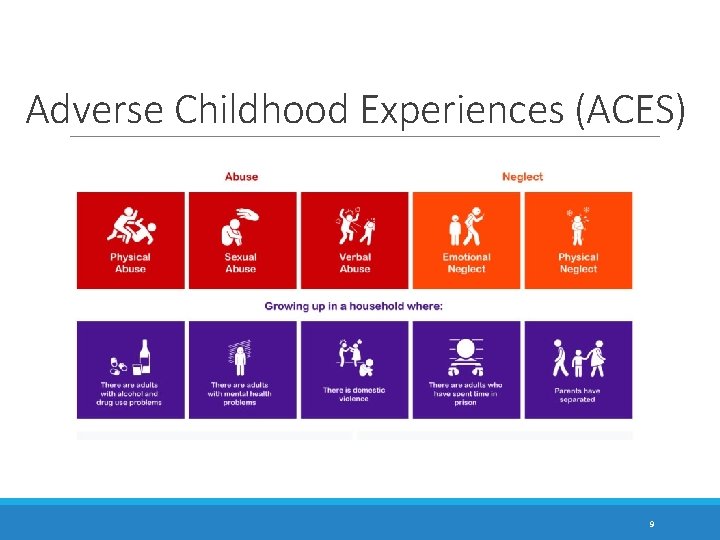
Adverse Childhood Experiences (ACES) 9
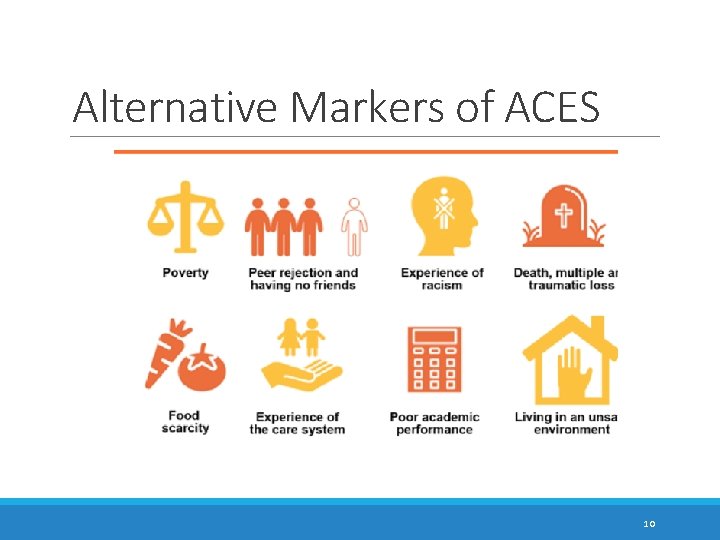
Alternative Markers of ACES 10
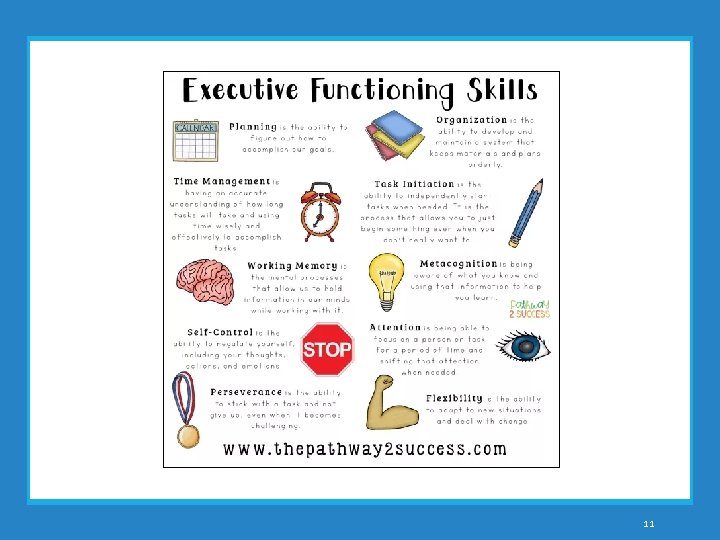
11

12
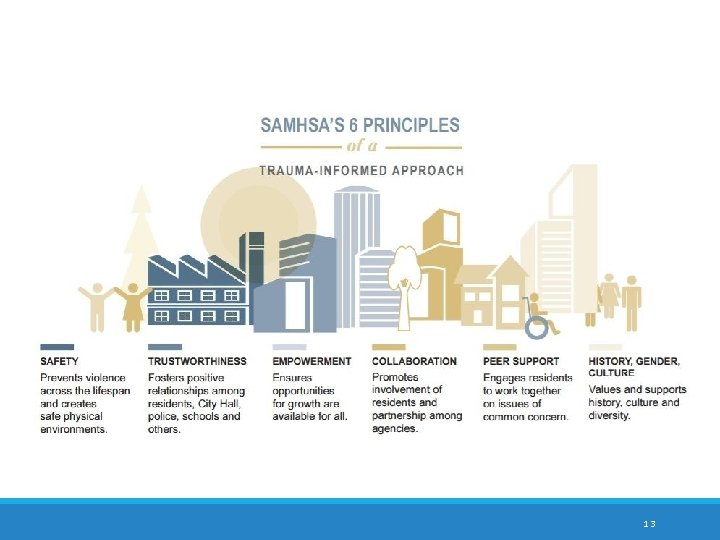
13
BREAK 14
FSS – Key Practices 15
Know Your Documents FSS Statute: Section 23 of the 1937 Act ◦ SEC. 23. [42 U. S. C. 1437 u] FSS Regulations: 24 CFR Part 984 FSS Waivers FR Notice: 79 FR 78100 FSS Action Plan FSS Contract of Participation (HUD 52650) FSS Escrow Calculation – optional form FSS Notice of Funding Availability Grant Agreement FSS Accounting Brief #23 HUD – 50058 Section 17 16
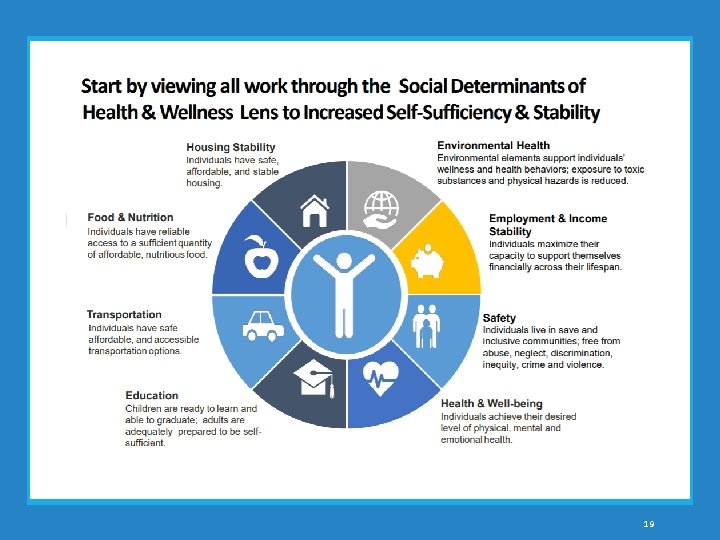
What if we spent as much time cultivating relationships amongst partners and systems as we do making sure residents follow rules? What if? What if it’s actually disrespectful to have things all figured out before we serve families? 17
Program Coordinating Committee Based on what you are finding in your needs assessments, are the right providers in place? Has your PCC been useful? How do you utilize them? Are your meetings helpful to your partners? Do you have to seek out any partners/services that you don’t already have lined up? Do you include families with lived experience with your systems and services as Subject Matter Experts on your PCC? Are you having trouble finding partners for any specific needs? 18
19
Collaboration Establish a comprehensive program with an array of services and Work closely with social services agencies and other non-traditional partners – a significant portion of a Coordinator’s time should be working with partners and building and maintaining a network. Train your FSS program staff and other staff at the PHA that work with FSS – or COULD – like intake, rent re-cert staff, property management, etc. Interact periodically with other PHAs who administer an FSS program. 20
Are you reaching out to employers to promote FSS and your participants? Employers as Partners Do you know what kind of training employers want your participants to have? Do you include Employers on your PCC? 21
Needs Assessment and ITSP – Needs Assessment ◦ Are you using a standard tool or did you create one? Pros/cons? ◦ Does it ask the “right” questions for your population? ◦ How have you tweaked it since you started using it? How do you determine what service(s) are needed? How do you decide what comes first in the plan? ◦ (e. g. substance abuse, domestic violence, low education, no work history… what comes first? ) ◦ Are you able to have a “long view”? ◦ Do you have a standard triage of needs? Are you strengths-based? ◦ What’s good? What’s working? What survival skills and informal systems have gotten them this far? 22
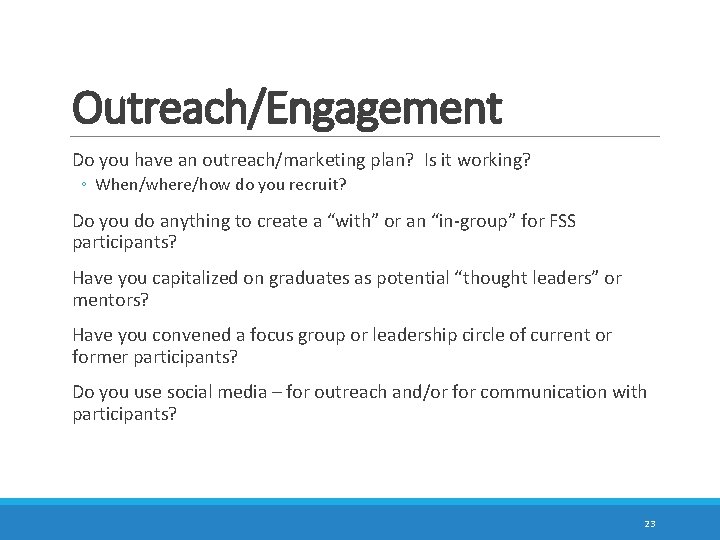
Outreach/Engagement Do you have an outreach/marketing plan? Is it working? ◦ When/where/how do you recruit? Do you do anything to create a “with” or an “in-group” for FSS participants? Have you capitalized on graduates as potential “thought leaders” or mentors? Have you convened a focus group or leadership circle of current or former participants? Do you use social media – for outreach and/or for communication with participants? 23
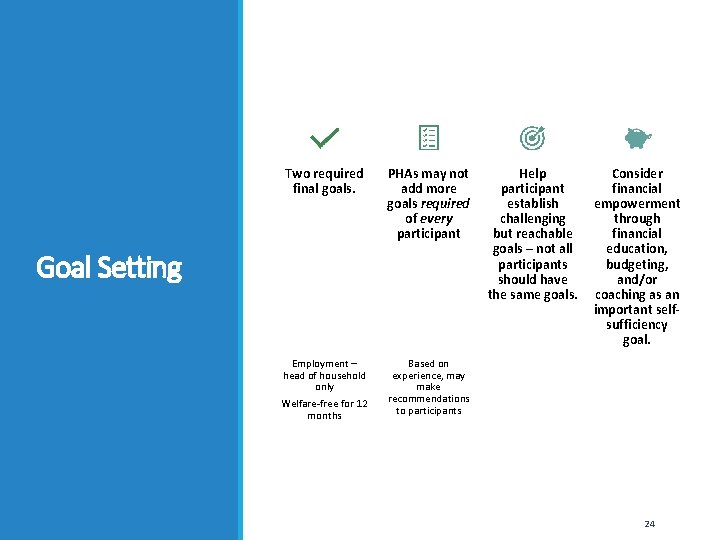
Two required final goals. PHAs may not add more goals required of every participant Employment – head of household only Welfare-free for 12 months Based on experience, may make recommendations to participants Goal Setting Help participant establish challenging but reachable goals – not all participants should have the same goals. Consider financial empowerment through financial education, budgeting, and/or coaching as an important selfsufficiency goal. 24
Focus on soft skills is also important. Examples include how participants present themselves at an interview and at work, and how the participant handles difficult situations at work. Goal Setting While an important (and required) goal, employment doesn’t need to be the only focus of a participant’s plan. Assess whether the participant is more suited to focus on education/training first. What’s going on with the WHOLE family? What’s happening with the WHOLE person? 25
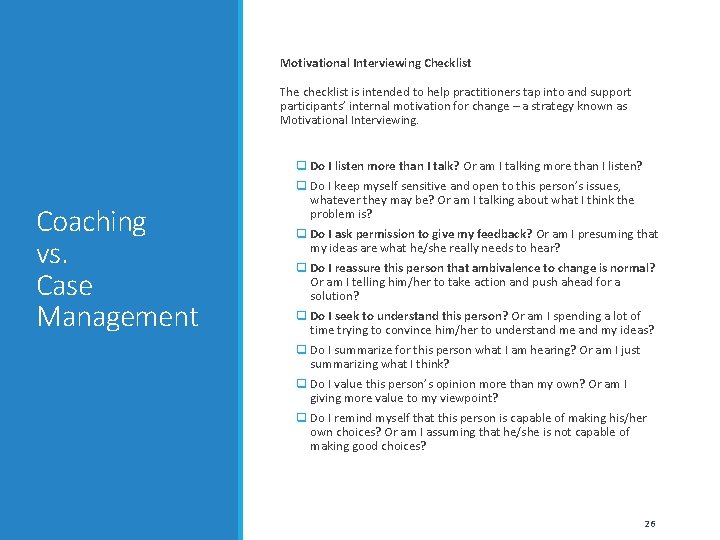
Motivational Interviewing Checklist The checklist is intended to help practitioners tap into and support participants’ internal motivation for change – a strategy known as Motivational Interviewing. Coaching vs. Case Management q Do I listen more than I talk? Or am I talking more than I listen? q Do I keep myself sensitive and open to this person’s issues, whatever they may be? Or am I talking about what I think the problem is? q Do I ask permission to give my feedback? Or am I presuming that my ideas are what he/she really needs to hear? q Do I reassure this person that ambivalence to change is normal? Or am I telling him/her to take action and push ahead for a solution? q Do I seek to understand this person? Or am I spending a lot of time trying to convince him/her to understand me and my ideas? q Do I summarize for this person what I am hearing? Or am I just summarizing what I think? q Do I value this person’s opinion more than my own? Or am I giving more value to my viewpoint? q Do I remind myself that this person is capable of making his/her own choices? Or am I assuming that he/she is not capable of making good choices? 26
Connecting Participants to Services – Best Practices How do you make referrals? ◦ Do you call for/with your participants to make appointments? ◦ Do you accompany them? ◦ If not, how do you ensure that they know how to get there/have the confidence to walk in the door/will sit and wait if needed? ◦ If so, how do you do so without encumbering independence? ◦ Have you actually been to the service provider’s site and walked through the process yourself? ◦ Do you walk the participant through what to expect at each service provider? Do you make sure they have whatever paperwork is needed for intake? ◦ Do you have a point person at each partner to whom you refer directly? ◦ Do you have any special intake provisions with your partners? ◦ Are these special provisions in an MOU? 27
Connecting Participants to Services – Best Practices How do you follow up with your provider partner? ◦ Is your data sharing all aggregated or do you do “co-staffing? ” ◦ Does the case manager function as a “hospitalist? ” How do you follow up with the participant? What do you do when a referral doesn’t go well? 28
Escrow How often do you show your participants their escrow balance? ◦ Required – once per year ◦ Best Practice – more often Interim withdrawls – best practice = allow! ◦ For what? Who decides? What are parameters? 29
Connect with your participants either in person or via phone (or some other technology such as skype) on an agreed-upon schedule. ◦ Newer participants may need to be seen more often than more stable participants – it’s not one-size-fits-all – consider a triage system. Ongoing Service Coordination Continue to support participants after employment is obtained. ◦ 1 st 90 days is most critical! Provide support to the entire family where necessary. Celebrate your participants’ successes. Translate the success into Management language 30
Action Plan Update your Action Plan to reflect policy changes, as required in regulation. ◦ Interim disbursements ◦ Motivation as a selection factor ◦ Re-enrollments ◦ Program size ◦ Goal changes ◦ Grievance policy 31

LUNCH 32

Tell/Sell Your Successes 33
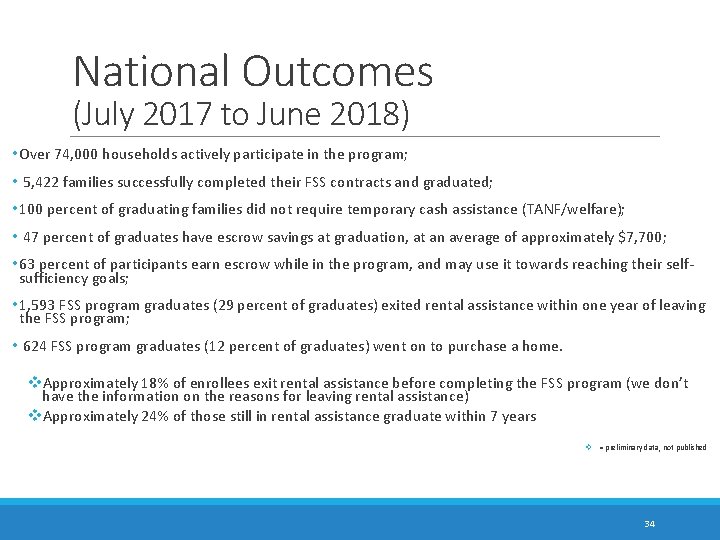
National Outcomes (July 2017 to June 2018) • Over 74, 000 households actively participate in the program; • 5, 422 families successfully completed their FSS contracts and graduated; • 100 percent of graduating families did not require temporary cash assistance (TANF/welfare); • 47 percent of graduates have escrow savings at graduation, at an average of approximately $7, 700; • 63 percent of participants earn escrow while in the program, and may use it towards reaching their selfsufficiency goals; • 1, 593 FSS program graduates (29 percent of graduates) exited rental assistance within one year of leaving the FSS program; • 624 FSS program graduates (12 percent of graduates) went on to purchase a home. v. Approximately 18% of enrollees exit rental assistance before completing the FSS program (we don’t have the information on the reasons for leaving rental assistance) v. Approximately 24% of those still in rental assistance graduate within 7 years v = preliminary data, not published 34
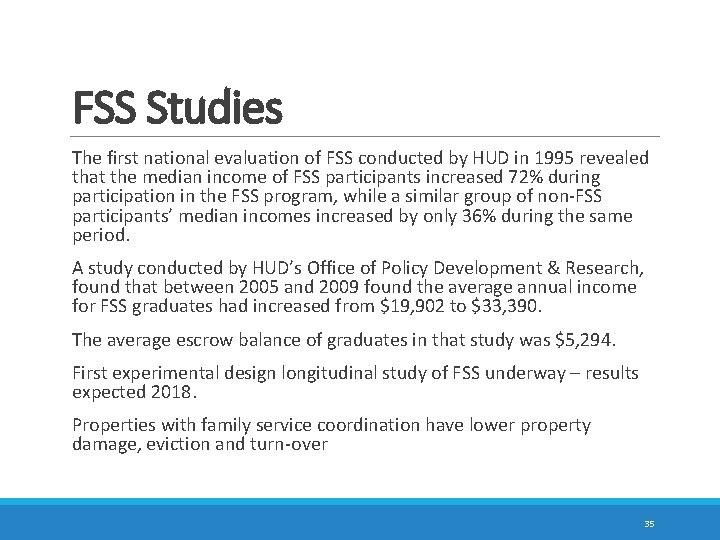
FSS Studies The first national evaluation of FSS conducted by HUD in 1995 revealed that the median income of FSS participants increased 72% during participation in the FSS program, while a similar group of non-FSS participants’ median incomes increased by only 36% during the same period. A study conducted by HUD’s Office of Policy Development & Research, found that between 2005 and 2009 found the average annual income for FSS graduates had increased from $19, 902 to $33, 390. The average escrow balance of graduates in that study was $5, 294. First experimental design longitudinal study of FSS underway – results expected 2018. Properties with family service coordination have lower property damage, eviction and turn-over 35
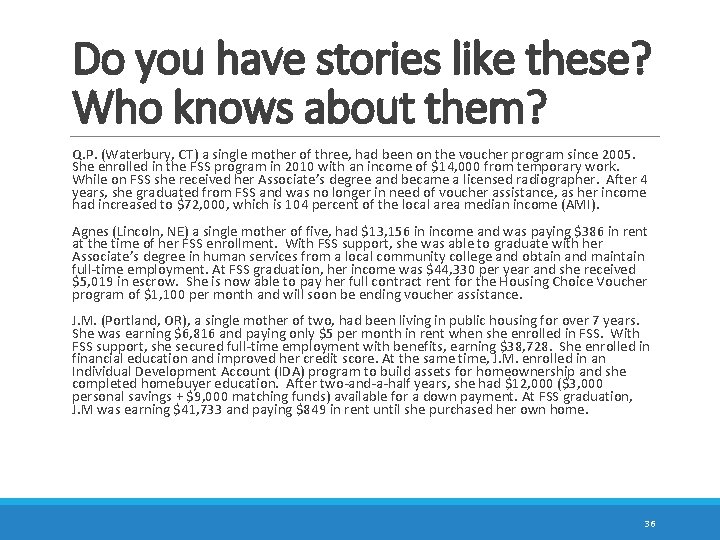
Do you have stories like these? Who knows about them? Q. P. (Waterbury, CT) a single mother of three, had been on the voucher program since 2005. She enrolled in the FSS program in 2010 with an income of $14, 000 from temporary work. While on FSS she received her Associate’s degree and became a licensed radiographer. After 4 years, she graduated from FSS and was no longer in need of voucher assistance, as her income had increased to $72, 000, which is 104 percent of the local area median income (AMI). Agnes (Lincoln, NE) a single mother of five, had $13, 156 in income and was paying $386 in rent at the time of her FSS enrollment. With FSS support, she was able to graduate with her Associate’s degree in human services from a local community college and obtain and maintain full-time employment. At FSS graduation, her income was $44, 330 per year and she received $5, 019 in escrow. She is now able to pay her full contract rent for the Housing Choice Voucher program of $1, 100 per month and will soon be ending voucher assistance. J. M. (Portland, OR), a single mother of two, had been living in public housing for over 7 years. She was earning $6, 816 and paying only $5 per month in rent when she enrolled in FSS. With FSS support, she secured full-time employment with benefits, earning $38, 728. She enrolled in financial education and improved her credit score. At the same time, J. M. enrolled in an Individual Development Account (IDA) program to build assets for homeownership and she completed homebuyer education. After two-and-a-half years, she had $12, 000 ($3, 000 personal savings + $9, 000 matching funds) available for a down payment. At FSS graduation, J. M was earning $41, 733 and paying $849 in rent until she purchased her own home. 36
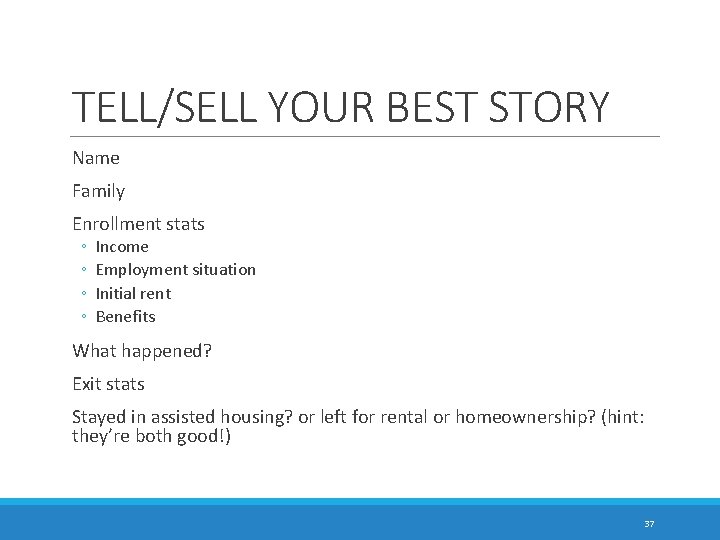
TELL/SELL YOUR BEST STORY Name Family Enrollment stats ◦ ◦ Income Employment situation Initial rent Benefits What happened? Exit stats Stayed in assisted housing? or left for rental or homeownership? (hint: they’re both good!) 37
FSS Re-Authorization NEW REGULATIONS 38
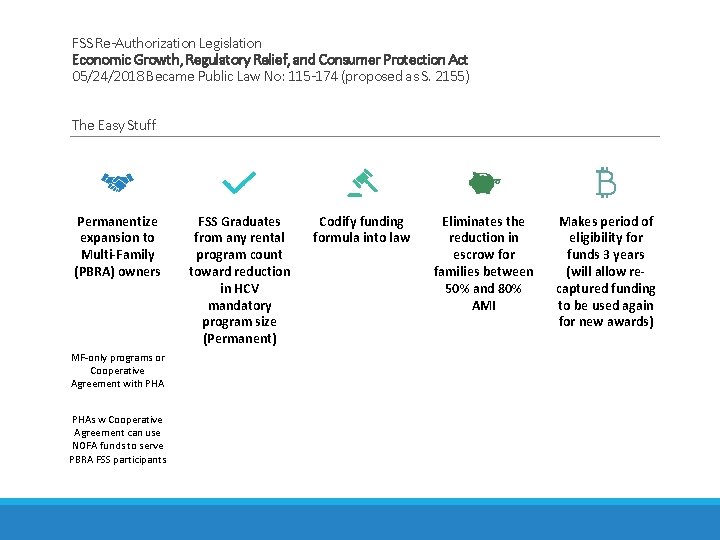
FSS Re-Authorization Legislation Economic Growth, Regulatory Relief, and Consumer Protection Act 05/24/2018 Became Public Law No: 115 -174 (proposed as S. 2155) The Easy Stuff Permanentize expansion to Multi-Family (PBRA) owners MF-only programs or Cooperative Agreement with PHAs w Cooperative Agreement can use NOFA funds to serve PBRA FSS participants FSS Graduates from any rental program count toward reduction in HCV mandatory program size (Permanent) Codify funding formula into law Eliminates the reduction in escrow for families between 50% and 80% AMI Makes period of eligibility for funds 3 years (will allow recaptured funding to be used again for new awards)
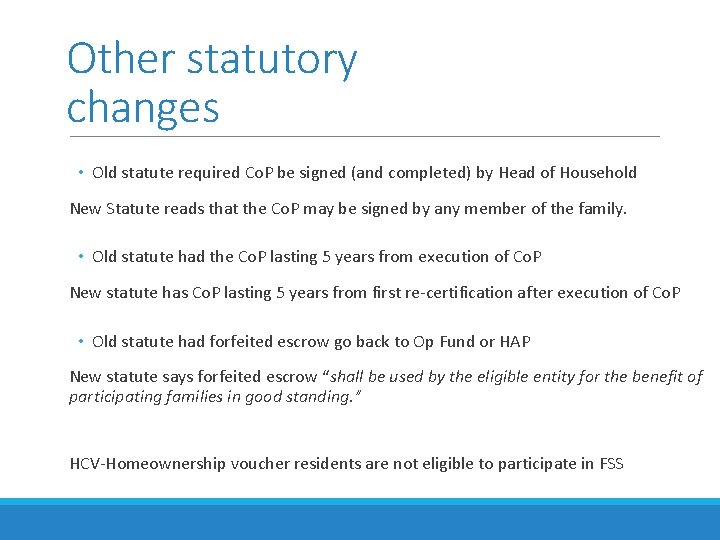
Other statutory changes • Old statute required Co. P be signed (and completed) by Head of Household New Statute reads that the Co. P may be signed by any member of the family. • Old statute had the Co. P lasting 5 years from execution of Co. P New statute has Co. P lasting 5 years from first re-certification after execution of Co. P • Old statute had forfeited escrow go back to Op Fund or HAP New statute says forfeited escrow “shall be used by the eligible entity for the benefit of participating families in good standing. ” HCV-Homeownership voucher residents are not eligible to participate in FSS
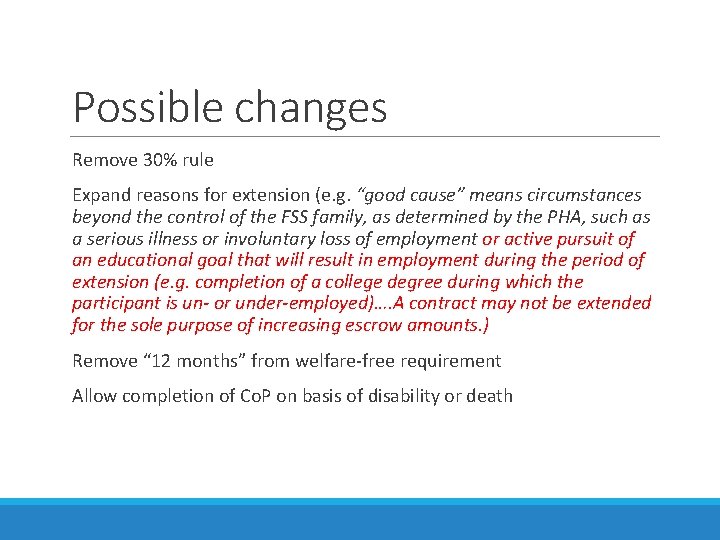
Possible changes Remove 30% rule Expand reasons for extension (e. g. “good cause” means circumstances beyond the control of the FSS family, as determined by the PHA, such as a serious illness or involuntary loss of employment or active pursuit of an educational goal that will result in employment during the period of extension (e. g. completion of a college degree during which the participant is un- or under-employed)…. A contract may not be extended for the sole purpose of increasing escrow amounts. ) Remove “ 12 months” from welfare-free requirement Allow completion of Co. P on basis of disability or death
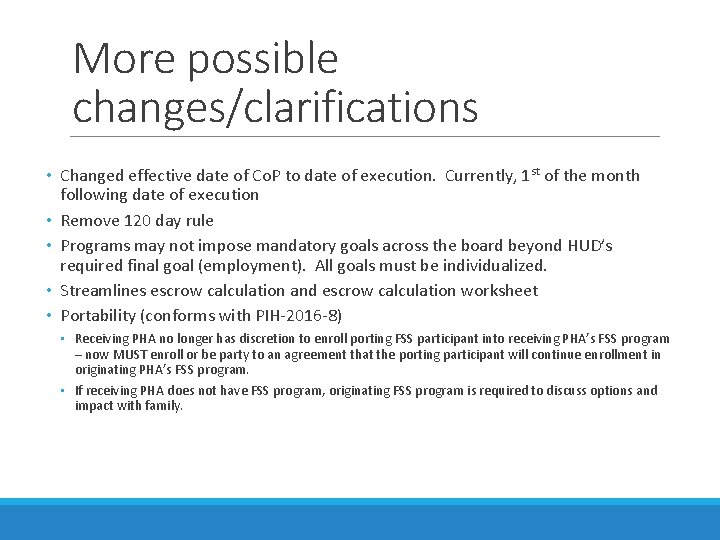
More possible changes/clarifications • Changed effective date of Co. P to date of execution. Currently, 1 st of the month following date of execution • Remove 120 day rule • Programs may not impose mandatory goals across the board beyond HUD’s required final goal (employment). All goals must be individualized. • Streamlines escrow calculation and escrow calculation worksheet • Portability (conforms with PIH-2016 -8) • Receiving PHA no longer has discretion to enroll porting FSS participant into receiving PHA’s FSS program – now MUST enroll or be party to an agreement that the porting participant will continue enrollment in originating PHA’s FSS program. • If receiving PHA does not have FSS program, originating FSS program is required to discuss options and impact with family.
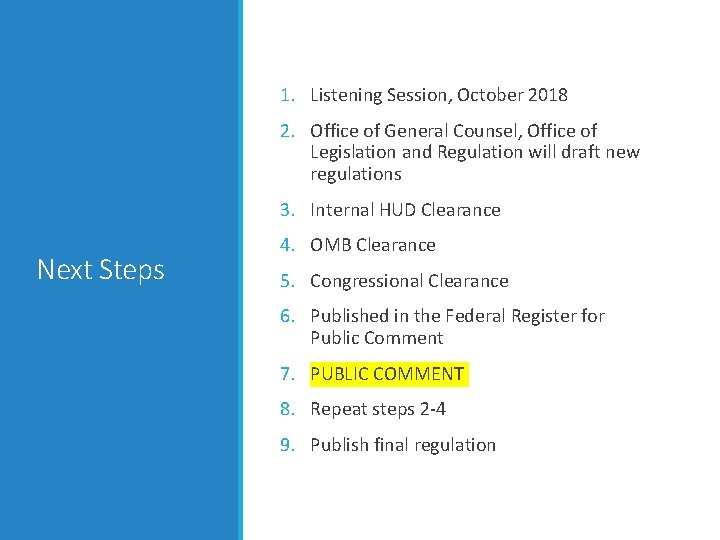
1. Listening Session, October 2018 2. Office of General Counsel, Office of Legislation and Regulation will draft new regulations 3. Internal HUD Clearance Next Steps 4. OMB Clearance 5. Congressional Clearance 6. Published in the Federal Register for Public Comment 7. PUBLIC COMMENT 8. Repeat steps 2 -4 9. Publish final regulation
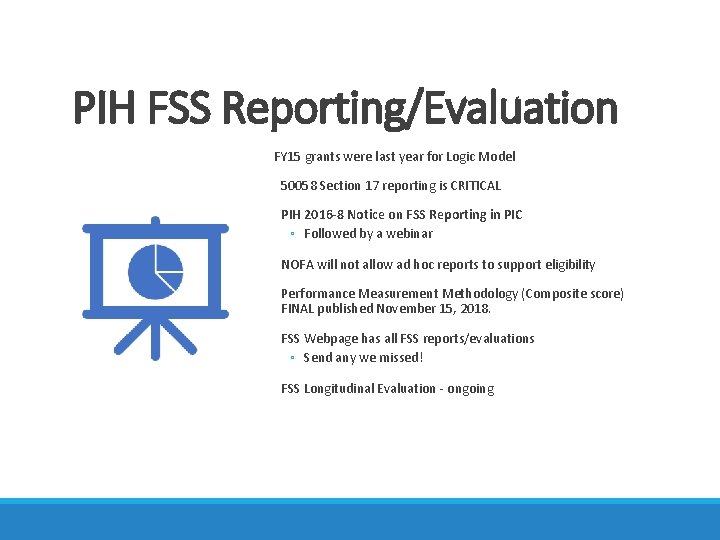
PIH FSS Reporting/Evaluation FY 15 grants were last year for Logic Model 50058 Section 17 reporting is CRITICAL PIH 2016 -8 Notice on FSS Reporting in PIC ◦ Followed by a webinar NOFA will not allow ad hoc reports to support eligibility Performance Measurement Methodology (Composite score) FINAL published November 15, 2018. FSS Webpage has all FSS reports/evaluations ◦ Send any we missed! FSS Longitudinal Evaluation - ongoing

FSS Performance Measurement (AKA COMPOSITE SCORE) 45
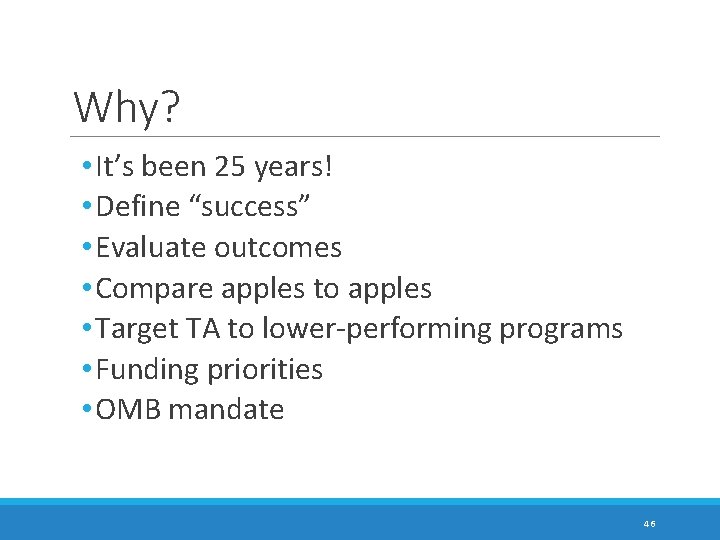
Why? • It’s been 25 years! • Define “success” • Evaluate outcomes • Compare apples to apples • Target TA to lower-performing programs • Funding priorities • OMB mandate 46
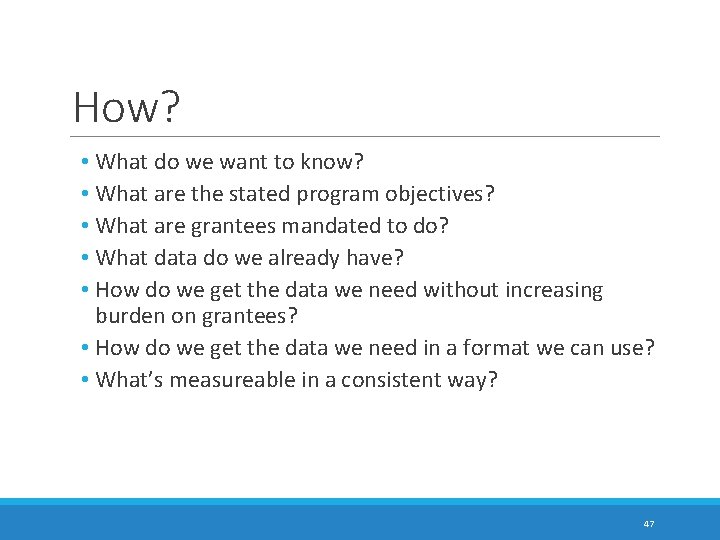
How? • What do we want to know? • What are the stated program objectives? • What are grantees mandated to do? • What data do we already have? • How do we get the data we need without increasing burden on grantees? • How do we get the data we need in a format we can use? • What’s measureable in a consistent way? 47
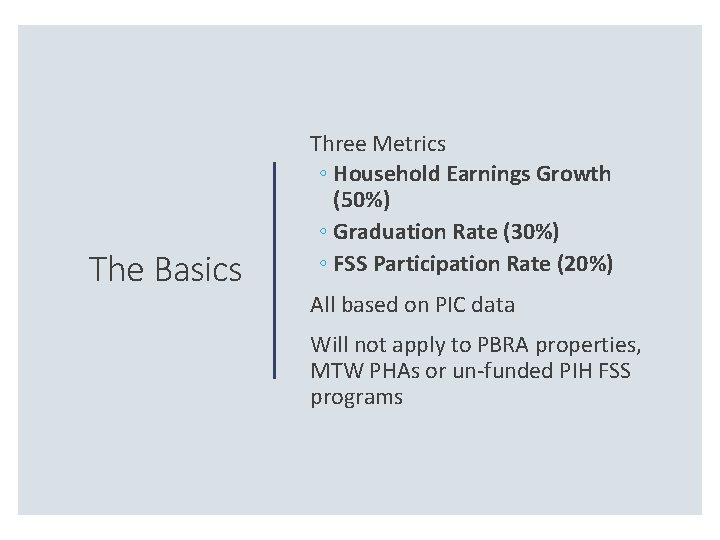
The Basics Three Metrics ◦ Household Earnings Growth (50%) ◦ Graduation Rate (30%) ◦ FSS Participation Rate (20%) All based on PIC data Will not apply to PBRA properties, MTW PHAs or un-funded PIH FSS programs
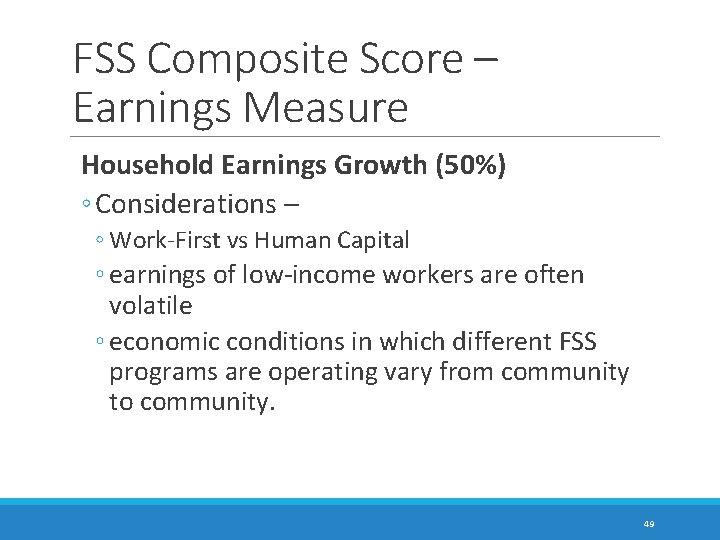
FSS Composite Score – Earnings Measure Household Earnings Growth (50%) ◦ Considerations – ◦ Work-First vs Human Capital ◦ earnings of low-income workers are often volatile ◦ economic conditions in which different FSS programs are operating vary from community to community. 49
FSS Composite Score – Earnings Measure ◦ Looking at cohort entered FSS 3. 5 -7. 5 years ago ◦ Minimum 3. 5 years ago to allow sufficient time to have passed for FSS participants to have benefitted from the program. ◦ Maximum 7. 5 years ago to ensure that the results reflect recent FSS program performance to the maximum extent practicable. ◦ Elderly (over 62 when enrolling) not included ◦ disabled (at enrollment or during Co. P) not included ◦ Only using ANNUAL re-exams, not interims ◦ Some PHAs don’t have interims 50
FSS Composite Score – Earnings Measure ◦ 3 comparison families for each participant family ◦ earnings as of the time of the FSS household’s entry into FSS, ◦ age of head of household, ◦ length of time in the voucher or public housing program, ◦ number of adults in the household, ◦ presence of a child with a disability, and ◦ presence of a non-head of household adult with a disability. THEN - Calculates the difference between the average earnings growth for all FSS participants and the average earnings growth for all comparison households at each PHA. 51
FSS Composite Score – Earnings Measure If state or regional PHA - comparison households be in the same county AND PHA as the FSS participants to which they are being compared. ◦ HUD will apply this protocol to all state (or other) PHAs where three or more counties are each home to at least 10 percent of households receiving housing assistance from the PHA (through HCV or public housing). ◦ To ensure this approach does not unduly dilute the ability to find comparable households, HUD will require that FSS participants be matched to comparison households in the same county only in counties where there at least 4 times as many non-FSS households as FSS households being served by the PHA. 52
FSS Composite Score – Earnings Measure ◦ Higher of 1. Earnings Growth Since Enrollment: the difference between (i) annual earnings upon enrollment in FSS and (ii) the most recent earnings estimate available in PIC for that household from an annual reexamination. 2. Average Annual Earnings While in FSS: the difference between (i) earnings upon enrollment in FSS and (ii) the household’s average annual earnings during the time period between enrollment in FSS and the most recent annual reexamination of income available in PIC. while both measures work acceptably for programs that encourage individuals to increase their earnings immediately Measure 1 - focus first on education and training Measure 2, Average Annual Earnings While in FSS, focuses on the difference between starting and average annual earnings, which ensures that an FSS participant who has made good progress in increasing earnings while in FSS, but who nevertheless has experienced a temporary setback of job loss as of the most recent annual reexamination, nevertheless has his or her progress recognized. 53
FSS Composite Score – Earnings Measure Finally, to adjust for the residual effect of local economic conditions, HUD computes an adjustment factor for each PHA. ◦ linear regression model to examine the relationship between the earnings growth of comparison households within a PHA and the average county median income of those households. ◦ On average, earnings growth of comparison households tends to be higher in counties with high median incomes, and lower in counties with low median incomes. ◦ HUD then develops an adjustment factor that eliminates this relationship and applies this adjustment factor to the earnings performance measure for each PHA ◦ RESULT - an adjusted earnings performance measure 54
FSS Composite Score – Graduation Measure Graduation Rate (30%) ◦% of FSS participants that enrolled 5 -8 years ago that have graduated. ◦Excludes non-graduates that left rental assistance during the analysis period 55
FSS Composite Score – Participation Measure FSS Participation Rate (20%) ◦ # of households at the PHA compared to minimum # required to be served by the grant ◦ higher of: (a) the PHA’s three-year average and (b) the most recent year. 56
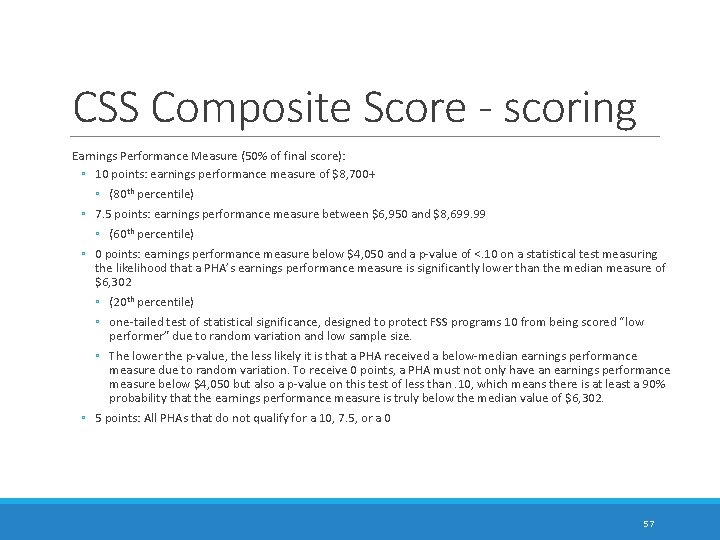
CSS Composite Score - scoring Earnings Performance Measure (50% of final score): ◦ 10 points: earnings performance measure of $8, 700+ ◦ (80 th percentile) ◦ 7. 5 points: earnings performance measure between $6, 950 and $8, 699. 99 ◦ (60 th percentile) ◦ 0 points: earnings performance measure below $4, 050 and a p-value of <. 10 on a statistical test measuring the likelihood that a PHA’s earnings performance measure is significantly lower than the median measure of $6, 302 ◦ (20 th percentile) ◦ one-tailed test of statistical significance, designed to protect FSS programs 10 from being scored “low performer” due to random variation and low sample size. ◦ The lower the p-value, the less likely it is that a PHA received a below-median earnings performance measure due to random variation. To receive 0 points, a PHA must not only have an earnings performance measure below $4, 050 but also a p-value on this test of less than. 10, which means there is at least a 90% probability that the earnings performance measure is truly below the median value of $6, 302. ◦ 5 points: All PHAs that do not qualify for a 10, 7. 5, or a 0 57
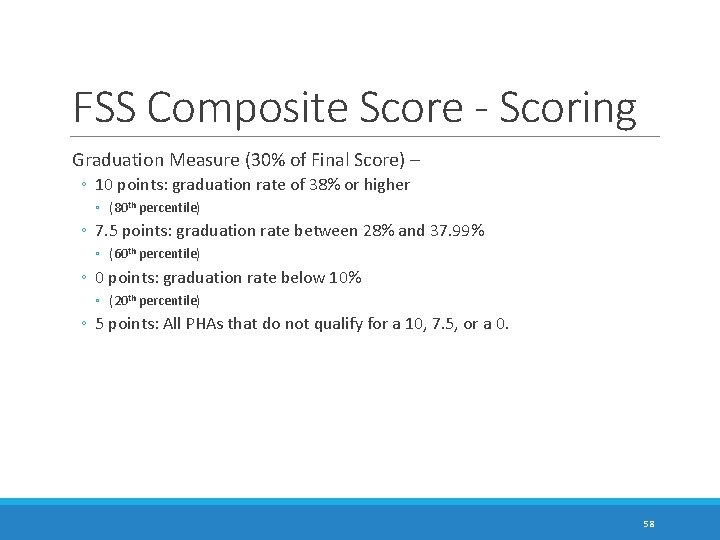
FSS Composite Score - Scoring Graduation Measure (30% of Final Score) – ◦ 10 points: graduation rate of 38% or higher ◦ (80 th percentile) ◦ 7. 5 points: graduation rate between 28% and 37. 99% ◦ (60 th percentile) ◦ 0 points: graduation rate below 10% ◦ (20 th percentile) ◦ 5 points: All PHAs that do not qualify for a 10, 7. 5, or a 0. 58
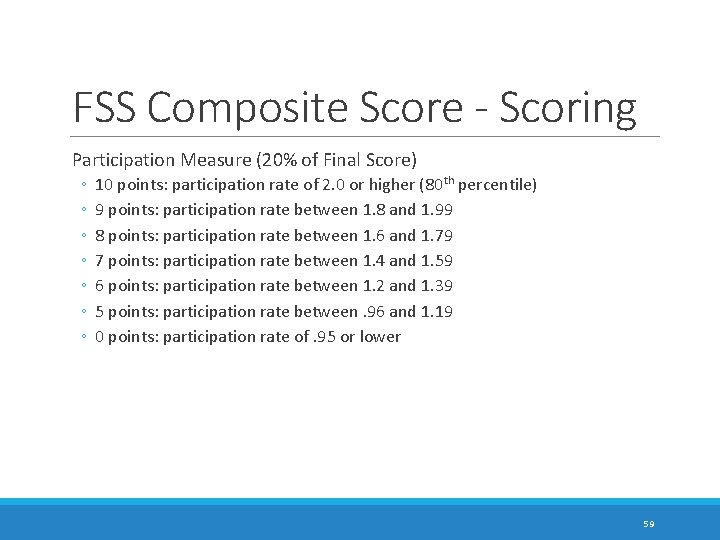
FSS Composite Score - Scoring Participation Measure (20% of Final Score) ◦ ◦ ◦ ◦ 10 points: participation rate of 2. 0 or higher (80 th percentile) 9 points: participation rate between 1. 8 and 1. 99 8 points: participation rate between 1. 6 and 1. 79 7 points: participation rate between 1. 4 and 1. 59 6 points: participation rate between 1. 2 and 1. 39 5 points: participation rate between. 96 and 1. 19 0 points: participation rate of. 95 or lower 59

FSS Composite Score - Scoring Category 1: FSS Performance score of 8. 0 or higher Category 2: FSS Performance score between 4. 26 and 7. 99 Category 3: FSS Performance score between 3. 26 and 4. 25 Category 4: FSS Performance score of 3. 25 or lower Thresholds are fixed, not relative If a participant entered more than once during that period, the methodology focuses on the older entry. 60
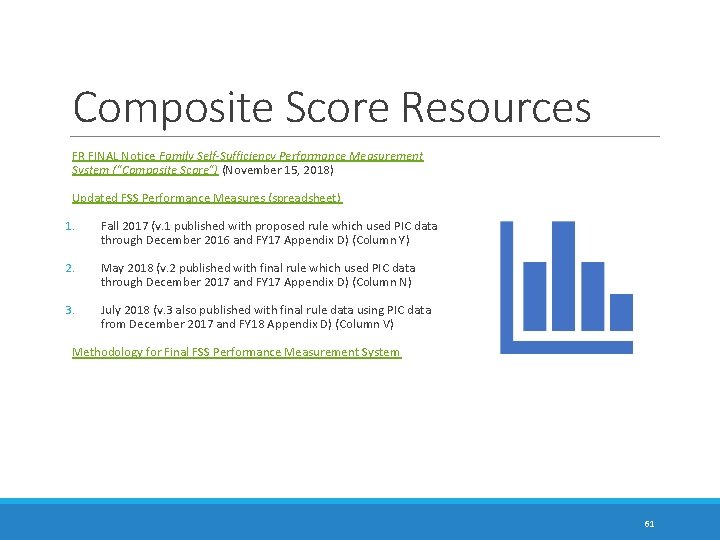
Composite Score Resources FR FINAL Notice Family Self-Sufficiency Performance Measurement System (“Composite Score") (November 15, 2018) Updated FSS Performance Measures (spreadsheet) 1. Fall 2017 (v. 1 published with proposed rule which used PIC data through December 2016 and FY 17 Appendix D) (Column Y) 2. May 2018 (v. 2 published with final rule which used PIC data through December 2017 and FY 17 Appendix D) (Column N) 3. July 2018 (v. 3 also published with final rule data using PIC data from December 2017 and FY 18 Appendix D) (Column V) Methodology for Final FSS Performance Measurement System 61
Break 62
FSS Updates 63
HUD Community & Supportive Services (CSS) CSS Mission: To support the work of partners and PHAs in reducing barriers and improving access to opportunities for communities, families, and residents to improve their quality of life. Vision: That all HUD-assisted communities, families, and residents have the opportunities, resources, and support to improve their capabilities, selfdetermination and quality of life.
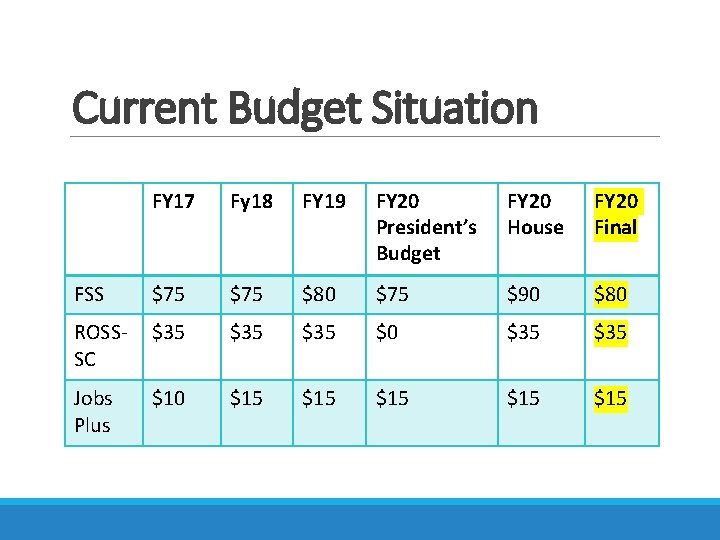
Current Budget Situation FY 17 Fy 18 FY 19 FY 20 President’s Budget FY 20 House FY 20 Final FSS $75 $80 $75 $90 $80 ROSSSC $35 $35 $0 $35 Jobs Plus $10 $15 $15 $15
Funding FY 19 NOFA awards made 12/31/19 ◦ Period of performance 1/1/20 – 12/31/20 ◦ Admin uses? ◦ New regulations will not be in place in time for them to affect FY 19 funding ◦ 120 -day rule ◦ homeowners FY 20 Renewal ◦ No eligibility for PBRA owners to apply for funding (maybe FY 21) No NOFA for new applicants
Standard Housing functions? Q - Can FSS Coordinators perform non-FSS functions for non-FSS participants? A – No, not using FSS funds. Q – Can FSS Coordinators perform non-FSS functions for FSS participants? A – WITH APPROVAL and justification that doing so is in the best interest of the FSS program. 67
Mandatory FSS Programs Some PHAs are required to administer FSS programs because they received FY 1991/1992 FSS incentive award funding, or because they received funding for additional certificates or vouchers or public housing units between FY 1993 and October 21, 1998. At that time, there was a statutory requirement that any PHA that received additional HCV or Rental Certificate program funding, or additional Public Housing units, must implement an FSS program equal to the number of the new rental assistance slots they received. As a result of the Public Housing Reform Act of 1998, funding received after October 21, 1998, no longer mandates an increase in the minimum size of a PHA's FSS program when the PHA is awarded new HCV or public housing funding. Mandatory minimum program size refers to the number of families the PHA is required to enroll and graduate from an FSS program. ◦ Different from # families PHAs are funded to serve via the NOFA Each time a family completes its FSS contract (on or after October 21, 1998), the PHA’s mandatory minimum program size is decreased by one slot. PHAs may count graduating participants from either rental assistance program (PH and HCV) to fulfill their mandatory program size requirements and subsequently reduce the program size. 68
Mandatory FSS Programs SEMAP ◦ Indicator 14 measures (for PHAs with mandatory FSS slots only): ◦ The percent of families enrolled, and ◦ The percent of current FSS participants with escrow balances ◦ PHAs can get up to 10 points on this indicator. ◦ These SEMAP components are scored automatically based on data entered by the PHA in the PIC system. ◦ Ensure that you enter the correct number of mandatory slots as this will affect the calculation. ◦ Field Offices have a document of the #14 info for past 10 years. TALK TO THEM. FIX IT. 69
Mandatory Program Reduction This applies to all PHAs, including those that administer only a single FSS program now and choose to expand to serve residents from the other rental assistance program. See “Waivers and Alternative Requirements for the FSS Program” Federal Register notice, published on December 29, 2014, at 79 FR 78100: https: //www. federalregister. gov/articles/2014/12/29/201430342/waivers-and-alternative-requirements-for-the-family-selfsufficiency-program 70
OGC Guidance on Termination of FSS Programs “There are no statutory or regulatory provisions that allow for the wholesale termination of an existing program. Once a PHA has established a HUD-approved FSS program, it must operate under applicable program requirements. It is our opinion that a PHA, whether operating a voluntary or mandatory program cannot terminate an existing program (e. g. terminate the contracts of current participants) based solely on its not receiving FSS Coordinator Funding or because of a decrease in tenant-based rental assistance. ” 71
FSS expansion to PBRA/Multi-Family (FY 15) PBRA owners can establish their own FSS program to serve PBRA residents. PBRA owners (that are not PHAs) are not eligible to apply for funding All Multi-Family FSS Guidance https: //www. hudexchange. info/programs/multifamily-fss/ ◦ Multi-Family published notice August 26, 2016 https: //portal. hud. gov/hudportal/documents/huddoc? id=16 -08 hsgn. pdf ◦ Family Self-Sufficiency Program Guidebook for Owners of Project-Based Section 8 Developments Currently 30 PBRA programs – half are RAD conversions
RAD – Implications for FSS ◦ Convert from PH to PBV – no changes other than source of escrow because FSS programs have been merged since FY 14. ◦ Convert from PH to PBRA ◦ May use existing FSS grant to continue to serve RAD-affected FSS participants and other PBRA residents ◦ BUT if convert entire stock to PBRA (no more ACC or HCV/PBV) = no longer eligible to apply for FSS funding. ◦ MUST continue to serve all FSS participants regardless of conversion until Co. P ends. ◦ See RAD Notice Revision 4 (H 2019 -09 PIH 2019 -23) ◦ Handout for residents https: //www. hud. gov/sites/documents/RFS 7_FSS_AND_ROSS. PDF 73
HOTMA – impact on Rent Calculations Earned Income Disregard will be eliminated Interim re-certs for change in income or deductions resulting in a 10%+ decrease in annual adjusted income, at the request of the family. Interim re-cert for change in income or deductions resulting in a 10%+ increase in annual adjusted income, or such other amount that the Secretary establishes by notice. Increased earned income is generally disregarded from the interim income review – so the rent will only go up/start or increase escrow a maximum of once per year. PHAs may elect not to conduct interim income reviews for income increases in the last three months of a certification period. Changes not yet effective – Draft rule was published in September 2019 for public comment. Comment period ended November 2019. 74
FSS-FUP The 2015 Appropriations Act directed HUD to carry out a demonstration to test the effectiveness of combining FUP youth vouchers with the FSS program. To accomplish this, HUD was given authority to waive all necessary sections of the FUP statute. HUD was not given authority to waive the FSS statute. HUD implemented the FUP-FSS demonstration through PIH-2016 -01. 50 applications were approved. 48 PHAs are implementing the demonstration starting July 2016 FUP youth vouchers serve youths ages 18 to 24, who have left foster care, or will leave foster care within 90 days, in accordance with a transition plan described in section 475(5)(H) of the Social Security Act, and is homeless or is at risk of becoming homeless at age 16 or older. FUP youth vouchers are typically for a period of no more than 36 months (recently changed through HOTMA. Previously, it was a period of no more than 18 months). Under the demonstration, FUP vouchers may be used for the whole period the young adult is on FSS. FUNDING 2018 – new vouchers – points for connecting FUP with FSS 2019 - $20 m in new FUP vouchers https: //www. hud. gov/program_offices/public_indian_housing/programs/hcv/family 75
Foster Youth Initiative (FYI) FYI offers a new opportunity for local • • • public housing authorities (PHAs) that do not participate in HUD’s Family Unification Program (FUP) to request Tenant Protection Vouchers (TPV for eligible young people ages 18 -24. available to youth for up to 36 months, and through partnerships with the local public child welfare agency (PCWA), youth will have access to supportive services to help them remain stably housed and reach successful independence. ◦ Rolling availability – apply now! https: //www. hud. gov/sites/dfiles/PIH/documents/PIH-2019 -20. pdf 76
Mainstream Vouchers Historically – head, co-head or spouse is disabled. FY 19 and forward, will assist any family that includes a non-elderly person with disabilities Targeted to (following on from NED 2) • • Transitioning out of institutional or other segregated setting At serious risk of institutionalization Homeless At risk of becoming homeless • Will be an FY 20 NOFA • https: //www. hud. gov/program_offices/public_indian_housing/programs/hcv/m ainstream 77
MTW Expansion – (authorized FY 16) 100 New MTW agencies ◦ ◦ ◦ 50 < 1, 000 units 47 < 6, 000 units 3 < 27, 000 units 5 = RAD May be regional agencies 7 years to add these 100 agencies ◦ Will be added in cohorts ◦ Each cohort will address one policy change ◦ Led by Research Advisory Group http: //portal. hud. gov/hudportal/HUD? src=/program_offices/public_indian_housing /programs/ph/mtw/expansion Cohort #1(MTW flexibilities) Cohort #2 (rent reform) 78
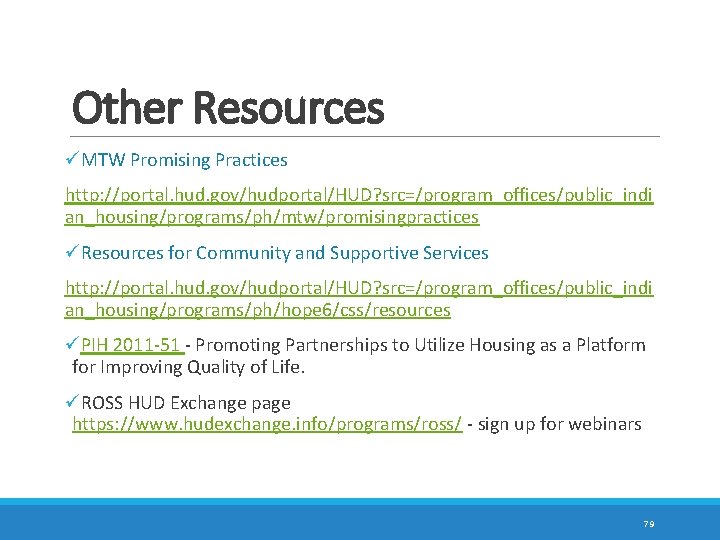
Other Resources üMTW Promising Practices http: //portal. hud. gov/hudportal/HUD? src=/program_offices/public_indi an_housing/programs/ph/mtw/promisingpractices üResources for Community and Supportive Services http: //portal. hud. gov/hudportal/HUD? src=/program_offices/public_indi an_housing/programs/ph/hope 6/css/resources üPIH 2011 -51 - Promoting Partnerships to Utilize Housing as a Platform for Improving Quality of Life. üROSS HUD Exchange page https: //www. hudexchange. info/programs/ross/ - sign up for webinars 79
Supportive Services Resources 80
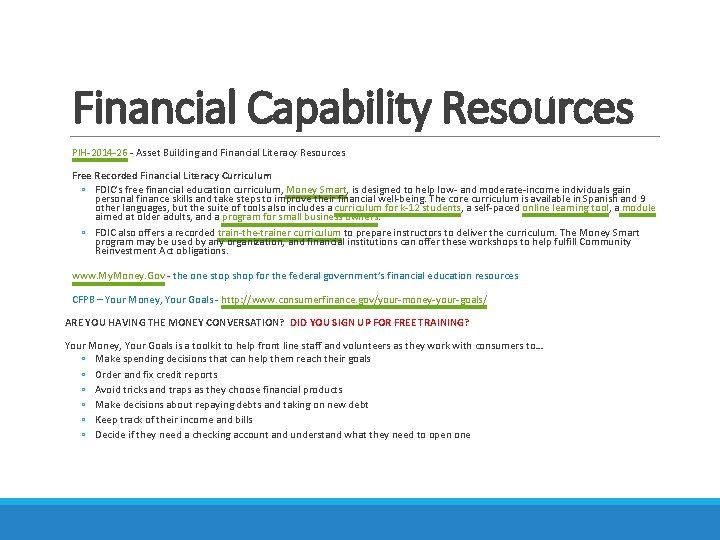
Financial Capability Resources PIH-2014 -26 - Asset Building and Financial Literacy Resources Free Recorded Financial Literacy Curriculum ◦ FDIC’s free financial education curriculum, Money Smart, is designed to help low- and moderate-income individuals gain personal finance skills and take steps to improve their financial well-being. The core curriculum is available in Spanish and 9 other languages, but the suite of tools also includes a curriculum for k-12 students, a self-paced online learning tool, a module aimed at older adults, and a program for small business owners. ◦ FDIC also offers a recorded train-the-trainer curriculum to prepare instructors to deliver the curriculum. The Money Smart program may be used by any organization, and financial institutions can offer these workshops to help fulfill Community Reinvestment Act obligations. www. My. Money. Gov - the one stop shop for the federal government’s financial education resources CFPB – Your Money, Your Goals - http: //www. consumerfinance. gov/your-money-your-goals/ ARE YOU HAVING THE MONEY CONVERSATION? DID YOU SIGN UP FOR FREE TRAINING? Your Money, Your Goals is a toolkit to help front line staff and volunteers as they work with consumers to… ◦ Make spending decisions that can help them reach their goals ◦ Order and fix credit reports ◦ Avoid tricks and traps as they choose financial products ◦ Make decisions about repaying debts and taking on new debt ◦ Keep track of their income and bills ◦ Decide if they need a checking account and understand what they need to open one

Financial Capability Resources Exploring the CFPB’s five principles for effective financial education. The principles build on insights about how people make financial decisions, and what we have learned about consumer experiences in the financial marketplace. The webinar will share researchbased strategies and practitioners’ tips on how financial educators can put the principles into practice. Access the report on the principles anytime on the CFPB website. You can also watch a recording of this topic and other CFPB Financial Education Exchange webinars here. We recently published a report on ways people without a credit history start building one. In order to bring visibility to this issue and spur action at the local level, today we’re releasing credit profiles on states and cities across the country. Check out our blog to learn more and download the credit profiles: www. consumerfinance. gov/about-us/blog/building-credit-local-level/ People who have no credit history, insufficient credit history, or no recent credit history may have limited access to credit. We want to raise awareness of ways organizations can help people in their communities become “credit visible” in a positive way. Local communities can take action to address the issue of access to credit, read our blog to find out how. Sign up to receive regular updates from the Office of Financial Empowerment and learn more about our work at www. consumerfinance. gov/empowerment/.
IRS/EITC HUD-IRS MOU on EITC find a local VITA center https: //www. hud. gov/sites/documents /HUDIRSAGREEMENT. PDF https: //www. irs. gov/Individuals/Free. Tax-Return-Preparation-for-You-by. Volunteers 83
Rent Reporting for Credit Building http: //www. creditbuildersalliance. org/whats-new/hot-topics/powerrent-reporting-pilot Rent reporting is seen by renters as a great opportunity for credit building and, paired with financial education, is a powerful financial capability strategy for public housing authorities seeking to help their residents achieve financial stability. Rent Reporting at Home Forward (Portland, OR HA) https: //vimeo. com/184048713/ceed 0 ba 22 e 84
Resource: First Book is an international nonprofit social enterprise that provides access to new books and educational resources for programs and classrooms working with kids from low-income families. Provides brand new, age-appropriate free or low-cost books for low income kids. www. firstbook. org All PHAs, and anyone working with kids in need can sign up for free, and everyone in your organization can register. You can use these books for anything--local resident meetings, book fairs, community events, and yes, the annual HUD Strong Families event! Contact the First Book Help Team by calling (866) READ-NOW or emailing help@firstbook. org Webinar https: //www. youtube. com/watch? v=5 GPa. Ds. IWWd. A

Resource: ABC Mouse Free access to ABC Mouse for PHAs or their partners that use the online software in classroom settings. Free access to ABC Mouse for those students 86
Resource: Book-Rich Environments Establish partnerships between PHAs and local libraries and build strong local coalitions Engaging children and families in the love of reading and literacy activities offered by the local library and literacy partners Distributing free, high quality, diverse books to children living in HUDassisted Housing Partners: HUD, Department of Education, National Book Foundation, the National Center for Families and Learning. Since 2016 HUD has distributed over 1 million books to children living in HUD-assisted households. May be strategically adding more sites – ask Maria-Lana
Resource: Education Data-Sharing Toolkit U. S. Department of Education released its first-ever Data-Sharing Tool Kit http: //www 2. ed. gov/programs/promiseneighborhoods/datasharingtool. pdf for Communities, providing schools and partner organizations with tools for responsible data-sharing to boost student achievement while respecting privacy. ◦ The tool kit dispels myths about FERPA and illustrates how communities can use data to improve academic and life outcomes. Improving educational outcomes among children living in HUD-assisted housing ◦ We know that stable housing directly impacts the educational outcomes of children, and we know that better educational outcomes are essential for improving the life trajectories of the children HUD serves. ◦ Based on the experience of Public Housing Agencies that have successfully negotiated datasharing partnerships, the Data-Sharing Road Map provides practical guidance for establishing partnerships with school districts and using data-driven strategies to strengthen the educational outcomes of children living in HUD-assisted housing. The Data-Sharing Road Map: Improving Student Outcomes through Partnerships between Public Housing Agencies and School Districts can be found at https: //portal. hud. gov/hudportal/documents/huddoc? id=datasharingroadmap. pdf. 88
Other Youth Resources üwww. youth. gov üSummer Food Service Program – through USDA www. youtube. com/watch? v=DYr_a. Fcy_KE üSafe Routes to School – DOT – find your state coordinator http: //safety. fhwa. dot. gov/saferoutes/ 89
What is HUD VAG STEM Innovation Networks? Watch the You-Tube Video!! https: //youtu. be/airm. TN 8 O 9 n 0 Partners with Public and Affordable housing communities, school districts, community stakeholders Focus on underserved and school-aged youth (pre. K-16) Allows participation in hands-on Science, Technology, Engineering, Math (STEM) activities – engage, excite, inspire Use of state-of-the art equipment and technology (3 -D printing, gene-editing, electrophoresis, DNA extraction, drones, race-cars, robots) Practical learning strategies to spark and sustain a career in STEM/STEAM Approach has the highest potential to break the cycle of poverty for students and their families assisted by CSS programs including ROSS, FSS, Jobs Plus, etc. by equipping their youth with knowledge and skills of tomorrow.
What We Do! We bring real-world, STEM projectbased learning to underserved and school-aged youth (pre. K-16) Introduce the Engineering Design Process to help these youth develop problem-solving skills that will last a lifetime. Youth are engaged in various on-site STEM problem-solving projects while: Developing leadership skills Exploring STEM careers Understanding personal and social responsibility. OUR Partners introduce the following STEM DISCIPLINES • Aerospace/Aviation • Civil, Chemical, Electrical, & Mechanical Engineering • Racing Competition • Technology • 3 D Printing • Software Coding App Development Video Games Design • Hardware Robotics Building Computers Drones 91
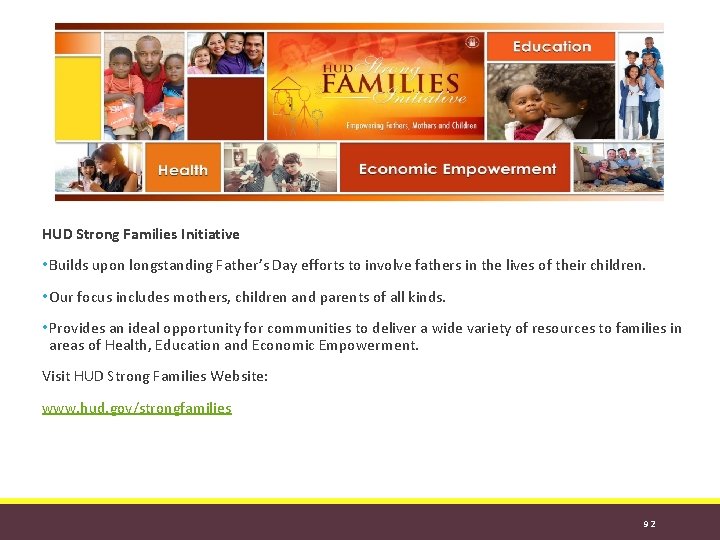
HUD Strong Families Initiative • Builds upon longstanding Father’s Day efforts to involve fathers in the lives of their children. • Our focus includes mothers, children and parents of all kinds. • Provides an ideal opportunity for communities to deliver a wide variety of resources to families in areas of Health, Education and Economic Empowerment. Visit HUD Strong Families Website: www. hud. gov/strongfamilies 92
A collaboration to narrow the digital divide for HUD-assisted families. Stakeholders provide affordable: ◦ High-speed In-Home Internet ◦ Desktop and Laptop Computers ◦ Digital Literacy Training Connect. Home launched in 87 communities, expanding to 100 in 2020! https: //connecthomeusa. org/ Anyone can benefit from a step-by-step Connect. Home Playbook for connecting HUD-assisted residents in your community.
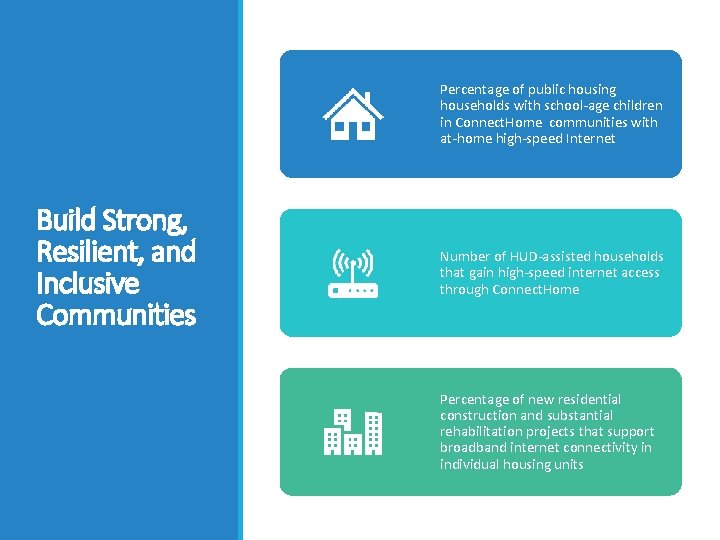
Percentage of public housing households with school-age children in Connect. Home communities with at-home high-speed Internet Build Strong, Resilient, and Inclusive Communities Number of HUD-assisted households that gain high-speed internet access through Connect. Home Percentage of new residential construction and substantial rehabilitation projects that support broadband internet connectivity in individual housing units
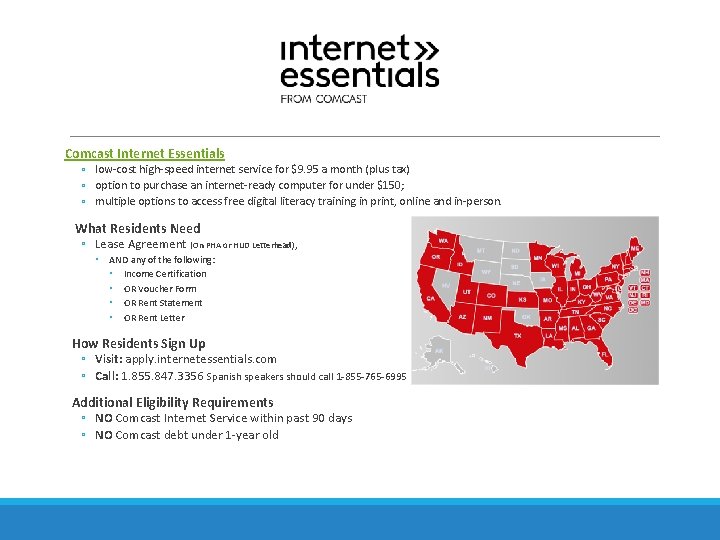
Comcast Internet Essentials ◦ low-cost high-speed internet service for $9. 95 a month (plus tax) ◦ option to purchase an internet-ready computer for under $150; ◦ multiple options to access free digital literacy training in print, online and in-person. What Residents Need ◦ Lease Agreement (On PHA or HUD Letterhead), ◦ AND any of the following: ◦ Income Certification ◦ OR Voucher Form ◦ OR Rent Statement ◦ OR Rent Letter How Residents Sign Up ◦ Visit: apply. internetessentials. com ◦ Call: 1. 855. 847. 3356 Spanish speakers should call 1 -855 -765 -6995 Additional Eligibility Requirements ◦ NO Comcast Internet Service within past 90 days ◦ NO Comcast debt under 1 -year old
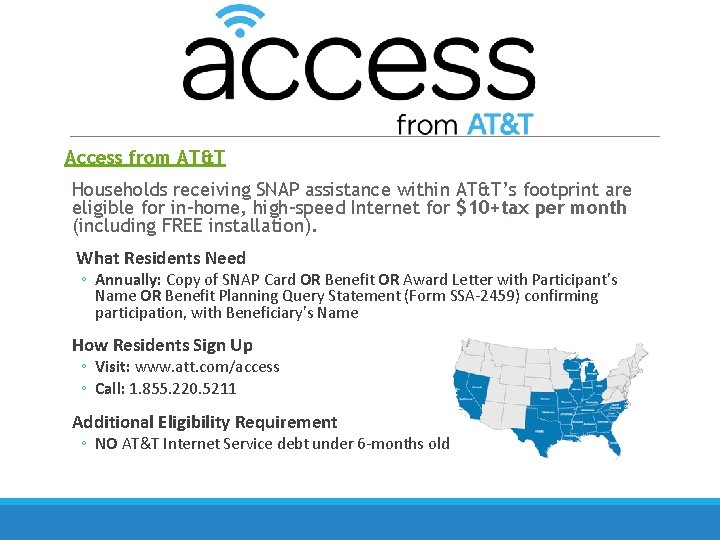
Access from AT&T Households receiving SNAP assistance within AT&T’s footprint are eligible for in-home, high-speed Internet for $10+tax per month (including FREE installation). What Residents Need ◦ Annually: Copy of SNAP Card OR Benefit OR Award Letter with Participant’s Name OR Benefit Planning Query Statement (Form SSA-2459) confirming participation, with Beneficiary’s Name How Residents Sign Up ◦ Visit: www. att. com/access ◦ Call: 1. 855. 220. 5211 Additional Eligibility Requirement ◦ NO AT&T Internet Service debt under 6 -months old
WIOA and PHA responsibility to the One. Stop Job. Corps Youth. Build From the Ground Up: Creating Sustainable Partnerships between Public Housing Authorities and Workforce Investment Boards http: //portal. hud. gov/hudportal/documents/huddoc%3 Fid% 3 D 14_dol_publication. pdf HUD-DOL
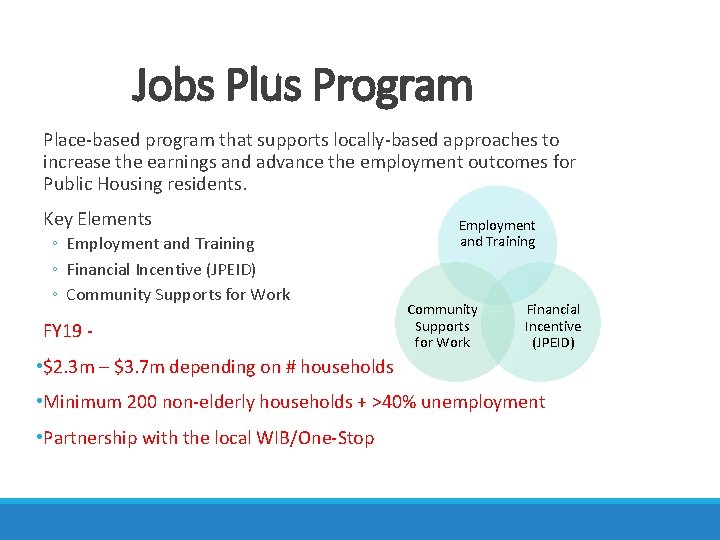
Jobs Plus Program Place-based program that supports locally-based approaches to increase the earnings and advance the employment outcomes for Public Housing residents. Key Elements ◦ Employment and Training ◦ Financial Incentive (JPEID) ◦ Community Supports for Work FY 19 - Employment and Training Community Supports for Work Financial Incentive (JPEID) • $2. 3 m – $3. 7 m depending on # households • Minimum 200 non-elderly households + >40% unemployment • Partnership with the local WIB/One-Stop
DOL – Online Community Workforce. GPS This site houses several Communities of Practice and Collections all opened to the public: Career Pathways, https: //careerpathways. workforcegps. org/, helps workforce development leaders, practitioners, and policymakers expand state and local career pathways efforts currently underway or being planned. Reentry Employment Opportunities, https: //reo. workforcegps. org/ , offers practitioners new ideas and tools to do the invaluable work of changing lives and renewing futures of former offenders. Youth Connections, https: //youth. workforcegps. org/, is an on-line learning destination for public workforce system staff and partners who serve youth. 99
Health üFederally Qualified Health Centers (and look-alikes) – including Community Health Centers ü CHCs provide primary and preventive health care, mental health services, dental services, transportation and translation services. These Health Centers are public or private corporations created through the initiative of local citizens interested in bringing health care to their areas. They are governed by consumer-majority boards of directors http: //findahealthcenter. hrsa. gov/Search_HCC. aspx üWith NHLBI-NIH, disseminating a “With Every Heartbeat is Life” Community Health Worker model and curriculum to almost 20 PHAs. http: //www. nhlbi. nih. gov/healthdisp/aa. htm 100
Reentry Quick References Building upon these resources, HUD co-hosted a Convening on Innovative Reentry Practices Re-entry Public Housing Toolkit ◦ It Starts with Housing: Public Housing Authorities Are Making Second Chances Real This Reentry Toolkit includes examples of programs that have been designed to help returning citizens access housing as a platform for opportunity. letter to PHAs from Former HUD Secretary Donovan ◦ https: //www. usich. gov/resources/uploads/asset_library/Rentry_letter_from_Donovan_to_P HAs_6 -17 -11. pdf HUD PIH Notice 2015 -19 – Arrests vs. Convictions ◦ https: //portal. hud. gov/hudportal/documents/huddoc? id=PIH 2015 -19. pdf FAQs on PIH Notice 2015 -19 ◦ http: //portal. hud. gov/hudportal/documents/huddoc? id=faqexcludearrestrec 33116. pdf Guidance on the Application of Fair Housing Act Standards to the Use of Criminal Records ◦ http: //portal. hud. gov/hudportal/documents/huddoc? id=HUD_OGCGuid. App. FHAStand. CR. pdf 101
For More Information – our team Youth – maria-lana. queen@hud. gov Returning Citizens – Kymian. Ray@hud. gov Jobs Plus/DOL – Jayme. Brown@hud. gov Health Partnerships – Jason. Y. Amirhadji@hud. gov Financial Literacy – Sandra. Norcom@hud. gov Elderly – Leigh. E. vanrij@hud. gov Connect. Home, gardening, Neighborhood Networks – dina. lehmann-kim@hud. gov ROSS – Tremayne. Youmans@hud. gov or ROSS-PIH@hud. gov STEM – Jerryl. Bennett@hud. gov FSS - anice. s. chenault@hud. gov & Jogchum. Poodt@hud. gov or FSS@HUD. gov 102
- Slides: 102