
Family Recovery Building Partnering Friendships for Loved Ones
Family Recovery: Building Partnering Friendships for Loved Ones Exploring how to exchange harmful messages by creating constructive interactions H. Gray Otis, Ph. D, Licensed Clinical Mental Health Counselor March 13, 2020
Presenter Gray Otis, Ph. D, License Clinical Mental Health Counselor q AMHCA Diplomate, Clinical Mental Health Specialist in Trauma q Prior experience as clinical director of residential and intensive out patient treatment programs q Private practice – owner Vanguard Behavioral Health © 2018 KEY CORE BELIEFS. ALL RIGHTS RESERVED. 2
Overview q True recovery is a family matter. q Too often, the missing piece in substance use recovery is the lack of changes that are needed to overcome adverse family relationships. q When family members become effective partners, enduring progress can be sustained. q Rather than simply focusing on the person with the addiction problem, the best chance for lasting success includes a structure for all family members to cultivate mutually supportive interpersonal skills. q This model of interacting provides an easy-to-understand approach that creates improved communications between all family members. q It will help them discard the old patterns of dysfunctional and discouraging exchanges by systematically replacing them. © 2018 KEY CORE BELIEFS. ALL RIGHTS RESERVED. Thoughts or Questions 3
Topics for Discussion q Understanding Our Key Core Beliefs and Emotions q G R E A T Relationships q Building the Future © 2018 KEY CORE BELIEFS. ALL RIGHTS RESERVED. 4
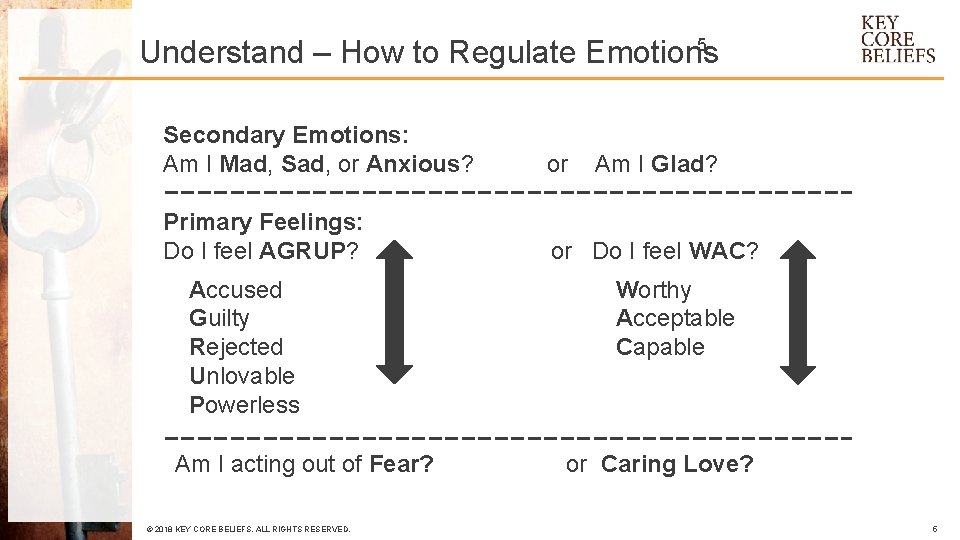
5 Understand – How to Regulate Emotions Secondary Emotions: Am I Mad, Sad, or Anxious? or Am I Glad? Primary Feelings: Do I feel AGRUP? Accused Guilty Rejected Unlovable Powerless Am I acting out of Fear? © 2018 KEY CORE BELIEFS. ALL RIGHTS RESERVED. or Do I feel WAC? Worthy Acceptable Capable or Caring Love? 5
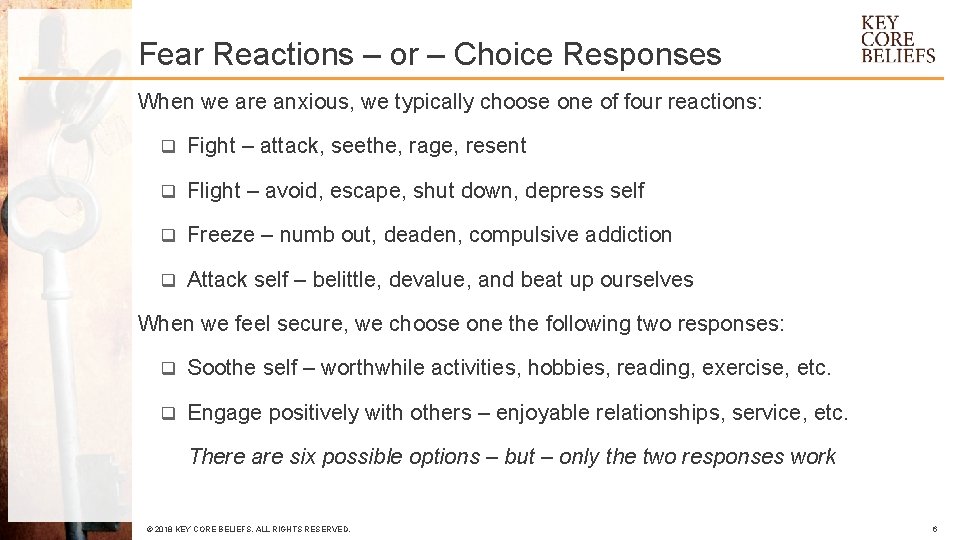
Fear Reactions – or – Choice Responses When we are anxious, we typically choose one of four reactions: q Fight – attack, seethe, rage, resent q Flight – avoid, escape, shut down, depress self q Freeze – numb out, deaden, compulsive addiction q Attack self – belittle, devalue, and beat up ourselves When we feel secure, we choose one the following two responses: q Soothe self – worthwhile activities, hobbies, reading, exercise, etc. q Engage positively with others – enjoyable relationships, service, etc. There are six possible options – but – only the two responses work © 2018 KEY CORE BELIEFS. ALL RIGHTS RESERVED. 6
We Are What We Believe Debate regarding the importance of: “genetics verses environment” or “nature verses nurture, ” However, there is no question that our accumulated self-beliefs meaningfully impact every part of our lives. For example, an individual who has achieved a measure of success in sports, in a profession, or in any other endeavor will persistently work towards continued success. That person would think to themselves, “Hey, I am competent!” By contrast, someone who repeatedly experiences personal disappointments might lose motivation. He or she might believe, “No matter what I do, I am always ineffective—I am hopeless. ” These are examples of self-beliefs. © 2018 KEY CORE BELIEFS. ALL RIGHTS RESERVED. 7
Characteristics of Key Core Beliefs Powerfully held convictions about self: q Consistent over time q Can be either conscious or subconscious Based on experiences in childhood, adolescence, and adulthood q Strongly linked to who we are – our unique sense of selfidentity q q Most commonly expressed as “I am. . . ” Statements (e. g. “I am a competitive person. . . I am competitive”) © 2018 KEY CORE BELIEFS. ALL RIGHTS RESERVED. 8
Characteristics of Key Core Beliefs Powerfully held convictions about self: q Consistent over time q Can be either conscious or subconscious Based on experiences in childhood, adolescence, and adulthood q Strongly linked to who we are – our unique sense of selfidentity q q Most commonly expressed as “I am. . . ” Statements What examples of Key Core Beliefs can you think that a person with an addiction might have? What examples of Key Core Beliefs can you think that a © 2018 KEY CORE BELIEFS. ALL RIGHTS RESERVED. 9
The Development of Key Core Beliefs q q q We accept our Key Core Beliefs as true – but – many are mistaken Based on our experiences, we continually create self-beliefs – constructed reality of the self Ø Negative Core Beliefs generally arise out of personally adverse interactions (“My friends don’t want to spend time with me. . . I am unattractive. ”) Each self-belief is either a Negative Core Belief or Positive Core Belief Ø Positive Core Beliefs arise out of personally affirmative interactions (“My teacher thinks I good at math. I must be pretty smart. . . I am smart. ”) q These self-beliefs filter our perceptions, thoughts, emotions, and actions. The accumulation of Key Core Beliefs develops our Self-Belief Identity 10 © 2018 KEY CORE BELIEFS. ALL RIGHTS RESERVED.
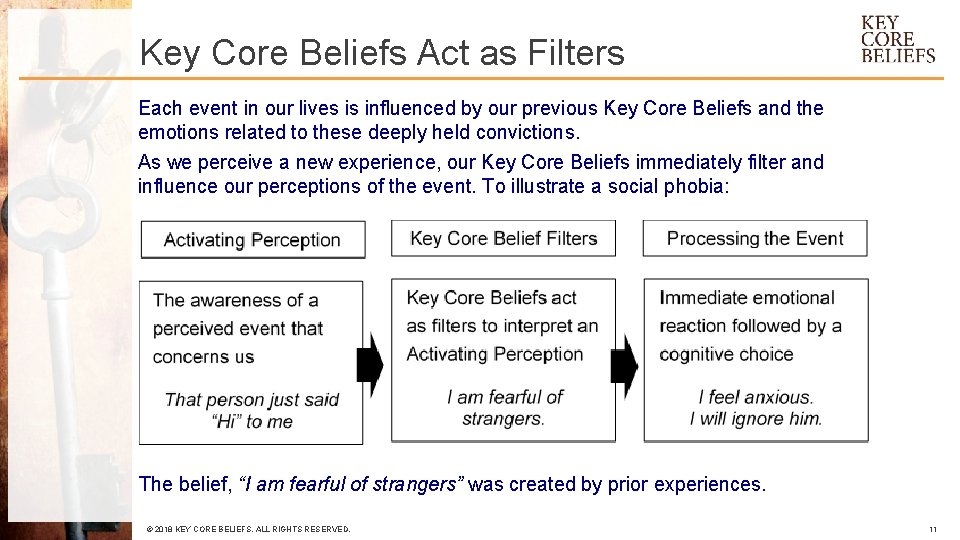
Key Core Beliefs Act as Filters Each event in our lives is influenced by our previous Key Core Beliefs and the emotions related to these deeply held convictions. As we perceive a new experience, our Key Core Beliefs immediately filter and influence our perceptions of the event. To illustrate a social phobia: The belief, “I am fearful of strangers” was created by prior experiences. © 2018 KEY CORE BELIEFS. ALL RIGHTS RESERVED. 11
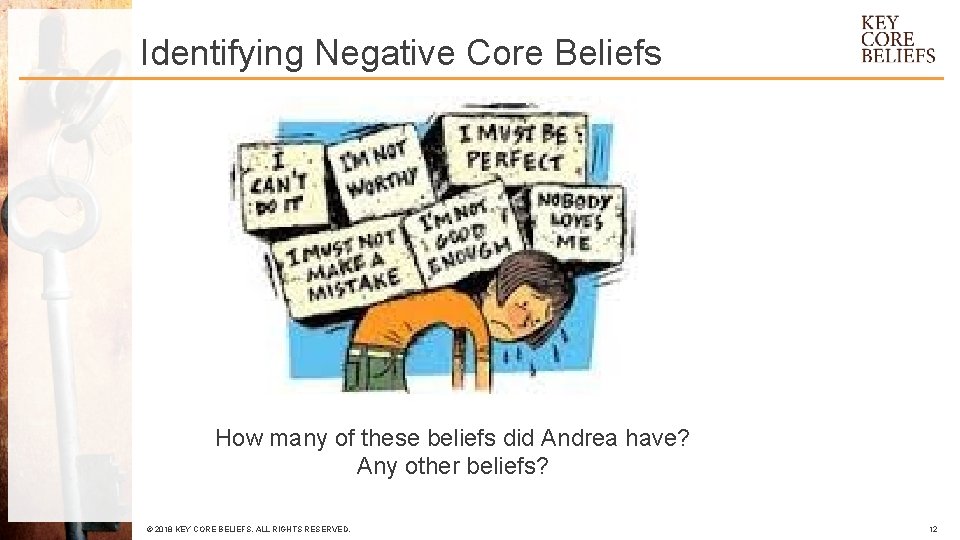
Identifying Negative Core Beliefs How many of these beliefs did Andrea have? Any other beliefs? © 2018 KEY CORE BELIEFS. ALL RIGHTS RESERVED. 12
Andrea’s Story Andrea was stuck because her son could never stop using meth. After six years of dealing with chronic worry, she developed a pattern of only staying at home (agoraphobia) that was getting worse. Her anxiety and agoraphobia combined with the normal stress of a tough marketing job reduced her ability to resist infections. The tipping point came when a winter cold turned into violent coughing and a trip to an urgent-care health facility. She was diagnosed with viral pneumonia and immediately hospitalized. Andrea said, “I can’t do anything right, I’m a mess”. © 2018 KEY CORE BELIEFS. ALL RIGHTS RESERVED. 13
Key Core Beliefs: What Lies Beneath Negative Core Beliefs are schemas, or patterns of internal convictions, that lie at the genesis of nearly all mental health disorders. Through the transformation of these injurious beliefs to Positive Core Beliefs, depression, anxiety, trauma that accompanies substance use will be resolved with lasting results. © 2018 KEY CORE BELIEFS. ALL RIGHTS RESERVED. 14
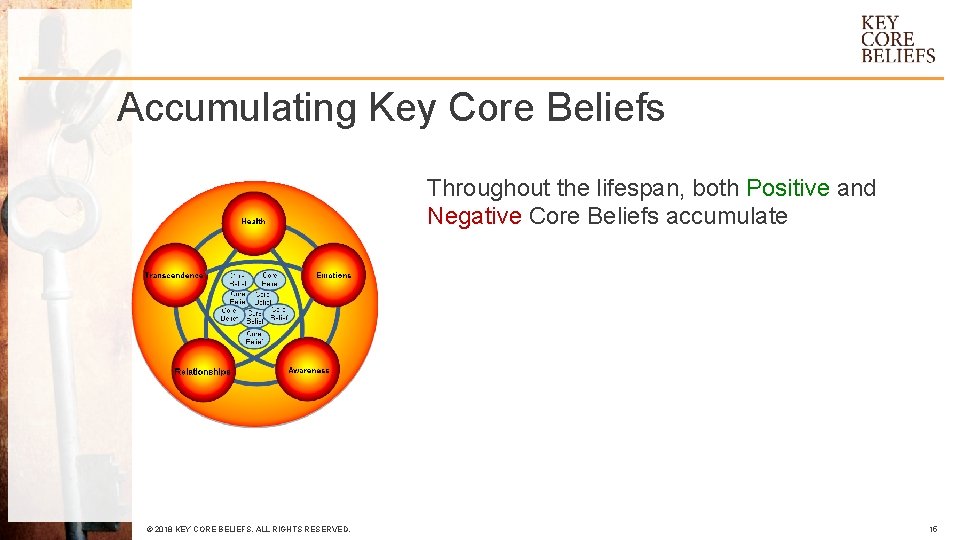
Accumulating Key Core Beliefs Throughout the lifespan, both Positive and Negative Core Beliefs accumulate © 2018 KEY CORE BELIEFS. ALL RIGHTS RESERVED. 15
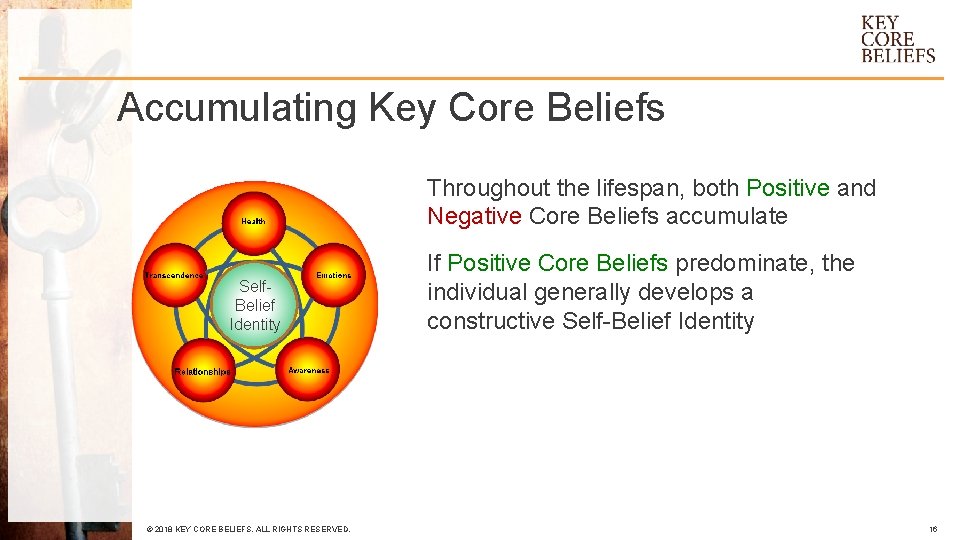
Accumulating Key Core Beliefs Throughout the lifespan, both Positive and Negative Core Beliefs accumulate Self. Belief Identity © 2018 KEY CORE BELIEFS. ALL RIGHTS RESERVED. If Positive Core Beliefs predominate, the individual generally develops a constructive Self-Belief Identity 16
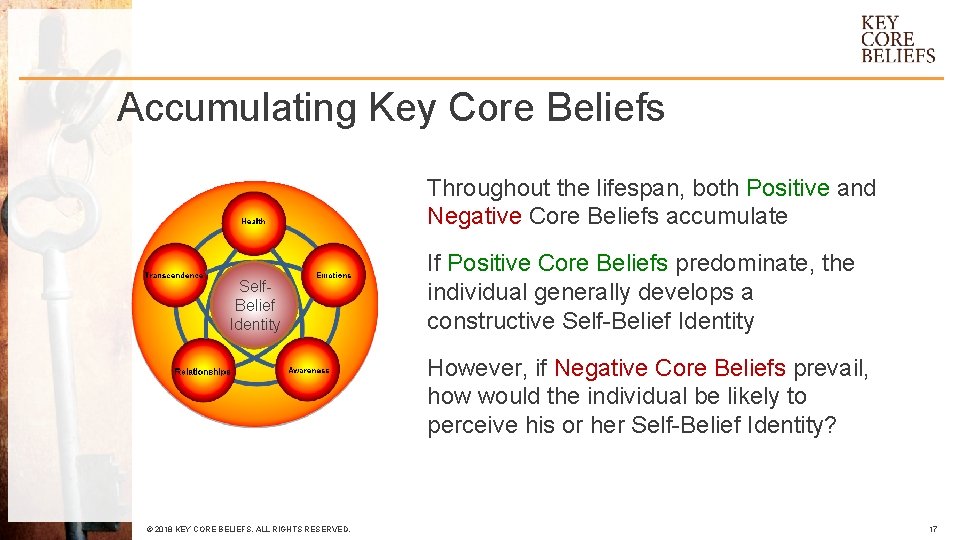
Accumulating Key Core Beliefs Throughout the lifespan, both Positive and Negative Core Beliefs accumulate Self. Belief Identity If Positive Core Beliefs predominate, the individual generally develops a constructive Self-Belief Identity However, if Negative Core Beliefs prevail, how would the individual be likely to perceive his or her Self-Belief Identity? © 2018 KEY CORE BELIEFS. ALL RIGHTS RESERVED. 17
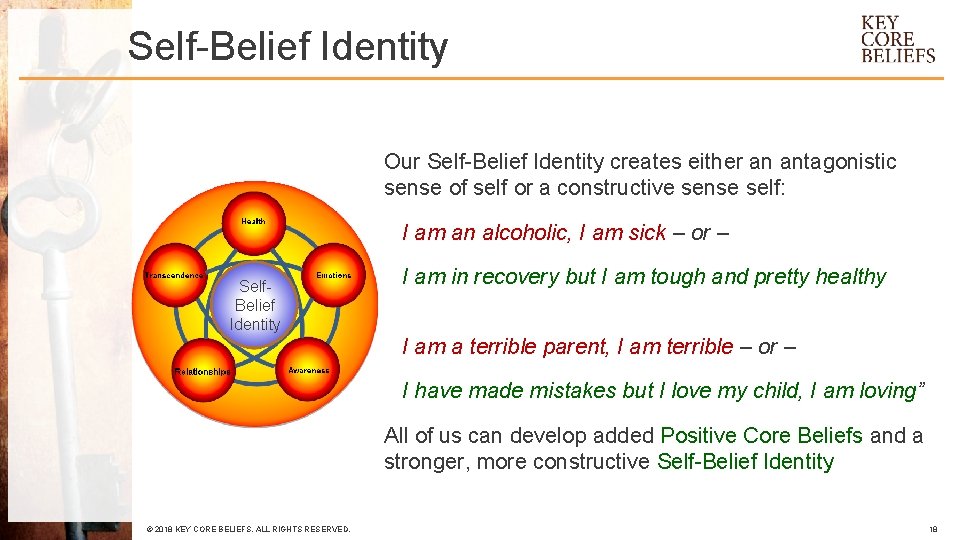
Self-Belief Identity Our Self-Belief Identity creates either an antagonistic sense of self or a constructive sense self: I am an alcoholic, I am sick – or – Self. Belief Identity I am in recovery but I am tough and pretty healthy I am a terrible parent, I am terrible – or – I have made mistakes but I love my child, I am loving” All of us can develop added Positive Core Beliefs and a stronger, more constructive Self-Belief Identity © 2018 KEY CORE BELIEFS. ALL RIGHTS RESERVED. 18
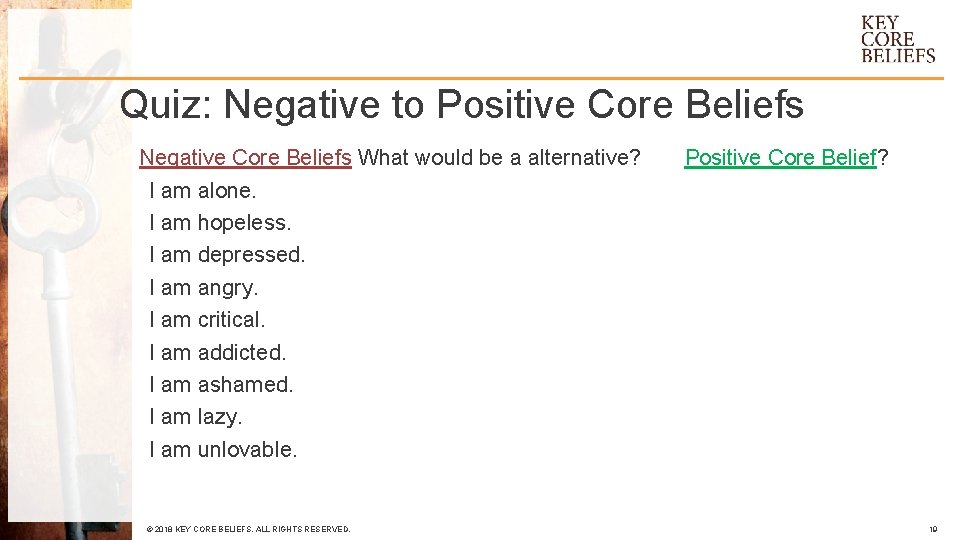
Quiz: Negative to Positive Core Beliefs Negative Core Beliefs What would be a alternative? Positive Core Belief? I am alone. I am hopeless. I am depressed. I am angry. I am critical. I am addicted. I am ashamed. I am lazy. I am unlovable. © 2018 KEY CORE BELIEFS. ALL RIGHTS RESERVED. 19
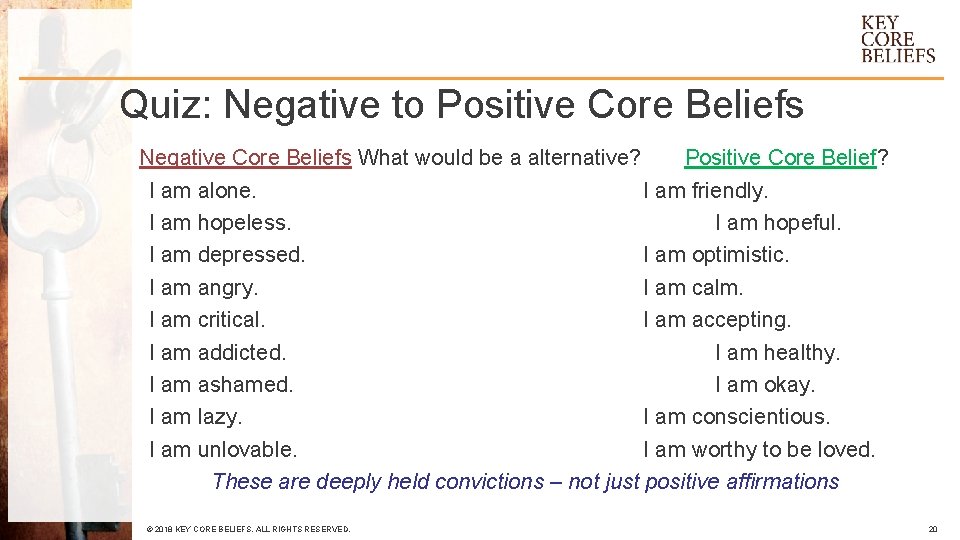
Quiz: Negative to Positive Core Beliefs Negative Core Beliefs What would be a alternative? Positive Core Belief? I am alone. I am friendly. I am hopeless. I am hopeful. I am depressed. I am optimistic. I am angry. I am calm. I am critical. I am accepting. I am addicted. I am healthy. I am ashamed. I am okay. I am lazy. I am conscientious. I am unlovable. I am worthy to be loved. These are deeply held convictions – not just positive affirmations © 2018 KEY CORE BELIEFS. ALL RIGHTS RESERVED. 20
How to Change Negative Core Beliefs The therapeutic process to transform any Negative Core Belief: 1. BECOME AWARE: Identify the Negative Core Belief. © 2018 KEY CORE BELIEFS. ALL RIGHTS RESERVED. 21
How to Change Negative Core Beliefs The therapeutic process to transform any Negative Core Belief: 1. BECOME AWARE: Identify the Negative Core Belief. 2. CREATE: Devise an alternative, desired Positive Core Belief. © 2018 KEY CORE BELIEFS. ALL RIGHTS RESERVED. 22
How to Change Negative Core Beliefs The therapeutic process to transform any Negative Core Belief: 1. BECOME AWARE: Identify the Negative Core Belief. 2. CREATE: Devise an alternative, desired Positive Core Belief. 3. ACT: Foster behaviors that reinforce the Positive Core Belief. © 2018 KEY CORE BELIEFS. ALL RIGHTS RESERVED. 23
How to Change Negative Core Beliefs The therapeutic process to transform any Negative Core Belief: 1. BECOME AWARE: Identify the Negative Core Belief. 2. CREATE: Devise an alternative, desired Positive Core Belief. 3. ACT: Foster behaviors that reinforce the Positive Core Belief. 4. PRACTICE: Consistently act to strengthen the Positive Core Belief. © 2018 KEY CORE BELIEFS. ALL RIGHTS RESERVED. 24
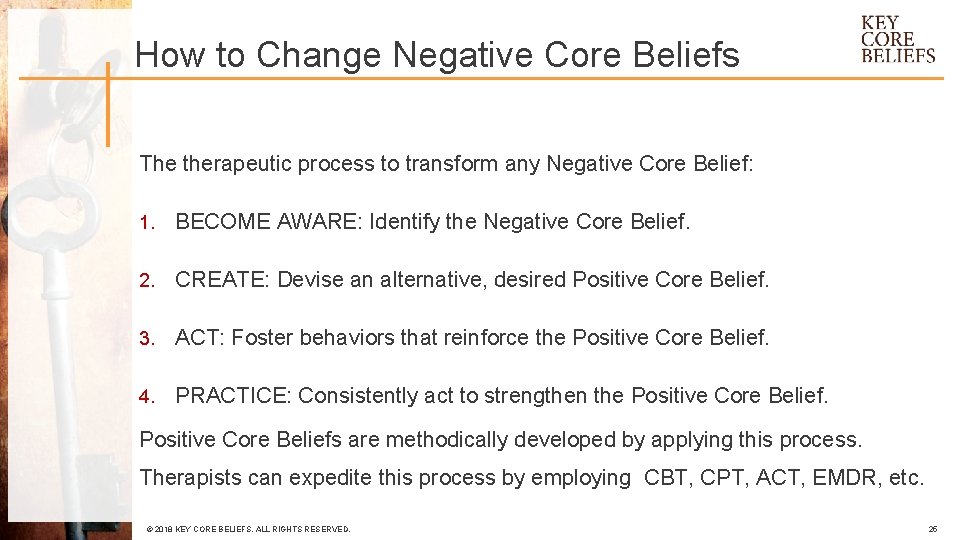
How to Change Negative Core Beliefs The therapeutic process to transform any Negative Core Belief: 1. BECOME AWARE: Identify the Negative Core Belief. 2. CREATE: Devise an alternative, desired Positive Core Belief. 3. ACT: Foster behaviors that reinforce the Positive Core Belief. 4. PRACTICE: Consistently act to strengthen the Positive Core Beliefs are methodically developed by applying this process. Therapists can expedite this process by employing CBT, CPT, ACT, EMDR, etc. © 2018 KEY CORE BELIEFS. ALL RIGHTS RESERVED. 25
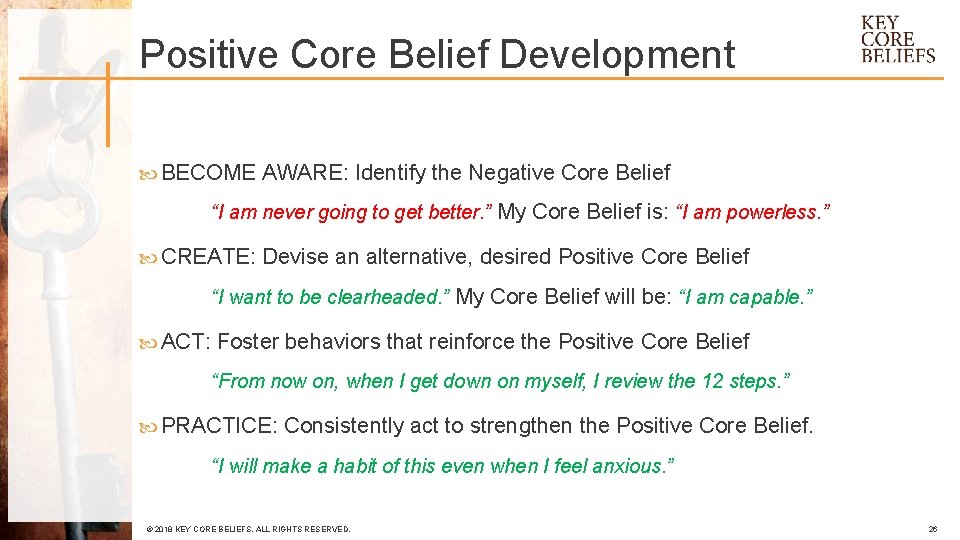
Positive Core Belief Development BECOME AWARE: Identify the Negative Core Belief “I am never going to get better. ” My Core Belief is: “I am powerless. ” CREATE: Devise an alternative, desired Positive Core Belief “I want to be clearheaded. ” My Core Belief will be: “I am capable. ” ACT: Foster behaviors that reinforce the Positive Core Belief “From now on, when I get down on myself, I review the 12 steps. ” PRACTICE: Consistently act to strengthen the Positive Core Belief. “I will make a habit of this even when I feel anxious. ” © 2018 KEY CORE BELIEFS. ALL RIGHTS RESERVED. 26
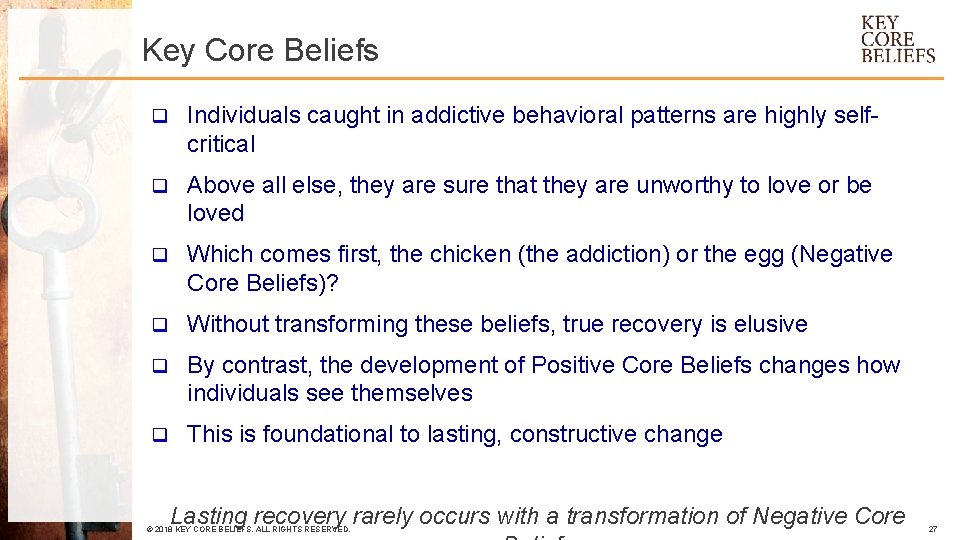
Key Core Beliefs q Individuals caught in addictive behavioral patterns are highly selfcritical q Above all else, they are sure that they are unworthy to love or be loved q Which comes first, the chicken (the addiction) or the egg (Negative Core Beliefs)? q Without transforming these beliefs, true recovery is elusive q By contrast, the development of Positive Core Beliefs changes how individuals see themselves q This is foundational to lasting, constructive change Lasting recovery rarely occurs with a transformation of Negative Core © 2018 KEY CORE BELIEFS. ALL RIGHTS RESERVED. 27
Topics for Discussion q Understanding Our Key Core Beliefs and Our Emotions q G R E A T Relationships q Building the Future © 2018 KEY CORE BELIEFS. ALL RIGHTS RESERVED. 28
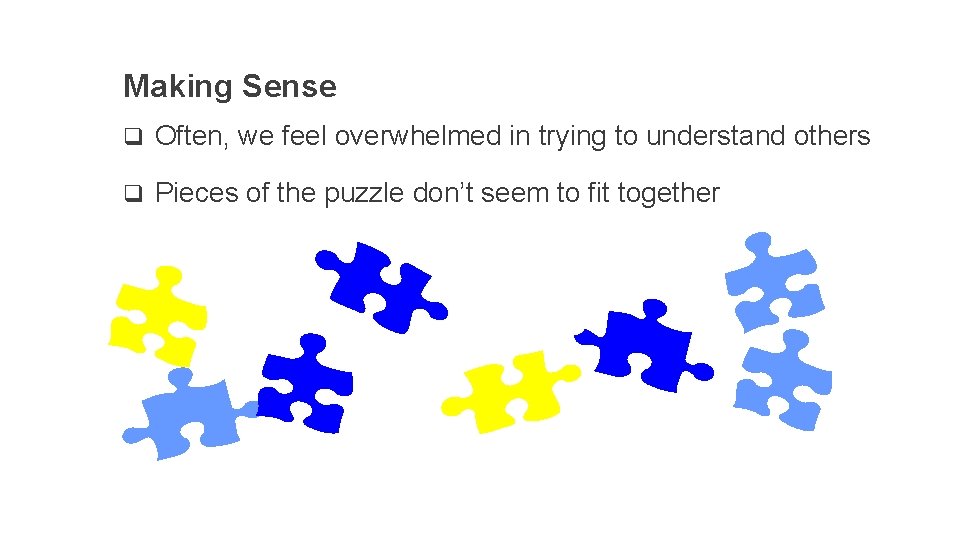
Making Sense q Often, we feel overwhelmed in trying to understand others q Pieces of the puzzle don’t seem to fit together
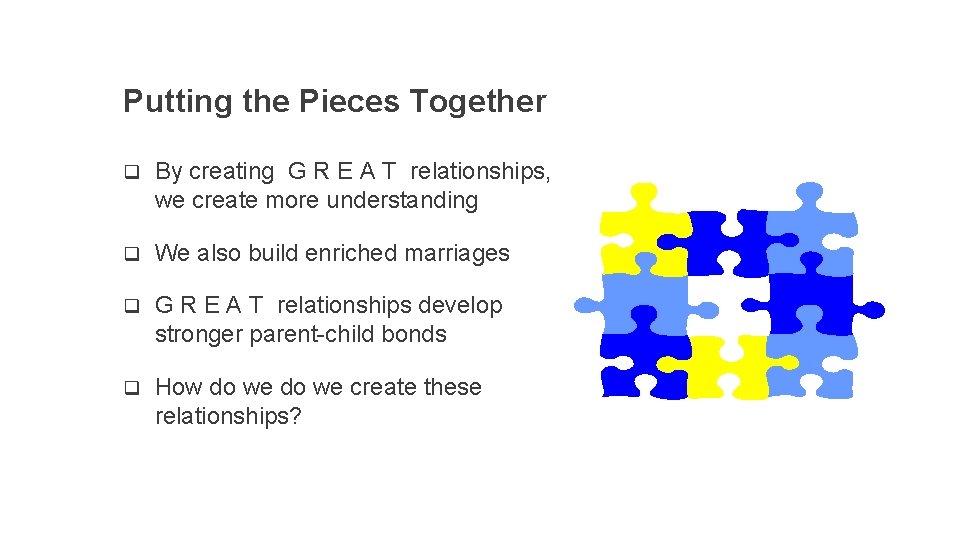
Putting the Pieces Together q By creating G R E A T relationships, we create more understanding q We also build enriched marriages q G R E A T relationships develop stronger parent-child bonds q How do we create these relationships?
G R E A T Partnering Relationships Think of someone whom you have had a wonderful relationship (e. g. Grandma) On a scale of 0 to 10, ask: Am I Genuine? Do I demonstrate that I am genuine by being honest, trustworthy, and sincere so that others can rely on me? Am I Respectful? Do I respect the agency of others and their right to make their own choices even when I disagree? Am I Empathetic? Do I express deep understanding for others by really listening to them and by striving to know their feelings? Am I Accepting? Do I fully accept others, as they are, without criticizing or imposing my expectations, values, or judgments on them? Am I Trustful? Do I believe that others are basically good-hearted and well intentioned by acknowledging the best about them? © 2018 KEY CORE BELIEFS. ALL RIGHTS RESERVED. 31
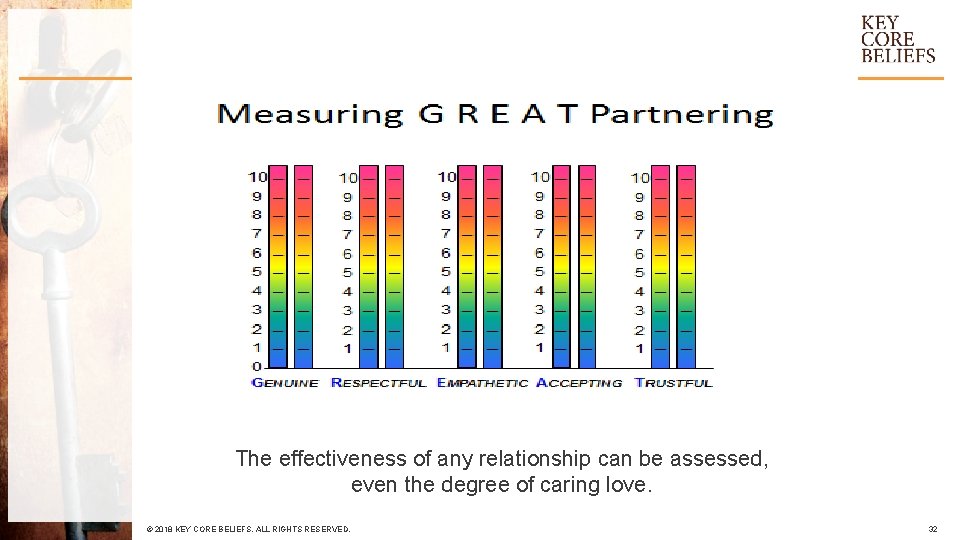
The effectiveness of any relationship can be assessed, even the degree of caring love. © 2018 KEY CORE BELIEFS. ALL RIGHTS RESERVED. 32
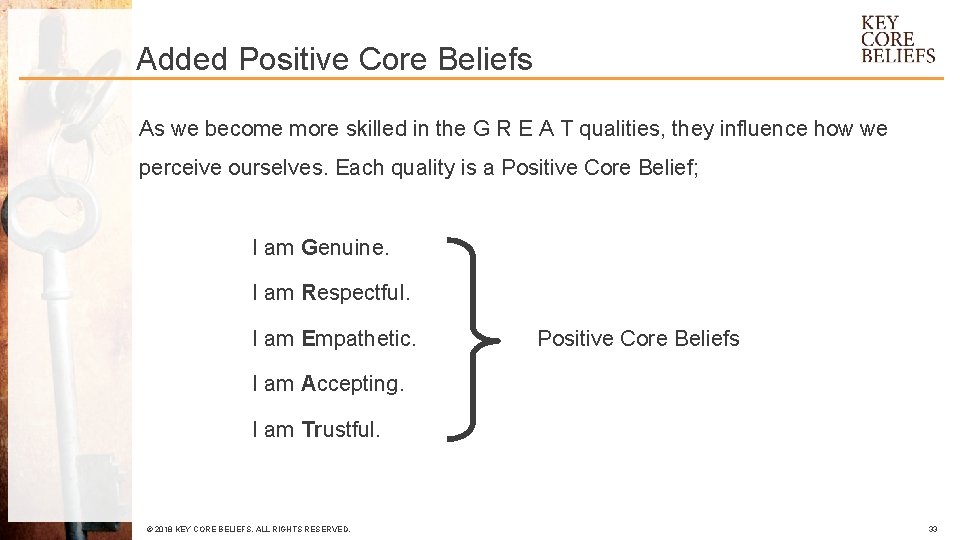
Added Positive Core Beliefs As we become more skilled in the G R E A T qualities, they influence how we perceive ourselves. Each quality is a Positive Core Belief; I am Genuine. I am Respectful. I am Empathetic. Positive Core Beliefs I am Accepting. I am Trustful. © 2018 KEY CORE BELIEFS. ALL RIGHTS RESERVED. 33
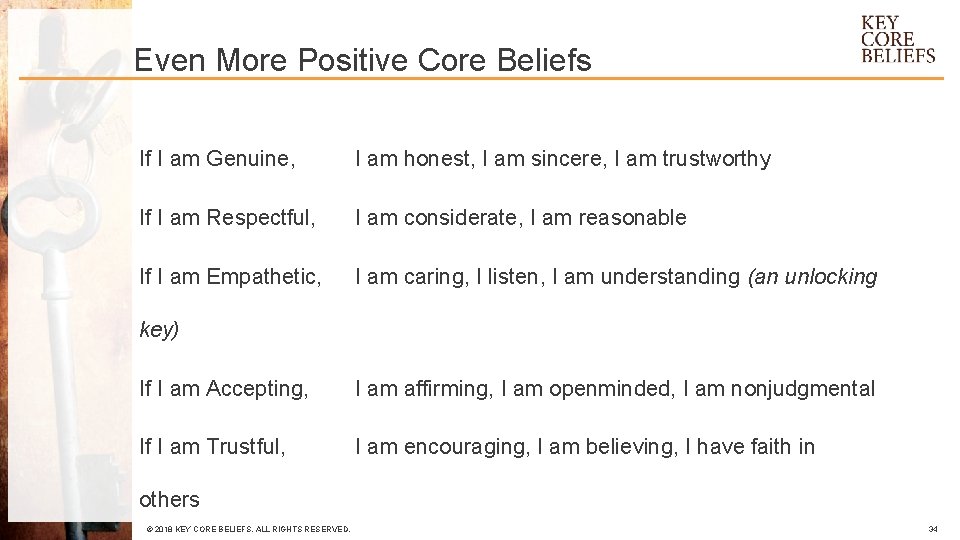
Even More Positive Core Beliefs If I am Genuine, I am honest, I am sincere, I am trustworthy If I am Respectful, I am considerate, I am reasonable If I am Empathetic, I am caring, I listen, I am understanding (an unlocking key) If I am Accepting, I am affirming, I am openminded, I am nonjudgmental If I am Trustful, I am encouraging, I am believing, I have faith in others © 2018 KEY CORE BELIEFS. ALL RIGHTS RESERVED. 34
Topics for Discussion q Understanding Our Emotions and Our Key Core Beliefs q G R E A T Relationships q Building the Future © 2018 KEY CORE BELIEFS. ALL RIGHTS RESERVED. 35
The only person you are destined to become is the person you decide to be. Ralph Waldo Emerson How does this apply to family members of those who are addicted? © 2018 KEY CORE BELIEFS. ALL RIGHTS RESERVED. 36
The 100% and the 90% Guarantees The 100% guarantee: q q q I am becoming more Genuine I am becoming more Respectful I am becoming more Empathetic I am becoming more Accepting I am becoming more Trustful “Therefore, I am worthy to be loved!” The 90% guarantee “The more consistently I positively change myself, the more others will positively respond. ” © 2018 KEY CORE BELIEFS. ALL RIGHTS RESERVED. 37
Review of the handouts © 2018 KEY CORE BELIEFS. ALL RIGHTS RESERVED. 38
Alison Jensen © 2018 KEY CORE BELIEFS. ALL RIGHTS RESERVED. 39
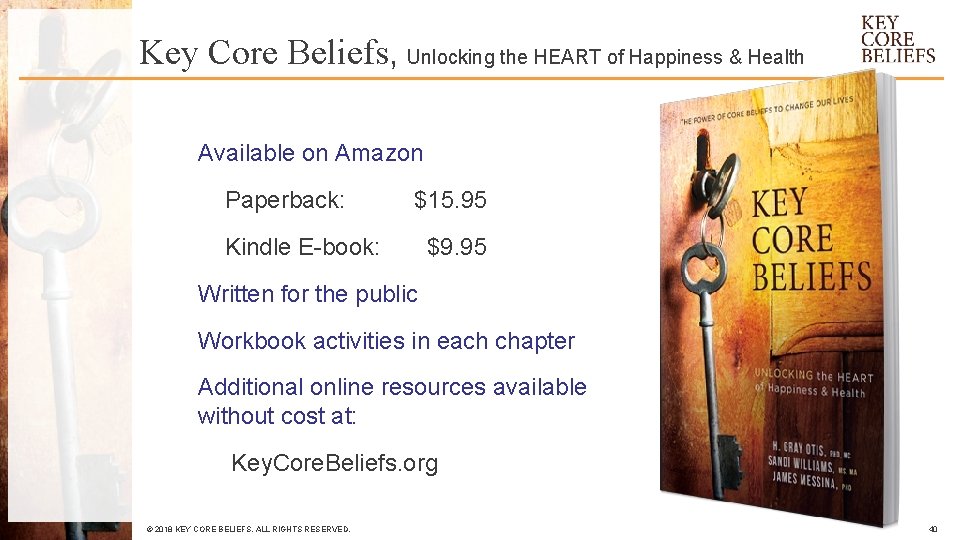
Key Core Beliefs, Unlocking the HEART of Happiness & Health Available on Amazon Paperback: $15. 95 Kindle E-book: $9. 95 Written for the public Workbook activities in each chapter Additional online resources available without cost at: Key. Core. Beliefs. org © 2018 KEY CORE BELIEFS. ALL RIGHTS RESERVED. 40
Resources q Both Sandi and Gray have specialized in substance use recovery including residential and intensive outpatient q Both are trauma resolution specialists q Gray is happy to consult q Sandi is available for general counseling and psychotherapy © 2018 KEY CORE BELIEFS. ALL RIGHTS RESERVED. 41
Questions? THANK YOU Gray Otis, Ph. D, LCMHC gray_otis@yahoo. com 801 -885 -8585 Sandi Williams, MA, MS, LMFT sandi@themeadowscounseling. com 801 -810 -9020 © 2018 KEY CORE BELIEFS. ALL RIGHTS RESERVED. 42
- Slides: 42