
Family influences and Dynamics Updated July 2017 Objectives
Family influences and Dynamics Updated July 2017
Objectives 4 Understand the evolving nature of the concept of family, and its organizational diversity 4 Understand the potential impact of family functioning and dynamics on adolescent development, and the interrelationship of adolescent physical and mental problems and family functioning. 4 Evaluate family functioning and dynamics, understand the role of the provider, and address problematic situations within the adolescent’s management plan
Different times … Different contexts

Think about your own Family History …
Family Tree drawing § A 17 year old boy, late maturation, Tanner G 4 P 3, admitted for depression. From a very early stage he showed socialisation difficulties. He is segregated by his peers. Third child. Older sister died at an early age from a traffic accident (would now be 21). Middle sister studying abroad (aged 19). He had always been infantilised by his father with whom he feels weakly linked. Strong bonds with his mother. Assessment of preferential familial links and bonds

Identification of Patterns of Family Functioning § Chaotic (lack of leadership, dramatic role shifts, erratic discipline, too much change). § Flexible (shared leadership, role sharing, democratic discipline, change when necessary). § Structured (leadership sometimes shared, roles stable, somewhat democratic discipline, change when demanded). § Rigid (authoritarian leadership, roles seldom change, strict discipline, too little change). Olson, Faces IV
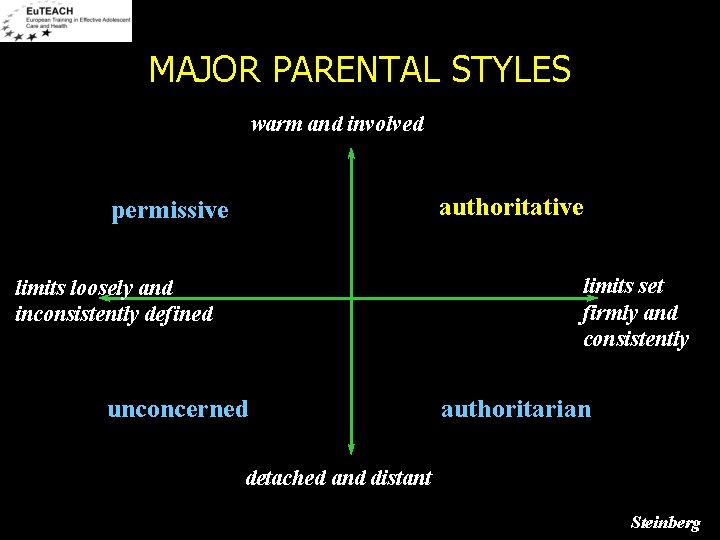
MAJOR PARENTAL STYLES warm and involved authoritative permissive limits set firmly and consistently limits loosely and inconsistently defined unconcerned authoritarian detached and distant Steinberg
Case-Study § Reflect on what might be the different perspectives of an asthmatic 14 year old girl who is having too many crisis because she is unable to cope with her daily preventive therapy. Her parents do not want to allow her to camp with her scout group because they are not sure she will be able to cope with the medication without their help. They also complain that she recently started not accepting family rules.
Think about. . . § Typical situations in which communication is damaged. § Situations which interfere with the wellbeing of most adolescents in their relationship with their original families.
Identify the impact of the dominant patterns of family functioning on the fulfilment of the developmental tasks. Personal and family history. New competences - Sexual (pubertal changes, body image) - Cognitive (development of abstract thinking and identity construction) - Social (development of autonomy: change in relationship with parents and peers, plans for the future)
Applying Family Therapy Techniques § Assessment of adolescents psycho-social maturation and autonomy § Assessment of preferential familial links and bonds § Is the adolescent a symptom carrier for the family? (whose problem is it? )
Small group debate with plenary report, based on a given scenario (2 groups)
Scenario 1 - A 15 year old type I diabetes girl living in a rigid family. - Parents afraid she misses insulin shots when out of their control. - The girl complains of excess of supervision: she is not able to socialise with her friends as much as she would wish; she says her parents look at her as if she was 10.
Scenario 2 - A 13 year old girl complaining of headaches. Her parents divorced a couple of months ago. She is living half of the week with her mother and the other half with her father. She mentions she feels like living in “nobody’s land”. A fight for the “possession” of the girl is taking place.
Applying Family Therapy Techniques § Facilitate communication between adolescent and parents § Pay attention to non-verbal communication § Balance the time allocated to each member of the family
Applying Family Therapy Techniques Identify “Who is asking what” § By detecting family ambivalence when stating the reason for coming to the Clinic. § By “reading” both adolescent and parental understanding of the problem.
Applying Family Therapy Techniques Identify “Who is asking what” (cont. ) § By being able to support both the parents and the adolescent in clarifying their respective demands.
Family Adjustment & Adaptation Response (FAAR) Model Joan M. Patterson, Ph. D. , University of Minnesota
Applying Family Therapy Techniques § Enable and empower each person to express him / herself § Modulate empathy towards the adolescent and his / her parents § Question about the main changing wishes in their family dynamics

Applying Family Therapy Techniques Defining the problem § Information comes from difference Bateson, 1973 § We learn more about phenomena by approaching them from various angles
Applying Family Therapy Techniques Defining the problem - Hypothesising and Circular Questioning § Hypotheses should preserve therapist neutrality § Must challenge everyone or everything whilst aligning with no-one § Must include all the elements of the system § Must address the total relational function Selvini Palazzoli, 1980
Applying Family Therapy Techniques Circular questioning (cont. ) § Involving each member in turn § Avoiding questions which invite yes/no responses § Checking back with each person how they see something on which others have commented on § The “empty chair” technique
Applying Family Therapy Techniques What is the Problem? What do you think X will say is the problem? § § § Who agrees with him? Who disagrees? How would you put it? In what way is this problem a problem? What makes this problem a problem? How is it a problem for you? Who is it most a problem for?
Case study A 15 year old girl and her parents where the girl spends her pocket money on buying a tiny T-shirt. She goes out in mid-winter with no coat. Her logic is that she wants to show off her new T-shirt. Her parents get very angry and stressed because their logic is she will catch a cold and will get sexually molested.
Case study A 16 year old girl complaining of headaches. Her parents divorced a couple of months ago. She is living half of the week with her mother and the other half with her father. She mentions she feels like living in “nobody’s land”. A fight for the “possession” of the girl is taking place.
By now you should be able to: § Demonstrate proficiency in supporting the parents and the adolescent in clarifying their respective demands. § Be able to balance the time allocated to each person. § Enable and empower each person to express him or herself. § Modulate empathy towards the adolescent and his/ /her parents.
By now you should be able to (cont. ): § Demonstrate proficiency in raising questions in an non-judgemental and open way. § Demonstrate proficiency in renegotiating roles and rules.

32
References Adolescent Job Aid https: //www. dropbox. com/s/kzom 8 nfttul 1 eot/ADOLESCENT%20 JOB%20 AID. doc? dl=0 Health for the World’s Adolescents. A second chance in a second decade. Section 2. WHO 2014. http: //apps. who. int/adolescent/second-decade/section Reaching teens. Strength-based communication strategies to build resilience and support healthy adolescent development. AAP 2014 www. aap. org/reachingteens Olson’s circumplex model: http: //www. uwagec. org/eruralfamilies/ERFLibrary/Readings/Circumplex. Model. Of. Marital. And. Fami ly. Systems. pdf Parenting Styles according to Baumrind http: //www. devpsy. org/teaching/parent/baumrind_styles. html
- Slides: 33