
Family Farming and Rural Poverty Reduction Francesco Pierri

- Slides: 34
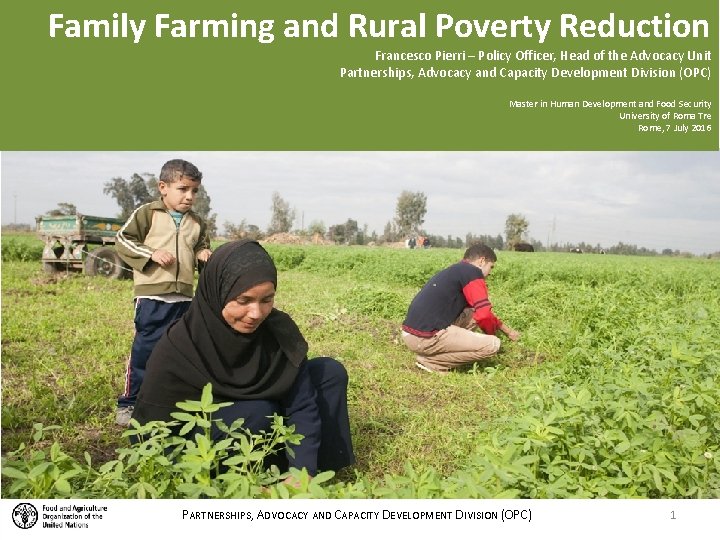
Family Farming and Rural Poverty Reduction Francesco Pierri – Policy Officer, Head of the Advocacy Unit Partnerships, Advocacy and Capacity Development Division (OPC) Master in Human Development and Food Security University of Roma Tre Rome, 7 July 2016 PARTNERSHIPS, ADVOCACY AND CAPACITY DEVELOPMENT DIVISION (OPC) 1
FAMILY FARMING : DEFINITION AND CHARACTERISTICS '‘A mean of organizing agricultural, forestry, fisheries, pastoral and aquaculture production which is managed and operated by a family and predominantly reliant on family capital and labour, including both women’s and men’s. The family and the farm are linked, co-evolve and combine economic, environmental, social and cultural functions'' (FAO, 2014). PARTNERSHIPS, ADVOCACY AND CAPACITY DEVELOPMENT DIVISION (OPC)
FAMILY FARMING : DEFINITION AND CHARACTERISTICS Often used as a synonym for: • Small-scale farming (farms defined by cultivated land area); • Subsistence farming (farms defined by production purpose); • Peasant agriculture (farms defined by its community roots and by its autonomy from industrial inputs). Used according to different objectives: It offers an ideological framework for the protection of lifestyles; a normative framework for the promotion of policies; an academic framework to foster knowledge production about the way in which agriculture works (Sourisseau et al. , 2014) PARTNERSHIPS, ADVOCACY AND CAPACITY DEVELOPMENT DIVISION (OPC)
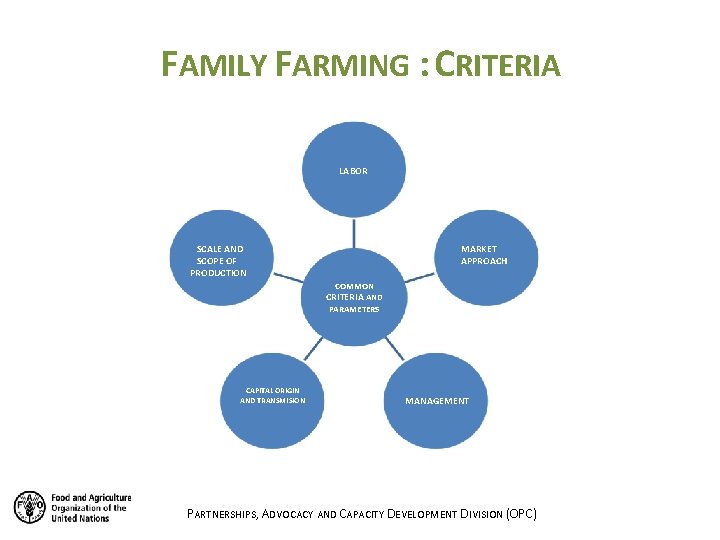
FAMILY FARMING : CRITERIA LABOR SCALE AND SCOPE OF PRODUCTION MARKET APPROACH COMMON CRITERIA AND PARAMETERS CAPITAL ORIGIN AND TRANSMISION MANAGEMENT PARTNERSHIPS, ADVOCACY AND CAPACITY DEVELOPMENT DIVISION (OPC)
FAMILY FARMING : CATEGORIES i. Family Farming with a clear market-oriented production; ii. Semi – capitalized FF, with difficulties of access to some markets, such as the financial market and the production factors, majorly land access and land tenure; iii. Subsistence FF that faces difficulties when trying to access land or in its tenure, with no capital and great difficulties to access formal credit, low or nil level of association, below the poverty line; iv. Subsistence FF that fails to cover the family’s basic needs, irregular tenure of land; they sell their labour off farm, receive help from the State, as policies for the social and production promotion. Family work is partly off- and partly on-farm. Below the poverty line; v. Rural wage earners that are also family farmers, with informal and/or irregular access and tenure of land; vi. Forms of common use of land in partnership. Labor and production cooperatives, and community work on State-owned land; vii. Indigenous communities – native populations – racial communities, shepherds, nomadic shepherds and gatherers. PARTNERSHIPS, ADVOCACY AND CAPACITY DEVELOPMENT DIVISION (OPC)
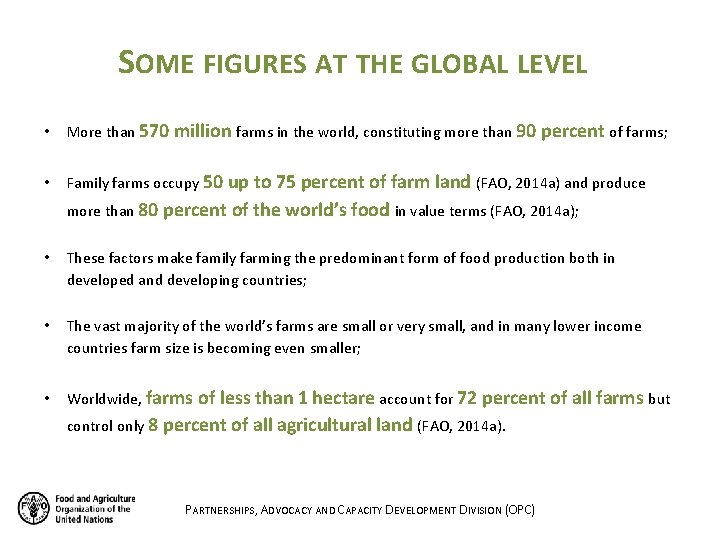
SOME FIGURES AT THE GLOBAL LEVEL • More than 570 million farms in the world, constituting more than 90 percent of farms; • Family farms occupy 50 up to 75 percent of farm land (FAO, 2014 a) and produce more than 80 percent of the world’s food in value terms (FAO, 2014 a); • These factors make family farming the predominant form of food production both in developed and developing countries; • The vast majority of the world’s farms are small or very small, and in many lower income countries farm size is becoming even smaller; • Worldwide, farms of less than 1 hectare account for 72 percent of all farms but control only 8 percent of all agricultural land (FAO, 2014 a). PARTNERSHIPS, ADVOCACY AND CAPACITY DEVELOPMENT DIVISION (OPC)
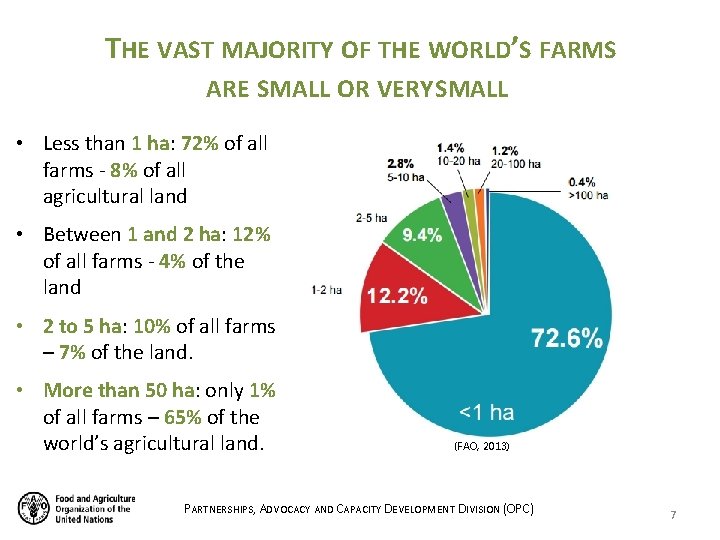
THE VAST MAJORITY OF THE WORLD’S FARMS ARE SMALL OR VERY SMALL • Less than 1 ha: 72% of all farms - 8% of all agricultural land • Between 1 and 2 ha: 12% of all farms - 4% of the land • 2 to 5 ha: 10% of all farms – 7% of the land. • More than 50 ha: only 1% of all farms – 65% of the world’s agricultural land. (FAO, 2013) PARTNERSHIPS, ADVOCACY AND CAPACITY DEVELOPMENT DIVISION (OPC) 7
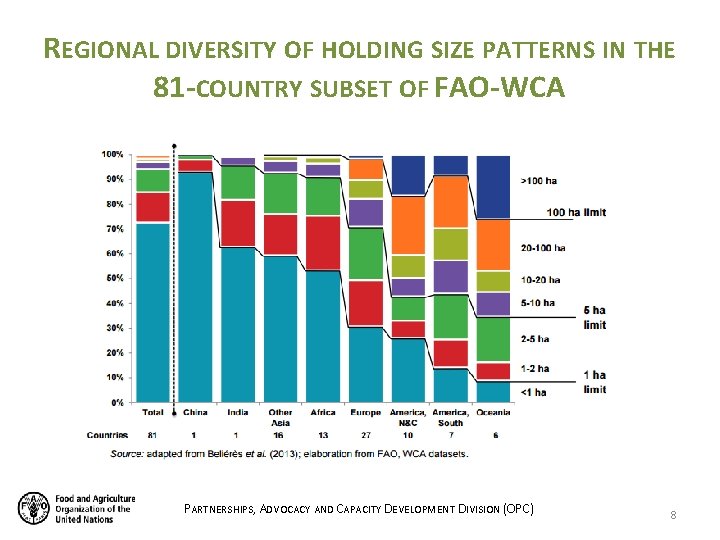
REGIONAL DIVERSITY OF HOLDING SIZE PATTERNS IN THE 81 -COUNTRY SUBSET OF FAO-WCA PARTNERSHIPS, ADVOCACY AND CAPACITY DEVELOPMENT DIVISION (OPC) 8
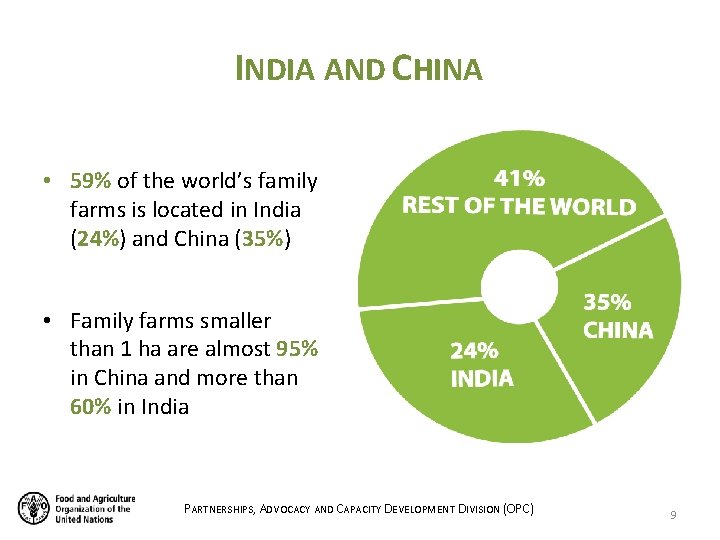
INDIA AND CHINA • 59% of the world’s family farms is located in India (24%) and China (35%) • Family farms smaller than 1 ha are almost 95% in China and more than 60% in India PARTNERSHIPS, ADVOCACY AND CAPACITY DEVELOPMENT DIVISION (OPC) 9
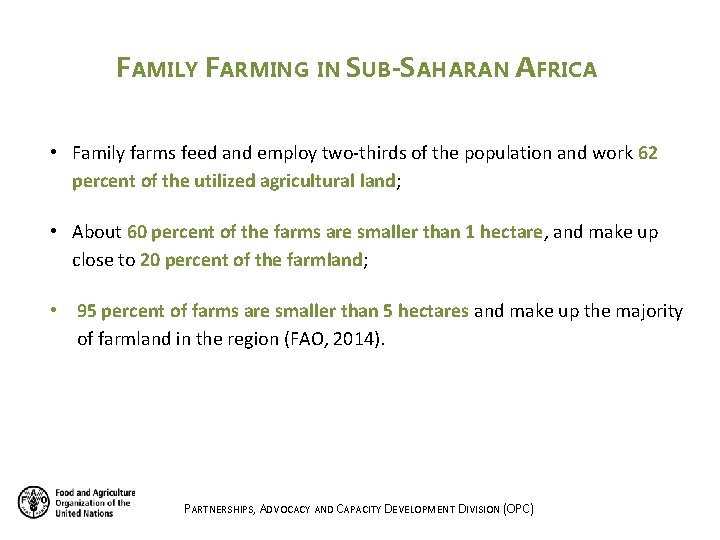
FAMILY FARMING IN SUB-SAHARAN AFRICA • Family farms feed and employ two-thirds of the population and work 62 percent of the utilized agricultural land; • About 60 percent of the farms are smaller than 1 hectare, and make up close to 20 percent of the farmland; • 95 percent of farms are smaller than 5 hectares and make up the majority of farmland in the region (FAO, 2014). PARTNERSHIPS, ADVOCACY AND CAPACITY DEVELOPMENT DIVISION (OPC)
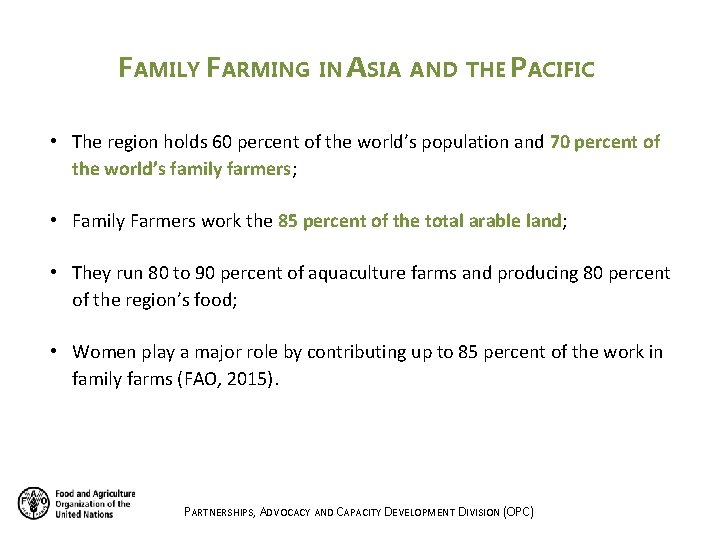
FAMILY FARMING IN ASIA AND THE PACIFIC • The region holds 60 percent of the world’s population and 70 percent of the world’s family farmers; • Family Farmers work the 85 percent of the total arable land; • They run 80 to 90 percent of aquaculture farms and producing 80 percent of the region’s food; • Women play a major role by contributing up to 85 percent of the work in family farms (FAO, 2015). PARTNERSHIPS, ADVOCACY AND CAPACITY DEVELOPMENT DIVISION (OPC)
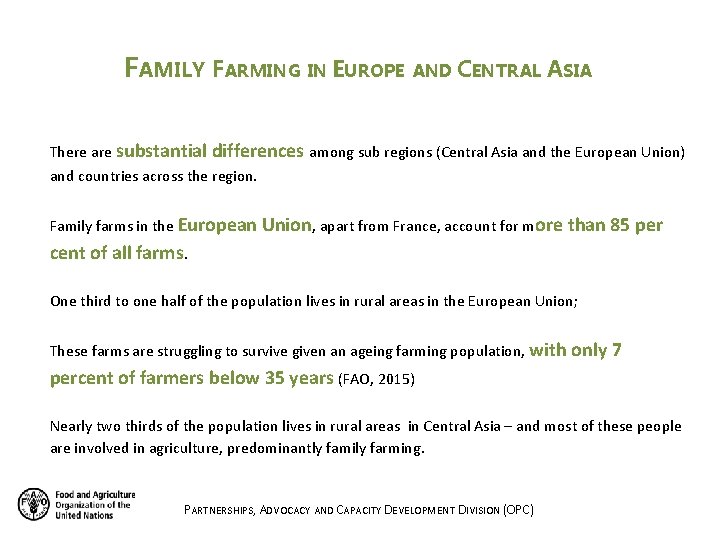
FAMILY FARMING IN EUROPE AND CENTRAL ASIA There are substantial differences among sub regions (Central Asia and the European Union) and countries across the region. Family farms in the European Union, apart from France, account for more than 85 per cent of all farms. One third to one half of the population lives in rural areas in the European Union; These farms are struggling to survive given an ageing farming population, with only 7 percent of farmers below 35 years (FAO, 2015) Nearly two thirds of the population lives in rural areas in Central Asia – and most of these people are involved in agriculture, predominantly family farming. PARTNERSHIPS, ADVOCACY AND CAPACITY DEVELOPMENT DIVISION (OPC)
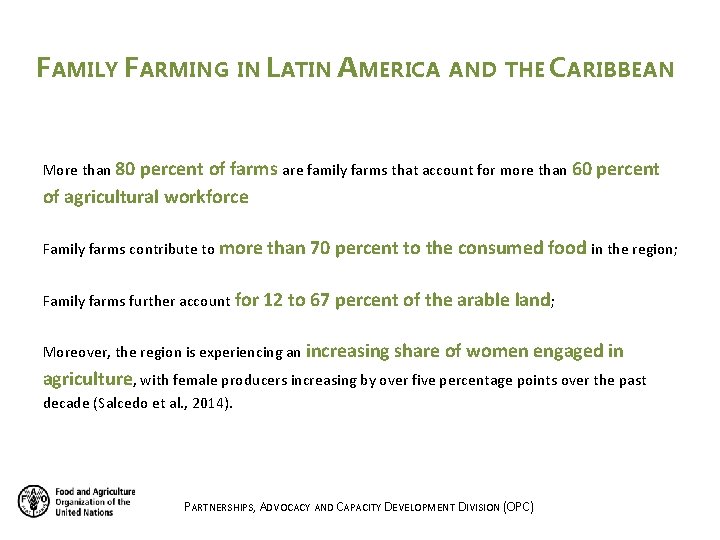
FAMILY FARMING IN LATIN AMERICA AND THE CARIBBEAN More than 80 percent of farms are family farms that account for more than 60 percent of agricultural workforce Family farms contribute to more than 70 percent to the consumed food in the region; Family farms further account for 12 to 67 percent of the arable land; Moreover, the region is experiencing an increasing share of women engaged in agriculture, with female producers increasing by over five percentage points over the past decade (Salcedo et al. , 2014). PARTNERSHIPS, ADVOCACY AND CAPACITY DEVELOPMENT DIVISION (OPC)
FAMILY FARMING IN NEAR EAST AND NORTH AFRICA About 40 percent of the region’s population lives and works in rural areas and nearly 85 percent of agricultural land holdings are farmed by families. More than 80 percent of agricultural production is provided by small-scale family farming. Family farms control only 25 percent of arable land, and the average size of a family farm in the region is less than 2 hectares and is steadily decreasing. Between 25 and 40 percent of the labour on family farms is provided by women and their role is increasingly important, especially given the steady increase in male out -migration (FAO, 2014). PARTNERSHIPS, ADVOCACY AND CAPACITY DEVELOPMENT DIVISION (OPC)
INTERNATIONAL YEAR OF FAMILY FARMING (IYFF 2014) • Policy dialogue at local, regional and international levels around the world: Member States, United Nations agencies, organizations and international networks of family farmers, civil society organizations, academia and research, private sector. • Regional Dialogue on Family Farming in the Near East and North Africa (Tunis, 20 – 21 November 2013) and Global Dialogue, (Rome, 27 - 29 November 2014): discussion on the main challenges at regional and global levels and on policies to be implemented. • National Committees for the IYFF have been created in around 50 countries, involving more than 650 organisations. • More than 500 meetings, workshops or conferences on Family Farming have been organised over the year across the world. PARTNERSHIPS, ADVOCACY AND CAPACITY DEVELOPMENT DIVISION (OPC)
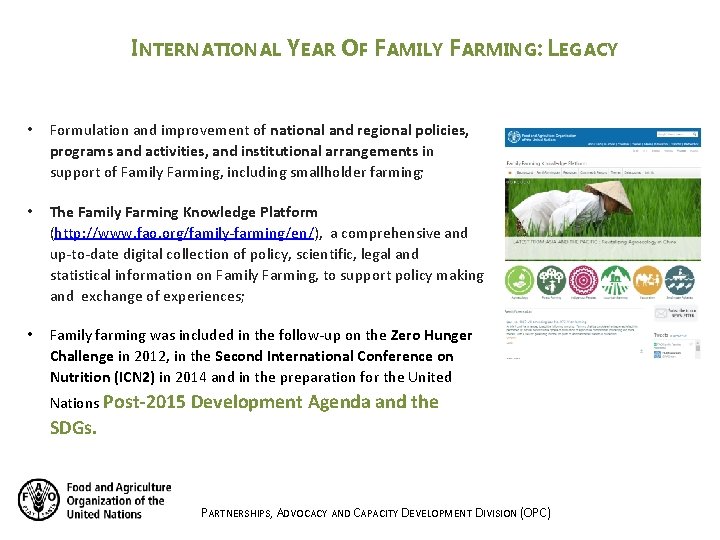
INTERNATIONAL YEAR OF FAMILY FARMING: LEGACY • Formulation and improvement of national and regional policies, programs and activities, and institutional arrangements in support of Family Farming, including smallholder farming; • The Family Farming Knowledge Platform (http: //www. fao. org/family-farming/en/), a comprehensive and up-to-date digital collection of policy, scientific, legal and statistical information on Family Farming, to support policy making and exchange of experiences; • Family farming was included in the follow-up on the Zero Hunger Challenge in 2012, in the Second International Conference on Nutrition (ICN 2) in 2014 and in the preparation for the United Nations Post-2015 Development Agenda and the SDGs. PARTNERSHIPS, ADVOCACY AND CAPACITY DEVELOPMENT DIVISION (OPC)
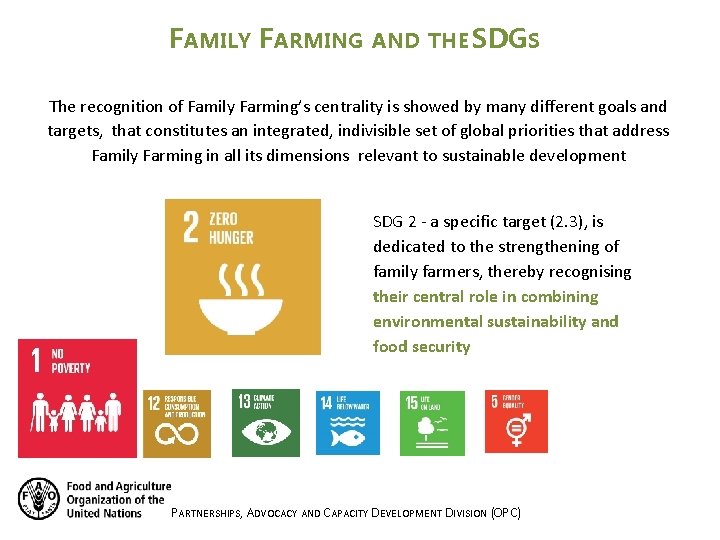
FAMILY FARMING AND THE SDGS The recognition of Family Farming’s centrality is showed by many different goals and targets, that constitutes an integrated, indivisible set of global priorities that address Family Farming in all its dimensions relevant to sustainable development SDG 2 - a specific target (2. 3), is dedicated to the strengthening of family farmers, thereby recognising their central role in combining environmental sustainability and food security PARTNERSHIPS, ADVOCACY AND CAPACITY DEVELOPMENT DIVISION (OPC)
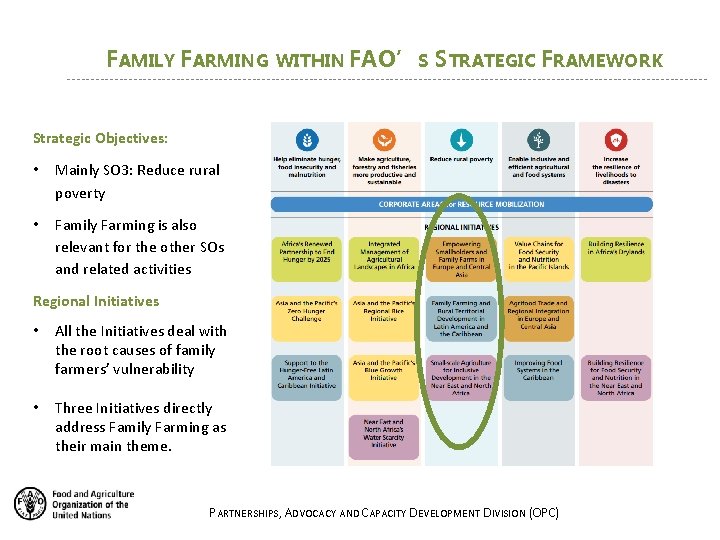
FAMILY FARMING WITHIN FAO’S STRATEGIC FRAMEWORK -------------------------------------------------------------------- Strategic Objectives: • Mainly SO 3: Reduce rural poverty • Family Farming is also relevant for the other SOs and related activities Regional Initiatives • All the Initiatives deal with the root causes of family farmers’ vulnerability • Three Initiatives directly address Family Farming as their main theme. PARTNERSHIPS, ADVOCACY AND CAPACITY DEVELOPMENT DIVISION (OPC)
WHY FAO’S FOCUS ON RURAL POVERTY REDUCTION? 1. Reducing rural poverty is key to eliminating hunger and malnutrition; 2. Between 2/3 to 3/4 of people living in extreme poverty live in rural areas; Vast majority in East Asia, South Asia, and Sub-Saharan Africa – 3. Despite recent economic growth, inequalities still pervasive, between economic classes, rural and urban areas, regions, ethnic groups and men and women; – Women have unequal access to and control over productive assets and income 4. Most of the poor depend on agriculture, livestock, fishing or forest resources for their livelihoods; 5. Five hundred million smallholder farms worldwide support around two billion people, or one third of humanity; 6. Pro-poor growth starts in agriculture; 7. We are guided by the SDGs (leave no one behind): – Elimination of extreme poverty in all its forms; reduction at least by half of men, women and children living in poverty by 2030 PARTNERSHIPS, ADVOCACY AND CAPACITY DEVELOPMENT DIVISION (OPC)
GLOBAL TRENDS AFFECTING RURAL POVERTY REDUCTION AND RURAL DEVELOPMENT • • • Growing population; Precarious urbanization; Increasing scarcity of natural resources; Arising competition for access and use of resources; Mass international, regional and domestic migrations; Climate change effects and increasing vulnerability PARTNERSHIPS, ADVOCACY AND CAPACITY DEVELOPMENT DIVISION (OPC) 20
TRENDS IN EUROPE AND CENTRAL ASIA • Land reforms remain incomplete and unfinished –Prevalence of small farms in farm structure and output –Absence of property rights and lack of transparency in land deals • Per capita food production and consumption rose (at different rate) –Individualization of agriculture has contributed to sector growth (yield increases), –Food self-sufficiency as FF survival strategy and response to risky market, but. . . –. . . still, substantial levels of malnourishment in some countries • • A growing climate change- related risks and environmental challenges in all countries –Low overall collective (local communities, marginalised, mountainous) and individual (farmers) capacity to adapt to the impacts of climate change –Poorly managed irrigation and drainage systems, limited investments, lack of support from and access to extension services –Linkages between gender and climate change adaptation - KG, TJK; PARTNERSHIPS, ADVOCACY AND CAPACITY DEVELOPMENT DIVISION (OPC) 21
TRENDS IN THE NEAR EAST AND NORTH AFRICA • Pressing need to increase the production while minimizing its arduousness, and the impact on the fragile environment • Opportunities to exit agriculture in rural areas are limited. • Lack of ability to provide decent employment to younger generations is a guarantee of long-term stability and growth • Security in general is a major concern: climate change, conflicts and migrations caused by deteriorating living conditions, particularly in rural and marginalized areas are at the centre of the problems in the region. PARTNERSHIPS, ADVOCACY AND CAPACITY DEVELOPMENT DIVISION (OPC) 22
BEYOND STRUCTURAL TRANSFORMATION • The canonical pathway of structural transformation (exit of workers from agriculture towards industry and services) is deeply changed by the characteristics of modern globalization and relative competitiveness. • Increasing land productivity is not sufficient. Part time agriculture, offfarms activities and economic diversification are key issues for small scale farmers • Agriculture cannot remain only a “passive” tank of manpower for others sectors. • Demographics matters, important at country level in order to benefit from the demographic dividend (bonus) in some countries • The agricultural sector has to assume its part in providing decent rural jobs. • Policy matters not only agricultural sector development but inclusive “territorial & rural development” both crucial to develop rural alternatives. PARTNERSHIPS, ADVOCACY AND CAPACITY DEVELOPMENT DIVISION (OPC) 23
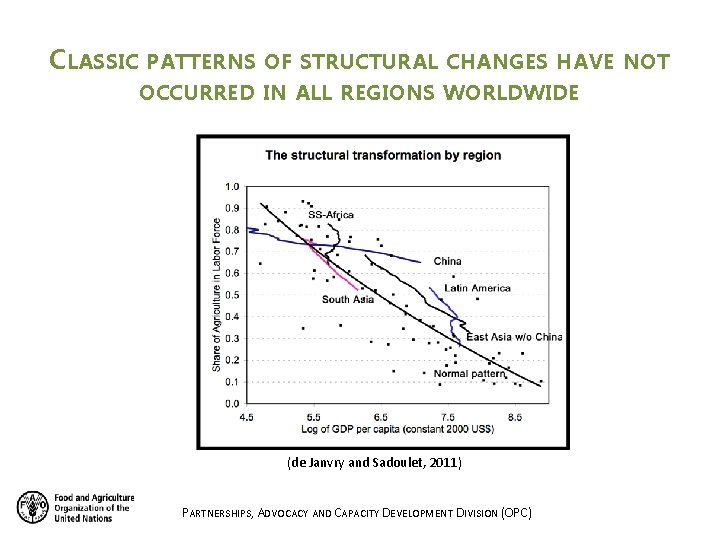
CLASSIC PATTERNS OF STRUCTURAL CHANGES HAVE NOT OCCURRED IN ALL REGIONS WORLDWIDE (de Janvry and Sadoulet, 2011) PARTNERSHIPS, ADVOCACY AND CAPACITY DEVELOPMENT DIVISION (OPC)
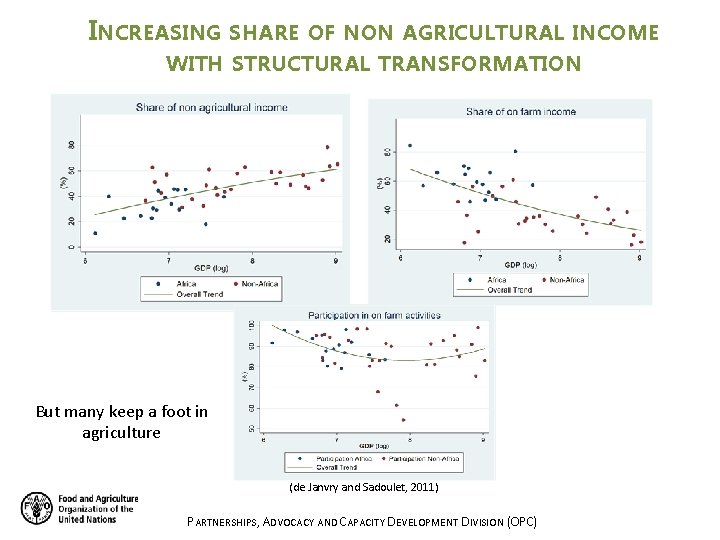
INCREASING SHARE OF NON AGRICULTURAL INCOME WITH STRUCTURAL TRANSFORMATION But many keep a foot in agriculture (de Janvry and Sadoulet, 2011) PARTNERSHIPS, ADVOCACY AND CAPACITY DEVELOPMENT DIVISION (OPC)
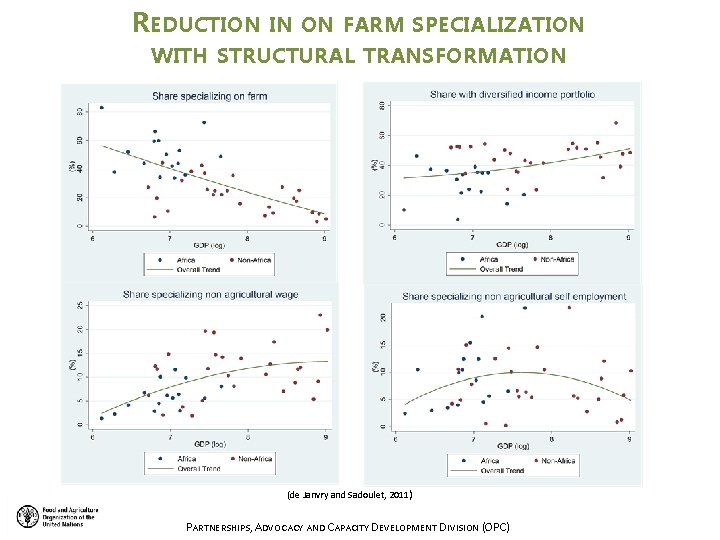
REDUCTION IN ON FARM SPECIALIZATION WITH STRUCTURAL TRANSFORMATION (de Janvry and Sadoulet, 2011) PARTNERSHIPS, ADVOCACY AND CAPACITY DEVELOPMENT DIVISION (OPC)
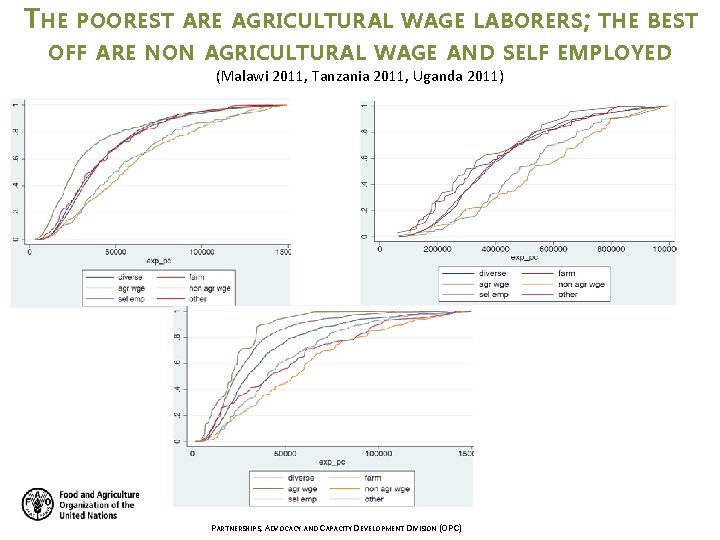
THE POOREST ARE AGRICULTURAL WAGE LABORERS; THE BEST OFF ARE NON AGRICULTURAL WAGE AND SELF EMPLOYED (Malawi 2011, Tanzania 2011, Uganda 2011) PARTNERSHIPS, ADVOCACY AND CAPACITY DEVELOPMENT DIVISION (OPC)
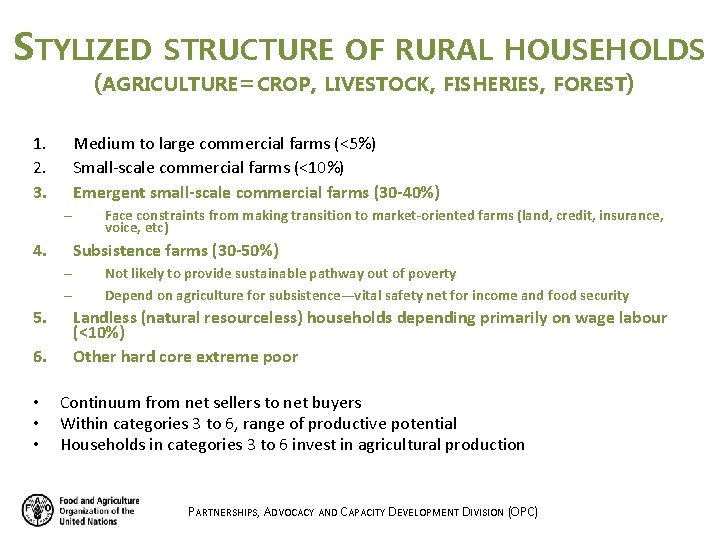
STYLIZED STRUCTURE OF RURAL HOUSEHOLDS (AGRICULTURE=CROP, LIVESTOCK, FISHERIES, FOREST) 1. 2. 3. Medium to large commercial farms (<5%) Small-scale commercial farms (<10%) Emergent small-scale commercial farms (30 -40%) – 4. Subsistence farms (30 -50%) – – 5. 6. • • • Face constraints from making transition to market-oriented farms (land, credit, insurance, voice, etc) Not likely to provide sustainable pathway out of poverty Depend on agriculture for subsistence—vital safety net for income and food security Landless (natural resourceless) households depending primarily on wage labour (<10%) Other hard core extreme poor Continuum from net sellers to net buyers Within categories 3 to 6, range of productive potential Households in categories 3 to 6 invest in agricultural production PARTNERSHIPS, ADVOCACY AND CAPACITY DEVELOPMENT DIVISION (OPC)
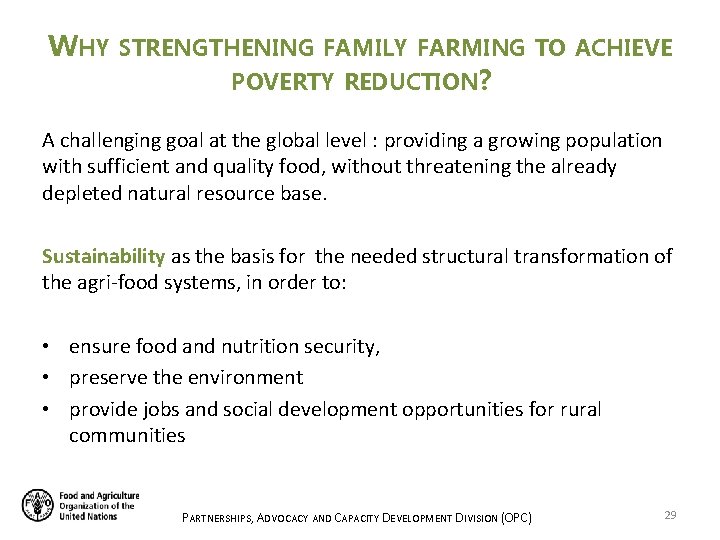
WHY STRENGTHENING FAMILY FARMING TO ACHIEVE POVERTY REDUCTION? A challenging goal at the global level : providing a growing population with sufficient and quality food, without threatening the already depleted natural resource base. Sustainability as the basis for the needed structural transformation of the agri-food systems, in order to: • ensure food and nutrition security, • preserve the environment • provide jobs and social development opportunities for rural communities PARTNERSHIPS, ADVOCACY AND CAPACITY DEVELOPMENT DIVISION (OPC) 29
WHY STRENGTHENING FAMILY FARMING TO ACHIEVE POVERTY REDUCTION? Support to family farms allows to cope with the challenges related to sustainability in its different dimensions: Economic sustainability: FF represent the largest source of employment worldwide, enhancing rural livelihoods, providing economic opportunities in rural areas, and representing an opportunity to boost local economies, as their incremental generated income is spent on housing, education, clothing, and other sectors of the local nonfarm economy. Environmental sustainability: FF act as the custodians of a finely adapted understanding of local ecologies and land capabilities, and sustaining productivity on often marginal lands through complex and innovative land management techniques that combine local knowledge with modern technology. Social sustainability: the existence of family farms are the first guarantees of maintaining culture, diversity and identity as a fundamental part of the social capital and cultural heritage in rural areas. PARTNERSHIPS, ADVOCACY AND CAPACITY DEVELOPMENT DIVISION (OPC) 30
HOW STRENGTHENING FAMILY FARMING TO ACHIEVE POVERTY REDUCTION? FAO’S APPROACH ( SP 3) A multi-pronged approach consisting of three outcome areas: • Access through empowerment of smallholders and family farmers to attain sustainable economic livelihoods from agriculture and natural resources through strengthening rural institutions and farmer producer organizations, improving rural services and links to markets; • Rural employment creation, in order to augment on-farm and off-farm livelihoods; • Strengthened social protection systems in rural areas and economies to reduce rural poverty while building resilience to risks and disasters. PARTNERSHIPS, ADVOCACY AND CAPACITY DEVELOPMENT DIVISION (OPC) 31
HOW STRENGTHENING FAMILY FARMING TO ACHIEVE POVERTY REDUCTION? LINKING AGRICULTURAL AND SOCIAL PROTECTION POLICIES Agricultural and social protection policies are both fundamental levers to overcome rural poverty: helping small farmers to improve productivity is one important vehicle, but in most contexts is not enough to lift all rural poor out of poverty, which in turn limit agricultural productivity itself. Providing social protection and pursuing agricultural development in an integrated way offers synergies that can increase the effectiveness of both: Better social protection can positively influence the investment decisions of poor households, helping poor farmers to overcome liquidity and credit constraints, invest in productive activities build assets and manage risks more effectively. These benefits spread beyond the immediate recipients to their communities and the broader economy as recipients purchase food, agricultural inputs and other rural goods and services. PARTNERSHIPS, ADVOCACY AND CAPACITY DEVELOPMENT DIVISION (OPC) 32
HOW STRENGTHENING TOWARDS FAMILY FARMING TO ACHIEVE POVERTY REDUCTION? A NEW RURAL DEVELOPMENT APPROACH • A coherent strategy aimed at strengthening family farming goes beyond strictly agricultural policies • Territorial development to be tailored in accordance with local realities. • Transform and upgrade public intervention in rural areas, abandoning the belief that agricultural productivity and economic development should be primarily driven by the private sector. • Development of effective and sustainable instruments to support young farmers is a central question to solve, including simplification of the regulatory and legislative framework, and financial support for start-up costs. PARTNERSHIPS, ADVOCACY AND CAPACITY DEVELOPMENT DIVISION (OPC) 33
Thank you for your attention francesco. pierri@fao. org PARTNERSHIPS, ADVOCACY AND CAPACITY DEVELOPMENT DIVISION (OPC)