
Family Engagement in Early Care and Education A


- Slides: 49
Family Engagement in Early Care and Education A Relationship-Based Approach to Family Engagement
Overview Understanding family engagement as relationship-based means: • Adopting strengths-based attitudes with families. • Reflecting on your own perspectives. • Learning about families’ perspectives and funds of knowledge. • Identifying strategies to create a welcoming environment.
By the end of this module, you should be able to: • Describe ways to create a program-wide, relationship-based culture that supports effective family engagement. • Identify and reflect on personal values, experiences, ethics, and biases. • Identify ways to explore with families their interests, strengths, and priorities.
Engaging All Families: A Strengths-Based Approach
Believing and Doing • What do you believe about parents’ roles in their children’s development? • How do you demonstrate this? • What would someone observe in your program that communicates these values?
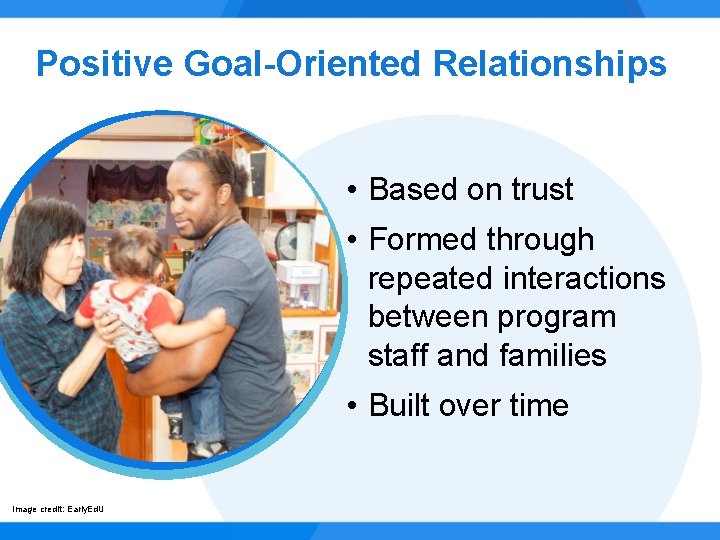
Positive Goal-Oriented Relationships • Based on trust • Formed through repeated interactions between program staff and families • Built over time Image credit: Early. Ed. U
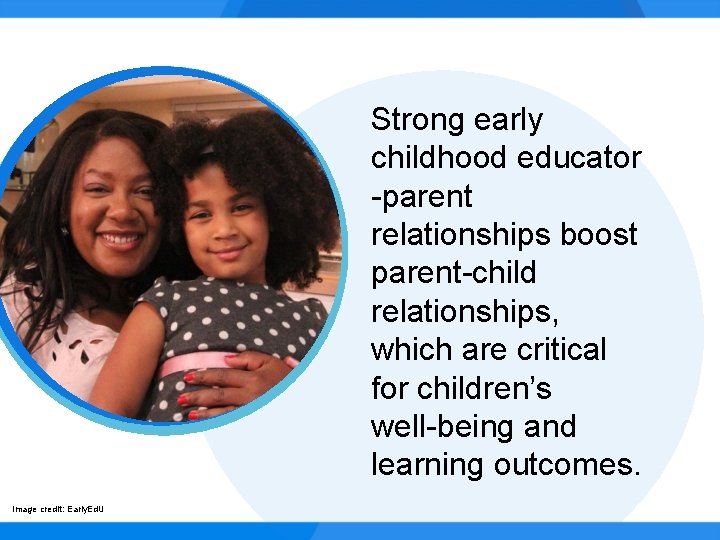
Strong early childhood educator -parent relationships boost parent-child relationships, which are critical for children’s well-being and learning outcomes. Image credit: Early. Ed. U
Results of Family Engagement Family engagement includes positive relationship qualities—safety, encouragement, trust, mutual respect and caring, and hope— and can lead to educator and family: • Changes in attitude • Increases in motivation • Sense of possibility • Shifts that promote positive family and child outcomes
Family Engagement Is. . . • Relationship-based • Ongoing • Responsive to the strengths, interests, and needs of families • Program-wide • Collaborative • Supportive of children’s growth, development, and learning • Important to begin before birth
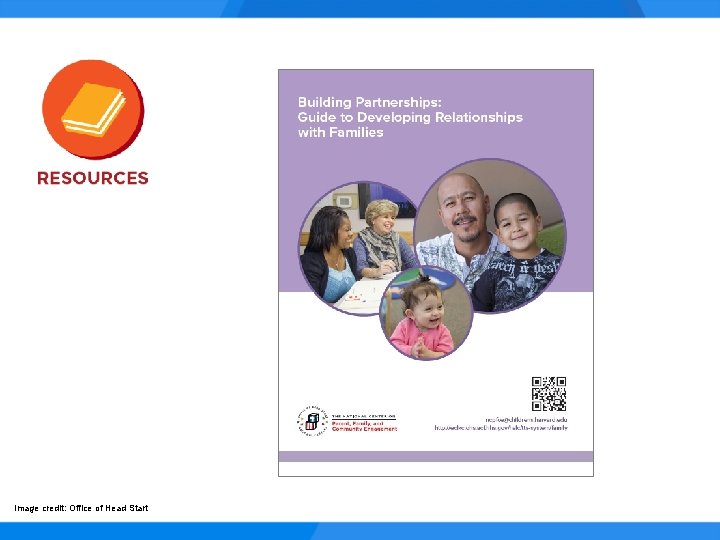
Image credit: Office of Head Start
Strengths-Based Attitudes Families: • Are the first and most important teachers of their children. • Are our partners in supporting their children’s development. • Have expertise about their children. • Have something valuable to contribute.
Observing Strengths-Based Attitudes Think about a time when you or someone you know used a strengths-based attitude with a family. • Which attitude was used? • What did you or someone else say or do that reflected that attitude?
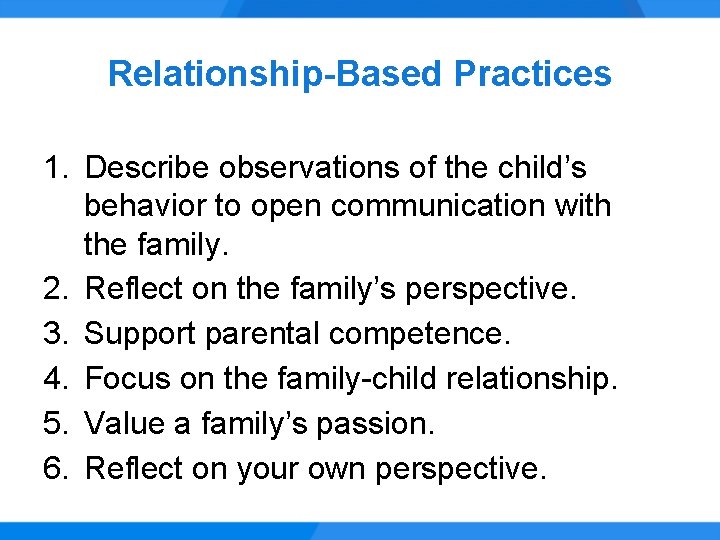
Relationship-Based Practices 1. Describe observations of the child’s behavior to open communication with the family. 2. Reflect on the family’s perspective. 3. Support parental competence. 4. Focus on the family-child relationship. 5. Value a family’s passion. 6. Reflect on your own perspective.
Finley’s Parent-Teacher Conference Watch this video from the Results Matter Video Library. What attitudes and practices do you see the educator using to connect with the parent?
VIDEO: Finley’s Parent-Teacher Conference
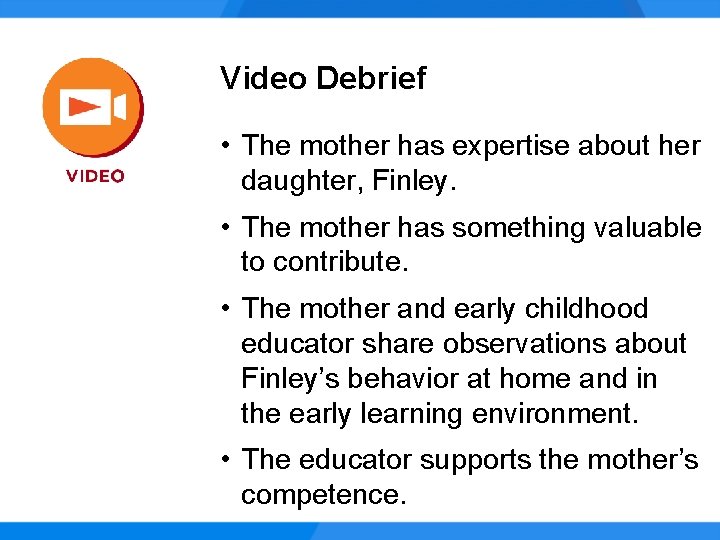
Video Debrief • The mother has expertise about her daughter, Finley. • The mother has something valuable to contribute. • The mother and early childhood educator share observations about Finley’s behavior at home and in the early learning environment. • The educator supports the mother’s competence.
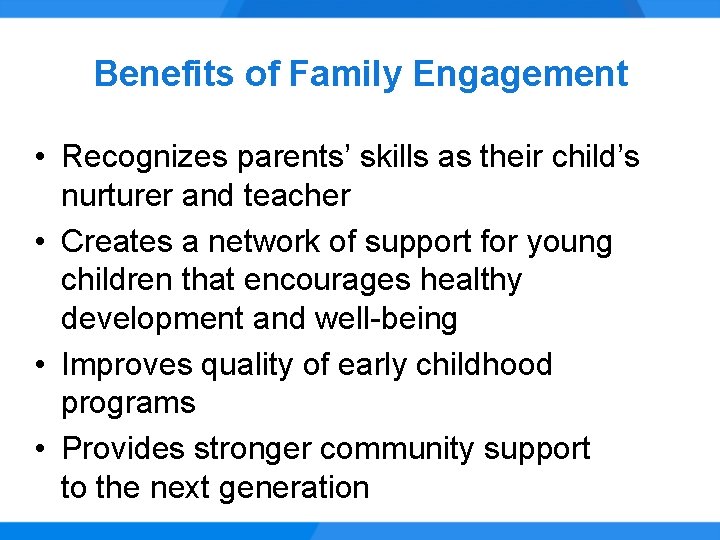
Benefits of Family Engagement • Recognizes parents’ skills as their child’s nurturer and teacher • Creates a network of support for young children that encourages healthy development and well-being • Improves quality of early childhood programs • Provides stronger community support to the next generation
Exploring Perspectives and Influences
Think about your own family and how you were raised. • How were your attitudes, beliefs, and values about caring for and guiding young children shaped by your family? • Have these changed over time? If so, how? • What caused these changes or reinforced what you already thought?
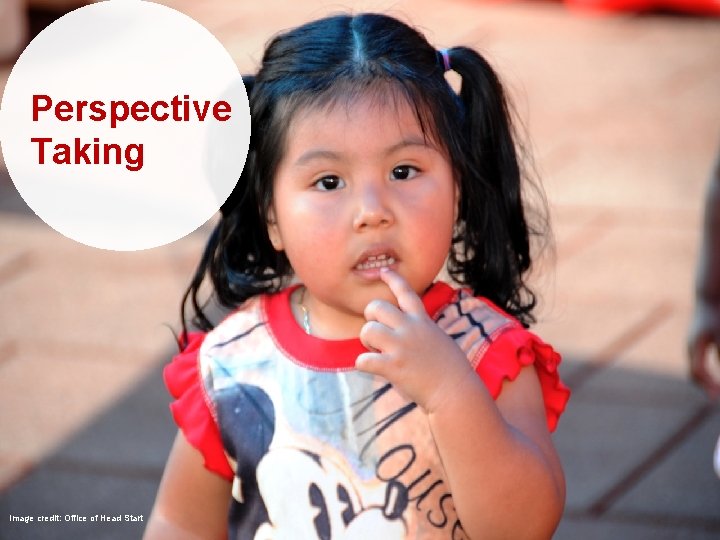
Perspective Taking Image credit: Office of Head Start
Real to Reel: Exploring Culture and Emotions Think about these questions while watching the video linked to the next slide: • How are culture and language represented in your program? • How might knowledge of cultural influences on emotions affect your work with families? • What other aspects of interaction may be influenced by culture?
VIDEO: Real to Reel: Exploring Culture and Emotions
Video Debrief • How are culture and language represented in your program? • How might knowledge of cultural influences on emotions affect your work with families? • What other aspects of interaction may be influenced by culture?
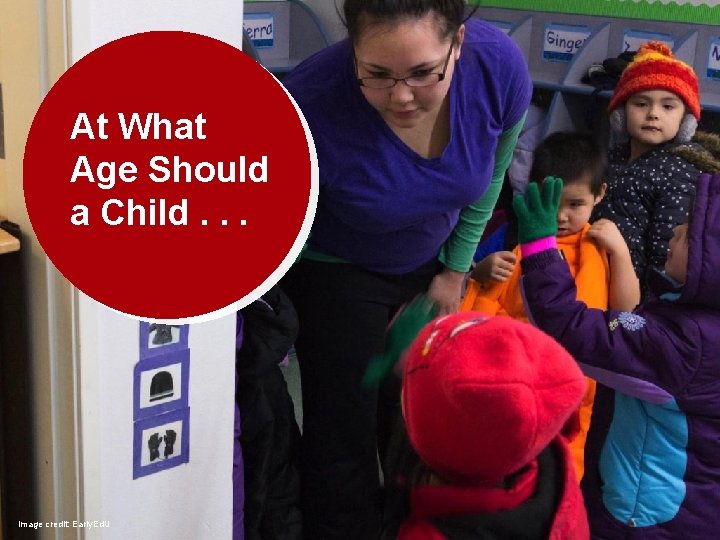
At What Age Should a Child. . . Image credit: Early. Ed. U
Child Development and Culture Think about your own upbringing, children you know, or experiences you have had, and respond to the prompts on the handout. Discuss your responses with a partner.
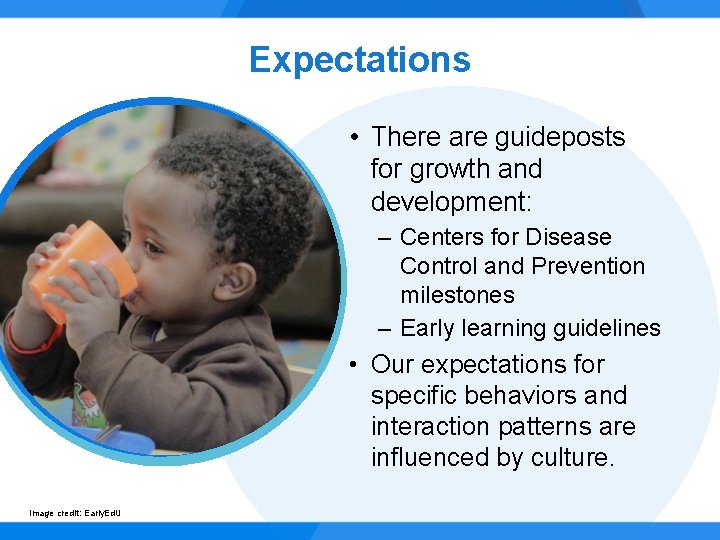
Expectations • There are guideposts for growth and development: – Centers for Disease Control and Prevention milestones – Early learning guidelines • Our expectations for specific behaviors and interaction patterns are influenced by culture. Image credit: Early. Ed. U
Looking at Differences • Consider the expectations that families in your program have for their children’s development. What do you see that is the same? What do you see that is different? • How do families’ styles of talking and interacting with children vary? • How does your program collect and use information about families’ cultures and languages?
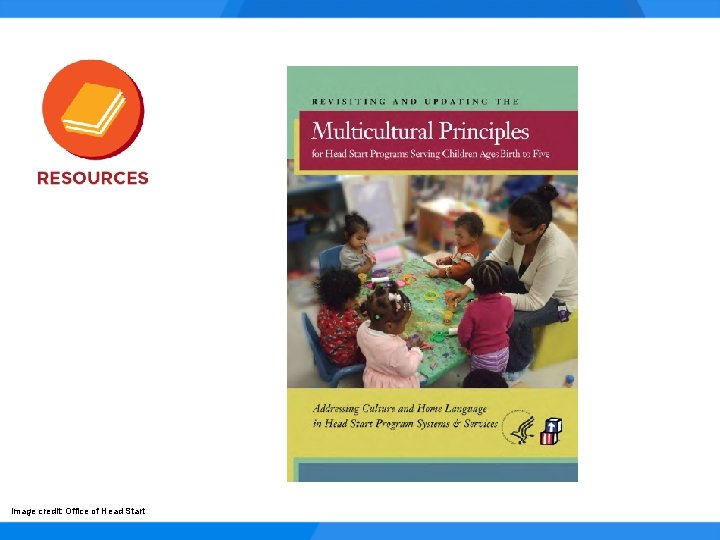
Image credit: Office of Head Start
Wondering About Families
Thinking About Families • What do you enjoy most in working with families? • What do you find challenging?
Funds of Knowledge “Essential cultural practices and bodies of knowledge that are embedded in the daily practices and routines of families” (Office of Head Start, Early Childhood Learning and Knowledge Center, n. d. )
Identify Funds of Knowledge in the Household • Identify the rich experiences in a family’s life. • Use what you learn from the families themselves, rather than making use of stereotypes and over-generalizations. • Help children build on what they already know.
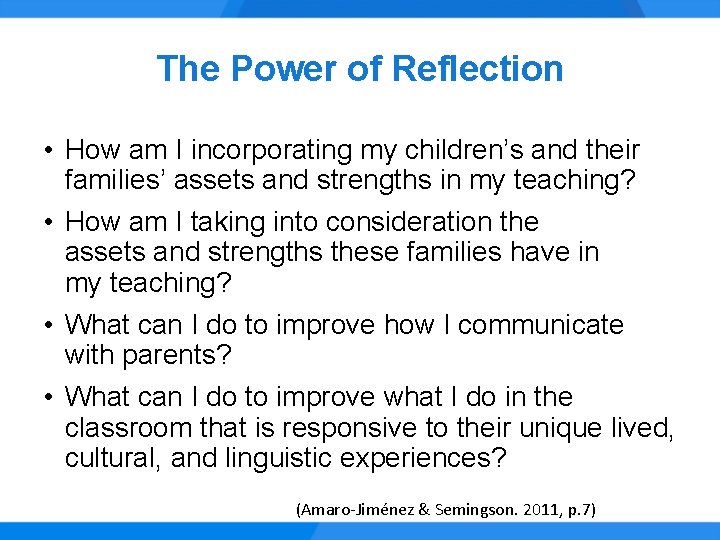
The Power of Reflection • How am I incorporating my children’s and their families’ assets and strengths in my teaching? • How am I taking into consideration the assets and strengths these families have in my teaching? • What can I do to improve how I communicate with parents? • What can I do to improve what I do in the classroom that is responsive to their unique lived, cultural, and linguistic experiences? (Amaro-Jiménez & Semingson. 2011, p. 7)
Funds of Knowledge: In His Own Words Watch as Dr. Luis Moll describes the concept funds of knowledge.
VIDEO: Funds of Knowledge–Luis Moll
Video Debrief • Funds of knowledge are about the knowledge base generated by families depending on their experiences. • Early childhood educators can learn about and use this information to support children’s ongoing learning.
Funds of Knowledge 1. Form small groups. 2. Think about funds of knowledge for you and your family. 3. Fill in your funds of knowledge on the handout. 4. Add a new category based on your culture. 5. In your small group, share what you feel comfortable discussing about your funds of knowledge.
Celebrating Culture As you watch this video, consider the following: • How does this parent describe the impact of the teacher listening and taking time to learn about their family’s strengths and needs? • Identify ways family experiences are valued in the early learning program.
VIDEO: Celebrating Culture
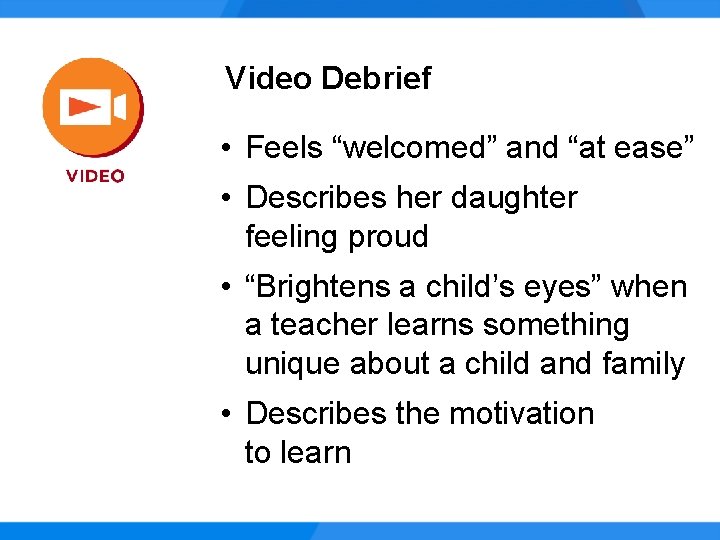
Video Debrief • Feels “welcomed” and “at ease” • Describes her daughter feeling proud • “Brightens a child’s eyes” when a teacher learns something unique about a child and family • Describes the motivation to learn
Welcoming Families
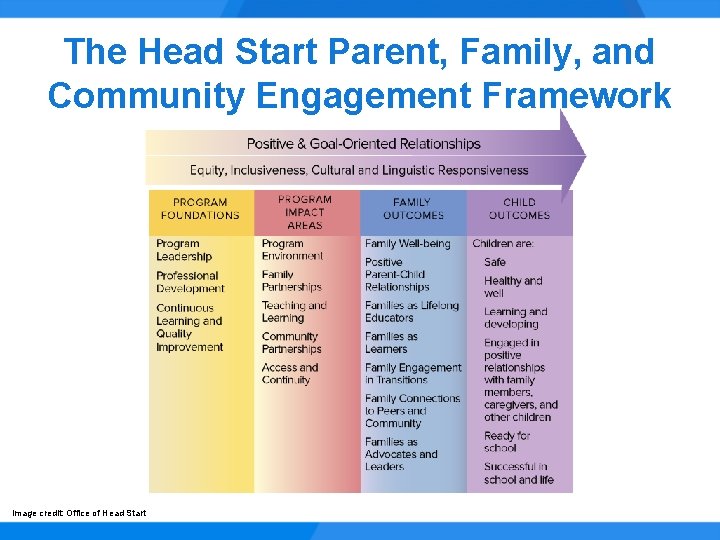
The Head Start Parent, Family, and Community Engagement Framework Image credit: Office of Head Start
Meaningful Connections What are two new ways that your program can create a welcoming, inclusive environment to engage all families?
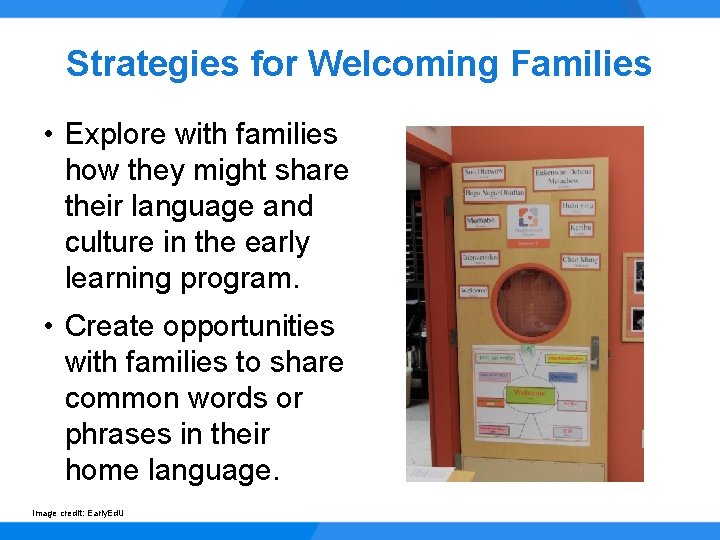
Strategies for Welcoming Families • Explore with families how they might share their language and culture in the early learning program. • Create opportunities with families to share common words or phrases in their home language. Image credit: Early. Ed. U
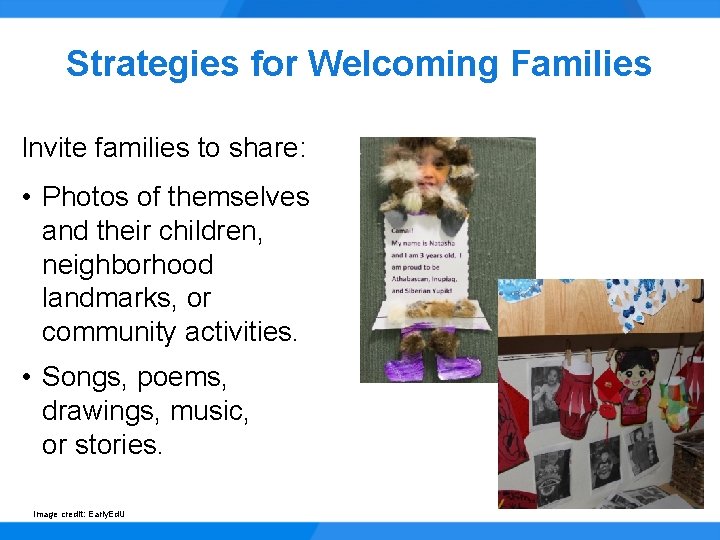
Strategies for Welcoming Families Invite families to share: • Photos of themselves and their children, neighborhood landmarks, or community activities. • Songs, poems, drawings, music, or stories. Image credit: Early. Ed. U
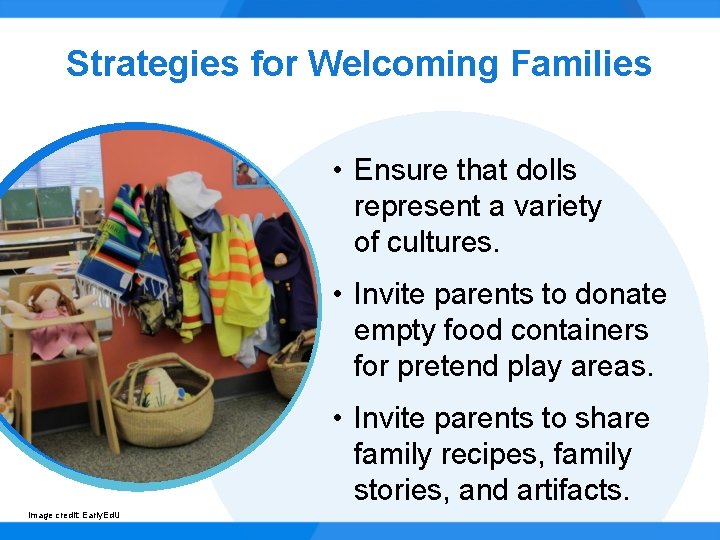
Strategies for Welcoming Families • Ensure that dolls represent a variety of cultures. • Invite parents to donate empty food containers for pretend play areas. • Invite parents to share family recipes, family stories, and artifacts. Image credit: Early. Ed. U
Bringing It All Together
A relationship-based approach to family engagement involves: • Adopting strengths-based attitudes. • Reflecting on your own perspectives. • Learning about families’ perspectives and funds of knowledge. • Identifying strategies to create a welcoming environment.
For more information about this resource, please contact us: PFCE@ecetta. info | 1 -866 -763 -6481 This document was developed with funds from Grant #90 HC 0014 for the U. S. Department of Health and Human Services, Administration for Children and Families, Office of Head Start, and Office of Child Care, by the National Center on Parent, Family, and Community Engagement. This resource may be duplicated for noncommercial uses without permission. Developed in collaboration with Early. Ed. U Alliance: A Higher Education Collaborative for Head Start and Early Childhood Teaching.