
Family Engagement in Case Planning Case Management Version


- Slides: 64
Family Engagement in Case Planning & Case Management Version 2. 3, 2013 1
Goals for the Training In this training we will cover: p The rules and regulations governing case planning p The steps and processes of completing a case plan p The three phases of case planning p The link between case planning and case management p Case Planning Rules & Regulations 2
Activity: How Do I Plan? p What’s my planning style? 3
The Art of Case Planning p Highly structured p Meets specific requirements p Individually tailored p Engages participants 4
Case Plan Definitions p Engagement p Permanence p Case Plan Update p Concurrent Services p Participatory Case Planning 5
Case Plan Requirements p Engagement p Assessment p Goal for Permanency p Service Objectives p Intervention p Timelines 6
Legal Requirements p ICWA p ILP p Child Well-being Efforts p Educational Stability Efforts 7
Case Plan Goals The primary goal of the case plan is permanency p There are 9 possible goals p n n n Remain home Return home Adoption with siblings Adoption Maintain in legal guardianship Legal guardianship 8
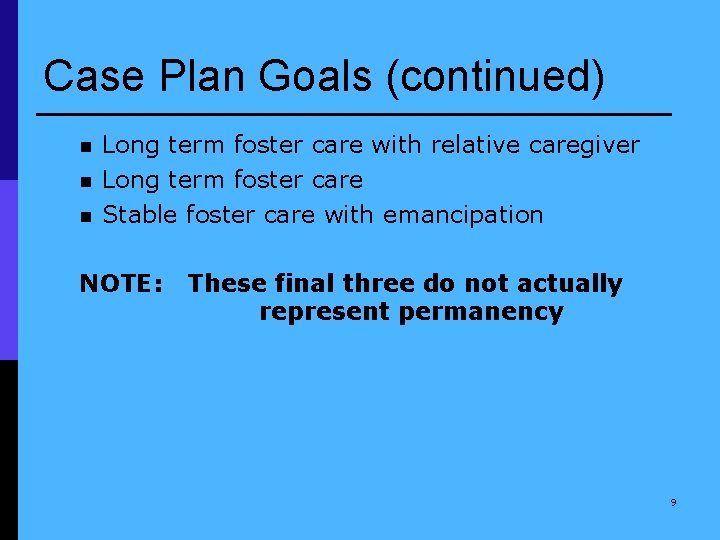
Case Plan Goals (continued) n n n Long term foster care with relative caregiver Long term foster care Stable foster care with emancipation NOTE: These final three do not actually represent permanency 9
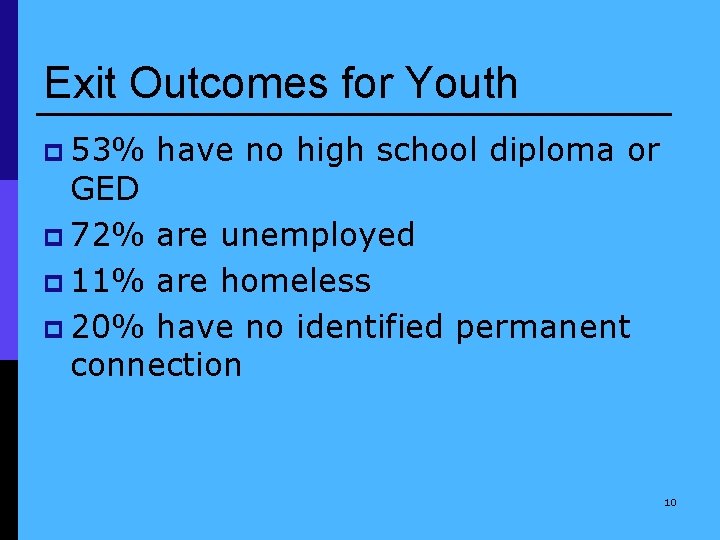
Exit Outcomes for Youth p 53% have no high school diploma or GED p 72% are unemployed p 11% are homeless p 20% have no identified permanent connection 10
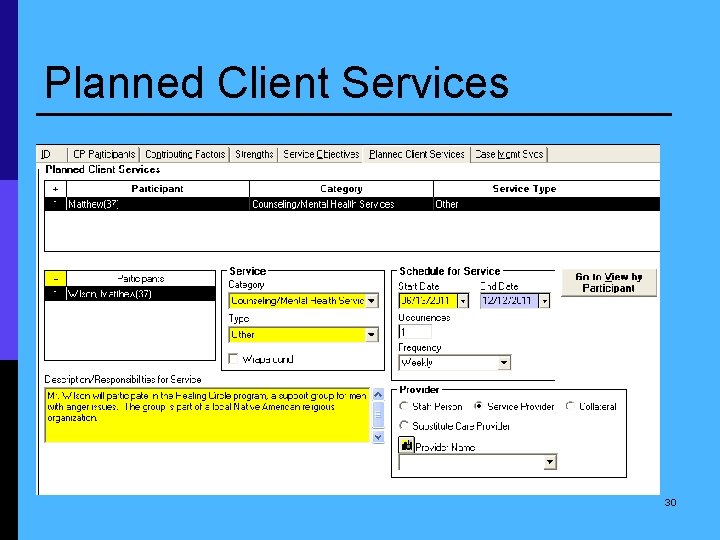
Two Key Case Plan Components p Service Objectives p Planned Client Services (aka Client Responsibilities) 11
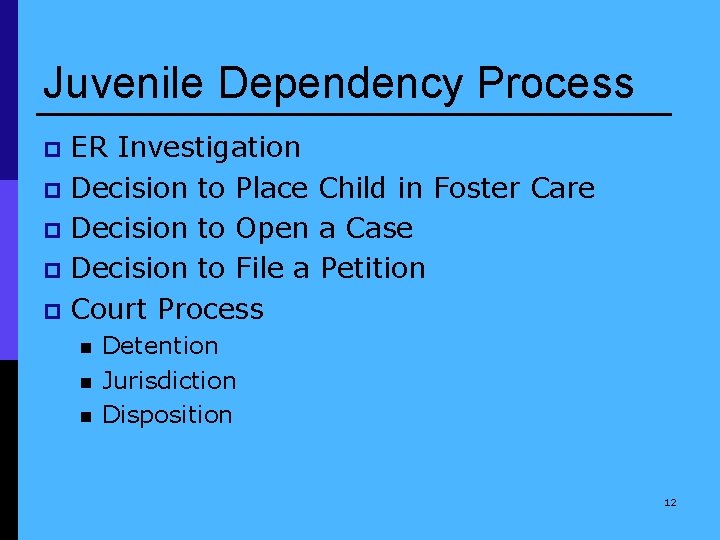
Juvenile Dependency Process ER Investigation p Decision to Place Child in Foster Care p Decision to Open a Case p Decision to File a Petition p Court Process p n n n Detention Jurisdiction Disposition 12
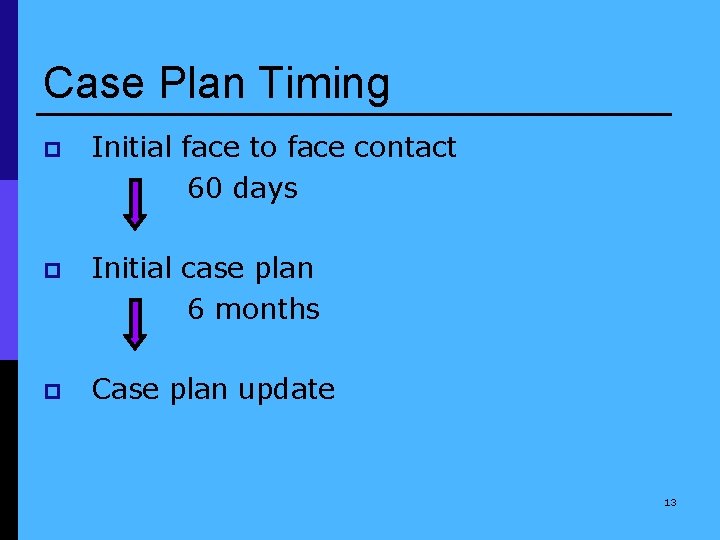
Case Plan Timing p Initial face to face contact 60 days p Initial case plan 6 months p Case plan update 13
Case Planning & Assessment p SDM - the Family Strengths and Needs Assessment is completed approximately every 3 to 6 months (prior to each case plan) and is used to identify priority needs and strengths. p CAT - the Continuing Services Assessment is completed as part of case plan development and identifies strengths, barriers to service involvement and areas of concern. 14
Case Planning p Engagement n Working together on the permanency goal, objectives and services p Assessment n Contributing factors and strengths p Intervention n Documenting what the family will do, what the agency will do and what the timelines are 15
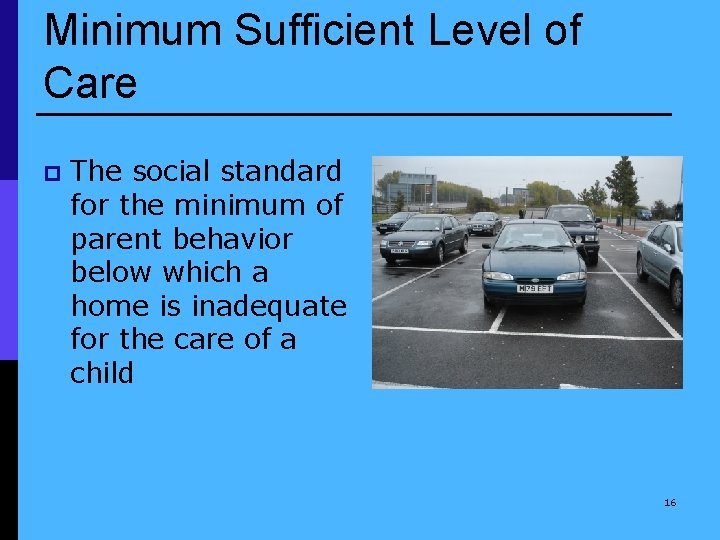
Minimum Sufficient Level of Care p The social standard for the minimum of parent behavior below which a home is inadequate for the care of a child 16
Reasonable Efforts p A single mother with a significant addiction left her young children alone while she was out using drugs p Parents leave their young children home alone while they go to work p Parents spank their children with a hairbrush and leave multiple welts and bruises 17
Addressing Bias in Case Planning p Biases that affect disproportionality exist in all phases of the child welfare system. p The child welfare system is not operating in a fair and equitable way all of the time. p As individuals and collectively we often don’t tune in to the underlying values and biases that affect our decision-making. 18
Activity: Recognizing Bias p Read the Dorthea Gibson Vignette p Work together as table groups to answer the questions at the end of the vignette p Engage in a large group discussion about the vignette 19
Engagement p The first task in case planning p Defined as positive involvement in a helping process p Results in improved outcomes for families 20
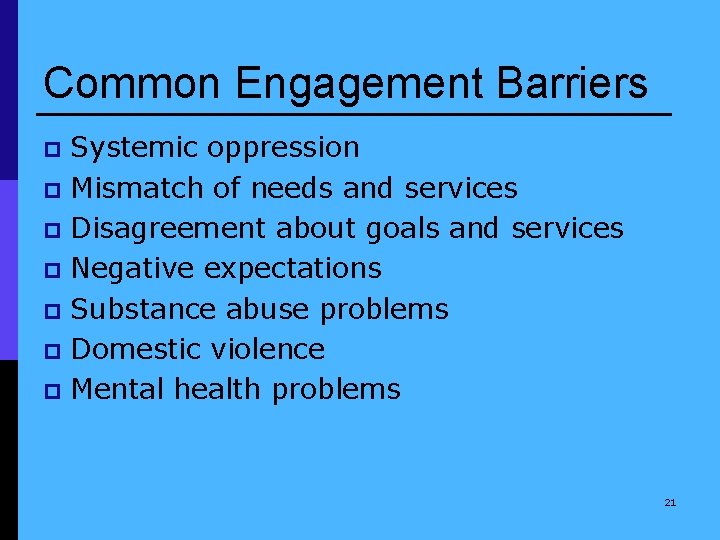
Common Engagement Barriers Systemic oppression p Mismatch of needs and services p Disagreement about goals and services p Negative expectations p Substance abuse problems p Domestic violence p Mental health problems p 21
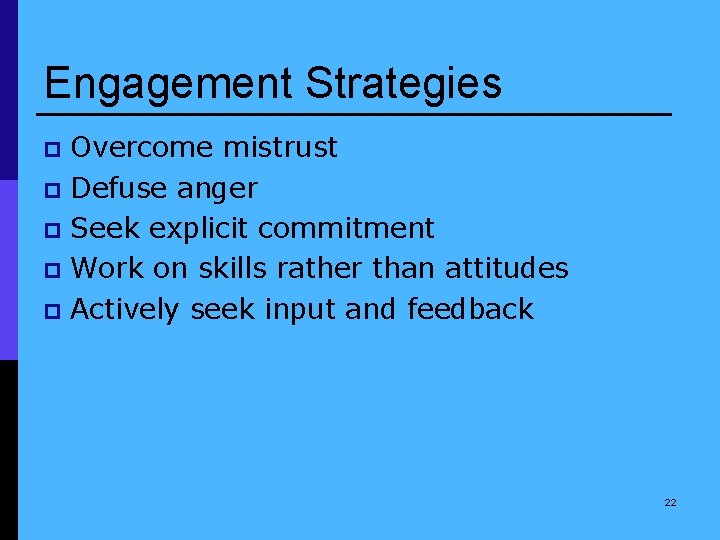
Engagement Strategies Overcome mistrust p Defuse anger p Seek explicit commitment p Work on skills rather than attitudes p Actively seek input and feedback p 22
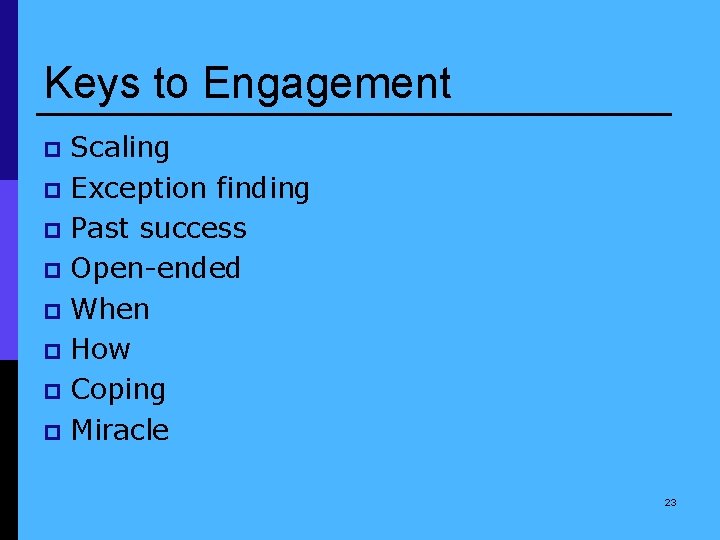
Keys to Engagement Scaling p Exception finding p Past success p Open-ended p When p How p Coping p Miracle p 23
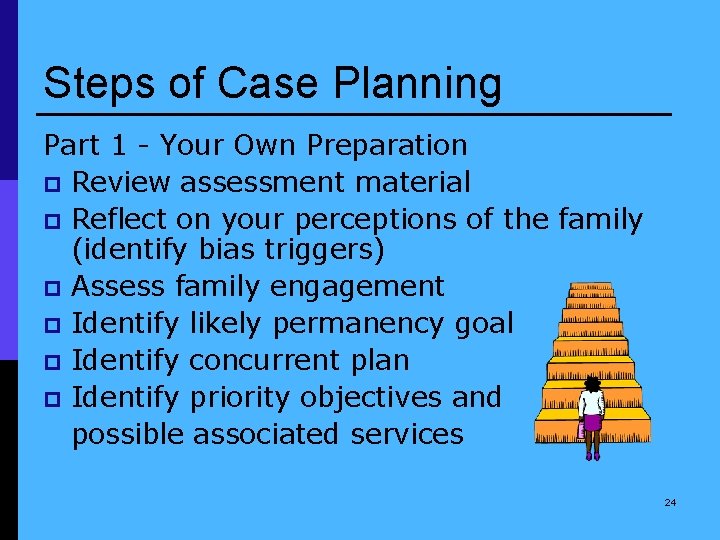
Steps of Case Planning Part 1 - Your Own Preparation p Review assessment material p Reflect on your perceptions of the family (identify bias triggers) p Assess family engagement p Identify likely permanency goal p Identify concurrent plan p Identify priority objectives and possible associated services 24
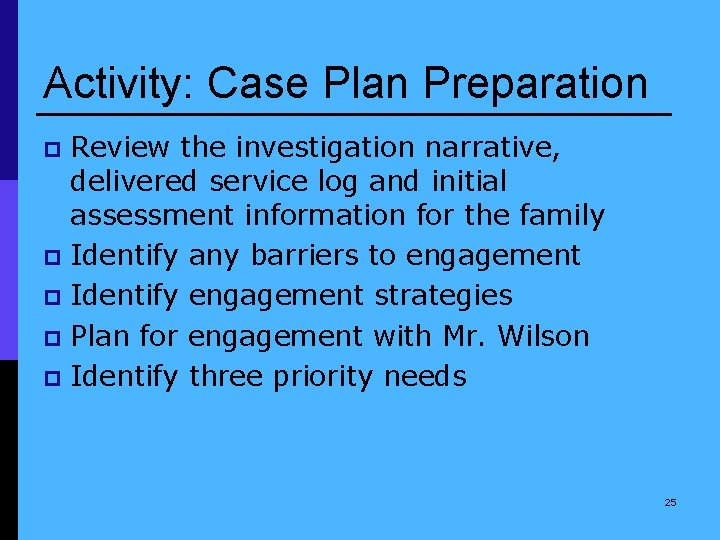
Activity: Case Plan Preparation Review the investigation narrative, delivered service log and initial assessment information for the family p Identify any barriers to engagement p Identify engagement strategies p Plan for engagement with Mr. Wilson p Identify three priority needs p 25
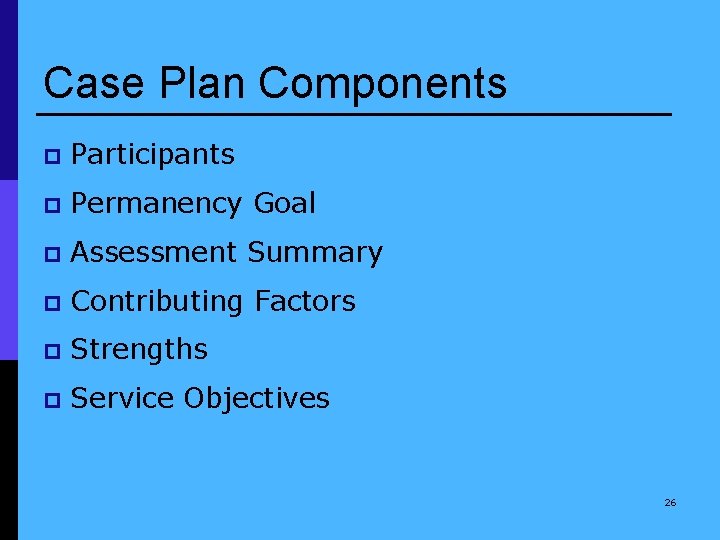
Case Plan Components p Participants p Permanency Goal p Assessment Summary p Contributing Factors p Strengths p Service Objectives 26
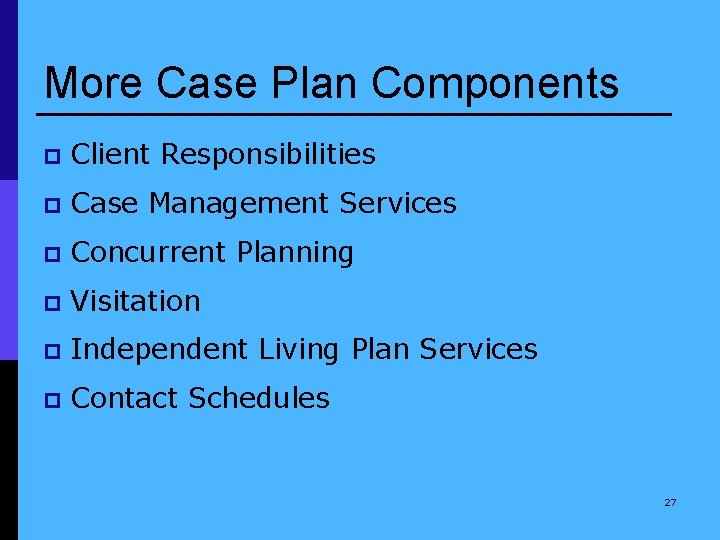
More Case Plan Components p Client Responsibilities p Case Management Services p Concurrent Planning p Visitation p Independent Living Plan Services p Contact Schedules 27
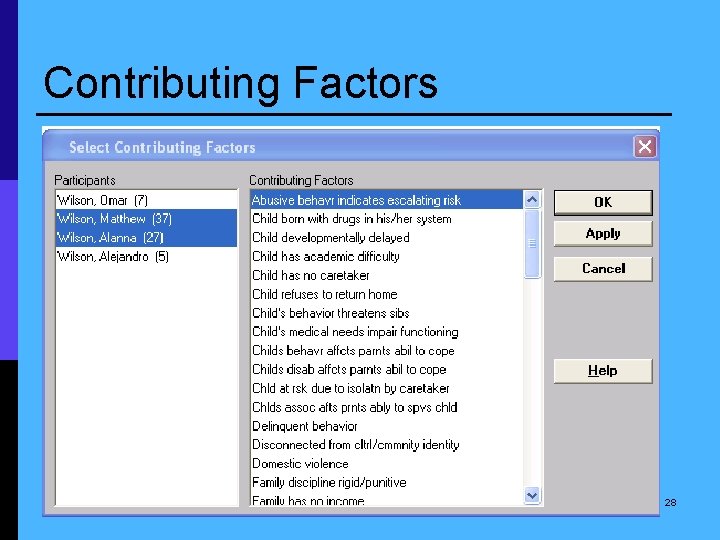
Contributing Factors 28
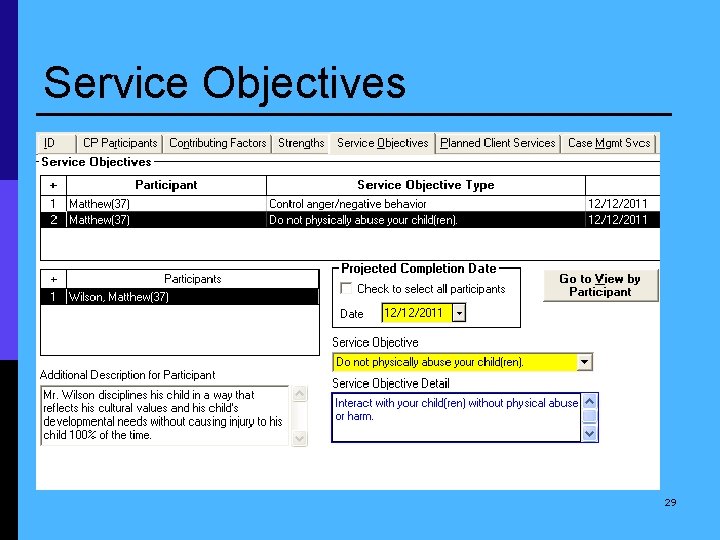
Service Objectives 29
Planned Client Services 30
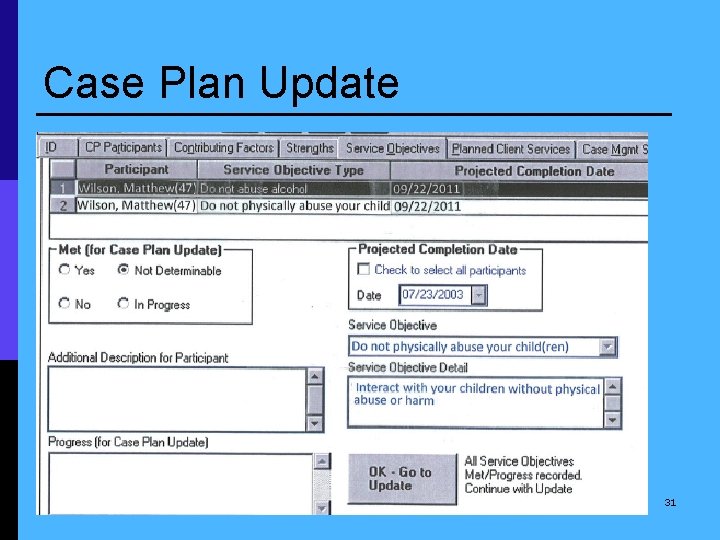
Case Plan Update 31
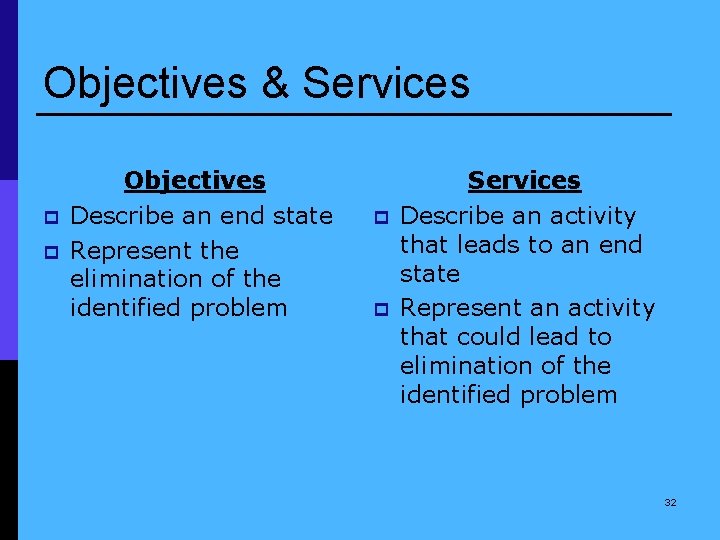
Objectives & Services p p Objectives Describe an end state Represent the elimination of the identified problem p p Services Describe an activity that leads to an end state Represent an activity that could lead to elimination of the identified problem 32
Service Objectives p Are statements that describe a specific desired behavioral outcome in positive terms p Are “end states” 33
S. M. A. R. T. Objectives S = Specific M = Measurable A = Achievable R = Relevant (or result-focused) T = Time-limited 34
S. M. A. R. T. Objectives Are Specific p Objectives describe the specific behavioral outcomes that will result in achievement of the permanency goal. 35
S. M. A. R. T. Objectives Are Measurable p The parties must be able to reach consensus regarding whether the objectives have been accomplished. p The objective must include some easily discernible criteria by which achievement can be measured. 36
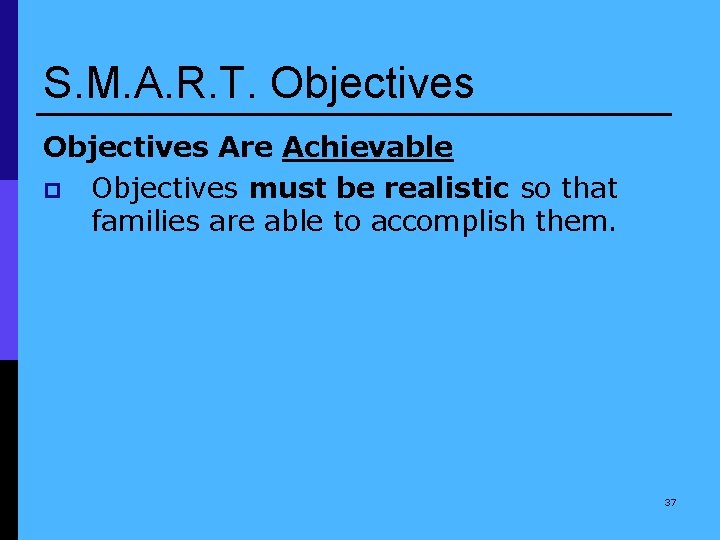
S. M. A. R. T. Objectives Are Achievable p Objectives must be realistic so that families are able to accomplish them. 37
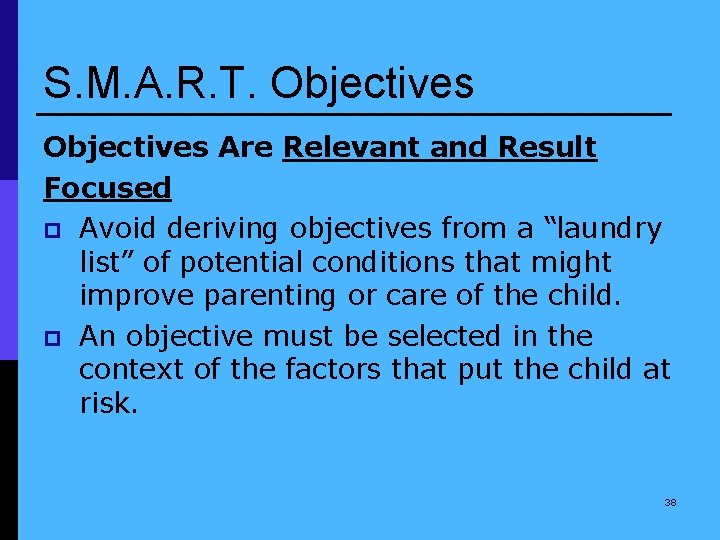
S. M. A. R. T. Objectives Are Relevant and Result Focused p Avoid deriving objectives from a “laundry list” of potential conditions that might improve parenting or care of the child. p An objective must be selected in the context of the factors that put the child at risk. 38
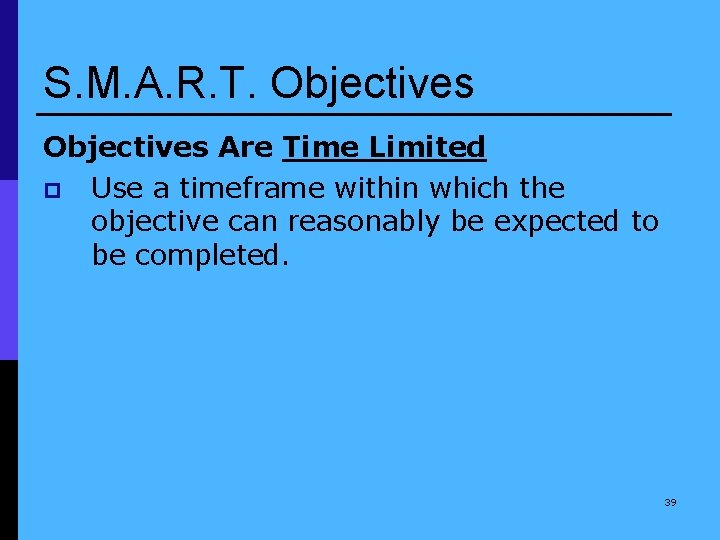
S. M. A. R. T. Objectives Are Time Limited p Use a timeframe within which the objective can reasonably be expected to be completed. 39
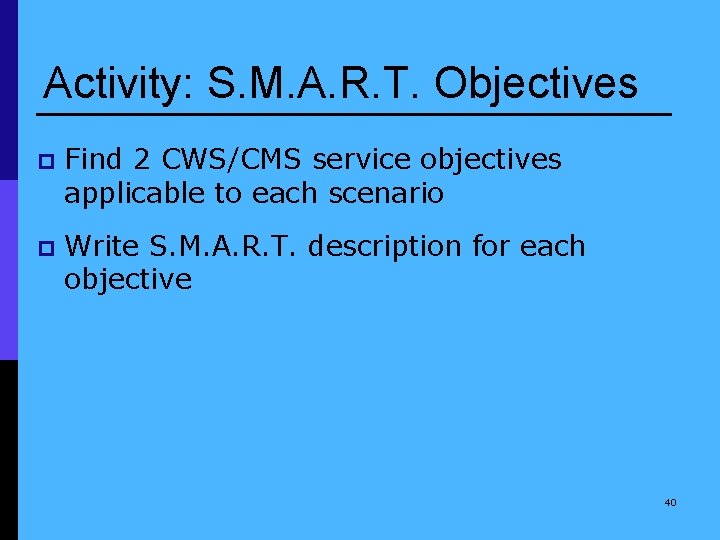
Activity: S. M. A. R. T. Objectives p Find 2 CWS/CMS service objectives applicable to each scenario p Write S. M. A. R. T. description for each objective 40
Case Planning JEOPARDY! Let’s Play! 41
Taking it home…. . 42
Good Morning Welcome Back! p What do you remember? p 43
Tailoring the Interventions p Limit the intervention to identified, prioritized areas of need p Tailor the interventions to fit family: their culture, strengths and needs 44
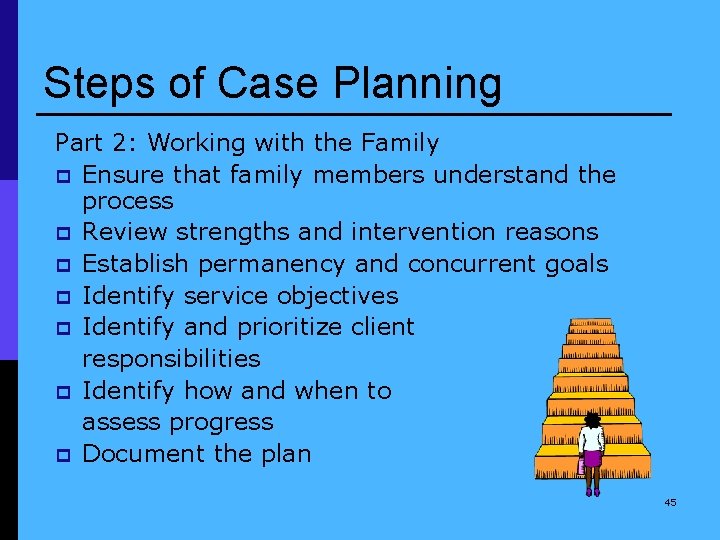
Steps of Case Planning Part 2: Working with the Family p Ensure that family members understand the process p Review strengths and intervention reasons p Establish permanency and concurrent goals p Identify service objectives p Identify and prioritize client responsibilities p Identify how and when to assess progress p Document the plan 45
Activity: Developing the Case Plan Using the Wilson Family Initial Case Plan Worksheet, complete the following: p Select a CWS/CMS objective that meets an identified need p Write a S. M. A. R. T. description for the objective p Select a CWS/CMS planned client service that meets an identified need p Write a S. M. A. R. T. description for the service 46
Case Management Tasks p Supporting Families – providing empathy and emotional support p Monitoring Progress – working with families to assess progress p Reassessing and Revising the Plan – making sure the plan stays relevant p Celebrating Success – highlighting achievements along the way 47
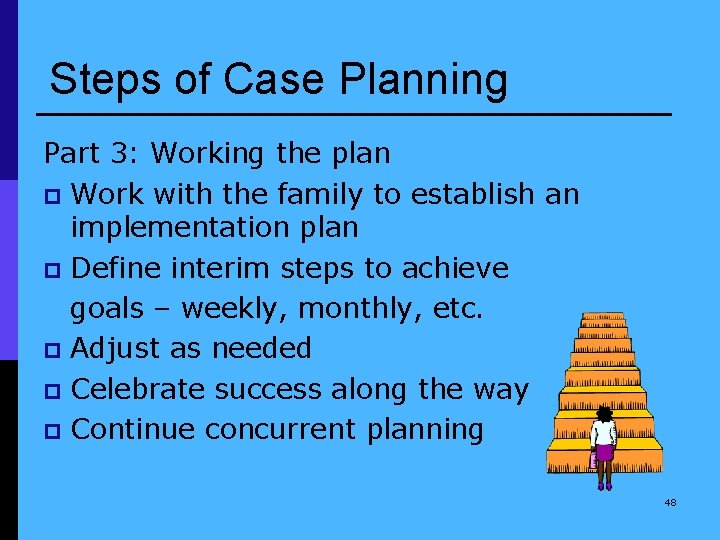
Steps of Case Planning Part 3: Working the plan p Work with the family to establish an implementation plan p Define interim steps to achieve goals – weekly, monthly, etc. p Adjust as needed p Celebrate success along the way p Continue concurrent planning 48
Activity: Preparing to Update the Plan p Review the updated assessment material for the Wilson family p Discuss the changing needs of the family as a large group 49
Video p Concurrent family – planning with the Pathways to Permanence 50
Concurrent Planning p The portion of the child’s case plan for a child receiving family reunification services which identifies the child’s permanency alternative and the services necessary to achieve permanency should family reunification fail. 51
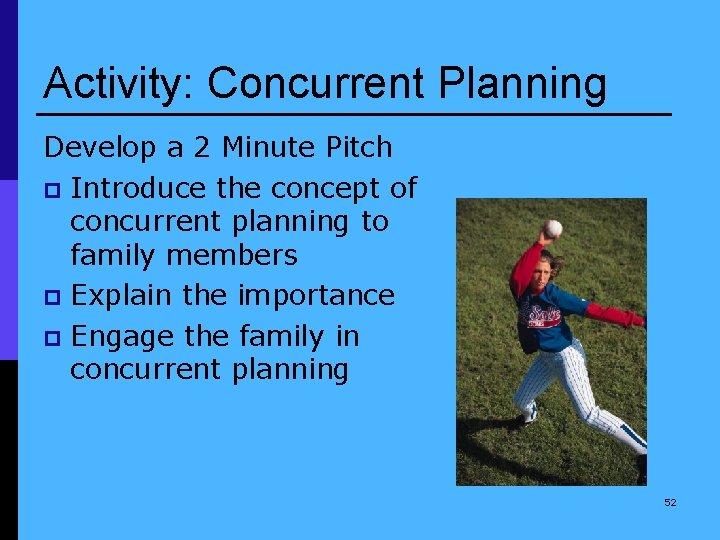
Activity: Concurrent Planning Develop a 2 Minute Pitch p Introduce the concept of concurrent planning to family members p Explain the importance p Engage the family in concurrent planning 52
Visitation allows children to maintain relationships with their parents, siblings, and others who were close to them prior to placement. p Even when reunification isn’t the permanency goal, still arrange for visitation. p Visiting should never be used as a reward or punishment. p Is a child’s right, not a parent’s privilege p 53
Visitation p Visiting should occur in settings that encourage natural interaction while minimizing risk. p Supervised visitation is an opportunity for the social worker to assess progress and to teach the parent. p Consider a good-bye visit when parental rights are terminated. 54
Activity: Visitation Brainstorm List visitation ideas that are: p Tailored to the child’s age and development p Culturally relevant p Structured to encourage positive interaction p Related to case plan objectives 55
Case Plan Requirements for Children Placed out of Home p Assessment of placement needs p Schedule of visits p Social Work contact with Substitute Care Provider p Child well-being information p Explanations of special placement circumstances p Concurrent Planning 56
Steps of Case Planning Part 4: Case Plan Update p Reassess p Describe progress p Measure progress against objectives and MSLC 57
Case Plan Update Requirements p Current family circumstances p Parental progress on objectives p Parental compliance with services p Efforts to achieve alternate permanency 58
Activity: Developing the Case Plan Update p Update the Wilson family case plan p Develop a visitation plan p Develop a concurrent planning goal and establish steps to achieve the goal 59
Steps of Case Planning Part 5: Reunification p Safety p MSLC p Readiness p Transition 60
Activity: Reunification Readiness p Review the updated assessment materials p Discuss Next Steps 61
Steps of Case Planning Part 6: Closing a Case p Assessment p MSLC p Objectives p Strengths and Protective Capacity 62
Aftercare Plans Goal: To prevent recurrence of abuse or neglect. p Focus: Needs to focus on the factors that make the family most vulnerable to recurrence of abuse or neglect. p Strengths: Identify the specific strengths of the family that can help them prevent or cope with vulnerable situations. p 63
My Action Plan 64