
Family Economics Financial Education A Collaborative Project Among
Family Economics & Financial Education A Collaborative Project Among:
Financial Statistics Puzzle 5. 0. 18 Play activity Prepare puzzle pieces « Type financial « Give each participant statistics using a large a piece of a puzzle font and landscape « Direct participants to layout, type one find others that have statistic per page the same color paper « Print each statistic on « Once they find different colored everyone with the paper same colored paper, « Cut each page into 4 -7 the group must put pieces, creating a their puzzle together separate puzzle for to reveal the financial each piece of paper statistic
Facilitation Tips «Once the statistics have been formed they can be posted on butcher paper. Give participants the opportunity to walk around and give initial feedback on the statistics «Have participants display their statistics in different areas of the school or community «Do fact or fiction statistics instead of all fact encouraging discussion among participants
Four on the Floor 5. 0. 7 « « « If a worksheet is in front of a participant, he/she must answer one of the questions and write down the response Then he/she crinkles the worksheet into a ball and tosses it across the room The participant closest to the worksheet must pick it up, answer one of the remaining questions, crinkle it into a ball, and toss it across the room This continues until all questions have been answered on the worksheet or until a certain time limit has been reached; because the questions are open ended, the activity can go on for as long as seems appropriate for the group After the activity is finished, have the last participant answer a question and keep the worksheet Choose one question to discuss first and have the participants read the corresponding responses aloud Discuss the questions and answers
Facilitation Tips «Create many sheets with many different questions, thus having many different questions being tossed around the room at the same time rather than having the same four questions being tossed around «Have participants toss the paper to the center of the room and retrieve a different one than the one they threw
Project Mission “Provide educators with no-cost curriculum materials and the skills and confidence to effectively teach family economics and finance”
Curriculum Development «Curriculum developed by educators for educators. «The team of educators developed, taught, and evaluated curriculum materials – The educators were part of the project’s Master Teacher program; • Educators complete a week-long training, use the curricula in their classrooms and provide continued support to FEFE through evaluation and development of new materials and newly trained family finance educators
Curriculum Development «Aligned to state and national standards «Up-to-date «Designed using a family based approach and the multiple intelligences model, in a ready-to-teach format requiring minimal educator preparation. «Lessons may be taught independently, in units, or as a semester course “Take Charge of Your Finances”
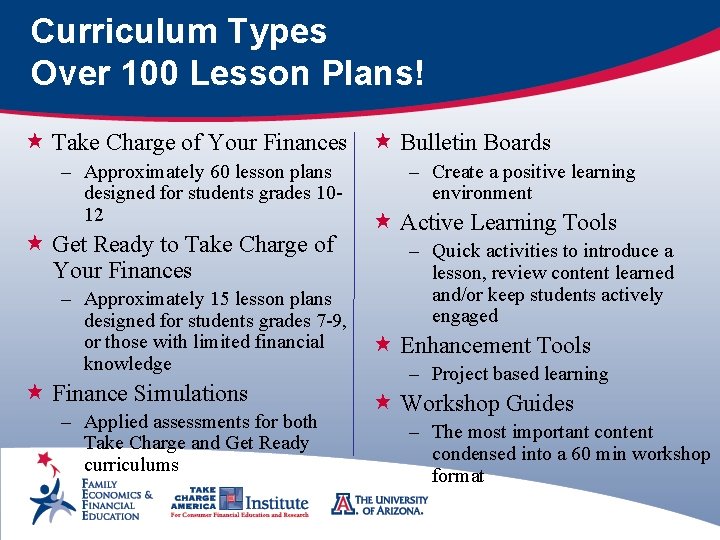
Curriculum Types Over 100 Lesson Plans! « Take Charge of Your Finances – Approximately 60 lesson plans designed for students grades 1012 « Get Ready to Take Charge of Your Finances – Approximately 15 lesson plans designed for students grades 7 -9, or those with limited financial knowledge « Finance Simulations – Applied assessments for both Take Charge and Get Ready curriculums « Bulletin Boards – Create a positive learning environment « Active Learning Tools – Quick activities to introduce a lesson, review content learned and/or keep students actively engaged « Enhancement Tools – Project based learning « Workshop Guides – The most important content condensed into a 60 min workshop format
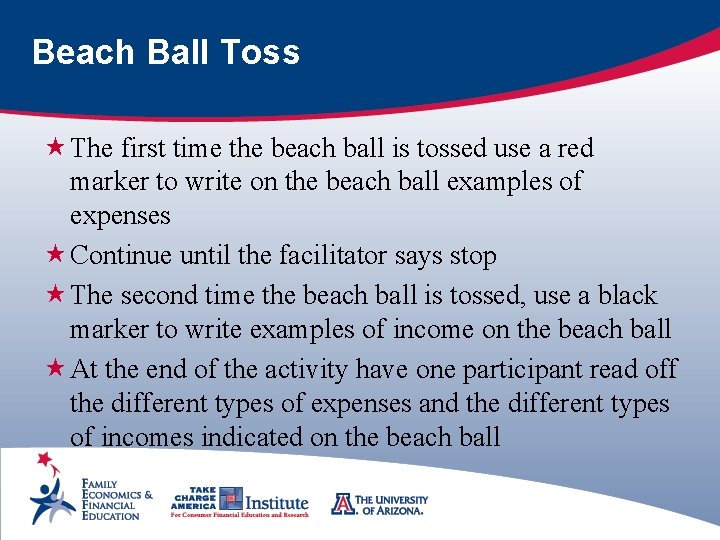
Beach Ball Toss « The first time the beach ball is tossed use a red marker to write on the beach ball examples of expenses « Continue until the facilitator says stop « The second time the beach ball is tossed, use a black marker to write examples of income on the beach ball « At the end of the activity have one participant read off the different types of expenses and the different types of incomes indicated on the beach ball
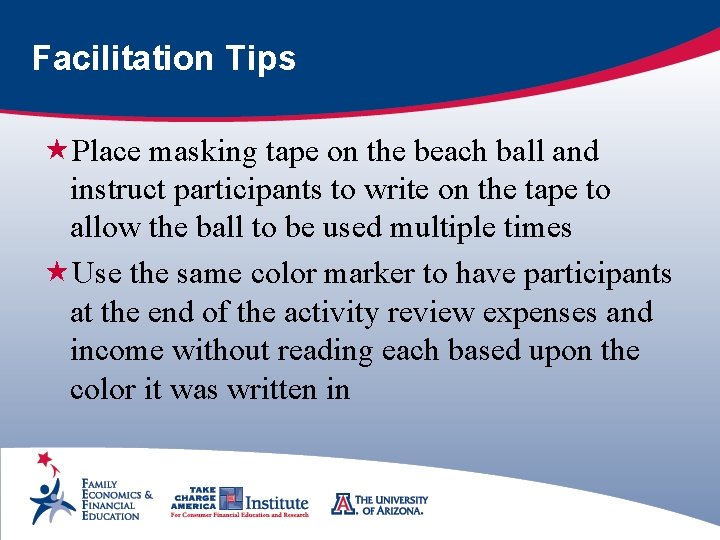
Facilitation Tips «Place masking tape on the beach ball and instruct participants to write on the tape to allow the ball to be used multiple times «Use the same color marker to have participants at the end of the activity review expenses and income without reading each based upon the color it was written in
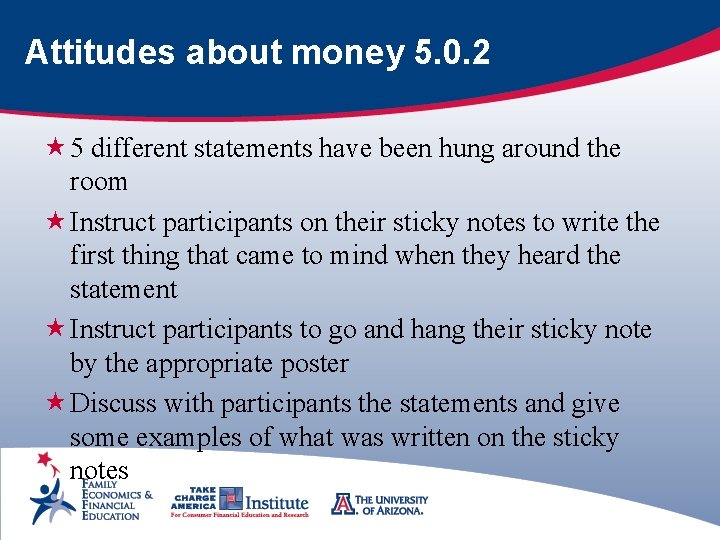
Attitudes about money 5. 0. 2 « 5 different statements have been hung around the room « Instruct participants on their sticky notes to write the first thing that came to mind when they heard the statement « Instruct participants to go and hang their sticky note by the appropriate poster « Discuss with participants the statements and give some examples of what was written on the sticky notes
Facilitation Tips « Group Activity – Have groups share with each other what their responses were to the individual questions « Individually – Hand out an Attitudes About Money worksheet 5. 0. 2. A 1 to each participant « Brainstorm sheets – Can also use butcher paper for the participants to attach their sticky notes to, or they can write directly on the butcher paper « Educator led discussion – The educator will read the questions and discuss answers aloud with the participants

CURRICULUM DESIGN & CODING
Ready-to-Teach Design « Lesson Plan – Introduction • All background information – Body • Recommended step-by-step facilitation – Conclusion • Activity based review – Materials • List of necessary supplies – Resources • Reference lesson plans, documents, Web sites and more for additional information
Lesson Plan Components « Worksheets – Test student’s knowledge – Consistent format – Can be used in multiple ways « Note taking guides – Graphic organizers to help participants make note of key content within the lessons « Answer Keys – Created for all worksheets and assessments « Power. Point presentation – Guides student learning – Created for most lesson plans « Information Sheets – Serves as the student’s text book
Curriculum Coding « Designed to identify curriculum materials in each unit and lesson plan « Code appears in the upper-right corner of all pages « Understanding the coding system is critical to effectively navigating the Web site « Helpful when asking the FEFE staff questions to reference the code « Refer to Curriculum Coding System document
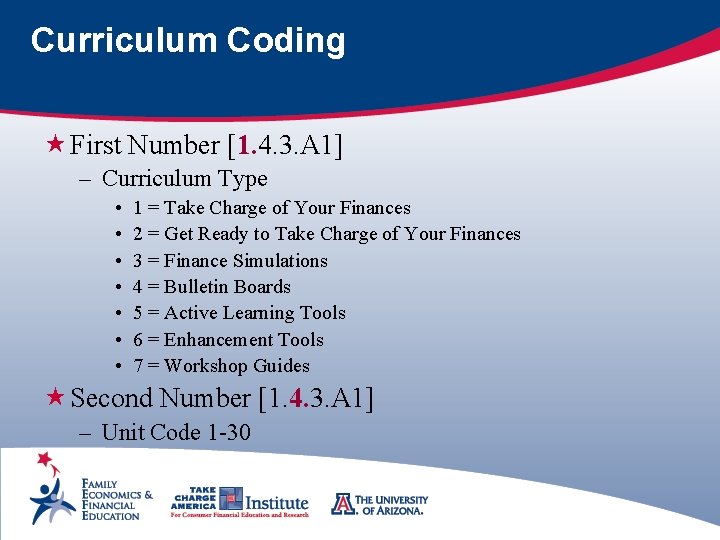
Curriculum Coding « First Number [1. 4. 3. A 1] – Curriculum Type • • 1 = Take Charge of Your Finances 2 = Get Ready to Take Charge of Your Finances 3 = Finance Simulations 4 = Bulletin Boards 5 = Active Learning Tools 6 = Enhancement Tools 7 = Workshop Guides « Second Number [1. 4. 3. A 1] – Unit Code 1 -30
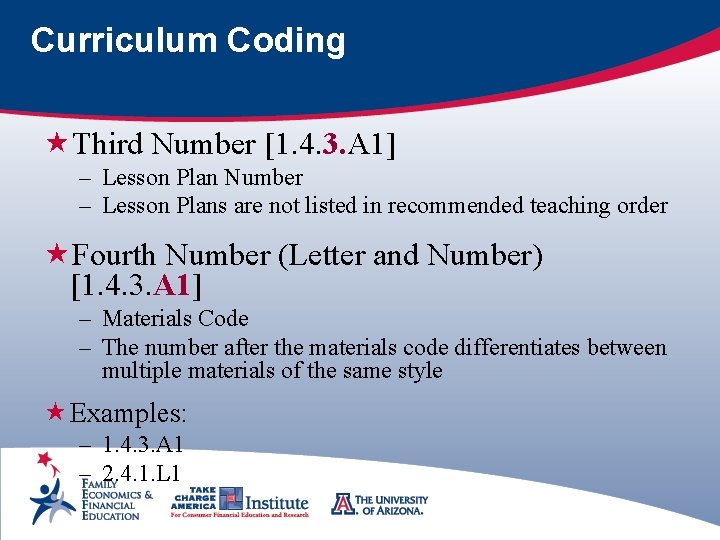
Curriculum Coding «Third Number [1. 4. 3. A 1] – Lesson Plan Number – Lesson Plans are not listed in recommended teaching order «Fourth Number (Letter and Number) [1. 4. 3. A 1] – Materials Code – The number after the materials code differentiates between multiple materials of the same style « Examples: – 1. 4. 3. A 1 – 2. 4. 1. L 1
FREE Curriculum! All curriculum is available for no cost! « Must create a user name and password to download materials « Can edit personal profile at any time – All spaces must be filled in for the profile to be created properly « Can choose to receive important FEFE announcements including curriculum revisions, the bi-monthly newsletter, and training updates « Can “Contact Us” to receive staff support
Employed Within Every Lesson ACTIVITY BASED LEARNING MODEL
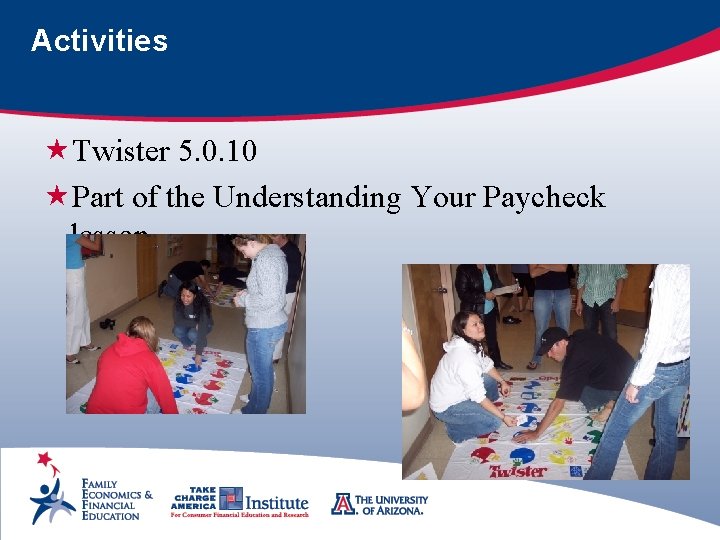
Activities «Twister 5. 0. 10 «Part of the Understanding Your Paycheck lesson
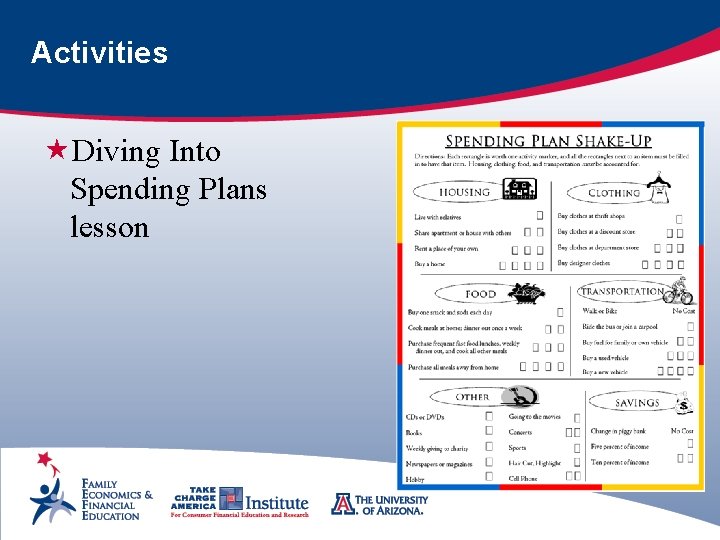
Activities «Diving Into Spending Plans lesson
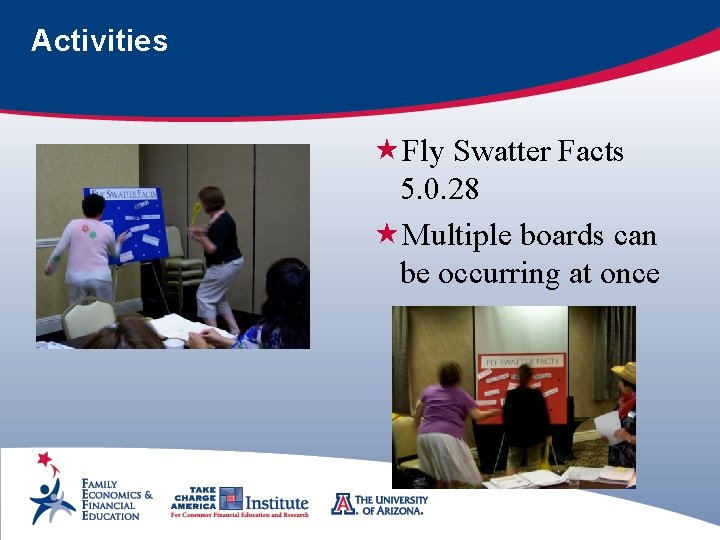
Activities «Fly Swatter Facts 5. 0. 28 «Multiple boards can be occurring at once
Family Finance Simulations Life in… & Life of…
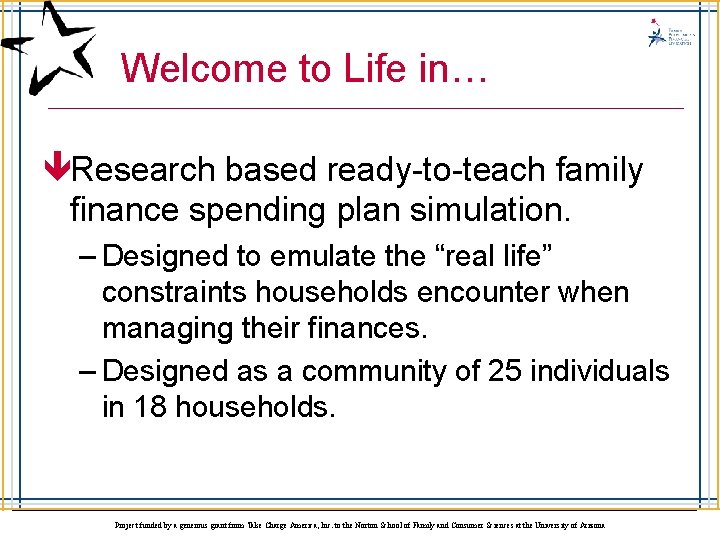
3. 18. 3. G 1 Welcome to Life in… êResearch based ready-to-teach family finance spending plan simulation. – Designed to emulate the “real life” constraints households encounter when managing their finances. – Designed as a community of 25 individuals in 18 households. Project funded by a generous grant from Take Charge America, Inc. to the Norton School of Family and Consumer Sciences at the University of Arizona
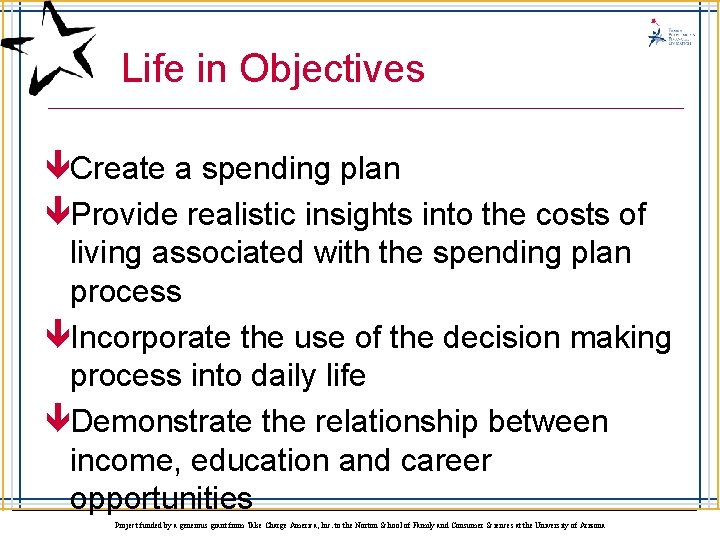
3. 18. 3. G 1 Life in Objectives êCreate a spending plan êProvide realistic insights into the costs of living associated with the spending plan process êIncorporate the use of the decision making process into daily life êDemonstrate the relationship between income, education and career opportunities Project funded by a generous grant from Take Charge America, Inc. to the Norton School of Family and Consumer Sciences at the University of Arizona
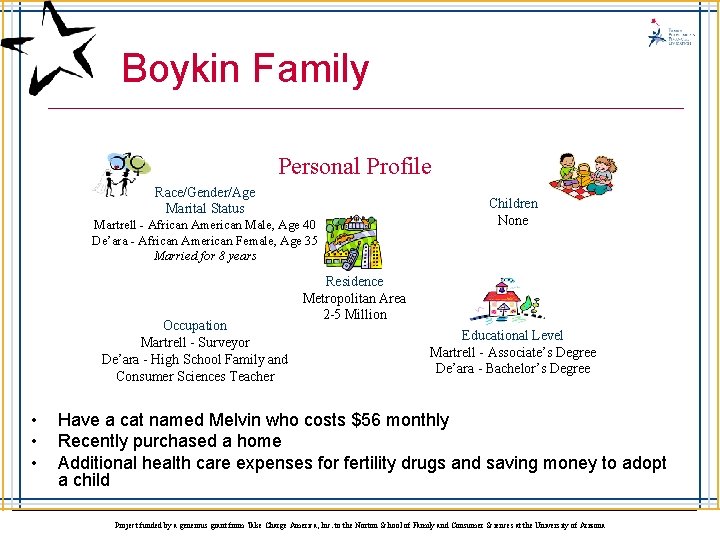
3. 18. 3. G 1 Boykin Family Personal Profile Race/Gender/Age Marital Status Martrell - African American Male, Age 40 De’ara - African American Female, Age 35 Married for 8 years Occupation Martrell - Surveyor De’ara - High School Family and Consumer Sciences Teacher • • • Children None Residence Metropolitan Area 2 -5 Million Educational Level Martrell - Associate’s Degree De’ara - Bachelor’s Degree Have a cat named Melvin who costs $56 monthly Recently purchased a home Additional health care expenses for fertility drugs and saving money to adopt a child Project funded by a generous grant from Take Charge America, Inc. to the Norton School of Family and Consumer Sciences at the University of Arizona
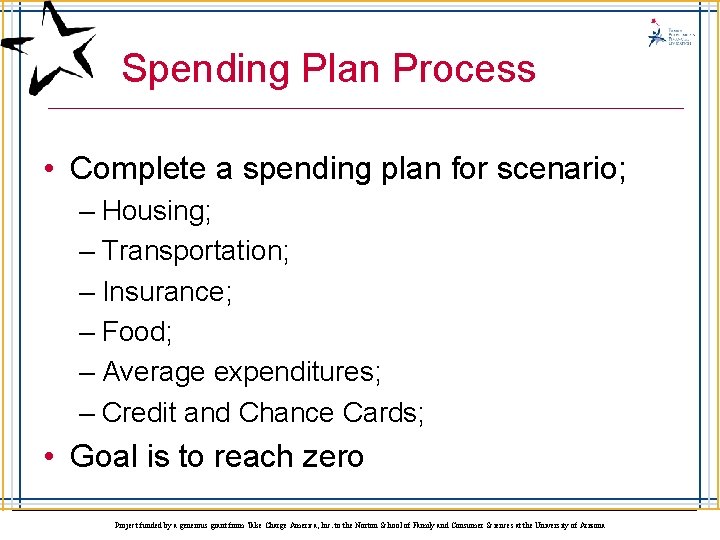
3. 18. 3. G 1 Spending Plan Process • Complete a spending plan for scenario; – Housing; – Transportation; – Insurance; – Food; – Average expenditures; – Credit and Chance Cards; • Goal is to reach zero Project funded by a generous grant from Take Charge America, Inc. to the Norton School of Family and Consumer Sciences at the University of Arizona
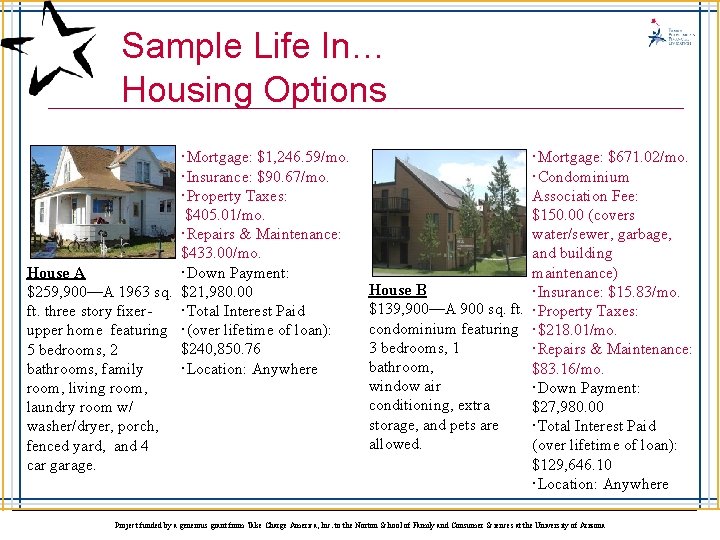
Sample Life In… Housing Options Mortgage: $1, 246. 59/mo. Insurance: $90. 67/mo. Property Taxes: $405. 01/mo. Repairs & Maintenance: $433. 00/mo. Down Payment: House A $259, 900—A 1963 sq. $21, 980. 00 Total Interest Paid ft. three story fixerupper home featuring (over lifetime of loan): $240, 850. 76 5 bedrooms, 2 Location: Anywhere bathrooms, family room, living room, laundry room w/ washer/dryer, porch, fenced yard, and 4 car garage. 3. 18. 3. G 1 Mortgage: $671. 02/mo. Condominium Association Fee: $150. 00 (covers water/sewer, garbage, and building maintenance) House B Insurance: $15. 83/mo. $139, 900—A 900 sq. ft. Property Taxes: condominium featuring $218. 01/mo. 3 bedrooms, 1 Repairs & Maintenance: bathroom, $83. 16/mo. window air Down Payment: conditioning, extra $27, 980. 00 storage, and pets are Total Interest Paid allowed. (over lifetime of loan): $129, 646. 10 Location: Anywhere Project funded by a generous grant from Take Charge America, Inc. to the Norton School of Family and Consumer Sciences at the University of Arizona
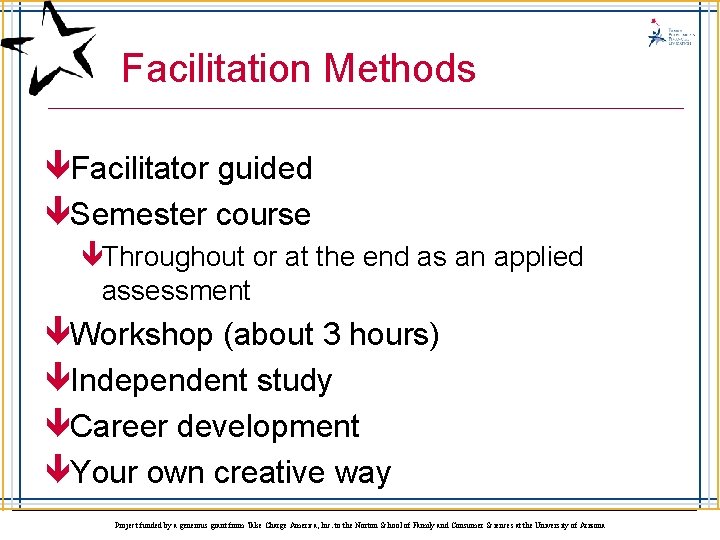
3. 18. 3. G 1 Facilitation Methods êFacilitator guided êSemester course êThroughout or at the end as an applied assessment êWorkshop (about 3 hours) êIndependent study êCareer development êYour own creative way Project funded by a generous grant from Take Charge America, Inc. to the Norton School of Family and Consumer Sciences at the University of Arizona
Family Economics & Financial Education Get ready to Take Charge of Your Finances Life Of…. . Taylor B. Jones “A Teenager’s Spending Plan” Funded by a grant from 32 Take Charge America, Inc.
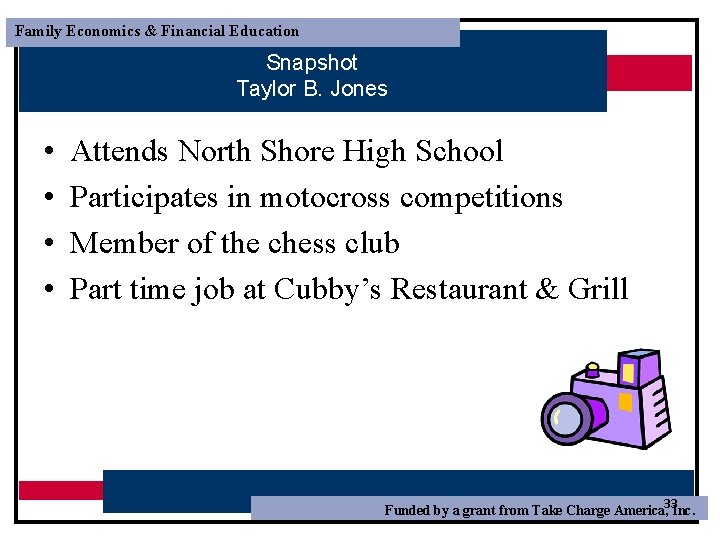
Family Economics & Financial Education Snapshot Taylor B. Jones • • Attends North Shore High School Participates in motocross competitions Member of the chess club Part time job at Cubby’s Restaurant & Grill Funded by a grant from 33 Take Charge America, 33 Inc.
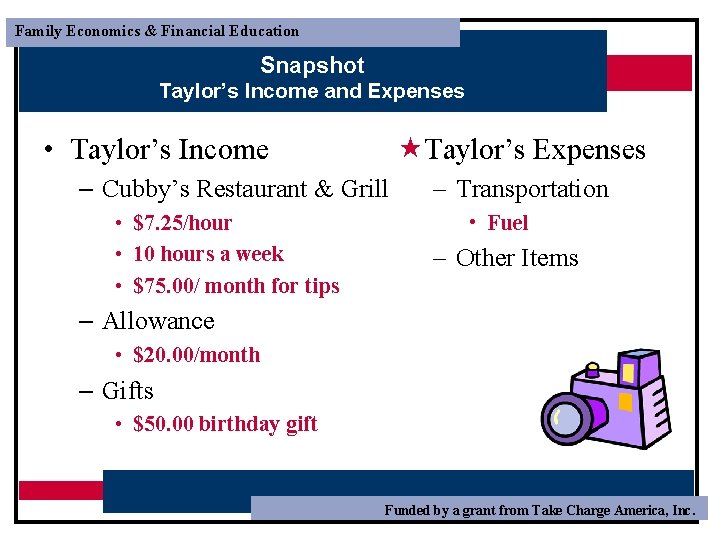
Family Economics & Financial Education Snapshot Taylor’s Income and Expenses • Taylor’s Income «Taylor’s Expenses – Cubby’s Restaurant & Grill • $7. 25/hour • 10 hours a week • $75. 00/ month for tips – Transportation • Fuel – Other Items – Allowance • $20. 00/month – Gifts • $50. 00 birthday gift Funded by a grant from 34 Take Charge America, Inc.
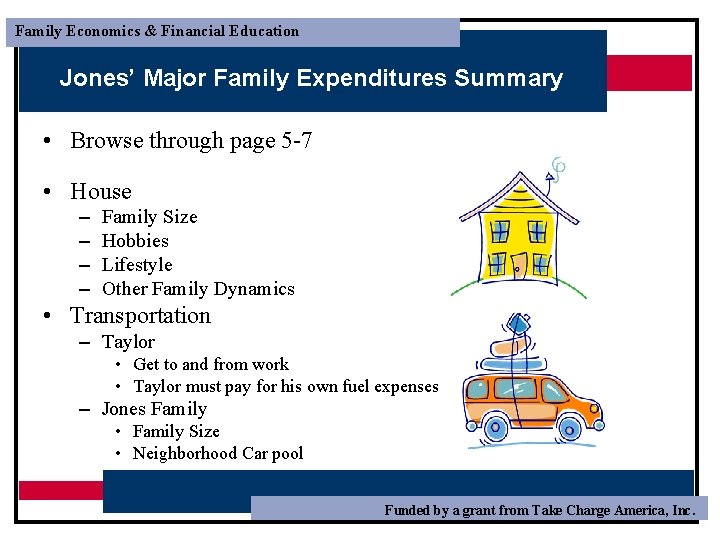
Family Economics & Financial Education Jones’ Major Family Expenditures Summary • Browse through page 5 -7 • House – – Family Size Hobbies Lifestyle Other Family Dynamics • Transportation – Taylor • Get to and from work • Taylor must pay for his own fuel expenses – Jones Family • Family Size • Neighborhood Car pool Funded by a grant from 35 Take Charge America, Inc.
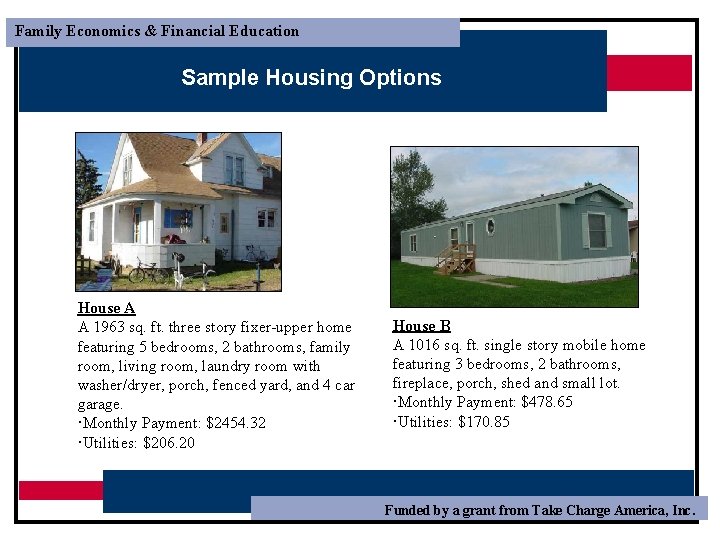
Family Economics & Financial Education Sample Housing Options House A A 1963 sq. ft. three story fixer-upper home featuring 5 bedrooms, 2 bathrooms, family room, living room, laundry room with washer/dryer, porch, fenced yard, and 4 car garage. Monthly Payment: $2454. 32 Utilities: $206. 20 House B A 1016 sq. ft. single story mobile home featuring 3 bedrooms, 2 bathrooms, fireplace, porch, shed and small lot. Monthly Payment: $478. 65 Utilities: $170. 85 Funded by a grant from 36 Take Charge America, Inc.
Family Economics & Financial Education Facilitation & Acquiring • Educator facilitated in 3 -4 45 minute class periods • Life of Monica Erickson, Life of Ben West, Life of Mandy Gonzales, and Life of Carlos Chavez are also available • Others will be coming soon! Funded by a grant from 37 Take Charge America, Inc.
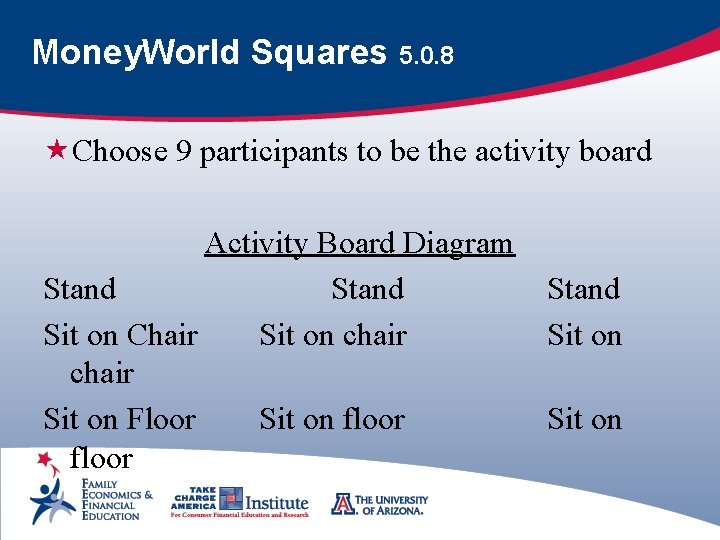
Money. World Squares 5. 0. 8 «Choose 9 participants to be the activity board Activity Board Diagram Stand Sit on Chair Sit on chair Sit on Floor Sit on floor
Money. World Squares 5. 0. 8 «The first team selects a square «Facilitator reads a question to the person in a square – The square answers the question (not the team) – After the square answers, the team chooses to agree or disagree with the square’s response
Money. World Squares 5. 0. 8 « If the square answers correctly and the team agrees with the answer or if the square answers incorrectly and the team disagrees with the answer, the team gets that square – The square then holds the letter, X or O, that corresponds with the team in front of them and the play moves to the next team « If the square answers correctly and the team disagrees with the answer or if the square answers incorrectly and the team agrees with the answer, the team does not get that square and play moves to the next team – If a team does not get a square, the square is not automatically won by the other team
Facilitation Tips «If there are not enough participants to be a activity board the individuals can play the activity by hanging the X and O cards on the board and playing a activity of tic tac toe as they get answers correct «If there are enough participants for multiple activity boards designate one individual to be the host with the questions and answers to help facilitation

FEFE WEB SITE
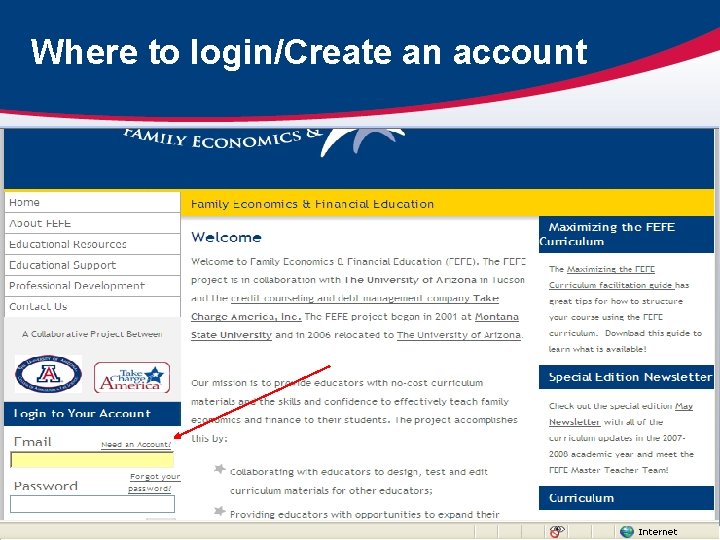
Where to login/Create an account
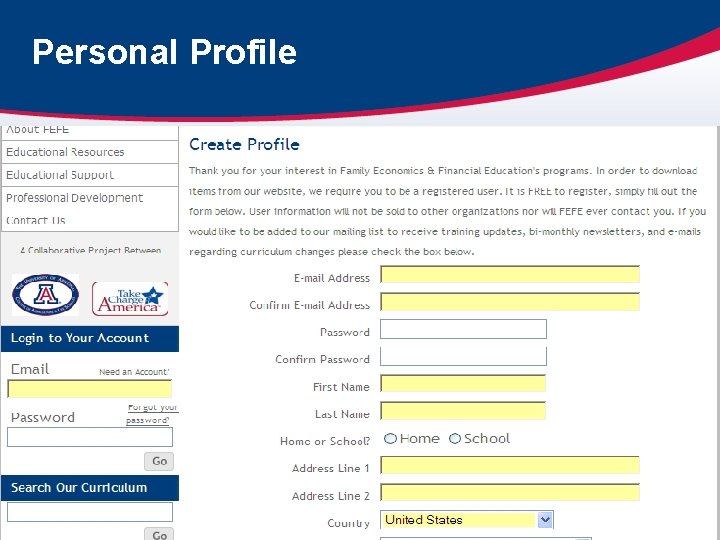
Personal Profile
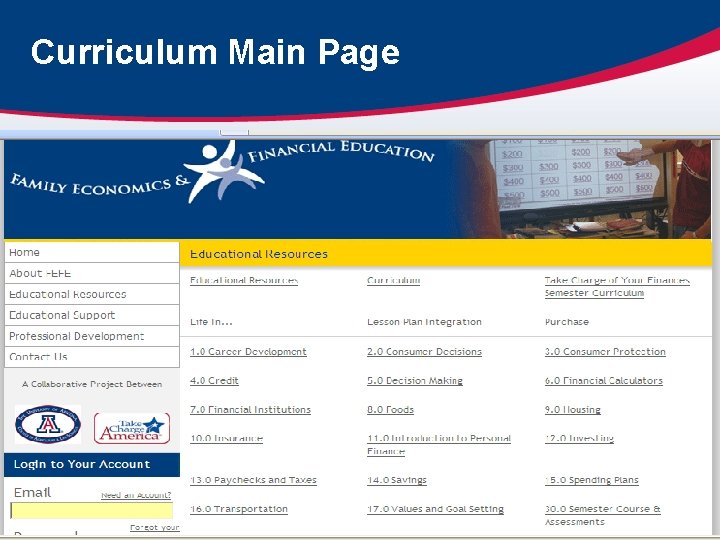
Curriculum Main Page
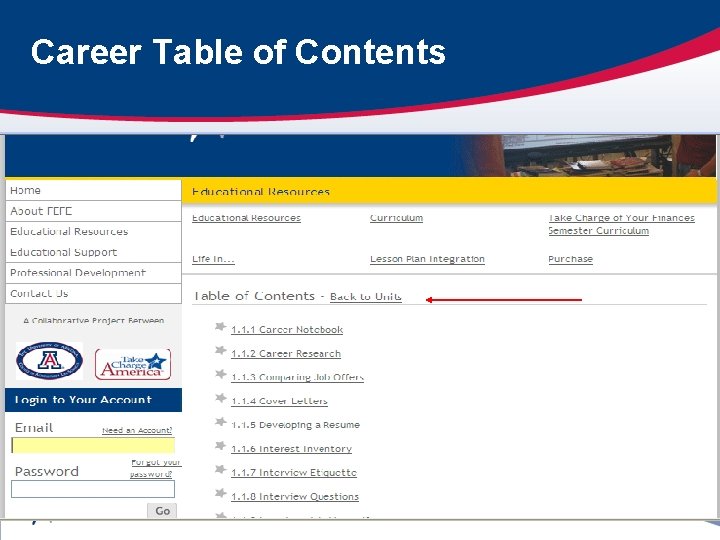
Career Table of Contents
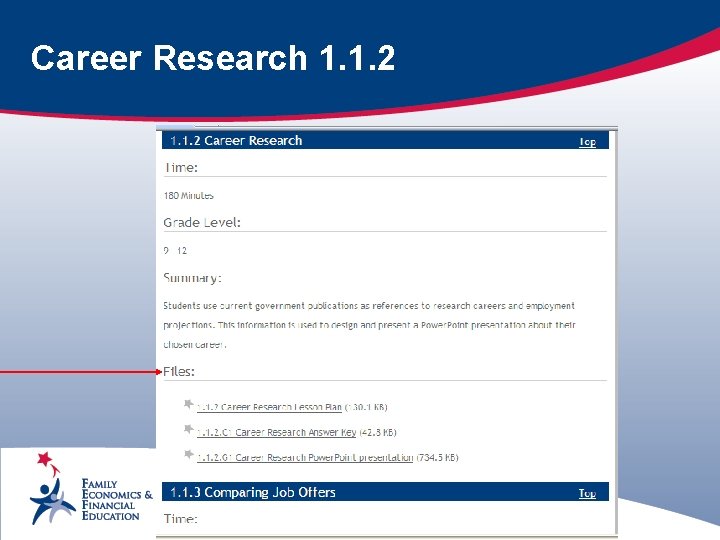
Career Research 1. 1. 2
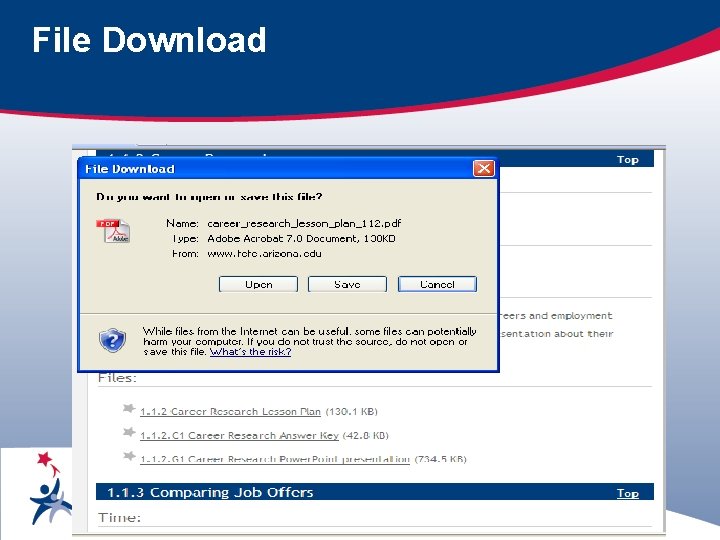
File Download
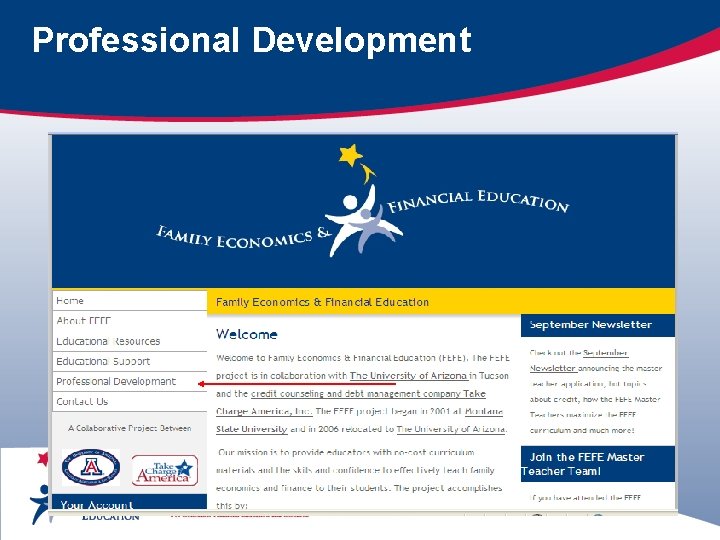
Professional Development
Professional Development « FEFE Newsletter with curriculum updates and important announcements – Must have indicated “Yes” on the FEFE Web site log-in « National Conference each June in Tucson, AZ « A limited amount of grants will be available each January « Week-long annual training conference; – Provide educators with background knowledge to teach personal finance; – Allow educators to experience the lesson plans to feel more comfortable teaching them; – Provide educators with all of the printed curriculum and materials necessary to teach the lesson plans; – Network with other professionals
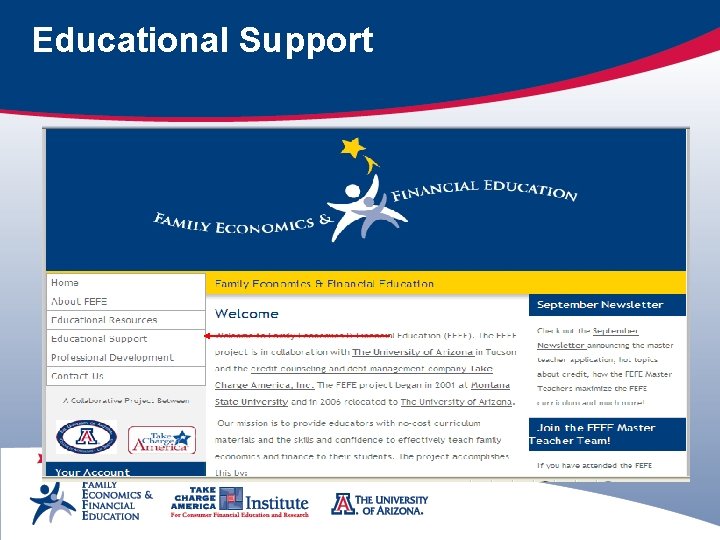
Educational Support
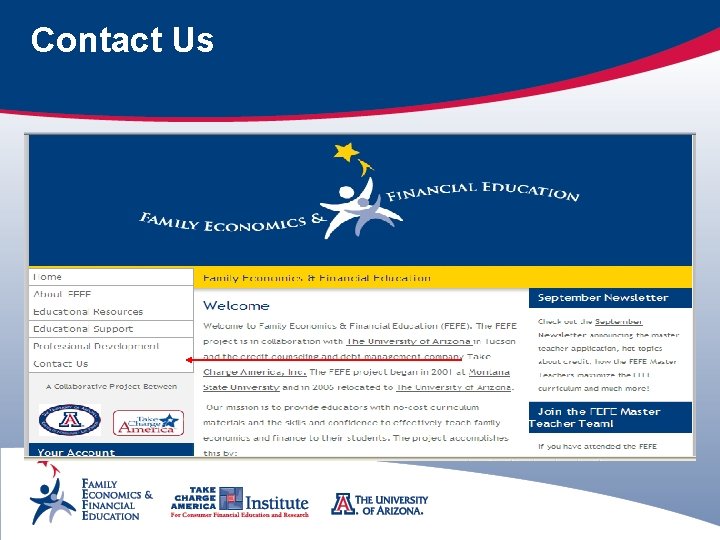
Contact Us

Contact Information Address: Family Economics and Financial Education The University of Arizona 650 N. Park Ave Room 427 Tucson, AZ 85721 E-Mail: fefe@cals. arizona. edu Web site: www. fefe. arizona. edu

Any Questions?
- Slides: 54