
Family By prof Salwa Tobar The family is

Family By prof. Salwa Tobar
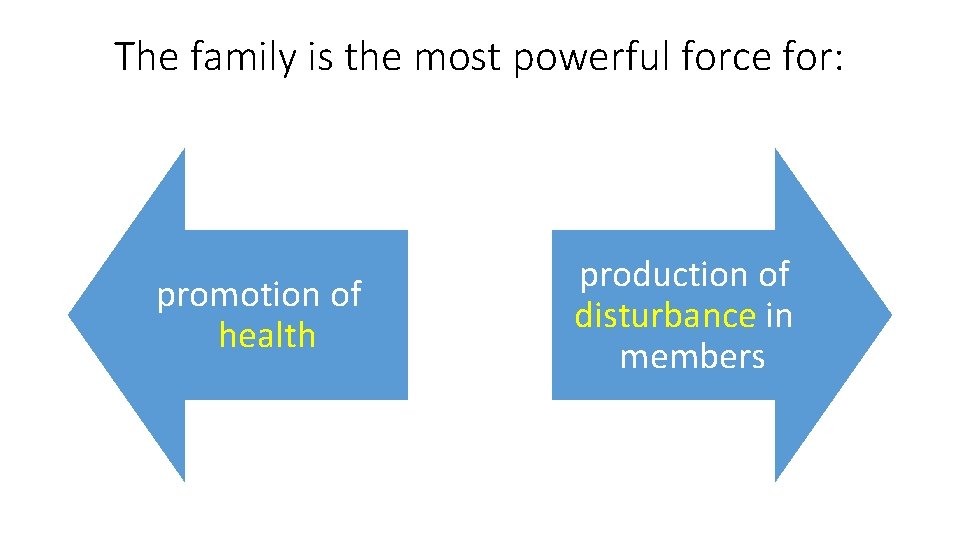
The family is the most powerful force for: promotion of health production of disturbance in members
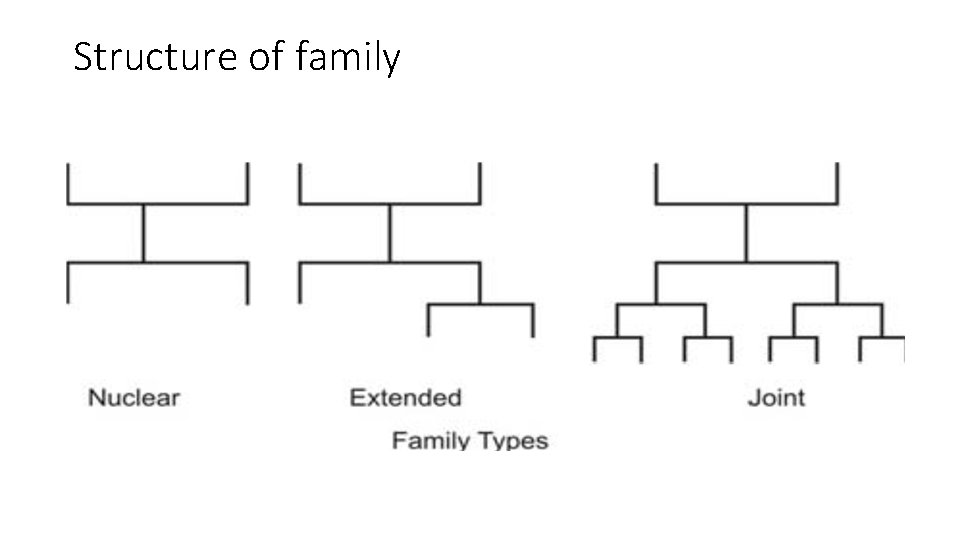
Structure of family
The family structure may be = the nuclear family consists of a married couple and their children = extended family h as parents, their son and his wife and children. =The joint family M ay contain 3 or more generations within one household.
It is more important to know • “what kind of patient has the disease” than “what kind of disease the patient has”. • ” What kind of patient”, is determined critically by the earliest social environment involved in shaping that person
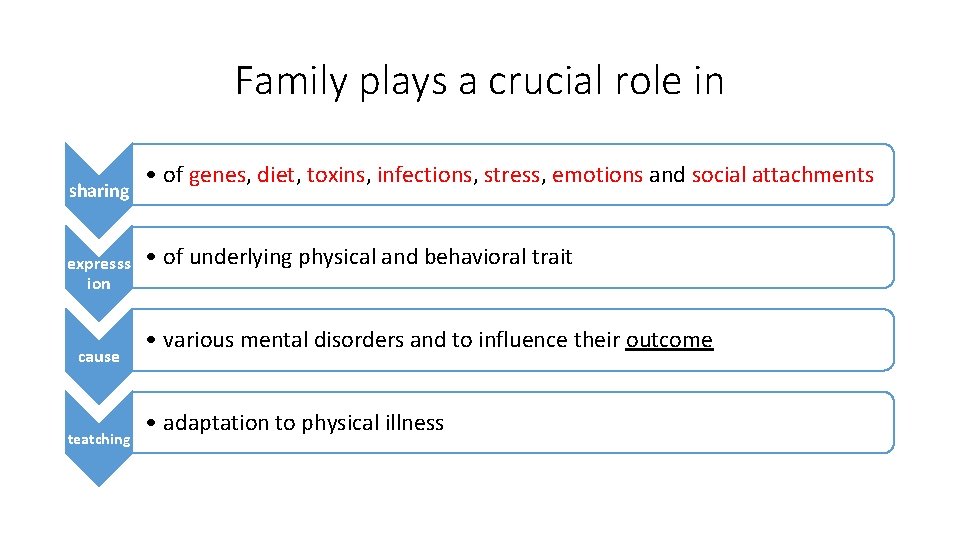
Family plays a crucial role in sharing expresss ion cause teatching • of genes, diet, toxins, infections, stress, emotions and social attachments • of underlying physical and behavioral trait • various mental disorders and to influence their outcome • adaptation to physical illness
• This is specially true for children’s behavioral disorders. • Even when child comes out of the family, its subsequent experiences are perceived, understood and emotionally reacted according to the foundations established within the family.
Classification of families according to • Affective Involvement • Control Styles • Communication
Affective Involvement • Optimally the family meets emotional needs of all members and provides: cohesion, security and sense of being valued. • that contribute to the development of: trust, self-esteem and independence. • The degree of affective involvement varies in the families, with some having more intense and involving family relationships. • The quality of involvement determines, whether the relationship is nurturing and supportive or destructive and self-serving).
Pathological Family types according to Affective Involvement • In the uninvolved family, both the degree and the quality of involvement are low. Such families encourage premature emotional separation, often resulting in pseudo independence that markedly impairs the capacity to tolerate true intimacy. • Some families still show a still higher intensity of affective involvement, but withdraw their acceptance as soon as any member fails to satisfy the others’ needs. Such parental narcissistic involvements are destructive in quality and usually excessive in degree.
enmeshment (symbiotic) relationships • Intense but destructive involvement. • It has pseudomutuality, undifferentiated family ego, and too richly cross jointed system. • They are destructive as they are incompatible with the development of autonomy. • usually involve tolerance, and reinforcement by other family members. • Those involved are overly sensitive and react with panic or rage to any attempt by the other partner at withdrawing.

Pathological Family types according to Affective Involvement Family type Degree of emotional involvement quality result uninvolved low -pseudo independence -Intolerance to true intimacy narcissistic Excessive withdraw their acceptance as soon as any member fails to satisfy the others’ needs destructive enmeshment intense undifferentiated family ego Decreased autonomy

Control Styles • Family members influence each other to ensure the accomplishment of the tasks and requirements of daily life. • Each family has its own prototypical control styles. • Generally control styles have been classified into four types: • (i) rigid, • (ii) flexible, • (iii) laissez-faire • (iv) chaotic.
• Rigid families are quite successful at maintenance control, but their rigidity interferes with successful adaptation and assumption of personal responsibility. • A flexible control style combines moderate predictability with high constructiveness. • In a flexible style, task accomplishment is relatively easy to achieve because its supportive and educational tone encourages family members to participate and to adopt the rules of the family.
• In laissez-faire style, members do as they please so long as to avoid bothering others and as little responsibility is assumed or expected. Because of their constant disorganization, role integration is rarely achieved, task accomplishment is haphasard and communication is frequently insufficient, unclear and indirect. • A chaotic style is extremely low, both in predictability and constructiveness. Changes depend more on the mood of the dominant members in the family than situational demands. Instability and inconsistency typify these families and the overall effect is destructive.
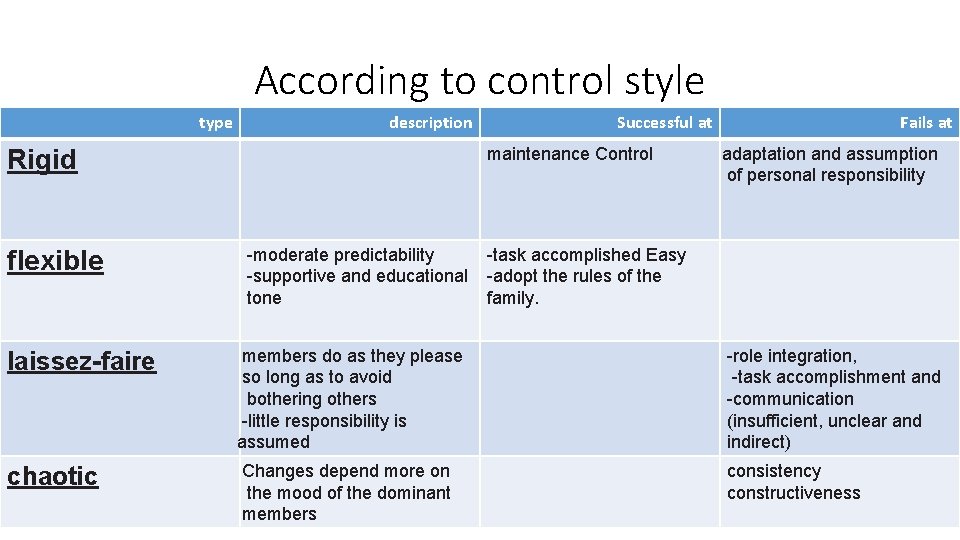
According to control style type description maintenance Control Rigid flexible Successful at -moderate predictability -supportive and educational tone Fails at adaptation and assumption of personal responsibility -task accomplished Easy -adopt the rules of the family. laissez-faire members do as they please so long as to avoid bothering others -little responsibility is assumed -role integration, -task accomplishment and -communication (insufficient, unclear and indirect) chaotic Changes depend more on the mood of the dominant members consistency constructiveness
The goal of communication amongst the family members is towards the achievement of a mutual understanding, which is possible only when: • the messages sent are clear, direct, and sufficient • and the receivers are psychologically available.
• Communication can be clear or masked (vague), disguised or ambiguous. • The more masked is the message, the more likely it is to arouse confusion, anxiety and subsequent distortion in the receiver. • In a disturbed family, the members interact with one another in ways that are exploitative or disturbing
Pathology and Communication in Families • Family psychopathology generally revolves around two concepts, which are central in understanding of psychopathology and used in therapy: • • the double-bind and the family homeostasis.
The double-bind messages • in which an individual receives two or more conflicting messages, with one negating the other. This creates a situation in which a successful response to one message results in a failed response to the other , so that the person will automatically be wrong regardless of response. • are peculiar to families, in which one of the members is schizophrenic. • may also be found in other families.
Homeostasis • The family (as the social system) is seen as maintaining a cooperative balance or homeostasis.
Systems Theory • Systems theory is a general theory to explain the interactions and relationships between the individual components comprising a larger structure. • This theory provides a framework to understand the behavior of the individual subsystems of the family such as the children or the parents, as well as their relationships to the outside world. • This theory has gained popularity as it not only explains how families work and function, but also provides a method of analyzing faults and flaws in the daily activities of family life. For instance, poor delineation of the boundaries between the parental and child subsystems can be responsible for problems of control and discipline with the children.
The four other concepts in the general system theory include • I- Wholeness • II- Equifinality • III- Feedback • IV Homeostasis
• I- Wholeness: • It states that the system cannot be understood by dissection and study of its individual parts, We study the system as a whole. • If one member in the system changes, then all the members of that system will change because of that one member’s behavior in terms of response to that change.
• II- Equifinality • The concept of equifinality implies that there are many paths to the same destination. • it means that the particular path a family takes as it evolves, its form is less significant than the final form itself. • This is because there are more than a set of events leading to a certain end state and therefore, studying the events will not produce much useful information as studying the end state.
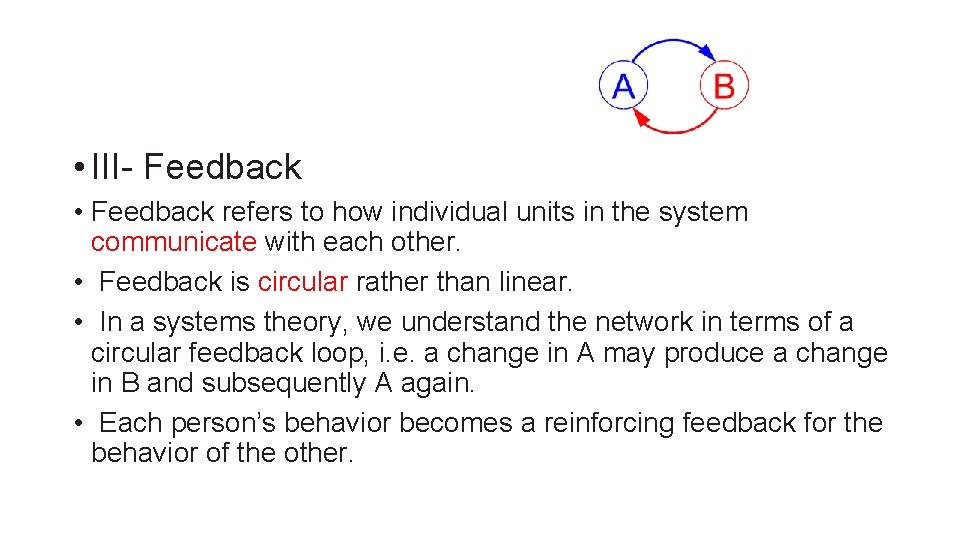
• III- Feedback • Feedback refers to how individual units in the system communicate with each other. • Feedback is circular rather than linear. • In a systems theory, we understand the network in terms of a circular feedback loop, i. e. a change in A may produce a change in B and subsequently A again. • Each person’s behavior becomes a reinforcing feedback for the behavior of the other.
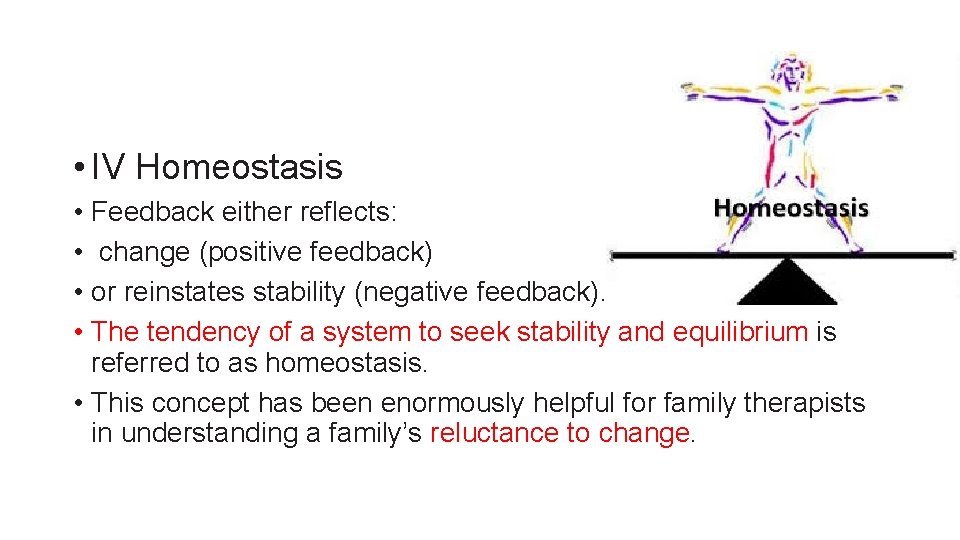
• IV Homeostasis • Feedback either reflects: • change (positive feedback) • or reinstates stability (negative feedback). • The tendency of a system to seek stability and equilibrium is referred to as homeostasis. • This concept has been enormously helpful for family therapists in understanding a family’s reluctance to change.
Model of Individual Psychopathology and Family Dysfunction • The fundamental principle of a systems theory is that traditional problems and other psychiatric disorders as schizophrenia, depression, drug abuse and anxiety are best understood as manifestations of disturbances in the family • The family member with “symptom” is little more than a messenger or family scapegoat; his/her symptoms serve to cover up the generalized family disturbance.
• In this sense, the symptoms of the identified “patient” are viewed as serving a function for the family as a whole, despite the overt distress that may occur as a consequence of these symptoms, e. g. a disruptive or delinquent child may consume an inordinate amount of attention from other family members, and thereby prevent parents from attending to the emptiness and lack of intimacy in their own marital relationship. • As long as the child continues to engage in delinquent acts; the parents are protected from having to focus on their marriage. • The functional value of the child’s symptoms is usually beyond the awareness of all family members.
We can consider the following example: • Spouse A is driving and spouse B is in a hurry to get to their destination (also conveys this before starting). • A accelerates and moves fast with a jerk, B holds on to the glass and criticizes A, B protests more loudly, A shouts back and the child C starts to cry. • At this point, the argument stops while B attends to C and A slows down.
• This sequence exemplifies one form of a repetitive dysfunctional family process, where the child behaves in such a way that attention is withdrawn from the conflict between the spouses and refocussed onto the child.
• Despite the expressed concern with the patients’ symptoms on the part of all family members, the family is inherently motivated to maintain homeostasis and will thereby resist any effort on the part of therapist to modify the symptomatic behavior of the identified patient. • This makes the task of the family therapist exceedingly difficult.
Family Therapy • If symptoms serve to stabilize the family and maintain homeostasis, it follows that the individual cannot be expected to change unless fundamental changes occur in the family system. • This notion that family members will resist therapists change attempts, has led to the development of this strategic therapy called family therapy. • The model also implies that changes in individuals will effectively come about only when the structure of the family undergoes a change. • Therefore, whetherapist is treating one client or the entire family, the target of change is the family system.
Family Counselling • Family counselling is widely used in medical practice. • You come across a family with Down’s syndrome, and the family wants to have another child. You have to provide genetic counselling to this family. • Similarly, role of family counselling in patients with AIDS, addictions, child psychiatric problems, development delays, patient undergoing painful procedures, all require family counselling.
Clinical Application • The importance of understanding family in relation to medicine is best understood when you are working in community medicine and you make family visits. • In all the hospitals, a concept of family medicine is emerging and has led to creation of separate departments of family medicine. • The significance of the family in relation to health and illness lies in the fact that almost every patient or potential patient, is a member of a family and the interaction within the family is a two way process. • The family may be considered from two points of view, one as possible causative or modifying agent in the patient’s illness, and on the other hand as more immediate social environment within which the illness occurs—including the reaction of the other family members to it.
• Family provides social support, which has been considered very important in the recovery of the patient. • In patients where there is no social support, the physicians have to work out in providing social support through non voluntary organizations. • Family pathology, or sickness of the family itself may lead to codependence; this means that in chronic illness, the spouse may also develop similar symptoms. • In some cases, chronic illness can lead to family breakdown, separation or divorce. This is especially true in patients having addictions or chronic mental illness. • The separation or divorce between parents, due to the social changes prevalent in the present time is also giving rise to psychological problems in children.
• In patients with AIDS, the relevance of understanding family and providing counselling cannot be simple. • The difficulties extended to the family members in looking after the sick patient also often calls for family counselling, to provide support and help to the entire family in the crisis situation.
Cultural factors • may also be important in immigrant families, where conflict arises between the first and the second generations owing to the influence of different values. • At times, social mobility causes conflict in children related to the values.

- Slides: 40