
Family and Community Engagement Images in this module
- Slides: 37
Family and Community Engagement Images in this module were obtained at google. com/images unless otherwise specified.
Context • What is family engagement? • Benefits of family engagement • Family engagement in PBIS • Communicating with families • High school considerations • Community involvement
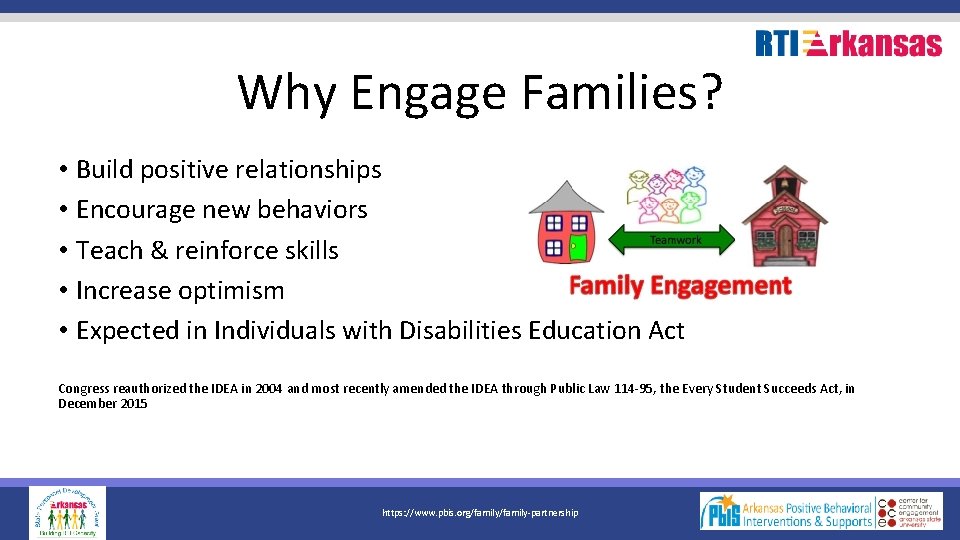
Why Engage Families? • Build positive relationships • Encourage new behaviors • Teach & reinforce skills • Increase optimism • Expected in Individuals with Disabilities Education Act Congress reauthorized the IDEA in 2004 and most recently amended the IDEA through Public Law 114 -95, the Every Student Succeeds Act, in December 2015 https: //www. pbis. org/family-partnership
Involvement vs. Engagement Family involvement: • Families do what educators ask or expect families to do. • The school/educator is driving the outcome. From "Collaborating For Success" Parent Engagement Toolkit – www. Michigan. gov; pbis. org; Christenson & Sheridan, 2001; Sheridan, Knoche, Kupzyk, Edwards, & Marvin, 2011
Involvement vs. Engagement Family engagement: • • • Families are partners. Families bring their own knowledge "together" with schools. Families share decision making and determination of goals and outcomes, such as… • • • active, interactive, and dynamic processes and practices that family members use. engagement as equal partners with educators and other key stakeholders. supporting their children’s development. From "Collaborating For Success" Parent Engagement Toolkit – www. Michigan. gov; pbis. org; Christenson & Sheridan, 2001; Sheridan, Knoche, Kupzyk, Edwards, & Marvin, 2011
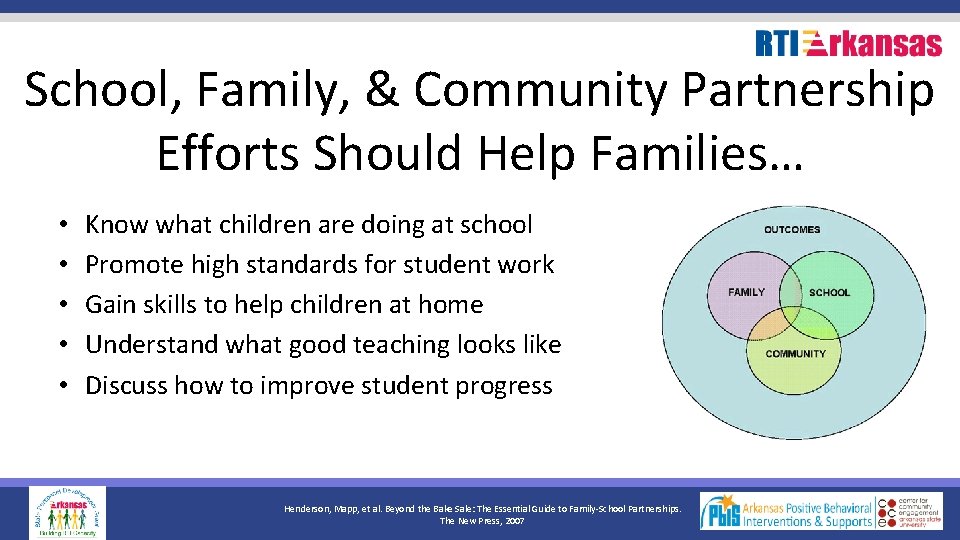
School, Family, & Community Partnership Efforts Should Help Families… • • • Know what children are doing at school Promote high standards for student work Gain skills to help children at home Understand what good teaching looks like Discuss how to improve student progress Henderson, Mapp, et al. Beyond the Bake Sale: The Essential Guide to Family-School Partnerships. The New Press, 2007
Positive Effect On Student Behavior • More positive attitudes and behavior • With support from home and school: • More self-confidence • Feel school is more important • Tend to do better in school • At-risk behaviors decrease National PTA, 10/28/2005
Benefits Of Family Engagement To Teachers And Schools • Greater job satisfaction • Higher ratings of teaching skills • Higher ratings of school effectiveness • Improved classroom behavior https: //www. pbis. org/family-partnership
Universal Components Of PBIS School-wide • Common purpose & approach to discipline • Behavioral expectations • Teaching of expected behaviors • Encouraging of expected behaviors • Discouraging of inappropriate behavior • Data-based monitoring & evaluation
How To Apply PBIS To Family Engagement Provide these for families: • A continuum of positive behavior supports for all families • Frequent, regular, positive contacts & acknowledgements • Formal, active participation & involvement as equal partners • Access to a system of integrated school & community resources
Developing Your Program • Evaluate current status • Formulate goals and strategies • Form action steps and responsibilities • Review performance • Evaluate your plan
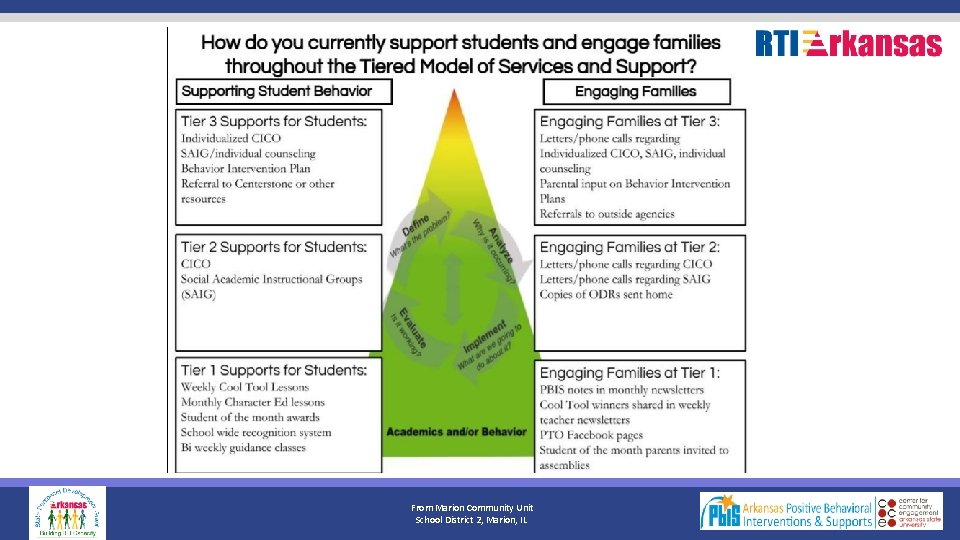
District Family Engagement Plan Example • Engagement is: • Involvement is: • Intermittent attendance or participation • One way, school-directed • School-driven decision making • Changes & evolves as child matures • Ongoing & continuous • Reciprocal • Strengths-based partnership between families & school • Shared responsibility • Changes & evolves as child matures From Marion Community Unit School District 2, Marion, IL
From Marion Community Unit School District 2, Marion, IL
Examples Of Actions & Strategies • Introduce behavioral expectations. • Show progress on school-wide outcomes. • Include family representatives on PBIS team. • Have a sign-up list of volunteer activities.
More Examples • Blend PBIS into the daily family routine. • Have trained family members wear “ask me about PBIS” buttons. • Incorporate PBIS into Individualized Education Program (IEP). • Provide information about community resources.
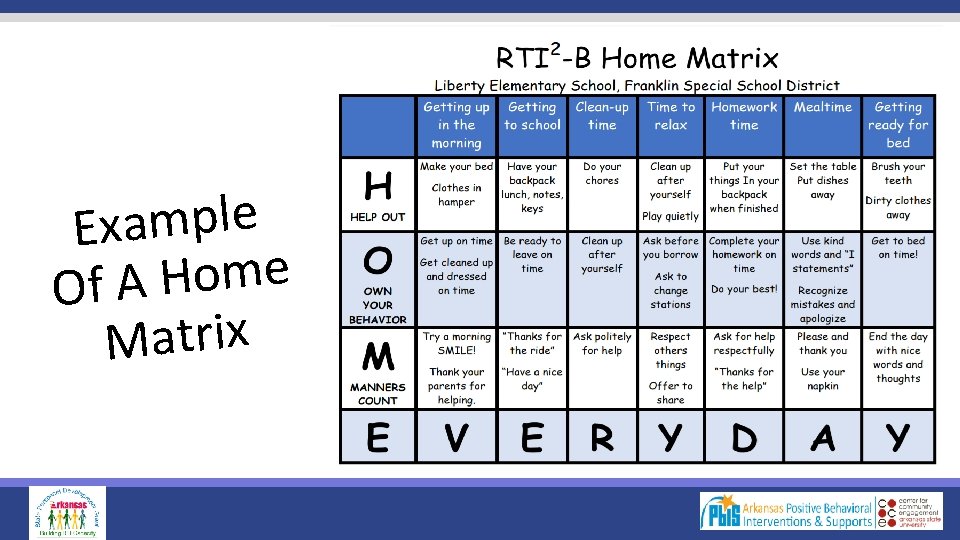
e l p m a x E e m o H A Of Matrix
Communicating With Families • Make it more personal. • Be culturally and linguistically responsive. • Define technical terminology. • Empower family members.
Communication Tips • Follow up after parent-teacher conferences. • Send home student work for review and comment. • Send home useful notices, memos, and/or newsletters. • Respect family’s perspective on their child's abilities and progress. • Use social media (e. g. , Facebook, messenger). • Text family.
Prepare Staff To Work With Families • Discuss hypothetical cases from family members’ points of view. • Have staff evaluate their assumptions and beliefs about families. • Develop staff communication skills. • Help staff understand research and rationale. • Provide staff time to process difficult situations. Harvard Family Research Project, 10/06
Remove Barriers • Have face-to-face visits. • Meet during nontraditional hours. • Visit families in the community. • Provide transportation, infant care, and meals at meetings.
Know The Community • Understand community beliefs, values, and attitudes. • Ensure staff are culturally sensitive. • Have current and former family volunteers help recruit. • Think of recruitment and retention as routine.
• Surveys: Some Ideas • Behavioral needs • Behavioral expectations • What families know about PBIS • How families can support PBIS • Develop information for families about PBIS. • Evaluate “family friendliness” of the school.
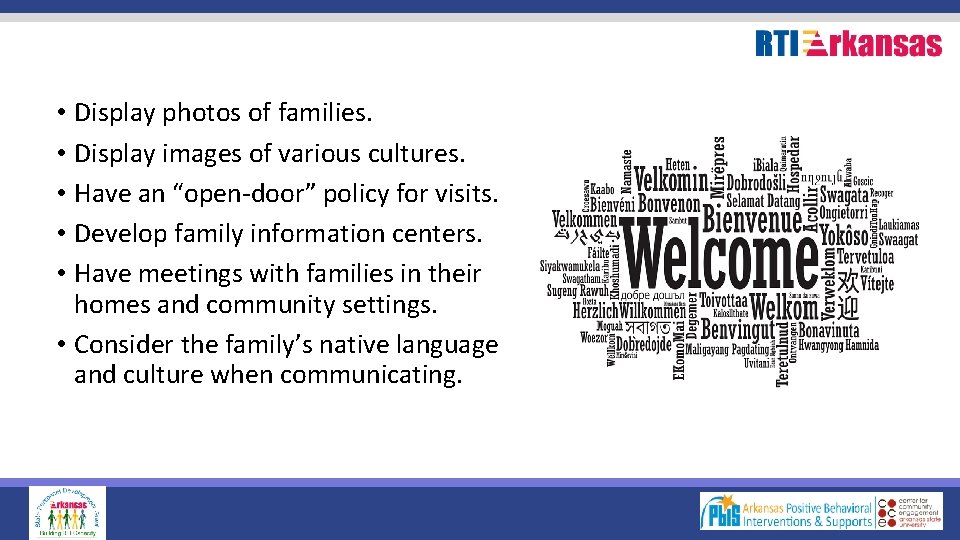
• Display photos of families. • Display images of various cultures. • Have an “open-door” policy for visits. • Develop family information centers. • Have meetings with families in their homes and community settings. • Consider the family’s native language and culture when communicating.
Retention • Send regular notes home about PBIS. • Send home thank you notes for supporting PBIS. • Increase use of technology as a form of communication with families. • Hold a PBIS day that families plan and coordinate. • Recruit families to develop displays related to PBIS.
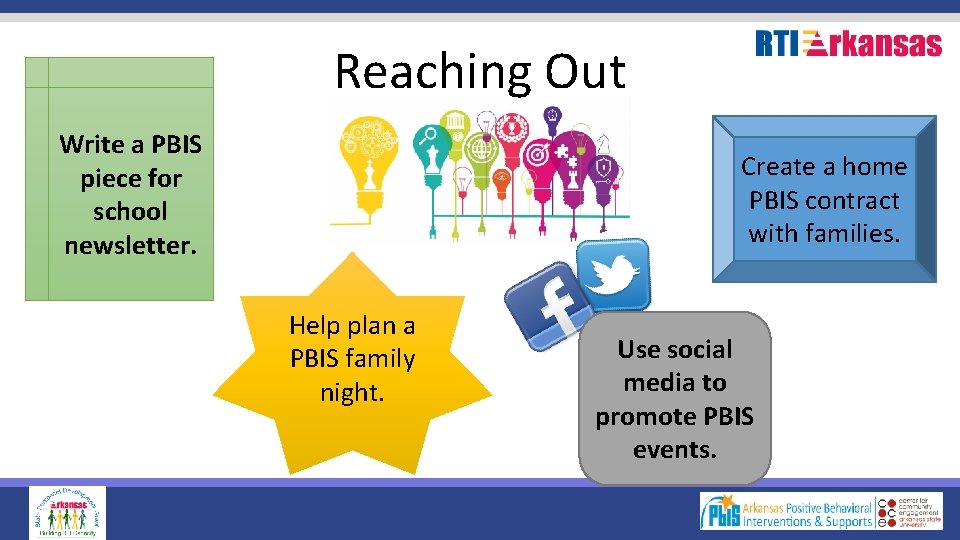
Reaching Out Write a PBIS piece for school newsletter. Create a home PBIS contract with families. Help plan a PBIS family night. Use social media to promote PBIS events.
Informing Families About PBIS • Set up a PBIS table during parent-teacher conferences. • Create PBIS family resources. • Develop a PBIS family calendar. • Have skits at half-time of sporting events about PBIS.
High School Family engagement is always important, but typically declines in the high school years. Challenges: • Large sizes of schools • Academic focus • Structure characterized by different departments • Developmental level of the students
High School Considerations To give family engagement a boost in high school, consider… • Including family members and students in PBIS teams • Creating multiple communication options • Giving clear guidance about who families are to contact • Removing barriers to promote family participation in events • Working with school counselors to engage families
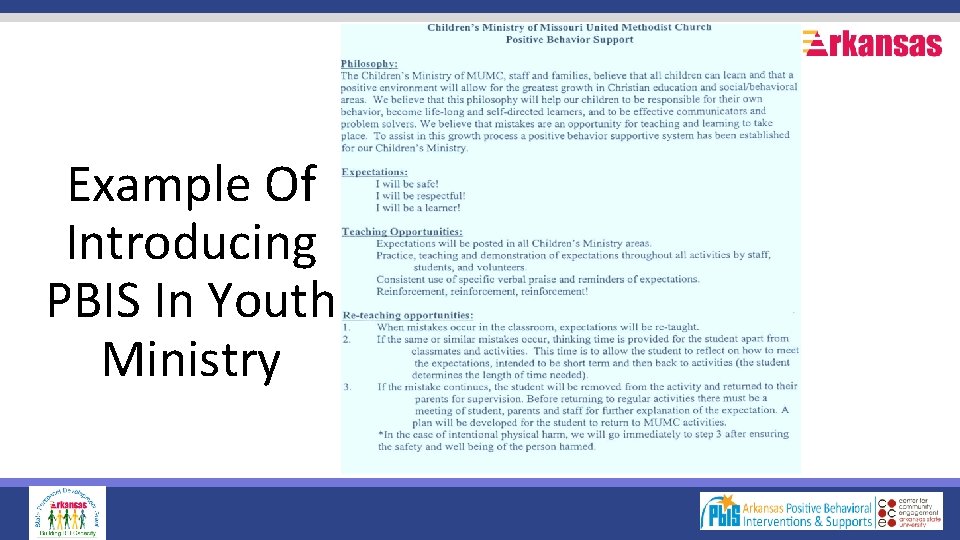
Community Engagement • Give annual surveys to identify community interests, talents, and volunteers. • Invite community member representatives on the PBIS team. • Invite community members to school events and assemblies. • Train local community centers that provide before and after care on Tier I practices. • Train local church youth ministries on Tier I.
Example Of Introducing PBIS In Youth Ministry
Partnerships Ask/invite local businesses to: • Donate resources; help with fundraising • Help disseminate information on PBIS to a broader community • Volunteer or help recruit volunteers • Attend school activities
Show Appreciation • • • Family representatives recognize students, staff, and teachers. Make sure everyone feels welcomed in the building. Create banners for businesses that help with fundraising. Host a raffle at a family night event. Recognize involved family and community members in the school newsletter, on websites, or on social media. From TN Behavior Supports Project
Guiding Questions • In what ways will you communicate with staff, families, students, and the community about PBIS? • In what ways would you like to see families involved and engaged? • What actions will you take to encourage families to become (more) involved? • How will you prepare staff to work with families? • How will you develop relationships/partnerships in the community?
Do It With Fidelity! Tiered Fidelity Inventory (TFI) • Efficient, valid index of extent to which PBIS core features are in place • Section 1. 11 Student/Family/Community Involvement
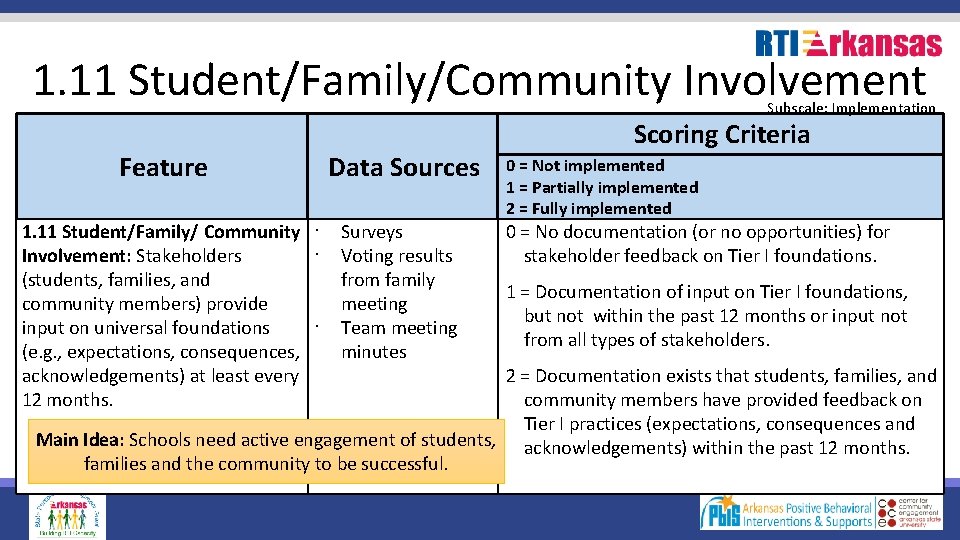
1. 11 Student/Family/Community Involvement Subscale: Implementation Feature 1. 11 Student/Family/ Community Involvement: Stakeholders (students, families, and community members) provide input on universal foundations (e. g. , expectations, consequences, acknowledgements) at least every 12 months. Data Sources ∙ Surveys ∙ Voting results ∙ from family meeting Team meeting minutes Scoring Criteria 0 = Not implemented 1 = Partially implemented 2 = Fully implemented 0 = No documentation (or no opportunities) for stakeholder feedback on Tier I foundations. 1 = Documentation of input on Tier I foundations, but not within the past 12 months or input not from all types of stakeholders. 2 = Documentation exists that students, families, and community members have provided feedback on Tier I practices (expectations, consequences and Main Idea: Schools need active engagement of students, acknowledgements) within the past 12 months. families and the community to be successful.
Summary • Engage families with the goal that they become equal partners in helping students develop (e. g. , socially, emotionally, educationally). • Use PBIS logic for developing a family engagement plan. • Communicate with families in ways that encourage and enable involvement with students and the school. • Eliminate barriers as much as possible. • Develop community partnerships.
Acknowledgements And Resources • PBIS/OPEC Technical Assistance Center • http: //www. pbis. org/Common/Cms/files/pbisresources/Family%20 Engagement %20 in%20 PBIS. pdf • US Department of Education • https: //y 4 y. ed. gov/tools/#family • Tennessee Behavior Supports Project • https: //vkc. mc. vanderbilt. edu/assets/files/resources/tbisfamilycommunity. pdf • Michigan Department of Education • http: //www. michigan. gov/documents/mde/4 a. _Final_Toolkit_without_bookmar ks_370151_7. pdf