
Families of Graphs In this section we will
- Slides: 15
Families of Graphs • In this section, we will study the following topics: § The six graphs of commonly used functions § Vertical and horizontal shifts (translations) § Reflections of graphs § Nonrigid transformations (dilations) 3/10/2021 1
1. 2 Functions Six Graphs of Common Functions We will be working with graphs of functions throughout this entire course, so it is essential that you know the basic shapes of the six common graphs. The six common functions are: 1. Constant function 2. Linear function 3. Absolute value function 4. Square root function (Ch 5) 5. Quadratic function 6. Cubic function Polynomial Function We will see how we can create many different functions by transforming these six common graphs. First, let’s look at the parent graphs.
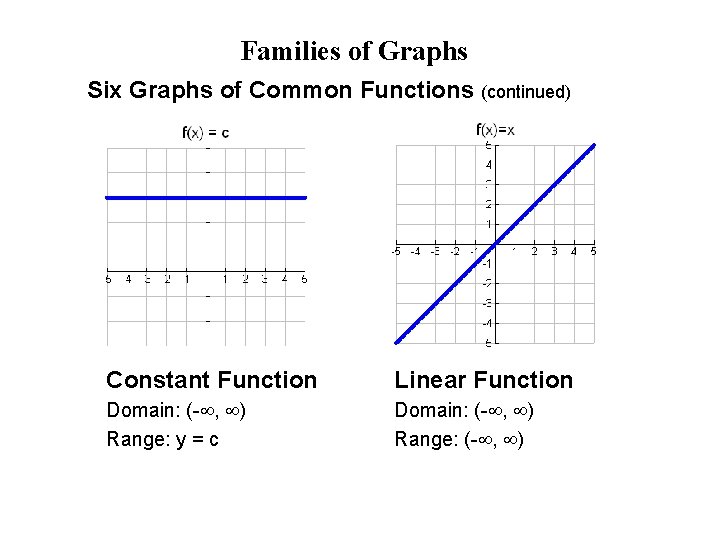
Families of Graphs Six Graphs of Common Functions (continued) Constant Function Linear Function Domain: (- , ) Range: y = c Domain: (- , ) Range: (- , )
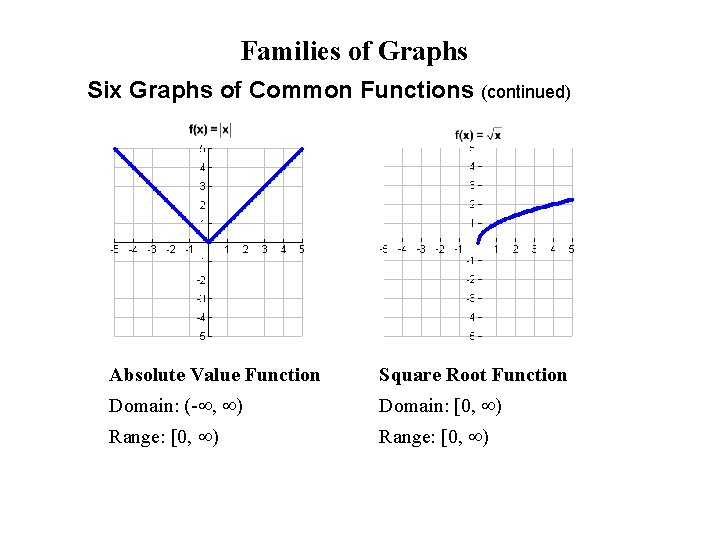
Families of Graphs Six Graphs of Common Functions (continued) • Absolute Value Function Square Root Function Domain: (- , ) Domain: [0, ) Range: [0, )
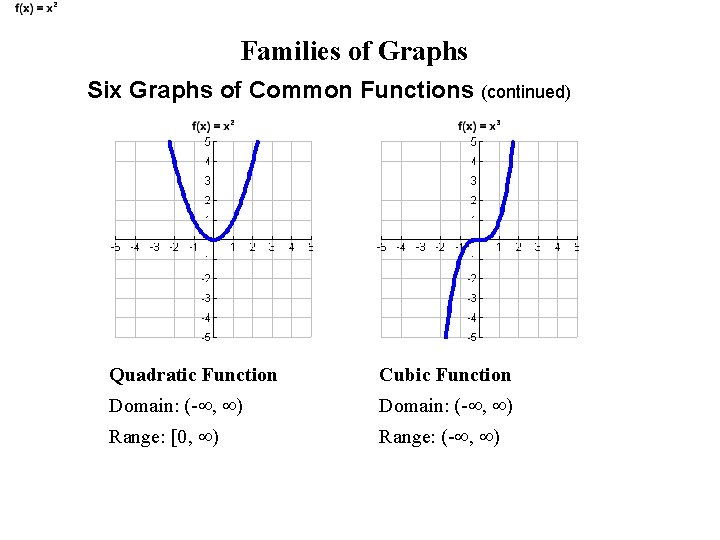
Families of Graphs Six Graphs of Common Functions (continued) Quadratic Function Cubic Function Domain: (- , ) Range: [0, ) Range: (- , )
Translations Vertical and Horizontal Shifts, also called translations, are simple transformations of the graph of a function whereby each point of the graph is shifted a certain number of units vertically and/or horizontally. The shape of the graph remains the same. Vertical shifts are shifts upward or downward. Horizontal shifts are shifts to the right or to the left.
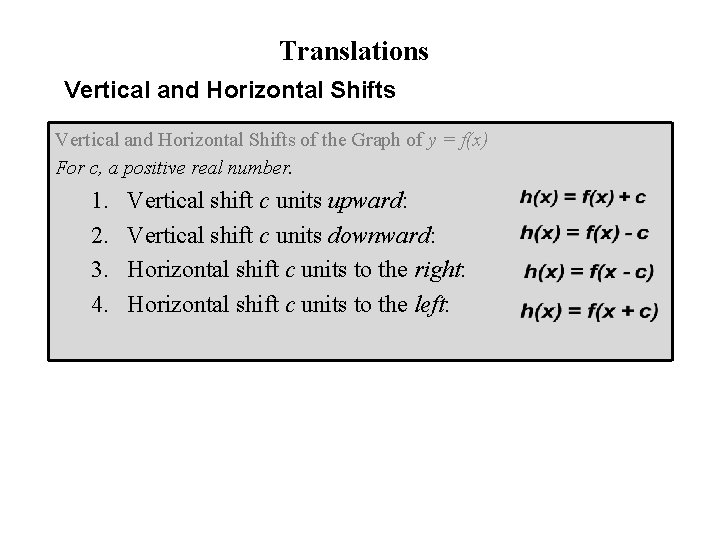
Translations Vertical and Horizontal Shifts of the Graph of y = f(x) For c, a positive real number. 1. 2. 3. 4. Vertical shift c units upward: Vertical shift c units downward: Horizontal shift c units to the right: Horizontal shift c units to the left:
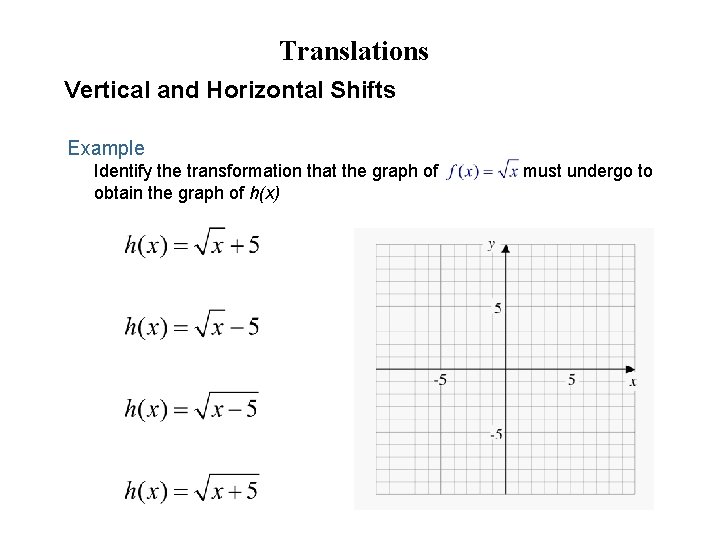
Translations Vertical and Horizontal Shifts Example Identify the transformation that the graph of obtain the graph of h(x) must undergo to
Translations Vertical and Horizontal Shifts (continued) Example: Name the transformations that f(x) = x 2 must undergo to obtain the graph of g(x) = (x + 3)2 – 5 Solution: Refer to Examples 1 and 2
Reflections Reflecting Graphs A reflection is a mirror image of the graph in a certain line. We will study the following two types of reflections. Reflections of the Graph of y = f(x) in the Coordinate Axes 1. Reflection in the x-axis: h(x) = - f(x) 2. Reflection in the y-axis: h(x) = f(-x)
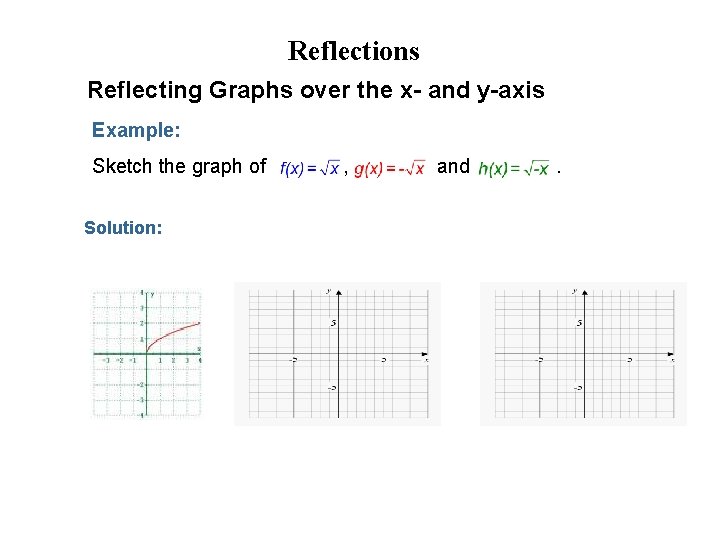
Reflections Reflecting Graphs over the x- and y-axis Example: Sketch the graph of Solution: , and .
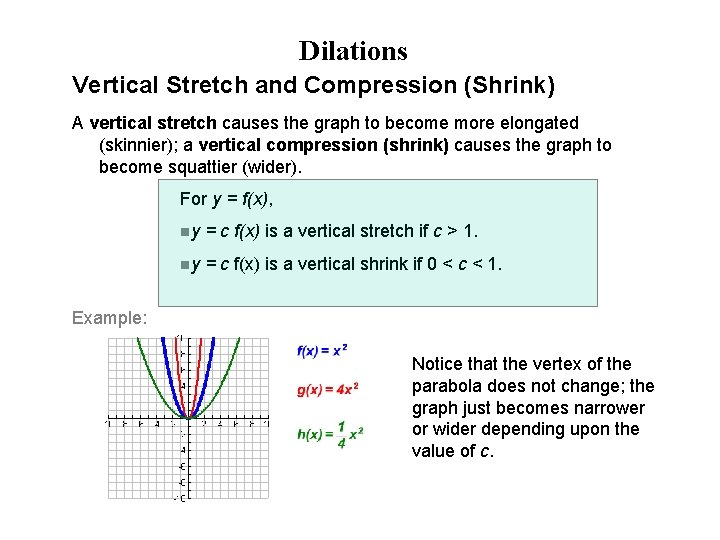
Dilations Nonrigid Transformations Shifts and reflections are called rigid transformations because the basic shape of the graph is NOT changed. Nonrigid transformations cause the original shape of the graph to change or become distorted. We will look briefly at vertical and horizontal stretches and compressions (shrinks) in this section and will revisit these transformations in greater depth when we study the trigonometric functions.
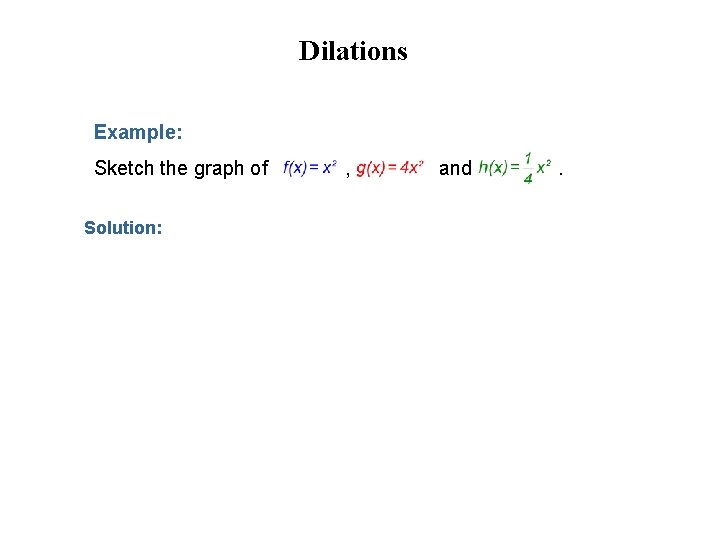
Dilations Example: Sketch the graph of Solution: , and .
Dilations Vertical Stretch and Compression (Shrink) A vertical stretch causes the graph to become more elongated (skinnier); a vertical compression (shrink) causes the graph to become squattier (wider). For y = f(x), ny = c f(x) is a vertical stretch if c > 1. ny = c f(x) is a vertical shrink if 0 < c < 1. Example: Notice that the vertex of the parabola does not change; the graph just becomes narrower or wider depending upon the value of c.
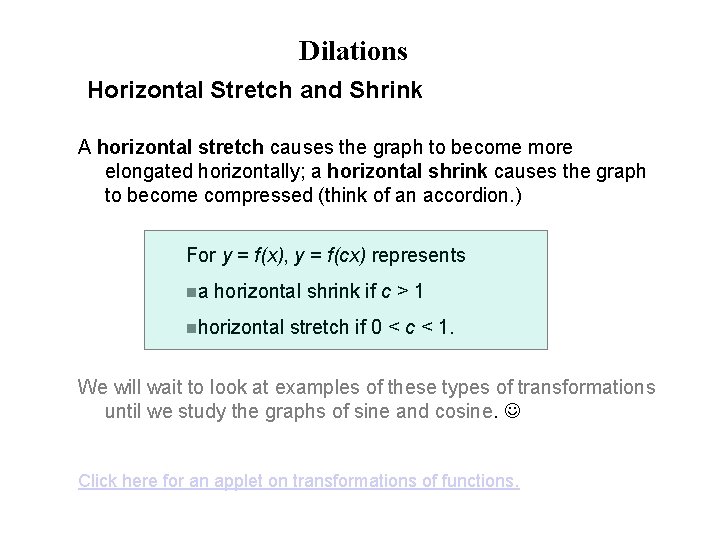
Dilations Horizontal Stretch and Shrink A horizontal stretch causes the graph to become more elongated horizontally; a horizontal shrink causes the graph to become compressed (think of an accordion. ) For y = f(x), y = f(cx) represents na horizontal shrink if c > 1 nhorizontal stretch if 0 < c < 1. We will wait to look at examples of these types of transformations until we study the graphs of sine and cosine. Click here for an applet on transformations of functions.