
FAMILIES By Lynette Martinez Definition What is a
FAMILIES By Lynette Martinez
■ Definition: What is a family? An intimate domestic group made up of people related to one another by bonds of blood, sexual mating, or legal ties(Google. com) Ø The history of the family is a branch of social history that concerns the sociocultural evolution of kinship groups from prehistoric to modern times. (Wikipedia. com) Ø Members percieve family, as a institution, as themselves because we make up the family. Everyone is apart of some family, no matter what type of family it is. Ø Members of the family institution, I believe, view themselves as someone who makes a difference in society. WHAT TYPE OF FAMILIES ARE THERE IN SOCIETY? Dual Parent Families, Single Parent Families, Same Sex Parent Families, Non- Blood Related Families, etc.
Double Parent Family ■ What is a two parent household? A two parent household is when both the mother and the father are living in the same house or involved with the children and both are either married, in a relationship, or even co-parenting. ■ Pros– Having a two parent household shows stability for the children which then causes the need to be stable once older, usually in a two parent household parents tend to give more love to children and they have less trust issues as other children. ■ Cons – Constant conflict between parents may have a bad effect on the children in school ■ Effects? In the 2007 -2009 U. S. Census Bureau, it was reported that the probability poverty percentage of married, two- parent families children has drop by 82% to 6. 8% (factfinder. census. gov) In an article, William Jeynes explaines that Harnish Mcrae observes, “the conventional family is an efficient mechanism for combining bringing up children and making a living. ”(thepublicdiscourse. com)

■ Single Parent Family What is a single parent household? A single parent household is when only one of the parents whether it’s the mother or father live with the child, in some cases the child is without both parents and is raised by the grandparent. ■ Pros– Some children could see their parents succeed and feel that it is okay to be independent when older, the parent does not have to worry about not agreeing with the other partner so children see less fighting ■ Cons– Children tend to have trust issues, parents tend to not parent as should for the child ■ Effects? In the Scholarly Article, Jackson explains, “Results indicate that maternal educational attainment was positively associated with earnings, which, together with instrumental support, were positively associated with financial strain. ”(Jackson 1414) In the Scholarly Article, Hemovich and Crano say, “Results found that drug use among daughters living with single fathers significantly exceeded…, in turn, significantly exceeded that of children of dual-parent families. ”(Hemovich. Crano 2104) In the Scholarly Article, Sauvola resulted that, “ 22% of the women with a single-parent family background had an induced abortion, whereas 14% of the women from a two-parent family
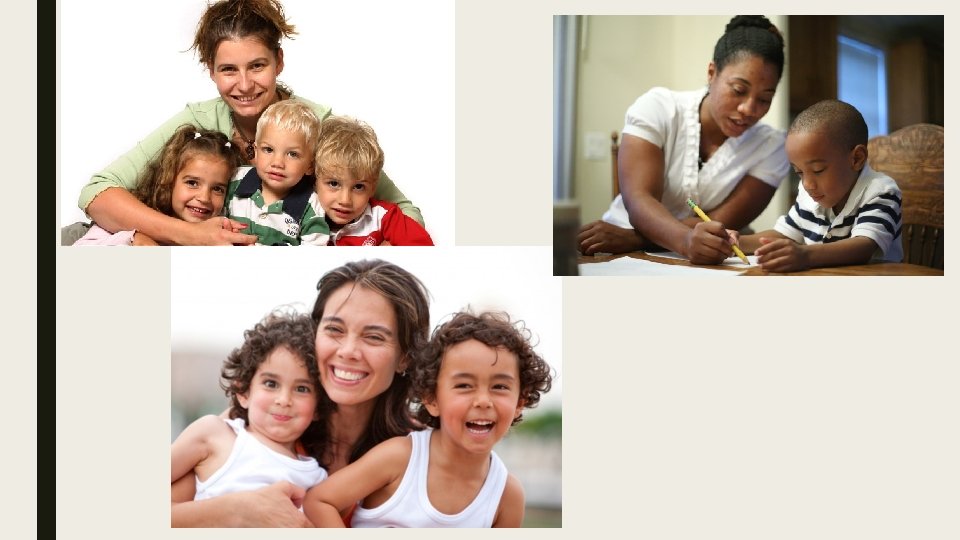
Same Sex Parent Family ■ What is a same sex parent household? A same sex parent household is when there are either two males or two females acting as both parents for a child together as either a married couple, unmarried couple, or just partners. ■ Pros– the feeling of no judgment, children with no parents are given a better environment rather then being in the court system for example. ■ Cons – Other children will judge the child of a same sex parent family, the child will feel different from the other kids, finding friends might be a struggle to a child. ■ Effects? In the News article Randy Shultz says, that Judge Cindy Lederman wrote in her ruling that allowed Mr. Gill to adopt his foster sons, reports by those organizations "find that there are no differences in the parenting of homosexuals or the adjustment of their children. "

Non Blood Related Family ■ What is a non blood related family? A non blood related family is more of a group of friends where they are not related by blood but have a relationship or friendship where they feel they are close to eachother like a brother, sister, mother, father, cousin, etc. ■ Pros– Friends are always great to have, never being alone, always feeling wanted and needed, networking ■ Cons– Friends come and go, your blood family will begin to feel neglected, you would never be home which causes a lack in the parenting area ■ Effects? In a newspaper article, Peter Monaghan interviews women who realize that they have not made women friends who study the same things they study and so they create a group in which it began to be "friends with academic benefits” (Monaghan, ebscohost. com)

Ø Conclusion Weber would say that family helps society when it comes to reproducing more people and being able to continue doing things. Marx would argue that family eventually leads to inequality of people. Ø The institution has changed drastically over time. The difference in how people now view family has changed, the thought of a traditional family has also changed and is no longer enforced within society, now people are allowed to marry the same sex and parent a child. Ø What society believes in now has caused the various change of family and the views of it. Now children who receive little to no parenting tend to not believe in a family and tend to look for the love of a family elsewhere. Ø A stable feature that has not changed is more of what a family is, which is love, something that someone knows they could always count on whether it’s a group of friends who consider themselves family or a child with a single- parent. Ø One way I would try to accomdate the insitution for society would be to maybe encourage parents whether they are together or not or caring for the child or not would be to make sure they give the children the attention they need to be able to succeed in life because people tend to forget that the child is the one who usually suffers. Ø The major participants in the institution is the society itself. Everyone has a family whether they like them or not. Some roles in the family are: Mother, Father, Daughter, Son, Sister, Brother, Cousins, Uncles, Aunts, etc. And some roles are more powerful then other but all are equally important. For example the mother and father are more powerful then the son and daughter and more then likely have a higher chance and being richer then the children. Ø Some people luckily get born into families that don’t have issues that others have such as financial issues or marital issues or even other issues, so yes I believe my institution works better for some members of society
Works Cited ■ https: //www. google. com/search? q=sociological+definition+of+family&oq=sociolfamily&gs_l=serp. 1. 2. 0 i 7 i 30 k 1 l 10. 6302. 8060. 0. 10 804. 6. 6. 0. 0. 216. 912. 0 j 5 j 1. 6. 0. . . 1 c. 1. 64. serp. . 0. 6. 912. . . 0 i 7 i 10 i 30 k 1. w 81 K 2_aq. Avg ■ Jackson, Aurora P. and Jeanne Brooks-Gunn. "Single Mothers in Low-Wage Jobs: Financial Strain, Parenting, and Preschoolers' Outcomes. " Child Development, vol. 71, no. 5, Sep/Oct 2000, p. 1409. EBSCOhost, login. ezp. pasadena. edu/login? url=http: //search. ebscohost. com/login. aspx? direct=true&db=aph&AN=3841095&site=ehost-live. ■ Hemovich, Vanessa and William D. Crano. "Family Structure and Adolescent Drug Use: An Exploration of Single-Parent Families. " Substance Use & Misuse, vol. 44, no. 14, 15 Nov. 2009, pp. 2099 -2113. EBSCOhost, doi: 10. 3109/10826080902858375. ■ Sauvola, Anu, et al. "Single-Parent Family Background and Physical Illness in Adulthood: A Follow-Up Study of the Northern Finland 1966 Birth Cohort. " Scandinavian Journal of Public Health, vol. 28, no. 2, June 2000, p. 95. EBSCOhost, login. ezp. pasadena. edu/login? url=http: //search. ebscohost. com/login. aspx? direct=true&db=aph&AN=6353172&site=ehost-live. ■ Schultz, Randy. "OPINION: Take some of the Same-Sex Hatred in Florida's off the Books. " Palm Beach Post, the (FL), 31 Mar. 2013. EBSCOhost, login. ezp. pasadena. edu/login? url=http: //search. ebscohost. com/login. aspx? direct=true&db=n 5 h&AN=2 W 61681067866&site=eho st-live. ■ http: //factfinder 2. census. gov/faces/tableservices/jsf/pages/productview. xhtml? pid=ACS_09_3 YR_S 1702&pro. Type=table ■ http: //www. thepublicdiscourse. com/2011/07/3532/ ■ MONAGHAN, PETER. "Friendships and Their Influence on Academic Success. " Chronicle of Higher Education, vol. 63, no. 17, 16 Dec. 2016, p. A 38. EBSCOhost, login. ezp. pasadena. edu/login? url=http: //search. ebscohost. com/login. aspx? direct=true&db=aph&AN=120251132&site=ehost-live.
- Slides: 12