
Families A look at the impact of substance
Families A look at the impact of substance abuse and addiction on the family unit. By Emily Shields CEP 504 – Pr. Lisker November 15, 2012
The cycle of dysfunction �Research has shown that substance abuse is often linked closely with a lack of ability to form functional relationships with family � Traumatic childhood and adolescent experiences � Continued strained relationships with family of origin throughout adulthood � Negative relationship patterns in adult intimate relationships � Destructive parenting styles
Marriage & The Family Unit �Alcoholic families � Exhibit more negative communication � Engage in higher levels of openly expressed anger � Struggle to maintain functional roles and often display distorted hierarchy � Higher rates of divorce � Higher rates of physical, sexual, and verbal abuse of children than nonalcoholic families These apply to other types of addictions within the family as well….
“A relationship in which there is continued investment of self�Construct versus reality esteem in the ability to influence-control “An unhealthy relationship in which a feelings and person who is closely involved with an behavior, both in oneself and in alcoholic or addicted person… [and] others, in the face of acts in such a way as to allow the serious adverse addict to continue the addicted behavior” (Gwinnel & Adamec, 2006) consequences” (Johnson, 2003) Codependency “Codependency is a problematic or maladaptive seeking of identity, self worth, and fulfillment outside the self” (Zelvin, 1997)
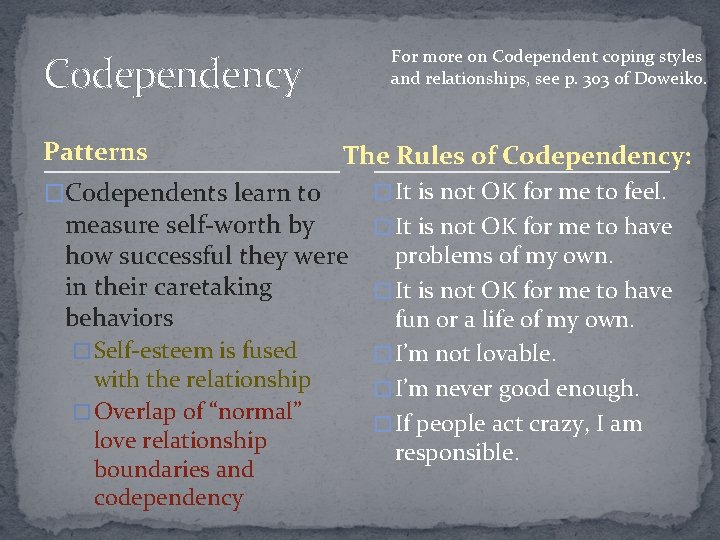
Codependency Patterns �Codependents learn to For more on Codependent coping styles and relationships, see p. 303 of Doweiko. The Rules of Codependency: � It is not OK for me to feel. measure self-worth by � It is not OK for me to have problems of my own. how successful they were in their caretaking � It is not OK for me to have behaviors fun or a life of my own. � Self-esteem is fused with the relationship � Overlap of “normal” love relationship boundaries and codependency � I’m not lovable. � I’m never good enough. � If people act crazy, I am responsible.
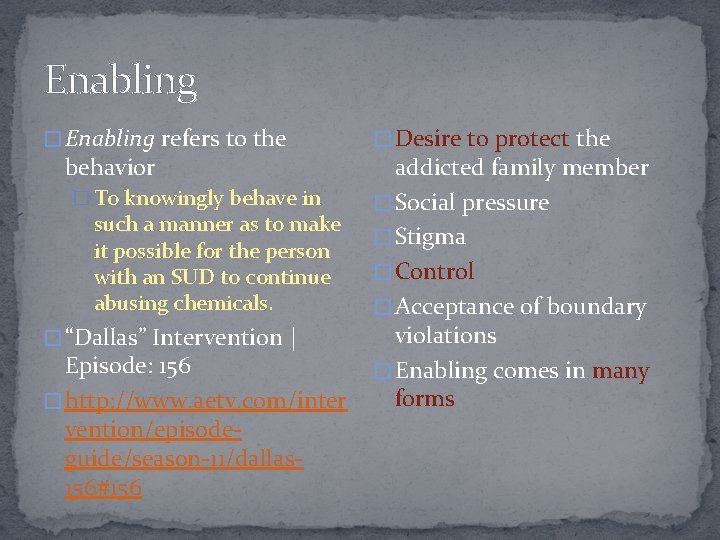
Enabling � Enabling refers to the behavior � To knowingly behave in such a manner as to make it possible for the person with an SUD to continue abusing chemicals. � “Dallas” Intervention | Episode: 156 � http: //www. aetv. com/inter vention/episodeguide/season-11/dallas 156#156 � Desire to protect the addicted family member � Social pressure � Stigma � Control � Acceptance of boundary violations � Enabling comes in many forms
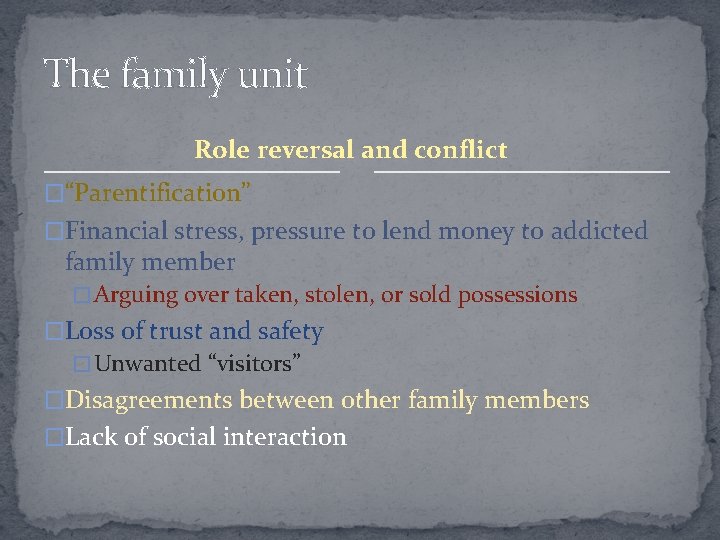
The family unit Role reversal and conflict �“Parentification” �Financial stress, pressure to lend money to addicted family member � Arguing over taken, stolen, or sold possessions �Loss of trust and safety � Unwanted “visitors” �Disagreements between other family members �Lack of social interaction
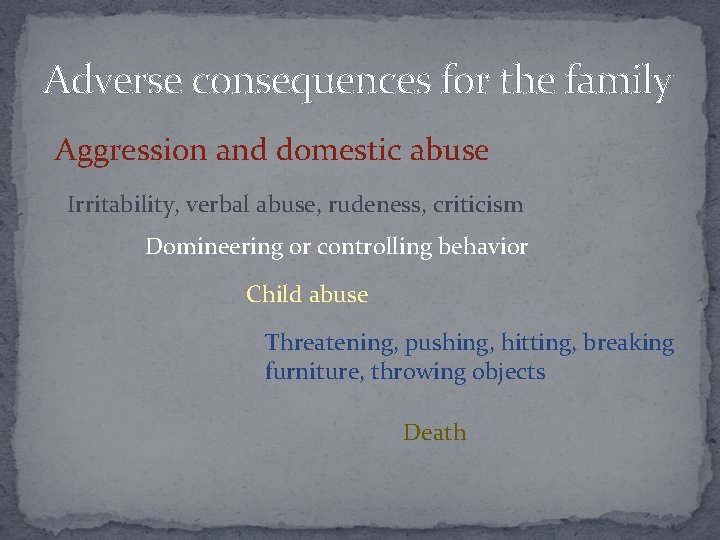
Adverse consequences for the family Aggression and domestic abuse Irritability, verbal abuse, rudeness, criticism Domineering or controlling behavior Child abuse Threatening, pushing, hitting, breaking furniture, throwing objects Death
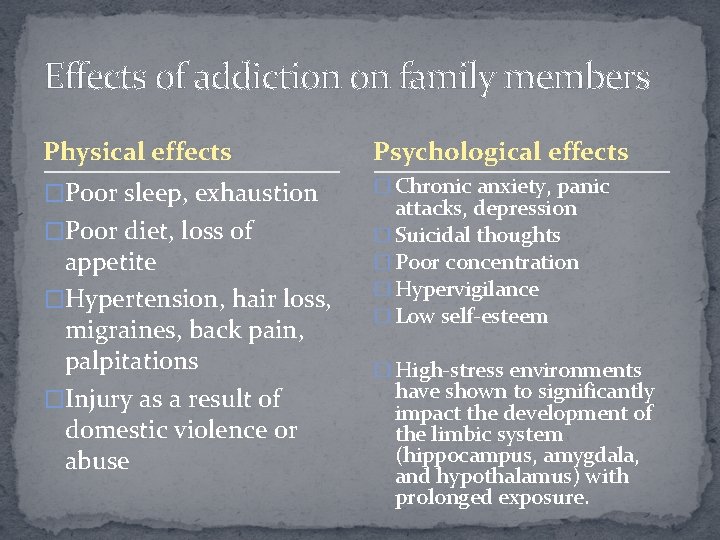
Effects of addiction on family members Physical effects Psychological effects �Poor sleep, exhaustion � Chronic anxiety, panic �Poor diet, loss of appetite �Hypertension, hair loss, migraines, back pain, palpitations �Injury as a result of domestic violence or abuse attacks, depression � Suicidal thoughts � Poor concentration � Hypervigilance � Low self-esteem � High-stress environments have shown to significantly impact the development of the limbic system (hippocampus, amygdala, and hypothalamus) with prolonged exposure.
Family support and therapy �Many family members need counseling for psychological, emotional, and physical abuse �Counseling is also needed for behavior modification and coping skills �Some clinicians advocate for a non-pathological model for treatment of families � Discard dated, biased, unsympathetic language and attitudes � Stress-strain-coping-support model (SSCS)
Resources Support Groups & Services � Nar-Anon: www. nar-anon. org � Family Addiction Outpatient Services Statler Towers, Ste 555, 107 Delaware Ave. , Buffalo � Adult Child and Family Clinic at ECMC 462 Grider St. , Buffalo � Supportive Living – Council on Addiction Recovery Services 201 South Union St. , Olean Shelters � Women’s Shelters: http: //www. womenshelters. org/cit/ ny-buffalo � Cornerstone Manor 150 E. North St. , Buffalo � Buffalo City Mission Women’s Shelter 100 E. Tupper St. , Buffalo � Community Missions of Niagara Frontier Emergency Housing and Crisis Shelter 1570 Buffalo Avenue, Niagara Falls � 24 -hour PASSAGE Hotline: 285 - 6984
References � Doweiko, Harold E (2009). Concepts of Chemical Dependency - 8 th Edition. � � � California: Brooks/Cole. Johnson, P. (2001). Dimensions of functioning in alcoholic and nonalcoholic families. Journal of Mental Health Counseling. Vol. 23, No. 2, April 2001, p. 127136. Orford, J. , Copello, A. , Velleman, R. , & Templeton, L. (2010). Family members affected by a close relative's addiction: The stress-strain-coping-support model. Drugs: Education, Prevention & Policy, 1736 -43. doi: 10. 3109/09687637. 2010. 514801 Orford, J. , Copello, A. , Ibanga, A. , Velleman, R. , & Templeton, L. (2010). The experiences of affected family members: A summary of two decades of qualitative research. Drugs: Education, Prevention & Policy, 17(S 1), 44 -62. Pasternak, A. , & Schier, K. (2012). The role reversal in the families of Adult Children of Alcoholics. Archives of Psychiatry and Psychotherapy, (3), 51 -57. Schäfer, G. (2011). Family functioning in families with alcohol and other drug addiction. Social Policy Journal of New Zealand. (37), 135 -151. Weber, D. A. , & Reynolds, C. R. (2004). Clinical perspectives on neurobiological effects of psychological trauma. Neuropsychology Review, 14(2), 115 -129.
- Slides: 12