
FAMILIAL THYROID CARCINOMA BASED ON DIAGNOSTIC HISTOPATHOLOGY FAMILIAL
FAMILIAL THYROID CARCINOMA BASED ON “DIAGNOSTIC HISTOPATHOLOGY” – FAMILIAL THYROID CARCINOMA: THE ROAD LESS TRAVELLED IN THYROID PATHOLOGY – AN UPDATE
SPORADIC THYROID CARCINOMAS • Majority of thyroid cancer sporadic • Best established risk factor for papillary thyroid carcinoma is ionizing radiation, low to intermediate dose – a/w ret/PTC proto-oncogene mutation • Other risk factors poorly understood • 45% papillary carcinomas have BRAF mutations • Female: Male 3: 1
FAMILIAL THYROID CARCINOMA • A minority of thyroid cancers • Gender incidence equal • Two main groups – Follicular cell origin - Derived from parafollicular C cells
GENERAL CHARACTERISTIC OF FAMILIAL THYROID CARCINOMA • Young patients • Positive family hx of thyroid cancer/nodules, esp. multinodular goitre • Multifocal tumours • Bilateral tumours • Possible precursor lesions e. g. c-cell hyperplasia
MEDULLARY CARCINOMA • Majority sporadic but 10 -20% familial • Recognised in 1951 by Robert Horn, previously classified as either “atypical adenomas” or grouped with anaplastic carcinomas • Mid twentieth century C cells identified in human thyroid and calcitonin discovered • In 1961 case report by Sipple described an individual with medullary thyroid carcinoma and bilateral pheochromocytomas
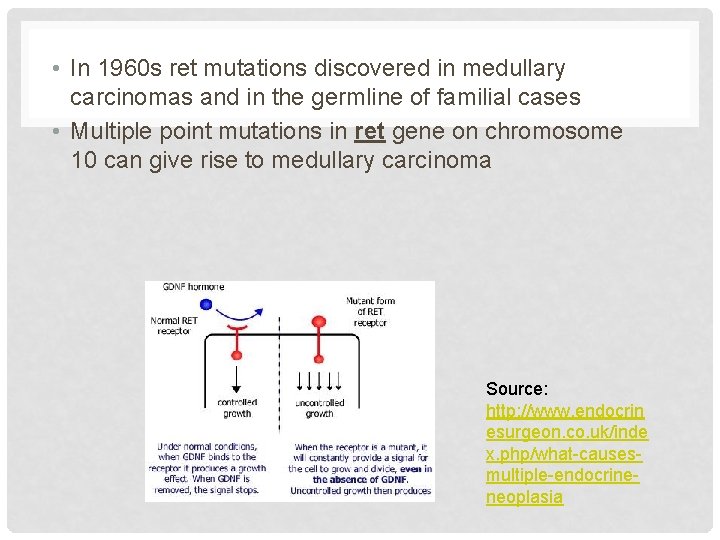
• In 1960 s ret mutations discovered in medullary carcinomas and in the germline of familial cases • Multiple point mutations in ret gene on chromosome 10 can give rise to medullary carcinoma Source: http: //www. endocrin esurgeon. co. uk/inde x. php/what-causesmultiple-endocrineneoplasia
GAIN OF FUNCTION MUTATIONS IN RET CAUSE: • Medullary carcinoma • Multiple neuroendocrine carcinoma syndromes (type 2 A and 2 B) • Pheochromocytoma • Parathyroid hyperplasia
MEDULLARY CARCINOMA PATHOLOGY • Usually in lateral upper two thirds of gland (area of highest C cell concentration) • Often yellow/tan in colour • Nest of cells separated by varying amounts of stroma • Round/oval/spindle shaped cells • Uniform cells with salt and pepper chromatin • Intra-nuclear cytoplasmic inclusions common

Pictures courtesy of Dr Rasika Singh
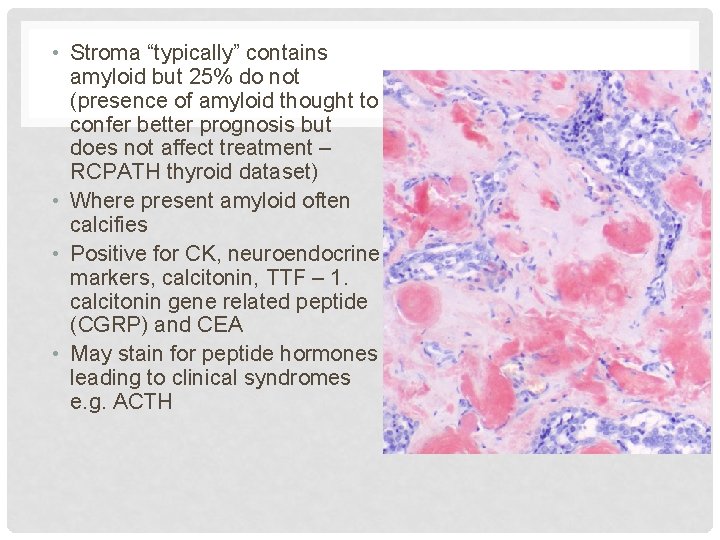
• Stroma “typically” contains amyloid but 25% do not (presence of amyloid thought to confer better prognosis but does not affect treatment – RCPATH thyroid dataset) • Where present amyloid often calcifies • Positive for CK, neuroendocrine markers, calcitonin, TTF – 1. calcitonin gene related peptide (CGRP) and CEA • May stain for peptide hormones leading to clinical syndromes e. g. ACTH

C CELL HYPERPLASIA – ? PRECURSOR TO MEDULLARY CARCINOMA Current definition of normal C cells in adult human thyroid • Isolated spindle cells in a parafollicular location • <50 per low power field • <6 per any follicle
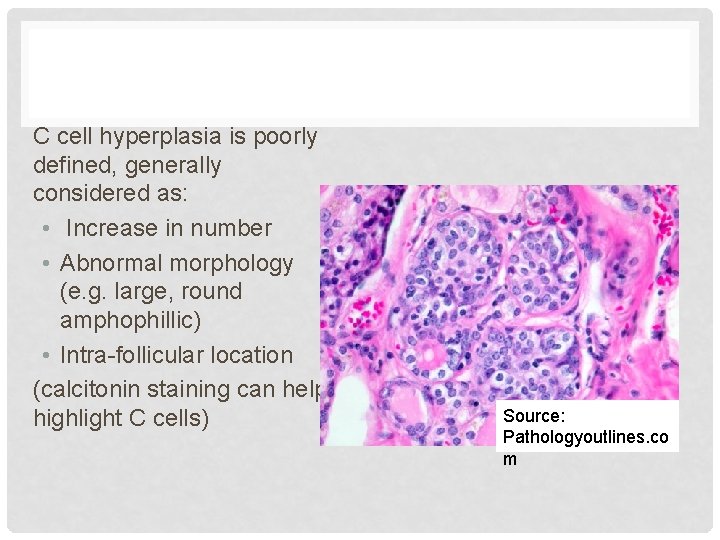
C cell hyperplasia is poorly defined, generally considered as: • Increase in number • Abnormal morphology (e. g. large, round amphophillic) • Intra-follicular location (calcitonin staining can help highlight C cells) Source: Pathologyoutlines. co m
May be difficult to distinguish C cell hyperplasia from lower limit of medullary carcinoma: • Delellis and Wolfe state that: C cell hyperplasia ranges from diffuse increase to nodules of C cells replacing follicles, if BM of follicle is breached this becomes a medullary carcinoma • RCPATH guidelines acknowledge C cell hyperplasia not well defined and would only diagnose this when nodules of C cells found in blocks not containing main tumour • Diagnosis of C cell hyperplasia in resection specimens now optional and not in core dataset
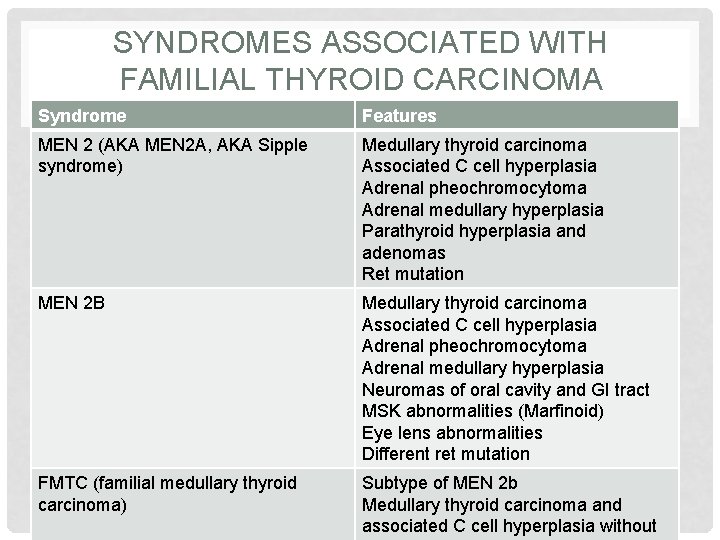
SYNDROMES ASSOCIATED WITH FAMILIAL THYROID CARCINOMA Syndrome Features MEN 2 (AKA MEN 2 A, AKA Sipple syndrome) Medullary thyroid carcinoma Associated C cell hyperplasia Adrenal pheochromocytoma Adrenal medullary hyperplasia Parathyroid hyperplasia and adenomas Ret mutation MEN 2 B Medullary thyroid carcinoma Associated C cell hyperplasia Adrenal pheochromocytoma Adrenal medullary hyperplasia Neuromas of oral cavity and GI tract MSK abnormalities (Marfinoid) Eye lens abnormalities Different ret mutation FMTC (familial medullary thyroid carcinoma) Subtype of MEN 2 b Medullary thyroid carcinoma and associated C cell hyperplasia without
FAMILIAL PAPILLARY CARCINOMA • To be considered familial cancer at least 3 first degree relatives should be affected • Histology may be the same as non-familial classic or follicular variant of papillary carcinoma though multifocal and bilateral lesions are found • Some series indicate more aggressive behaviour – lymphatic invasion, mets and recurrences increased • Most investigators have not found BRAF mutations (conversely 40% of sporadic have BRAF mutations)
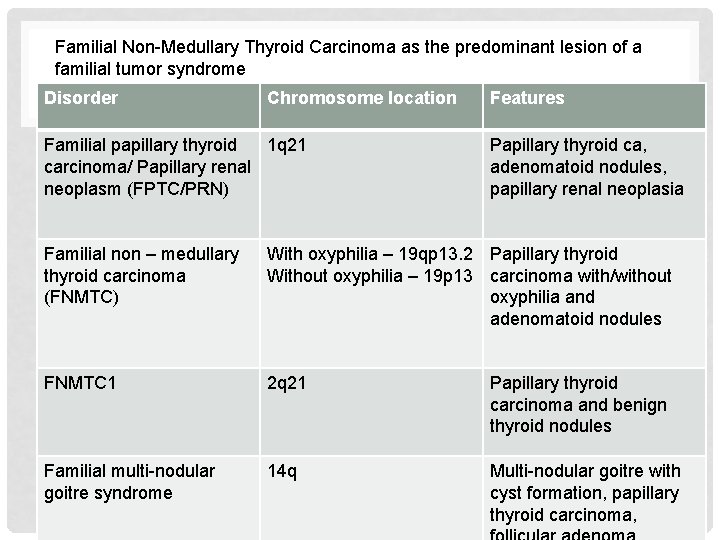
Familial Non-Medullary Thyroid Carcinoma as the predominant lesion of a familial tumor syndrome Disorder Chromosome location Familial papillary thyroid 1 q 21 carcinoma/ Papillary renal neoplasm (FPTC/PRN) Features Papillary thyroid ca, adenomatoid nodules, papillary renal neoplasia Familial non – medullary thyroid carcinoma (FNMTC) With oxyphilia – 19 qp 13. 2 Papillary thyroid Without oxyphilia – 19 p 13 carcinoma with/without oxyphilia and adenomatoid nodules FNMTC 1 2 q 21 Papillary thyroid carcinoma and benign thyroid nodules Familial multi-nodular goitre syndrome 14 q Multi-nodular goitre with cyst formation, papillary thyroid carcinoma,
OTHER FAMILIAL TUMOUR SYNDROMES A/W NON-MEDULLARY THYROID CARCINOMA
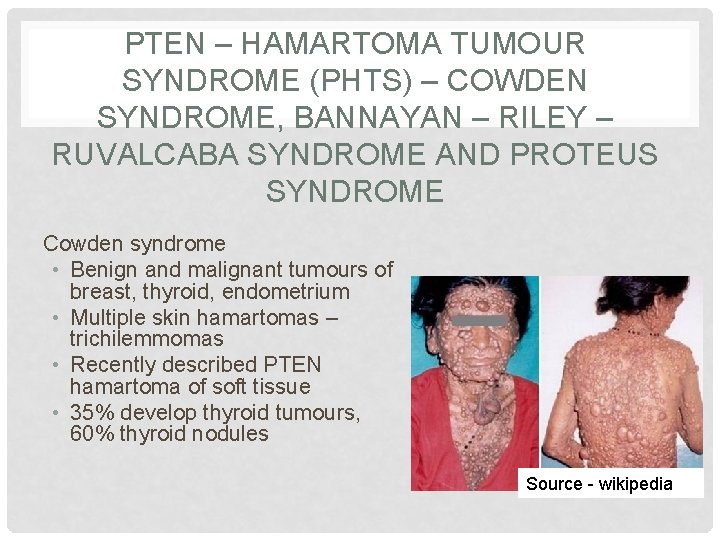
PTEN – HAMARTOMA TUMOUR SYNDROME (PHTS) – COWDEN SYNDROME, BANNAYAN – RILEY – RUVALCABA SYNDROME AND PROTEUS SYNDROME Cowden syndrome • Benign and malignant tumours of breast, thyroid, endometrium • Multiple skin hamartomas – trichilemmomas • Recently described PTEN hamartoma of soft tissue • 35% develop thyroid tumours, 60% thyroid nodules Source - wikipedia
• Some patients lack PTEN alterations but have hereditary epigenetic changes to KILLIN promoter hypermethylation of PTEN promoter • Hence different mutations leading to same syndrome – some patietns have preserved PTEN staining • Clinically important as certain therapies e. g. sirolimus targeted at Akt-m. TOR pathway targeted at PTEN mutations
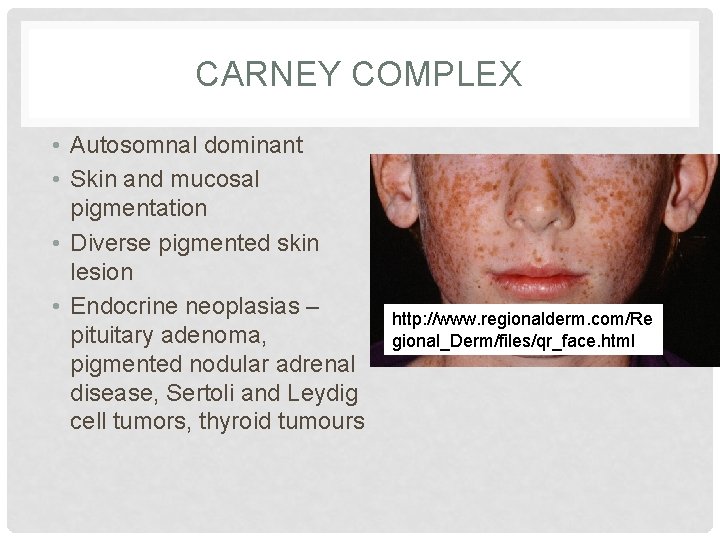
CARNEY COMPLEX • Autosomnal dominant • Skin and mucosal pigmentation • Diverse pigmented skin lesion • Endocrine neoplasias – pituitary adenoma, pigmented nodular adrenal disease, Sertoli and Leydig cell tumors, thyroid tumours http: //www. regionalderm. com/Re gional_Derm/files/qr_face. html
WERNER SYNDROME • AKA adult progeria • Autosomnal Recessive connective tissue disease • Premature aging, bilateral cataracts, gray hair and skin atrophy • Benign thyroid lesions and PTC • Mutation in WRN gene – Rec. Q helicase – ensures DNA stability

- Slides: 22