
FAMAFRENCH MODEL Concept and Application 1 Learning Objectives

FAMA-FRENCH MODEL Concept and Application 1
Learning Objectives q Concept of Fama and French model q Concept of three risk factors in the model q The interpretation of the model q The pros and cons of the model q 8 steps to use the Fama and French model q An empirical study in UK market 2
Fama and French Literature on Factor Models q Fama and French (1992, 1993, 1995, 1996, 1998, 2006, 2014) q An alternative asset pricing model to CAPM q Three risk factors affecting asset expected return (Fama and French, 1993) Market risk premium Size effect or size premium Book-to-Market value effect or value premium 3

Model/ Formula (Fama-French, 1993) Rit – Rft = αit + βi. M (RMt - Rft) + βis. SMBt + βih. HMLt + εit Rit is the total return of individual stock/portfolio i Rft is the risk free asset return RMt is the total market portfolio return Rit – Rft is expected excess return RMt - Rft is the excess return on a market portfolio index SMBt is the size premium HMLt is the value premium 4

Steps for Fama-French, 1993 q Step 1: Collecting data q Step 2: Construct portfolios formed on Size and value q Step 3: Calculate average returns of each portfolio q Step 4: calculate SMB q Step 5: Calculate HML q Step 6: Calculate Rit – Rft q Step 7: Calculate RMt - Rft q Step 8: Running multiple regression 5
STEP 1: Collecting data q Book-to-market ratio (BE/ME) q Market Capitalization (Market Cap) q Monthly stock price including dividend q Risk free rate of return (Rf): short-date Treasury Bills q Market Return (Rm): monthly market index return 6
STEP 2: Construction of six Portfolio S/L Represented the group of portfolio that have a small size and low book-to-market value S/M Represented the group of portfolio that have a small size and medium book-to-market value S/H Represented the group of portfolio that have a small size and high book-to-market value B/L Represented the group of portfolio that have a big size and low book-to-market value B/M Represented the group of portfolio that have a big size and medium book-to-market value B/H Represented the group of portfolio that have a big size and high book-to-market value 7
Step 3: Calculate average returns of each portfolio q Calculate the average return of each observed stock q Calculate the average return of six constructed portfolios 8

Step 4: Calculate SMB q Based on the formula: SMB= 1/3(Small Low + Small Medium + Small High) – 1/3(Big Low + Big Medium + Big High) 9
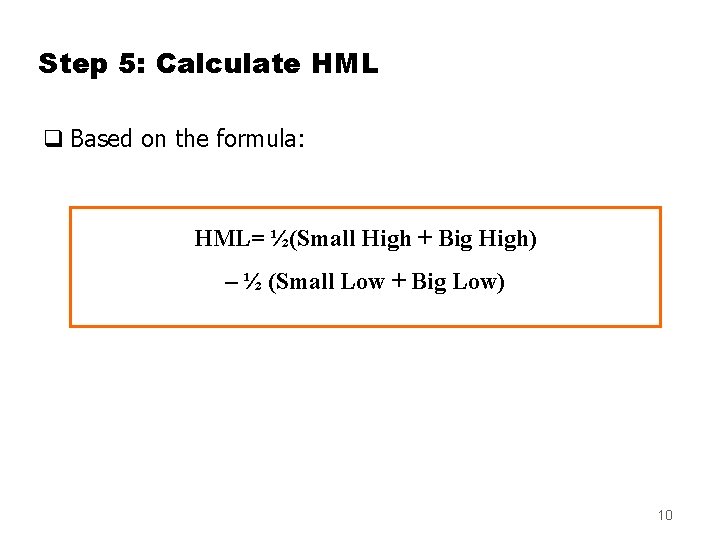
Step 5: Calculate HML q Based on the formula: HML= ½(Small High + Big High) – ½ (Small Low + Big Low) 10
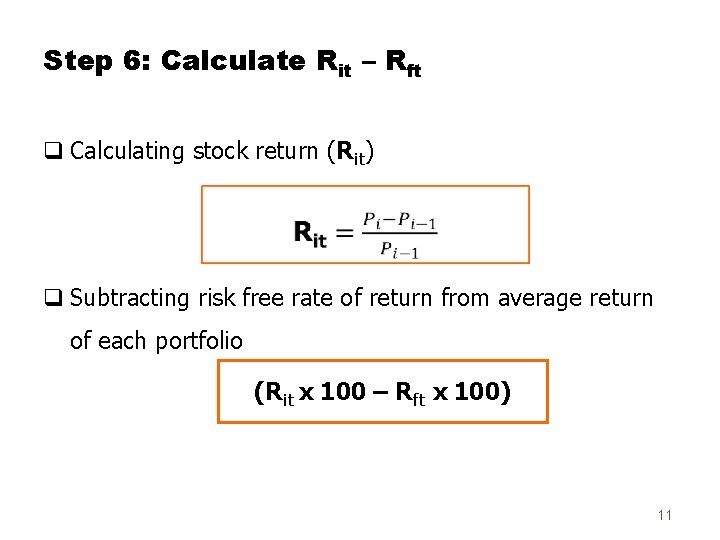
Step 6: Calculate Rit – Rft q Calculating stock return (Rit) q Subtracting risk free rate of return from average return of each portfolio (Rit x 100 – Rft x 100) 11

Step 7: Calculating Rmt – Rft q Calculating Market return (Rmt) q Subtracting risk free rate of return from market return (Rmt x 100 – Rft x 100) 12
Step 8: Running multiple regression q Diagnostic tests (Nonstationary, Autocorrelation, Heteroscedasticity and Multicollinearity) q Running multiple regression for one dependent (Rit – Rft) and three independent variables (Rmt – Rft), SMB and HML). q Could use Excel or SPSS or Eviews software. 13
An Application using UK FTSE 100 Data q London Stock Exchange FTSE 100 q Period: 2009 -2013 q Monthly data q Times series multiple regression test q Sample: 94 stocks q SEE EXCEL FILE 14

Thank you 15
- Slides: 15