
False and Misleading Advertisements in India By R
False and Misleading Advertisements in India By R. Sumedha
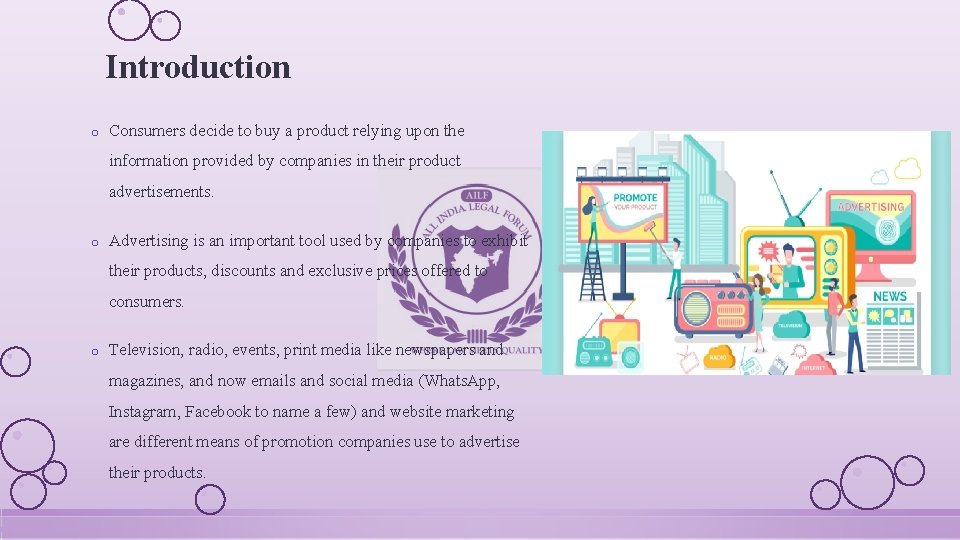
Introduction o Consumers decide to buy a product relying upon the information provided by companies in their product advertisements. o Advertising is an important tool used by companies to exhibit their products, discounts and exclusive prices offered to consumers. o Television, radio, events, print media like newspapers and magazines, and now emails and social media (Whats. App, Instagram, Facebook to name a few) and website marketing are different means of promotion companies use to advertise their products.
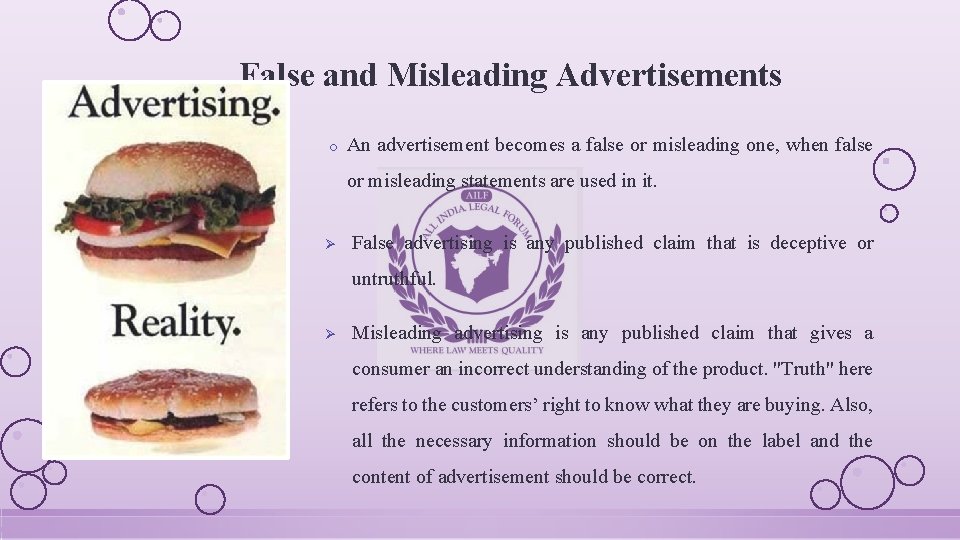
False and Misleading Advertisements o An advertisement becomes a false or misleading one, when false or misleading statements are used in it. False advertising is any published claim that is deceptive or untruthful. Misleading advertising is any published claim that gives a consumer an incorrect understanding of the product. "Truth" here refers to the customers’ right to know what they are buying. Also, all the necessary information should be on the label and the content of advertisement should be correct.
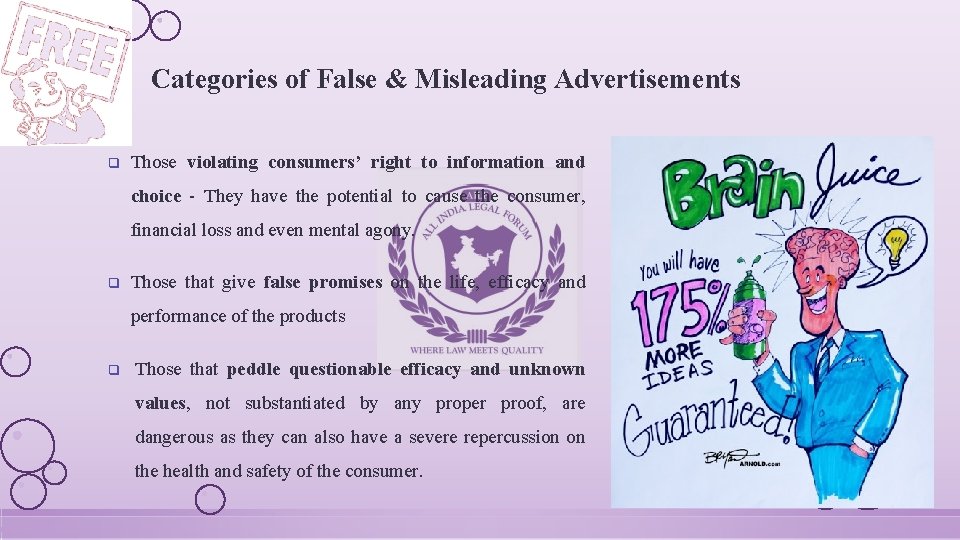
Categories of False & Misleading Advertisements q Those violating consumers’ right to information and choice - They have the potential to cause the consumer, financial loss and even mental agony. q Those that give false promises on the life, efficacy and performance of the products q Those that peddle questionable efficacy and unknown values, not substantiated by any proper proof, are dangerous as they can also have a severe repercussion on the health and safety of the consumer.
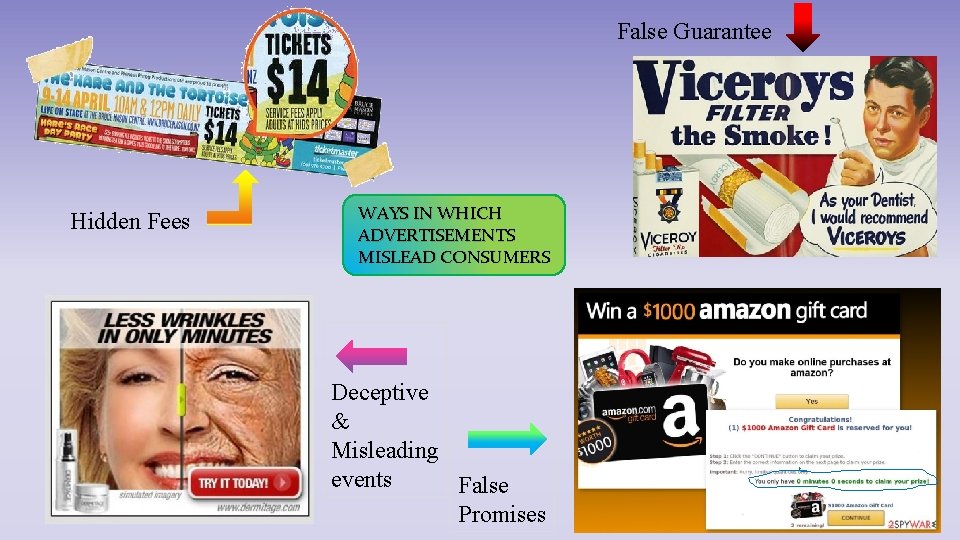
False Guarantee Hidden Fees WAYS IN WHICH ADVERTISEMENTS MISLEAD CONSUMERS Deceptive & Misleading events False Promises
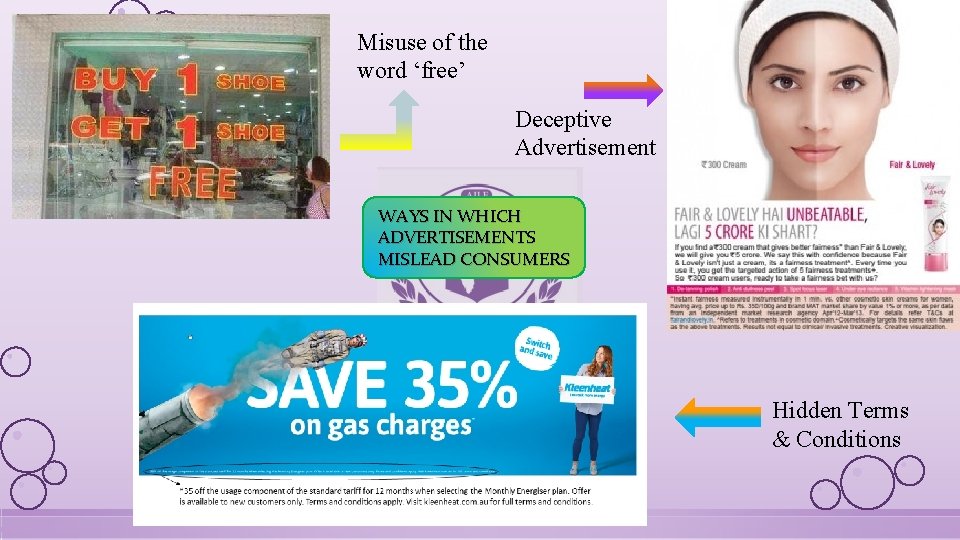
Misuse of the word ‘free’ Deceptive Advertisement WAYS IN WHICH ADVERTISEMENTS MISLEAD CONSUMERS Hidden Terms & Conditions
Cases of false/ misleading advertisements: The Consumer Complaint Council (CCC) of the Advertising Standards Council of India (ASCI) upheld in 2017, that various advertisements i. e. , 82 in healthcare category, 75 in education, 11 in personal care, eight to the food and beverages category and 24 from other categories were found to be false and misleading. Some famous cases are: 1. Hindustan Unilever Ltd (HUL) for its Lever Ayush soap saying ‘based on 5, 000 -year-old ayurveda scriptures with 15 ayurvedic herbs’ , besides other claims, were inadequately substantiated and are misleading.

Cases of false/ misleading advertisements: 2. Cab aggregator Uber India's advertisement claim which said ‘save Rs 500 on your next 10 Uber rides and ride Uber and the discount will auto apply’, were found misleading by ASCI. “ The advertisement claims were misleading by omission of validity of the promotion period, and that the offer is subject to terms and conditions, ” ASCI said. 3. Usha International advertisement claim for its Usha Honeywell evaporative air cooler which said 'cools up to 80 square metres', was found inadequately substantiated under test conditions and misleading by exaggeration
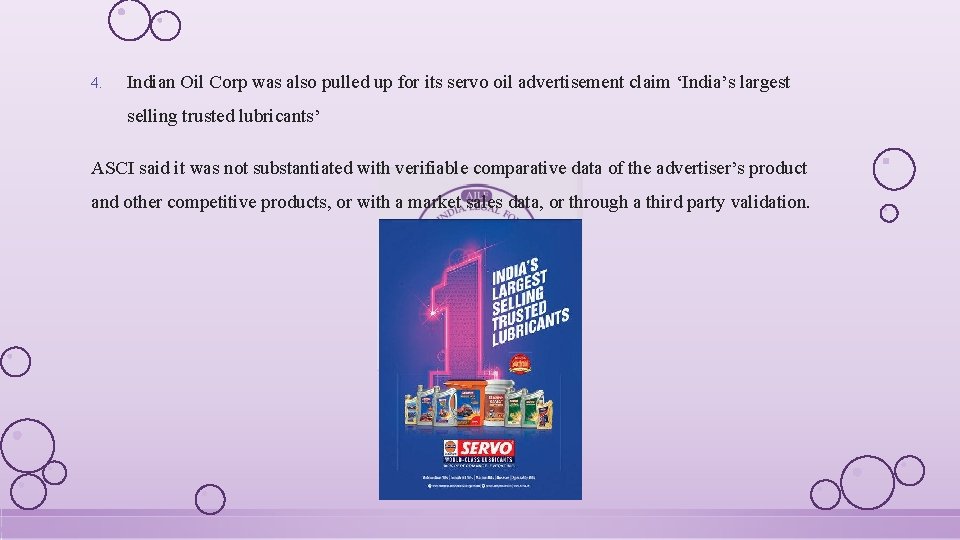
4. Indian Oil Corp was also pulled up for its servo oil advertisement claim ‘India’s largest selling trusted lubricants’ ASCI said it was not substantiated with verifiable comparative data of the advertiser’s product and other competitive products, or with a market sales data, or through a third party validation.
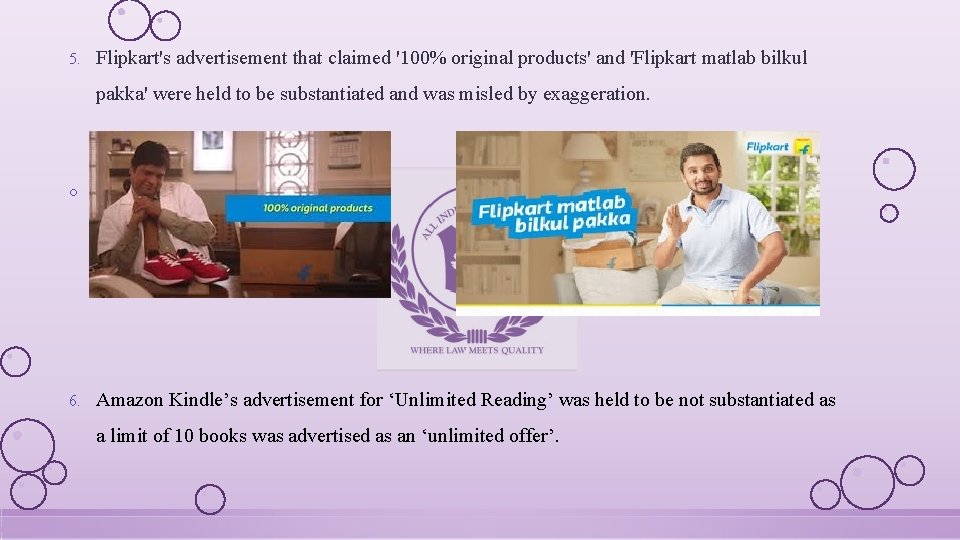
5. Flipkart's advertisement that claimed '100% original products' and 'Flipkart matlab bilkul pakka' were held to be substantiated and was misled by exaggeration. o 6. Amazon Kindle’s advertisement for ‘Unlimited Reading’ was held to be not substantiated as a limit of 10 books was advertised as an ‘unlimited offer’.
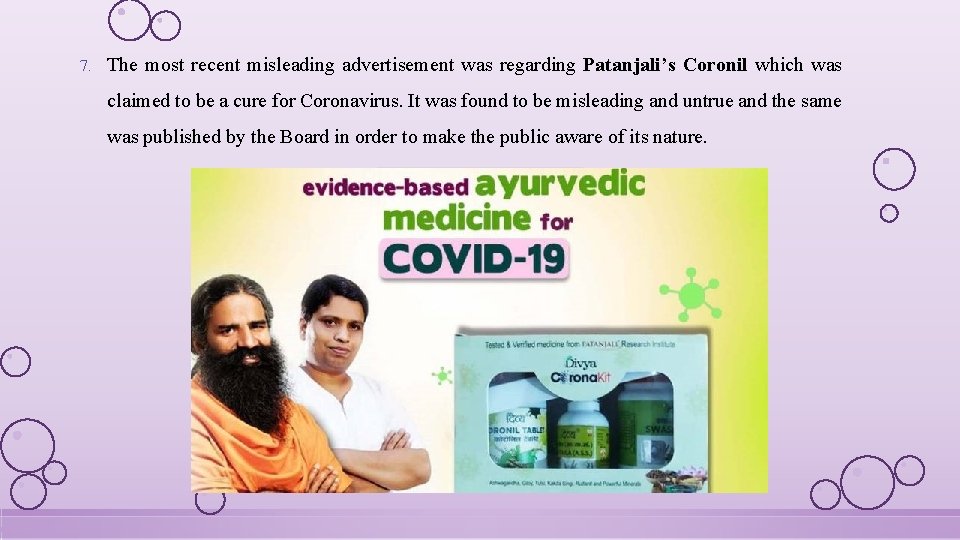
7. The most recent misleading advertisement was regarding Patanjali’s Coronil which was claimed to be a cure for Coronavirus. It was found to be misleading and untrue and the same was published by the Board in order to make the public aware of its nature.
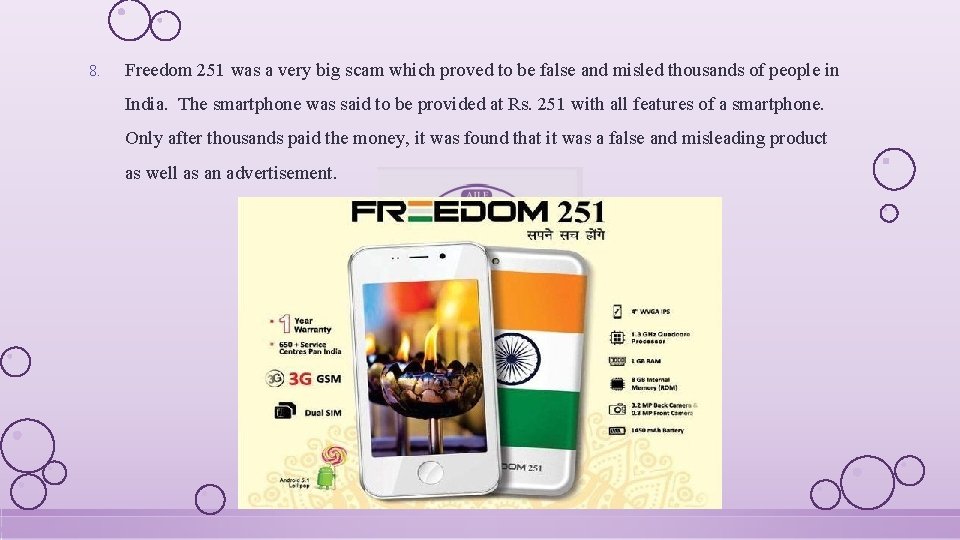
8. Freedom 251 was a very big scam which proved to be false and misled thousands of people in India. The smartphone was said to be provided at Rs. 251 with all features of a smartphone. Only after thousands paid the money, it was found that it was a false and misleading product as well as an advertisement.
Laws relating to False and Misleading Advertisements in India: The New Consumer Protection Act , 2019 deals with some provisions relating to false/misleading advertisements. They are: Section 10(1) of the Act mentions that the Central Government shall establish a Central Consumer Protection Authority to regulate matters relating to violation of rights of consumers, unfair trade practices and false or misleading advertisements which are prejudicial to the interests of public and consumers and to promote, protect and enforce the rights of consumers as a class. Section 17 states that a complaint relating to violation of consumer rights or unfair trade practices or false or misleading advertisements can be forwarded either in writing or in electronic mode, to the District Collector or the Commissioner of regional office or the Central Authority. Section 15(1) states that the Central Authority can have an Investigation Wing for conducting an inquiry or investigation regarding the Consumer Protection Act.
o Section 2(28) defines “misleading advertisement” in relation to any product or service, means an advertisement, which falsely describes a product or service, gives a false guarantee which is likely to mislead the consumers regarding the nature, substance, quantity or quality of such product or service, conveys an express or implied representation which, would constitute an unfair trade practice or deliberately conceals important information; Section 21 deals with the Power of Central Authority to issue directions and penalties against false or misleading advertisements. They can impose orders like: o (1) to discontinue such advertisement or to modify it. o (2 can impose a penalty up to Rs. 10 lakhs on the manufacturer or endorser. o (3) can prohibit the endorser of a false or misleading advertisement from making endorsement of any product or service for 1 to 3 years if it is done subsequently.
The Advertising Standards Council of India (ASCI) The objective of ASCI is to maintain and enhance the confidence of the public in advertising and to ensure that advertisements conform to the Code for Self-Regulation ASCI has the power to prohibit or remove misleading advertisements which are offensive to public decency or morality and promote products which are hazardous or harmful to society, particularly minors. It has established the ASCI Consumer Complaints Council to deal with false and misleading advertisements. The Advertising Standards Council of India accepts complaints against false and misleading advertisements in three categories: i. From the consumers or government ii. From one advertiser against another iii. Form the ASCI board members, members of the Consumer Complaint Council, etc.
Requirements to be followed for publishing Advertisements in India: The following requirements have to be fulfilled with regard to all advertisements telecasted or published in India: 1. Truthful and Honest representations to consumers and competitors. 2. Non-Offensive to Public- Within the bounds of generally accepted standards of public decency and propriety. 3. Product should be against Harmful Products/Situations 4. Fair in Competition -Not derogatory to competition. No plagiarism. 5. Before advertising, marketers must hold documentary evidence to prove all claims, whether direct or implied.
Remedies Available: o Consumers can file a complaint with ASCI on the advertisement with all relevant details and the ASCI may take a decision on a complaint so received by it. o Legal orders can be granted by courts when the misleading advertisement causes deception. Compensation can be awarded by the courts when the consumer proves that they have suffered some injury or damage due to such false/misleading advertisement. A Consumer Complaint can be filed with the District Consumer Disputes Redressal Forum, State Consumer Disputes Redressal Commission or National Consumer Disputes Redressal Commission. o
Conclusion o False or misleading advertisements are around us through various modes i. e, online and offline. o While considering false advertisements it is pertinent to remember the principle of ‘Caveat Emptor’ which means that the buyer should be aware regarding the goods purchased. o In recent times, online shopping has risen to heights where consumers are highly benefitted and are equally fooled by various false products and misleading advertisements. o Empowered consumers can play great role not only in process of making the laws/regulations apt but also in helping effective implementation of those. o Consumer empowerment is strongly recommended to curb misleading ads. At the same time, it is a responsibility on the part of the manufacturers to provide consumer satisfaction by advertising honestly for the good of the consumers and their products.

Thank You
- Slides: 20