
Falls Sara Bradley and Christine Chang MD Brookdale
Falls Sara Bradley and Christine Chang, MD Brookdale Dept of Geriatrics and Adult Development March 4. 2008 10: 00 -10: 40
Objectives By the conclusion of the talk, learner will be able to: 1. List 5 potentially modifiable risk factors for falls in older community dwelling adults. 2. Conduct a physical exam specific to falls, including a gait assessment. 3. Discuss 5 evidenced-based interventions that can reduce future falls.
Falls Definition: Unintentional change in position, coming to rest at a lower position Not due to an overwhelming intrinsic or environmental cause No loss of consciousness
Epidemiology of Falls • 1/3 of ambulatory and ½ institutionalized elderly fall each year • ½ falls result in injury (10 -15 % in fractures) • ¼ of all fallers limit their activities and lifestyle due to fear of falling
Cost of Falls • 6% of Medicare costs • 15% of ED visits for 65+ years • Extra $24, 000/person/year health costs • Totals $19 billion/year
Theory of Why People Falls occur when: • Older adults who are predisposed because of accumulated effect of diseases / impairments (intrinsic) • Are exposed to precipitating challenges (extrinsic)
Evaluation of Falls: History • Describe fall • Ask questions to R/O syncope • Use systematic method to look into etiology of falls
Evaluation of Falls: History Immutable Predisposing Factors 1. Age 2. Female • Variable for falls • Risk injury 3. Past fall
Evaluation of Falls: History Modifiable Predisposing Factors (Intrinsic) 1. Decreased strength ( fall risk 4 X) 2. Impaired balance, gait ( fall risk 3 X) 3. Visual • Depth perception ( fall risk 2. 5 X) • Contrast sensitivity
Evaluation of Falls: History Modifiable Predisposing Factors (Intrinsic) 4. Disease management • Stroke • Parkinsonism • Orthostasis ( fall risk 2 X) • Cognitive impairment ( fall risk 2 X) • Depressive symptoms ( fall risk 1. 5 X) • Foot problems ( fall risk 2 X) + Arthritis
Evaluation of Falls: History Modifiable Precipitators of Falls (extrinsic) 1. Medications • 4+ Medications • High risk medications: • Psychotropics (e. g. sedatives, antidepressants-SSRI & TCA) • Antihypertensives • Digoxin • Anticholinergics
Evaluation of Falls: History Modifiable Precipitators of Falls (extrinsic) 2. 3. 4. 5. Acute illness Multi-focal lens Footwear Environment: Stairs; tripping hazards 6. Unsafe behaviors
Evaluation of Falls: Physical 1. Check orthostatics 2. Perform a visual exam if once has not been done in the last year • Look for cataracts • Test visual acuity with glasses 3. Evaluate cognition with the 3 Item Recall
Evaluation of Falls: Physical 4. Gait Assessment: Motor + Balance + Coordination
Evaluation of Falls: Physical Motor Assessment: Quad strength: Can rise from chair without using arms
Evaluation of Falls: Physical Balance Assessment: 3 Stances (abnl if < 10 secs each) Consider Resistance to nudge or picking a penny off the floor One leg stand (abnl if < 10 secs)
Evaluation of Falls: Physical Coordination Assessment: Abnormal if: Hesitant start Broad-based gait Path deviates Heels do not clear toes of other foot Extended arms
Diagnostic Testing Routine: Cbc, comprehensive chem, B 12, Tsh Drug levels, INR As indicated: EKG/Holter & other cardiac tests Imaging EEG Vestibular testing
Fall Prevention Evidenced-based single intervention strategies Interventions of unknown effectiveness Multi-factorial assessment with targeted interventions Gillespie L, et al. Cochrane Database Syst Rev. 2003; 4: 2005 update
Effective Single Interventions Professionally supervised strength & balance training, ↓falls ~20% (3 trials) Tai Chi group exercise ↓falls 49% (1 trial) Home modification in patients with h/o falls, ~34% (3 trials) ↓falls Withdrawal of psychotropics ↓falls by 63% (1 trial) Cardiac pacing in pts w/ carotid sinus hypersensitivity ↓falls by 58% (1 trial) Gillespie L, et al. Cochrane Database Syst Rev. 2003; 4: 2005 update
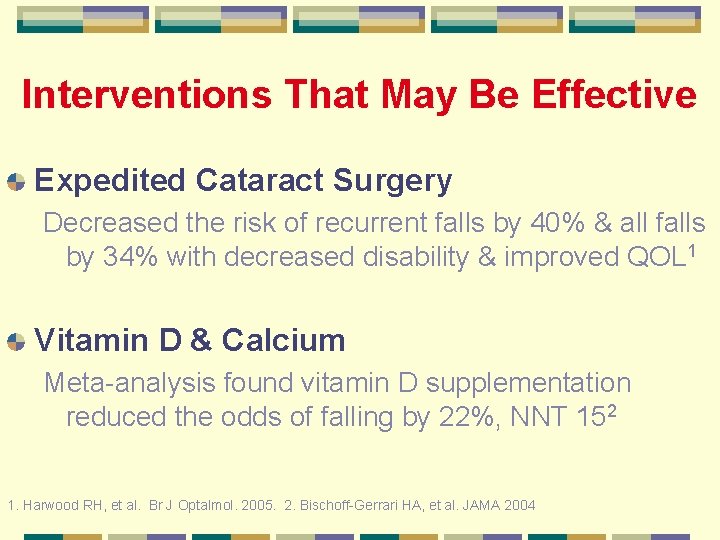
Interventions That May Be Effective Expedited Cataract Surgery Decreased the risk of recurrent falls by 40% & all falls by 34% with decreased disability & improved QOL 1 Vitamin D & Calcium Meta-analysis found vitamin D supplementation reduced the odds of falling by 22%, NNT 152 1. Harwood RH, et al. Br J Optalmol. 2005. 2. Bischoff-Gerrari HA, et al. JAMA 2004
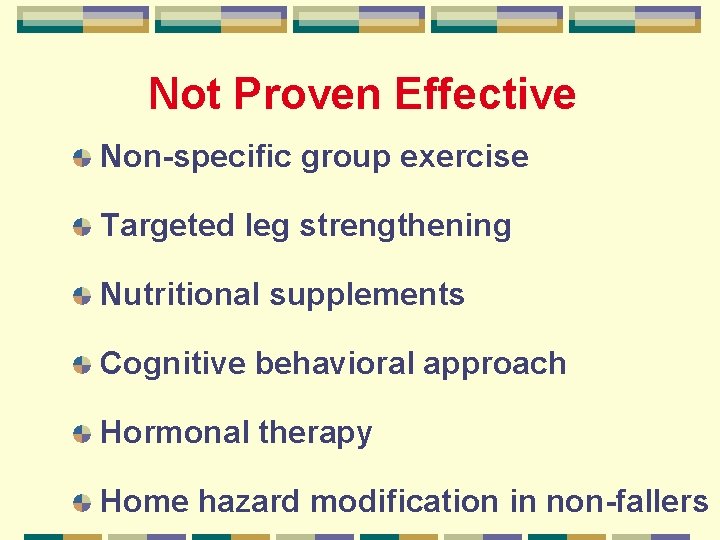
Not Proven Effective Non-specific group exercise Targeted leg strengthening Nutritional supplements Cognitive behavioral approach Hormonal therapy Home hazard modification in non-fallers
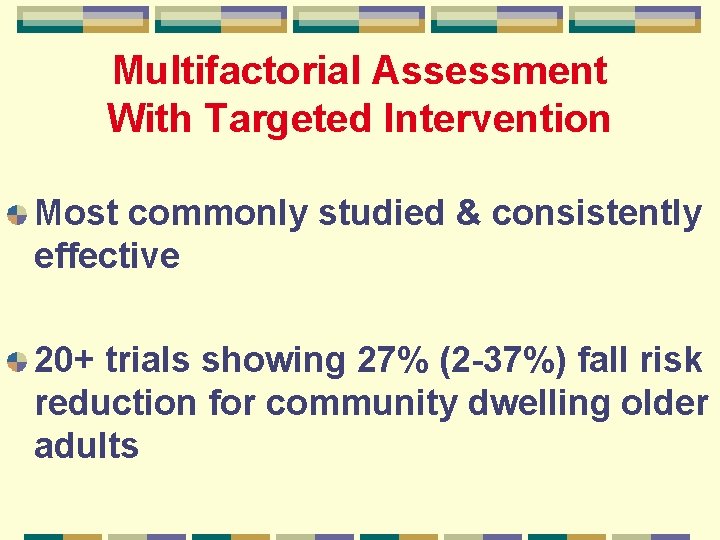
Multifactorial Assessment With Targeted Intervention Most commonly studied & consistently effective 20+ trials showing 27% (2 -37%) fall risk reduction for community dwelling older adults
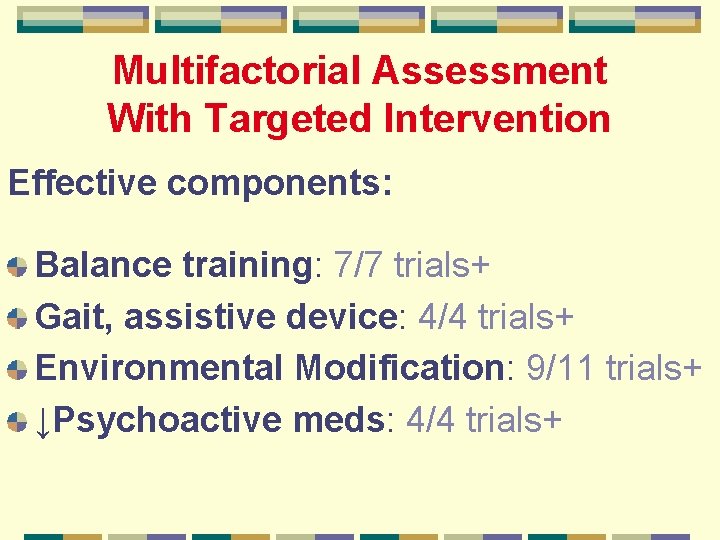
Multifactorial Assessment With Targeted Intervention Effective components: Balance training: 7/7 trials+ Gait, assistive device: 4/4 trials+ Environmental Modification: 9/11 trials+ ↓Psychoactive meds: 4/4 trials+
Multifactorial Assessment With Targeted Intervention (cont) Effective components: ↓Other meds: 4/4 trials + Manage orthostasis: 2/2 trials + Manage other CV & medical conditions: 2/3 trial + Cardiac pacing: 1+ trial
Fall Prevention in Practice Identify Patients At Risk l 70+ with h/o 2 or more falls or 1 injurious fall OR self -reported or observed difficulty with mobility l Ask at least annually about falls Assess & manage the health problems that increase fall risk
Therapeutic Approach Identify & treat immediate underlying causes & predisposing risk factors Review & reduce meds Manage postural hypotension PT/OT evaluation for strength, balance, & gait training Environmental modification
Medication Review Decrease meds, esp psychotropics (benzos, sedatives, anti-depressants) Taper to lowest effective dose or stop Consider need for all meds before adding new one Prescribe non-pharmacologic treatments Advise pt to carry up-to-date med list
Postural Hypotension Frequently unrecognized Adequate hydration l ½ c. water every ½ hr for first 8 hrs of day Liberalize salt in diet Reduce meds that contribute Teach patients to change position slowly
PT/OT Evaluation Gait & strength assessment & training Balance training Exercises that challenge stability yet are safe l Tai chi l Assistive devices l Recommendations for & regular inspection Appropriate footwear l High box, low heel, thin sole
Environmental Modification Home safety assessment l By pt or caregiver using checklist, MD at home visit, or visiting nurse Hazards include: Clutter l Electric cords l Slippery throw rugs & loose carpet l Poor lighting l
Optimize Disease Management Vision Test acuity, eval for cataracts, ophthalmology referral l Patient education l Allow time for eyes to accommodate to changing level of light l Do not walk using bifocals or reading glasses l Osteoporosis l Consider vitamin D, bisphonates
Clinical Pearls Screen all pts >75 yrs for falls at least yearly Evaluate the circumstances of the fall Systematically evaluate for modifiable predisposing factors and precipitants • • • Motor/balance/gait Environment Medications Vision Disease management, including cognition
Acknowledgment Thanks to Dr. Helen Fernandez for her mentorship
- Slides: 34