
Falls Falls Prevention Occupational Therapy Perspective Sarsha Pincini
![References 10. Queensland Government. Queensland Stay On Your Feet: community good practice guidelines [Internet].](https://slidetodoc.com/presentation_image/5f2ed8295c5f2f03a9002784b5e6b94f/image-33.jpg "References 10. Queensland Government. Queensland Stay On Your Feet: community good practice guidelines [Internet].")
![References 31. Queensland Government. Queensland Stay On Your Feet: community good practice guidelines [Internet].](https://slidetodoc.com/presentation_image/5f2ed8295c5f2f03a9002784b5e6b94f/image-37.jpg "References 31. Queensland Government. Queensland Stay On Your Feet: community good practice guidelines [Internet].")
- Slides: 40
Falls & Falls Prevention Occupational Therapy Perspective Sarsha Pincini, Samantha Webber, Lauren Morley & Casey Rynne.
Introduction What is a fall? ● Unintentional change in position, causing individual to land at a lower level 1 Why are falls an issue? ● Decreased mobility 2 ● Decline in participation in activities 2
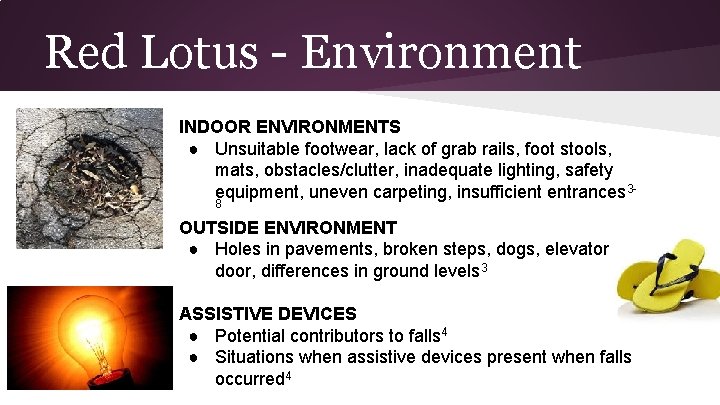
Red Lotus - Environment INDOOR ENVIRONMENTS ● Unsuitable footwear, lack of grab rails, foot stools, mats, obstacles/clutter, inadequate lighting, safety equipment, uneven carpeting, insufficient entrances 38 OUTSIDE ENVIRONMENT ● Holes in pavements, broken steps, dogs, elevator door, differences in ground levels 3 ASSISTIVE DEVICES ● Potential contributors to falls 4 ● Situations when assistive devices present when falls occurred 4
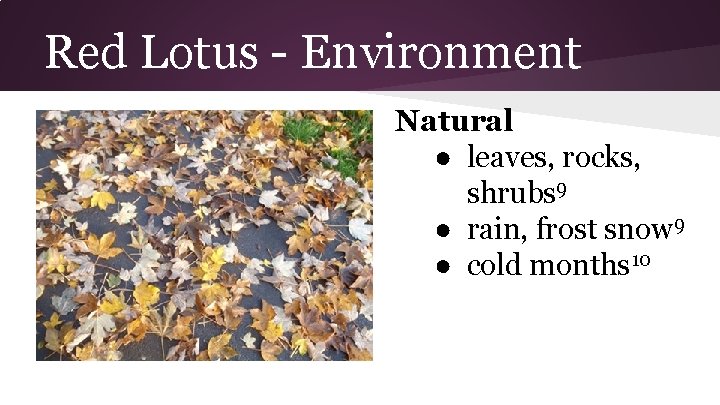
Red Lotus - Environment Natural ● leaves, rocks, shrubs 9 ● rain, frost snow 9 ● cold months 10
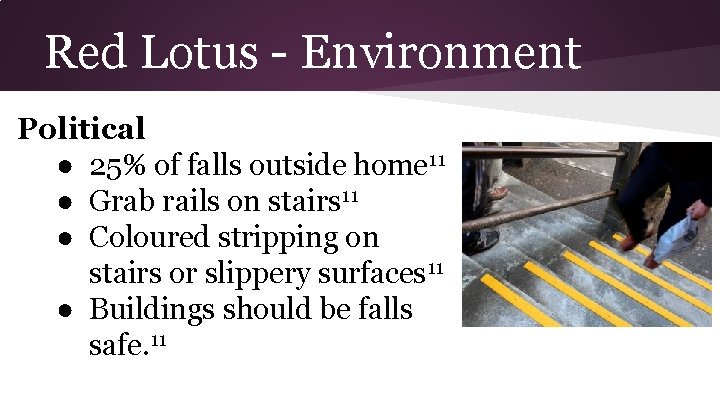
Red Lotus - Environment Political ● 25% of falls outside home 11 ● Grab rails on stairs 11 ● Coloured stripping on stairs or slippery surfaces 11 ● Buildings should be falls safe. 11
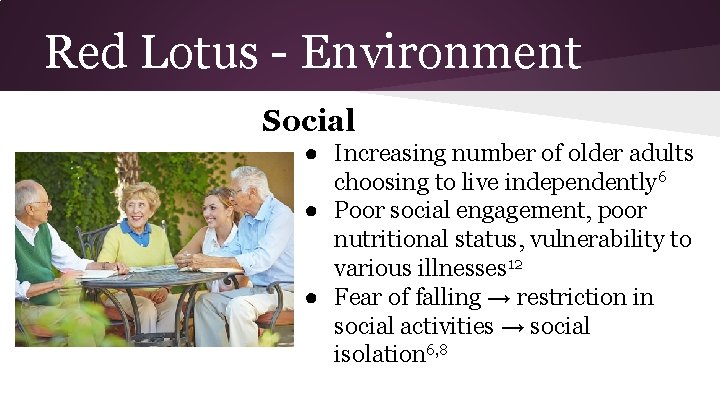
Red Lotus - Environment Social ● Increasing number of older adults choosing to live independently 6 ● Poor social engagement, poor nutritional status, vulnerability to various illnesses 12 ● Fear of falling → restriction in social activities → social isolation 6, 8
Red Lotus - Environment Economic ● High cost in society & a burden in the healthcare system 3, 13 ● Falls cost 86. 4 million 4 ● Cost after falling vs. fall prevention methods 10 ● Cost of a fall was much higher than the cost to prevent 7 ● Elderly are more susceptible to financial limitations 6
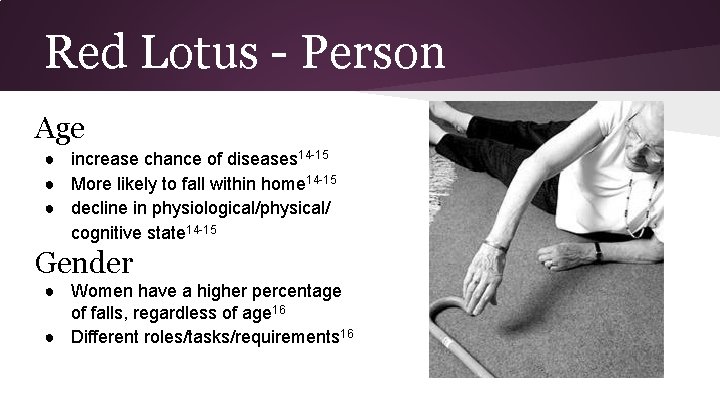
Red Lotus - Person Age ● increase chance of diseases 14 -15 ● More likely to fall within home 14 -15 ● decline in physiological/physical/ cognitive state 14 -15 Gender ● Women have a higher percentage of falls, regardless of age 16 ● Different roles/tasks/requirements 16
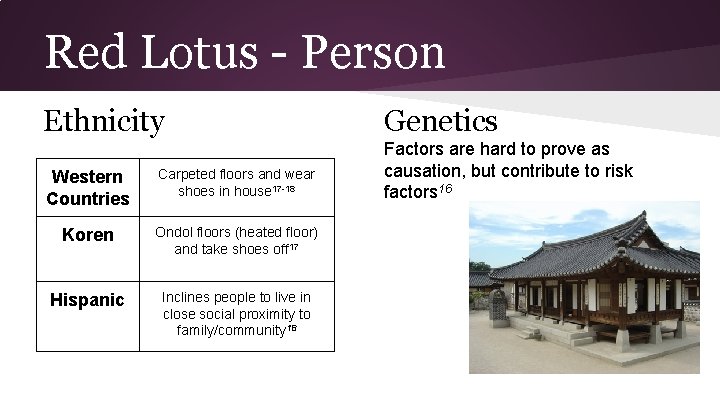
Red Lotus - Person Ethnicity Western Countries Carpeted floors and wear shoes in house 17 -18 Koren Ondol floors (heated floor) and take shoes off 17 Hispanic Inclines people to live in close social proximity to family/community 18 Genetics Factors are hard to prove as causation, but contribute to risk factors 16
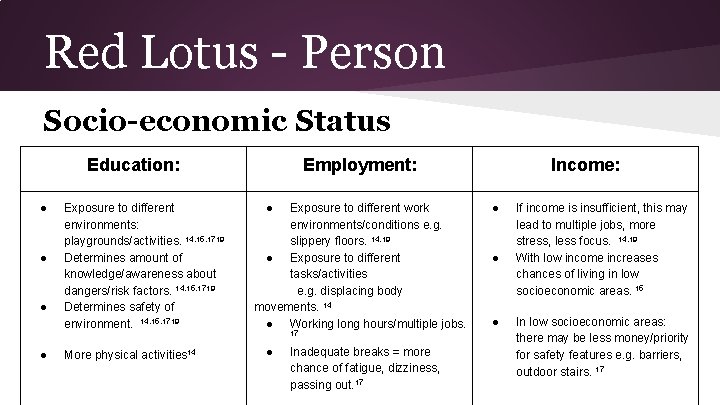
Red Lotus - Person Socio-economic Status Education: ● ● Exposure to different environments: playgrounds/activities. 14, 15, 1719 Determines amount of knowledge/awareness about dangers/risk factors. 14, 15, 1719 Determines safety of environment. 14, 15, 1719 More physical activities 14 Employment: ● Exposure to different work environments/conditions e. g. slippery floors. 14, 19 ● Exposure to different tasks/activities e. g. displacing body movements. 14 ● Working long hours/multiple jobs. 17 ● Inadequate breaks = more chance of fatigue, dizziness, passing out. 17 Income: ● ● ● If income is insufficient, this may lead to multiple jobs, more stress, less focus. 14, 19 With low income increases chances of living in low socioeconomic areas. 15 In low socioeconomic areas: there may be less money/priority for safety features e. g. barriers, outdoor stairs. 17
Red Lotus - Person Cognitive ● Lack of knowledge about the risk factors of falls/preventative strategies. 17, 22 ● A fear of falling. 17, 22 ● Limited hazard awareness. 17, 22 ● Resistant to preventative measures e. g. grab rail. 17, 22 ● Different beliefs about appropriate roles. 17, 22 ● Intellectual disability including dementia. 17, 22
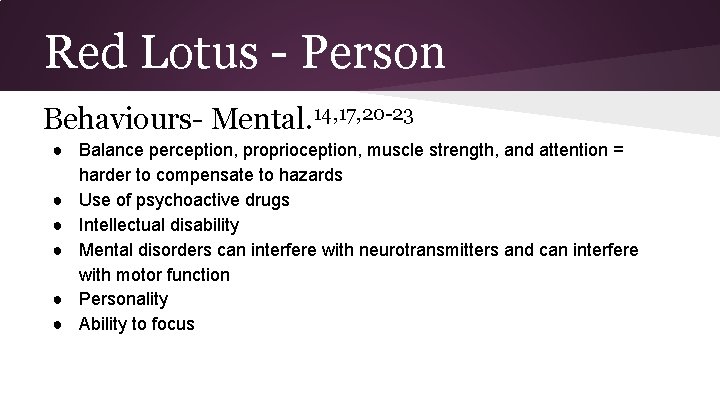
Red Lotus - Person Behaviours- Mental. 14, 17, 20 -23 ● Balance perception, proprioception, muscle strength, and attention = harder to compensate to hazards ● Use of psychoactive drugs ● Intellectual disability ● Mental disorders can interfere with neurotransmitters and can interfere with motor function ● Personality ● Ability to focus
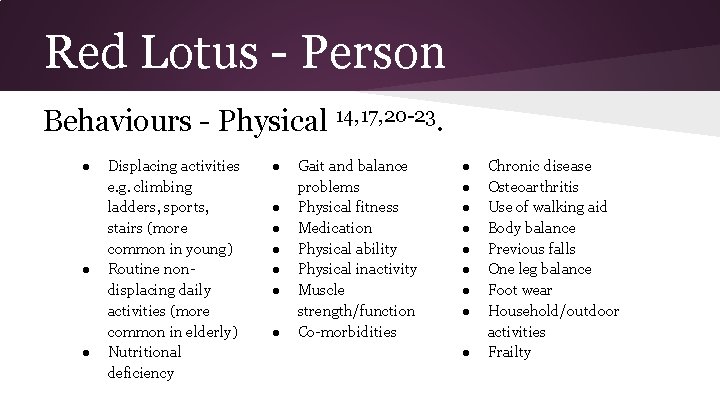
Red Lotus - Person Behaviours - Physical 14, 17, 20 -23. ● ● ● Displacing activities e. g. climbing ladders, sports, stairs (more common in young) Routine nondisplacing daily activities (more common in elderly) Nutritional deficiency ● ● ● ● Gait and balance problems Physical fitness Medication Physical ability Physical inactivity Muscle strength/function Co-morbidities ● ● ● ● ● Chronic disease Osteoarthritis Use of walking aid Body balance Previous falls One leg balance Foot wear Household/outdoor activities Frailty
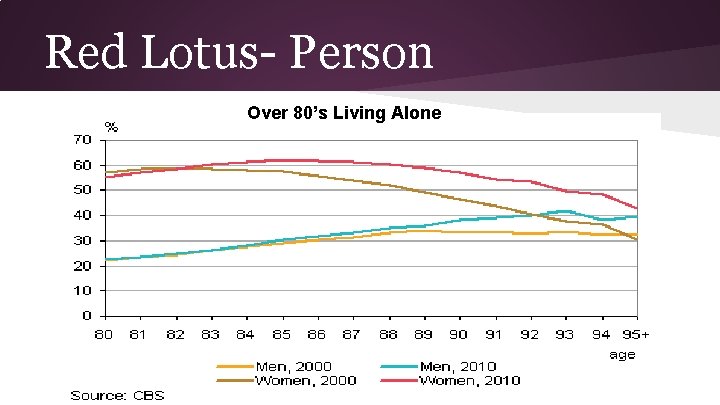
Red Lotus- Person Over 80’s Living Alone
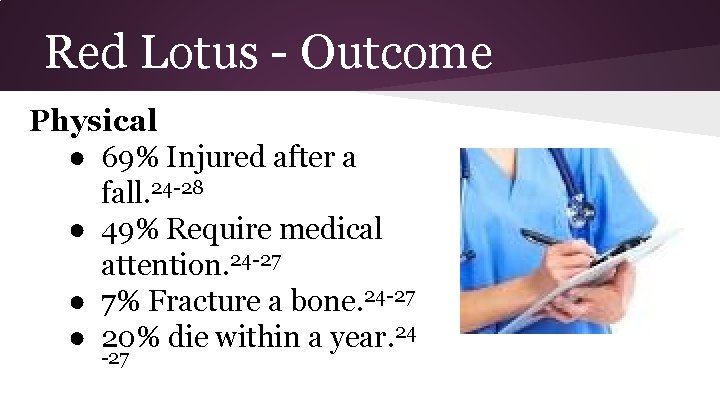
Red Lotus - Outcome Physical ● 69% Injured after a fall. 24 -28 ● 49% Require medical attention. 24 -27 ● 7% Fracture a bone. 24 -27 ● 20% die within a year. 24 -27
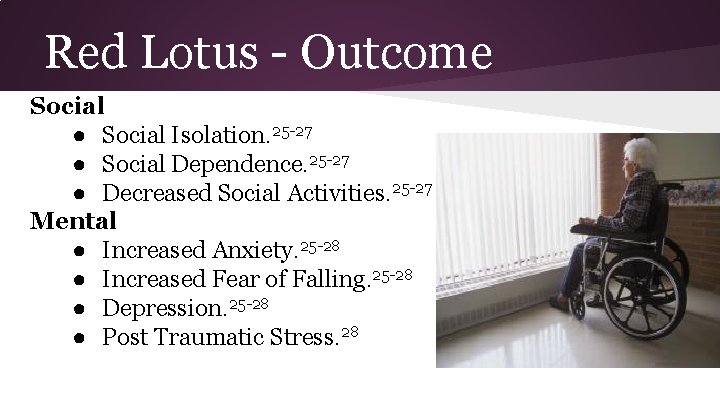
Red Lotus - Outcome Social ● Social Isolation. 25 -27 ● Social Dependence. 25 -27 ● Decreased Social Activities. 25 -27 Mental ● Increased Anxiety. 25 -28 ● Increased Fear of Falling. 25 -28 ● Depression. 25 -28 ● Post Traumatic Stress. 28
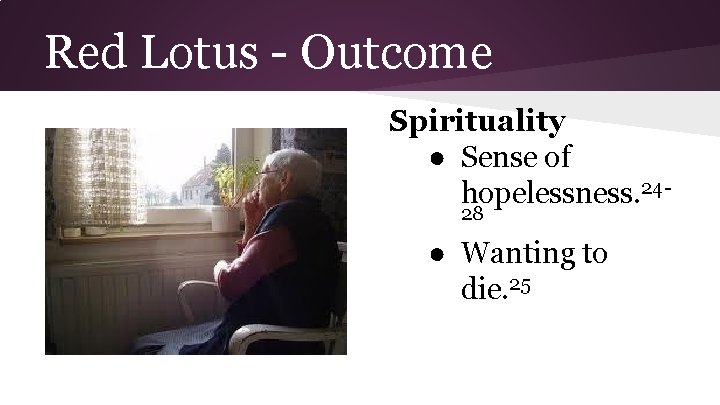
Red Lotus - Outcome Spirituality ● Sense of hopelessness. 2428 ● Wanting to die. 25
SOLUTION: Falls Prevention 1. Primary prevention: preventing a fall from occurring by acting on causes (i. e. risk factors). 29 2. Secondary prevention: preventing or reducing the seriousness of an injury by implementing protective mechanisms (eg. hip protectors). 29 3. Tertiary prevention: reduce seriousness of an injury immediately after a fall by providing medical treatment and rehabilitation to stabilise and restore physical and mental function. 29
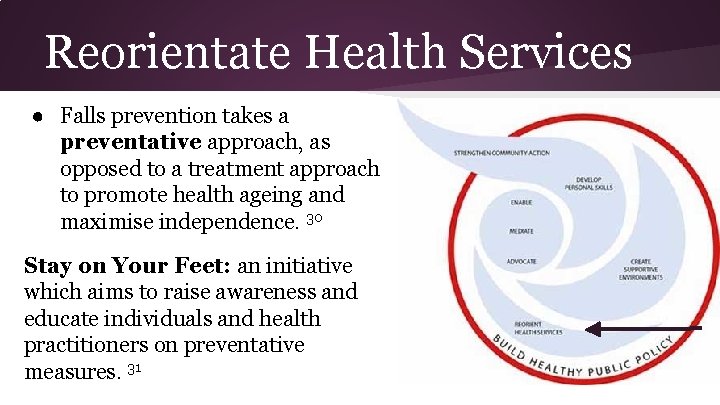
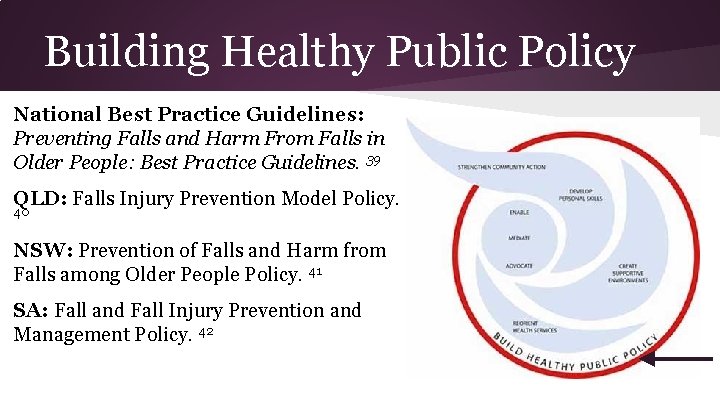
Reorientate Health Services ● Falls prevention takes a preventative approach, as opposed to a treatment approach to promote health ageing and maximise independence. 30 Stay on Your Feet: an initiative which aims to raise awareness and educate individuals and health practitioners on preventative measures. 31
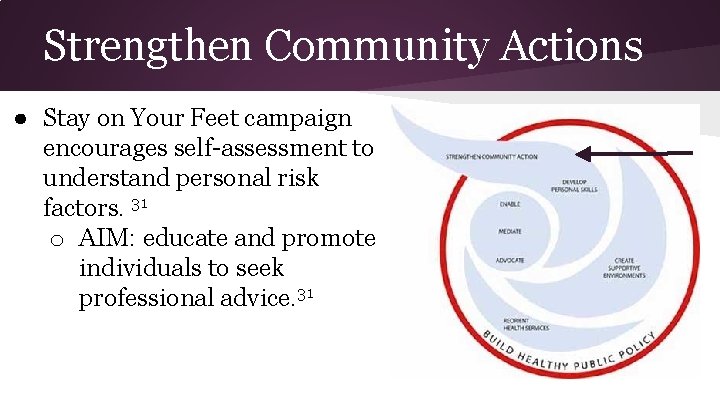
Strengthen Community Actions ● Stay on Your Feet campaign encourages self-assessment to understand personal risk factors. 31 o AIM: educate and promote individuals to seek professional advice. 31
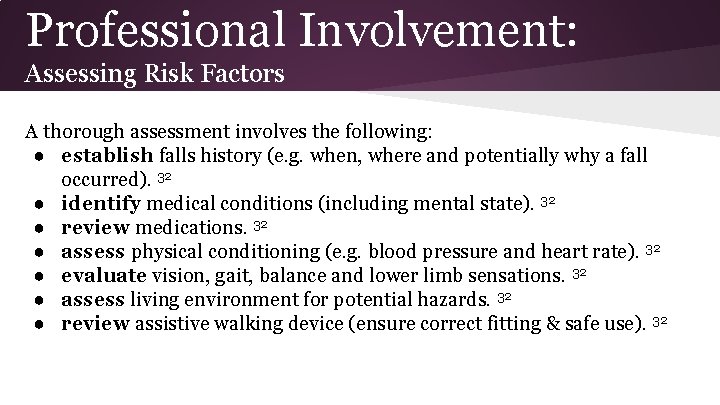
Professional Involvement: Assessing Risk Factors A thorough assessment involves the following: ● establish falls history (e. g. when, where and potentially why a fall occurred). 32 ● identify medical conditions (including mental state). 32 ● review medications. 32 ● assess physical conditioning (e. g. blood pressure and heart rate). 32 ● evaluate vision, gait, balance and lower limb sensations. 32 ● assess living environment for potential hazards. 32 ● review assistive walking device (ensure correct fitting & safe use). 32
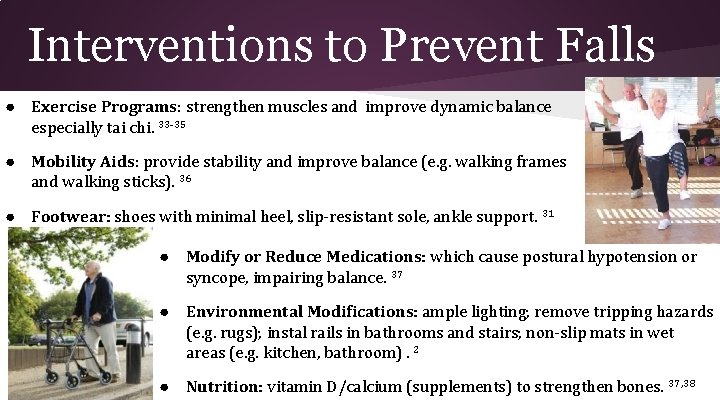
Interventions to Prevent Falls ● Exercise Programs: strengthen muscles and improve dynamic balance especially tai chi. 33 -35 ● Mobility Aids: provide stability and improve balance (e. g. walking frames and walking sticks). 36 ● Footwear: shoes with minimal heel, slip-resistant sole, ankle support. 31 ● Modify or Reduce Medications: which cause postural hypotension or syncope, impairing balance. 37 ● Environmental Modifications: ample lighting; remove tripping hazards (e. g. rugs); instal rails in bathrooms and stairs; non-slip mats in wet areas (e. g. kitchen, bathroom). 2 ● Nutrition: vitamin D/calcium (supplements) to strengthen bones. 37, 38
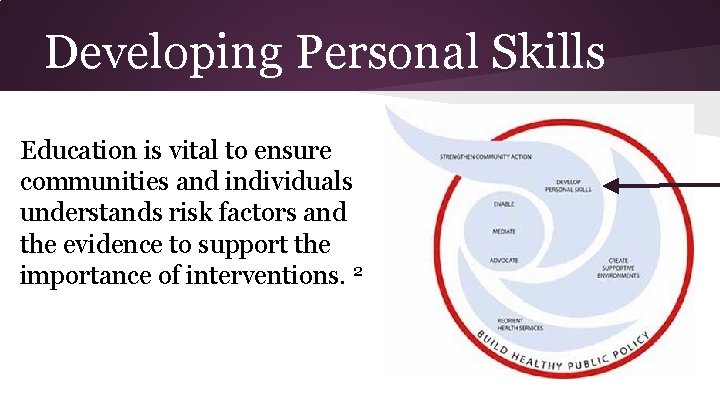
Developing Personal Skills Education is vital to ensure communities and individuals understands risk factors and the evidence to support the importance of interventions. 2
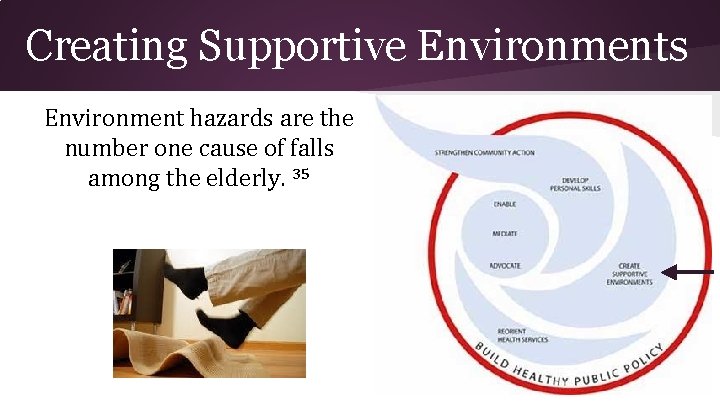
Creating Supportive Environments Environment hazards are the number one cause of falls among the elderly. 35
Building Healthy Public Policy National Best Practice Guidelines: Preventing Falls and Harm From Falls in Older People: Best Practice Guidelines. 39 QLD: Falls Injury Prevention Model Policy. 40 NSW: Prevention of Falls and Harm from Falls among Older People Policy. 41 SA: Fall and Fall Injury Prevention and Management Policy. 42
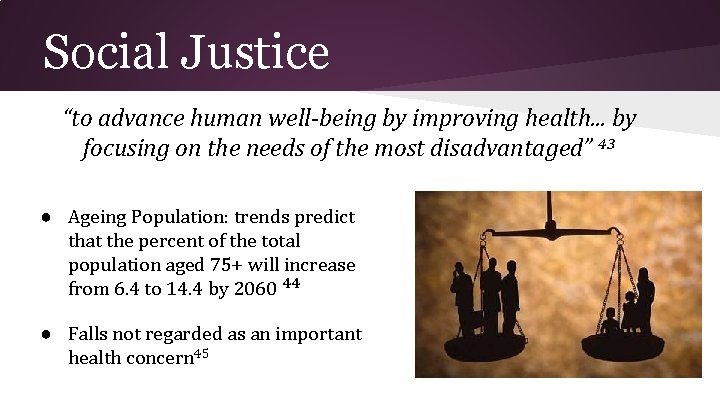
Social Justice “to advance human well-being by improving health. . . by focusing on the needs of the most disadvantaged” 43 ● Ageing Population: trends predict that the percent of the total population aged 75+ will increase from 6. 4 to 14. 4 by 2060 44 ● Falls not regarded as an important health concern 45
Implications: Occupational Therapy Occupational Therapists: ● ADVOCATE for and ENABLE independence. 46
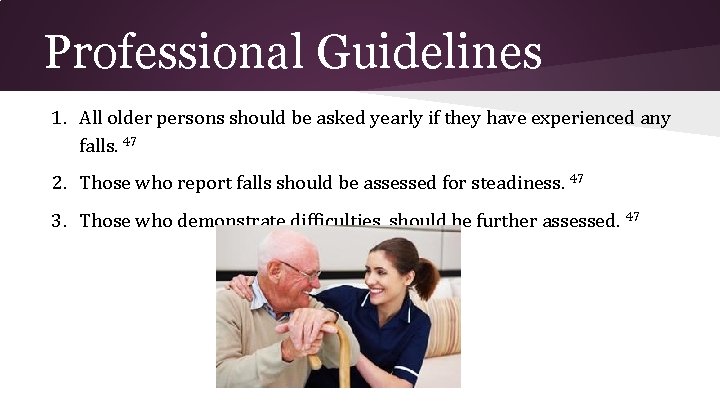
Professional Guidelines 1. All older persons should be asked yearly if they have experienced any falls. 47 2. Those who report falls should be assessed for steadiness. 47 3. Those who demonstrate difficulties, should be further assessed. 47
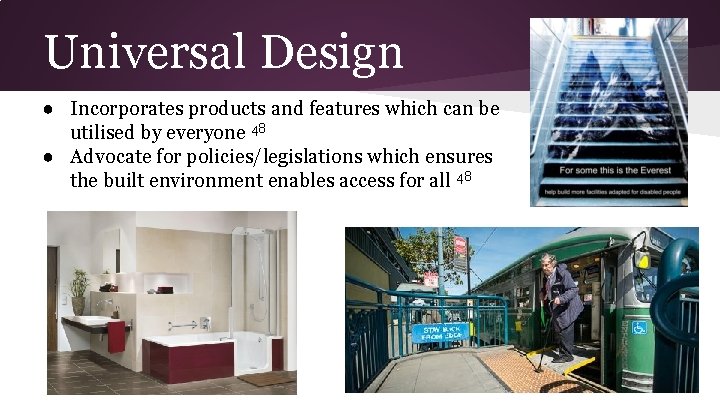
Universal Design ● Incorporates products and features which can be utilised by everyone 48 ● Advocate for policies/legislations which ensures the built environment enables access for all 48
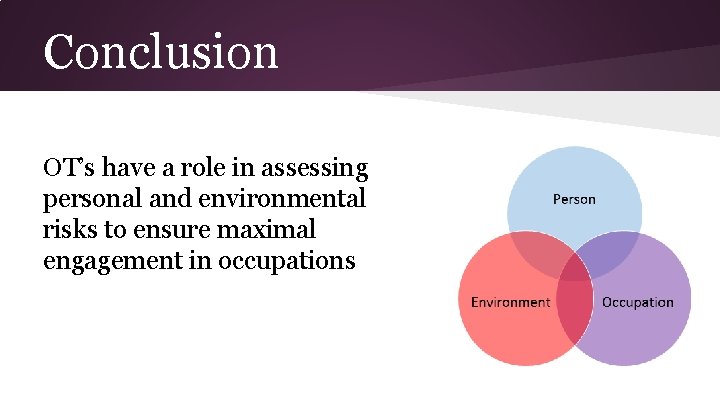
Conclusion OT’s have a role in assessing personal and environmental risks to ensure maximal engagement in occupations
References 1. Feder G, Cryer C, Donovan S, Carter Y. Guidelines for the prevention of falls in people over 65. B M J. 2000; 321(7267): 1007 -1011 2. Tinetti ME, Speechley M. Prevention of falls among the elderly. N Eng J Med. 1989; 320: 10551059. 3. H"agvide M, Larsson, T, Borell, L. Fall scenarios In causing older women's hip fractures. Scandinavian journal of occupational therapy. 2003; 20(1): 21 -28. 4. Letts L, Moreland J, Richardson J, Coman L, Edwards Mm Ginis K, et al. The physical environment as a fall risk factor in older adults: Systematic review and meta-analysis of cross -sectional and cohort studies. Australian occupational therapy journal. 2010; 57(1): 51 -64. 5. Szanton S, Thorpe R, Boyd C, Tanner E, Leff B, Agree E, et al. Community Aging in Place, Advancing Better Living for Elders: A Bio-Behavioral-Environmental Intervention to Improve Function and Health-Related Quality of Life in Disabled Older Adults. Journal of the American Geriatrics Society. 2011; 59(12): 2314 -2320.
References 6. Paul S. Liu Y. Inadequate light levels and their effect on falls and daily activities of community dwelling older adults: A review of literature. New Zealand Journal of Occupational Therapy. 2012; 59(2): 39. 7. Whitney S, Marchetti G, Ellis J, Otis L. Improvements in balance in older adults engaged in a specialized home care falls prevention program. Journal of geriatric physical therapy. 2013; 36(1): 3 -12. 8. Preventing falls in older people: assessment and interventions. (2011). Nursing Standard, [online] 25(52). Available from: http: //eds. a. ebscohost. com/eds/results? sid=8 eb 8 a 9 e 9 -5 ad 8 -47 b 9 -a 2 f 6327 cd 8831 b 39%40 sessionmgr 4003&vid=0&hid=4108&bquery=Preventing+falls+in+older+ people%3 a&bdata=Jm. Nsa. TA 9 Rl. Qx. Jm. Nsdj. A 9 WSZ 0 e. XBl. PTAmc 2 l 0 ZT 1 l. ZHMtb. Gl 2 ZQ%3 d%3 d. 9. Department of Veteran’s Affairs. Home. Front guide to preventing falls for older people [Internet]. c 2006 [updated 2006; cited 2014 Sep) Available from: http: //www. dva. gov. au/about. DVA/publications/health/Documents/preve nting_falls. pdf
References 10. Queensland Government. Queensland Stay On Your Feet: community good practice guidelines [Internet]. 2008 [cited 2014 Sept 22] Available from: http: //www. health. qld. gov. au/stayonyourfeet/documents/33383_full. pd 11. North Coast Health Promotion. Preventing falls in public places: Challenge and opportunity for local government [Internet]. c 1996 [updated 2009; cited 2014 Sep 30] Available from: http: //www. health. vic. gov. au/agedcare/maintaining/falls_dev/downloads/D 1%20 Preventi ng%20 falls%20 in%20 public%20 places. pdf 12. Lee W, Cheng Y, Liu J, Yang K, Jeng S. Living alone as a red flag sign of falls among older people in rural Taiwan. Journal of Clinical Gerontology and Geriatrics. 2011; 2(3): 76 -79. 13. Smith R, Widiatmoko D. The cost-effectiveness of home assessment and modification to reduce falls in the elderly. Australian and New Zealand Journal of Public Health. 1998; 22(4): 436 -440. 14. Talbot L, Musiol R, Witham E, Metter E. Falls in young, middle-aged and older community dwelling adults: perceived cause, environmental factors and injury. BMC Public Health. 2005; 5(1): 86.
References 15. Rivara F, Alexander B, Johnston B, Soderberg R. Population-based study of fall injuries in children and adolescents resulting in hospitalization or death. Pediatrics. 1993; 92(1): 61 --61. 16. Pajala S, Era P, Koskenvuo M, Kaprio J, Viljanen A, Rantanen T. Genetic factors and susceptibility to falls in older women. Journal of the American Geriatrics Society. 2006; 54(4): 613 --618. 17. Lim Y, Sung M. Home environmental and health-related factors among home fallers and recurrent fallers in community dwelling older Korean women. International journal of nursing practice. 2012; 18(5): 481 --488. 18. Brito T, Coqueiro R, Fernandes M, Jesus C. Determinants of Falls in Community-Dwelling Elderly: Hierarchical Analysis. Public Health Nursing. 2014; 31(4): 290 -297. 19. Kool B, Ameratunga S, Lee M, Robinson E, Crengle S, Jackson R. Prevalence of risk and protective factors for falls in the home environment in a population-based survey of young and middle-aged adult New Zealanders. Australian and New Zealand journal of Public Health. 2010; 34(1): 63 --66.
References 20. Bongue B, Dupre C, Beauchet O, Rossat A, Fantino B, Colvez A. A screening tool with five risk factors was developed for fall-risk prediction in community-dwelling elderly. Journal of clinical epidemiology. 2011; 64(10): 1152 --1160. 21. Fairhall N, Sherrington C, Lord S, Kurrle S, Langron C, Lockwood K et al. Effect of a multifactorial, interdisciplinary intervention on risk factors for falls and fall rate in frail older people: a randomised controlled trial. Age and ageing. 2013: 204. 22. Cahill S, Stancliffe R, Clemson L, Durvasula S. Reconstructing the fall: individual, behavioural and contextual factors associated with falls in individuals with intellectual disability. Journal of Intellectual Disability Research. 2014; 58(4): 321 --332. 23. Brito T, Coqueiro R, Fernandes M, Jesus C. Determinants of falls in community-dwelling elderly: hierarchical analysis. Public Health Nursing. 2014; 31(4): 290 -297. 24. Walker E. Howland J. Falls and fear of falling among elderly persons living in the community: Occupational Therapy Interventions. 1991; 45: 119 -122.
References 25. Stel V, Smit J, Pluijm S, Lips P. Consequences of falling in older men and women and risk factors for health service use and functional decline. 2004; 33(1): 58 -65. 26. Ellis A, Trent R. Do the risks and consequences of hospitilaized fall injuries among older adults in California vary by type of fall. The Journals of Gerontology: Series A. 2001; 56(11): 68 -92. 27. Salked G. Quality of life related to fear of falling a hip fracture in older women: A time trade off study. BMJ. 2000; 3210 -341. 28. Jayasinghe N, Sparks M, Kato K, Wyka K, Wibur K, Chiaramonte G. et al. Posttraumatic stress symptoms in older adults hospitalised for fall injury. 2014; 163(14): 207 - 222. 29. Queensland Government. Explanatory notes: Queensland Stay On Your Feet model for falls prevention in older people across the health continuum [Internet]. 2007 [cited 2014 Oct 1] Available from: http: //www. health. qld. gov. au/stayonyourfeet/documents/33421. pdf 30. World Health Organisation. Ottawa Charter for health promotion [Internet]. 2014 [cited 2014 Sept 22]. Available from: http: //www. who. int/healthpromotion/conferences/previous/ottawa/en/
References 31. Queensland Government. Queensland Stay On Your Feet: community good practice guidelines [Internet]. 2008 [cited 2014 Sept 22] Available from: http: //www. health. qld. gov. au/stayonyourfeet/documents/33383_full. pdf 32. American Geriatrics Society. Guidelines for the prevention of falls in older adults. Journal of the American Geriatrics Society. 2001; 49(5): 664 -672. 33. Skelton D, Todd C. What are the main risk factors for falls amongst older people and what are the most effective interventions to prevent these falls? [Internet]. 2004 [cited 2014 Sept 22] Available from: http: //www. euro. who. int/__data/assets/pdf_file/0018/74700/E 82552. pdf? ua=1 34. Feder G, Cryer C, Donovan S, Carter Y. Guidelines for the prevention of falls in people over 65. B M J. 2000; 321(7267): 1007 -1011. 35. Rubenstein L. Falls in older people: epidemiology, risk factors and strategies for prevention. Age and Ageing. 2006; 35(S 2): 37 -41. 36. Mann W, Hurren D, Tomita M, Charva B. An analysis of the problems with walkers encountered by elderly persons. Phys Occup Ther Geriatr. 1995; 13: 1 -23.
References 37. American Geriatrics Society. Guidelines for the prevention of falls in older adults. Journal of the American Geriatrics Society. 2001; 49(5): 664 -672. 38. Gillespie L, Robertson M, Gillespie W, Sherrington C, Gates S, Clemson L et al. Interventions for preventing falls in older people living in the community (review). Cochrane Database of Systematic Reviews. 2012; 9: 1 -412. 39. Australian Commission on Safety and Quality in Healthcare. Preventing falls and harm from falls in older people: best practice guidelines for Australian hospitals [Internet] 2009 [cited 2014 Oct 2]. Available from: http: //www. safetyandquality. gov. au/wpcontent/uploads/2012/01/Guidelines-HOSP 1. pdf 40. Queensland Health, Queensland Government. Preventing falls and harm from falls policy [Internet]. 2014 [cited 2014 Oct 2]. Avaliable from: http: //www. health. qld. gov. au/stayonyourfeet/documents/falls-model-policy. doc 41. New South Wales Government, Health. Policy directive: falls - prevention of falls and harm from falls among older people: 2011 -2015 [Internet]. 2011 [cited 2014 Oct 2]. Available from: http: //www 0. health. nsw. gov. au/policies/pd/2011/pdf/PD 2011_029. pdf
References 42. Government of South Australia, South Australia Health. Fall and fall injury prevention and management policy directive [Internet]. 2014 [cited 2014 Oct 2]. Available from: http: //www. sahealth. sa. gov. au/wps/wcm/connect/8 acea 4004654 c 05 ab 1 a 9 fb 2 e 504170 d 4/ Directive_Fall+and+Fall+Injury+Prevention_June 2013. pdf? MOD=AJPERES&CACHEID=8 acea 4 004654 c 05 ab 1 a 9 fb 2 e 504170 d 4 43. Gostin L, Powers M. Require for the public’s health? Public health ethics and policy imperatives: social justice demands more than fair distribution of resources in extreme public health emergencies. Health Affairs. 2006; 25(4): 1053 -1060. 44. Australian Government Productivity Commission. Nov 2012. An ageing Australia: Preparing for the future [Internet]. 2012 [cited 2014 Sept 22]. Available from: http: //www. pc. gov. au/__data/assets/pdf_file/0005/129749/ageing-australia. pdf 45. Laing S, Silver I, York S, Phelan E. Fall prevention knowledge, attitude, and practice of community stakeholders and older adults. J Ageing Res. 2011; 1 -9. doi: 10. 4061/2011/395357
References 46. Braveman B, Bass-Haugen J. Social justice and health disparities: an evolving discourse in occupational therapy research and intervention. American Journal of Occupational THerapy. 2009; 63: 7 -12. 47. American Geriatrics Society. Guidelines for the prevention of falls in older adults. Journal of the American Geriatrics Society. 2001; 49(5): 664 -672. 48. Iwarsson S, Stahl A. Accessibility, usability and universal design–positioning and deÆnition of concepts describing person-environment relationships. Disability and Rehabilitation. 2003; 25(2): 57 -66.