
FALLING OBJECTS PROJECTILES PES 1000 PHYSICS IN EVERYDAY

FALLING OBJECTS & PROJECTILES PES 1000 – PHYSICS IN EVERYDAY LIFE
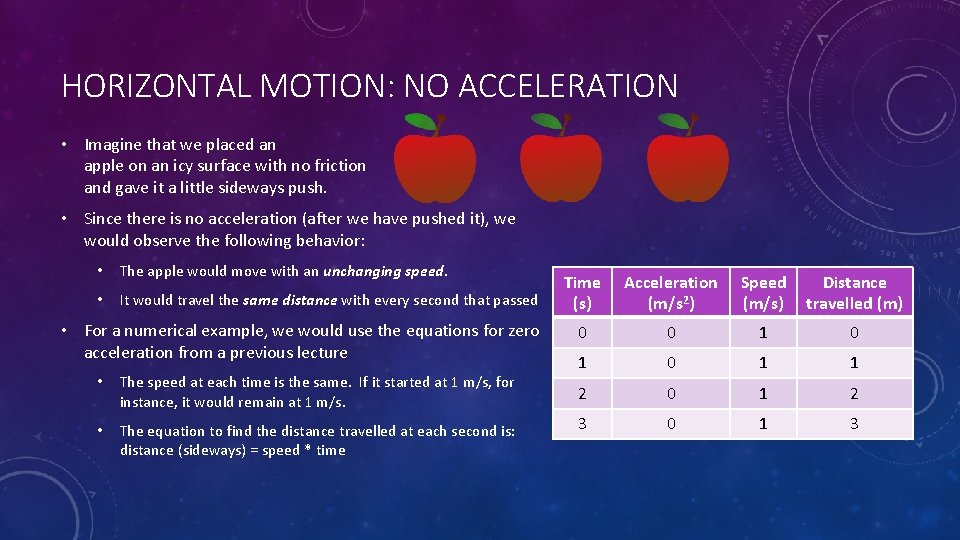
HORIZONTAL MOTION: NO ACCELERATION • Imagine that we placed an apple on an icy surface with no friction and gave it a little sideways push. • Since there is no acceleration (after we have pushed it), we would observe the following behavior: • The apple would move with an unchanging speed. • It would travel the same distance with every second that passed • For a numerical example, we would use the equations for zero acceleration from a previous lecture • The speed at each time is the same. If it started at 1 m/s, for instance, it would remain at 1 m/s. • The equation to find the distance travelled at each second is: distance (sideways) = speed * time Time (s) Acceleration (m/s 2) Speed (m/s) Distance travelled (m) 0 0 1 0 1 1 2 0 1 2 3 0 1 3

DROPPING AN OBJECT FROM REST • Imagine instead dropping the apple from a tall building, releasing it without throwing it. • We will make the following assumptions: • Air resistance is negligible, and will be ignored • Initial velocity will be zero. • Gravitational acceleration is constant for the entire drop. The value of acceleration is about 9. 81 m/s per second • There is no wind or any other sideways accelerating forces • We would observe the following behavior: • The apple would have a constantly increasing speed • The apple would fall a farther and farther distance every second that passed • Note: under these assumptions, all objects will fall at same rate, regardless of their weight! 9. 81 m/s 2
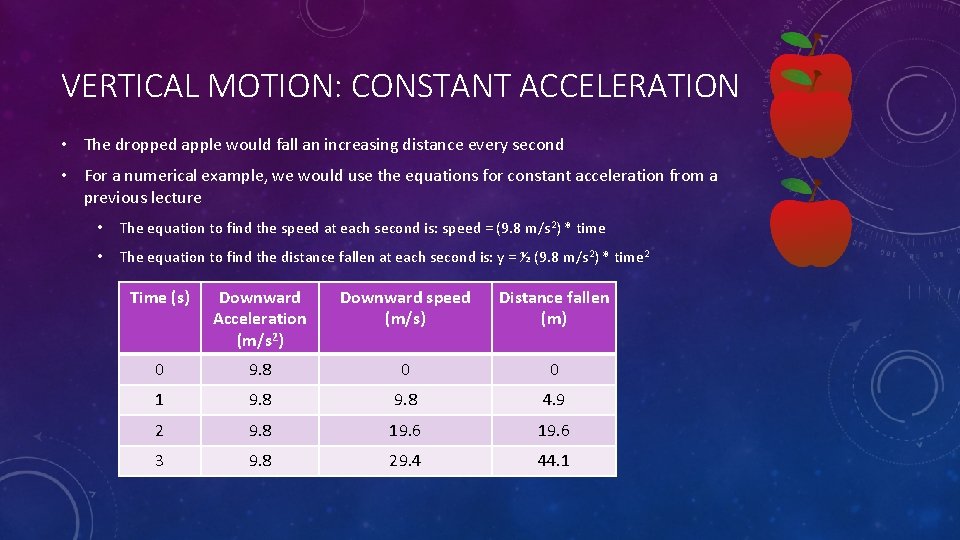
VERTICAL MOTION: CONSTANT ACCELERATION • The dropped apple would fall an increasing distance every second • For a numerical example, we would use the equations for constant acceleration from a previous lecture • The equation to find the speed at each second is: speed = (9. 8 m/s 2) * time • The equation to find the distance fallen at each second is: y = ½ (9. 8 m/s 2) * time 2 Time (s) Downward Acceleration (m/s 2) Downward speed (m/s) Distance fallen (m) 0 9. 8 0 0 1 9. 8 4. 9 2 9. 8 19. 6 3 9. 8 29. 4 44. 1
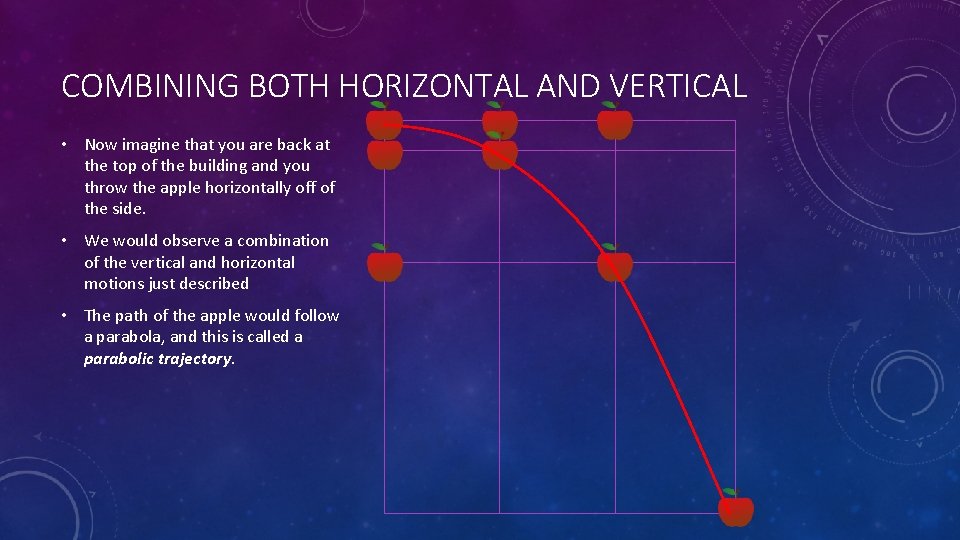
COMBINING BOTH HORIZONTAL AND VERTICAL • Now imagine that you are back at the top of the building and you throw the apple horizontally off of the side. • We would observe a combination of the vertical and horizontal motions just described • The path of the apple would follow a parabola, and this is called a parabolic trajectory.
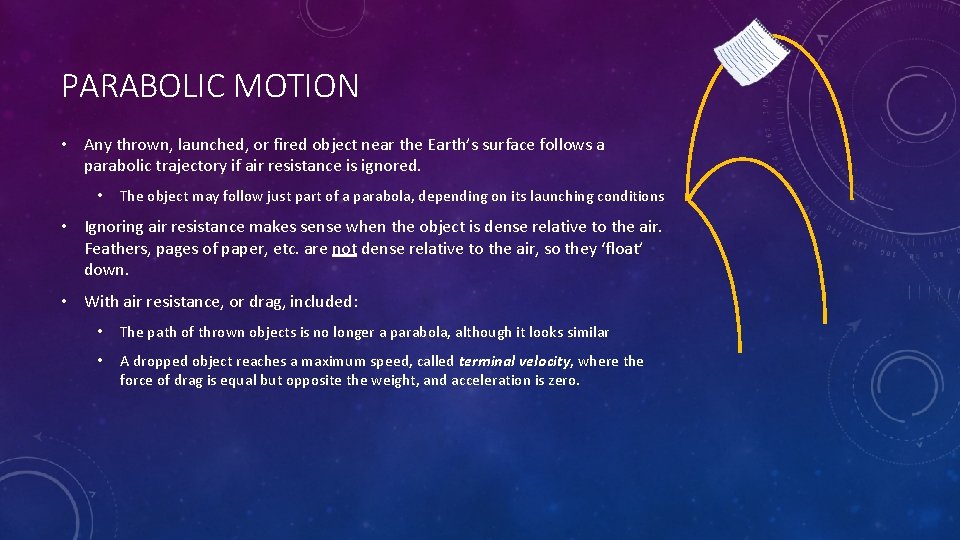
PARABOLIC MOTION • Any thrown, launched, or fired object near the Earth’s surface follows a parabolic trajectory if air resistance is ignored. • The object may follow just part of a parabola, depending on its launching conditions • Ignoring air resistance makes sense when the object is dense relative to the air. Feathers, pages of paper, etc. are not dense relative to the air, so they ‘float’ down. • With air resistance, or drag, included: • The path of thrown objects is no longer a parabola, although it looks similar • A dropped object reaches a maximum speed, called terminal velocity, where the force of drag is equal but opposite the weight, and acceleration is zero.

PARABOLIC MOTION SIMULATION • The ‘Parabolic Motion’ simulation lets you experiment with parabolic trajectories with and without air resistance • It can be found here: https: //phet. colorado. edu/en/simulation/legacy/projectile-motion • Let’s play with the simulation: • (You may need to install Java script in your browser: https: //java. com/en/download/ )
- Slides: 7