
Falling Liquid Film Flow along Cascadetype First Wall
![Experimental Setup Valve Flow Condition Flow Meter Re: 4800~9600 Flow Meter T=17. 5[。c] Valve](https://slidetodoc.com/presentation_image/281f66e1b1853a6cad0be6784715061f/image-10.jpg "Experimental Setup Valve Flow Condition Flow Meter Re: 4800~9600 Flow Meter T=17. 5[。c] Valve")
- Slides: 18
Falling Liquid Film Flow along Cascadetype First Wall of Laser-Fusion Reactor T. Kunugi, T. Nakai, Z. Kawara Department of Nuclear Engineering Kyoto University, Japan Lijiang river 10. 24. 2007 Collaborated with T. Norimatsu ILE Osaka University, Japan
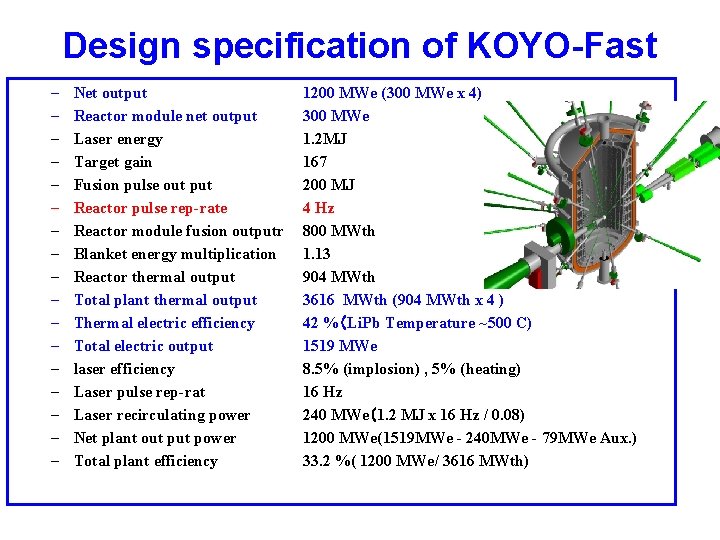
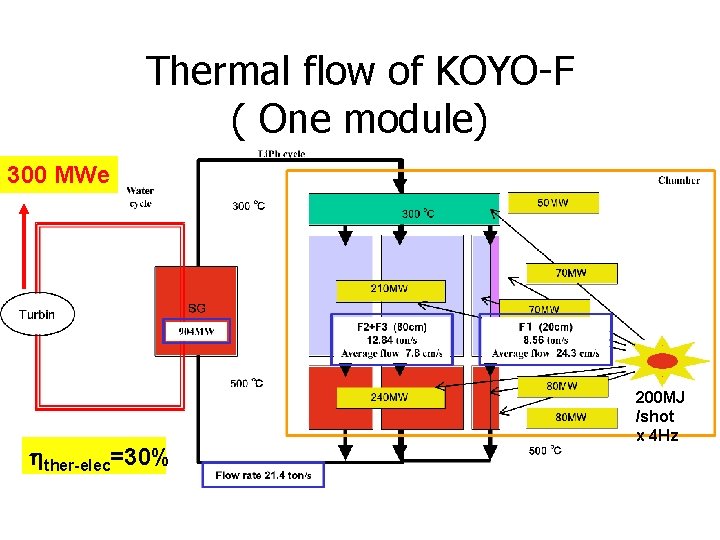
Design specification of KOYO-Fast – – – – – Net output Reactor module net output Laser energy Target gain Fusion pulse out put Reactor pulse rep-rate Reactor module fusion outputr Blanket energy multiplication Reactor thermal output Total plant thermal output Thermal electric efficiency Total electric output laser efficiency Laser pulse rep-rat Laser recirculating power Net plant out power Total plant efficiency 1200 MWe (300 MWe x 4) 300 MWe 1. 2 MJ 167 200 MJ 4 Hz 800 MWth 1. 13 904 MWth 3616 MWth (904 MWth x 4 ) 42 %(Li. Pb Temperature ~500 C) 1519 MWe 8. 5% (implosion) , 5% (heating) 16 Hz 240 MWe(1. 2 MJ x 16 Hz / 0. 08) 1200 MWe(1519 MWe - 240 MWe - 79 MWe Aux. ) 33. 2 %( 1200 MWe/ 3616 MWth)
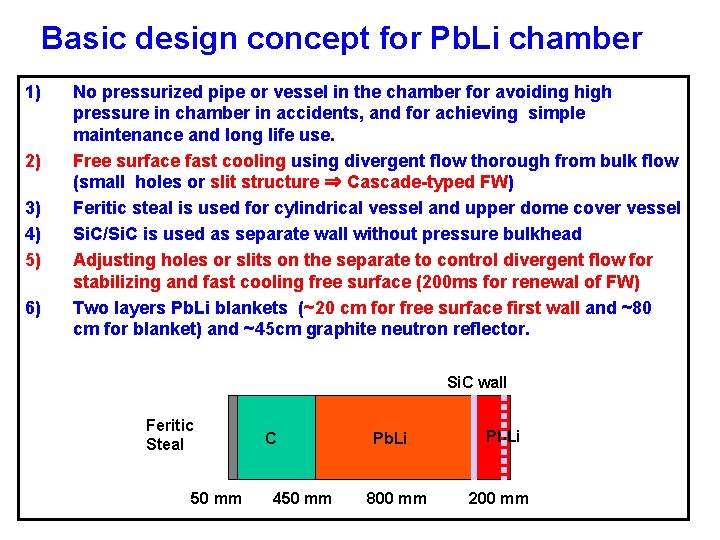
Basic design concept for Pb. Li chamber 1) 2) 3) 4) 5) 6) No pressurized pipe or vessel in the chamber for avoiding high pressure in chamber in accidents, and for achieving simple maintenance and long life use. Free surface fast cooling using divergent flow thorough from bulk flow (small holes or slit structure ⇒ Cascade-typed FW) Feritic steal is used for cylindrical vessel and upper dome cover vessel Si. C/Si. C is used as separate wall without pressure bulkhead Adjusting holes or slits on the separate to control divergent flow for stabilizing and fast cooling free surface (200 ms for renewal of FW) Two layers Pb. Li blankets (~20 cm for free surface first wall and ~80 cm for blanket) and ~45 cm graphite neutron reflector. Si. C wall Feritic Steal 50 mm C 450 mm Pb. Li 800 mm Pb. Li 200 mm
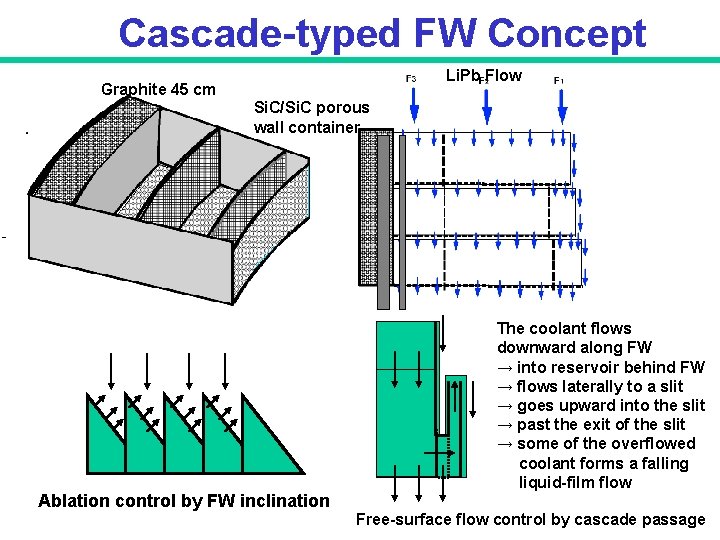
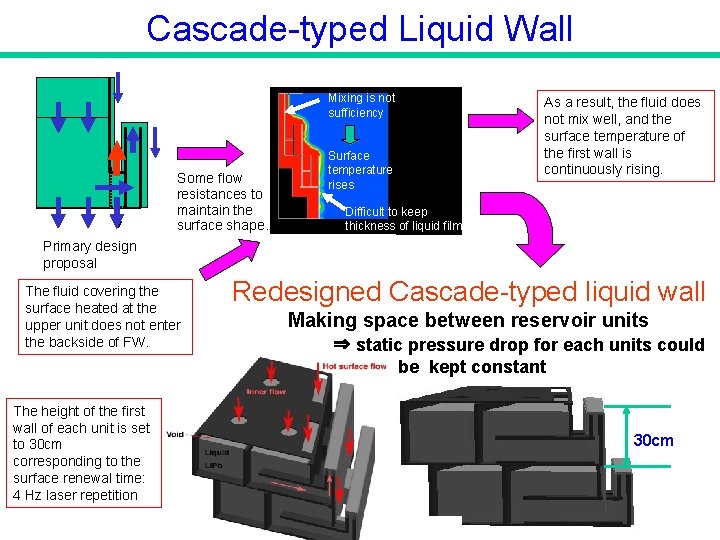
Cascade-typed FW Concept Li. Pb Flow Graphite 45 cm Si. C/Si. C porous wall container Ablation control by FW inclination The coolant flows downward along FW → into reservoir behind FW → flows laterally to a slit → goes upward into the slit → past the exit of the slit → some of the overflowed coolant forms a falling liquid-film flow Free-surface flow control by cascade passage
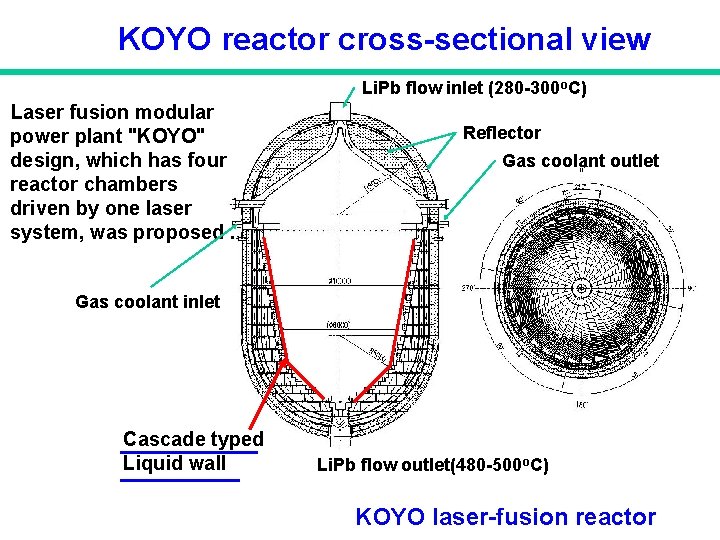
KOYO reactor cross-sectional view Li. Pb flow inlet (280 -300 o. C) Laser fusion modular power plant "KOYO" design, which has four reactor chambers driven by one laser system, was proposed. Reflector Gas coolant outlet Gas coolant inlet Cascade typed Liquid wall Li. Pb flow outlet(480 -500 o. C) KOYO laser-fusion reactor
Thermal flow of KOYO-F ( One module) 300 MWe hther-elec=30% 200 MJ /shot x 4 Hz
Cascade-typed Liquid Wall Mixing is not sufficiency Some flow resistances to maintain the surface shape. Surface temperature rises As a result, the fluid does not mix well, and the surface temperature of the first wall is continuously rising. Difficult to keep thickness of liquid film Primary design proposal The fluid covering the surface heated at the upper unit does not enter the backside of FW. The height of the first wall of each unit is set to 30 cm corresponding to the surface renewal time: 4 Hz laser repetition Redesigned Cascade-typed liquid wall Making space between reservoir units ⇒ static pressure drop for each units could be kept constant 30 cm
Proof-of-principle experiment • The flow visualization experiment was performed as a POP experiment. • In order to examine the performance of the new cascade-typed FW concept, numerical simulation was performed using STREAM code with k-e turbulent model.
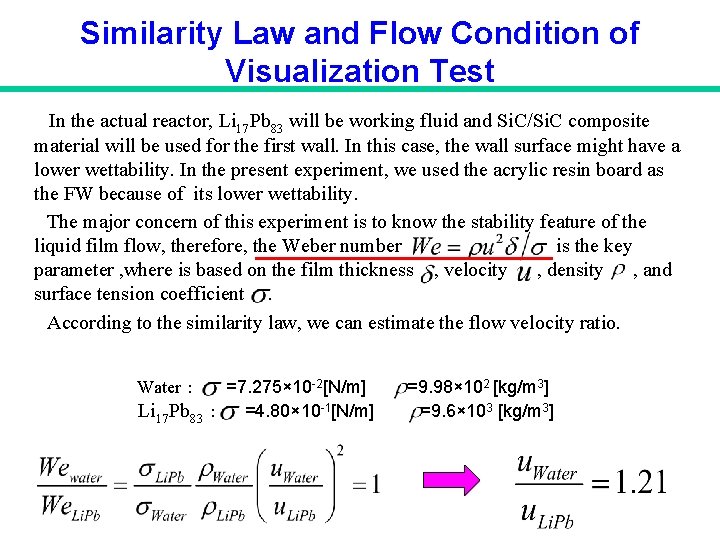
Similarity Law and Flow Condition of Visualization Test In the actual reactor, Li 17 Pb 83 will be working fluid and Si. C/Si. C composite material will be used for the first wall. In this case, the wall surface might have a lower wettability. In the present experiment, we used the acrylic resin board as the FW because of its lower wettability. The major concern of this experiment is to know the stability feature of the liquid film flow, therefore, the Weber number is the key parameter , where is based on the film thickness , velocity , density , and surface tension coefficient . According to the similarity law, we can estimate the flow velocity ratio. Water: =7. 275× 10 -2[N/m] =9. 98× 102 [kg/m 3] Li 17 Pb 83: =4. 80× 10 -1[N/m] =9. 6× 10³ [kg/m 3]
Experimental Setup Valve Flow Condition Flow Meter Re: 4800~9600 Flow Meter T=17. 5[。c] Valve Pump Tank Drain Electric Balance
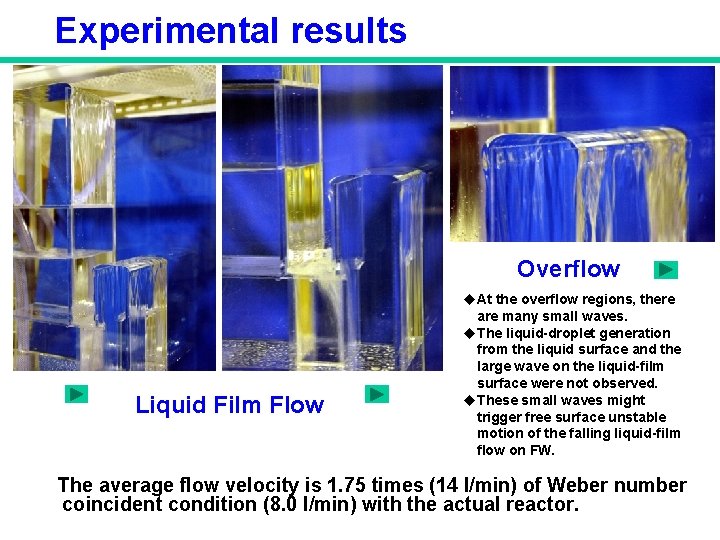
Experimental results Overflow Liquid Film Flow u. At the overflow regions, there are many small waves. u. The liquid-droplet generation from the liquid surface and the large wave on the liquid-film surface were not observed. u. These small waves might trigger free surface unstable motion of the falling liquid-film flow on FW. The average flow velocity is 1. 75 times (14 l/min) of Weber number coincident condition (8. 0 l/min) with the actual reactor.
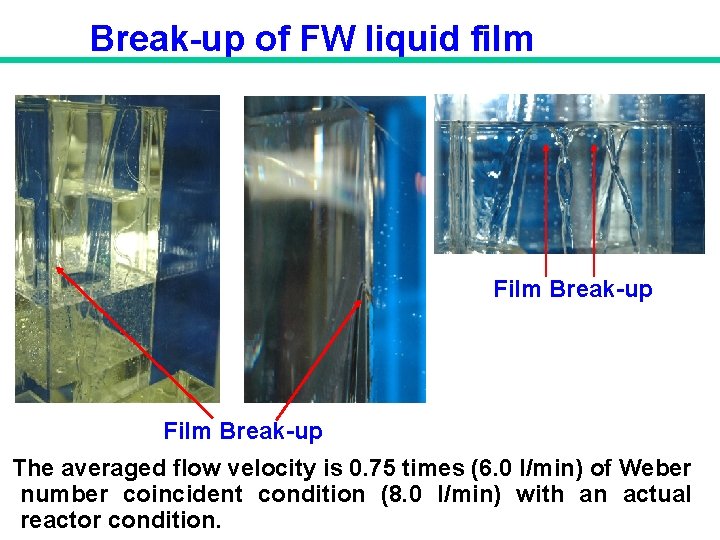
Break-up of FW liquid film Film Break-up The averaged flow velocity is 0. 75 times (6. 0 l/min) of Weber number coincident condition (8. 0 l/min) with an actual reactor condition.
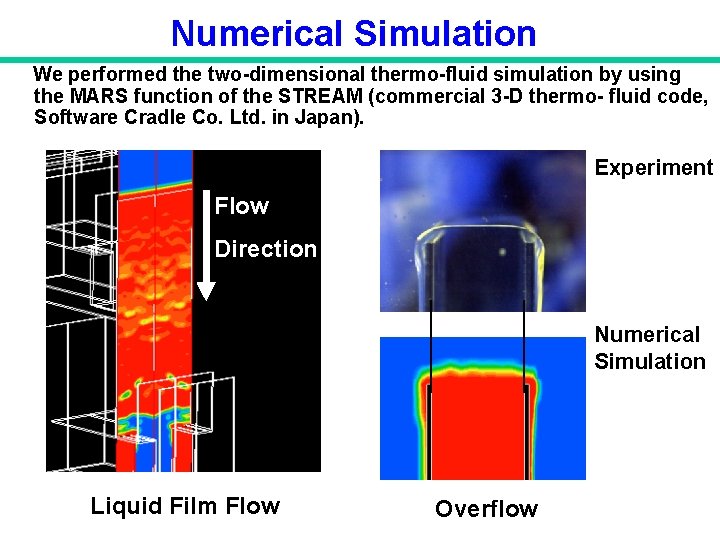
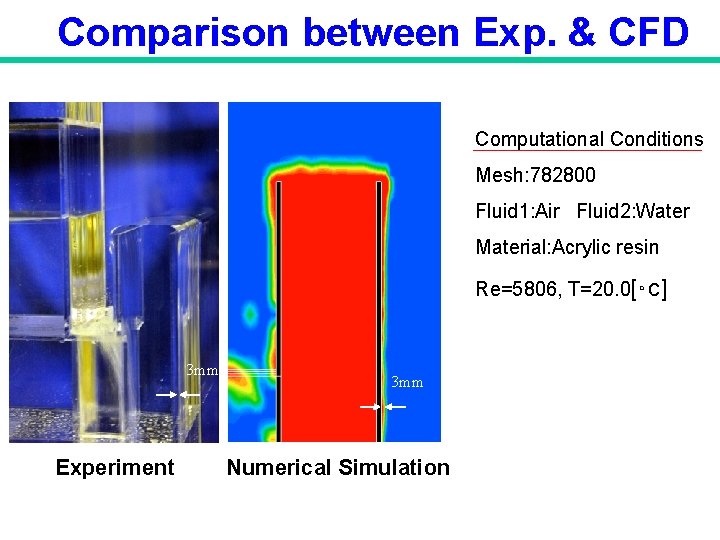
Numerical Simulation We performed the two-dimensional thermo-fluid simulation by using the MARS function of the STREAM (commercial 3 -D thermo- fluid code, Software Cradle Co. Ltd. in Japan). Experiment Flow Direction Numerical Simulation Liquid Film Flow Overflow
Comparison between Exp. & CFD Computational Conditions Mesh: 782800 Fluid 1: Air Fluid 2: Water Material: Acrylic resin Re=5806, T=20. 0[。c] 3 mm Experiment 3 mm Numerical Simulation
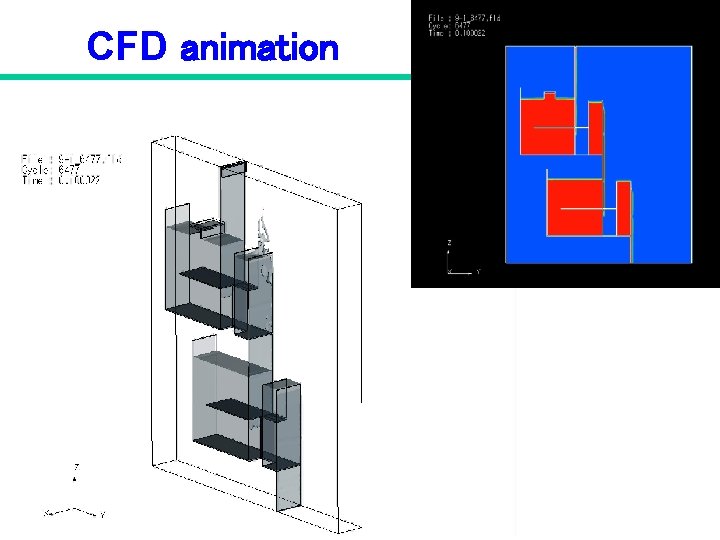
CFD animation
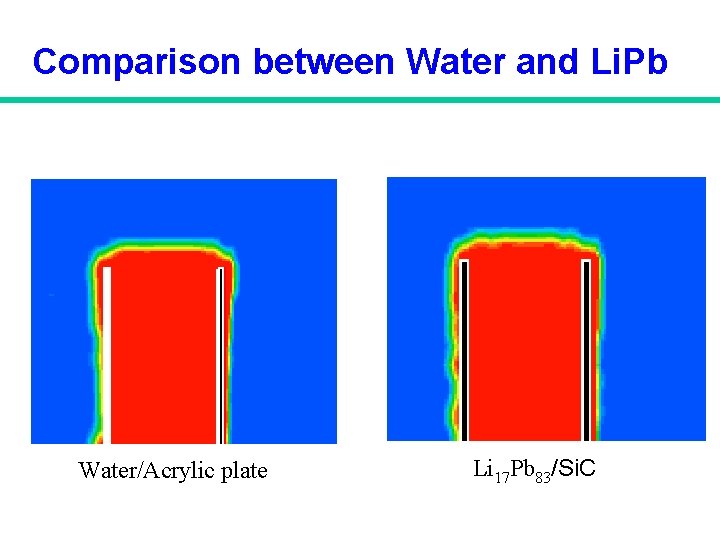
Comparison between Water and Li. Pb Water/Acrylic plate Li 17 Pb 83/Si. C
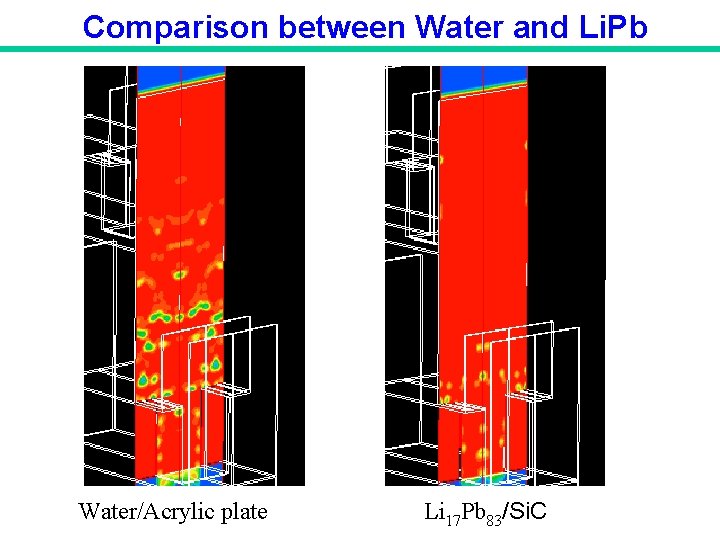
Comparison between Water and Li. Pb Water/Acrylic plate Li 17 Pb 83/Si. C
Conclusions • We proposed the cascade typed liquid wall concept, and conducted the POP experiments and the numerical simulation (CFD) based on the consideration of the similarity law. • The CFD result qualitatively agreed with the POP flow visualization experiment, so that the cascade-typed liquid film system will be realized. • We also confirmed that the stable liquid film with sufficient thickness (liquid wall covering the first wall) could be naturally formed. Therefore, it seems that this liquid wall concept might be possible to apply to the real reactor.