
Fallacies Continued Presumption Ambiguity Illicit Transference C G

Fallacies, Continued Presumption, Ambiguity, & Illicit Transference C. G. Parker | PHIL 1504 2/17/2016 1
Three Types � Presumption ◦ ◦ fallacies Begging the question Complex question False dichotomy Suppressed Evidence C. G. Parker | PHIL 1504 2/17/2016 2
Three Types � Presumption ◦ ◦ fallacies Begging the question Complex question False dichotomy Suppressed Evidence � Ambiguity fallacies ◦ Equivocation ◦ Amphiboly C. G. Parker | PHIL 1504 2/17/2016 3
Three Types � Presumption ◦ ◦ fallacies Begging the question Complex question False dichotomy Suppressed Evidence � Ambiguity fallacies ◦ Equivocation ◦ Amphiboly � Illicit transference fallacies ◦ Composition ◦ Division C. G. Parker | PHIL 1504 2/17/2016 4

3. 4 Fallacies of Presumption assume that which needs to be proven. C. G. Parker | PHIL 1504 2/17/2016 5

3. 4 Fallacies of Presumption The fallacy of Begging the Question is committed whenever the arguer creates the illusion that inadequate premises provide adequate support for the conclusion. C. G. Parker | PHIL 1504 2/17/2016 6
Begging the Question When you beg the question, you assume the conclusion is true in your premises; or, alternatively, you leave out a key premises that you have assumed to be true. C. G. Parker | PHIL 1504 2/17/2016 7
Begging the Question When you beg the question, you assume the conclusion is true in your premises; or, alternatively, you leave out a key premises that you have assumed to be true. The source of support for the conclusion is missing. C. G. Parker | PHIL 1504 2/17/2016 8
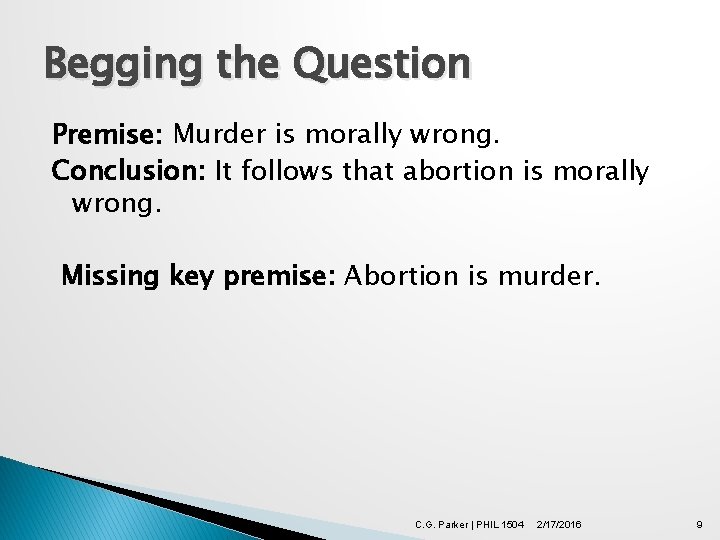
Begging the Question Premise: Murder is morally wrong. Conclusion: It follows that abortion is morally wrong. Missing key premise: Abortion is murder. C. G. Parker | PHIL 1504 2/17/2016 9
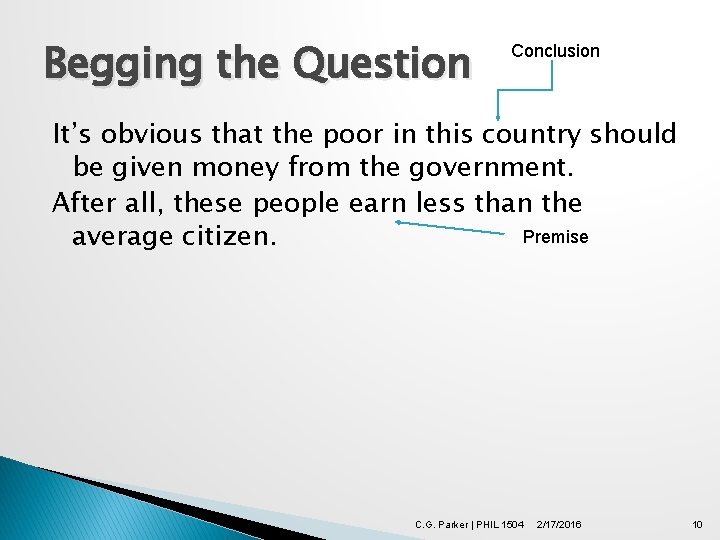
Begging the Question Conclusion It’s obvious that the poor in this country should be given money from the government. After all, these people earn less than the Premise average citizen. C. G. Parker | PHIL 1504 2/17/2016 10
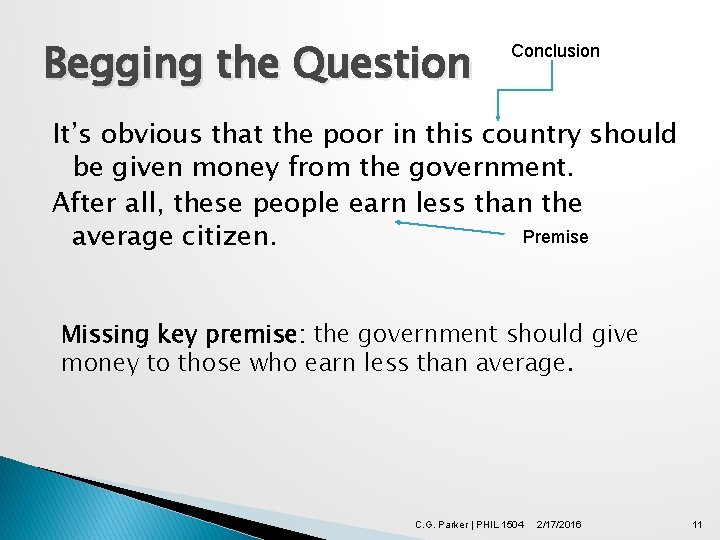
Begging the Question Conclusion It’s obvious that the poor in this country should be given money from the government. After all, these people earn less than the Premise average citizen. Missing key premise: the government should give money to those who earn less than average. C. G. Parker | PHIL 1504 2/17/2016 11
Begging the question Sometimes question-begging is disguised through the use of synonymous terms. “We know the death penalty is an acceptable punishment, because it’s acceptable to execute someone for a crime. ” C. G. Parker | PHIL 1504 2/17/2016 12
Begging the question Sometimes question-begging is disguised through the use of synonymous terms. “We know the death penalty is an acceptable punishment, because it’s acceptable to execute someone for a crime. ” “Death penalty” and “executing someone for a crime” mean the same thing, but the arguer acts as if the conclusion is informative. C. G. Parker | PHIL 1504 2/17/2016 13
Begging the question Sometimes this will be hidden in terms of a generalization. If the generalization is unsupported, then this can be begging the question. C. G. Parker | PHIL 1504 2/17/2016 14
Begging the question Sometimes this will be hidden in terms of a generalization. If the generalization is unsupported, then this can be begging the question. “Mary shouldn’t eat chicken, because eating meat is something that people shouldn’t do. ” Note that this is a valid argument – it’s just not informative. C. G. Parker | PHIL 1504 2/17/2016 15
Begging the question “We designed the polygraph test by taking liars, asking them questions, and noting what physiological signs they displayed while answering. We know they were liars, because they failed the polygraph test. ” C. G. Parker | PHIL 1504 2/17/2016 16
Begging the question “We designed the polygraph test by taking liars, asking them questions, and noting what physiological signs they displayed while answering. We know they were liars, because they failed the polygraph test. ” “Future events will resemble current and past events. We know this because, historically, this has always been the case. ” C. G. Parker | PHIL 1504 2/17/2016 17
Begging the question “We designed the polygraph test by taking liars, asking them questions, and noting what physiological signs they displayed while answering. We know they were liars, because they failed the polygraph test. ” “Future events will resemble current and past events. We know this because, historically, this has always been the case. ” “There are no frost giants on Earth because Thor killed them. Therefore, Thor exists. ” C. G. Parker | PHIL 1504 2/17/2016 18
3. 4 Complex Question A complex question is committed when two (or more) questions are asked in the guise of a single question, that presumes a particular answer is true. C. G. Parker | PHIL 1504 2/17/2016 19
3. 4 Complex Question A complex question is committed when two (or more) questions are asked in the guise of a single question, that presumes a particular answer is true. Complex questions are usually trap questions. C. G. Parker | PHIL 1504 2/17/2016 20
3. 4 Complex Question “What is it that makes women such naturally better caregivers? ” “When did you start hating America? ” C. G. Parker | PHIL 1504 2/17/2016 21

3. 4 False Dichotomy A false dichotomy is presented when a disjunctive (“either. . . or. . . ”) premise presents two unlikely alternatives as if they were the only ones available. C. G. Parker | PHIL 1504 2/17/2016 22
3. 4 False Dichotomy A false dichotomy is presented when a disjunctive (“either. . . or. . . ”) premise presents two unlikely alternatives as if they were the only ones available. Typically, this is done so the arguer can eliminate the undesirable alternative, leaving the desirable one as the conclusion. C. G. Parker | PHIL 1504 2/17/2016 23
False Dilemma (P 1) Either claim X is true or claim Y is true. (P 2) Claim Y is false. (C) Therefore claim X is true. This pattern is fallacious when the first premise is false (e. g. , there are other options available)
False Dilemma Examples: “You can join PETA, or continue to condone the suffering of animals. ” “I thought you were a nice person, but I didn’t see you at church on Sunday. ” A person can not want to be involved in PETA, but still fight against the suffering of animals. And missing church doesn’t imply that the person isn’t nice.

Suppressed Evidence The fallacy of suppressed evidence occurs when in an inductive argument, the arguer ignores important evidence that outweighs the presented evidence and entails a very different conclusion. C. G. Parker | PHIL 1504 2/17/2016 26
Suppressed Evidence Sometimes, in an inductive argument, the arguer ignores important evidence that outweighs the presented evidence and entails a very different conclusion. C. G. Parker | PHIL 1504 2/17/2016 27
Suppressed Evidence Sometimes, in an inductive argument, the arguer ignores important evidence that outweighs the presented evidence and entails a very different conclusion. This is a case of the suppressed evidence fallacy, which occurs when true and relevant information is left out. C. G. Parker | PHIL 1504 2/17/2016 28
Suppressed Evidence Sometimes, in an inductive argument, the arguer ignores important evidence that outweighs the presented evidence and entails a very different conclusion. This is a case of the suppressed evidence fallacy, which occurs when true and relevant information is left out. We’re calling this a Fallacy of Presumption because it involves the presumption that the true premises are complete. C. G. Parker | PHIL 1504 2/17/2016 29
Fallacies of ambiguity Fallacies of Ambiguity rely upon shifts in meaning that occur between the premise and conclusion. C. G. Parker | PHIL 1504 2/17/2016 30
Equivocation occurs when the conclusion of an argument depends on the fact that a word or phrase is used, either explicitly or implicitly, in two different senses in the argument. C. G. Parker | PHIL 1504 2/17/2016 31
Equivocation occurs when the conclusion of an argument depends on the fact that a word or phrase is used, either explicitly or implicitly, in two different senses in the argument. P 1) No man has two noses. P 2) One man has one more nose than no man does. C) Therefore, one man has three noses. C. G. Parker | PHIL 1504 2/17/2016 32
Amphiboly The fallacy of amphiboly is committed when the arguer misinterprets an ambiguous statement and then draws a conclusion based on this faulty interpretation. C. G. Parker | PHIL 1504 2/17/2016 33
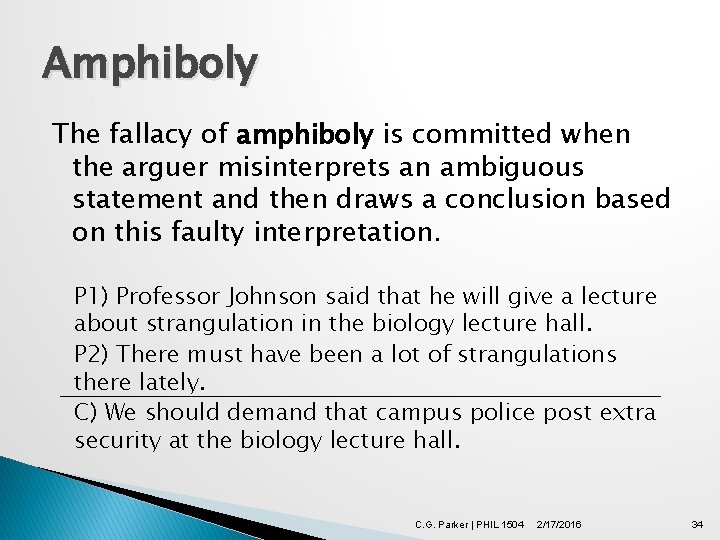
Amphiboly The fallacy of amphiboly is committed when the arguer misinterprets an ambiguous statement and then draws a conclusion based on this faulty interpretation. P 1) Professor Johnson said that he will give a lecture about strangulation in the biology lecture hall. P 2) There must have been a lot of strangulations there lately. C) We should demand that campus police post extra security at the biology lecture hall. C. G. Parker | PHIL 1504 2/17/2016 34
3. 4 Fallacies of Illicit Transference � Fallacies of Illicit Transference rely upon a deceptive similarity in linguistic structure. C. G. Parker | PHIL 1504 2/17/2016 35
3. 4 Fallacies of Illicit Transference Composition: this fallacy is committed when the conclusion of an argument depends on the erroneous transference of an attribute from the parts to the whole. C. G. Parker | PHIL 1504 2/17/2016 36
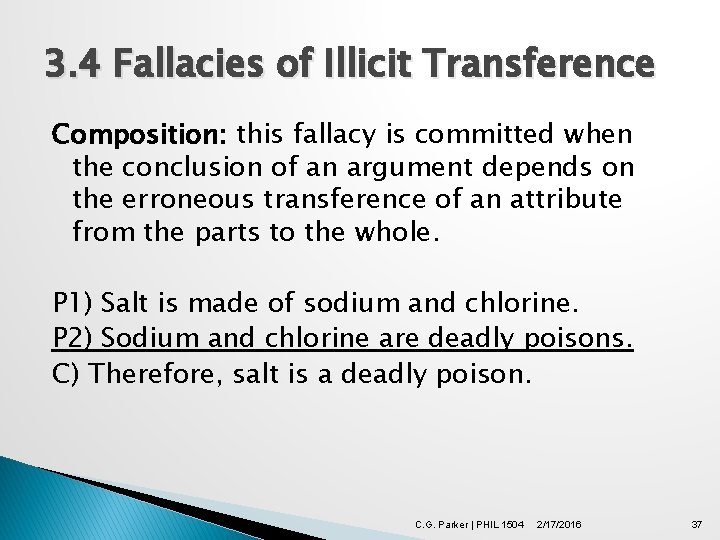
3. 4 Fallacies of Illicit Transference Composition: this fallacy is committed when the conclusion of an argument depends on the erroneous transference of an attribute from the parts to the whole. P 1) Salt is made of sodium and chlorine. P 2) Sodium and chlorine are deadly poisons. C) Therefore, salt is a deadly poison. C. G. Parker | PHIL 1504 2/17/2016 37
3. 4 Fallacies of Illicit Transference Division: this fallacy is the exact reverse of composition. As composition goes from parts to whole, division goes from whole to parts. C. G. Parker | PHIL 1504 2/17/2016 38
3. 4 Fallacies of Illicit Transference Division: this fallacy is the exact reverse of composition. As composition goes from parts to whole, division goes from whole to parts. P 1) The 2 nd grade at Lovelace Elementary School eats a lot of ice cream. P 2) Carlos is a 2 nd grader at Lovelace Elementary. C) Therefore, Carlos eats a lot of ice cream. C. G. Parker | PHIL 1504 2/17/2016 39
3. 4 Fallacies of Illicit Transference Division: this fallacy is the exact reverse of composition. As composition goes from parts to whole, division goes from whole to parts. P 1) Caroline is a lovely girl. C) Caroline has a lovely small intestine. C. G. Parker | PHIL 1504 2/17/2016 40
- Slides: 40