
Fall Protection www lineagelogistics com Training Matrix Subject
Fall Protection www. lineagelogistics. com
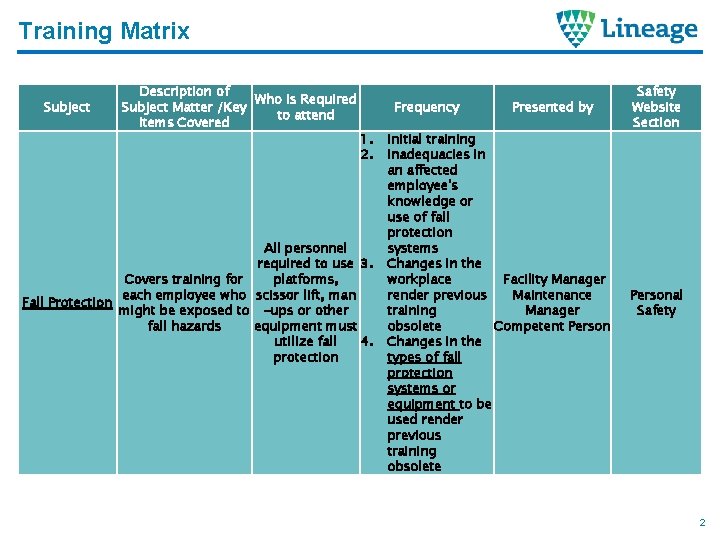
Training Matrix Subject Description of Who is Required Subject Matter /Key to attend Items Covered Frequency 1. 2. All personnel required to use 3. Covers training for platforms, each employee who scissor lift, man Fall Protection might be exposed to -ups or other fall hazards equipment must utilize fall 4. protection Presented by Initial training Inadequacies in an affected employee's knowledge or use of fall protection systems Changes in the Facility Manager workplace Maintenance render previous Manager training Competent Person obsolete Changes in the types of fall protection systems or equipment to be used render previous training obsolete Safety Website Section Personal Safety 2
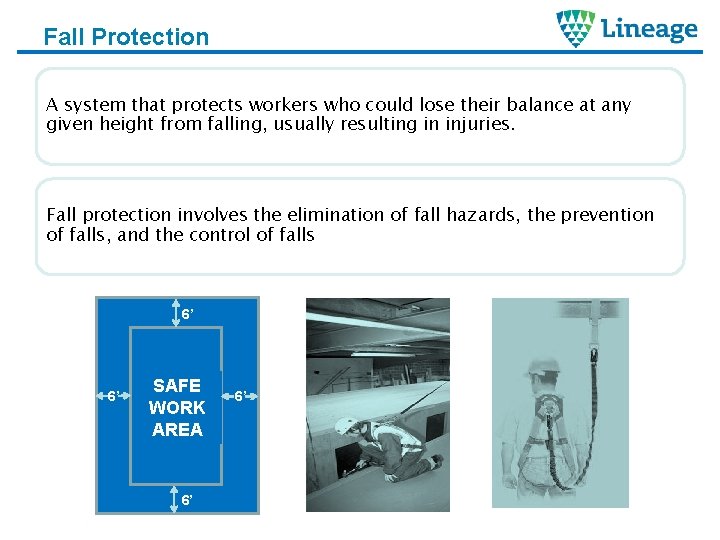
Fall Protection A system that protects workers who could lose their balance at any given height from falling, usually resulting in injuries. Fall protection involves the elimination of fall hazards, the prevention of falls, and the control of falls 6’ 6’ SAFE WORK AREA 6’ 6’
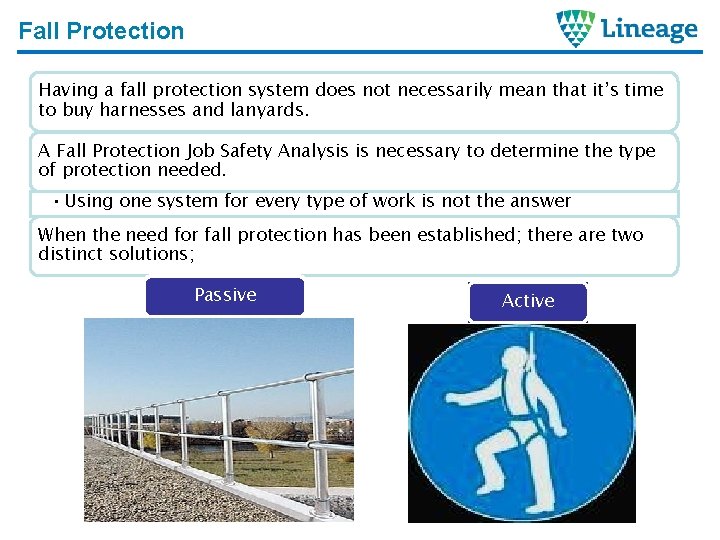
Fall Protection Having a fall protection system does not necessarily mean that it’s time to buy harnesses and lanyards. A Fall Protection Job Safety Analysis is necessary to determine the type of protection needed. • Using one system for every type of work is not the answer When the need for fall protection has been established; there are two distinct solutions; Passive Active

Passive Fall Protection System Passive Fall Protection is a system that is stationary, does not move, adapt, or change when in or out of use. Passive systems do not require the use of personal protective equipment or active participation from the worker
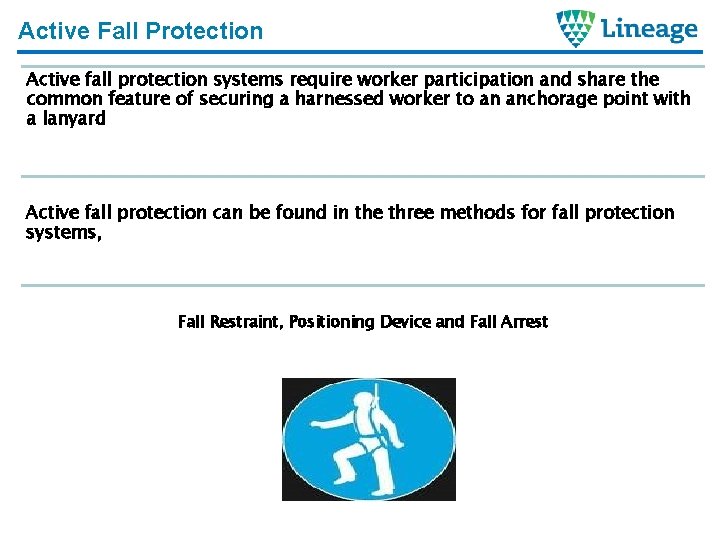
Active Fall Protection Active fall protection systems require worker participation and share the common feature of securing a harnessed worker to an anchorage point with a lanyard Active fall protection can be found in the three methods for fall protection systems, Fall Restraint, Positioning Device and Fall Arrest
Fall Protection in General Industry To prevent employees from being injured from falls, employers must: • Guard every floor hole into which a worker can accidentally walk by use of a railing and toeboard or a floor hole cover. • Provide a guardrail and toeboard around every open-sided platform, floor or runway that is 4 feet or higher off the ground or next level. • Regardless of height, if a worker can fall into or onto dangerous machines or equipment (such as a vat of acid or a conveyor belt), employers must provide guardrails and toeboards to prevent workers from falling and getting injured. • Other means of fall protection that may be required on certain jobs include safety harness and line, safety nets, stair railings and handrails 7

Fall Protection Systems Fall Restraint, Positioning Device and Fall Arrest systems are different methods of fall protection designed to control fall hazards They all either prevent a fall from occurring or stop a fall before hitting the ground. Whatever fall protection system is used, it must effectively protect the workers from fall hazards and consequent injuries. Fall Restraint Positioning Device Fall Arrest Full Body Harness Guardrails/hole covers Warning line and Safety monitor Vertical Walls Safety net Catch platform

Fall Restraint System A fall restraint system keeps a worker from reaching a fall point preventing a fall from occurring (for example, be able to work only up to the edge of a roof). Types of fall restraint/prevention systems include: Standard guardrail system: capable of withstanding at least 200 pounds of force applied within 2 inches of the top edge, in any direction and at any point along the edge Safety belt or harness (personal fall restraint system) The restraint system can allow the worker to reach only as far as the sides and edges of the walking/working surface. Warning line system and safety monitor system
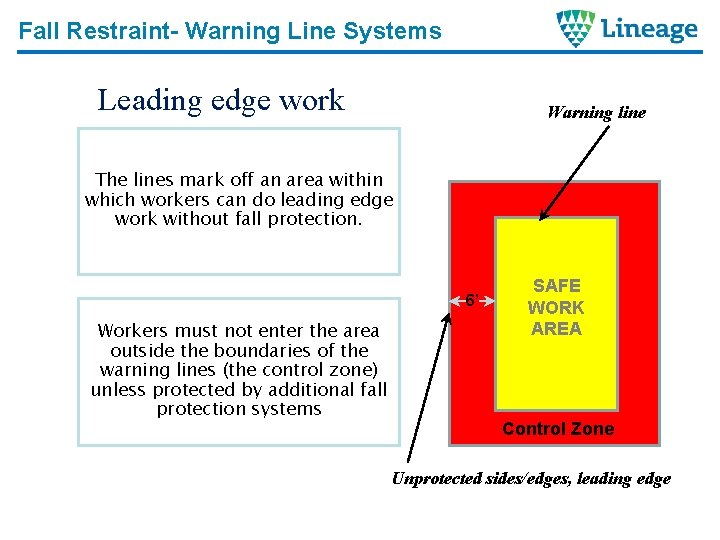
Fall Restraint- Warning Line Systems Leading edge work Warning line The lines mark off an area within which workers can do leading edge work without fall protection. 6’ Workers must not enter the area outside the boundaries of the warning lines (the control zone) unless protected by additional fall protection systems SAFE WORK AREA Control Zone Unprotected sides/edges, leading edge

Positioning Device Positioning device system means a full body harness rigged to allow an employee to be supported on an elevated, vertical surface and work with both hands free while leaning Positioning devices shall be rigged such that an employee cannot free fall more than 2 feet Positioning devices shall be secured to an anchorage capable of supporting at least twice the potential impact load of an employee's fall or 3, 000 pounds

Fall Arrest Systems A fall arrest system does not prevent a fall from occurring, but is designed to catch a person who has already fallen. A Personal Fall Arrest System has three (3) key components Full Body Harness Shock Absorbing Lanyard Anchorage Connector Deceleration Devices, Self-Retracting Lifelines are often used as part of a PFAS The use of a body belt for fall arrest is prohibited

Fall Arrest Systems When stopping a fall, a personal fall arrest system must: Limit maximum fall arresting force on an employee to 1, 800 pounds when used with a full-body harness; Limit free fall distance to less than 6 feet (1. 8 m), and be rigged in such a way as to prevent contact with a lower level; Bring the employee to a complete stop while limiting maximum deceleration distance to 3 -1/2 feet (1. 1 m); and Have sufficient strength to withstand twice the potential energy of a worker free falling from a distance of 6 feet (1. 8 m) (or the free fall distance permitted by the system, whichever is less). 13
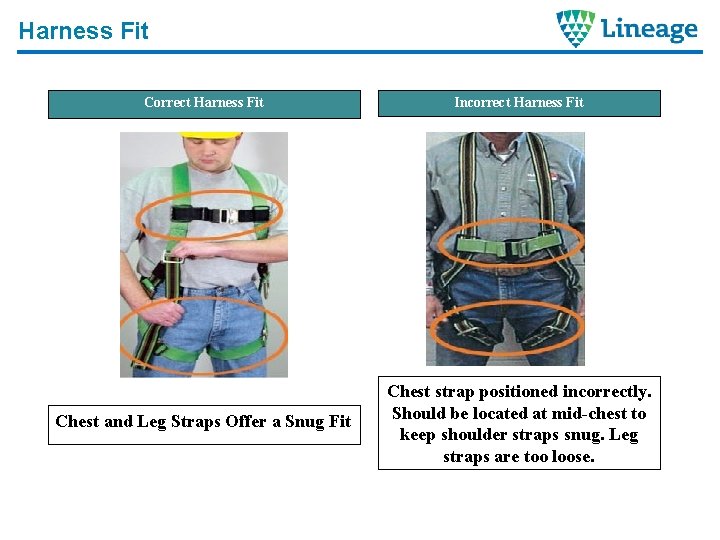
Harness Fit Correct Harness Fit Chest and Leg Straps Offer a Snug Fit Incorrect Harness Fit Chest strap positioned incorrectly. Should be located at mid-chest to keep shoulder straps snug. Leg straps are too loose.
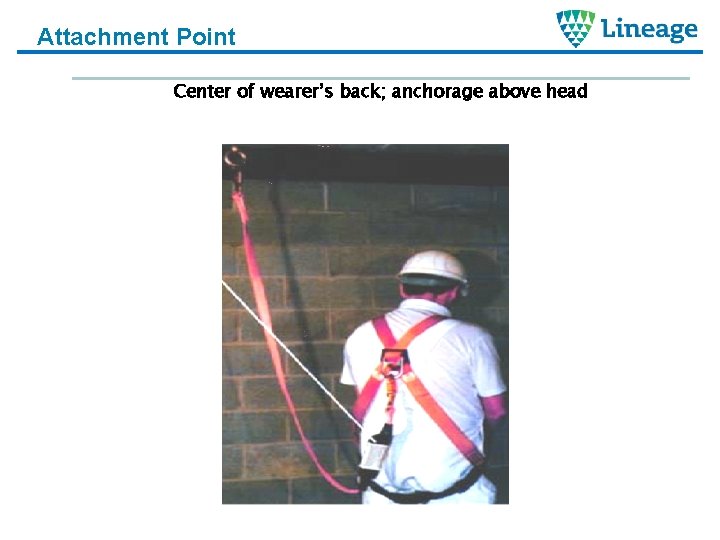
Attachment Point Center of wearer’s back; anchorage above head
Shock Absorbing Lanyard connects to the back D-ring of harnesses and a qualified anchorage connector. • Lanyards are required to have self-closing, self-locking snap hooks to reduce the possibility of disengagement, or “rollout”. • Shock-absorbing lanyards extend deceleration distance during a fall, significantly reducing fall arresting forces • The shock-absorbing lanyard or self-retracting lifeline and the Full-body harnesses are the components that actually bear the greatest fall forces during a fall
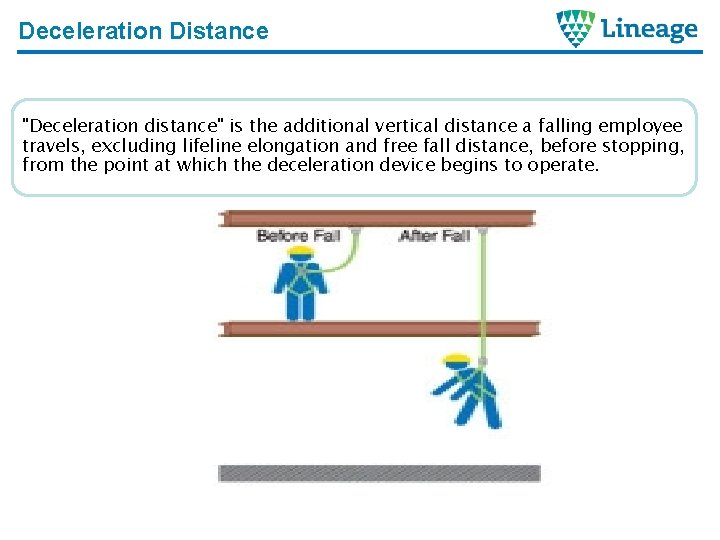
Deceleration Distance "Deceleration distance" is the additional vertical distance a falling employee travels, excluding lifeline elongation and free fall distance, before stopping, from the point at which the deceleration device begins to operate.
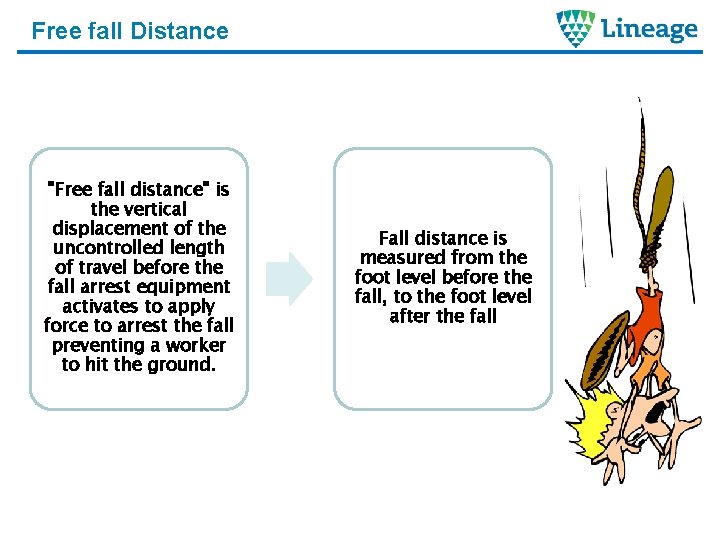
Free fall Distance "Free fall distance" is the vertical displacement of the uncontrolled length of travel before the fall arrest equipment activates to apply force to arrest the fall preventing a worker to hit the ground. Fall distance is measured from the foot level before the fall, to the foot level after the fall
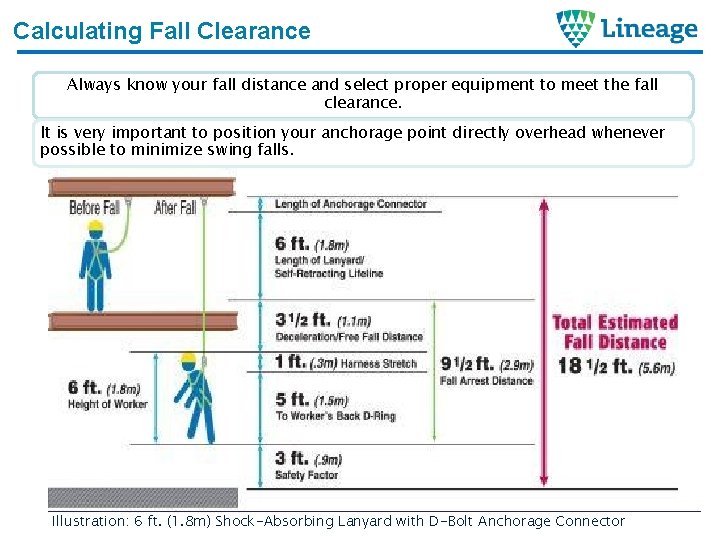
Calculating Fall Clearance Always know your fall distance and select proper equipment to meet the fall clearance. It is very important to position your anchorage point directly overhead whenever possible to minimize swing falls. Illustration: 6 ft. (1. 8 m) Shock-Absorbing Lanyard with D-Bolt Anchorage Connector
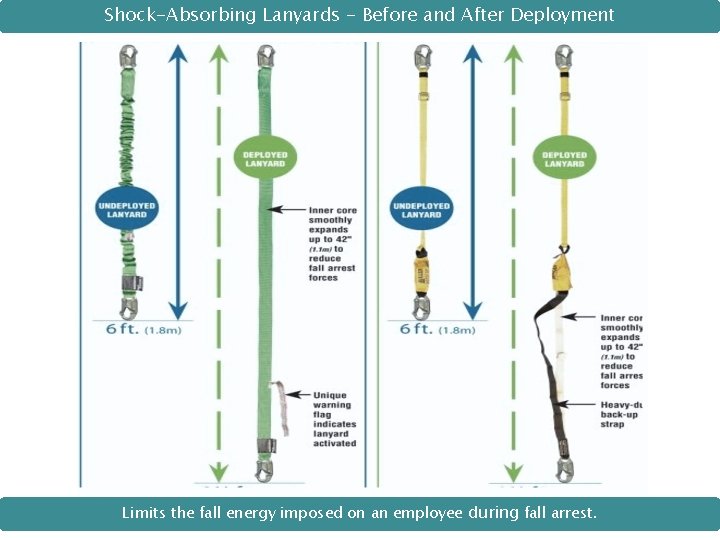
Shock-Absorbing Lanyards - Before and After Deployment Limits the fall energy imposed on an employee during fall arrest.
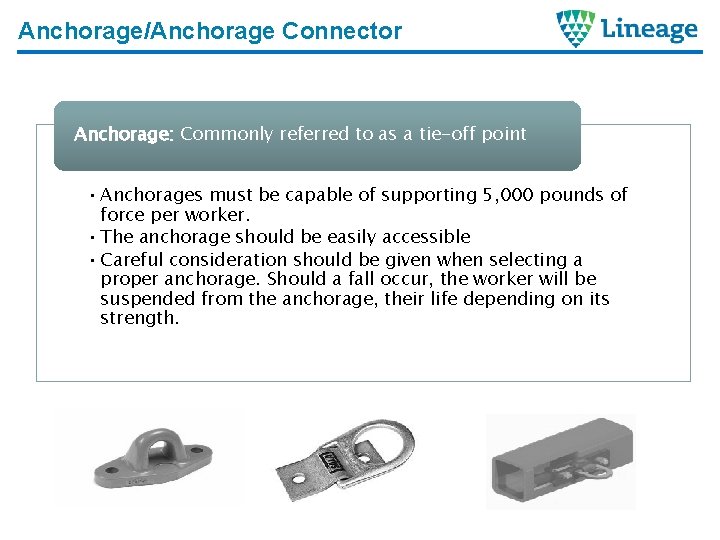
Anchorage/Anchorage Connector Anchorage: Commonly referred to as a tie-off point • Anchorages must be capable of supporting 5, 000 pounds of force per worker. • The anchorage should be easily accessible • Careful consideration should be given when selecting a proper anchorage. Should a fall occur, the worker will be suspended from the anchorage, their life depending on its strength.
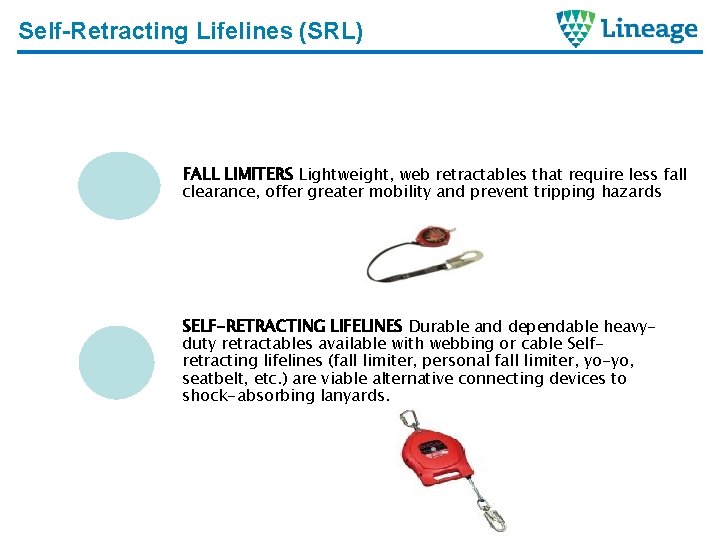
Self-Retracting Lifelines (SRL) FALL LIMITERS Lightweight, web retractables that require less fall clearance, offer greater mobility and prevent tripping hazards SELF-RETRACTING LIFELINES Durable and dependable heavyduty retractables available with webbing or cable Selfretracting lifelines (fall limiter, personal fall limiter, yo-yo, seatbelt, etc. ) are viable alternative connecting devices to shock-absorbing lanyards.
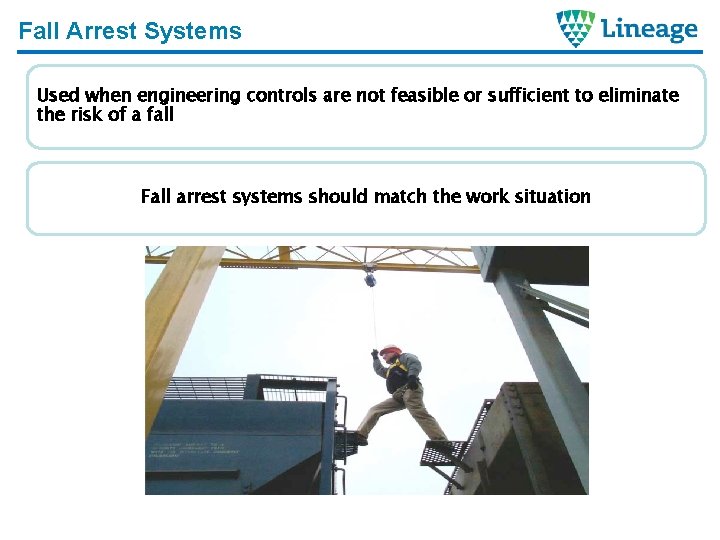
Fall Arrest Systems Used when engineering controls are not feasible or sufficient to eliminate the risk of a fall Fall arrest systems should match the work situation
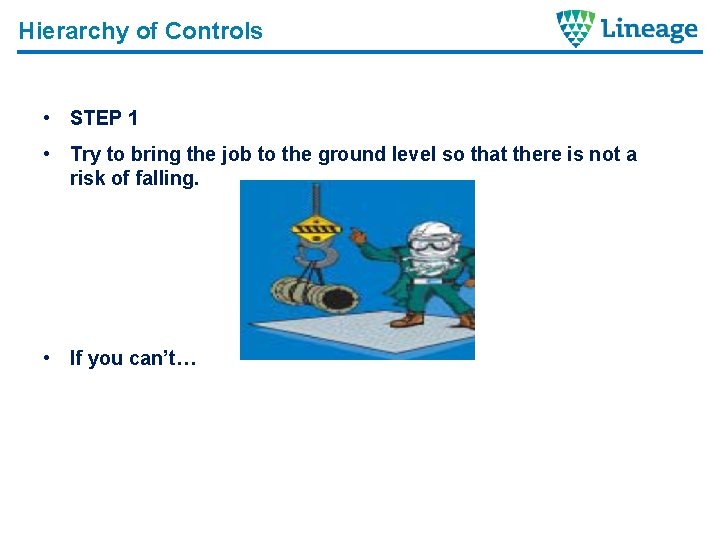
Hierarchy of Controls • STEP 1 • Try to bring the job to the ground level so that there is not a risk of falling. • If you can’t…
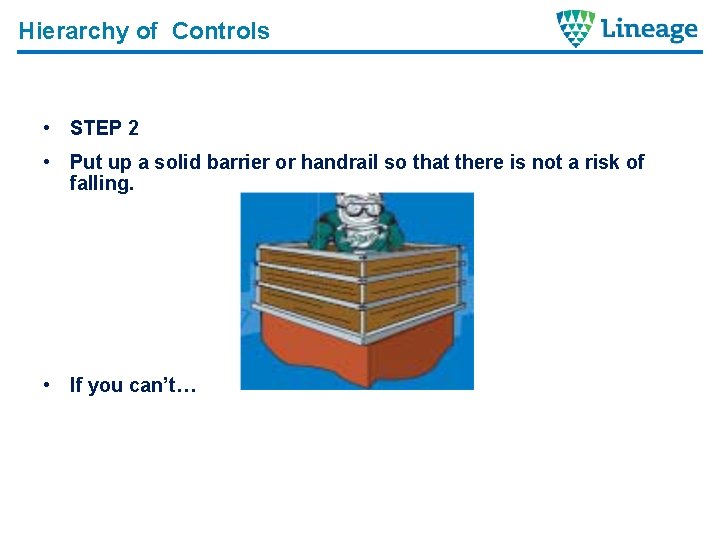
Hierarchy of Controls • STEP 2 • Put up a solid barrier or handrail so that there is not a risk of falling. • If you can’t…
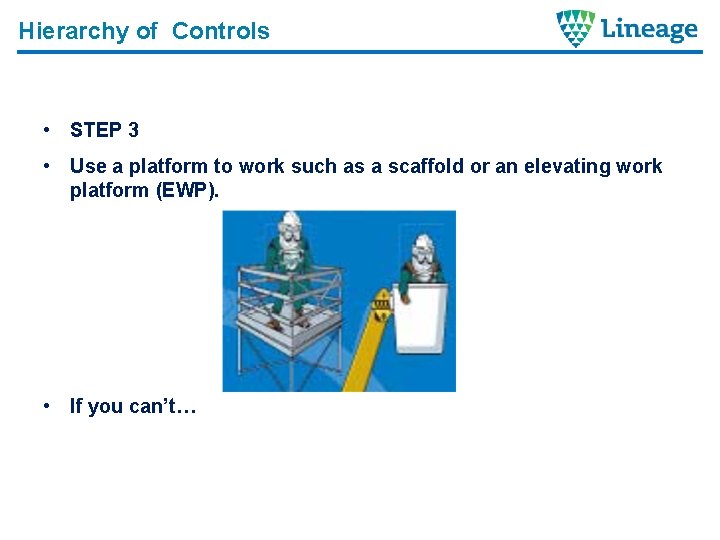
Hierarchy of Controls • STEP 3 • Use a platform to work such as a scaffold or an elevating work platform (EWP). • If you can’t…
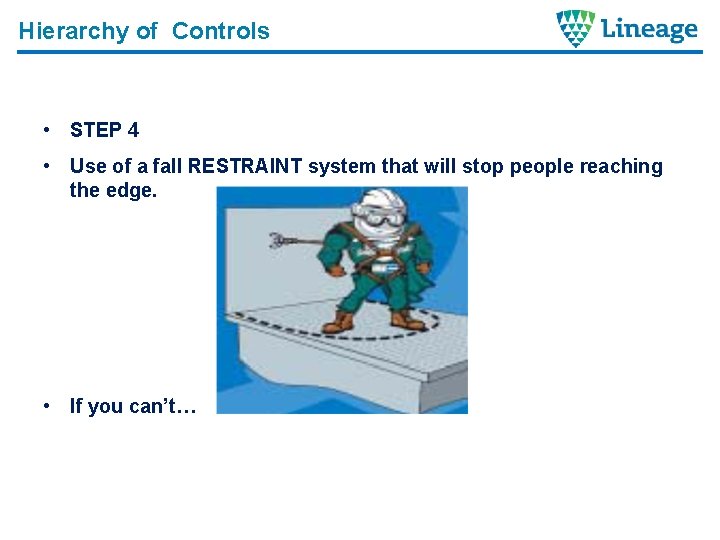
Hierarchy of Controls • STEP 4 • Use of a fall RESTRAINT system that will stop people reaching the edge. • If you can’t…
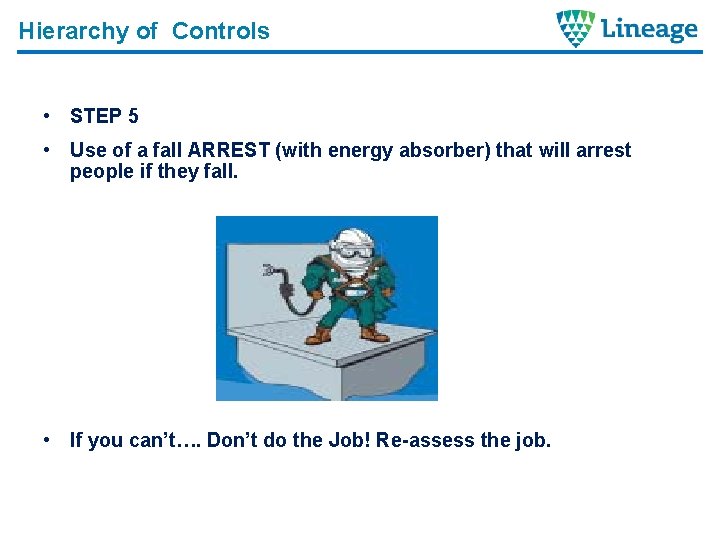
Hierarchy of Controls • STEP 5 • Use of a fall ARREST (with energy absorber) that will arrest people if they fall. • If you can’t…. Don’t do the Job! Re-assess the job.
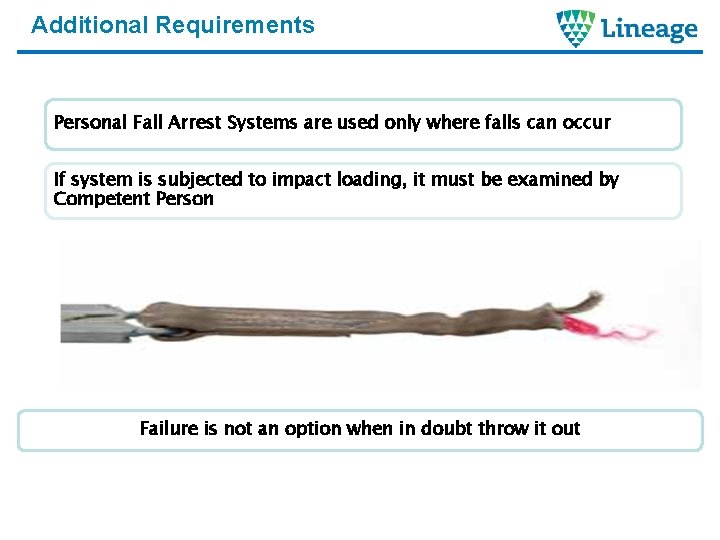
Additional Requirements Personal Fall Arrest Systems are used only where falls can occur If system is subjected to impact loading, it must be examined by Competent Person Failure is not an option when in doubt throw it out
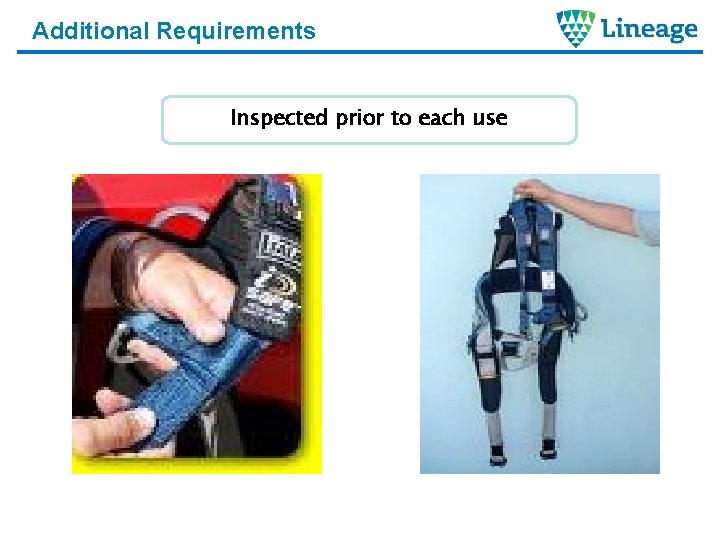
Additional Requirements Inspected prior to each use
Additional Requirements To maintain a safe work environment, it is essential that persons are properly trained to: • Recognize potential fall hazards • Evaluate the risk posed by each hazard • Control the hazard with preventive or protective measures • Determine which system to use in specific work environments • Demonstrate proper anchoring procedures • Conduct inspection and maintenance procedures • Properly wear fall protection equipment including size, fit and adjustment 31
QUESTIONS?
- Slides: 32