
Fall Protection for Construction Training objectives v Nature
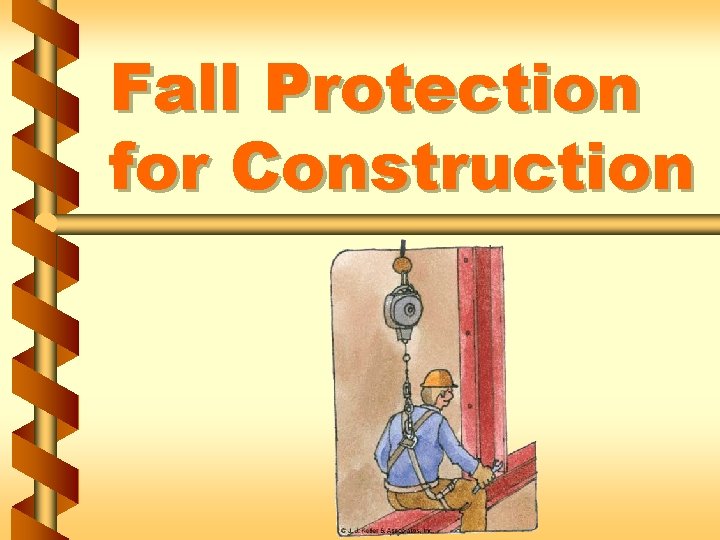
Fall Protection for Construction
Training objectives v Nature of fall hazards in the work area v Subpart M of the construction regulations 1 a
Training objectives v Procedures for erecting, maintaining, disassembling, and inspecting fall protection systems 1 b
Training objectives v Use and operation of: • guardrail systems • personal fall arrest systems • safety net systems • warning line systems • safety monitoring systems • controlled access zones • other protections to be used 1 c
Training objectives v Role of each employee when a safety monitoring system is used v Role of employees in fall protection plans 1 d
Training objectives v Limitations on the use of mechanical equipment during roofing work on low-sloped roofs 1 e
Training objectives v Correct procedures for the handling and storage of equipment and materials and the erection of overhead protection 1 f
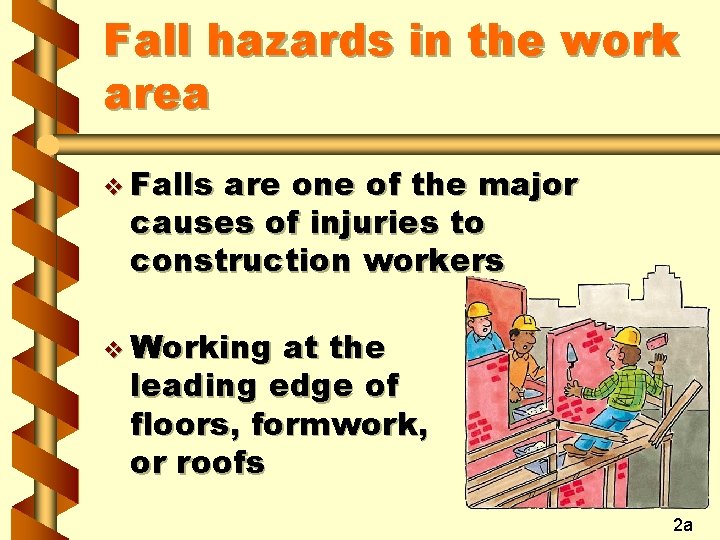
Fall hazards in the work area v Falls are one of the major causes of injuries to construction workers v Working at the leading edge of floors, formwork, or roofs 2 a
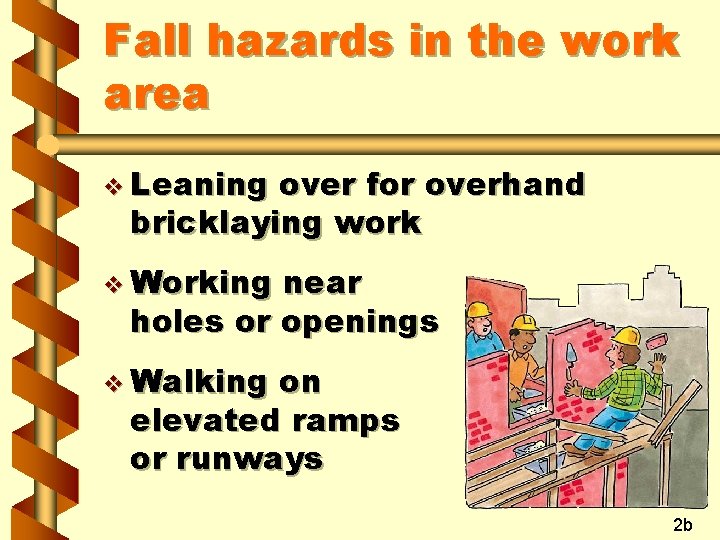
Fall hazards in the work area v Leaning over for overhand bricklaying work v Working near holes or openings v Walking on elevated ramps or runways 2 b
Standard applicability v The OSHA standard requires construction employers to: • identify and evaluate fall hazards • provide fall protection • train employees v The requirements are performance-oriented 3 a
Standard applicability v The standard does not cover construction workers who are inspecting, investigating, or assessing workplace conditions: • prior to the actual start of work; or • after all work has been completed 3 b
Standard applicability v Other OSHA standards also contain fall protection requirements, but they may not outline specific rules for fall protection during all parts of the job 3 c
Standard applicability v Review: • Subpart L - Scaffolds • Subpart N - Cranes and derricks • Subpart R - Steel erection • Subpart S - Tunneling • Subpart V - Electric transmission and distribution lines and equipment • Subpart X - Stairways and ladders 3 d
Fall protection measures v All walking and working surfaces must be strong enough to safely support employees v Employees must be protected from fall hazards whenever they are 6 feet or more above a lower level 4 a
Fall protection measures v Construction workers who are exposed to the hazard of falling onto or into dangerous equipment must be protected at any height v All employees must be protected from falling objects 4 b
Fall protection measures v Guardrail v Safety systems net systems v Personal fall arrest systems v Positioning device systems 4 c
Fall protection measures v Warning line systems v Controlled v Safety access zones monitoring systems v Covers 4 d
Terms v Anchorage v Body belt (safety belt) v Body harness v Controlled access zone (CAZ) 5 a
Terms v Dangerous equipment v Deceleration device v Deceleration distance v Free fall 5 b
Terms v Free fall distance v Guardrail system v Lanyard v Leading edge 5 c
Terms v Lifeline v Low-slope v Lower roof levels v Mechanical equipment 5 d
Terms v Overhand bricklaying and related work v Personal fall arrest system v Positioning v Roofing device system work 5 e
Terms v Safety-monitoring v Self-retracting v Steep system lifeline/lanyard roof 5 f
Terms v Unprotected sides and edges v Walking/working v Warning surface line system 5 g
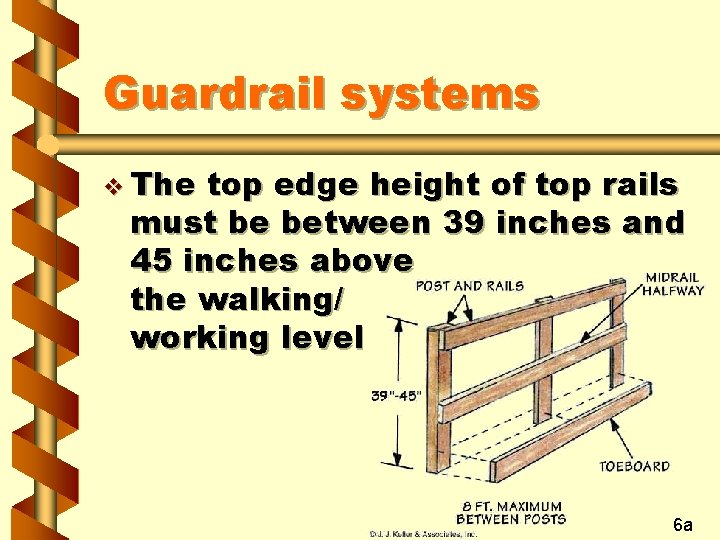
Guardrail systems v The top edge height of top rails must be between 39 inches and 45 inches above the walking/ working level 6 a
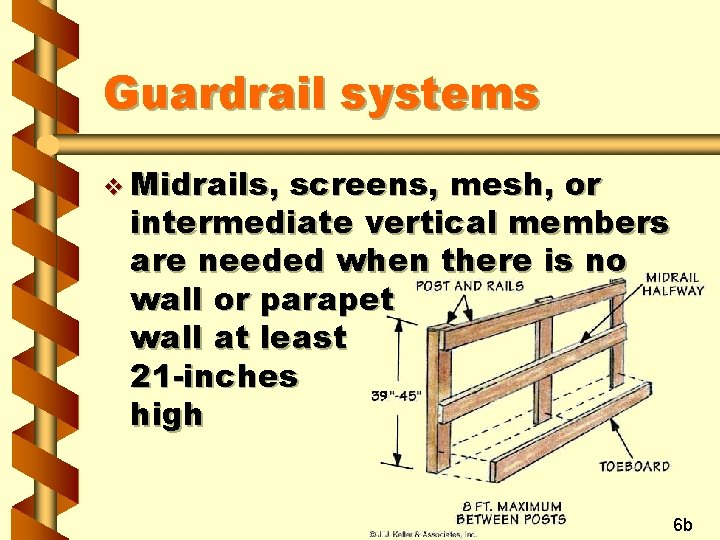
Guardrail systems v Midrails, screens, mesh, or intermediate vertical members are needed when there is no wall or parapet wall at least 21 -inches high 6 b
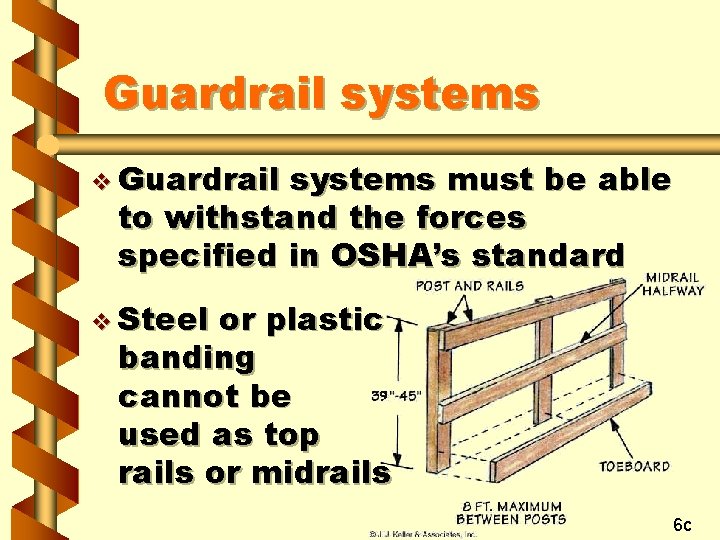
Guardrail systems v Guardrail systems must be able to withstand the forces specified in OSHA’s standard v Steel or plastic banding cannot be used as top rails or midrails 6 c
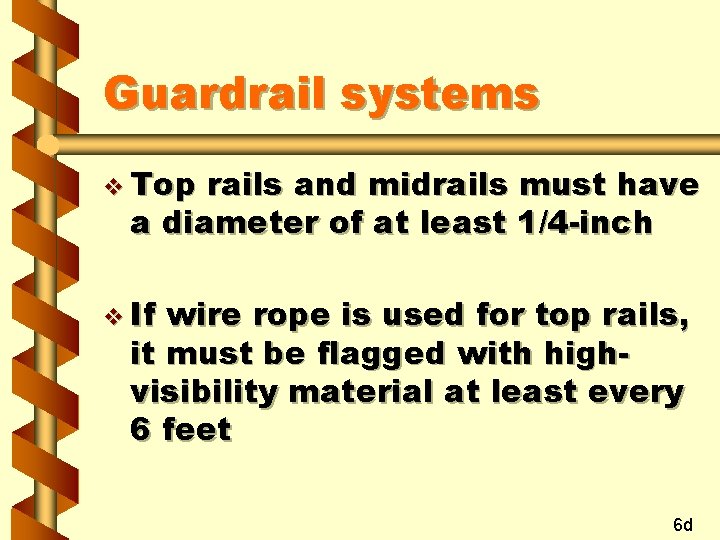
Guardrail systems v Top rails and midrails must have a diameter of at least 1/4 -inch v If wire rope is used for top rails, it must be flagged with highvisibility material at least every 6 feet 6 d
Guardrail systems v Top rails or midrails made from manila, plastic or synthetic rope must be inspected frequently v The guardrail’s surface must be smooth enough so it does not cause lacerations or other injuries, or snag clothing 6 e
Guardrail systems v The ends of top rails and midrails must not overhang the terminal posts to create a projection hazard 6 f
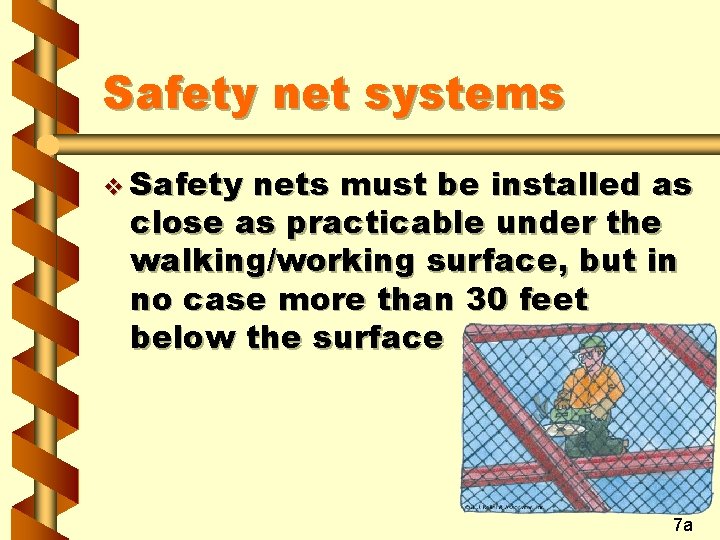
Safety net systems v Safety nets must be installed as close as practicable under the walking/working surface, but in no case more than 30 feet below the surface 7 a
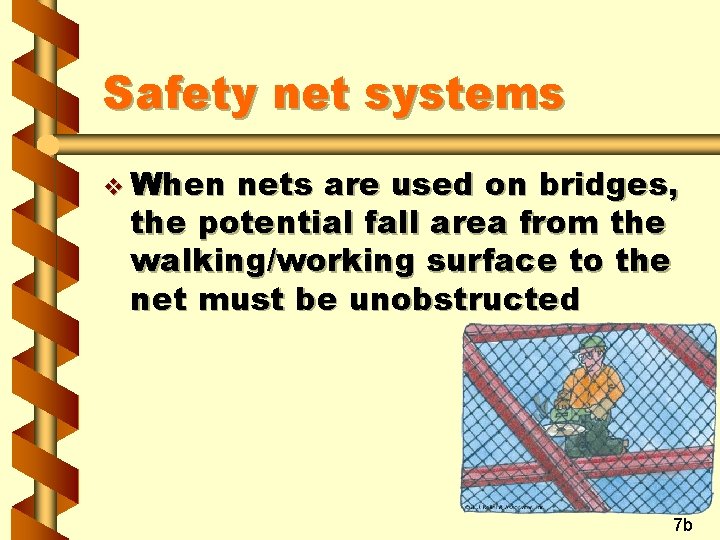
Safety net systems v When nets are used on bridges, the potential fall area from the walking/working surface to the net must be unobstructed 7 b
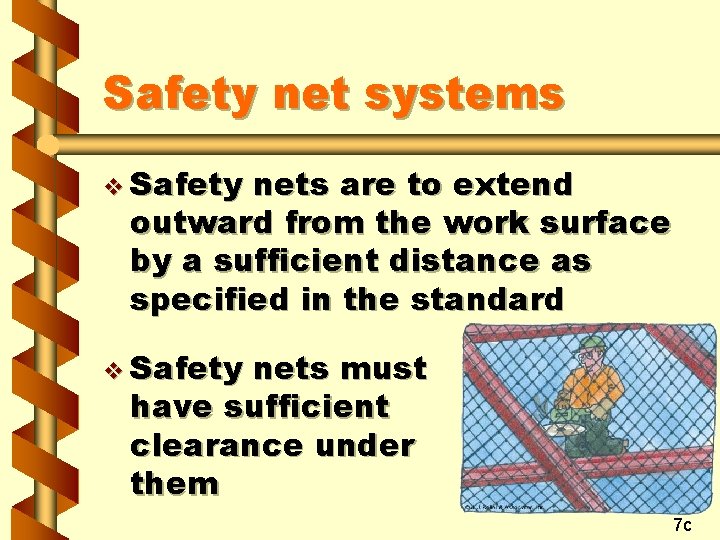
Safety net systems v Safety nets are to extend outward from the work surface by a sufficient distance as specified in the standard v Safety nets must have sufficient clearance under them 7 c
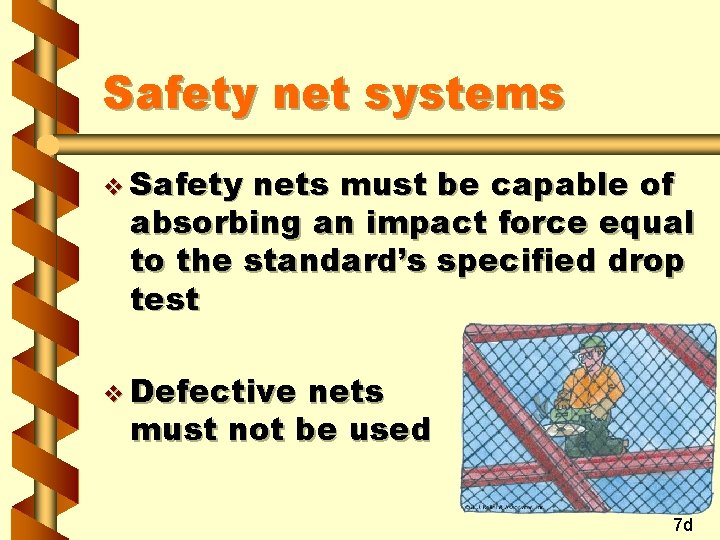
Safety net systems v Safety nets must be capable of absorbing an impact force equal to the standard’s specified drop test v Defective nets must not be used 7 d
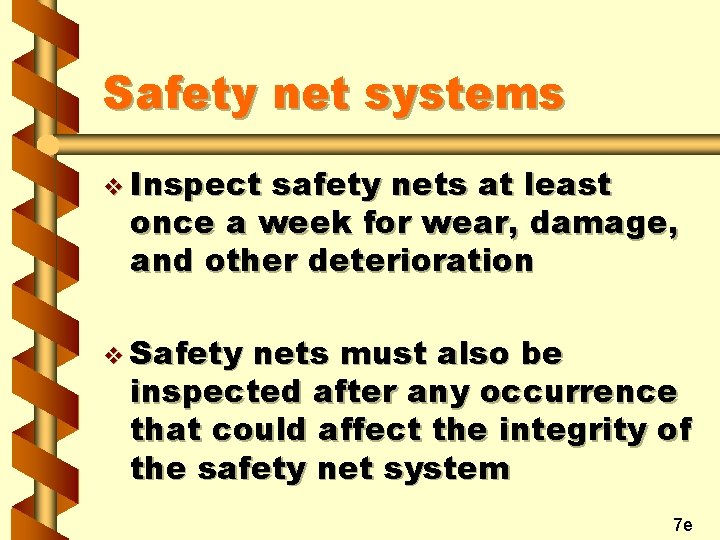
Safety net systems v Inspect safety nets at least once a week for wear, damage, and other deterioration v Safety nets must also be inspected after any occurrence that could affect the integrity of the safety net system 7 e
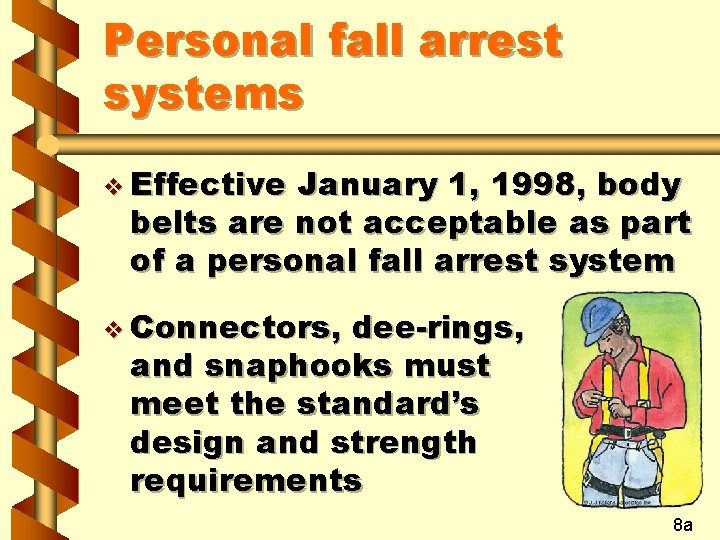
Personal fall arrest systems v Effective January 1, 1998, body belts are not acceptable as part of a personal fall arrest system v Connectors, dee-rings, and snaphooks must meet the standard’s design and strength requirements 8 a
Personal fall arrest systems v Devices used to connect to a horizontal lifeline are to be capable of locking in both directions on the lifeline v Lanyards and vertical lifelines must meet the standard’s minimum breaking strength requirements 8 b
Personal fall arrest systems v When vertical lifelines are used, each employee must be attached to a separate lifeline v Lifelines must be protected from being cut or abraded 8 c
Personal fall arrest systems v Self-retracting lifelines and lanyards must meet the standard’s load requirements v Anchorages used for personal fall arrest equipment must be independent of any anchorage being used to support or suspend platforms 8 d
Personal fall arrest systems - when stopping a fall must v Limit the maximum arresting force on an employee to 1, 800 pounds when used with a body harness v Be rigged so that an employee cannot free fall more than 6 feet 8 e
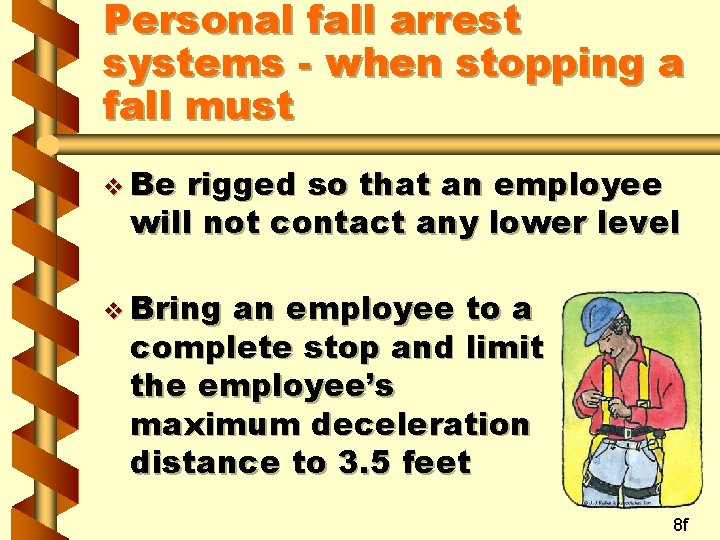
Personal fall arrest systems - when stopping a fall must v Be rigged so that an employee will not contact any lower level v Bring an employee to a complete stop and limit the employee’s maximum deceleration distance to 3. 5 feet 8 f
Personal fall arrest systems - when stopping a fall must v Have sufficient strength to withstand twice the anticipated potential impact energy 8 g
Positioning Device Systems v Positioning devices are to be rigged so that an employee cannot free fall more than 2 feet 9 a
Positioning Device Systems v Positioning devices must be secured to an anchorage capable of supporting: • at least twice the potential impact load of an employee’s fall; or • 3, 000 pounds, whichever is greater 9 b
Positioning Device Systems v Connectors, dee-rings, and snaphooks must meet the standard’s design and strength requirements 9 c
Positioning Device Systems v Positioning device systems must be inspected before each use for: • wear • damage • deterioration • defective components 9 d
Positioning Device Systems v Body belts and components must only be used as part of a positioning device system—they cannot be used to hoist materials 9 e
Fall protection systems v Employers have a duty to anticipate fall hazards, and to plan work activities accordingly v Careful planning and preparation lay the necessary groundwork for an accident-free workplace 10 a
Fall protection systems v Limit work activities to walking/working surfaces that have the strength and structural integrity to safely support employees 10 b
Fall protection systems v The rule identifies areas or activities where fall protection is needed. These include, but are not limited to: • unprotected sides and edges • hoist areas • holes • wall openings • formwork and reinforcing steel 10 c
Fall protection systems v The rule identifies areas or activities where fall protection is needed. These include, but are not limited to: • ramps, runways, and other walkways • excavations (protection from falling into excavations greater that 6 -feet deep only) 10 d
Fall protection systems v The rule identifies areas or activities where fall protection is needed. These include, but are not limited to: • dangerous equipment • overhand bricklaying and related work 10 e
Fall protection systems v The rule identifies areas or activities where fall protection is needed. These include, but are not limited to: • roofing work • leading edge work • precast concrete erection 10 f
Fall protection systems v The rule identifies areas or activities where fall protection is needed. These include, but are not limited to: • residential construction • other walking and working surfaces 10 g
Fall protection systems v Employers need to: • give instructions to prevent exposure to unsafe conditions • ensure employees follow the procedures and understand the training • be aware of the safety methods being used by specialty subcontractors 10 h
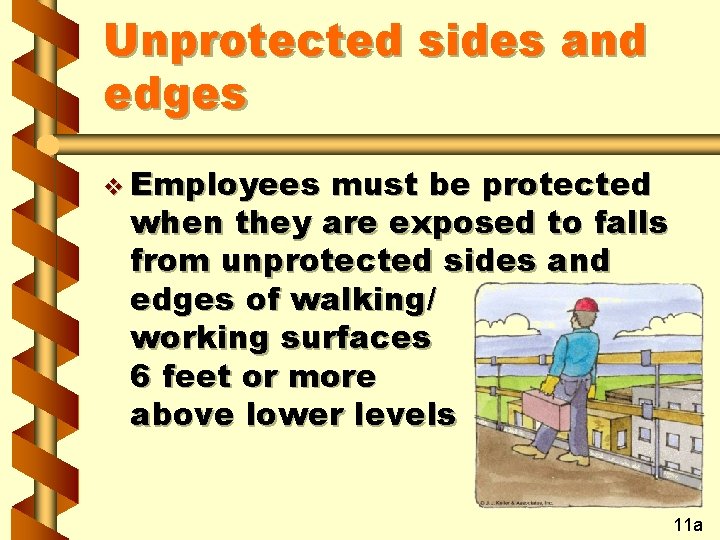
Unprotected sides and edges v Employees must be protected when they are exposed to falls from unprotected sides and edges of walking/ working surfaces 6 feet or more above lower levels 11 a
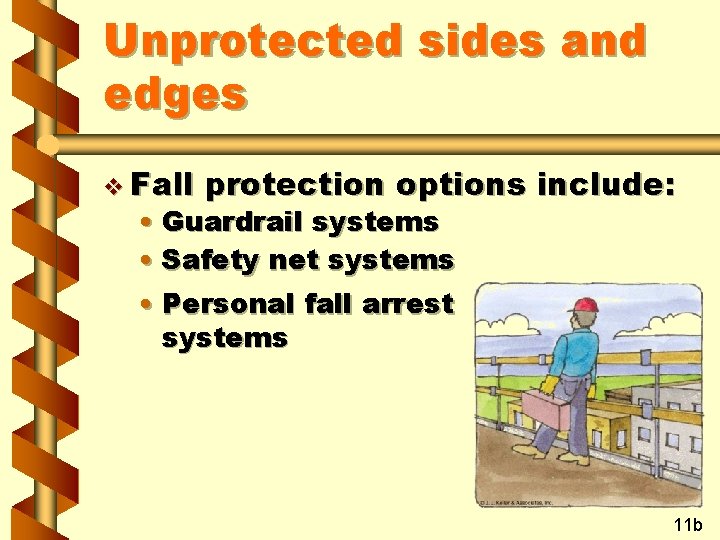
Unprotected sides and edges v Fall protection options include: • Guardrail systems • Safety net systems • Personal fall arrest systems 11 b
Protecting hoist areas v Employees in a hoist area must be protected from falling 6 feet or more v Fall protection options include: • guardrail systems • personal fall arrest systems 12 a
Protecting hoist areas v When guardrail systems are used at hoisting areas, a chain, gate, or removable guardrail section must be placed across the access opening when hoisting operations are not taking place 12 b
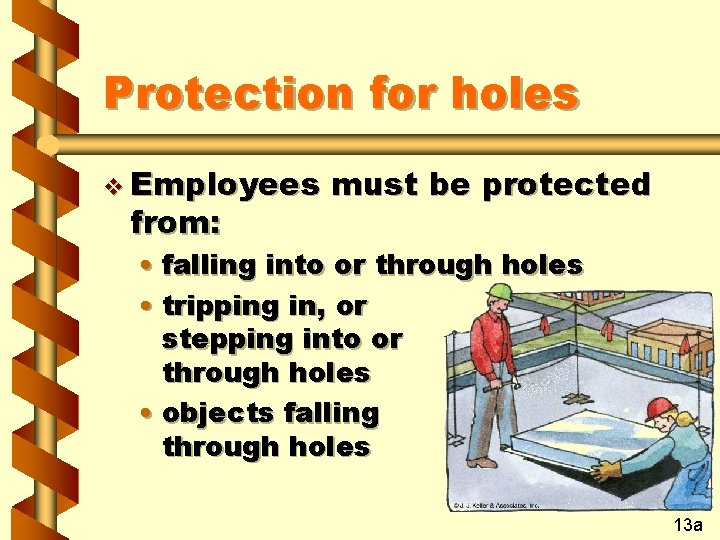
Protection for holes v Employees from: must be protected • falling into or through holes • tripping in, or stepping into or through holes • objects falling through holes 13 a
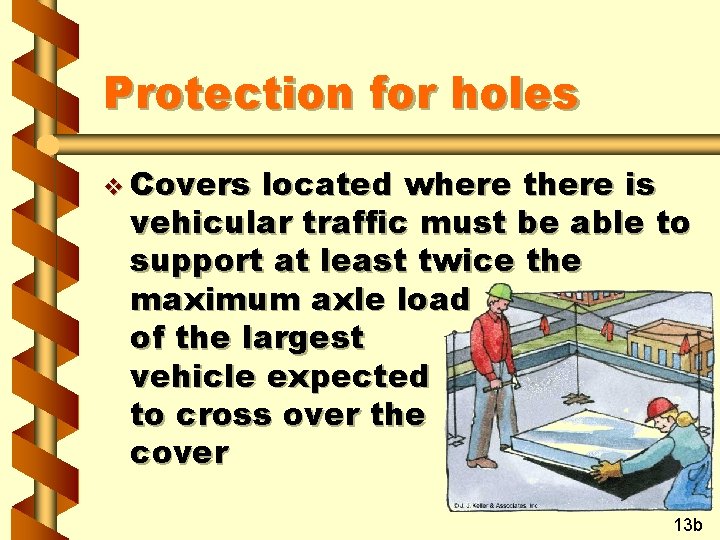
Protection for holes v Covers located where there is vehicular traffic must be able to support at least twice the maximum axle load of the largest vehicle expected to cross over the cover 13 b
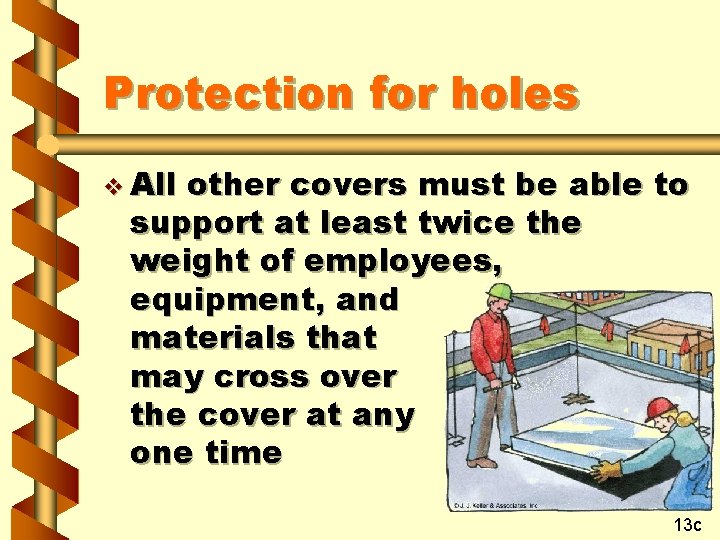
Protection for holes v All other covers must be able to support at least twice the weight of employees, equipment, and materials that may cross over the cover at any one time 13 c
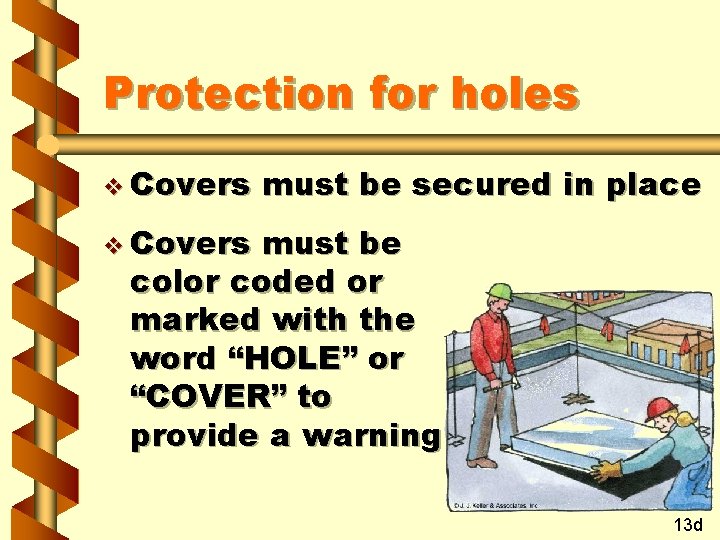
Protection for holes v Covers must be secured in place v Covers must be color coded or marked with the word “HOLE” or “COVER” to provide a warning 13 d
Protecting wall openings v Employees must be protected from falling out or or through wall openings v Fall protection options include: • guardrail systems • safety net systems • personal fall arrest systems 14 a
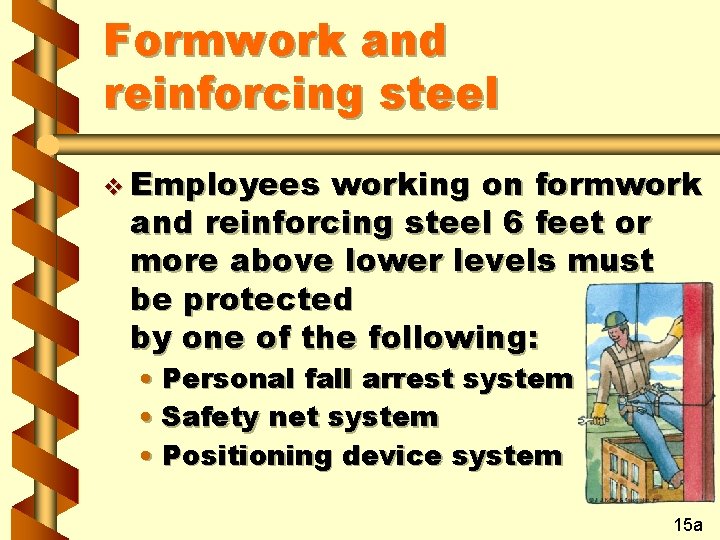
Formwork and reinforcing steel v Employees working on formwork and reinforcing steel 6 feet or more above lower levels must be protected by one of the following: • Personal fall arrest system • Safety net system • Positioning device system 15 a
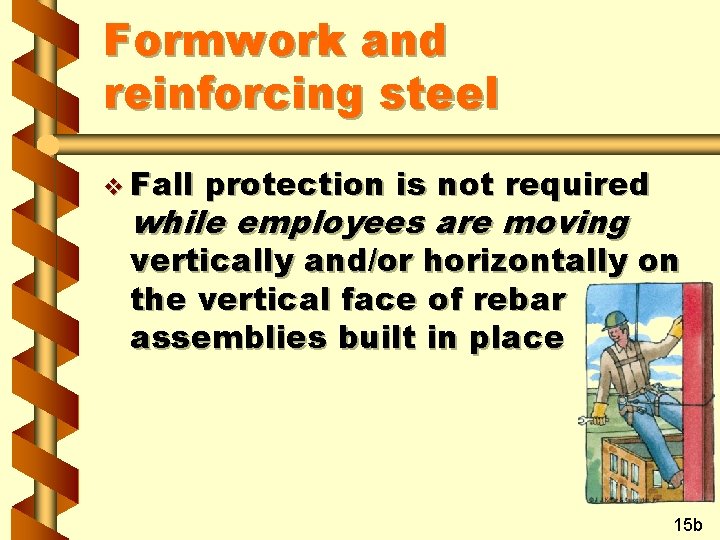
Formwork and reinforcing steel v Fall protection is not required while employees are moving vertically and/or horizontally on the vertical face of rebar assemblies built in place 15 b
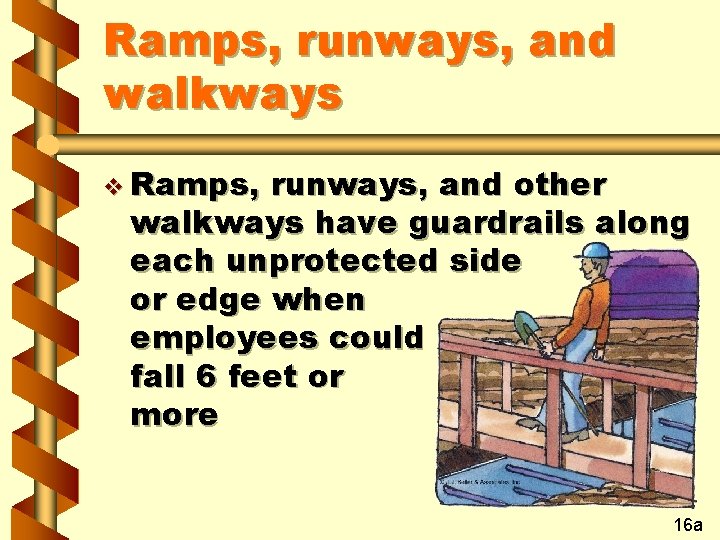
Ramps, runways, and walkways v Ramps, runways, and other walkways have guardrails along each unprotected side or edge when employees could fall 6 feet or more 16 a
Excavations v If the excavation depth is 6 feet or more, edges of excavations must be protected by: • guardrail systems • fences • barricades 17 a
Falls into dangerous equipment v Employees working 6 feet or more above dangerous equipment must be protected from falling by one of the following systems: • Guardrail systems • Personal fall arrest systems • Safety net systems 18 a
Falls into dangerous equipment v Where the walking/working surface is less than 6 feet above the dangerous equipment hazards, guardrails or equipment guards must shield employees from the hazard 18 b
Overhand bricklaying v Each employee performing overhand bricklaying and related work 6 feet or more above lower levels must be protected by one of the following systems: 19 a
Overhand bricklaying v Guardrail v Personal v Safety systems fall arrest systems net systems v Controlled access zones 19 b
Overhand bricklaying v The controlled access zone: • is defined by a control line erected between 10 feet and 15 feet from the working edge 19 c
Overhand bricklaying v The controlled access zone: • must extend far enough to enclose all employees performing overhand bricklaying and related work at the working edge 19 d
Overhand bricklaying v The controlled access zone: • needs additional control lines erected at each end to enclose the controlled access zone • allows only employees engaged in overhand bricklaying or related work in the controlled access zone 19 e
Overhand bricklaying v Control lines consist of ropes, wires, tapes, or equivalent materials, and supporting stanchions as follows: • Each line is flagged or otherwise clearly marked with high-visibility material at intervals of at least 6 feet 19 f
Overhand bricklaying v Control lines consist of ropes, wires, tapes, or equivalent materials, and supporting stanchions as follows: 19 f
Overhand bricklaying • Each line is rigged and supported so that: – its lowest point is at least 39 inches from the walking/working surface – its highest point is not more than 50 inches from the walking/working surface • Each line must have a minimum breaking strength of 200 pounds 19 g
Overhand bricklaying v All employees reaching more than 10 inches below the level of a walking/working surface must be protected from falling 19 h
Overhand bricklaying v Fall protection options include: • guardrails • personal fall arrest systems • safety nets 19 i
Overhand bricklaying v To provide for falling object protection during overhand bricklaying and related work: • no materials or equipment except masonry and mortar can be stored within 4 feet of the working edge 19 j
Overhand bricklaying v To provide for falling object protection during overhand bricklaying and related work: • excess mortar, broken or scattered masonry units, and all other materials and debris must be removed at regular intervals 19 k
Roofing on low-slope roofs Employees engaged in roofing activities on low-slope roofs with unprotected sides and edges 6 feet or more above lower levels must be protected by one of the following methods: 20 a
Roofing on low-slope roofs v Guardrail v Safety systems net systems v Personal fall arrest systems 20 b
Roofing on low-slope roofs v. A combination of warning line and guardrail systems v A combination of warning line and safety net systems v A combination of warning line and personal fall arrest systems 20 c
Roofing on low-slope roofs v. A combination of warning line and safety monitoring systems v On roofs 50 feet or less in width, the use of a safety monitoring system alone 20 d
Roofing on low-slope roofs: safety monitoring system When a safety monitoring system is used: v A designated competent person must monitor employee safety v The safety monitor cannot have other responsibilities that could distract him/her from the monitoring function 20 e
Roofing on low-slope roofs: safety monitoring system v Mechanical equipment must not be used or stored in areas where safety monitoring systems are being used 20 f
Roofing on low-slope roofs: safety monitoring system v No employee, other than an employee engaged in roofing work, or an employee covered by a fall protection plan, can be allowed in an area where an employee is being protected by a safety monitoring system 20 g
Roofing on low-slope roofs: safety monitoring system v Each employee working in a controlled access zone must comply with fall hazard warnings from safety monitors 20 h
Roofing on low-slope roofs: warning line system When warning line systems are used: v Warning line systems are to be erected around all sides of the roof work area 20 i
Roofing on low-slope roofs: warning line system v The warning line must be at least 6 feet from the roof edge when mechanical equipment is not being used 20 j
Roofing on low-slope roofs: warning line system v The warning line must be farther from the roof edge when mechanical equipment is being used 20 k
Roofing on low-slope roofs: warning line system v Two warning lines must form an access path to connect points of access, materials handling areas, storage areas, and hoisting areas to the work area 20 l
Roofing on low-slope roofs: warning line system v When a point of access is not in use, a rope, wire, chain, or other barricade, must be placed across the path 20 m
Roofing on low-slope roofs: warning line system v Warning line ropes, wires, chains, and supporting stanchions must meet the standard’s design and strength requirements 20 n
Roofing on low-slope roofs: warning line system v No employee is allowed in the area between a roof edge and a warning line unless the employee is performing roofing work in that area 20 o
Roofing on low-slope roofs v To provide for falling object protection during roofing work: • materials and equipment must not be stored within 6 feet of a roof edge unless guardrails are erected at the edge • materials that are piled, grouped, or stacked near a roof edge must be stable and self-supporting 20 p
Roofing on steep roofs v Each employee engaged in roofing activities on steep roofs with unprotected sides and edges 6 feet or more above lower levels must be protected from falling 21 a
Roofing on steep roofs v. A steep roof has slopes greater than 4 in 12 (vertical to horizontal) 21 b
Roofing on steep roofs v Fall protection options include: • Guardrail systems with toeboards • Personal fall arrest systems • Safety net systems 21 c
Leading edge work v Leading edge work 6 feet or more above lower levels requires one of the following fall protection methods: • Guardrail systems • Safety net systems • Personal fall arrest systems 22 a
Leading edge work v If these conventional systems cannot be used, a fall protection plan must be in place 22 b
Leading edge work v When used to control access to areas where leading edge and other operations are taking place, the controlled access zone is defined by a control line that restricts access 22 c
Leading edge work v When control lines are used, they are to be between 6 feet and 25 feet from the unprotected or leading edge, except when erecting precast concrete members 22 d
Leading edge work v The control line must extend along the entire length of the unprotected or leading edge v Each side of the control line is to be connected to a guardrail system or wall 22 e
Leading edge work control lines Control lines consist of ropes, wires, tapes, or equivalent materials, and supporting stanchions as follows: 22 f
Leading edge work control lines v Each line must be flagged or otherwise clearly marked with high-visibility material at intervals of at least 6 feet 22 g
Leading edge work control lines v Each line is to be rigged and supported so that its: • lowest point is at least 39 inches from the walking/working surface • highest point is not more than 45 inches v Each line must have a minimum breaking strength of 200 pounds 22 h
Precast concrete erection v Erecting precast concrete members 6 feet or more above a lower level requires one of the following fall protection methods: • Guardrail systems • Safety net systems • Personal fall arrest systems 23 a
Precast concrete erection v If these conventional systems cannot be used, a fall protection plan must be in place 23 b
Precast concrete erection v. A controlled access zone may be used to control access to areas where leading edge and other operations are taking place 23 c
Precast concrete erection v The controlled access zone is defined by a control line (or other means) that restricts access 23 d
Precast concrete erection v When erecting precast concrete members, the control line is to be: • between 6 feet and 60 feet; or • half the length of the member being erected, whichever is less, from the leading edge 23 e
Precast concrete erection v The control line must extend along the entire length of the unprotected or leading edge v Each side of the control line is to be connected to a guardrail system or wall 23 f
Precast concrete erection - control lines Control lines consist of ropes, wires, tapes, or equivalent materials, and supporting stanchions as follows: 23 g
Precast concrete erection - control lines v Each line is to be flagged or otherwise clearly marked with high-visibility material at intervals of at least 6 feet 23 h
Precast concrete erection - control lines v Each line is to be rigged and supported so that its: • lowest point is at least 39 inches from the walking/working surface • highest point is not more than 45 inches v Each line must have a minimum breaking strength of 200 pounds 23 i
Residential construction v Employers engaged in residential construction must protect employees from falls of 6 feet or more to lower levels by the use of one of these fall protection systems: • Guardrail systems • Safety net systems • Personal fall arrest systems 24 a
Residential construction v If it is infeasible or creates a greater hazard to implement these conventional systems, a fall protection plan can be used instead 24 b
Fall protection plans v The use of a fall protection plan is available only to employees engaged in: • leading edge work • precast concrete erection work • residential construction work 25 a
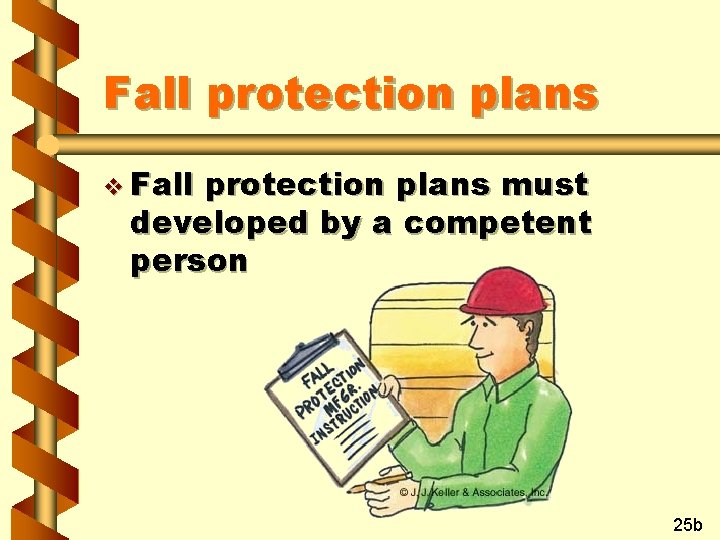
Fall protection plans v Fall protection plans must developed by a competent person 25 b
Other walking/working surfaces v All employees exposed to falls of 6 feet or more to lower levels must be protected by a: • guardrail system • safety net system • personal fall arrest system 26 a
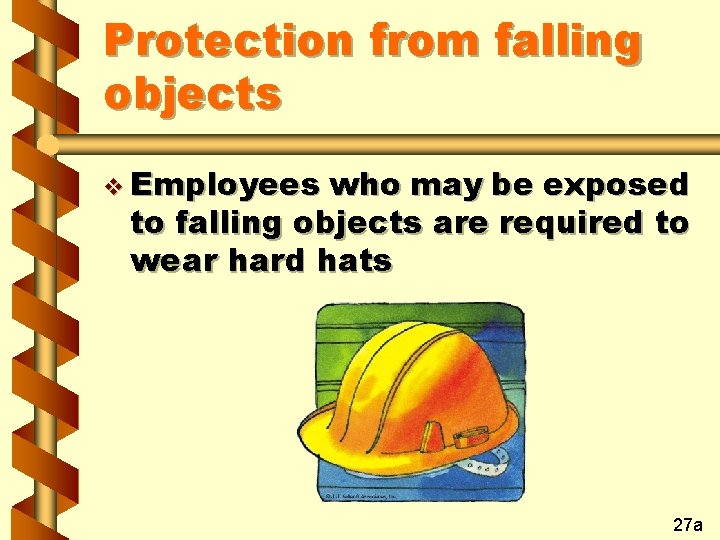
Protection from falling objects v Employees who may be exposed to falling objects are required to wear hard hats 27 a
Protection from falling objects v Employers must also do one of the following: • Erect toeboards, screens, or guardrail systems to prevent objects from falling from higher levels • Erect a canopy structure and keep potential falling objects far enough from the edge of the higher level 27 b
Protection from falling objects v Employers must also do one of the following: • Barricade the area to which objects could fall, and keep employees out of thearea • Keep objects far enough away from the edge of a higher level 27 c
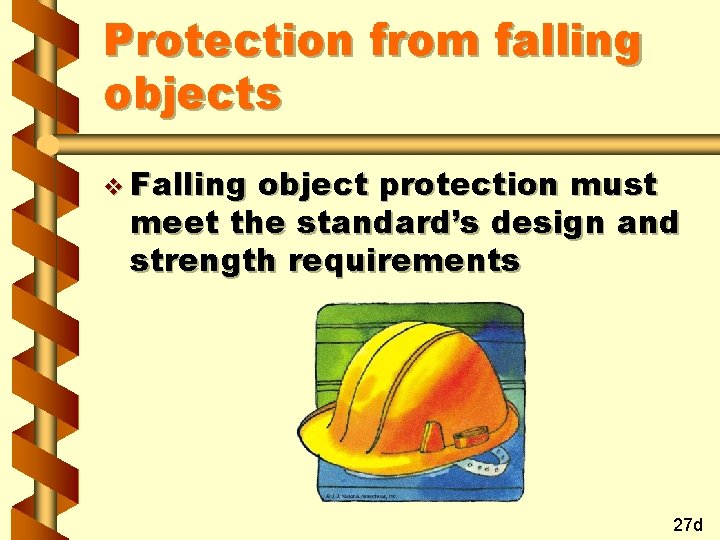
Protection from falling objects v Falling object protection must meet the standard’s design and strength requirements 27 d
- Slides: 127