
Fall of the Soviet Union 1991 Unit Objective
Fall of the Soviet Union (1991) Unit Objective • Analyzing the causes and impact of the fall of the Soviet Union and America’s role in it
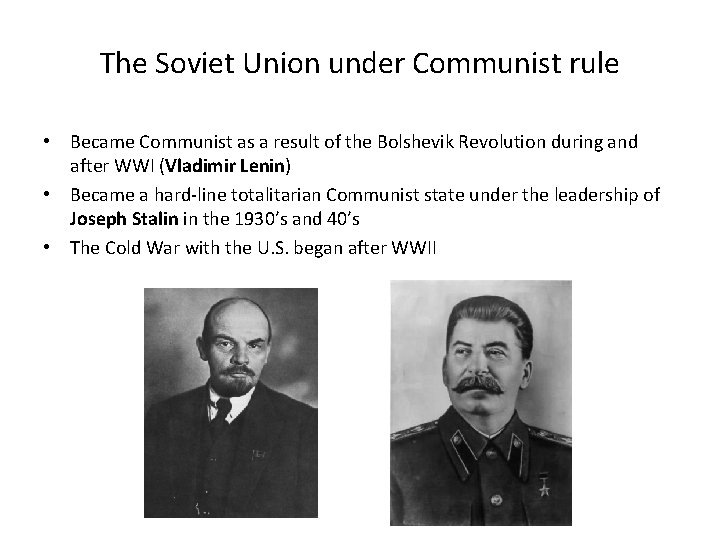
The Soviet Union under Communist rule • Became Communist as a result of the Bolshevik Revolution during and after WWI (Vladimir Lenin) • Became a hard-line totalitarian Communist state under the leadership of Joseph Stalin in the 1930’s and 40’s • The Cold War with the U. S. began after WWII
Politburo • • RULING COMMITTEE OF COMMUNIST PARTY CRUSHED ALL POLITICAL DISAGREEMENT CENSORED PRESS RESTRICTED FREEDOM OF RELIGION

Social/Economic Reforms began under new leader Mikhail Gorbachev (1982) • Elected by Politburo as General Secretary due to his youth (54, youngest since Stalin; Soviets had selected older secretaries who soon died in recent years), energy, and political skills
• Gorbachev recognized that the Soviets could no longer compete with the U. S. economically and reforms were necessary • The U. S. , under President Ronald Reagan, had drastically increased military spending and the Soviets were pressured to keep up but couldn’t due to a poor economy • Communism as an economic system was failing— The biggest problem that led to the fall of the Soviet Union
Glasnost NEW OPENNESS IN SOVIET SOCIETY • Gorbachev wanted economic and social reforms that were impossible under the old totalitarian government that rewarded silence and discouraged individuals from acting on their own—a free flow of ideas and information was necessary
Impact of Glasnost • CHURCHES ALLOWED TO OPEN • DISSIDENTS (POLITICAL PRISONERS) RELEASED FROM PRISON • BOOKS PUBLISHED BY BANNED AUTHORS, FREE PRESS, PEOPLE COMPLAINED OPENLY

Perestroika • RESTRUCTURING OF THE SOVIET ECONOMY TO BE MORE CAPITALIST BUT NOT MOVE AWAY COMPLETELY FROM COMMUNISM (TWEAK COMMUNISM, NOT THROW IT OUT)
• Goal was to make the economic system more efficient and productive, not throw out Communism • Necessary because workers and farmers had little incentive to improve efficiency under the old system • Impact: LOCAL MANAGERS GAINED MORE CONTROL, SOME PRIVATELY OWNED SMALL BUSINESSES ALLOWED, SOME IMPROVEMENT
Democratization • GRADUAL OPENING OF POLITICAL SYSTEM WITH MEANINGFUL COMPETITIVE ELECTIONS FOR THE FIRST TIME
Giving up control of Iron Curtain • Failing economy led Gorbachev to push for arms control and give up domination of Eastern Europe (couldn’t afford to keep up with increased U. S. spending under Ronald Reagan) • Led to removal of Communist governments and fighting for control of new governments
Impact of Gorbachev’s Reforms • 1990: First ever competitive elections with candidates other than Communists • The Communist Party lost control over six republics that then began movements toward independence
Impact of Gorbachev’s Reforms • Eastern Europe: The Soviets ceased controlling the former Iron Curtain countries leading to the fall of the Berlin Wall in 1989 (The symbolic end of the Cold War), the reunification of Germany in 1990, and the fall of communism throughout Eastern Europe
Impact of Gorbachev’s Reforms • Ethnic unrest: OVER 100 ETHNIC GROUPS THAT HAD BEEN SUPRESSED UNDER COMMUNIST RULE BEGAN TO PUSH FOR INDEPENDENCE -Baltic republic of Lithuania, absorbed into the Soviet Union after WWII, declared independence in 1990 followed by Latvia and Estonia
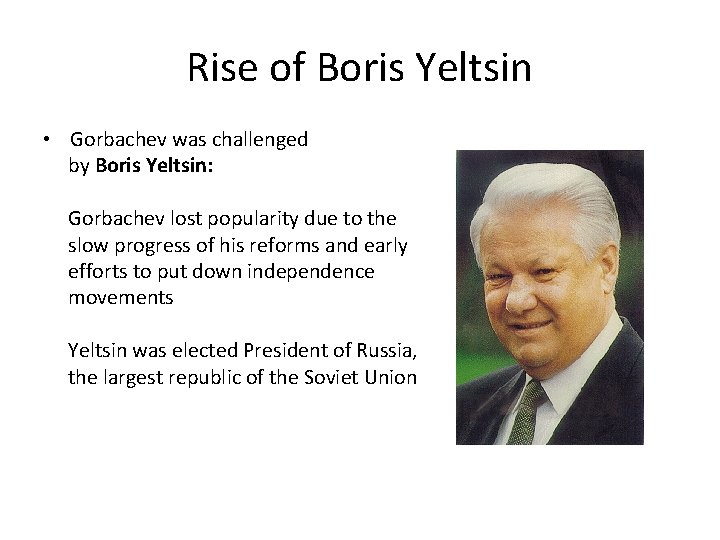
Rise of Boris Yeltsin • Gorbachev was challenged by Boris Yeltsin: Gorbachev lost popularity due to the slow progress of his reforms and early efforts to put down independence movements Yeltsin was elected President of Russia, the largest republic of the Soviet Union
The August Coup • Facing increasing pressure for independence or possible revolution against Soviet control, Gorbachev made moves toward forming a new federation of independent republics that would share a common president and foreign and military policies • The Communist Party would have remained in control of the social and economic life
The August Coup • Hardline Communists tried to militarily remove Gorbachev from power (coup de tat) and reverse all of his reforms • The coup failed, but Gorbachev decided to resign on Dec. 25, 1991 • The Soviet Union ceased to exist and was replaced by the Commonwealth of Independent States
Commonwealth of Independent States • ALL THE REPUBLICS OF THE SOVIET UNION BECAME INDEPENDENT NATIONS BUT WERE ALLIES • RUSSIA BECAME KNOWN AS THE RUSSIAN FEDERATION WITH YELTSIN AS ITS PRESIDENT
Boris Yeltsin • Economic “Shock Therapy”: ABRUPT SHIFT TO FREE-MARKET CAPITALISM • Has had mixed results—slow progress at rebuilding the Russian economy (standard of living in Russia declined greatly in 1990 s) and building a truly democratic government
Chechnya • SOVIET MUSLIM REGION THAT DECLARED INDEPENDENCE FROM THE RUSSIAN FEDERATION IN 1991 • YELTSIN REFUSED TO GRANT IT, HAS LED TO WAR AGAINST THE REBELS AND TERRORISM AGAINST RUSSIA
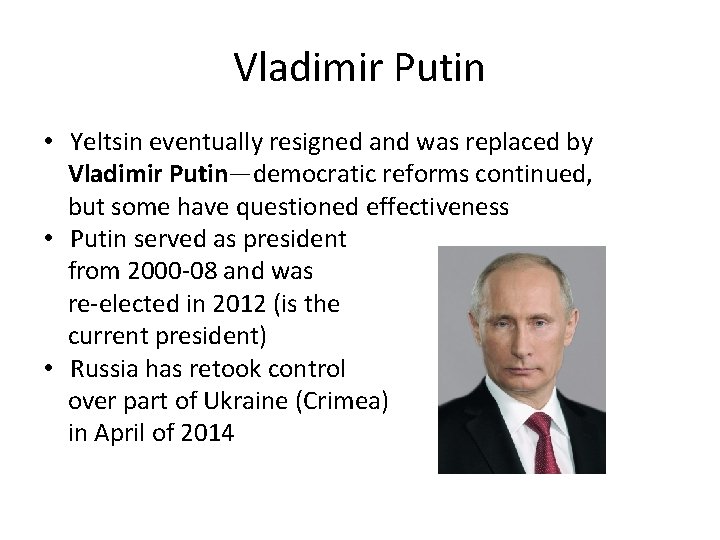
Vladimir Putin • Yeltsin eventually resigned and was replaced by Vladimir Putin—democratic reforms continued, but some have questioned effectiveness • Putin served as president from 2000 -08 and was re-elected in 2012 (is the current president) • Russia has retook control over part of Ukraine (Crimea) in April of 2014
Impact on Western Europe • No longer had to fear Soviet invasion • Need for NATO questioned (had been designed to protect against Soviet invasion; Warsaw Pact ended when Soviet Union ended) • NATO became a security force for all of Europe and many former Warsaw Pact nations joined
Impact on America • COLD WAR OVER • U. S. REMAINED INTERVENTIONIST • TERRORISM BECAME THE BIGGEST THREAT, ESPECIALLY AFTER 9/11
- Slides: 23