
Fall Final Review Question 1 When we discuss

- Slides: 50
Fall Final Review
Question 1 When we discuss “our environment” we are referring to A. All conditions in the world. B. only conditions that cause negative effects on our health. C. primarily interactions that harm the atmosphere. D. the sum of all the conditions surrounding us that influence life.
Question 2 The population with the greatest ability to respond to environmental change most likely is the one with A. low genetic diversity. B. more animals than plants. . C. high genetic diversity. D. two types of dominant organisms. [1 -4]
Question 3 The concentration of carbon dioxide in the atmosphere A. is increasing in part due to fossil fuel use. B. has not significantly changed in the past 200 years. C. is increasing in part due to deforestation. D. both a and c. • [10]
Question 4 Calculating ecological footprint involves consideration of A. the impact of activities on the resources of Earth. B. water usage for crops and direct consumption. C. food calories required for continuing normal activity. D. All of these answers are correct. [19]
Question 5 • The study of environmental science differs from study of the natural sciences such as biology and chemistry because it A. involves politics, law and economics. B. isn’t included in most institutions of higher learning. C. eliminates the consideration of physics. D. doesn’t take into account the scientific process. [28]
Question 6 Matter is A. anything that has volume and mass. B. anything that has energy. C. anything that doesn’t have volume. D. None of these answers are correct. [3]
Question 7 To produce sodium chloride, common table salt, a single electron in the outer shell of the sodium atom is transferred to the outer shell of the chlorine atom. This is an example of A. the formation of an ionic bond. B. the formation of a covalent bond. C. radioactive decay. D. the formation of a hydrogen bond. • [6]
Question 8 Water is a good solvent. This statement explains which of the following phenomena? I. High concentrations of dissolved ions in seawater. II. Capacity of living organisms to store many types of molecules in solution in their cells. III. Easy transport of toxic substances through the environment. A. I only. B. II only C. I and III. D. I, II, and III.
Question 9 Energy conversion by living things is A. evident in animals producing food. B. he way electromagnetic radiation is produced. C. a fundamental component of all environmental systems. D. None of the above.
Question 10 A systems analysis of an ecosystem could involve I. inputs of nutrients. II. outputs of energy. III. evaporation. A. I only B. III only C. I and II D. I, II, and III 2 -24
Question 11 The state of global systems on Earth, such as the atmosphere and oceans, A. are in steady state today. B. have never been in steady state. C. are changing. D. are clearly showing a net loss of water. 2 -26
Question 12 Extinctions of species can be the result of A. natural systems changing. B. introduction of invasive species by humans. C. systems that are not in steady state. D. All of these answers are correct. 2 -30
Question 13 • Which of the following are biotic? • I. Decomposers II. Energy flow III. Producers A. I only B. II only C. III only D. I and III [3 -2]
Question 14 Of the following, which are products of photosynthesis? I. Glucose II. Carbon dioxide III. Water A. I only B. II only C. III only D. I and II [3 -4]
Question 15 The sun is the ultimate source of energy for terrestrial ecosystems. Approximately how much of the potential energy available from the sun’s rays hitting the earth is used in photosynthesis? A. 1% B. 10% C. 50% D. 90% [3 -7]
Question 16 A forest has a GPP of 3. 8 kg C/m 2/year and the rate of cellular respiration is 2. 4 kg C/m 2/year. NPP? A. 6. 2 kg C/m 2/year B. 1. 4 kg C/m 2/year C. 1. 0 kg C/m 2/year D. 9. 12 kg C/m 2/year • [3 -8]
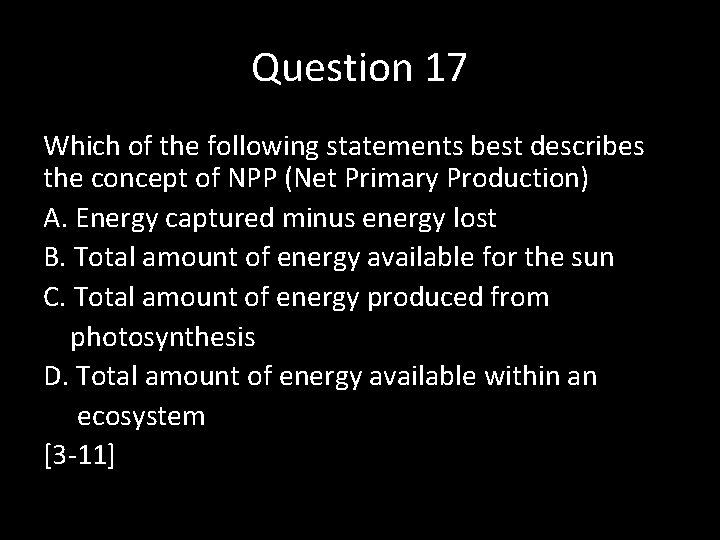
Question 17 Which of the following statements best describes the concept of NPP (Net Primary Production) A. Energy captured minus energy lost B. Total amount of energy available for the sun C. Total amount of energy produced from photosynthesis D. Total amount of energy available within an ecosystem [3 -11]
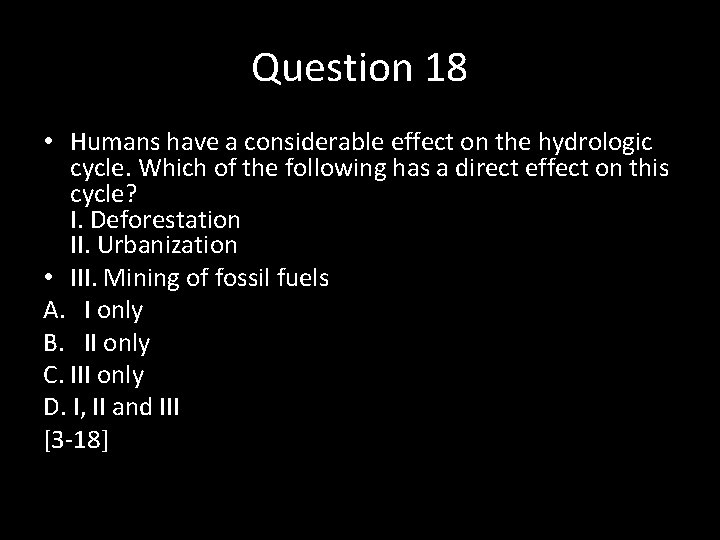
Question 18 • Humans have a considerable effect on the hydrologic cycle. Which of the following has a direct effect on this cycle? I. Deforestation II. Urbanization • III. Mining of fossil fuels A. I only B. II only C. III only D. I, II and III [3 -18]
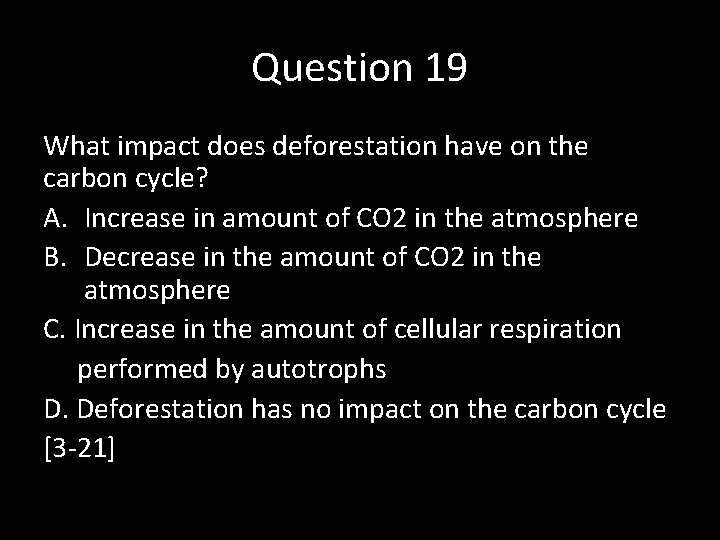
Question 19 What impact does deforestation have on the carbon cycle? A. Increase in amount of CO 2 in the atmosphere B. Decrease in the amount of CO 2 in the atmosphere C. Increase in the amount of cellular respiration performed by autotrophs D. Deforestation has no impact on the carbon cycle [3 -21]
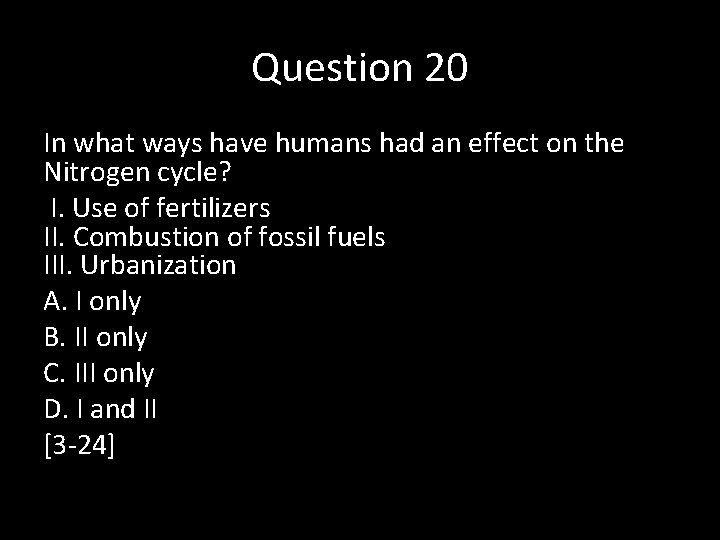
Question 20 In what ways have humans had an effect on the Nitrogen cycle? I. Use of fertilizers II. Combustion of fossil fuels III. Urbanization A. I only B. II only C. III only D. I and II [3 -24]
Question 21 The addition of a limiting nutrient to an ecosystem may lead to an algal bloom. What effect will this algal bloom have on the oxygen content of the water? A. The algae bloom will cause the oxygen content in the water to increase overall B. The algae bloom will cause the oxygen content in the water to decrease, leading to hypoxic conditions C. The algae bloom will have no impact on the oxygen content of the water D. The algae bloom will cause rapid fluctuations of oxygen in the water [3 -26]
Question 22 What impact have humans had on the phosphorus cycle? I. Use of phosphorus containing fertilizers II. Increased urbanization of forested areas III. Increased use of phosphorus containing detergents A. I only B. II only C. III only D. I and III [3 -27]
Question 23 What is a watershed? A. Network of rivers and bays that lead to the ocean B. Reservoir of water stored underground C. Area of land that drains to a water body D. Extensive wetland system leading to a bay [3 -28]
Question 24 An ecosystem that has been clear cut showed a dramatic decrease in the amount of nutrients and energy that were cycled in the ecosystem. In this example, the ecosystem has: A. High resistance B. Low resistance C. High resilience D. Low resilience {3 -29]
Question 25 Which of the following is the best description of a region’s climate? A. The average temperature and precipitation over several decades B. The average precipitation over a 1 -2 year time period C. The amount of rainfall that an area receives over a period of 1 year D. The average temperature and rainfall over a period of 1 -2 years
Question 26 Which level of the atmosphere contains the ozone layer? a. Troposphere b. Stratosphere c. Mesosphere d. Thermosphere
Question 27 Which of the following has the highest albedo: A. Asphalt B. Fresh snow C. Forest D. Water [4 -6]
Question 28 Which of the following statements about the Coriolis Effect is incorrect? A. The Coriolis effect causes objects to be deflected to the west in the northern hemisphere B. The Coriolis effect causes objects to be deflected to the east in the southern hemisphere C. Global winds are not affected by the Coriolis effect D. The different rotation speeds of Earth at different latitudes causes the deflection of traveling objects [4 -11]
Question 29 As water freezes or evaporates, what happens to the salinity of the remaining ocean water? A. Salinity decreases B. Salinity increases C. Increases as water freezes, decreases as water evaporates D. Increases as water evaporates, decreases as water freezes [4 -15]
Question 30 What factors are used to classify a biome? I. Average temperature II. Average precipitation III. Distinctive plants adapted to area A. I only B. II only C. III only D. I, II and III
Question 31 Which of the following is the Earth’s most diverse biome? A. Wetlands B. Tropical Rainforest C. Temperate seasonal forest D. Coral reefs [4 -24]
Question 32 What is most significant when determining the diversity of an ecosystem? A. The number of organisms present B. The number of species present C. The amount of land the ecosystem covers D. The amount of precipitation an ecosystem receives E. The interactions between producers and consumers • [5 -1]
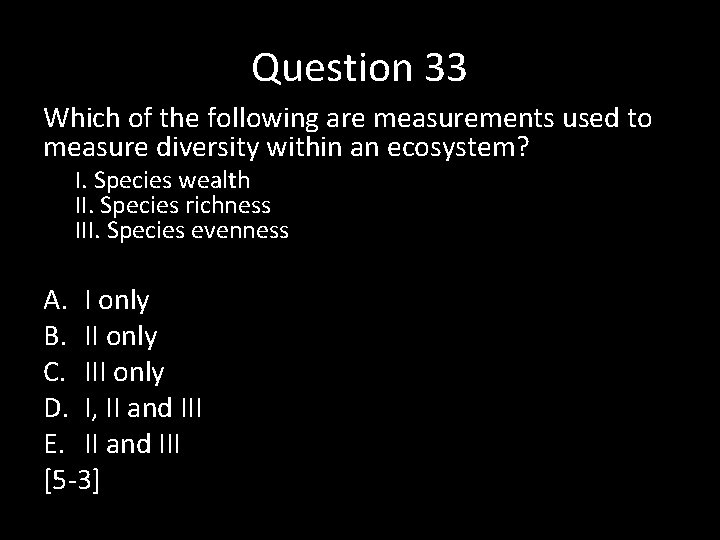
Question 33 Which of the following are measurements used to measure diversity within an ecosystem? I. Species wealth II. Species richness III. Species evenness A. I only B. II only C. III only D. I, II and III E. II and III [5 -3]
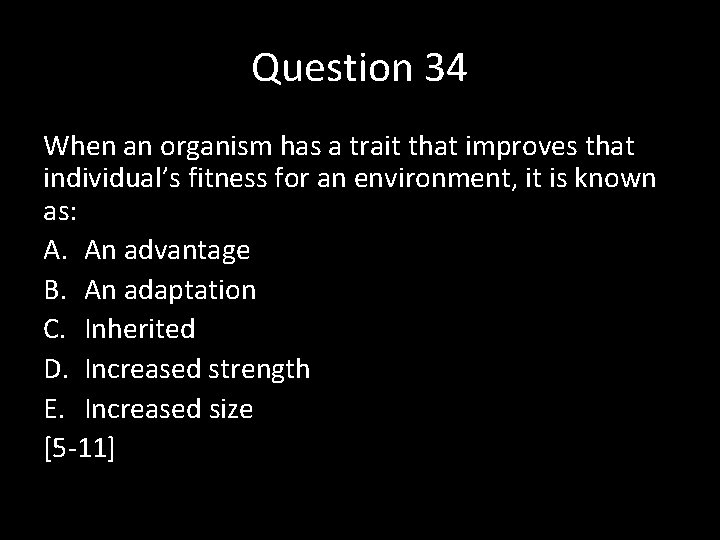
Question 34 When an organism has a trait that improves that individual’s fitness for an environment, it is known as: A. An advantage B. An adaptation C. Inherited D. Increased strength E. Increased size [5 -11]
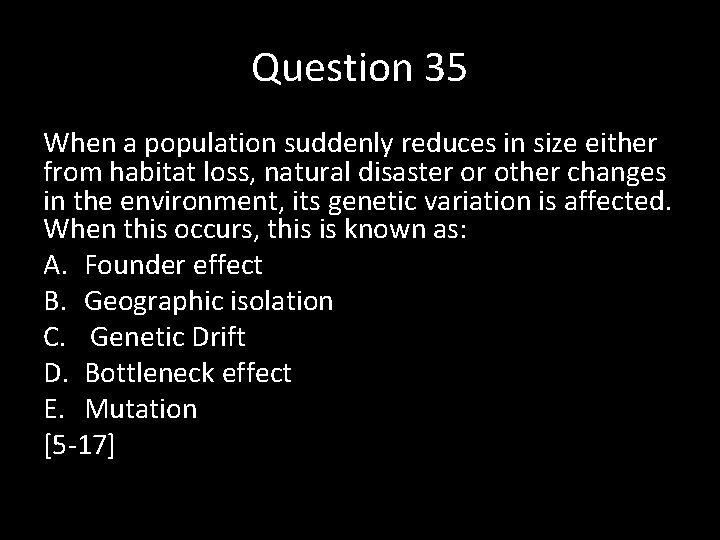
Question 35 When a population suddenly reduces in size either from habitat loss, natural disaster or other changes in the environment, its genetic variation is affected. When this occurs, this is known as: A. Founder effect B. Geographic isolation C. Genetic Drift D. Bottleneck effect E. Mutation [5 -17]
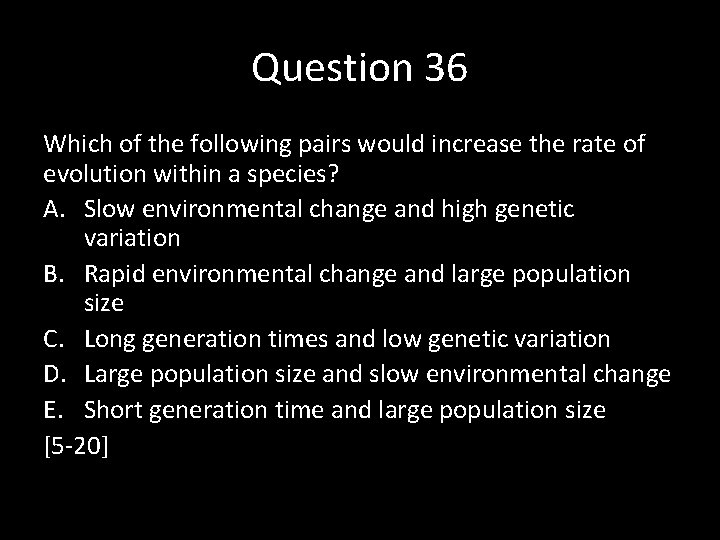
Question 36 Which of the following pairs would increase the rate of evolution within a species? A. Slow environmental change and high genetic variation B. Rapid environmental change and large population size C. Long generation times and low genetic variation D. Large population size and slow environmental change E. Short generation time and large population size [5 -20]
Question 37 Which type of species would be most vulnerable to environmental changes? A. Species with a large population size B. Niche generalists C. Niche specialists D. Species with rapid reproductive rates E. Species with high genetic variation [5 -23]
Question 38 The organisms that represent all of the different interacting species within an ecosystem make up a A. population B. community C. trophic level D. biosphere E. Genus [6 -1]
Question 39 An ecosystem’s carrying capacity for a population is determined by all of the following factors EXCEPT A. space. B. energy. C. water. D. food. E. climatic events, such as tornadoes. [6 -5]
Question 40 Rapid growth may be temporarily be observed in a population in response to all of these EXCEPT A. elimination of a pollutant. B. elimination of predators. C. increase in food supply. D. introduction of a new parasite. E. introduction into a new habitat. [6 -7]
Question 41 If you were studying the niche of a species of bird, you might study A. the food it eats. B. its predators. C. the temperatures it needs to survive. D. the places where it builds its nests. E. all of the above [6 -16]
Question 42 Which of these outcomes is likely in a natural situation when two closely related species compete for resources in the same habitat? A. Population size and distribution of each species may be reduced. B. Interbreeding between the two species will occur. C. One of the species will always become extinct. D. Both species will become extinct. E. Distribution and size of both populations will increase. [6 -19
Question 43 The most critical factor in controlling human population growth is A. controlling reproductive lifespan. B. decreasing the age of first birth. C. decreasing the average number of births per woman. D. decreasing infant death. E. increasing overall wellness for the human race. [7 -3]
Question 44 The human population is currently following roughly a J-shaped curve. This means that the population is growing A. arithmetically. B. sigmoidally. C. at a decreasing rate. D. by a boom and bust cycle. E. exponentially. [7 -5]
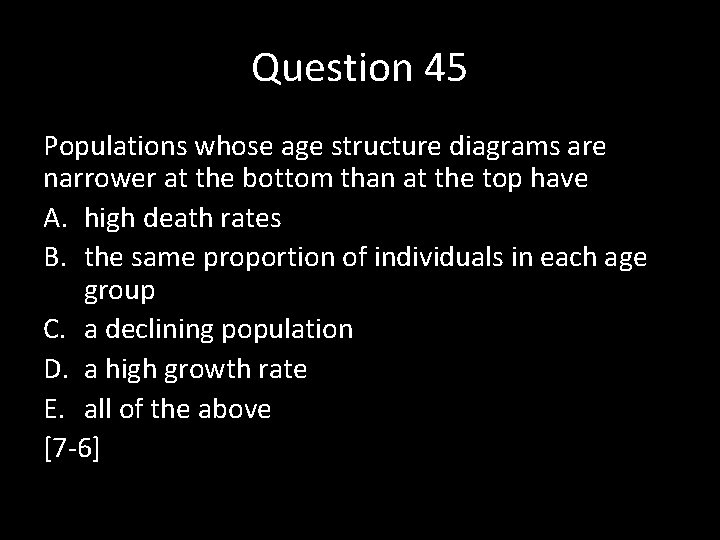
Question 45 Populations whose age structure diagrams are narrower at the bottom than at the top have A. high death rates B. the same proportion of individuals in each age group C. a declining population D. a high growth rate E. all of the above [7 -6]
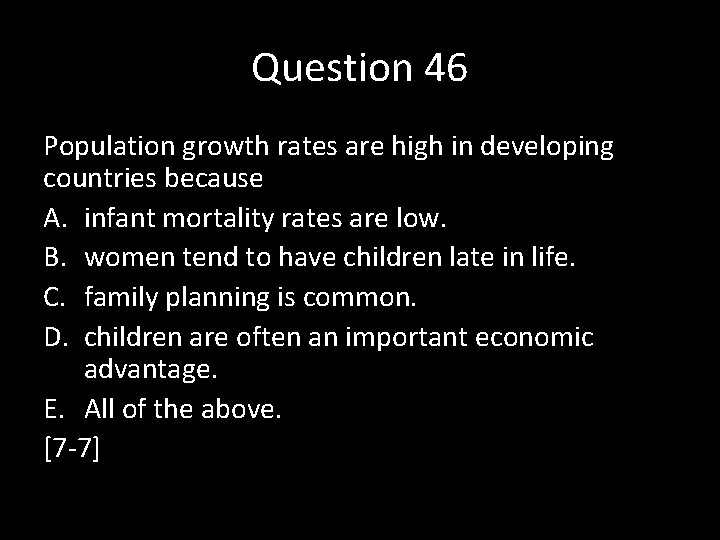
Question 46 Population growth rates are high in developing countries because A. infant mortality rates are low. B. women tend to have children late in life. C. family planning is common. D. children are often an important economic advantage. E. All of the above. [7 -7]
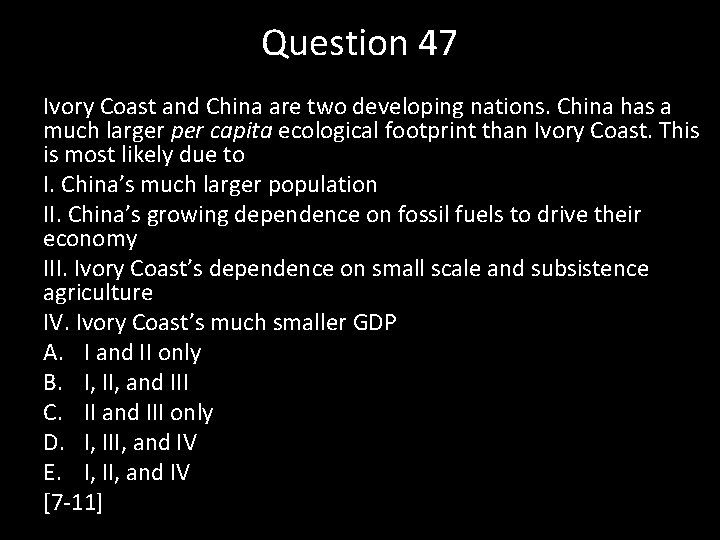
Question 47 Ivory Coast and China are two developing nations. China has a much larger per capita ecological footprint than Ivory Coast. This is most likely due to I. China’s much larger population II. China’s growing dependence on fossil fuels to drive their economy III. Ivory Coast’s dependence on small scale and subsistence agriculture IV. Ivory Coast’s much smaller GDP A. I and II only B. I, II, and III C. II and III only D. I, III, and IV E. I, II, and IV [7 -11]
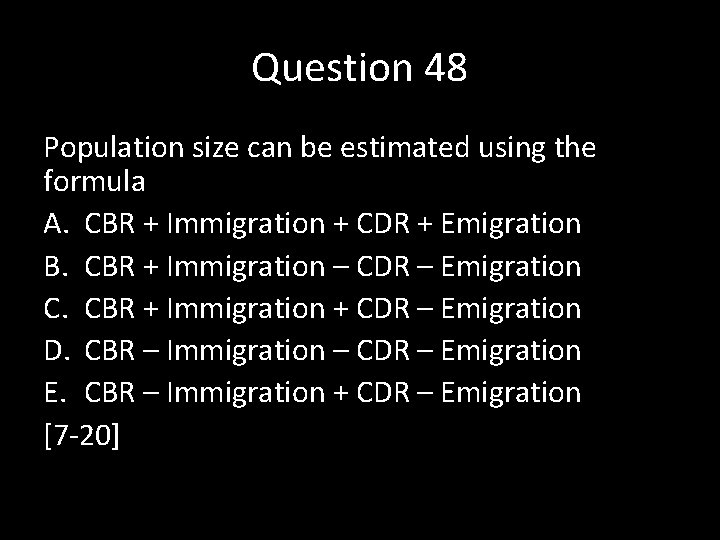
Question 48 Population size can be estimated using the formula A. CBR + Immigration + CDR + Emigration B. CBR + Immigration – CDR – Emigration C. CBR + Immigration + CDR – Emigration D. CBR – Immigration – CDR – Emigration E. CBR – Immigration + CDR – Emigration [7 -20]
Question