
FALL DETECTION OF ELDERLY THROUGH FLOOR VIBRATIONS AND

FALL DETECTION OF ELDERLY THROUGH FLOOR VIBRATIONS AND SOUND Mr. Dima Litvak Prof. Israel Gannot Dr. Yaniv Zigel July 2008
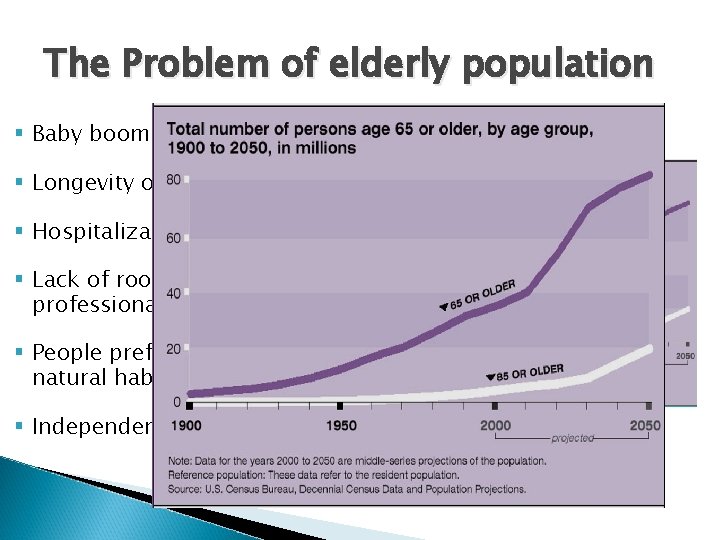
The Problem of elderly population § Baby boomers are growing older § Longevity of life § Hospitalization costs raise § Lack of rooms and health care professionals in Care Centers § People prefer to stay in their natural habitats § Independence of elderly people
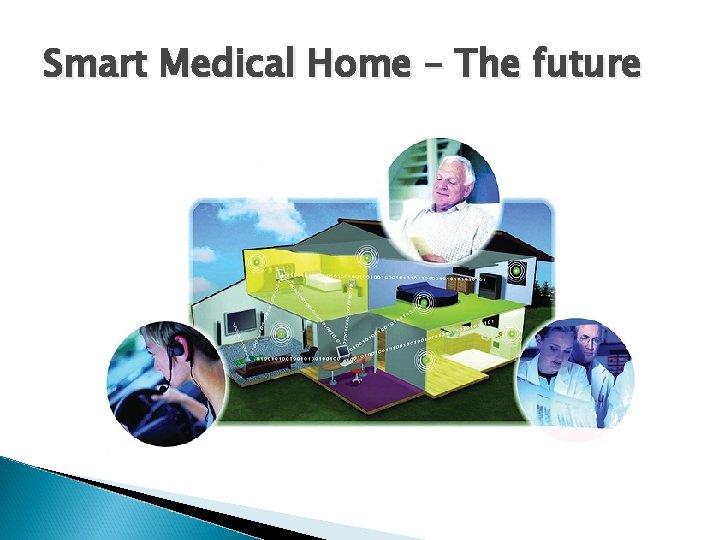
Smart Medical Home – The future
The Statistics of Falls § First cause of accidental death, third cause of chronic disability, and the fifth most common cause of death [1 -2]. § 1 of 3 persons over the age of 65 fall at least once a year [3]. § At least 70% of all falls occur at home[4]. § The costs of falls in the US in 2006 were $19. 2 billion [5]. § People that fall, develop a phobia of falling again [6]. § Fast fall detection increases the chances to survive. [8]
![Popular solutions § Social alarms [9 -10] § Wearable automatic fall detectors [11 -15]](http://slidetodoc.com/presentation_image_h2/3fe74590d5e60c239d43e71c48547ea1/image-5.jpg "Popular solutions § Social alarms [9 -10] § Wearable automatic fall detectors [11 -15]")
Popular solutions § Social alarms [9 -10] § Wearable automatic fall detectors [11 -15] § Video based fall detection systems [16 -17] § Floor vibration passive system [18]
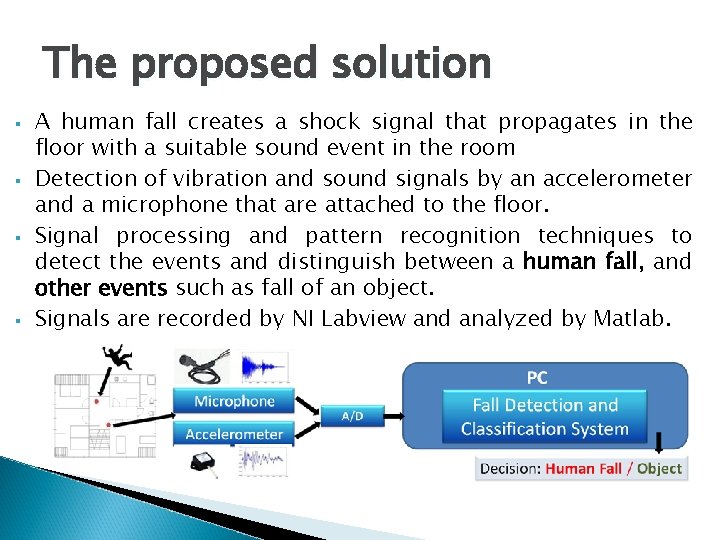
The proposed solution § § A human fall creates a shock signal that propagates in the floor with a suitable sound event in the room Detection of vibration and sound signals by an accelerometer and a microphone that are attached to the floor. Signal processing and pattern recognition techniques to detect the events and distinguish between a human fall, and other events such as fall of an object. Signals are recorded by NI Labview and analyzed by Matlab.
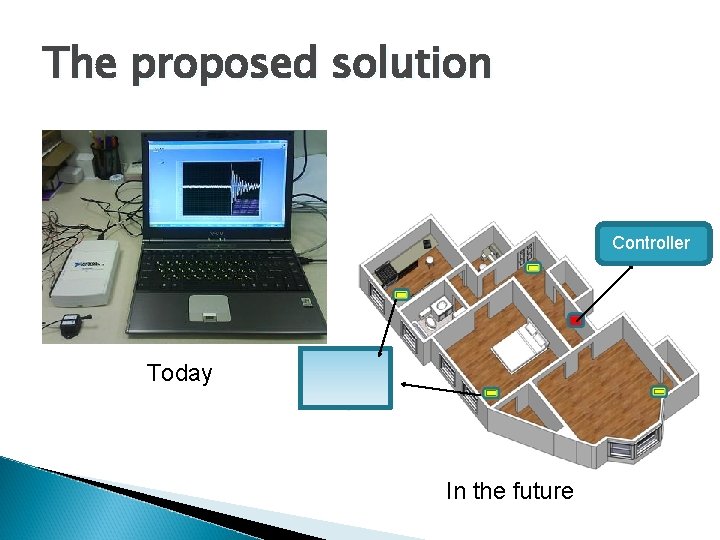
The proposed solution Controller Today In the future
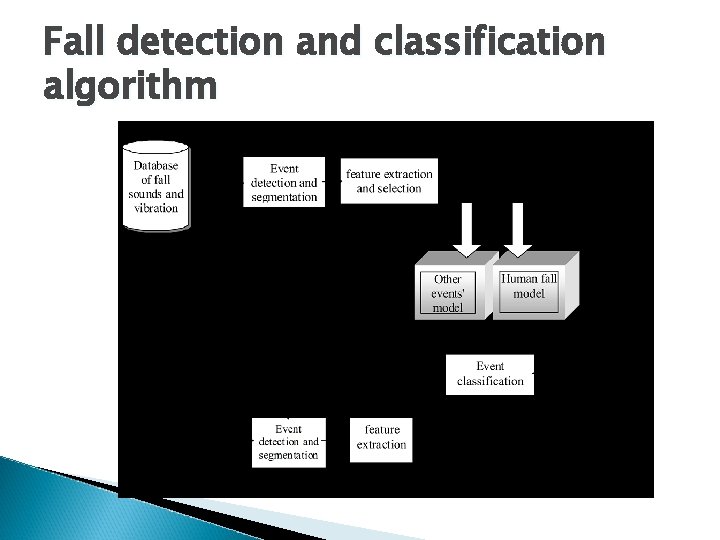
Fall detection and classification algorithm
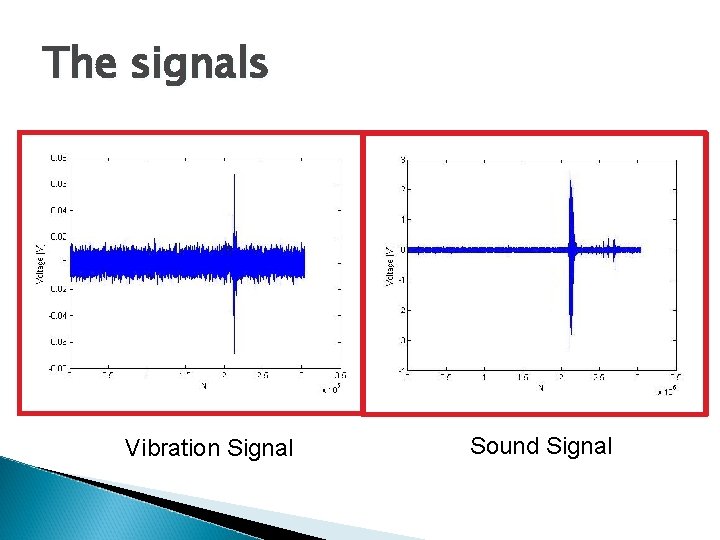
The signals Vibration Signal Sound Signal
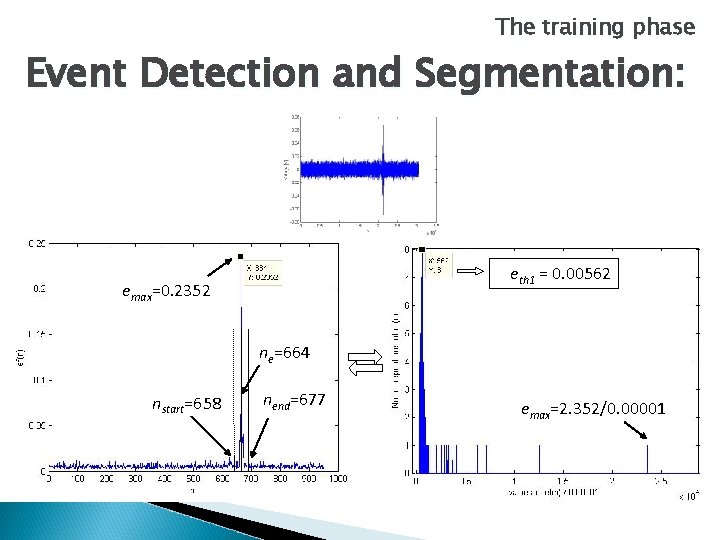
The training phase Event Detection and Segmentation: eth 1 = 0. 00562 emax=0. 2352 ne=664 nstart=658 nend=677 emax=2. 352/0. 00001
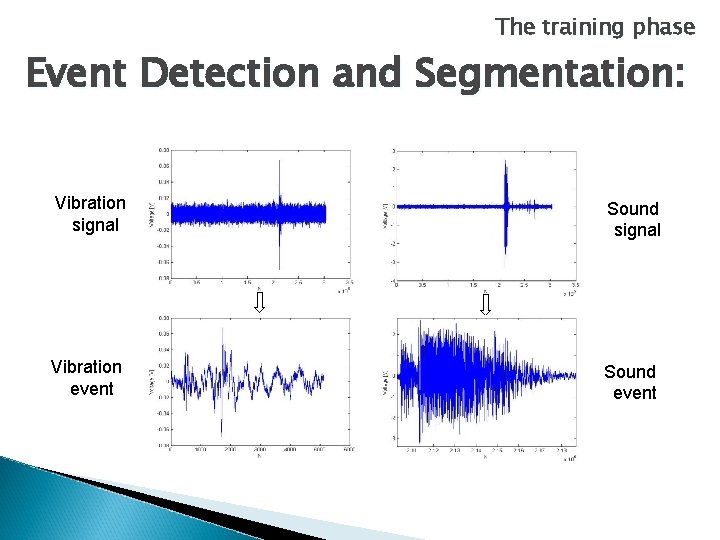
The training phase Event Detection and Segmentation: Vibration signal Sound signal Vibration event Sound event
Feature Extraction: § § § The training phase The signals of a human fall and other events might look similar. Therefore, the main problem is to find the appropriate special features for classification. Temporal Features: length (time) and energy of vibration and sound events (total of 4 features) Spectral Features: shock response spectrum (SRS) [19] from vibration event and Mel frequency cepstral coefficients (MFCC) [20] from sound event.
![The training phase Shock response spectrum (SRS): § Robinovitch et al. [21] described the](http://slidetodoc.com/presentation_image_h2/3fe74590d5e60c239d43e71c48547ea1/image-13.jpg "The training phase Shock response spectrum (SRS): § Robinovitch et al. [21] described the")
The training phase Shock response spectrum (SRS): § Robinovitch et al. [21] described the dynamics of impact to the hip during a fall event as Mass-Spring system. x § kc bc The SRS calculation is kind of a wavelet transform that assumes that the fall event is a mass-spring system.
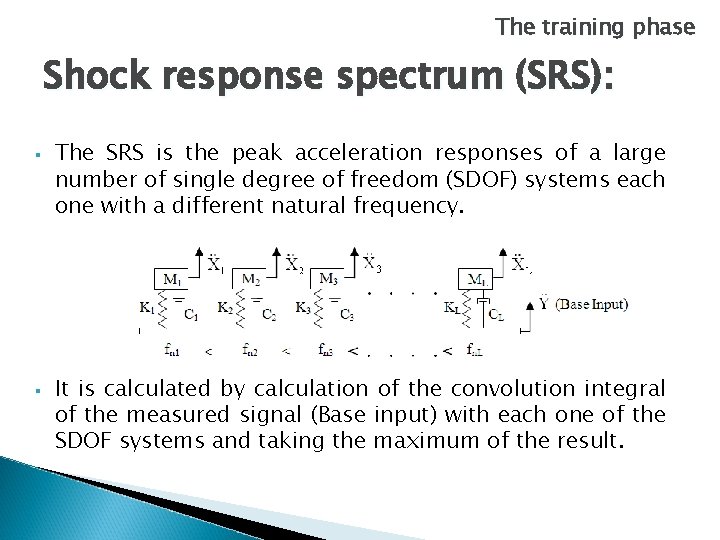
The training phase Shock response spectrum (SRS): § § The SRS is the peak acceleration responses of a large number of single degree of freedom (SDOF) systems each one with a different natural frequency. It is calculated by calculation of the convolution integral of the measured signal (Base input) with each one of the SDOF systems and taking the maximum of the result.
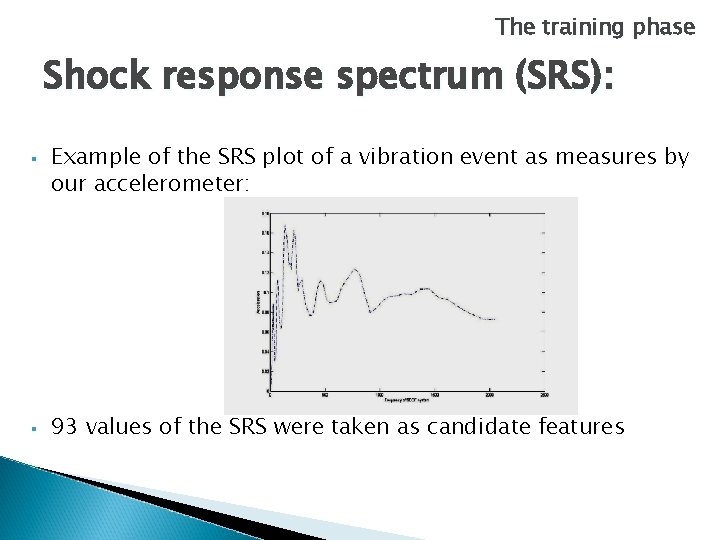
The training phase Shock response spectrum (SRS): § § Example of the SRS plot of a vibration event as measures by our accelerometer: 93 values of the SRS were taken as candidate features
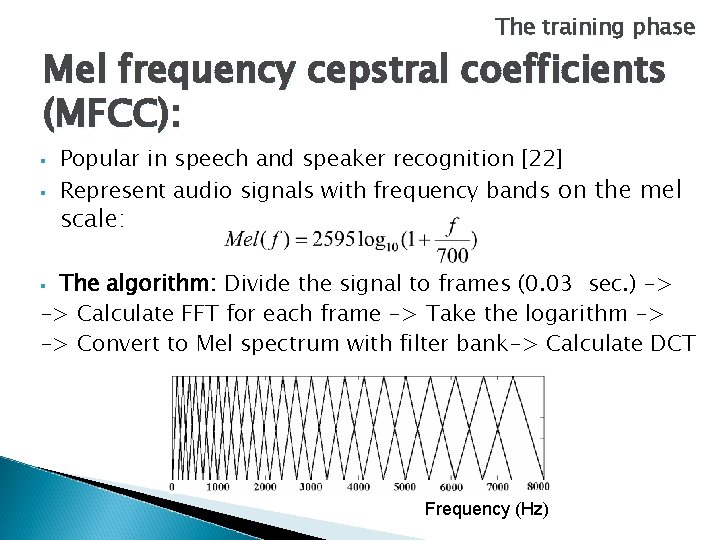
The training phase Mel frequency cepstral coefficients (MFCC): § § Popular in speech and speaker recognition [22] Represent audio signals with frequency bands on the mel scale: The algorithm: Divide the signal to frames (0. 03 sec. ) -> -> Calculate FFT for each frame -> Take the logarithm -> -> Convert to Mel spectrum with filter bank-> Calculate DCT § Frequency (Hz)
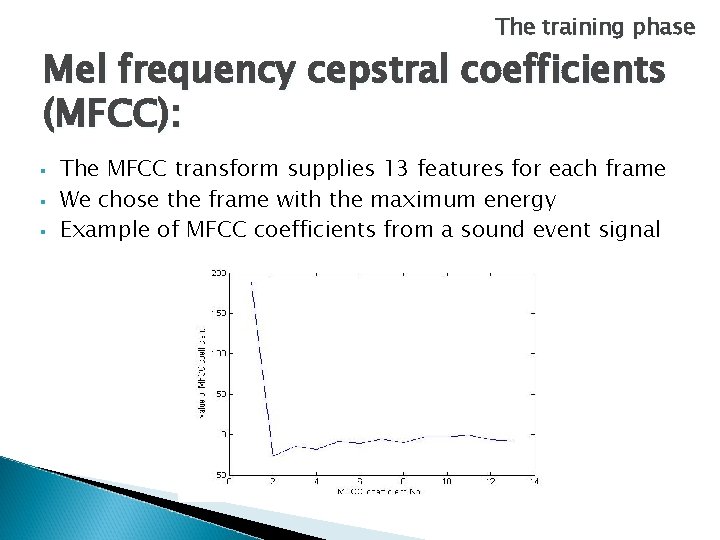
The training phase Mel frequency cepstral coefficients (MFCC): § § § The MFCC transform supplies 13 features for each frame We chose the frame with the maximum energy Example of MFCC coefficients from a sound event signal
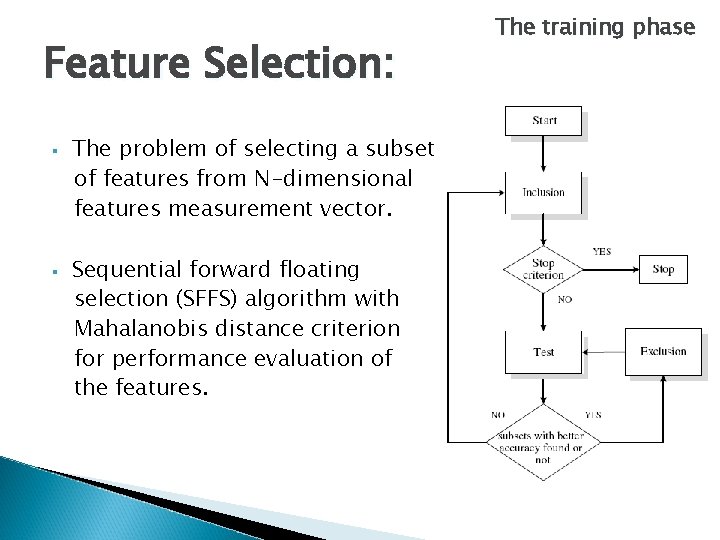
Feature Selection: § § The problem of selecting a subset of features from N-dimensional features measurement vector. Sequential forward floating selection (SFFS) algorithm with Mahalanobis distance criterion for performance evaluation of the features. The training phase
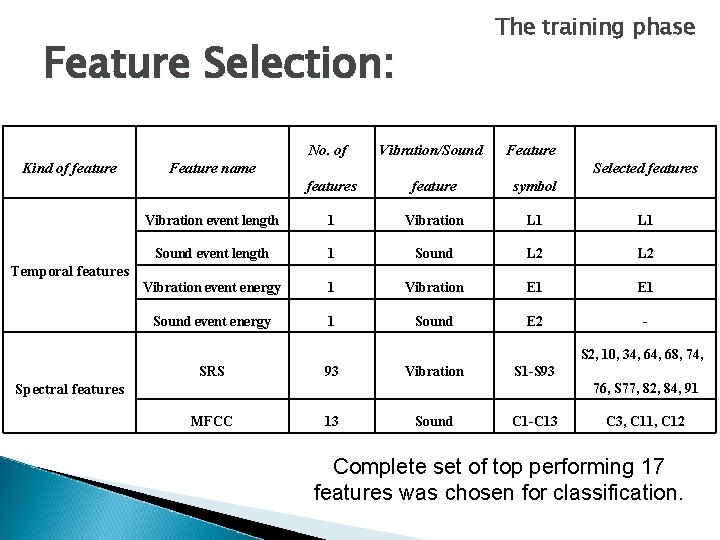
The training phase Feature Selection: No. of Kind of feature Vibration/Sound Feature name Selected features feature symbol Vibration event length 1 Vibration L 1 Sound event length 1 Sound L 2 Vibration event energy 1 Vibration E 1 Sound event energy 1 Sound E 2 - Temporal features S 2, 10, 34, 68, 74, SRS 93 Vibration S 1 -S 93 Spectral features 76, S 77, 82, 84, 91 MFCC 13 Sound C 1 -C 13 C 3, C 11, C 12 Complete set of top performing 17 features was chosen for classification.
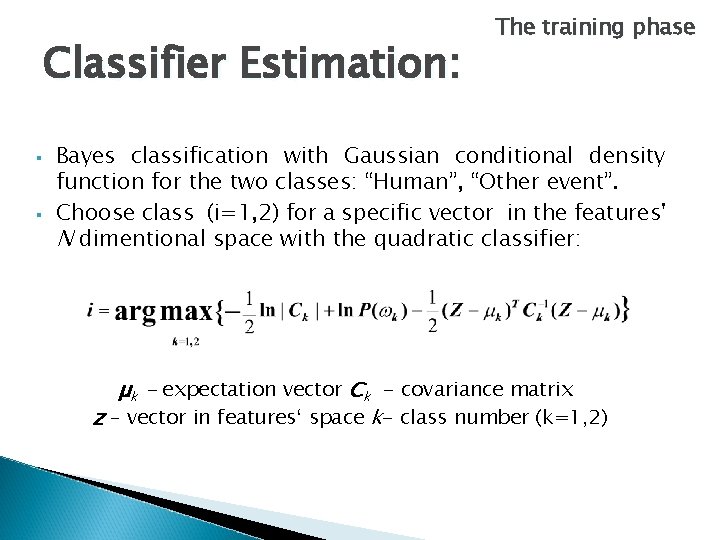
Classifier Estimation: § § The training phase Bayes classification with Gaussian conditional density function for the two classes: “Human”, “Other event”. Choose class (i=1, 2) for a specific vector in the features' N dimentional space with the quadratic classifier: µk - expectation vector Ck - covariance matrix z – vector in features‘ space k- class number (k=1, 2)
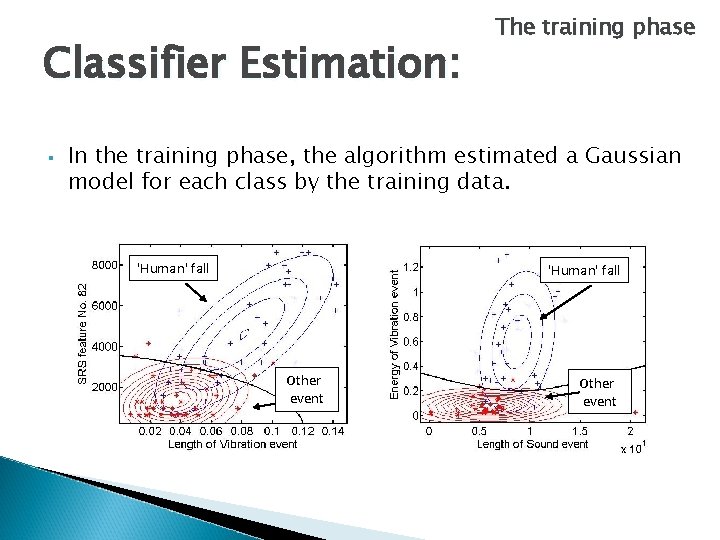
Classifier Estimation: § The training phase In the training phase, the algorithm estimated a Gaussian model for each class by the training data. 'Human' fall Other event
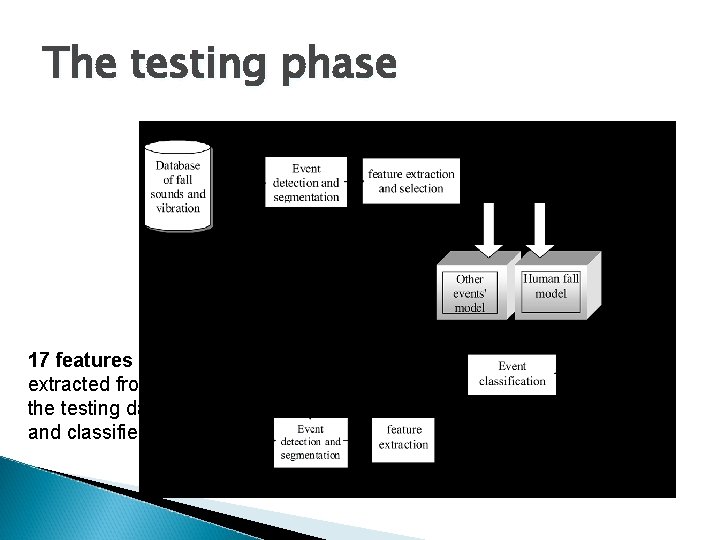
The testing phase 17 features are extracted from the testing data, and classified
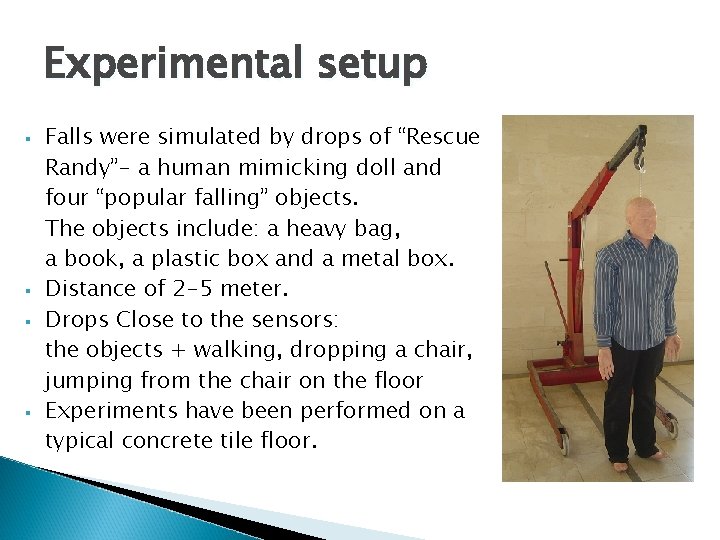
Experimental setup § § Falls were simulated by drops of “Rescue Randy”- a human mimicking doll and four “popular falling” objects. The objects include: a heavy bag, a book, a plastic box and a metal box. Distance of 2 -5 meter. Drops Close to the sensors: the objects + walking, dropping a chair, jumping from the chair on the floor Experiments have been performed on a typical concrete tile floor.
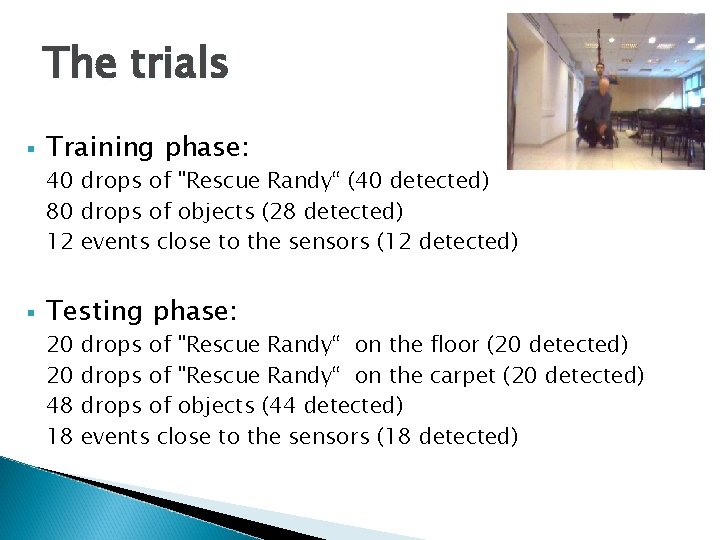
The trials § Training phase: 40 drops of "Rescue Randy“ (40 detected) 80 drops of objects (28 detected) 12 events close to the sensors (12 detected) § Testing phase: 20 20 48 18 drops of "Rescue Randy“ on the floor (20 detected) drops of "Rescue Randy“ on the carpet (20 detected) drops of objects (44 detected) events close to the sensors (18 detected)
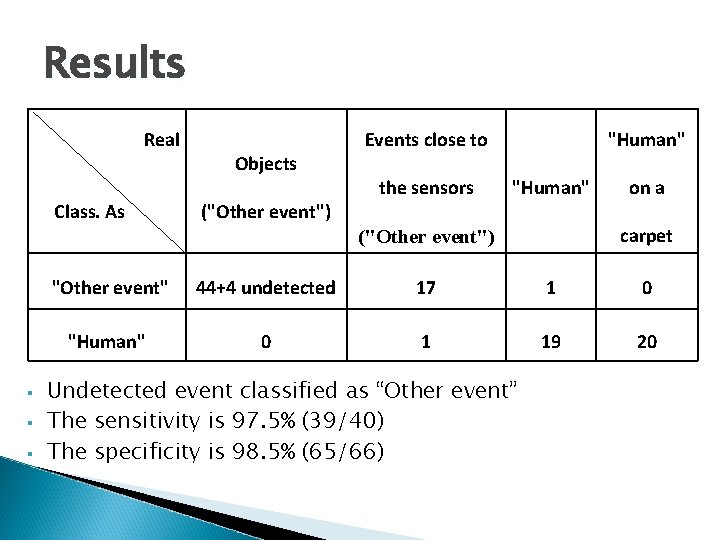
Results Real Class. As Objects ("Other event") "Human" Events close to the sensors "Human" carpet ("Other event") § § § on a "Other event" 44+4 undetected 17 1 0 "Human" 0 1 19 20 Undetected event classified as “Other event” The sensitivity is 97. 5% (39/40) The specificity is 98. 5% (65/66)
Discussion § § § The results show that the proposed solution has a potential to serve as a reliable innovative solution for detection of falls. The proposed solution is a low cost, does not require the person to wear anything, and is considerate of privacy. The system is adaptive, can be calibrated to any kind of floor and room acoustics. For improvement of the classification algorithm, training can be performed using various weights of "Rescue Randy" dolls and objects, in a wider variety of kinds of drops. Evaluation of the maximum distance in which the sensitivity is low.
![References § § § [1] Spellbring, A. M. Assessing elderly patients at high risk](http://slidetodoc.com/presentation_image_h2/3fe74590d5e60c239d43e71c48547ea1/image-27.jpg "References § § § [1] Spellbring, A. M. Assessing elderly patients at high risk")
References § § § [1] Spellbring, A. M. Assessing elderly patients at high risk for falls: A reliability study. J Nurs Care Quality 6(3): 30 -35, 1992. [2] Murray CJL, Lopez AD, editors. The global burden of disease. Boston: The Harvard School of Public Health; 1996. p. 201– 46. [3] MC Ncvitt, SR Cumming, "Risk factors for recurrent non syncopal falls. A prospective shldy", JAMA, 261, pp 2663 -2668. [4] Sorock GS. Falls among the elderly: Epidemiology and prevention. American Journal of Preventive Medicine 1988; 4(5): 282 -8. [5] The costs of fatal and non-fatal falls among older adults. Stevens JA, Corso PS, Finkelstein EA, Miller Inj Prev. 2006 Oct; 12(5): 290 -5. [6] Legters K. Fear of falling. Phys Ther 2002; 82: 264– 72. [7] Luukinen H, Koski K, Honkanen R, et al. Incidence of injury-causing falls among older adults by place of residence: a population-based study. J Am Geriatr Soc 1995; 43: 871– 6. [8] Persons found in their homes helpless or dead. N Engl J Med 1996; 334: 1710 -1716. [9] J. [9] Porteus, and S. Brownsell, “Using telecare: exploring technologies for independent living for older people, ” Anchor Trust, Kidlington, UK, 2000. [10] http: //www. vivatec. co. uk/wristcare_nurse_call. html. [11]G. Williams, K. Doughty, K. Cameron, D. A. Bradley, “A smart fall and activity monitor for telecare applications, ” Proc. 20 th Annu. Inter. Conf. of the IEEE-EMBS, Hong-Kong, 1998, pp. 1151 -1154 [12] T. Degen, H. Jaeckel, M. Rufer, S. Wyss, “SPEEDY: a fall detector in a wrist watch, ” in Proc. Seventh IEEE Int. Symp. on Wearable Computers (ISWC'03), New-York, Oct. 2003, pp. 184– 187
![§ § § References [13] N. Noury, A. Tarmizi, D. Savall et al. ,](http://slidetodoc.com/presentation_image_h2/3fe74590d5e60c239d43e71c48547ea1/image-28.jpg "§ § § References [13] N. Noury, A. Tarmizi, D. Savall et al. ,")
§ § § References [13] N. Noury, A. Tarmizi, D. Savall et al. , “A smart sensor for the fall detection in daily routine, ” in Proc. SICICA 2003, Aveiro, Portugal, July 2003 [14] U. Lindemann, A. Hock, et al. , “Evaluation of a fall detector based on accelerometers: A pilot study, ” Medical and Biological Engineering and Computing, vol. 43, no. 5, pp. 548 -551, Sep. 2005. [15] A. K. Bourke, and G. M. Lyons, “A threshold-based fall-detection algorithm using a bi-axial gyroscope sensor, ” Medical Engineering and Physics, vol. 30, no. 1, pp. 84 -90, Jan. 2008. [16] C. W. Lin, and Z. H. Ling, “Automatic fall incident detection in compressed video for intelligent homecare, ” in Proc. ICCCN 2007, Hawaii, Aug. 2007, pp. 1172 -1177. [17] G. Wu, “Distinguishing fall activities from normal activities by velocity characteristics, ” Journal of Biomechanics, vol. 33, no. 11, pp. 1497 -1500, 2000. [18] M. Alwan, P. Rajendran, S. Kell et al. , “A smart and passive floor vibration based fall detector for elderly, ” in Proceedings ICTTA’ 06, Damascus, Syria, Apr. 2006, pp. 23– 28. [19] T. Irvine (2002, May 24), "An introduction to the shock response spectrum", Available: http: //www. vibrationdata. com/tutorials 2/srs_intr. pdf. [20] S. Davis, and P. Mermelstein, “Comparison of parametric representations for monosyllabic word recognition in continuously spoken sentences, ” IEEE Transactions on Acoustics, Speech, and Signal Processing, vol. 28, no. 4, pp. 357 -366, Aug. 1980. [21] S. N. Robinovitch, W. C. Hayes, and T. A. Mc. Mahon, “Distribution of contact force during impact to the hip, ” Annals of Biomedical Engineering, vol. 25, no. 3, pp. 499 -508, 1997. [22] Y. Zigel, and A. Cohen, "Text-dependent speaker verification using feature selection with recognition related criterion. " in Proc. Odyssey The Speaker and Language Recognition Workshop , Toledo, May 2004, pp. 329 -336. [23] Pudil, P. , Novovicova´, J. , & Kittler, J. (1994). Floating search methods in feature selection. Pattern Recognition Letters, 15(11), 1119– 1125. [24] T. W. O'Neill, et al. , “Age and sex influences on fall characteristics, ”British Medical Journal, vol. 53, no. 11, pp. 773 -775, Nov. 1994.
Thanks § Prof. Israel Gannot and Dr. Yaniv Zigel § Lab staff: Arik, Idan, Moshe, Marina, Michal, Ranit, Tomer § LTC Yakov Shalom – Head of Medical Engineering division, medical corps, IDF Workshop staff § My girlfriend Alona, and my Family. §
- Slides: 29