
Fall 2021 Orientation Slide Deck Overview and Tips
- Slides: 46
Fall 2021 Orientation Slide Deck: Overview and Tips for Using this Orientation “Shell” This orientation slide deck serves as a shell and a starting point for districts and BOCES to present relevant information and local protocols and processes for completing educator evaluations for the 2021 -2022 school year. It is not meant to be used “as-is”. Information specific to the local district/BOCES needs to be added, as well as a determination made regarding which slides to include for different audiences.
Fall 2021 Orientation Slide Deck: Overview and Tips for Using this Orientation “Shell” Tips for Using this Slide Deck in your Orientation: • Use the completely white slides to add content and tailor your presentation to district/BOCES-specific processes and protocols for educator evaluation. For example: • Add your district/BOCES logo and branding (placeholder included within slides) • Text in green font offers ideas for possible content to include on that slide and needs to be removed prior to sharing with your staff • A tremendous amount of local flexibility exists within the evaluation system. A reminder and link to examples is offered on pages where opportunities exist to tailor aspects of the evaluation process.
Fall 2021 Orientation Slide Deck: Overview and Tips for Using this Orientation “Shell” Additional Tips for Using this Slide Deck in your Orientation: • Not all content will be relevant for all audiences. Slides may be hidden and/or deleted depending upon the audience, e. g. , returning staff as distinct from staff new to your district/BOCES. • • Slides with CDE branding address information about state statute and rule associated with SB 10 -191, as well as the State Model Evaluation System (SMES). This information may be relevant and included or may already be widely known and therefore can be removed. Additionally, some slides can be used as a handout only to provide reinforcement of content as needed (in lieu of inclusion in the slide deck). • Additional content suggestions, as well as relevant links to other resources, can be found within the “Notes” section on most slides.
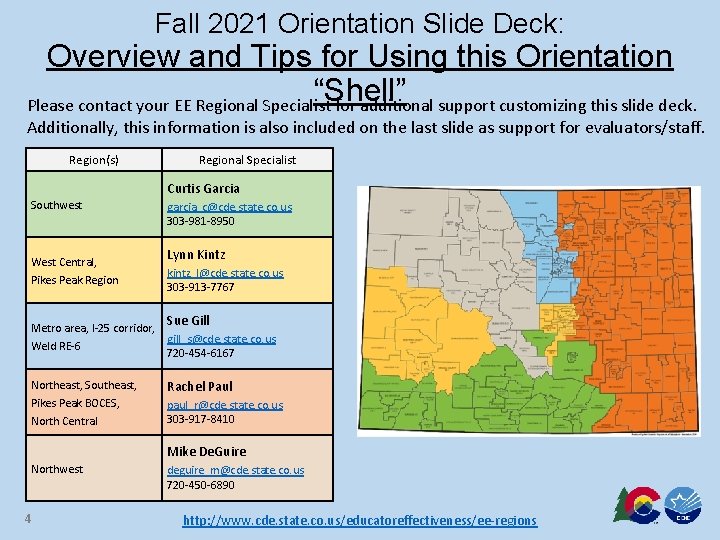
Fall 2021 Orientation Slide Deck: Overview and Tips for Using this Orientation “Shell” Please contact your EE Regional Specialist for additional support customizing this slide deck. Additionally, this information is also included on the last slide as support for evaluators/staff. Region(s) Regional Specialist Curtis Garcia Southwest West Central, Pikes Peak Region garcia_c@cde. state. co. us 303 -981 -8950 Lynn Kintz kintz_l@cde. state. co. us 303 -913 -7767 Sue Gill Metro area, I-25 corridor, gill_s@cde. state. co. us Weld RE-6 720 -454 -6167 Northeast, Southeast, Rachel Paul Pikes Peak BOCES, North Central paul_r@cde. state. co. us 303 -917 -8410 Mike De. Guire Northwest 4 deguire_m@cde. state. co. us 720 -450 -6890 http: //www. cde. state. co. us/educatoreffectiveness/ee-regions
Create your own title slide with district logo and branding District/BOCES Logo Local Orientation for Educator Evaluation 2021 -2022 SCHOOL YEAR <<date(s)>> 5
Educator Effectiveness Overview 6
SB 10 -191 Senate Bill 10 -191 changed the way all educators (principals/assistant principals, teachers and special services providers) are evaluated, with the ultimate goal of continuously supporting educators' professional growth and, in turn, accelerating student results. • All districts are required to evaluate all licensed personnel on all professional practice standards for teachers, special services providers (SSPs), and principals. 7
SB 10 -191 • Districts and BOCES should have an Advisory Personnel Performance Evaluation Council (formerly 1338). This council must consult with the local school board as to the fairness, effectiveness, credibility, and professional quality of local evaluation systems, processes and procedures. • Districts and BOCES should determine how licensed personnel in unique roles will be evaluated. This may include educators in dual roles, teachers on special assignment, instructional coaches and deans. 8
SB 10 -191 • Measures of Student Learning/Outcomes must account for 50% of an educator’s annual evaluation (Teacher, Principal, SSP). • All educators must be given a written evaluation report upon the completion of an evaluation. Teachers must receive the report no later than two weeks before the end of the school year. 9
Professional Practice Requirements • Districts need to determine the weights for the Educator Quality Standards. • Probationary Teachers are required to have two observations during the year and non-probationary Teachers require at least one observation. • There is only one state requirement for using artifacts in support of evaluating Teachers and SSPs. In addition to observation, at least one of the following performance measures must be used, when appropriate to the specific duties of the educator: (a) student perception measures (e. g. , surveys) where appropriate and feasible, (b) peer feedback, (c) feedback from parents or guardians; or (d) review of lesson plans, student work samples or student support documentation. C. C. R. 4. 04(A)(6) C. C. R. 5. 01(D)(6) Local flexibility options! 10
Measures of Student Learning (MSL) – Teacher Requirements Highlighted Requirements Outlined in State Board Rule for Teachers: 1) A measure of individually-attributed growth C. C. R. 5. 01(D)(7)(a) 2) A measure of collectively-attributed growth C. C. R. 5. 01(D)(7)(b) 3) When available, statewide summative assessment results C. C. R. 5. 01(D)(7)(c) 4) For subjects with statewide summative assessment results available in two consecutive grades, results from the Colorado Growth Model C. C. R. 5. 01(D)(7)(d) Local flexibility options! 11
Measures of Student Learning (MSL) – Principal Requirements Highlighted Requirements Outlined in State Board Rule for Principals 1) Data included in the school performance framework is used to evaluate Principal performance. C. C. R. 5. 01(D)(3)(a) School Districts and BOCES may choose to weight specific components of the school performance framework differently than they are weighted in the school performance framework, depending on the Principal’s responsibilities and the performance needs of the school, so long as student longitudinal growth carries the greatest weight. 2) At least one other Measure of Student Academic Growth must be incorporated and must ensure that the MSL selected for principal evaluations are consistent with the MSL used for the evaluation of Teachers in each principal’s school. C. C. R. 5. 01(D)(3)(b) Local flexibility options! 12
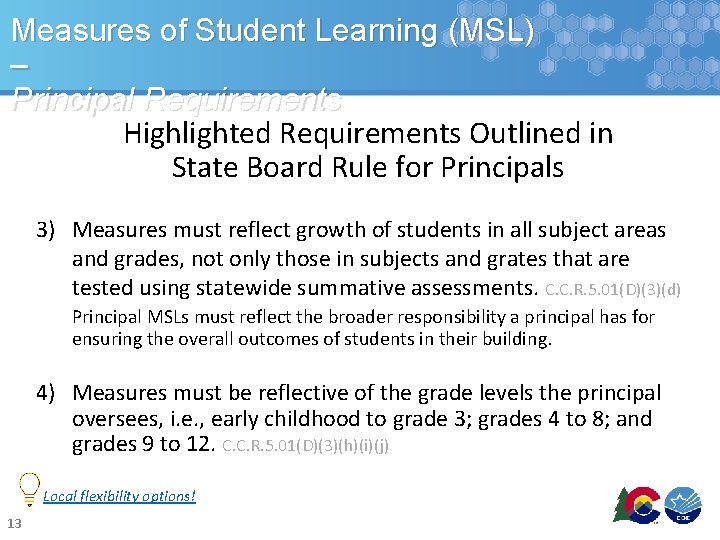
Measures of Student Learning (MSL) – Principal Requirements Highlighted Requirements Outlined in State Board Rule for Principals 3) Measures must reflect growth of students in all subject areas and grades, not only those in subjects and grates that are tested using statewide summative assessments. C. C. R. 5. 01(D)(3)(d) Principal MSLs must reflect the broader responsibility a principal has for ensuring the overall outcomes of students in their building. 4) Measures must be reflective of the grade levels the principal oversees, i. e. , early childhood to grade 3; grades 4 to 8; and grades 9 to 12. C. C. R. 5. 01(D)(3)(h)(i)(j) Local flexibility options! 13
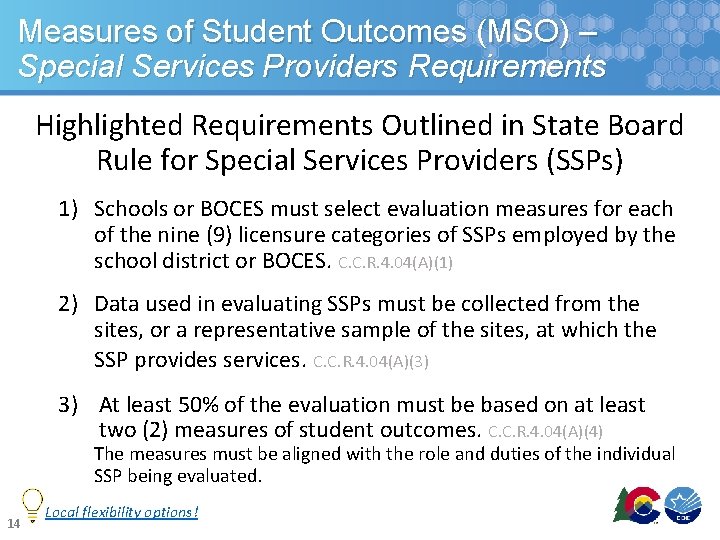
Measures of Student Outcomes (MSO) – Special Services Providers Requirements Highlighted Requirements Outlined in State Board Rule for Special Services Providers (SSPs) 1) Schools or BOCES must select evaluation measures for each of the nine (9) licensure categories of SSPs employed by the school district or BOCES. C. C. R. 4. 04(A)(1) 2) Data used in evaluating SSPs must be collected from the sites, or a representative sample of the sites, at which the SSP provides services. C. C. R. 4. 04(A)(3) 3) At least 50% of the evaluation must be based on at least two (2) measures of student outcomes. C. C. R. 4. 04(A)(4) The measures must be aligned with the role and duties of the individual SSP being evaluated. 14 Local flexibility options!
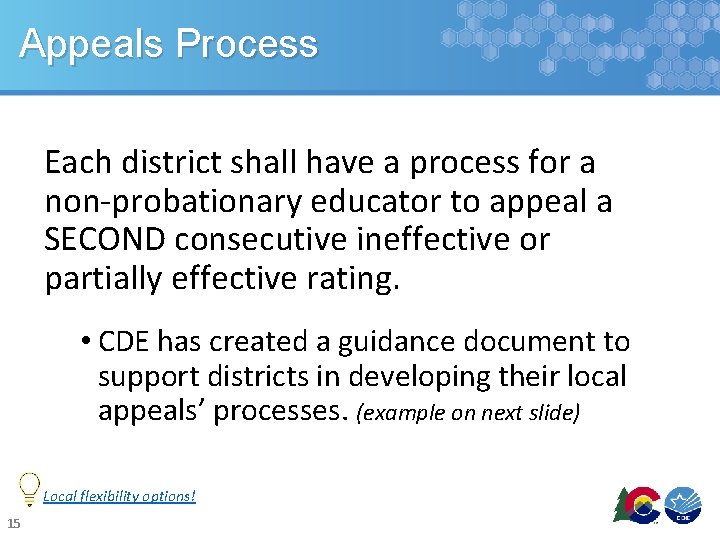
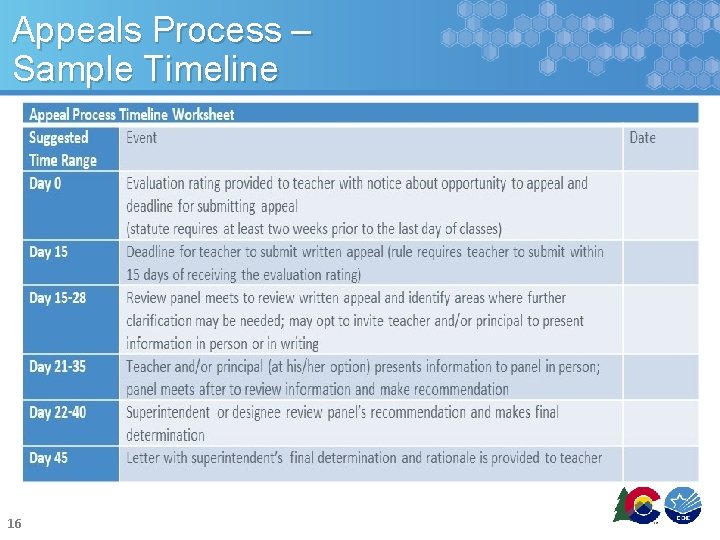
Appeals Process Each district shall have a process for a non-probationary educator to appeal a SECOND consecutive ineffective or partially effective rating. • CDE has created a guidance document to support districts in developing their local appeals’ processes. (example on next slide) Local flexibility options! 15
Appeals Process – Sample Timeline 16
District Level Guidance District Logo Provide an overview of information specific to your district and district-level decisions related to the appeals process for educator evaluations including, at minimum, what is required. -You may choose to delete the prior two slides completely, as appropriate, and address your own process which may be far more comprehensive than the mandated minimum. In our district, the appeal process includes: • 17
Educator Evaluation Cycle 18
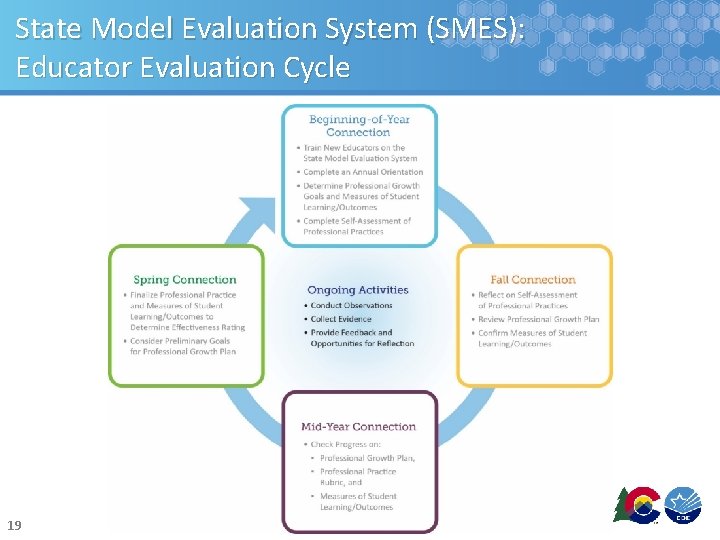
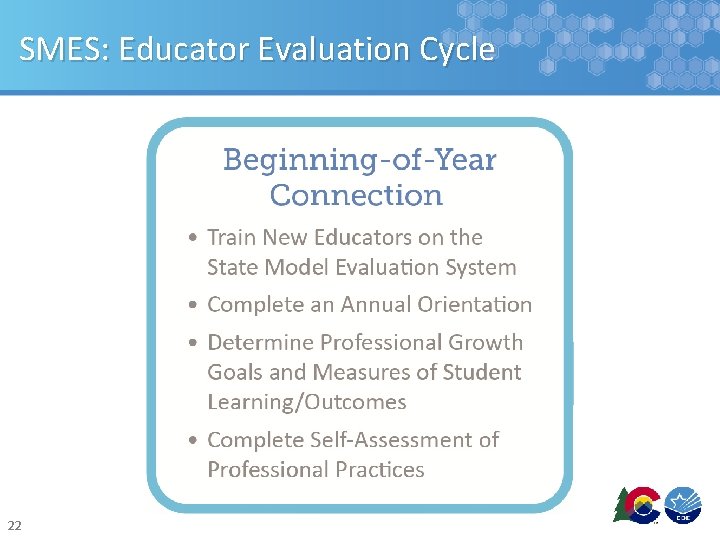
State Model Evaluation System (SMES): Educator Evaluation Cycle 19
District Level Guidance District Logo Provide an overview of information specific to your district and district-level decisions related to the process for educator evaluation. - Possible content to highlight, as well as available resources/links are included in the “Notes” section. In our district, the evaluation process includes: • 20
Building Level Guidance District Logo Provide an overview of building level decisions related to the process for educator evaluation. - Possible content to highlight, as well as available resources/links are included in the “Notes” section. In our district, the evaluation process includes building -level guidance such as: • 21
SMES: Educator Evaluation Cycle 22
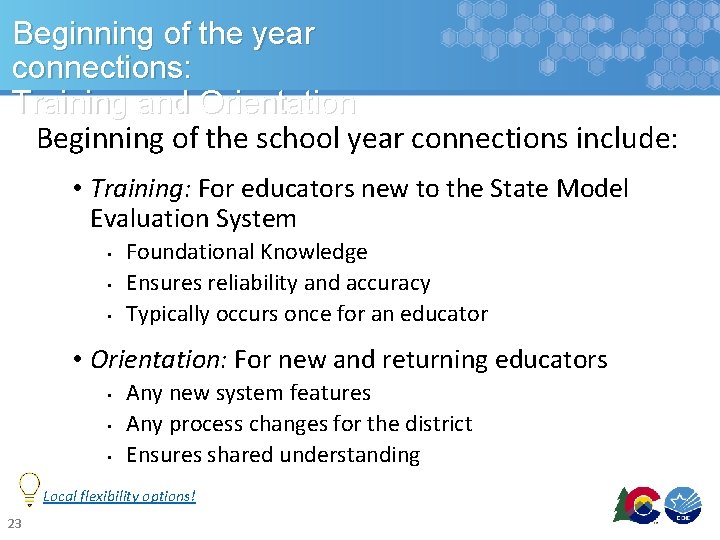
Beginning of the year connections: Training and Orientation Beginning of the school year connections include: • Training: For educators new to the State Model Evaluation System • • • Foundational Knowledge Ensures reliability and accuracy Typically occurs once for an educator • Orientation: For new and returning educators • • • Any new system features Any process changes for the district Ensures shared understanding Local flexibility options! 23
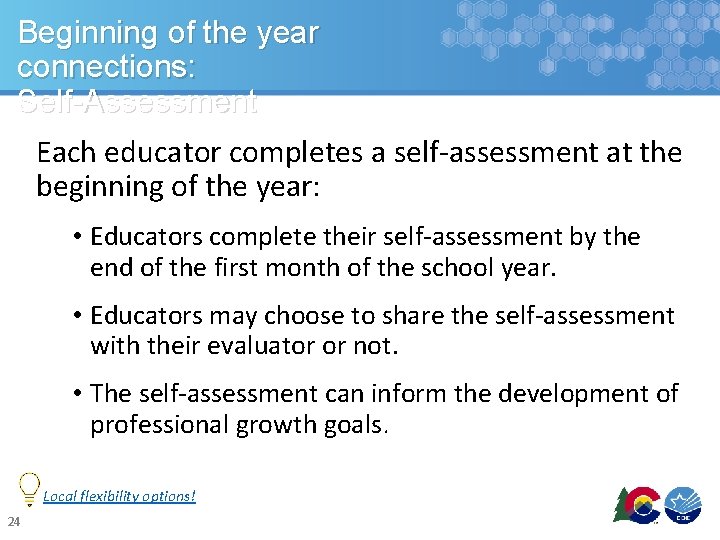
Beginning of the year connections: Self-Assessment Each educator completes a self-assessment at the beginning of the year: • Educators complete their self-assessment by the end of the first month of the school year. • Educators may choose to share the self-assessment with their evaluator or not. • The self-assessment can inform the development of professional growth goals. Local flexibility options! 24
Beginning of the year connections: Self-Assessment Add building level decisions: 25 District Logo
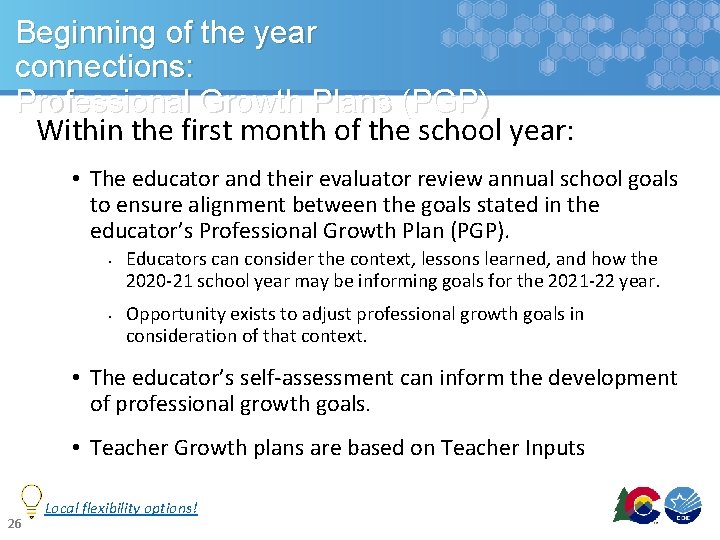
Beginning of the year connections: Professional Growth Plans (PGP) Within the first month of the school year: • The educator and their evaluator review annual school goals to ensure alignment between the goals stated in the educator’s Professional Growth Plan (PGP). • • Educators can consider the context, lessons learned, and how the 2020 -21 school year may be informing goals for the 2021 -22 year. Opportunity exists to adjust professional growth goals in consideration of that context. • The educator’s self-assessment can inform the development of professional growth goals. • Teacher Growth plans are based on Teacher Inputs 26 Local flexibility options!
Beginning of the year connections: Professional Growth Plans (PGP) District Logo Provide overview of information related to building level decisions related to PGPs and related processes/practices. Building level decisions on PGPs include: 27
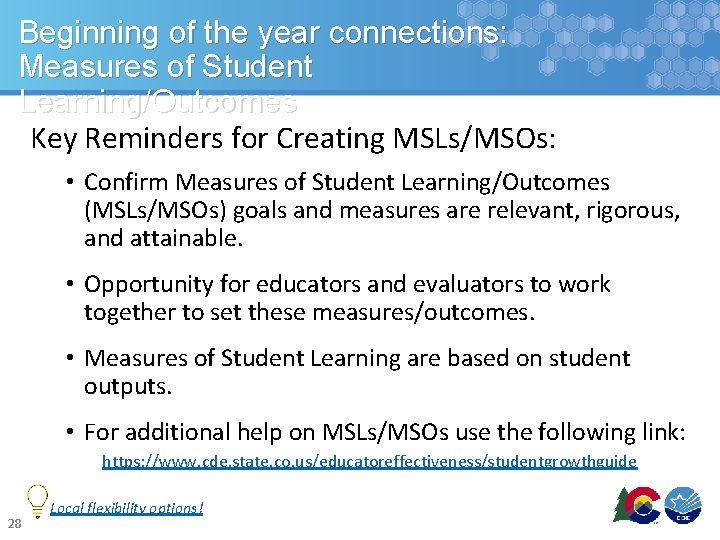
Beginning of the year connections: Measures of Student Learning/Outcomes Key Reminders for Creating MSLs/MSOs: • Confirm Measures of Student Learning/Outcomes (MSLs/MSOs) goals and measures are relevant, rigorous, and attainable. • Opportunity for educators and evaluators to work together to set these measures/outcomes. • Measures of Student Learning are based on student outputs. • For additional help on MSLs/MSOs use the following link: https: //www. cde. state. co. us/educatoreffectiveness/studentgrowthguide 28 Local flexibility options!
Beginning of the year connections: Measures of Student Learning/Outcomes District Logo Provide overview of information related to building level decisions related to the MSLs/MSOs and related processes/practices. Building level decisions on MSLs/MSOs include: 29
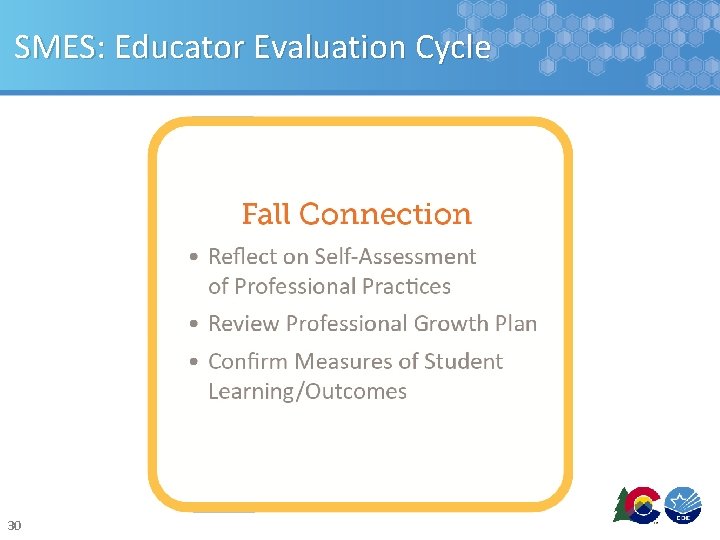
SMES: Educator Evaluation Cycle 30
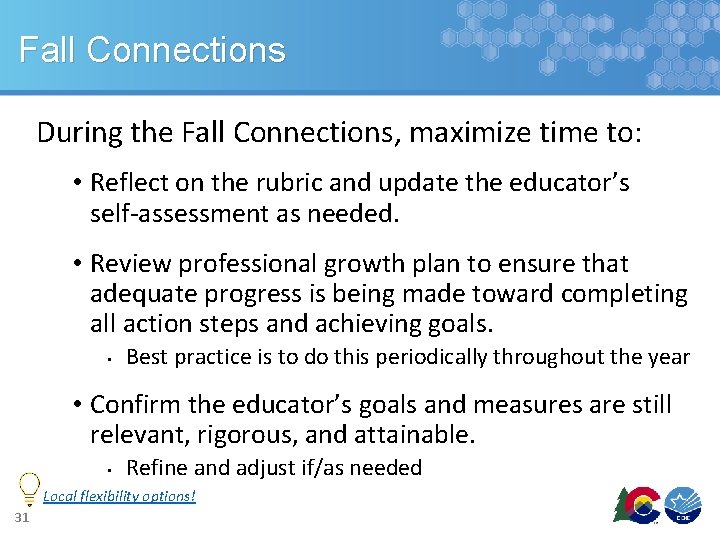
Fall Connections During the Fall Connections, maximize time to: • Reflect on the rubric and update the educator’s self-assessment as needed. • Review professional growth plan to ensure that adequate progress is being made toward completing all action steps and achieving goals. • Best practice is to do this periodically throughout the year • Confirm the educator’s goals and measures are still relevant, rigorous, and attainable. • Refine and adjust if/as needed Local flexibility options! 31
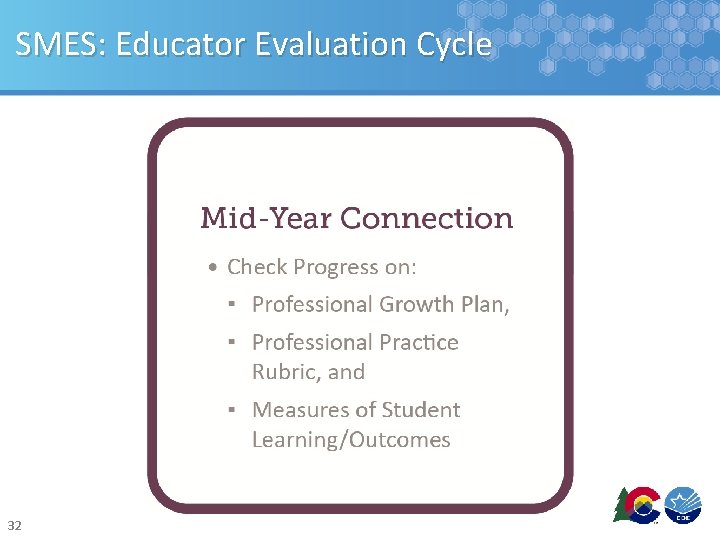
SMES: Educator Evaluation Cycle 32
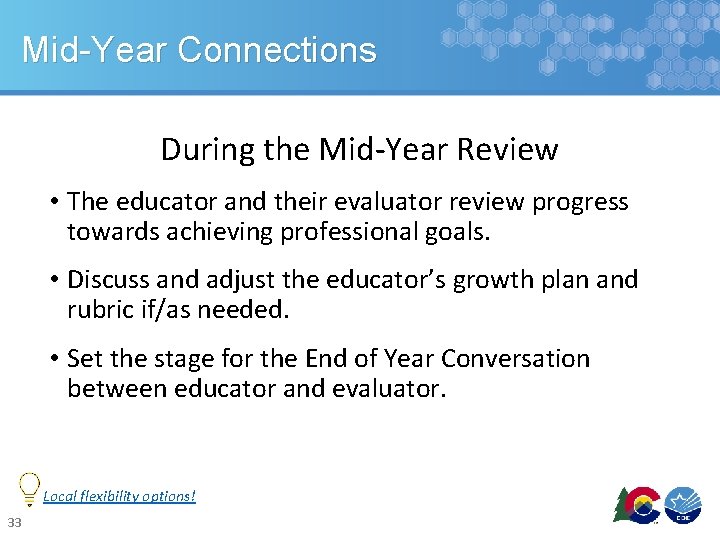
Mid-Year Connections During the Mid-Year Review • The educator and their evaluator review progress towards achieving professional goals. • Discuss and adjust the educator’s growth plan and rubric if/as needed. • Set the stage for the End of Year Conversation between educator and evaluator. Local flexibility options! 33
Mid-Year Connections District Logo Provide overview of information related to building-level decisions related to the Mid-Year Review and related processes/practices. Mid-Year Reviews in our building include: • . 34
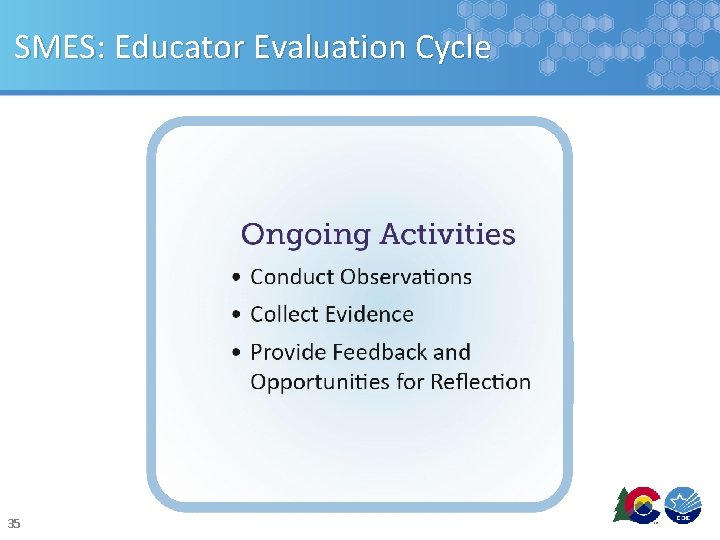
SMES: Educator Evaluation Cycle 35
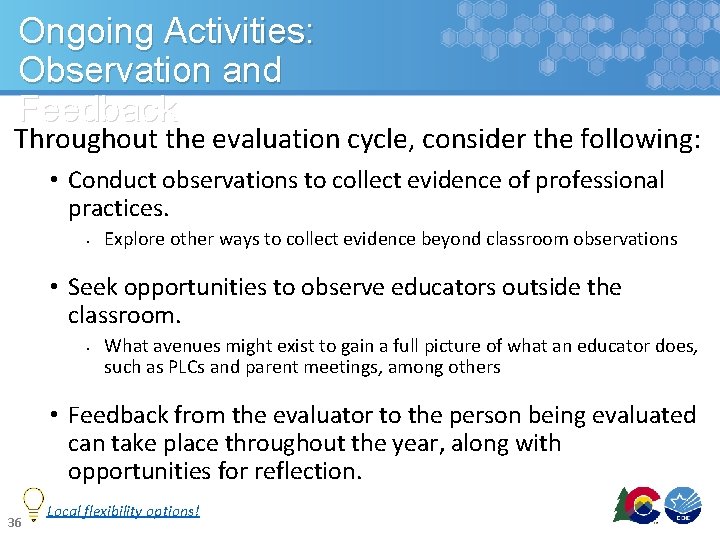
Ongoing Activities: Observation and Feedback Throughout the evaluation cycle, consider the following: • Conduct observations to collect evidence of professional practices. • Explore other ways to collect evidence beyond classroom observations • Seek opportunities to observe educators outside the classroom. • What avenues might exist to gain a full picture of what an educator does, such as PLCs and parent meetings, among others • Feedback from the evaluator to the person being evaluated can take place throughout the year, along with opportunities for reflection. 36 Local flexibility options!
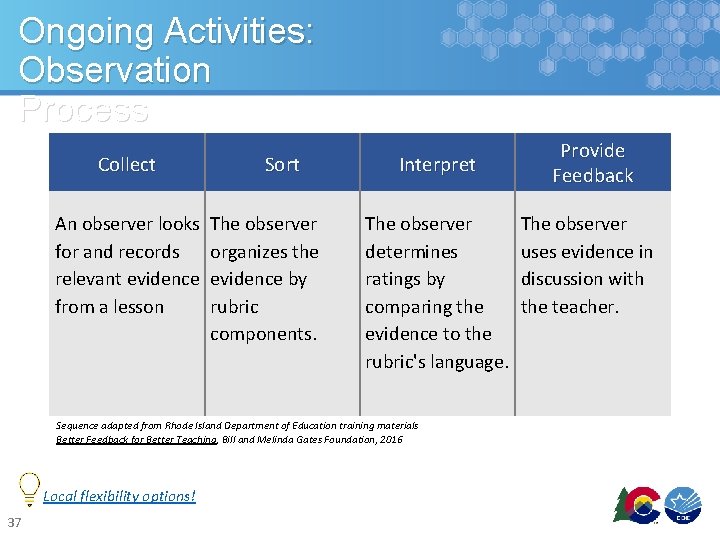
Ongoing Activities: Observation Process Collect An observer looks for and records relevant evidence from a lesson Sort The observer organizes the evidence by rubric components. Interpret The observer determines ratings by comparing the evidence to the rubric's language. Sequence adapted from Rhode Island Department of Education training materials Better Feedback for Better Teaching, Bill and Melinda Gates Foundation, 2016 Local flexibility options! 37 Provide Feedback The observer uses evidence in discussion with the teacher.
Ongoing Activities: Observation and Feedback District Logo District level decisions on observation and feedback In our district, this looks like… • 38
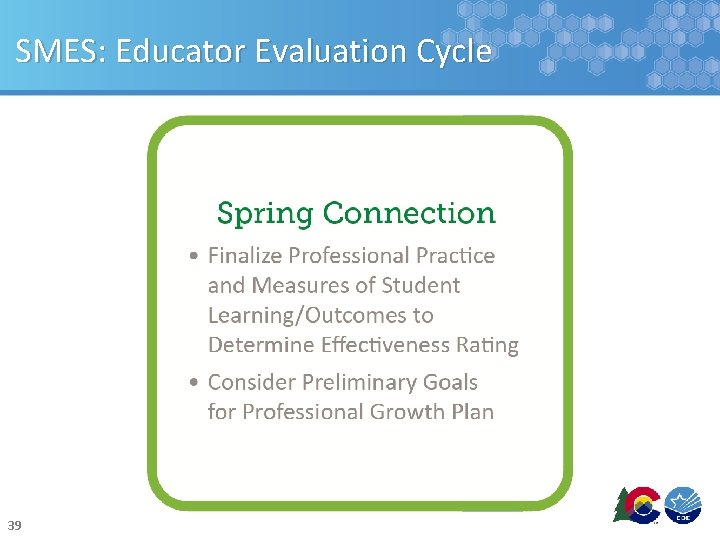
SMES: Educator Evaluation Cycle 39
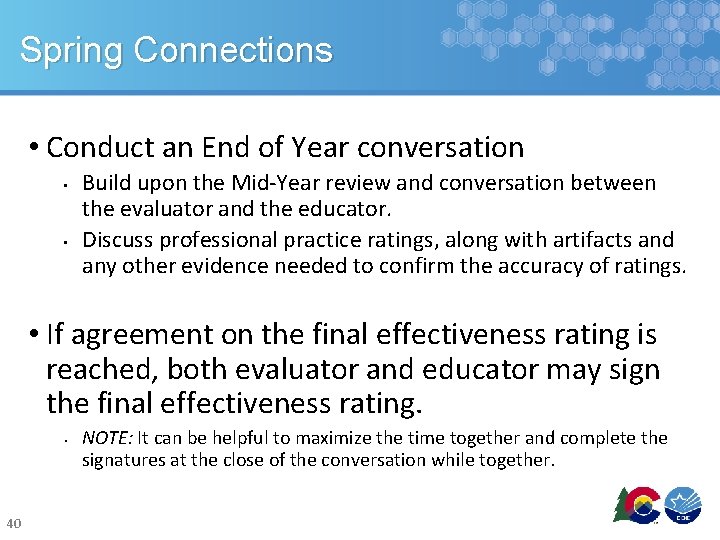
Spring Connections • Conduct an End of Year conversation • • Build upon the Mid-Year review and conversation between the evaluator and the educator. Discuss professional practice ratings, along with artifacts and any other evidence needed to confirm the accuracy of ratings. • If agreement on the final effectiveness rating is reached, both evaluator and educator may sign the final effectiveness rating. • 40 NOTE: It can be helpful to maximize the time together and complete the signatures at the close of the conversation while together.
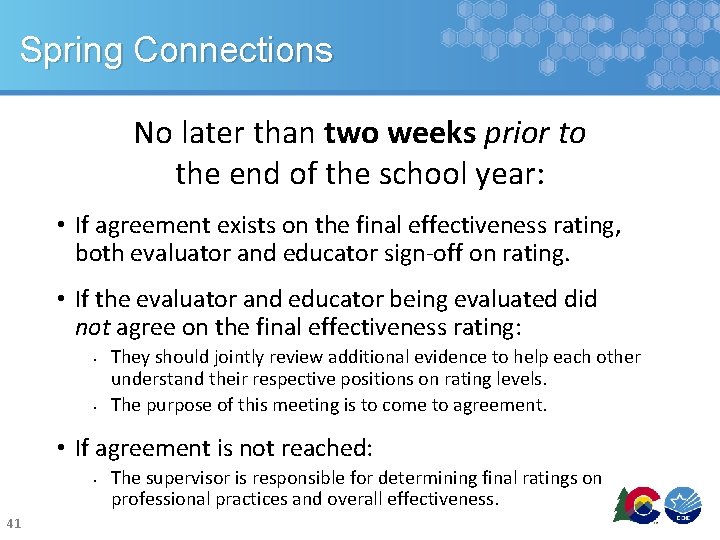
Spring Connections No later than two weeks prior to the end of the school year: • If agreement exists on the final effectiveness rating, both evaluator and educator sign-off on rating. • If the evaluator and educator being evaluated did not agree on the final effectiveness rating: • • They should jointly review additional evidence to help each other understand their respective positions on rating levels. The purpose of this meeting is to come to agreement. • If agreement is not reached: • 41 The supervisor is responsible for determining final ratings on professional practices and overall effectiveness.
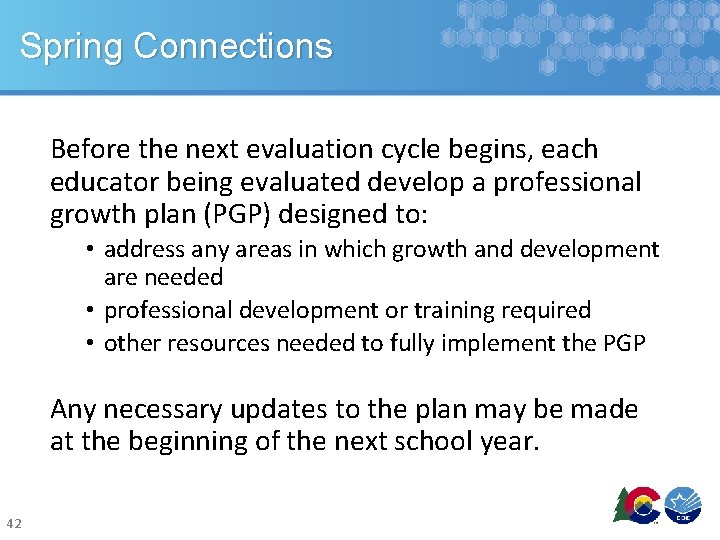
Spring Connections Before the next evaluation cycle begins, each educator being evaluated develop a professional growth plan (PGP) designed to: • address any areas in which growth and development are needed • professional development or training required • other resources needed to fully implement the PGP Any necessary updates to the plan may be made at the beginning of the next school year. 42
Spring Connections in our district Include district level decisions for: • finalizing the evaluation assessment/rubric • finalizing MSL/MSOs • completing the current goals and using that information to plan goals for the next year 43 District Logo
Support Contact Information 44
District/Building Contacts and Resources District Logo Colorado Performance Management System (COPMS) through RANDA: • Login Support through our District Local Access Manager (LAM) • Include name(s) and email address(es) • System support through RANDA copms@cde. state. co. us • Additional Building contacts and resources • • • 45 Include name(s) and email address(es)
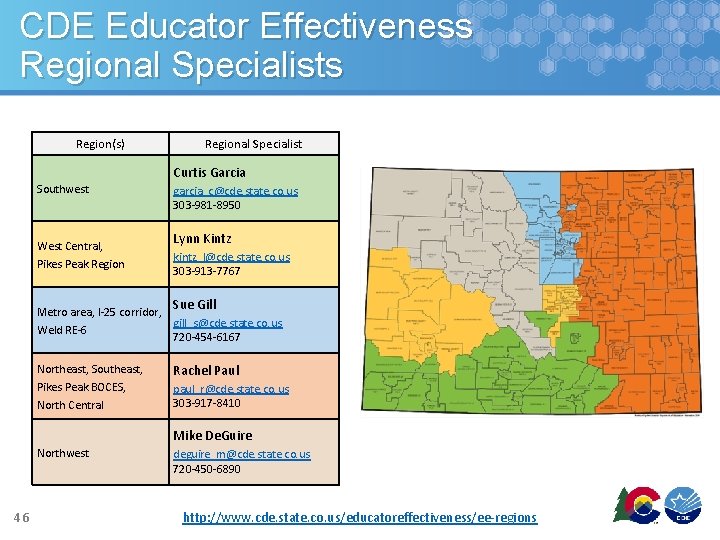
CDE Educator Effectiveness Regional Specialists Region(s) Regional Specialist Curtis Garcia Southwest West Central, Pikes Peak Region garcia_c@cde. state. co. us 303 -981 -8950 Lynn Kintz kintz_l@cde. state. co. us 303 -913 -7767 Sue Gill Metro area, I-25 corridor, gill_s@cde. state. co. us Weld RE-6 720 -454 -6167 Northeast, Southeast, Rachel Paul Pikes Peak BOCES, North Central paul_r@cde. state. co. us 303 -917 -8410 Mike De. Guire Northwest 46 deguire_m@cde. state. co. us 720 -450 -6890 http: //www. cde. state. co. us/educatoreffectiveness/ee-regions