
Falcon Focus EQ What is the relationship between
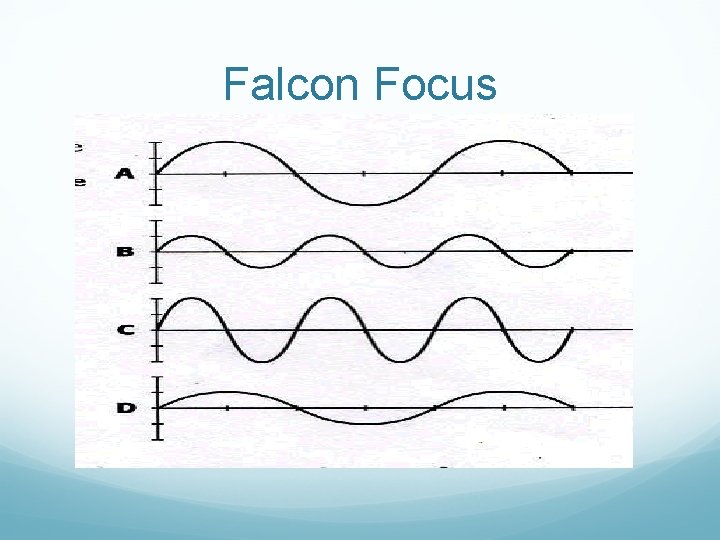
Falcon Focus
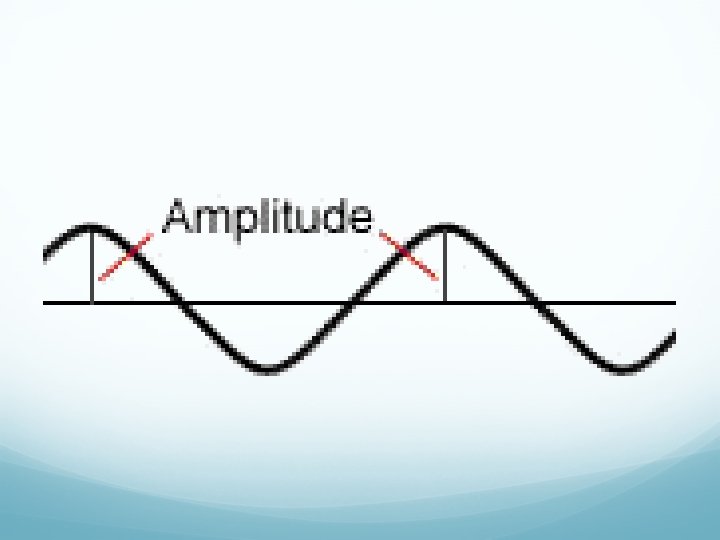
EQ What is the relationship between the following? frequency & wavelength frequency & speed wavelength & energy amplitude & pitch
EQ What are the six behaviors of waves? What is the difference between reflection and refraction?
BEHAVIOR OF WAVES Standard 8. P. 3 The student will demonstrate an understanding of the properties and behaviors of waves. Performance Indicator 8. P. 3 A. 3 Analyze and interpret data to describe the behavior of waves (including refraction, reflection, transmission, and absorption) as they interact with various materials.
OBJECTIVE LEARN THE DIFFERENCE BETWEEN THE BEHAVIOR OF WAVES
BEHAVIOR OF WAVES Standard 8. P. 3 Students will demonstrate an understanding of the properties and behaviors of waves. Performance Indicator 8. P. 3 A. 3 Analyze and interpret data to describe the behavior of waves (including refraction, reflection, transmission, and absorption) as they interact with various materials.
BEHAVIOR OF WAVES 1. REFLECTION 2. REFRACTION 3. DIFFRACTION 4. TRANSMISSION (TRANSPARENT, TRANSLUCENT, & OPAQUE) 5. ABSORPTION 6. CONSTRUCTIVE INTERFERENCE 7. DESTRUCTIVE INTERFERENCE
REFLECTION
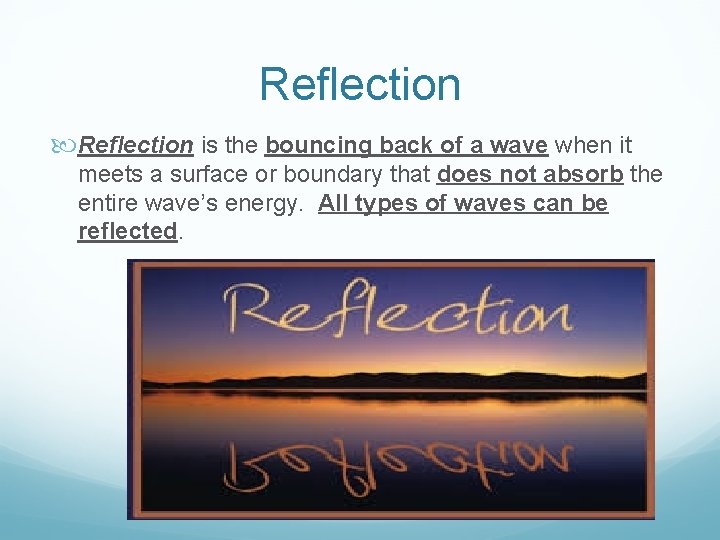
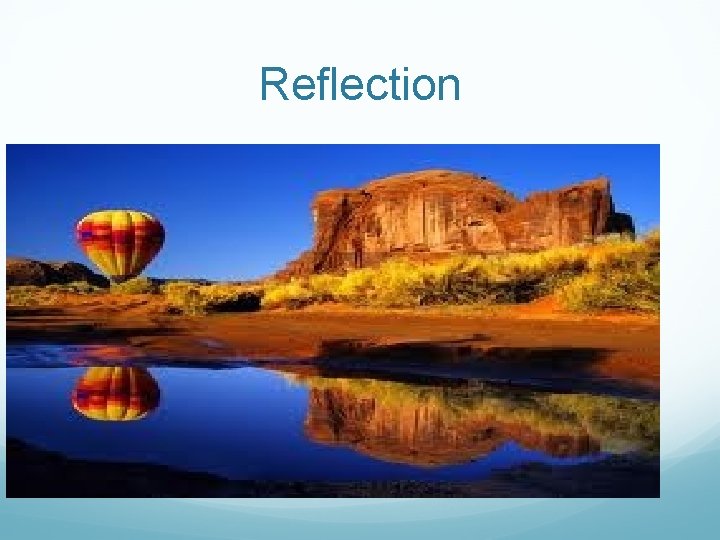
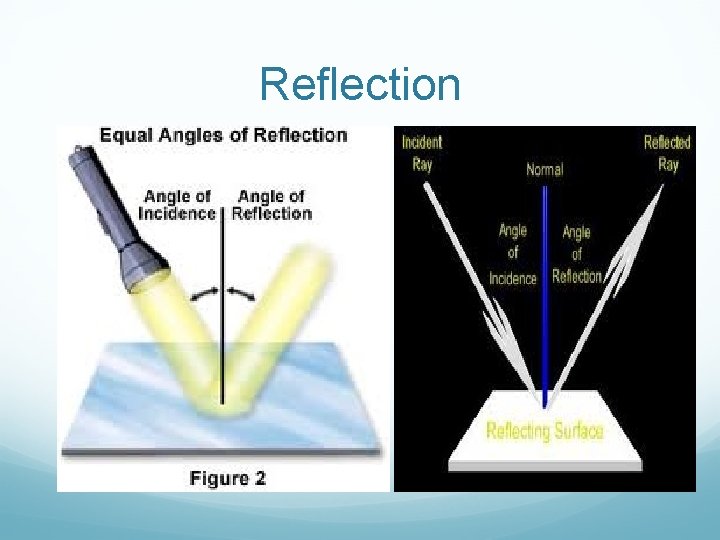
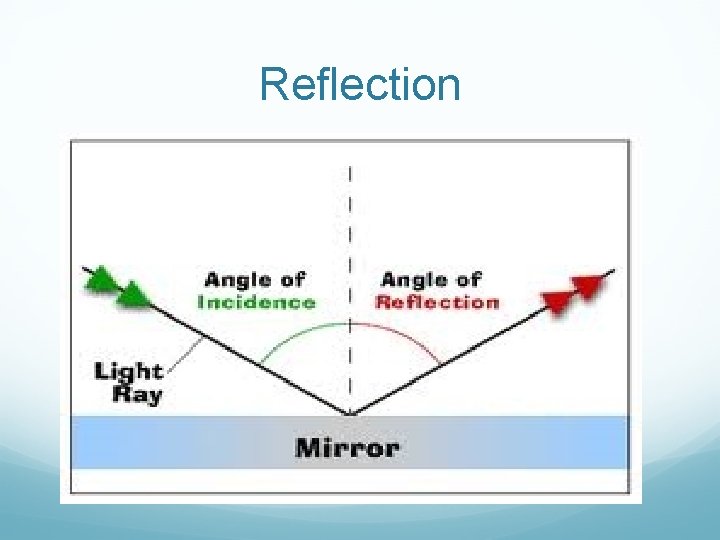
Reflection is the bouncing back of a wave when it meets a surface or boundary that does not absorb the entire wave’s energy. All types of waves can be reflected.
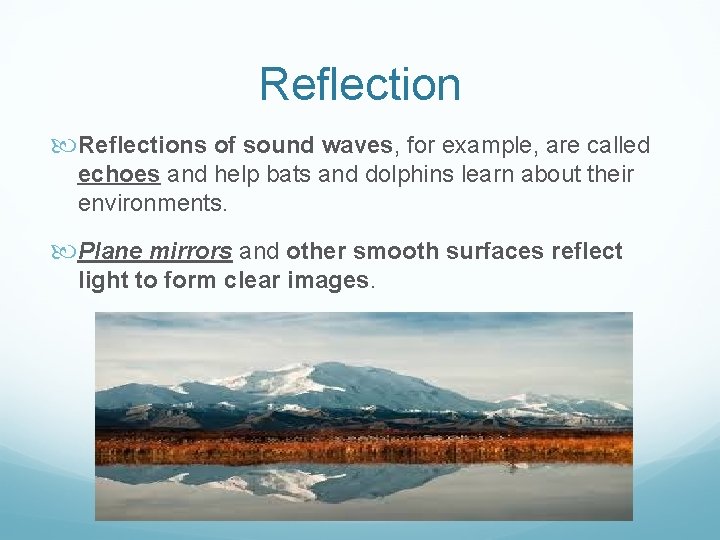
Reflections of sound waves, for example, are called echoes and help bats and dolphins learn about their environments. Plane mirrors and other smooth surfaces reflect light to form clear images.
Examples Plane Mirror , The color of an object & Echo, Echolocation, Waves Bouncing off cliffs, ball bouncing from the wall
ECHOLOCATION Echolocation is the use of sound waves and echoes to determine where objects are in space. BATS, HUMANS, DOLPHINS
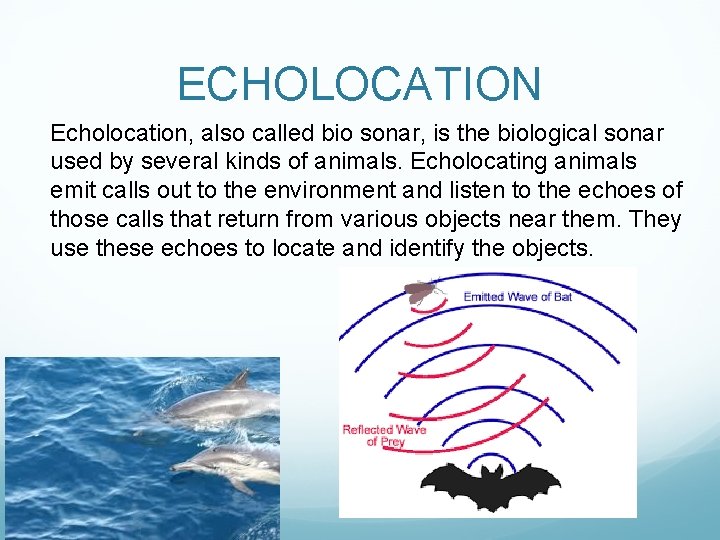
ECHOLOCATION Echolocation, also called bio sonar, is the biological sonar used by several kinds of animals. Echolocating animals emit calls out to the environment and listen to the echoes of those calls that return from various objects near them. They use these echoes to locate and identify the objects.
Reflection
Reflection
Reflection
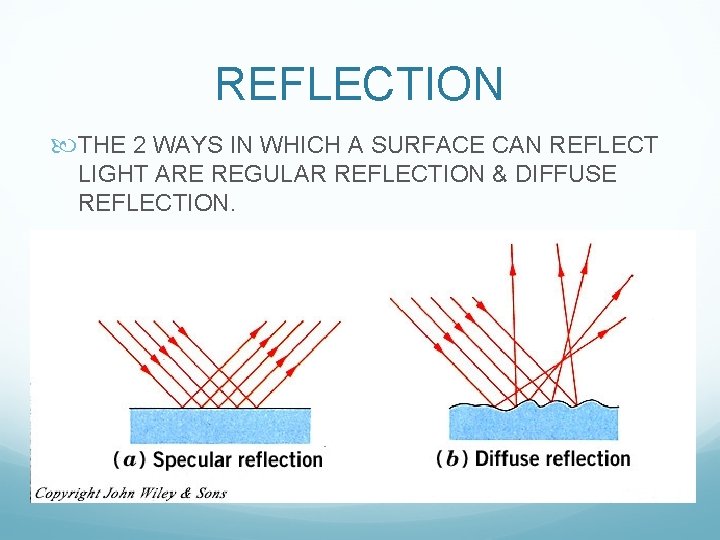
REFLECTION THE 2 WAYS IN WHICH A SURFACE CAN REFLECT LIGHT ARE REGULAR REFLECTION & DIFFUSE REFLECTION.
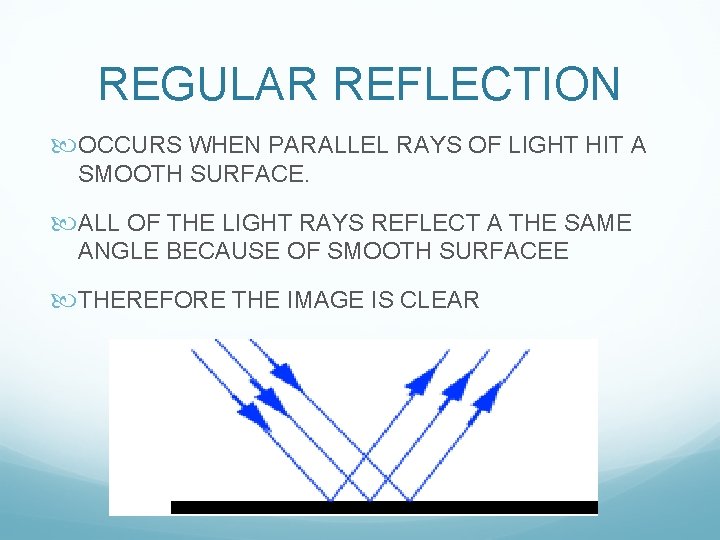
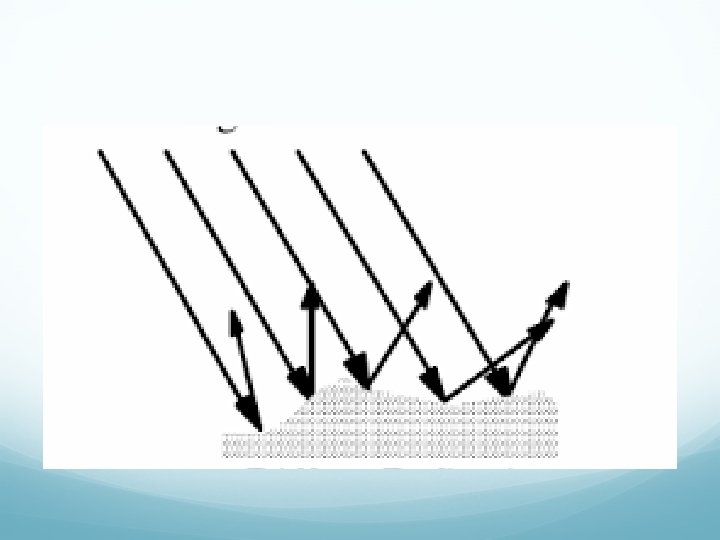
REGULAR REFLECTION OCCURS WHEN PARALLEL RAYS OF LIGHT HIT A SMOOTH SURFACE. ALL OF THE LIGHT RAYS REFLECT A THE SAME ANGLE BECAUSE OF SMOOTH SURFACEE THEREFORE THE IMAGE IS CLEAR
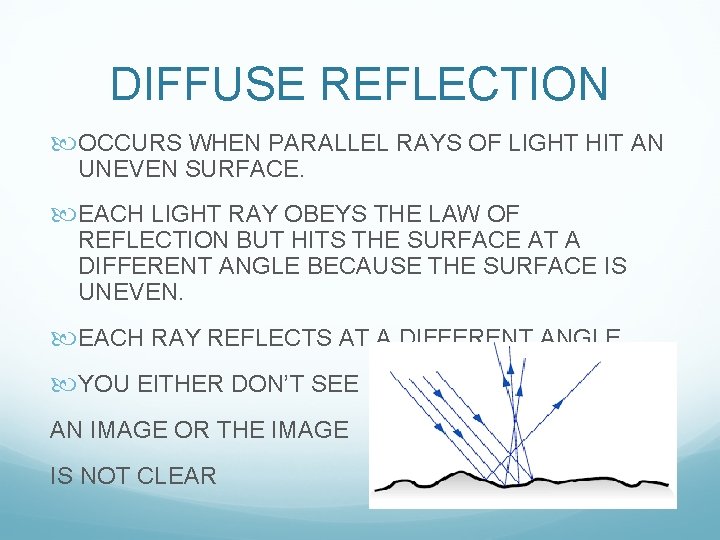
DIFFUSE REFLECTION OCCURS WHEN PARALLEL RAYS OF LIGHT HIT AN UNEVEN SURFACE. EACH LIGHT RAY OBEYS THE LAW OF REFLECTION BUT HITS THE SURFACE AT A DIFFERENT ANGLE BECAUSE THE SURFACE IS UNEVEN. EACH RAY REFLECTS AT A DIFFERENT ANGLE YOU EITHER DON’T SEE AN IMAGE OR THE IMAGE IS NOT CLEAR
TYPES OF MIRRORS & IMAGES MIRRORS: PLANE MIRROR CONCAVE MIRROR CONVEX MIRROR IMAGES: VIRTUAL REAL
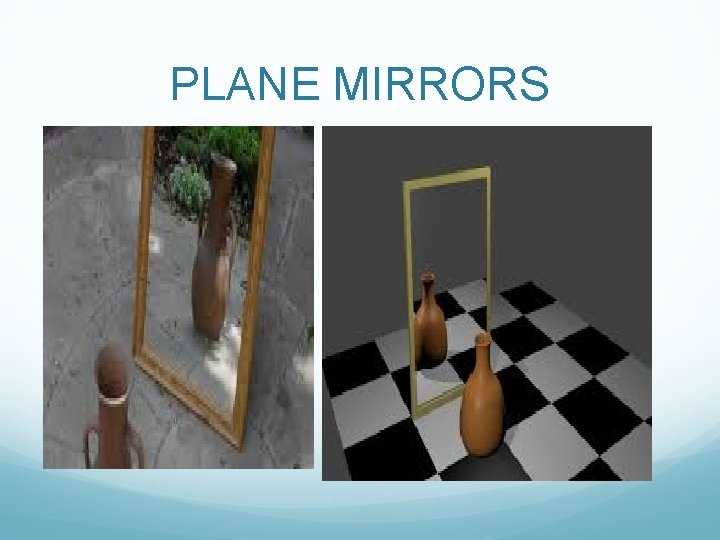
PLANE MIRRORS A FLAT SHEET OF GLASS THAT HAS A SMOOTH, SILVERCOLORED COATING ON ONE SIDE. PRODUCES A CLEAR, VIRTUAL, AND UPRIGHT IMAGE THAT IS THE SAME SIZE AS THE OBJECT. THE IMAGE YOU SEE IN A PLANE MIRROR IS AN VIRTUAL IMAGE: AN IMAGE THAT FORMS WHERE LIGHT SEES TO COME FROM. (VIRTUAL DESCRIBES SOMETHING THAT DOES NOT REALLY EXIST. )- THE OBJECT IS BETWEEN THE MIRROR AND FOCAL POINT. YOUR IMAGE APPEARS TO BE BEHIND THE MIRROR, BUT YOU CAN’T REACH BEHIND THE MIRROR AND TOUCH IT.
PLANE MIRRORS
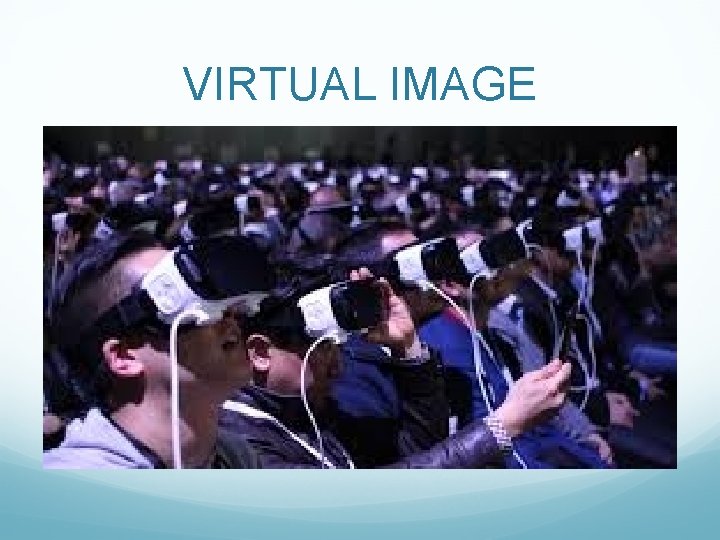
VIRTUAL IMAGE
CONCAVE MIRROR A MIRROR WITH A SURFACE THAT CURVES INWARD LIKE THE INSIDE OF A BOWL CAN REFLECT PARALLEL RAYS OF LIGHT SO THAT THEY MEET AT A POINT (FOCAL POINT) CAN PRODUCE REAL OR VIRTUAL IMAGES REAL IMAGES: FORMS WHEN LIGHT RAYS ACTUALLY MEET. THE OBJECT IS FATHER AWAY FROM THE MIRROR THAN THE FOCAL POINT.
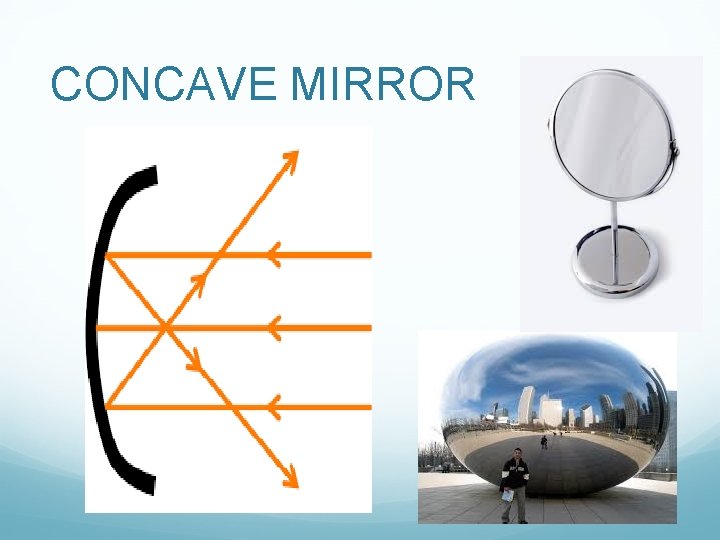
CONCAVE MIRROR
CONVEX MIRROR A MIRROR WITH A SURFACE THAT CURVES OUTWARD REFLECT PARALLEL RAYS OF LIGHT THAT SPREADS OUT BUT APPEARS TO COME FROM A FOCAL POINT BEHIND THE MIRROR. PRODUCES A VIRTUAL IMAGE THAT IS ALWAYS SMALLER THAN THE OBJECT ALLOWS YOU TO SEE A LARGER AREA
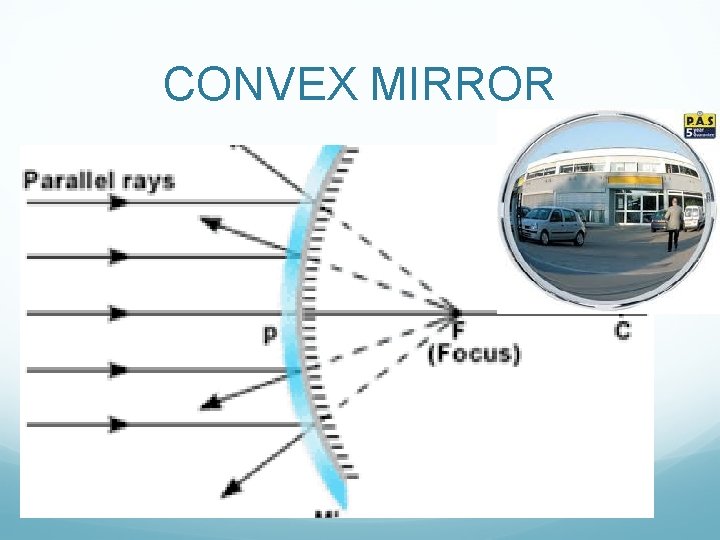
CONVEX MIRROR
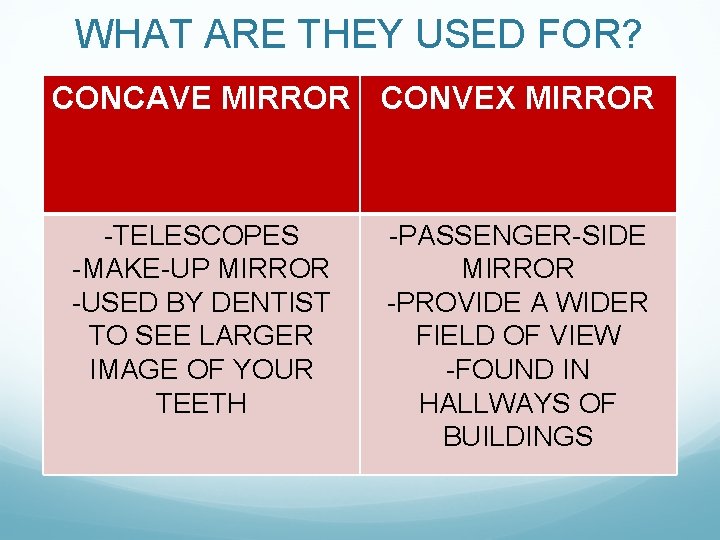
WHAT ARE THEY USED FOR? CONCAVE MIRROR CONVEX MIRROR -TELESCOPES -MAKE-UP MIRROR -USED BY DENTIST TO SEE LARGER IMAGE OF YOUR TEETH -PASSENGER-SIDE MIRROR -PROVIDE A WIDER FIELD OF VIEW -FOUND IN HALLWAYS OF BUILDINGS
STATION SLINKY MIRRORS
REFRACTION
Refraction is the bending of waves caused by a change in their speed as they pass from one medium to another. As waves pass at an angle from one medium to another, they may speed up or slow down. The greater the change in speed of the waves, the more the waves will bend. Refraction of light going from air through a convex lens, for example, can make images appear larger as the light waves bend.
EXAMPLE SKATEBOARD GOING FROM THE SIDEWALK TO THE GRASS. WHAT WILL HAPPEN? HOW WOULD YOU COMPARE THAT TO A MEDIUM? WHEN A WAVE ENTERS A NEW MEDIUM AT AN ANGLE, ONE SIDE OF THE WAVE CHANGES SPEED BEFORE THE OTHER SIDE WHICH CAUSES THE WAVE TO BEND.
Examples: Prism, Magnifying Glass, Convex lenses, Glasses, Drop of water on letters, Rainbow, Anything that is being magnified
Station PENCIL IN A GLASS OF WATER HOW DOES THIS DEMONSTRATE REFRACTION?
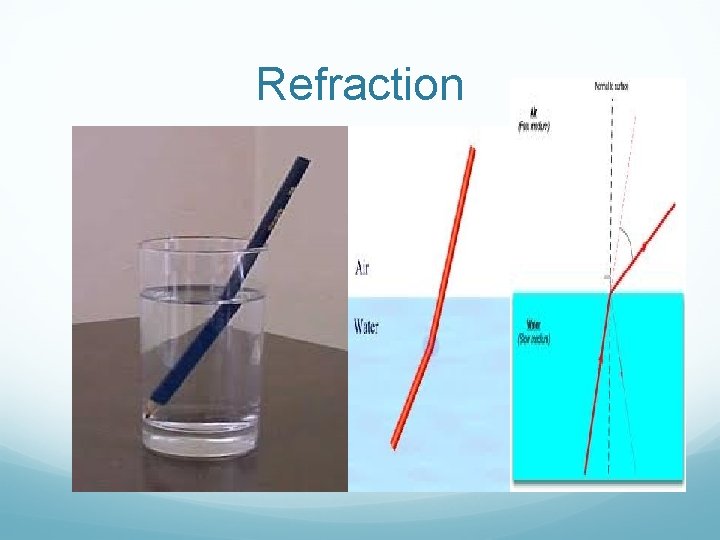
Refraction
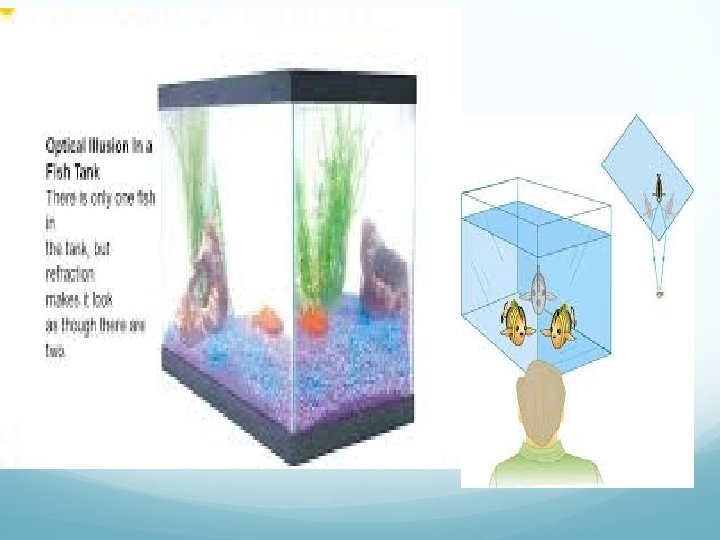
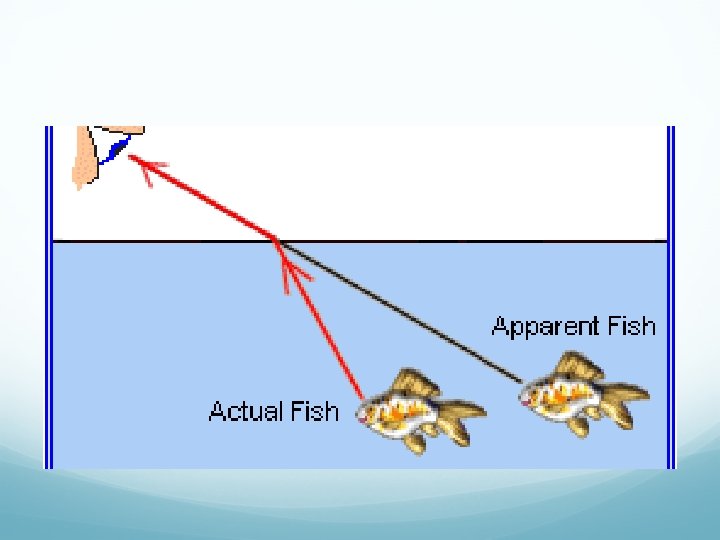
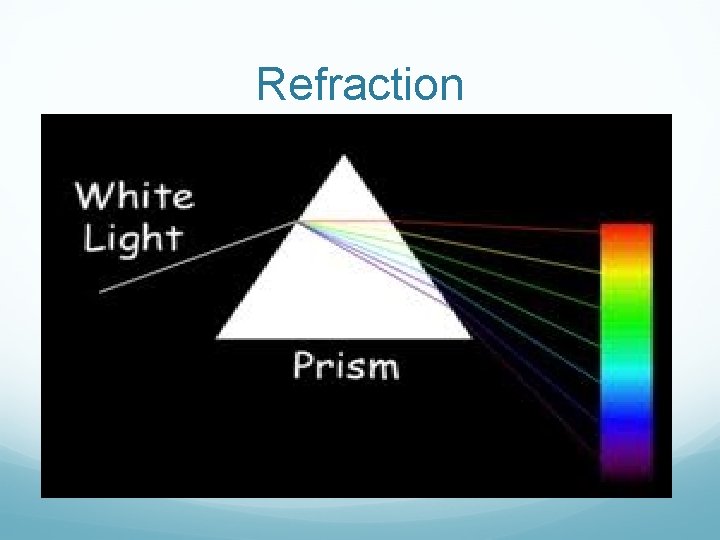
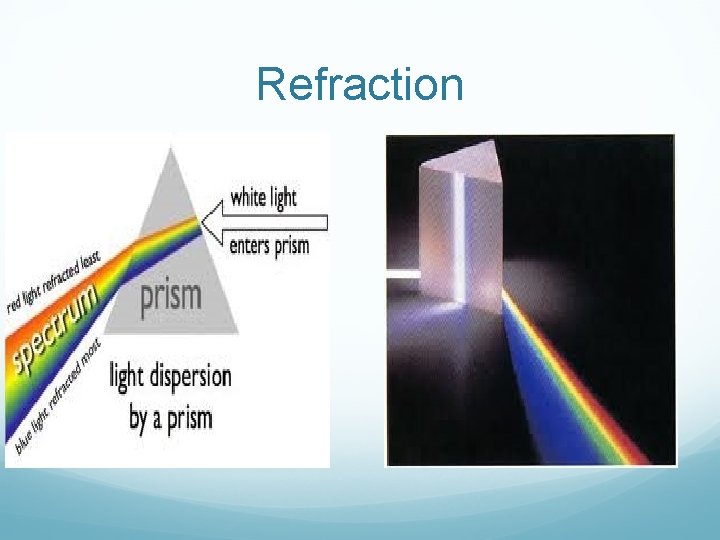
Refraction Prisms or diffraction gratings separate white light into its different components or colors by bending the light at different angles depending on the frequencies of the light passing through the prism or diffraction grating. Different colors of light have different frequencies.
Refraction
Refraction
INDEX OF REFRACTION
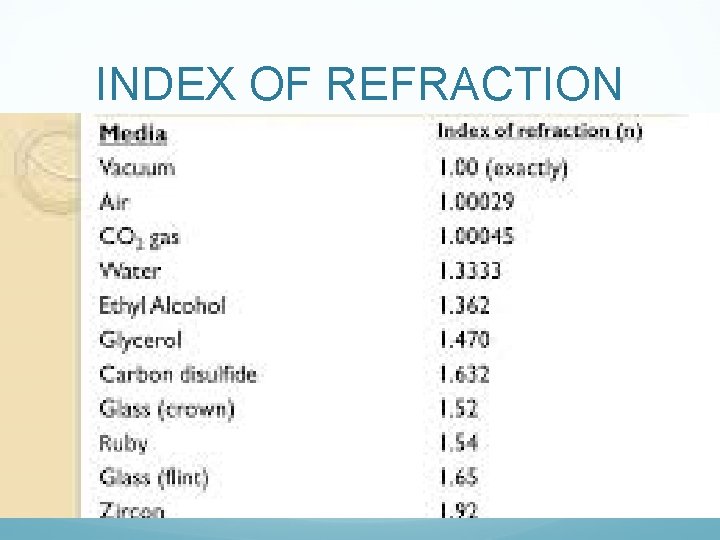
The higher the index of refraction of a medium, the more it bends light. The index of refraction of water is 1. 33. The index of refraction of glass is about 1. 5. So light is bent more by glass than by water.
SOUND SPEED SOUND TRAVELS FASTEST THROUGH A SOLID. ORDER IT TRAVELS FASTEST THROUGH: SOLID/FASTEST LIQUID/SLOWER GAS/ SLOWES
LIGHT SPEED THE SPEED OF LIGHT TRAVELS THE FASTEST IN GAS ORDER IT TRAVELS: GAS/FASTEST WATER/SLOWER SOLID/SLOWEST
REFRACTION & LENSES ANYTIME YOU LOOK THROUGH BINOCULARS, A CAMERA, OR EYEGLASSES, YOU ARE USING LENSES TO BEND LIGHT. THE TYPE OF IMAGE FORMED BY A LENS DEPENDS ON THE SHAPE OF THE LENS AND THE POSITION OF THE OBJECT.
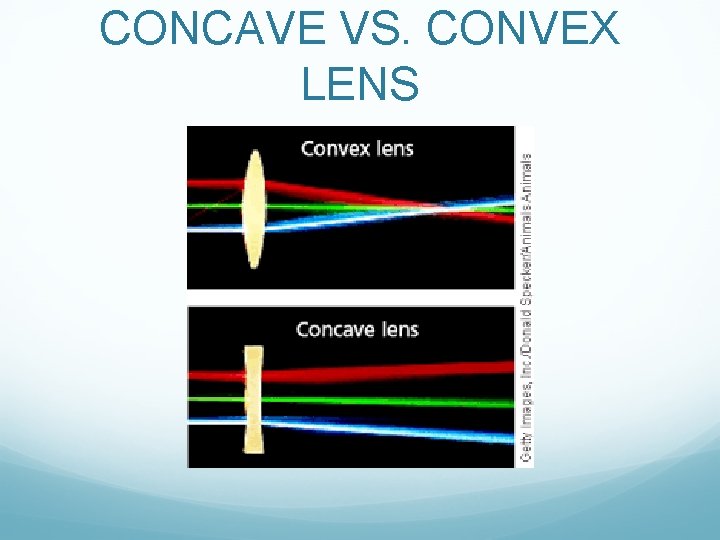
CONCAVE VS. CONVEX LENS
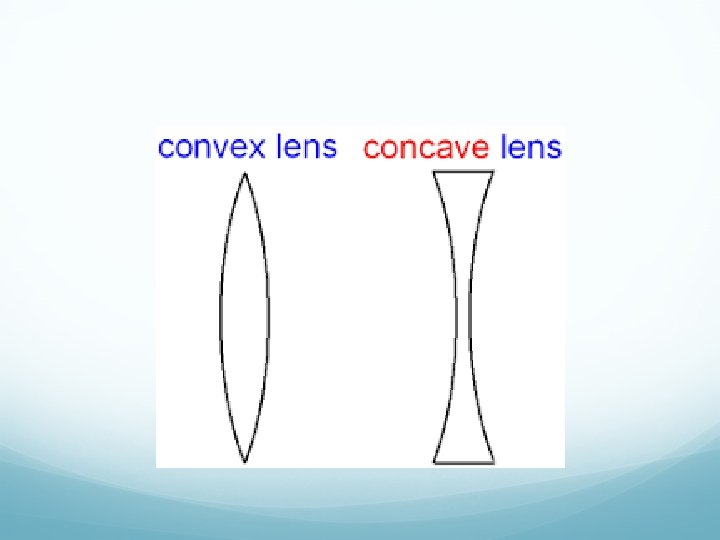
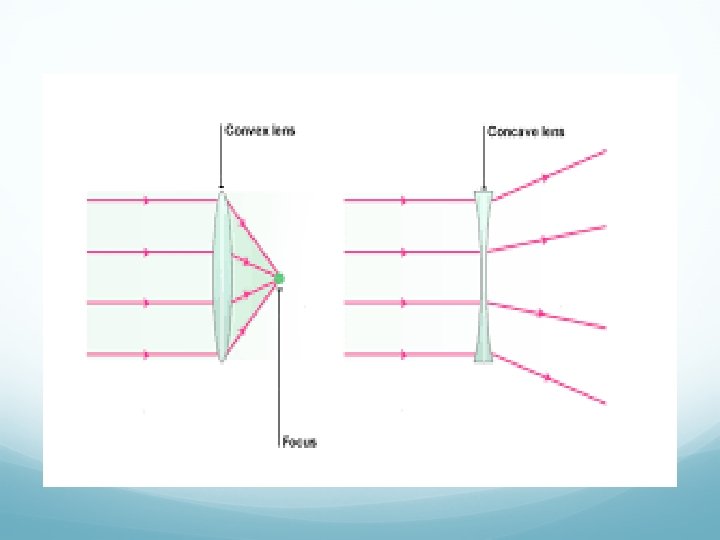
CONCAVE LENS A CONCAVE LENS IS THINNER IN THE CENTER THAN AT THE EDGES. WHEN LIGHT RAYS TRAVELING PARALLEL TO THE OPTICAL AXIS PASS THROUGH A CONCAVE LENS, THEY BEND AWAY FROM THE OPTICAL AXIS AND NEVER MEET. CONCAVE LENS CAN PRODUCE ONLY VIRTUAL IMAGES BECAUSE PARALLEL LIGHT RAYS PASSING THROUGH THE LENS NEVER MEET.
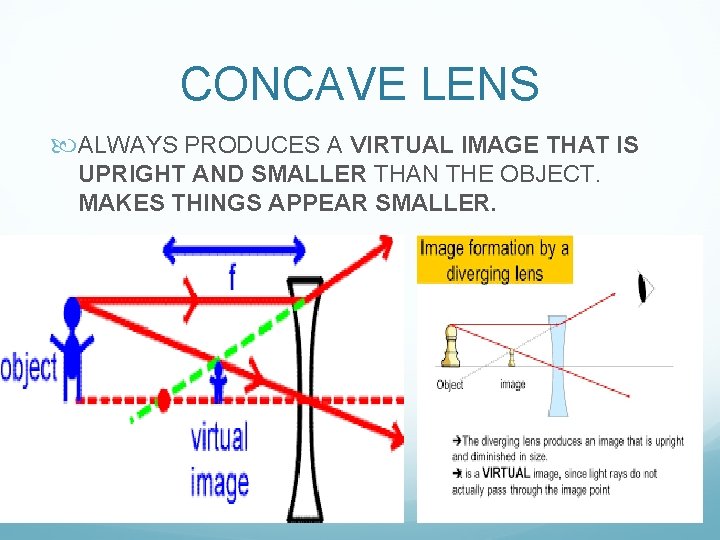
CONCAVE LENS ALWAYS PRODUCES A VIRTUAL IMAGE THAT IS UPRIGHT AND SMALLER THAN THE OBJECT. MAKES THINGS APPEAR SMALLER.
CONVEX LENS A CONVEX LENS IS THICKER IN THE CENTER THAN AT THE EDGES. AS LIGHT RAYS PARALLEL TO THE OPTICAL AXIS PASS THORUGH A CONVEX LENS, THEY ARE BENT TOWARD THE CENTER FO THE LENS. A CONVEX LENS ACTS LIKE A CONCAVE MIRROR, BECAUSE IT FOCUSES RAYS OF LIGHT. CAN FORM A REAL OR VIRTUAL IMAGE
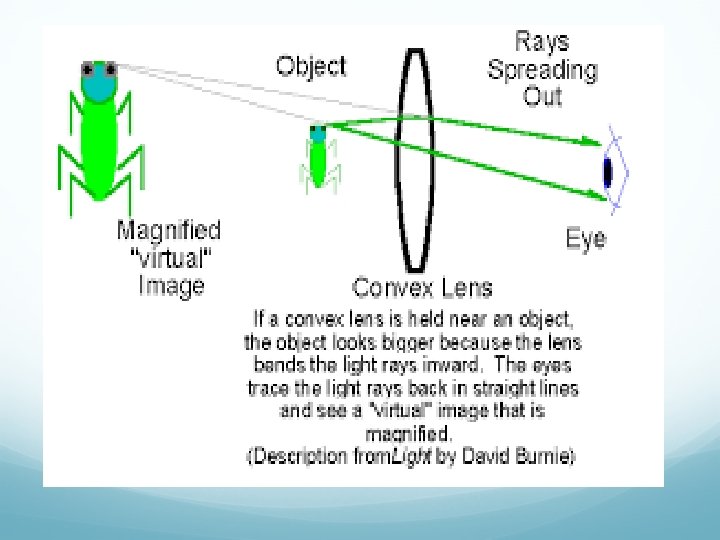
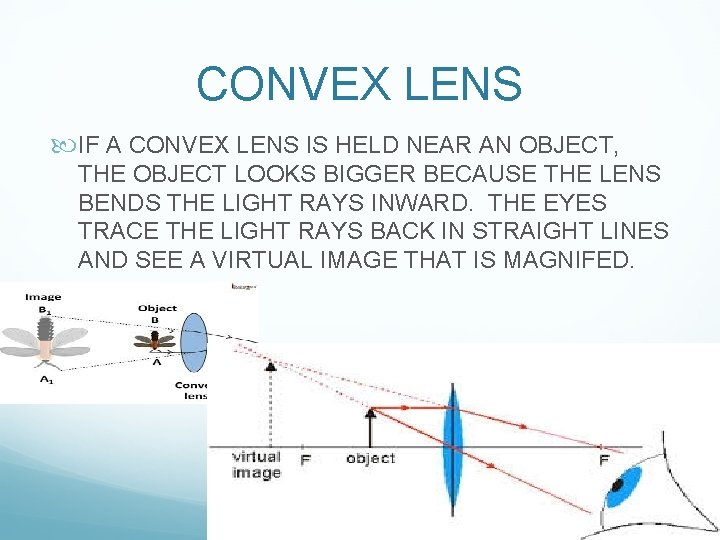
CONVEX LENS IF A CONVEX LENS IS HELD NEAR AN OBJECT, THE OBJECT LOOKS BIGGER BECAUSE THE LENS BENDS THE LIGHT RAYS INWARD. THE EYES TRACE THE LIGHT RAYS BACK IN STRAIGHT LINES AND SEE A VIRTUAL IMAGE THAT IS MAGNIFED.

BRINGING IT ALL TOGETHER
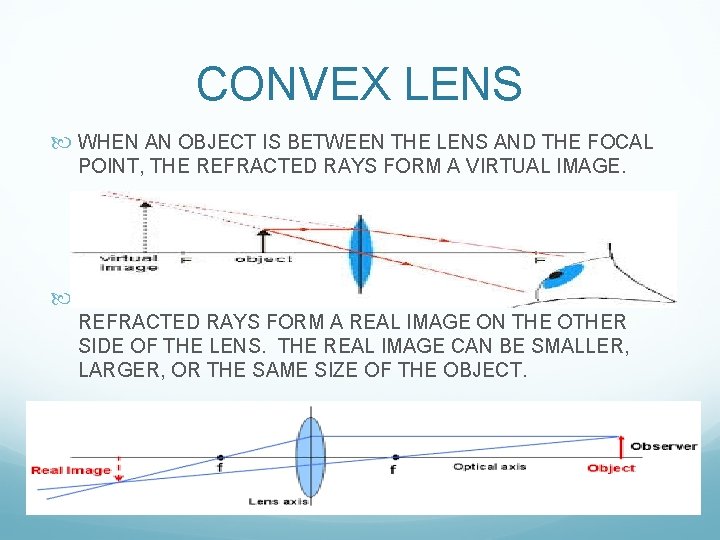
CONVEX LENS WHEN AN OBJECT IS BETWEEN THE LENS AND THE FOCAL POINT, THE REFRACTED RAYS FORM A VIRTUAL IMAGE. IF THE OBJECT IS OUTSIDE THE FOCAL POINT, THE REFRACTED RAYS FORM A REAL IMAGE ON THE OTHER SIDE OF THE LENS. THE REAL IMAGE CAN BE SMALLER, LARGER, OR THE SAME SIZE OF THE OBJECT.
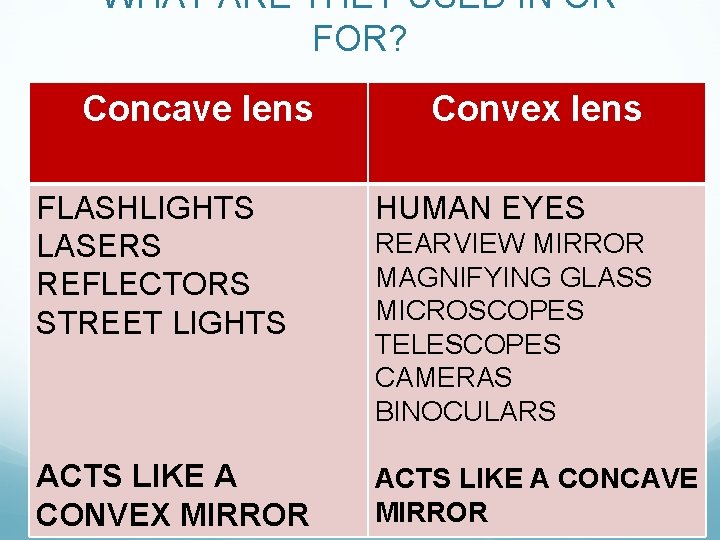
WHAT ARE THEY USED IN OR FOR? Concave lens FLASHLIGHTS LASERS REFLECTORS STREET LIGHTS ACTS LIKE A CONVEX MIRROR Convex lens HUMAN EYES REARVIEW MIRROR MAGNIFYING GLASS MICROSCOPES TELESCOPES CAMERAS BINOCULARS ACTS LIKE A CONCAVE MIRROR
CHECK POINT 1. Name the 4 wave behaviors. 2. Explain refraction. 3. Give 2 examples of refraction. 4. Explain reflection. 5. Give 2 examples of reflection.
DIFFRACTION
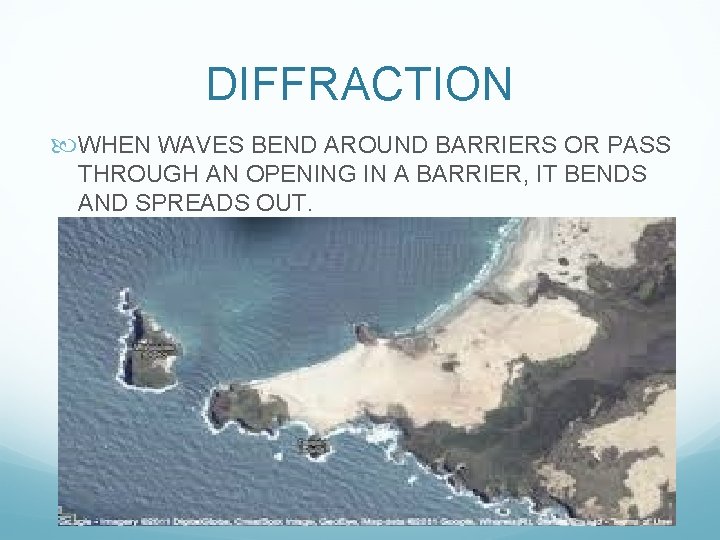
DIFFRACTION WHEN WAVES BEND AROUND BARRIERS OR PASS THROUGH AN OPENING IN A BARRIER, IT BENDS AND SPREADS OUT.
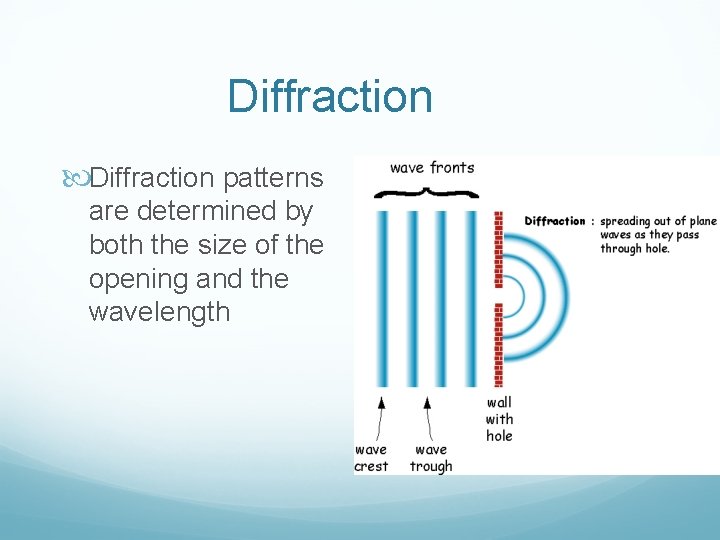
Diffraction patterns are determined by both the size of the opening and the wavelength
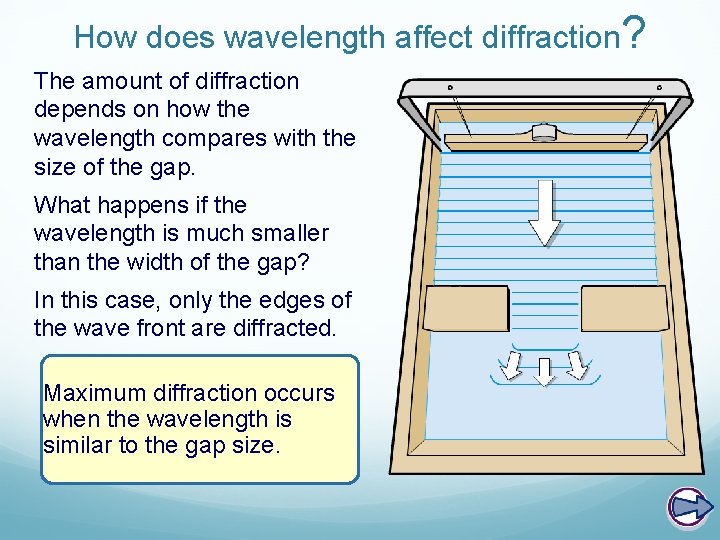
How does wavelength affect diffraction? The amount of diffraction depends on how the wavelength compares with the size of the gap. What happens if the wavelength is much smaller than the width of the gap? In this case, only the edges of the wave front are diffracted. Maximum diffraction occurs when the wavelength is similar to the gap size.
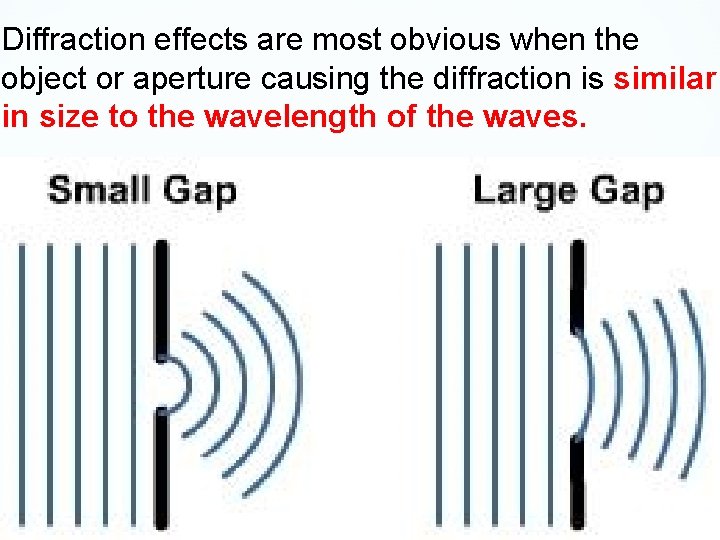
Diffraction effects are most obvious when the object or aperture causing the diffraction is similar in size to the wavelength of the waves.
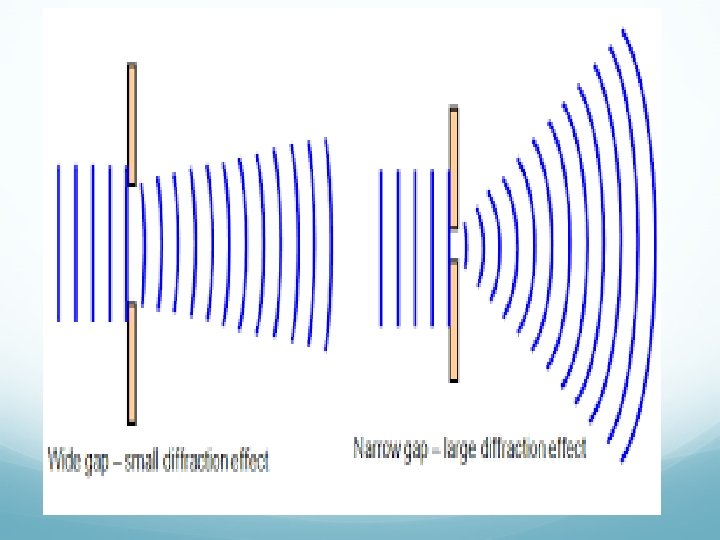
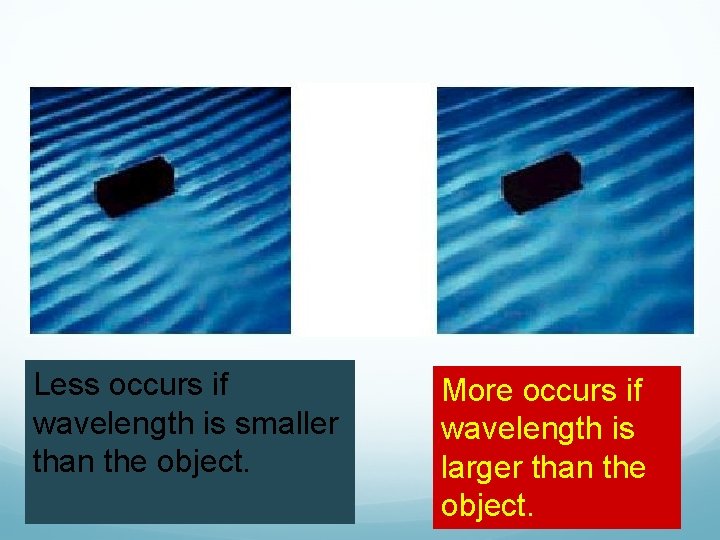
Less occurs if wavelength is smaller than the object. More occurs if wavelength is larger than the object.
The nearer the slit size is to the wavelength, the more the wave will diffract. 1. The smaller the gap the greater the diffraction. 2. The longer the wavelength the greater the diffraction
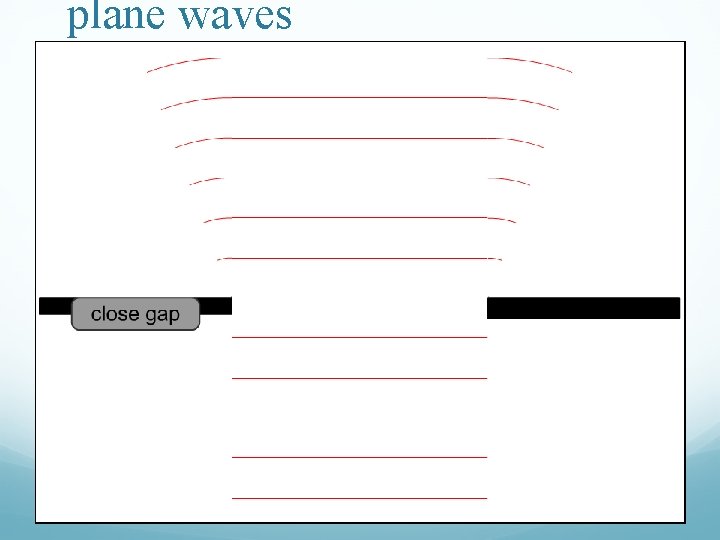
plane waves
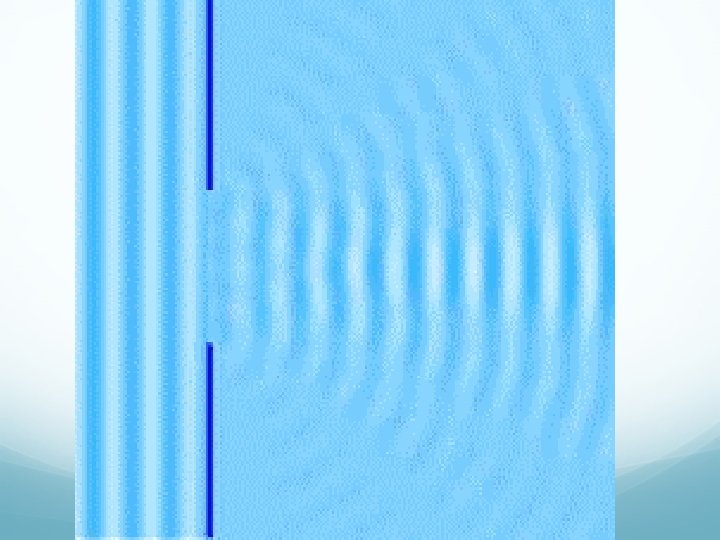
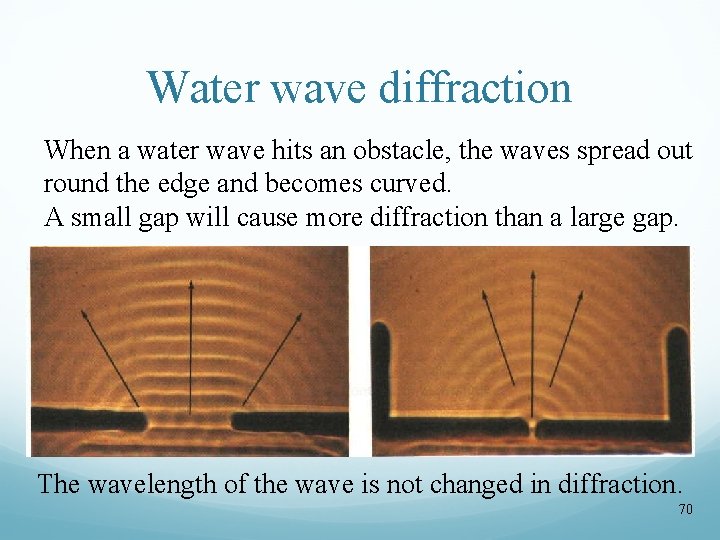
Water wave diffraction When a water wave hits an obstacle, the waves spread out round the edge and becomes curved. A small gap will cause more diffraction than a large gap. The wavelength of the wave is not changed in diffraction. 70
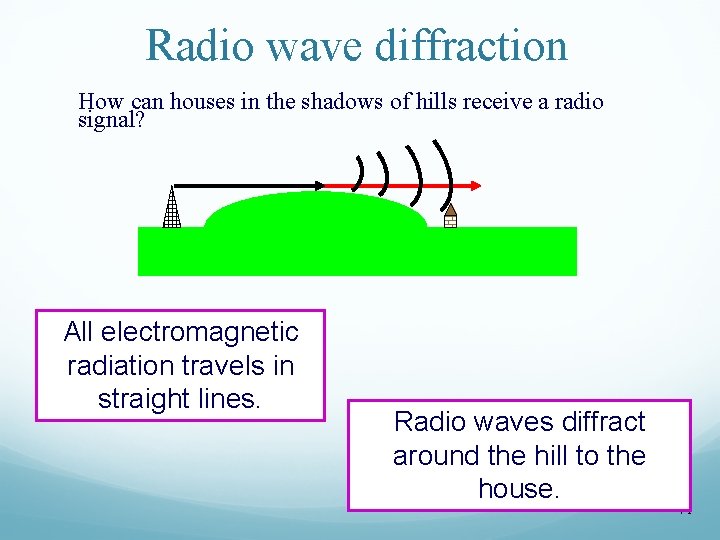
Radio wave diffraction How can houses in the shadows of hills receive a radio signal? All electromagnetic radiation travels in straight lines. Radio waves diffract around the hill to the house. 71
TRANSMISSION
Transmission of waves occurs when waves pass through a given point or medium. Sound waves are transmitted through solids, liquids, and gases.
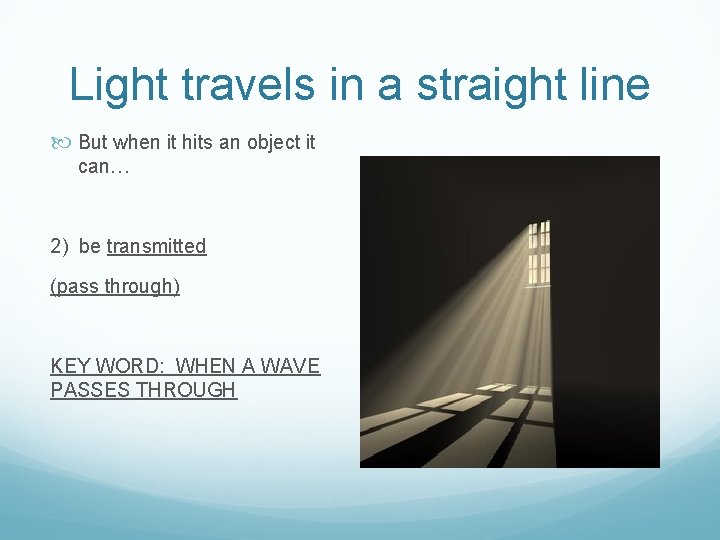
Light travels in a straight line But when it hits an object it can… 2) be transmitted (pass through) KEY WORD: WHEN A WAVE PASSES THROUGH
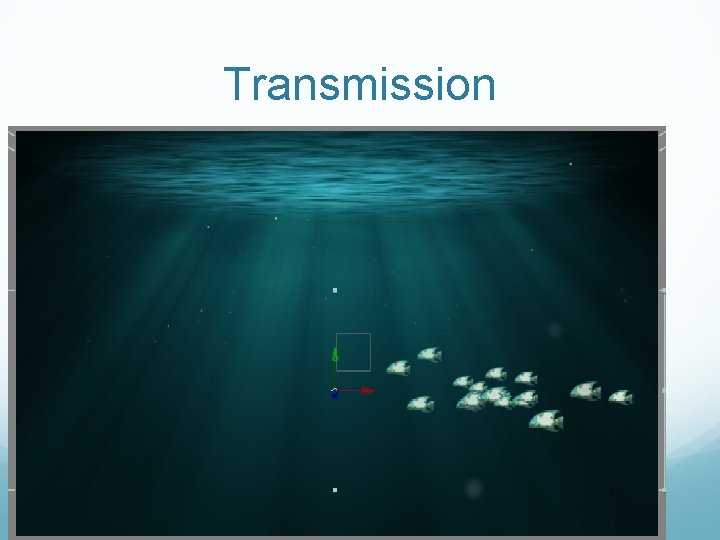
Transmission
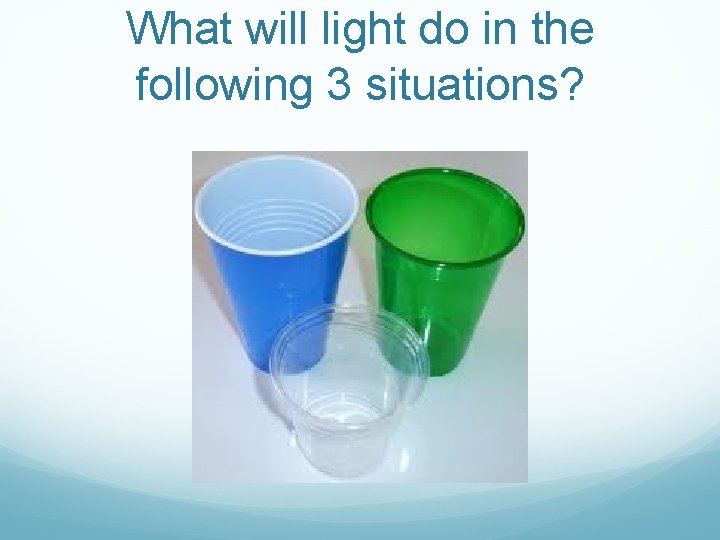
What will light do in the following 3 situations?
Transmission Light waves are transmitted through transparent materials (may be clear or colored material such as filters) that allow most of the light that strikes them to pass through them. Only a small amount of light is reflected or absorbed. Opaque materials allow no light waves to be transmitted through them. Translucent materials transmit some light, but cause it to be scattered so no clear image is seen.
Transparent Items can be classified by the way they interact with light. Materials that allow most all light to pass through them are called transparent. Examples of transparent items are glass, water, and air.
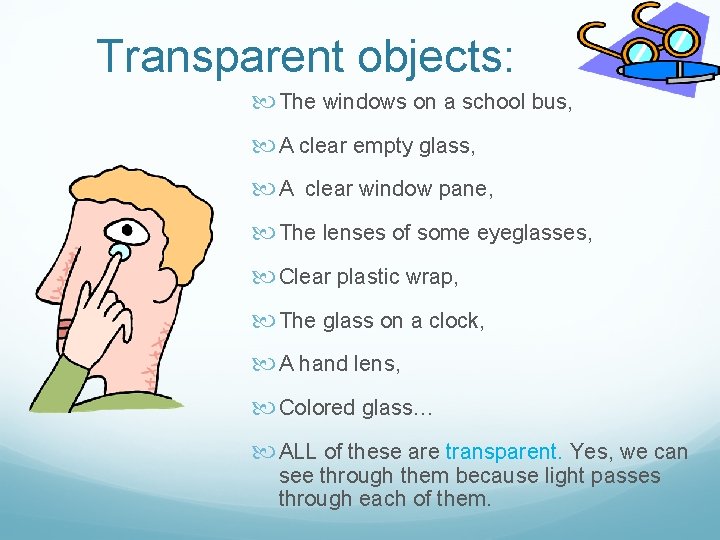
Transparent objects: The windows on a school bus, A clear empty glass, A clear window pane, The lenses of some eyeglasses, Clear plastic wrap, The glass on a clock, A hand lens, Colored glass… ALL of these are transparent. Yes, we can see through them because light passes through each of them.
Translucent Those materials that allow some light to pass through them are called translucent and include things like frosted glass and wax paper.
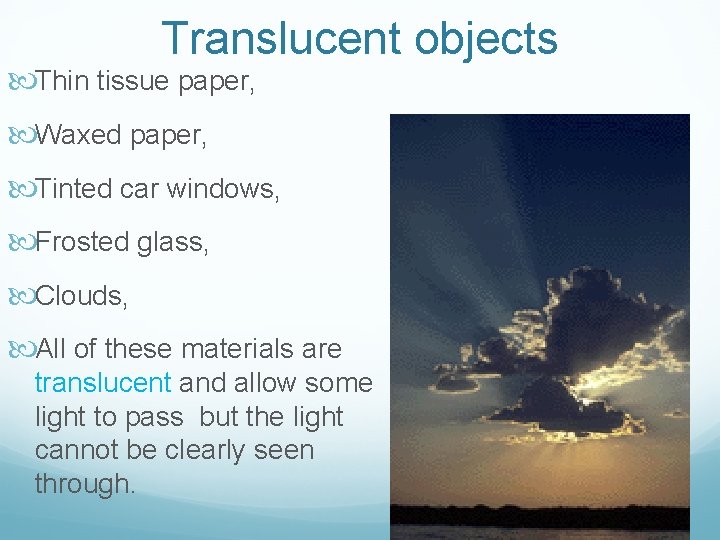
Translucent objects Thin tissue paper, Waxed paper, Tinted car windows, Frosted glass, Clouds, All of these materials are translucent and allow some light to pass but the light cannot be clearly seen through.
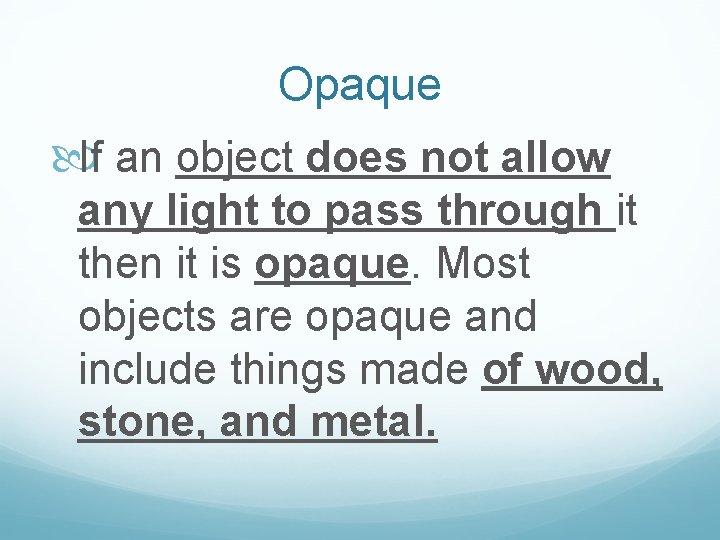
Opaque If an object does not allow any light to pass through it then it is opaque. Most objects are opaque and include things made of wood, stone, and metal.
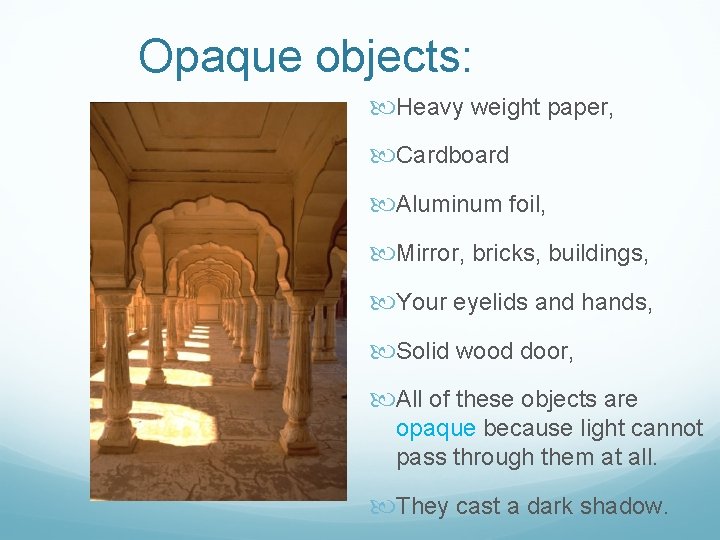
Opaque objects: Heavy weight paper, Cardboard Aluminum foil, Mirror, bricks, buildings, Your eyelids and hands, Solid wood door, All of these objects are opaque because light cannot pass through them at all. They cast a dark shadow.
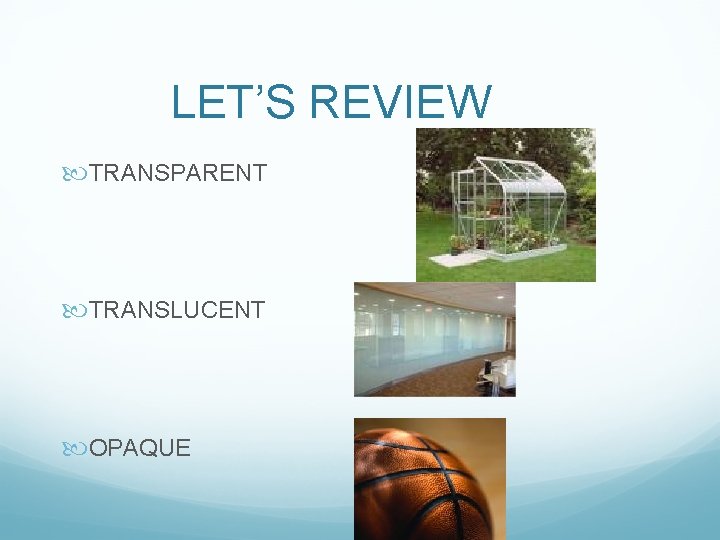
LET’S REVIEW TRANSPARENT TRANSLUCENT OPAQUE
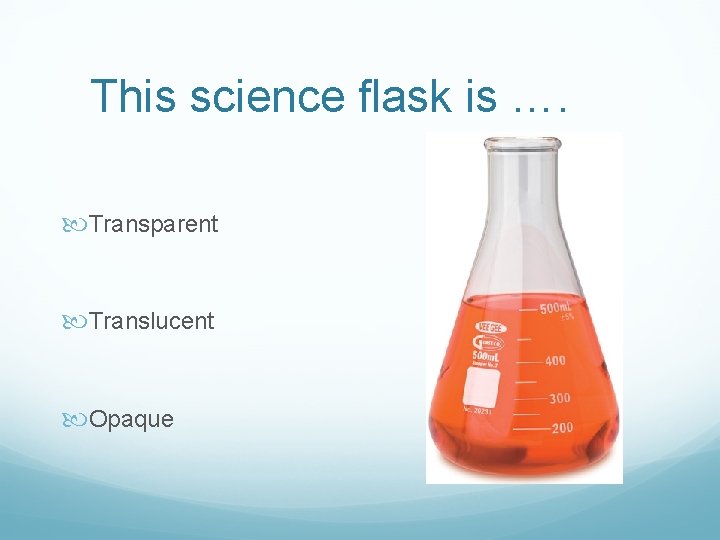
This science flask is …. Transparent Translucent Opaque
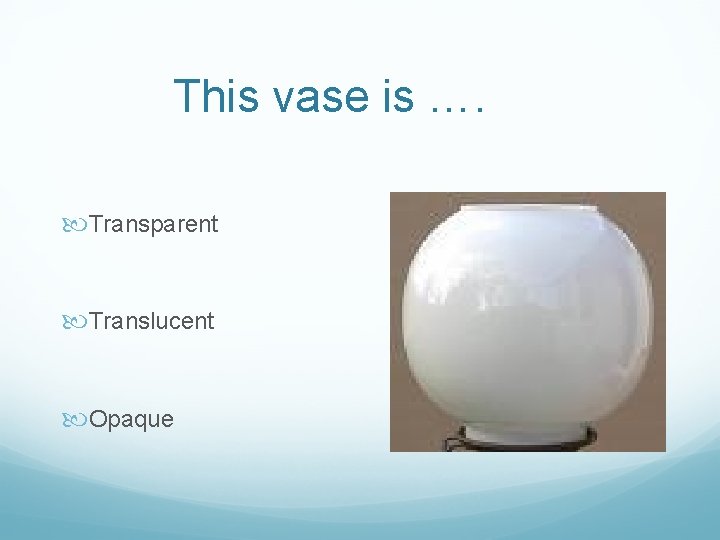
This vase is …. Transparent Translucent Opaque
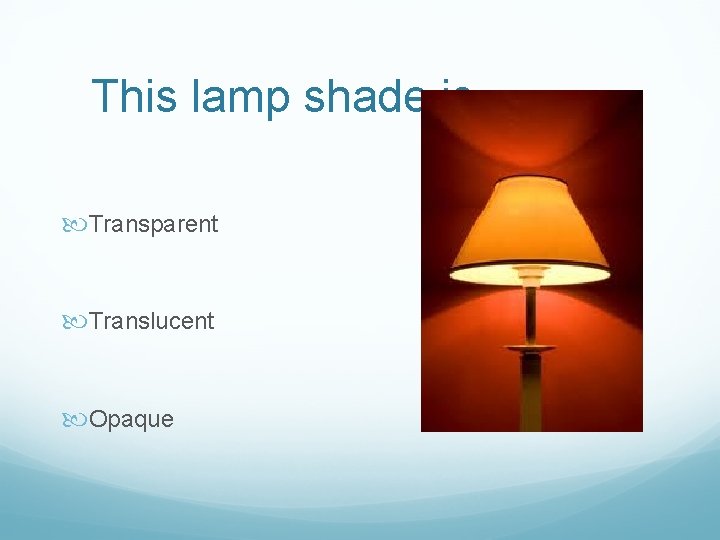
This lamp shade is… Transparent Translucent Opaque
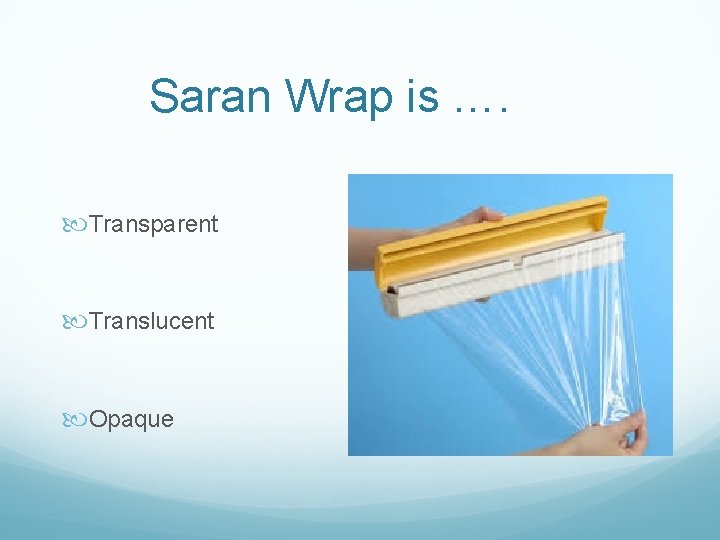
Saran Wrap is …. Transparent Translucent Opaque
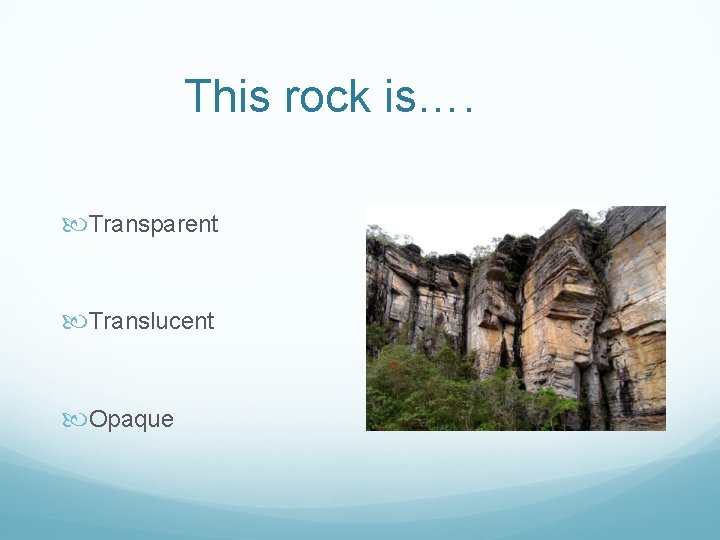
This rock is…. Transparent Translucent Opaque
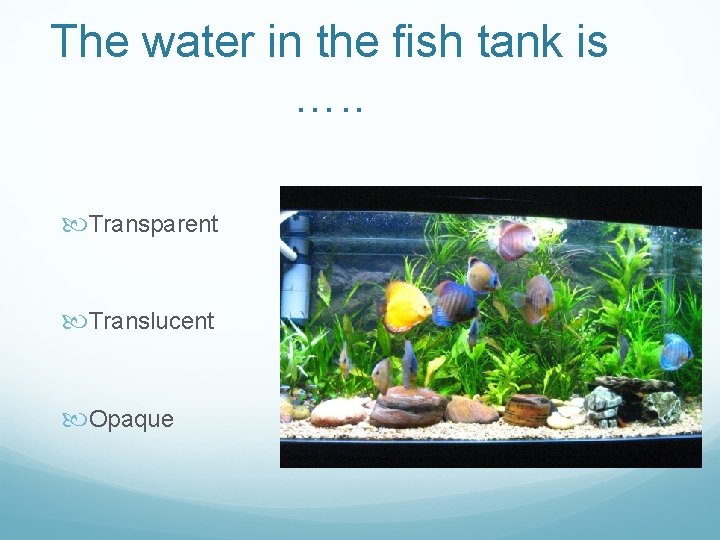
The water in the fish tank is …. . Transparent Translucent Opaque

Notebook Paper is… Transparent Translucent Opaque
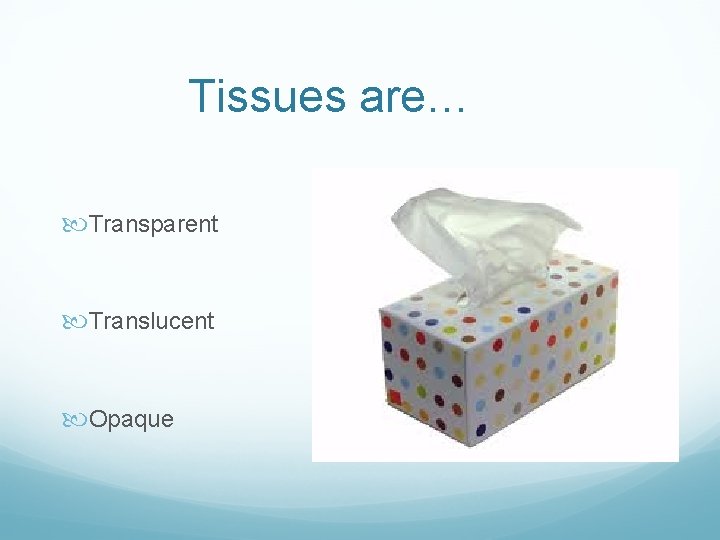
Tissues are… Transparent Translucent Opaque
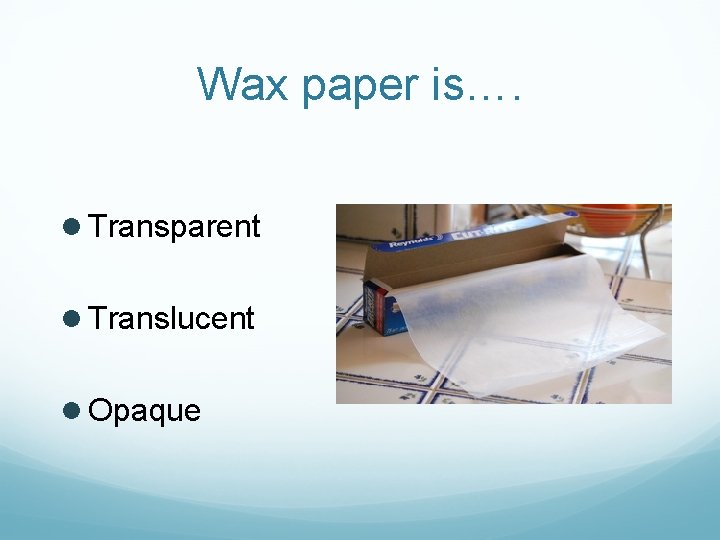
Wax paper is…. l Transparent l Translucent l Opaque
ABSORPTION
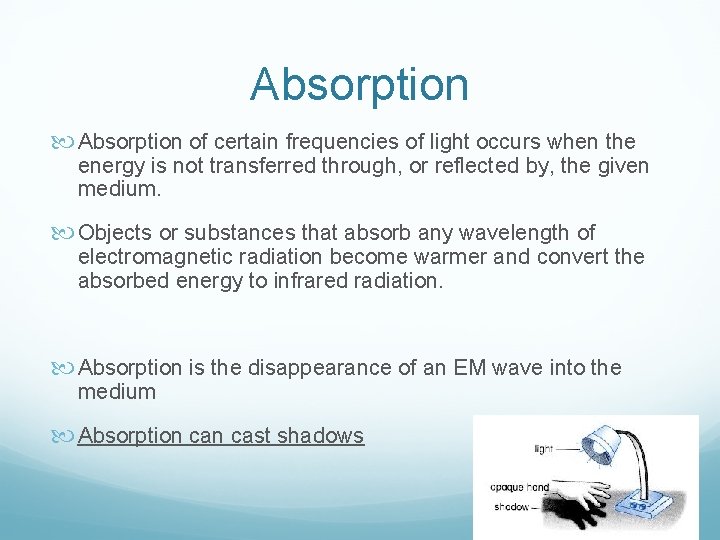
Absorption of certain frequencies of light occurs when the energy is not transferred through, or reflected by, the given medium. Objects or substances that absorb any wavelength of electromagnetic radiation become warmer and convert the absorbed energy to infrared radiation. Absorption is the disappearance of an EM wave into the medium Absorption cast shadows
Absorption happens when the medium has the ability to absorb the energy of the wave When the wave is absorbed, its energy is transferred to the medium and the wave is gone
Examples of Absorption Theater Curtains The color Black
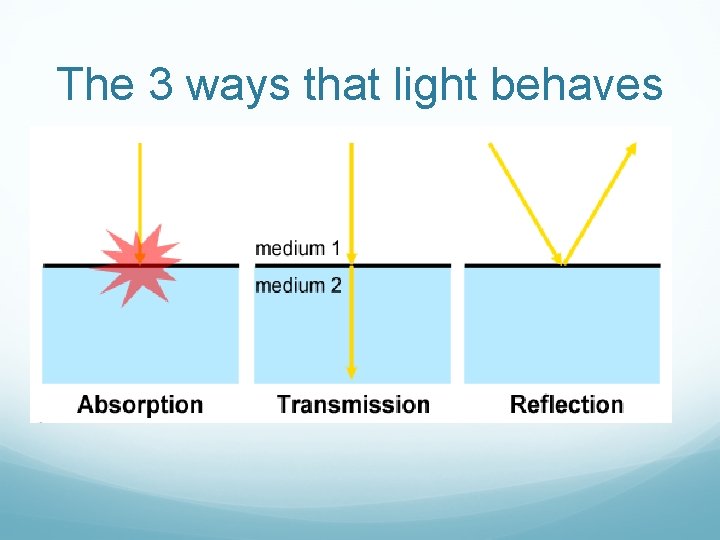
The 3 ways that light behaves
BEHAVIOR OF WAVES Standard 8. P. 3 Students will demonstrate an understanding of the properties and behaviors of waves. Performance Indicator 8. P. 3 A. 4 Analyze and interpret data to describe the behavior of mechanical waves as they intersect.
Interference Waves interfere with each other. Interference is the interaction between waves that meet. The extremes of what can happen are called constructive interference and destructive interference
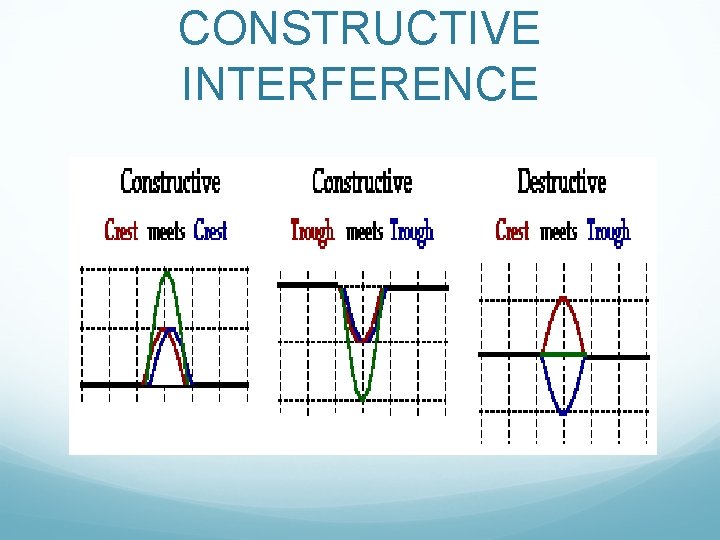
CONSTRUCTIVE INTERFERENCE Interference may be constructive: ○ A crest will interfere with another crest constructively to produce a larger crest and a trough will interfere to produce a larger trough. ○ Compressions interfere constructively with each other as do rarefactions. Constructive Interference – 2 waves combine to form a new wave with a larger amplitude.
CONSTRUCTIVE INTERFERENCE
DESTRUCTIVE INTERFERENCE Interference may be destructive: ○ A crest will interfere with a trough to lessen or cancel the displacement of each. Compressions interfere with rarefactions to lessen or cancel the displacement of each. Destructive Interference – 2 waves combine to produce a wave with a smaller amplitude.
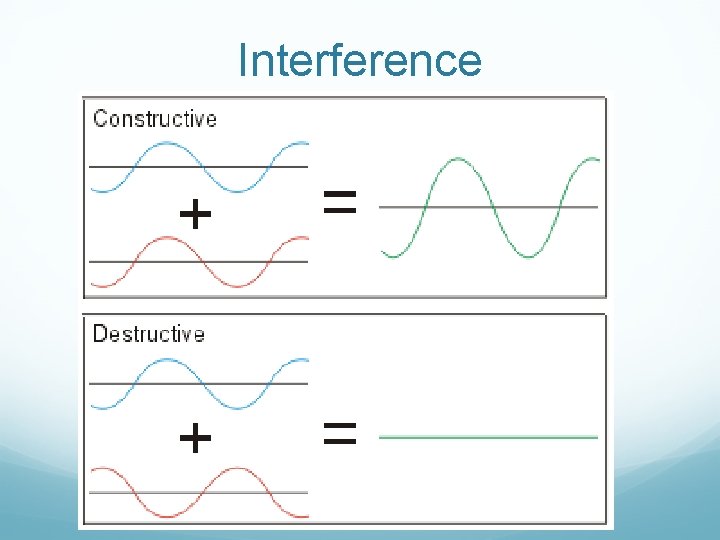
Interference
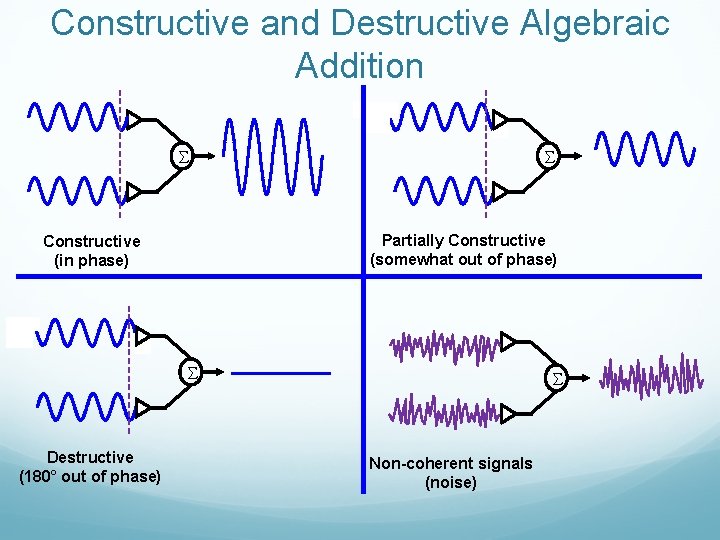
Constructive and Destructive Algebraic Addition S S Partially Constructive (somewhat out of phase) Constructive (in phase) S Destructive (180° out of phase) S Non-coherent signals (noise)
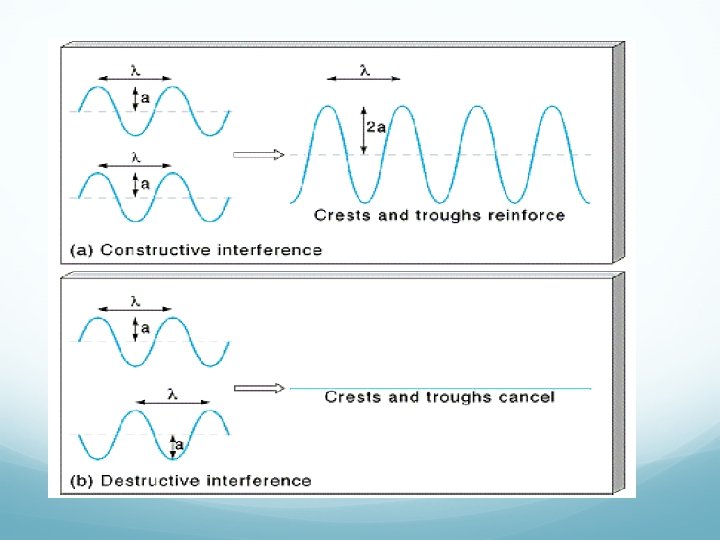
SOUND WAVES Sound waves interfere with each other changing what you hear. ○ Destructive interference makes sounds quieter; constructive interference makes sounds louder. ○ Sound waves reflect in tubes or some musical instruments to produce standing waves which reinforce sound through constructive interference to make the sound louder.
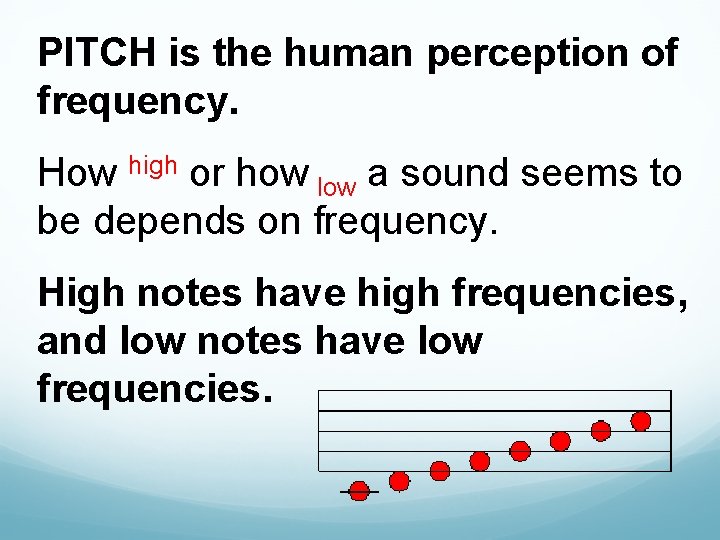
PITCH is the human perception of frequency. How high or how low a sound seems to be depends on frequency. High notes have high frequencies, and low notes have low frequencies.
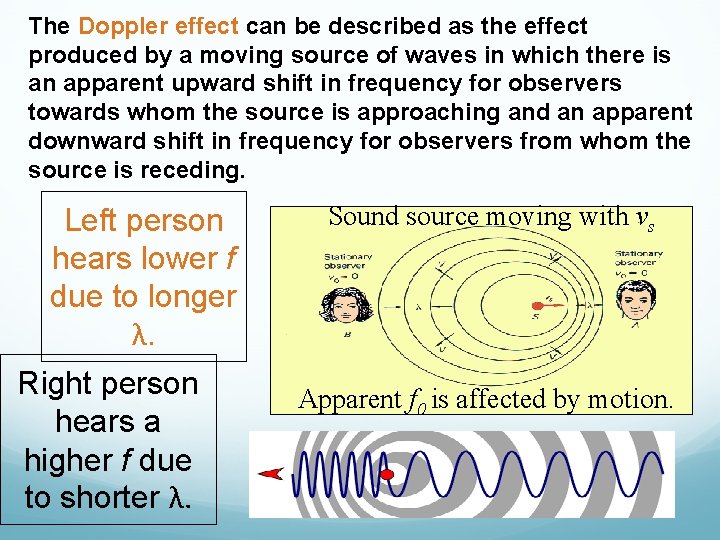
The Doppler effect can be described as the effect produced by a moving source of waves in which there is an apparent upward shift in frequency for observers towards whom the source is approaching and an apparent downward shift in frequency for observers from whom the source is receding. Left person hears lower f due to longer λ. Right person hears a higher f due to shorter λ. Sound source moving with vs Apparent f 0 is affected by motion.
- Slides: 109