
Faithfulness and Markedness The Plan for Today Markedness

![A Third Tableau Obl. Hd FI Econ [VP John left] [IP Infl [VP John](https://slidetodoc.com/presentation_image/d2e6e8fb97fe0397077577400e96d613/image-48.jpg "A Third Tableau Obl. Hd FI Econ [VP John left] [IP Infl [VP John")
![Simple Negation Input {John, not, left} Some candidates [not [John left] [Neg. P John](https://slidetodoc.com/presentation_image/d2e6e8fb97fe0397077577400e96d613/image-50.jpg "Simple Negation Input {John, not, left} Some candidates [not [John left] [Neg. P John")
- Slides: 87
Faithfulness and Markedness The Plan for Today • Markedness and Faithfulness and conflict resolution in OT • Two factorial typologies in phonology: - syllable structure - syllable peaks and margins 10/3/2020 1
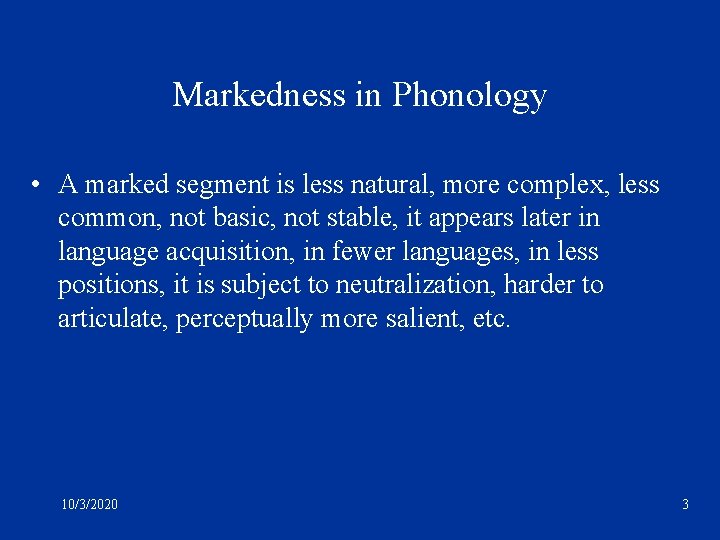
Faithfulness and Markedness • Presentation of Grimshaw’s account of do-support in English, as a result of the interaction of faithfulness and markedness • Presentation of Pesetsky’s deletion theory • A reflection on markedness hierarchies in syntax 10/3/2020 2
Markedness in Phonology • A marked segment is less natural, more complex, less common, not basic, not stable, it appears later in language acquisition, in fewer languages, in less positions, it is subject to neutralization, harder to articulate, perceptually more salient, etc. 10/3/2020 3
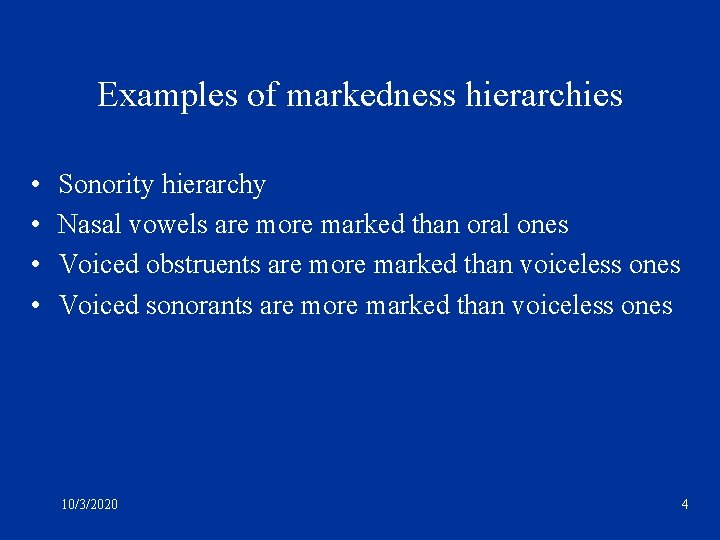
Examples of markedness hierarchies • • Sonority hierarchy Nasal vowels are more marked than oral ones Voiced obstruents are more marked than voiceless ones Voiced sonorants are more marked than voiceless ones 10/3/2020 4
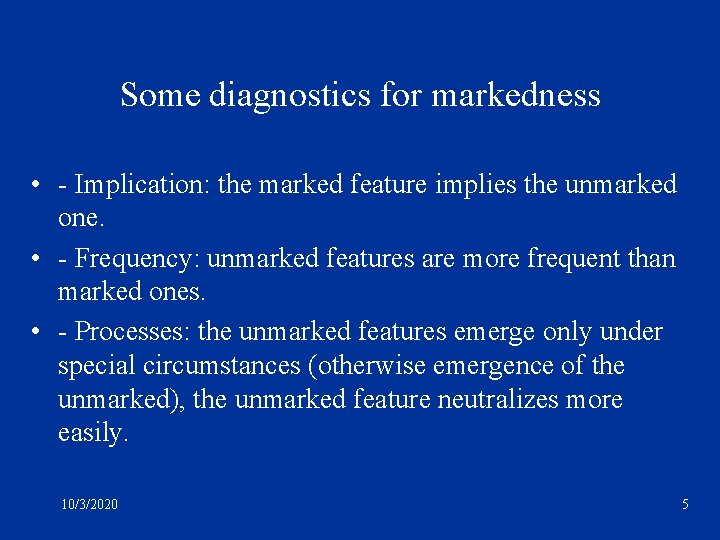
Some diagnostics for markedness • - Implication: the marked feature implies the unmarked one. • - Frequency: unmarked features are more frequent than marked ones. • - Processes: the unmarked features emerge only under special circumstances (otherwise emergence of the unmarked), the unmarked feature neutralizes more easily. 10/3/2020 5
Markedness vs. Faithfulness • Since markedness requires simple structures and faithfulness requires that inputs always be realized the way they come, regardless of their complexity, the two kinds of constraints often impose conflicting demands on outputs. • Depending on which win, structures are faithful or unmarked. 10/3/2020 6
Markedness vs. Faithfulness • OT is especially good at the resolution of conflicts between markedness and faithfulness. • Different languages make different choices, and the possible solutions are accounted for by the same constraints but ranked differently. • Ideally all possible rankings define possible grammars and all possible grammars are the results of different rankings. 10/3/2020 7
Simple factorial typology 1 • Syllables without onsets and with codas are tolerated in many languages, but only if there is no other way to syllabify. A sequence VCV is in the default case (and in all languages) syllabified as V. CV. (Jakobson’s typology): all languages have CV syllables. • French, German and English tolerate syllables without onsets and with codas , but only if there is no way out, that is if no other syllabification is better, because of higher ranking constraints (faithfulness). 10/3/2020 8
Simple factorial typology 1 • Strategies to obtain a better (less marked syllable structure). Remember hiatus avoidance: • Monomorphemic VCV are always syllabified as V. CV or VCambysyll. V but never as VC. V • E: coma, comma • G: Koma, Komma • F: coma (no ambisyllabicity) 10/3/2020 9
Simple factorial typology 1 • Some languages do not have syllables without onsets, or ones with codas, and systematically use strategies to enhance ‘bad’ syllables, for instance in loanwords. • Japanese: kurimasu for Christmas and arubatu for Arbeit. • How does OT account for these observations? 10/3/2020 10
Simple factorial typology 1 • In considering hiauts avoidance, we have seen that nearly no language applies pure faithfulness or pure markedness, but that finer distinctions must be made which consider morphological and phonological facts. 10/3/2020 11
Simple factorial typology 1 • The factorial typology shown here is thus an idealization. • The constraint ranking necessary to account for hiatus is shown to be more general since it also applies to other segment strings without hiatus. 10/3/2020 12
Simple factorial typology 1 • • Prince & Smolensky (1993) on syllabification Markedness Constraints: ONSET, NOCODA, Faithfulness Constraints: MAX, DEP Through permutation of these constraints, different kinds of syllables are obtained. 10/3/2020 13
Faithfulness (/V/) 10/3/2020 14
Epenthesis (/V/) 10/3/2020 15
Deletion (/V/) 10/3/2020 16
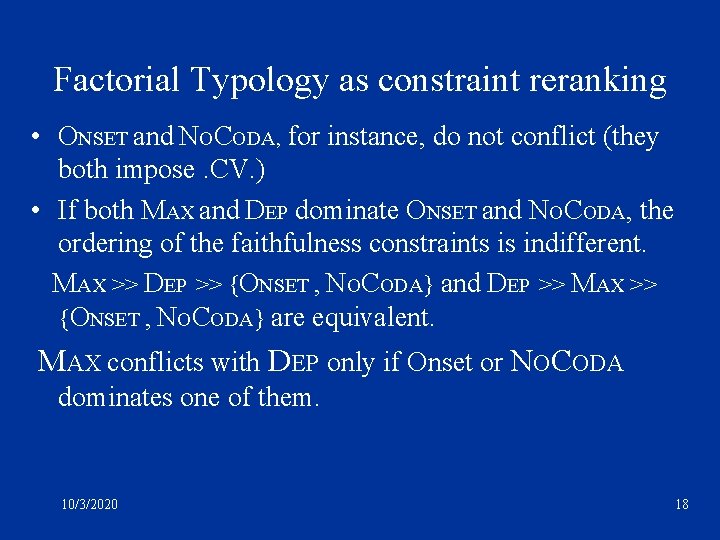
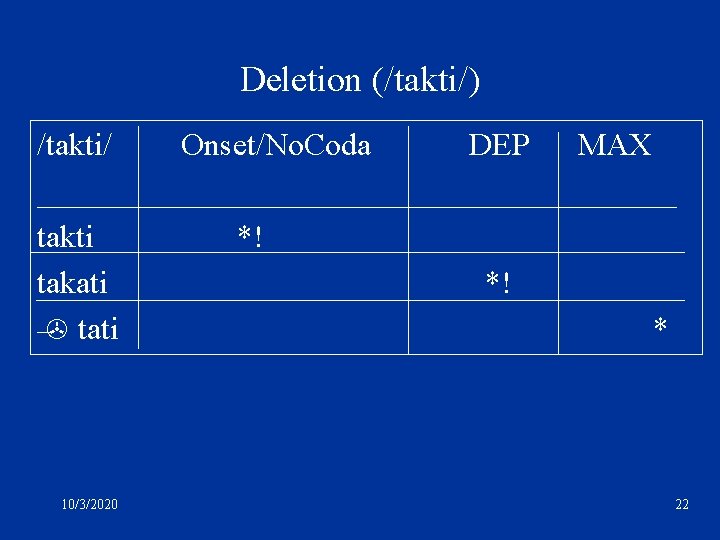
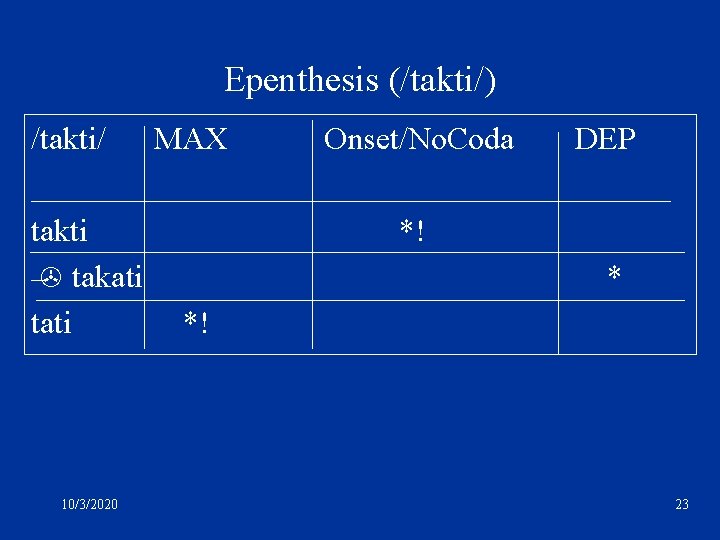
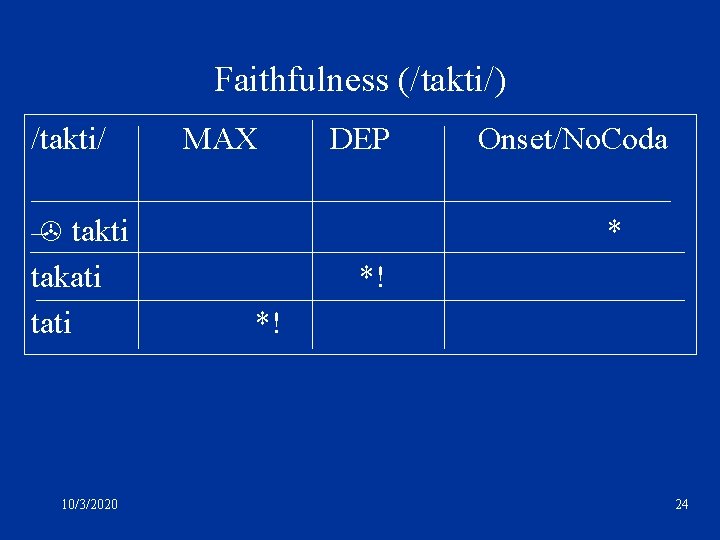
Factorial typology as constraint reranking • With 3 constraints, 6 permutations are possible, but only 3 are distinct. The other ones deliver the same results. • Given 4 constraints: ONSET, NOCODA, MAX, and DEP, what are the possible grammars? • 24 (4!) possible permutations of them. But not all 24 are interesting, because some constraints never conflict with each other. 10/3/2020 17
Factorial Typology as constraint reranking • ONSET and NOCODA, for instance, do not conflict (they both impose. CV. ) • If both MAX and DEP dominate ONSET and NOCODA, the ordering of the faithfulness constraints is indifferent. MAX >> DEP >> {ONSET , NOCODA} and DEP >> MAX >> {ONSET , NOCODA} are equivalent. MAX conflicts with DEP only if Onset or NOCODA dominates one of them. 10/3/2020 18
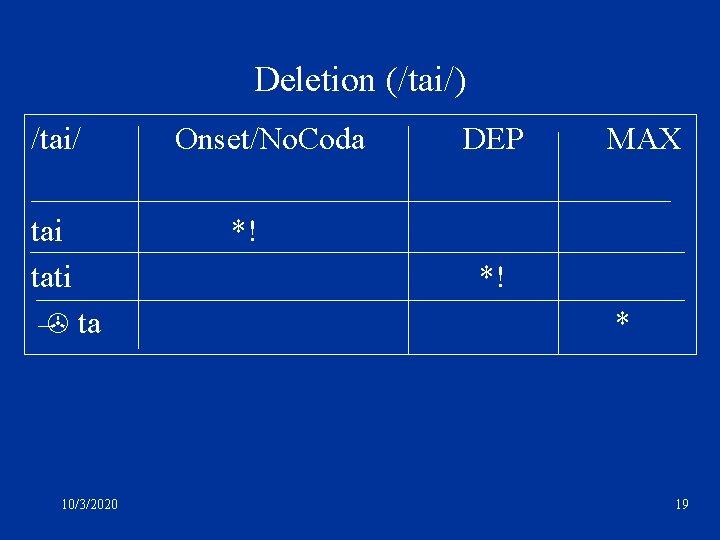
Deletion (/tai/) /tai/ Onset/No. Coda DEP MAX ____________________ tai *! tati *! –> ta * 10/3/2020 19
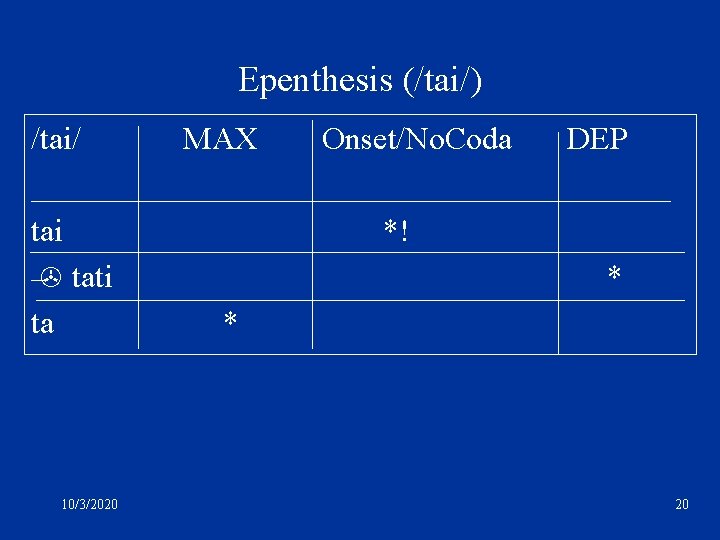
Epenthesis (/tai/) /tai/ MAX Onset/No. Coda DEP ____________________ tai *! –> tati * ta * 10/3/2020 20
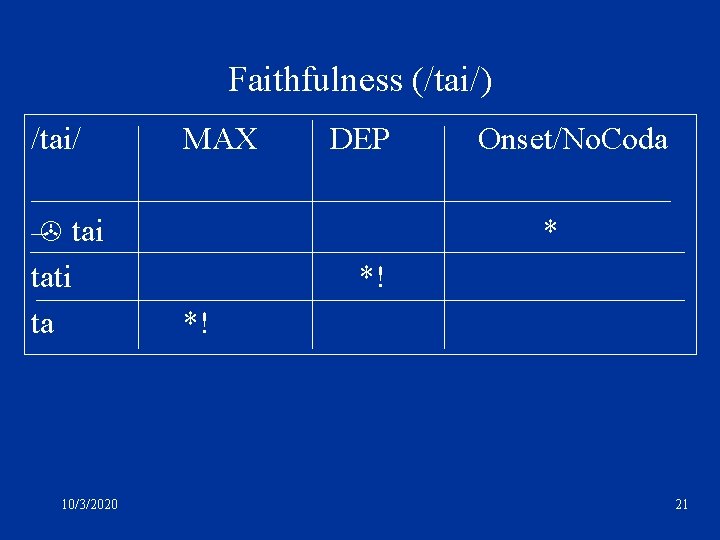
Faithfulness (/tai/) /tai/ MAX DEP Onset/No. Coda ____________________ –> tai * tati *! ta *! 10/3/2020 21
Deletion (/takti/) /takti/ Onset/No. Coda DEP MAX ____________________ takti *! takati *! –> tati * 10/3/2020 22
Epenthesis (/takti/) /takti/ MAX Onset/No. Coda DEP ____________________ takti *! –> takati * tati *! 10/3/2020 23
Faithfulness (/takti/) /takti/ MAX DEP Onset/No. Coda ____________________ –> takti * takati *! tati *! 10/3/2020 24
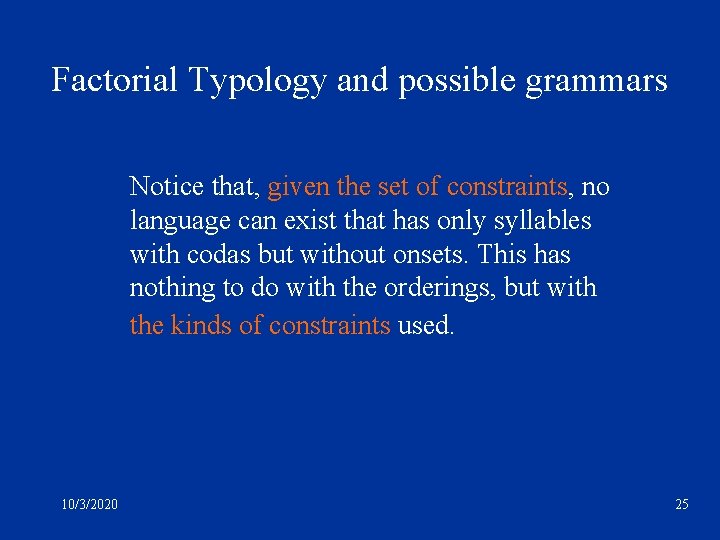
Factorial Typology and possible grammars Notice that, given the set of constraints, no language can exist that has only syllables with codas but without onsets. This has nothing to do with the orderings, but with the kinds of constraints used. 10/3/2020 25
Factorial Typology and possible grammars Given the fact that all languages have Cs and Vs, there is also no language without CV syllables. And VCV will aways be syllabified as V. CV, as desired. 10/3/2020 26
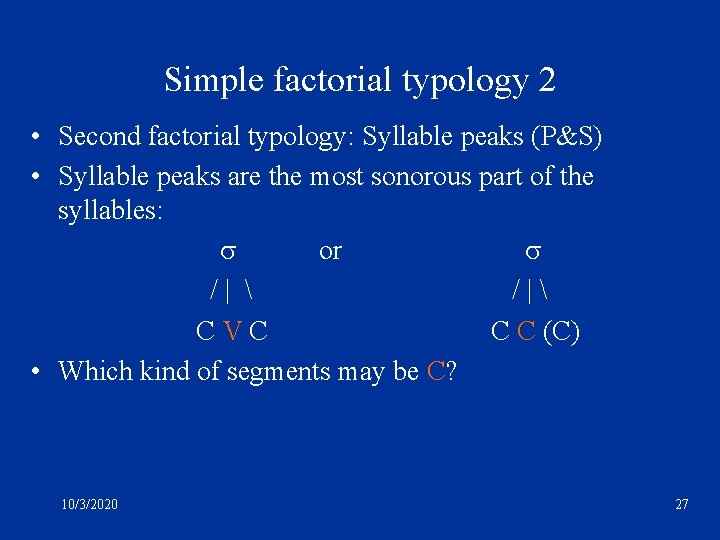
Simple factorial typology 2 • Second factorial typology: Syllable peaks (P&S) • Syllable peaks are the most sonorous part of the syllables: s or s / | C V C C C (C) • Which kind of segments may be C? 10/3/2020 27
Simple factorial typology 2 • French has only vowels as syllable peaks: words like ocre or si� ècle have a coda with increasing sonority. • Though such codas are marked and impossible in most languages, this is still better than make the liquid syllabic. 10/3/2020 28
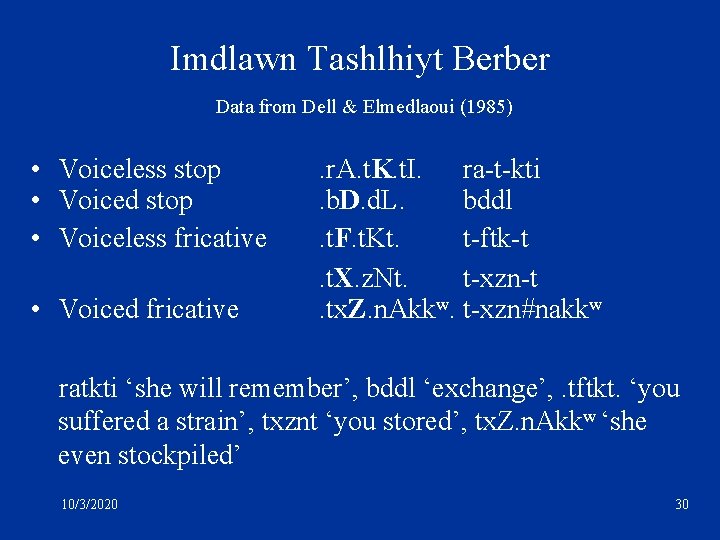
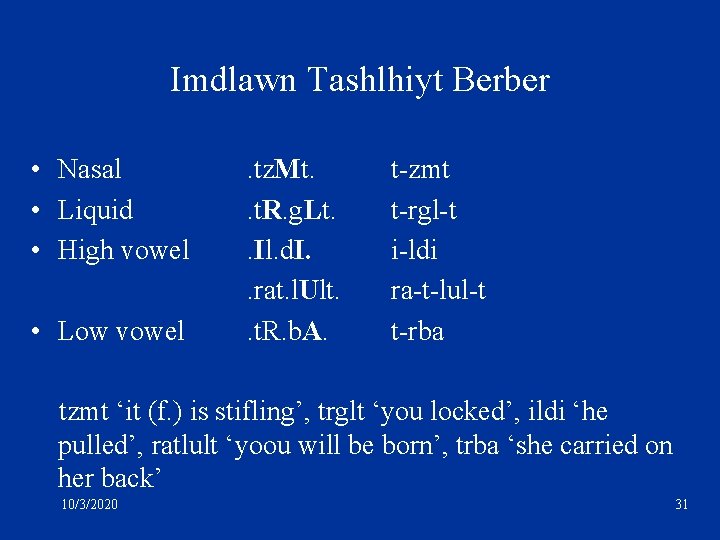
Simple factorial typology 2 • German and English have vowels and sonorants as syllable peaks: G: Himmel, eben, nieder E: eagle, meter, button • Imdlawn Tashlhiyt Berber tolerates all segments as syllable peaks, also obstruents: 10/3/2020 29
Imdlawn Tashlhiyt Berber Data from Dell & Elmedlaoui (1985) • • • • Voiceless stop Voiced stop Voiceless fricative Voiced fricative . r. A. t. K. t. I. ra-t-kti . b. D. d. L. bddl. t. F. t. Kt. t-ftk-t. t. X. z. Nt. t-xzn-t. tx. Z. n. Akkw. t-xzn#nakkw ratkti ‘she will remember’, bddl ‘exchange’, . tftkt. ‘you suffered a strain’, txznt ‘you stored’, tx. Z. n. Akkw ‘she even stockpiled’ 10/3/2020 30
Imdlawn Tashlhiyt Berber • Nasal • Liquid • High vowel • Low vowel . tz. Mt. . t. R. g. Lt. . Il. d. I. . rat. l. Ult. . t. R. b. A. t-zmt t-rgl-t i-ldi ra-t-lul-t t-rba tzmt ‘it (f. ) is stifling’, trglt ‘you locked’, ildi ‘he pulled’, ratlult ‘yoou will be born’, trba ‘she carried on her back’ 10/3/2020 31
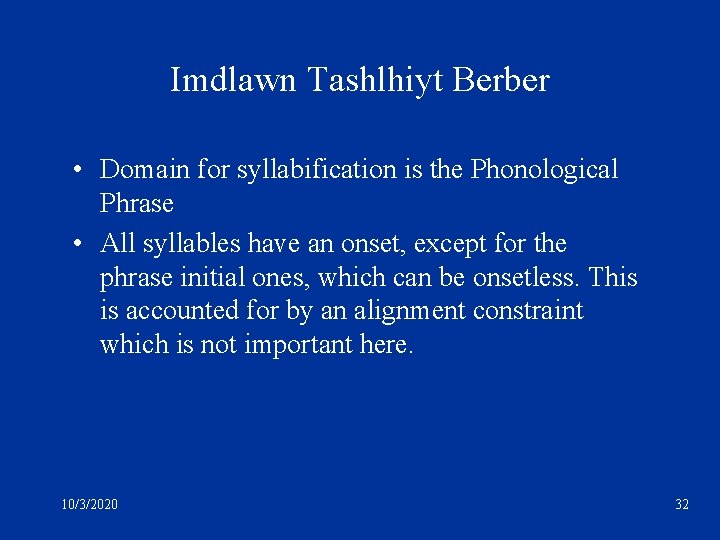
Imdlawn Tashlhiyt Berber • Domain for syllabification is the Phonological Phrase • All syllables have an onset, except for the phrase initial ones, which can be onsetless. This is accounted for by an alignment constraint which is not important here. 10/3/2020 32
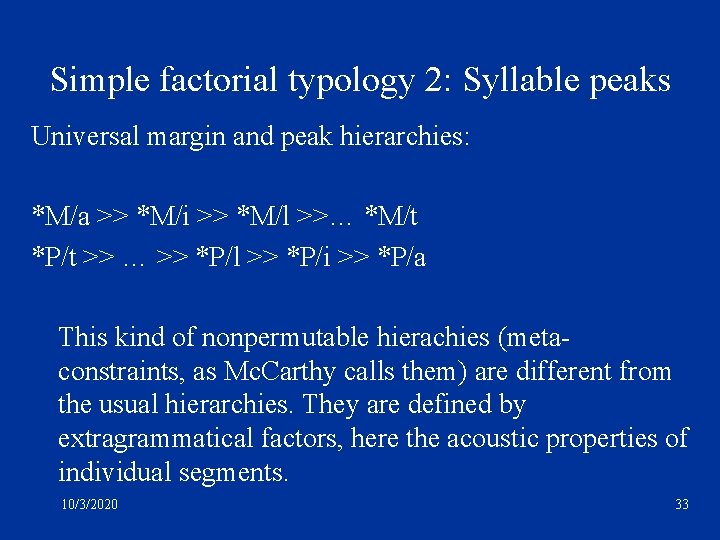
Simple factorial typology 2: Syllable peaks Universal margin and peak hierarchies: *M/a >> *M/i >> *M/l >>… *M/t *P/t >> … >> *P/l >> *P/i >> *P/a This kind of nonpermutable hierachies (metaconstraints, as Mc. Carthy calls them) are different from the usual hierarchies. They are defined by extragrammatical factors, here the acoustic properties of individual segments. 10/3/2020 33
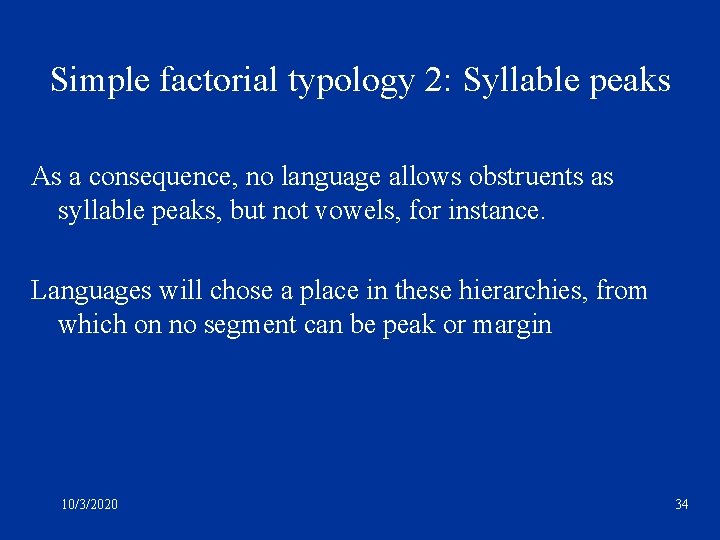
Simple factorial typology 2: Syllable peaks As a consequence, no language allows obstruents as syllable peaks, but not vowels, for instance. Languages will chose a place in these hierarchies, from which on no segment can be peak or margin 10/3/2020 34
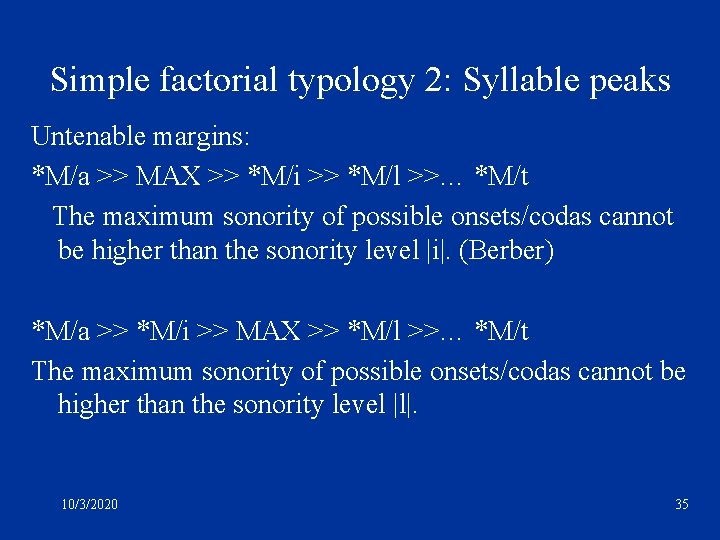
Simple factorial typology 2: Syllable peaks Untenable margins: *M/a >> MAX >> *M/i >> *M/l >>… *M/t The maximum sonority of possible onsets/codas cannot be higher than the sonority level |i|. (Berber) *M/a >> *M/i >> MAX >> *M/l >>… *M/t The maximum sonority of possible onsets/codas cannot be higher than the sonority level |l|. 10/3/2020 35
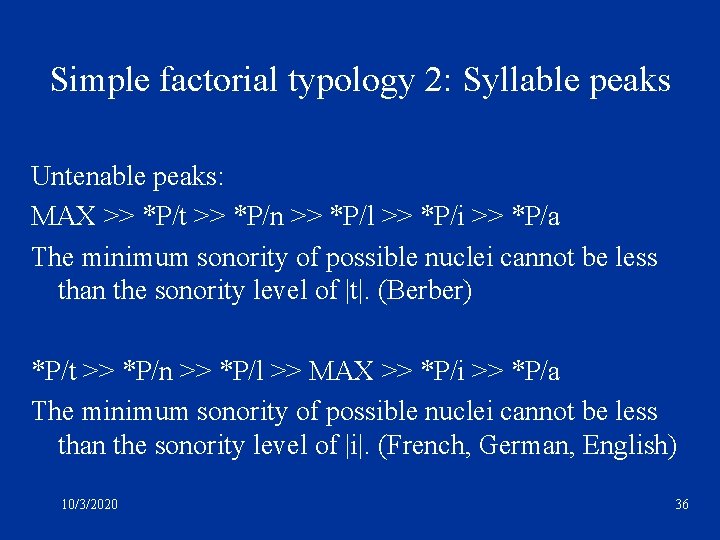
Simple factorial typology 2: Syllable peaks Untenable peaks: MAX >> *P/t >> *P/n >> *P/l >> *P/i >> *P/a The minimum sonority of possible nuclei cannot be less than the sonority level of |t|. (Berber) *P/t >> *P/n >> *P/l >> MAX >> *P/i >> *P/a The minimum sonority of possible nuclei cannot be less than the sonority level of |i|. (French, German, English) 10/3/2020 36
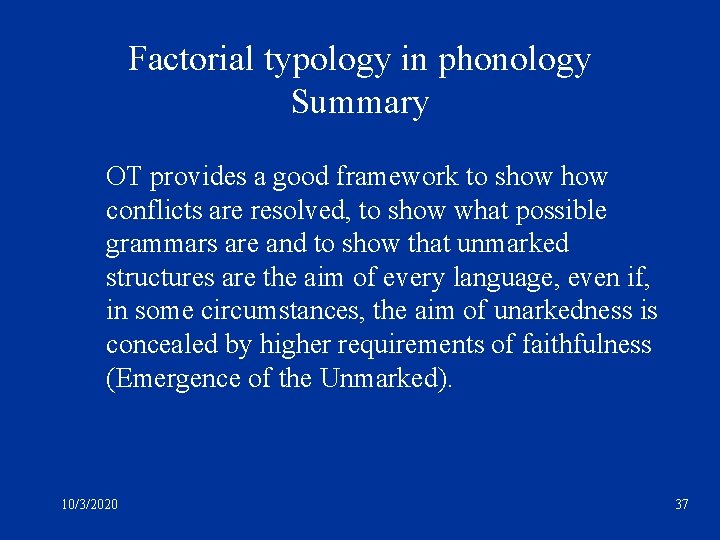
Factorial typology in phonology Summary OT provides a good framework to show conflicts are resolved, to show what possible grammars are and to show that unmarked structures are the aim of every language, even if, in some circumstances, the aim of unarkedness is concealed by higher requirements of faithfulness (Emergence of the Unmarked). 10/3/2020 37
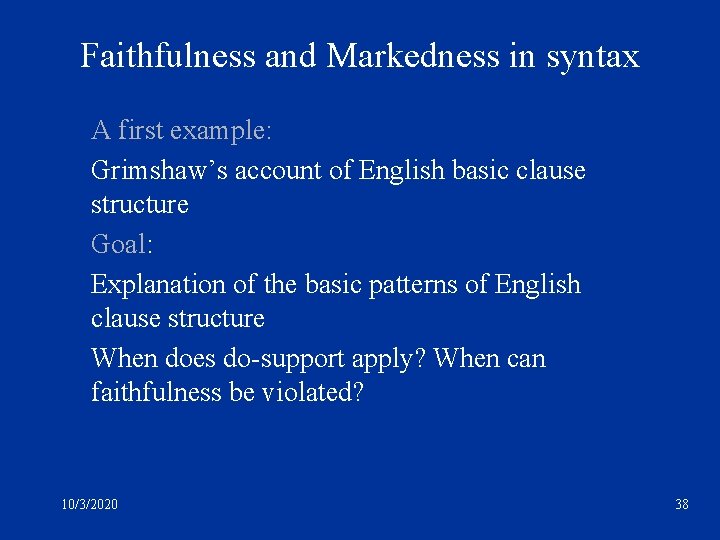
Faithfulness and Markedness in syntax A first example: Grimshaw’s account of English basic clause structure Goal: Explanation of the basic patterns of English clause structure When does do-support apply? When can faithfulness be violated? 10/3/2020 38
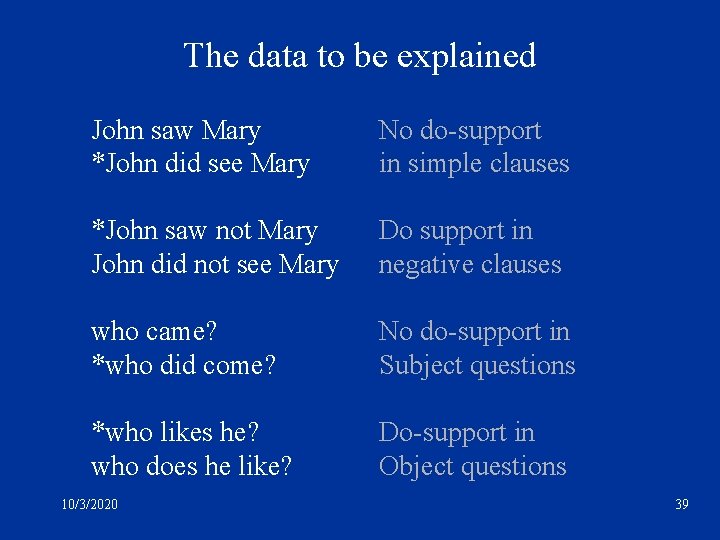
The data to be explained John saw Mary *John did see Mary No do-support in simple clauses *John saw not Mary John did not see Mary Do support in negative clauses who came? *who did come? No do-support in Subject questions *who likes he? who does he like? Do-support in Object questions 10/3/2020 39
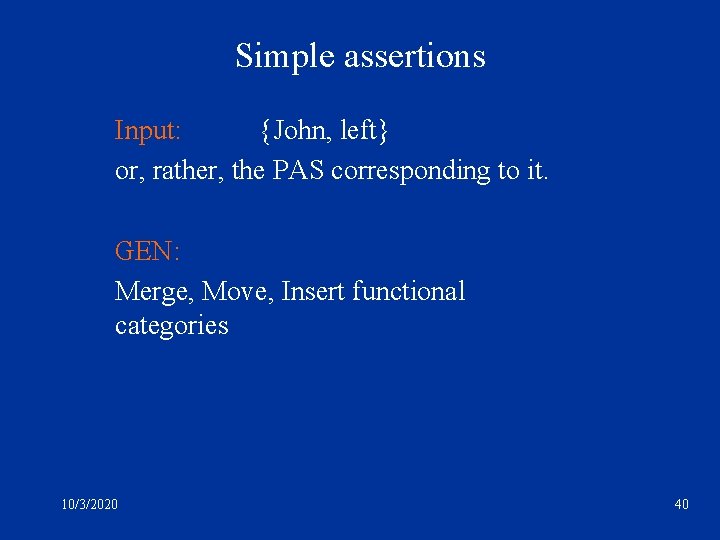
Simple assertions Input: {John, left} or, rather, the PAS corresponding to it. GEN: Merge, Move, Insert functional categories 10/3/2020 40
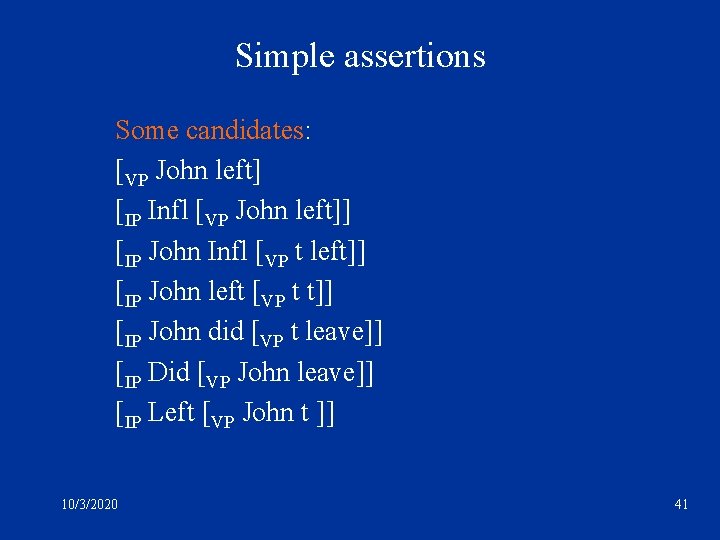
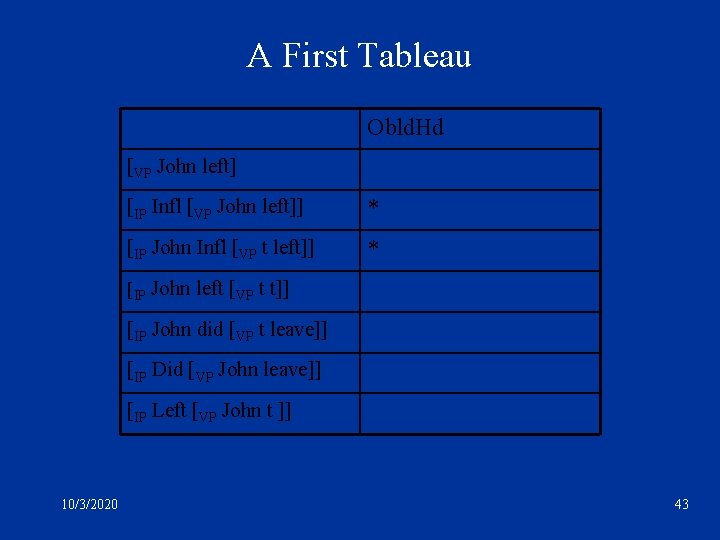
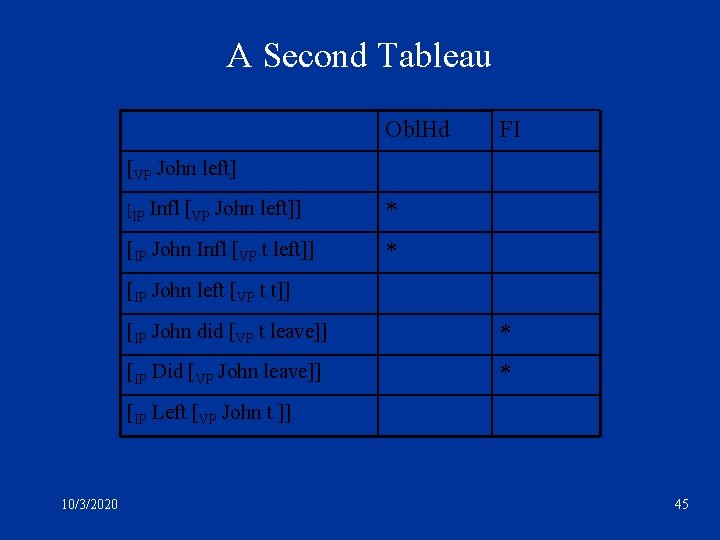
Simple assertions Some candidates: [VP John left] [IP Infl [VP John left]] [IP John Infl [VP t left]] [IP John left [VP t t]] [IP John did [VP t leave]] [IP Did [VP John leave]] [IP Left [VP John t ]] 10/3/2020 41
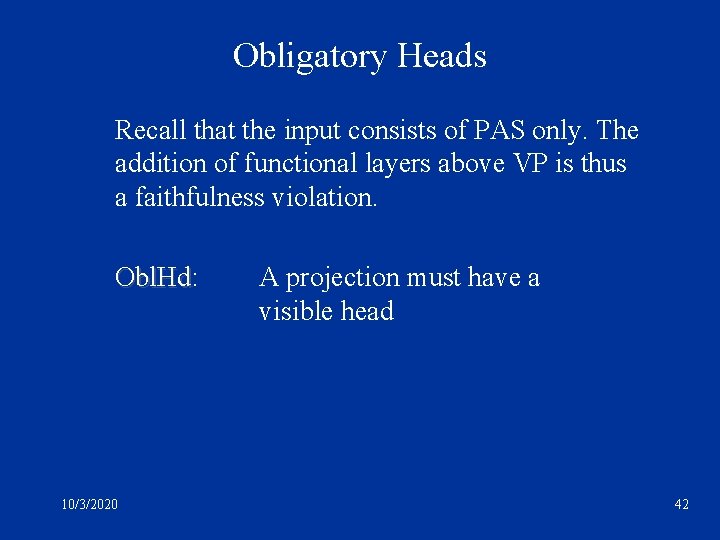
Obligatory Heads Recall that the input consists of PAS only. The addition of functional layers above VP is thus a faithfulness violation. Obl. Hd: Obl. Hd 10/3/2020 A projection must have a visible head 42
A First Tableau Obld. Hd [VP John left] [IP Infl [VP John left]] * [IP John Infl [VP t left]] * [IP John left [VP t t]] [IP John did [VP t leave]] [IP Did [VP John leave]] [IP Left [VP John t ]] 10/3/2020 43
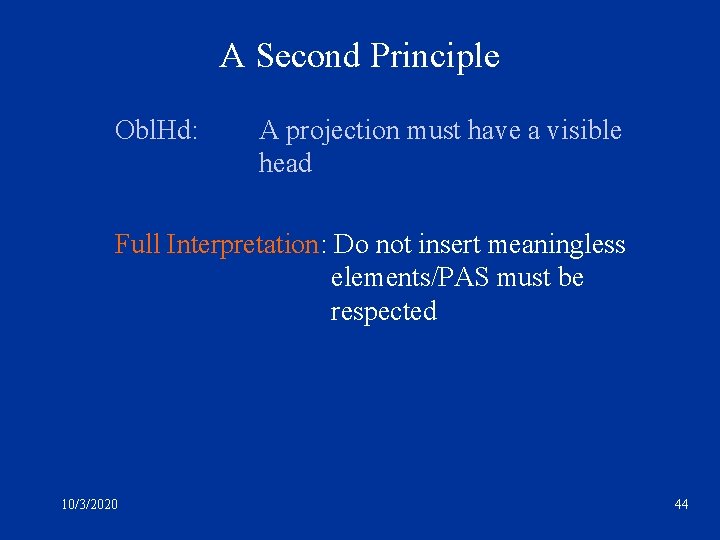
A Second Principle Obl. Hd: A projection must have a visible head Full Interpretation: Do not insert meaningless elements/PAS must be respected 10/3/2020 44
A Second Tableau Obl. Hd FI [VP John left] [IP Infl [VP John left]] * [IP John Infl [VP t left]] * [IP John left [VP t t]] [IP John did [VP t leave]] * [IP Did [VP John leave]] * [IP Left [VP John t ]] 10/3/2020 45
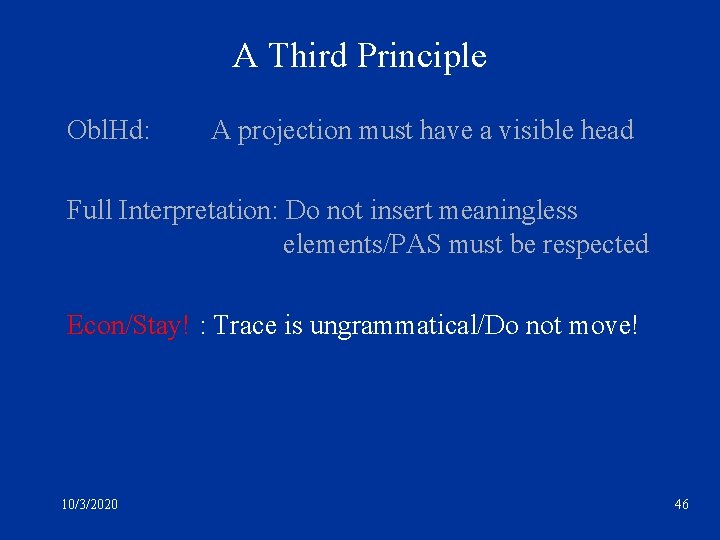
A Third Principle Obl. Hd: A projection must have a visible head Full Interpretation: Do not insert meaningless elements/PAS must be respected Econ/Stay! : Trace is ungrammatical/Do not move! 10/3/2020 46
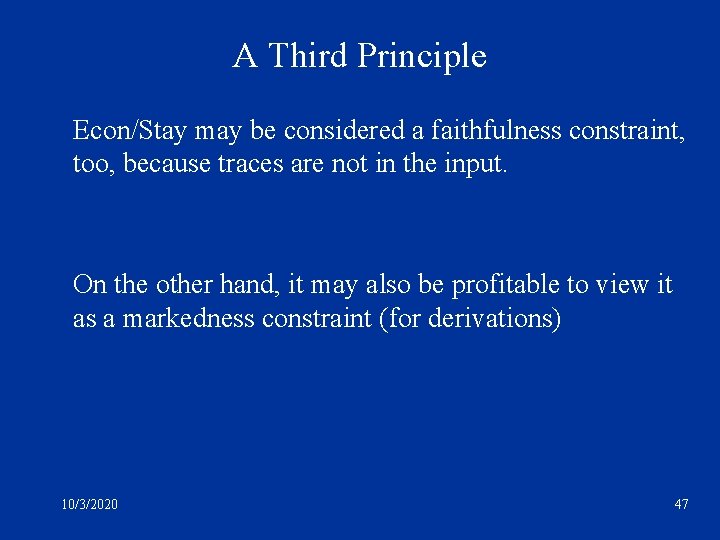
A Third Principle Econ/Stay may be considered a faithfulness constraint, too, because traces are not in the input. On the other hand, it may also be profitable to view it as a markedness constraint (for derivations) 10/3/2020 47
A Third Tableau Obl. Hd FI Econ [VP John left] [IP Infl [VP John left]] *! [IP John Infl [VP t left]] *! * [IP John left [VP t t]] [IP John did [VP t leave]] *! [IP Did [VP John leave]] *! [IP Left [VP John t ]] 10/3/2020 *!* * *! 48
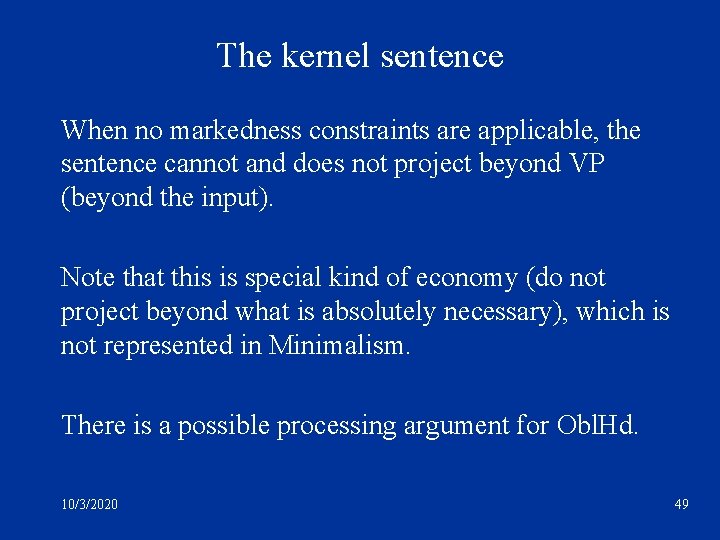
The kernel sentence When no markedness constraints are applicable, the sentence cannot and does not project beyond VP (beyond the input). Note that this is special kind of economy (do not project beyond what is absolutely necessary), which is not represented in Minimalism. There is a possible processing argument for Obl. Hd. 10/3/2020 49
Simple Negation Input {John, not, left} Some candidates [not [John left] [Neg. P John [not [t left]] [IP John left [not [t t]] [IP John Infl [not [t left]] [IP John did [not [t leave]] [IP Did [not [John leave]] 10/3/2020 50
Negation & the Principles Introduced so far 10/3/2020 51
New Principles The faithfulness principles considered so far do not yield the correct result. We need to consider a further principle, a markedness constraint: Subject (vulgo: EPP) The highest A-specifier of a sentence must be filled! 10/3/2020 52
Negation & the New Principle 10/3/2020 53
New Principles SUBJ already implies that the subject is the highest element in the clause --but not any structural position will do. Case, a second markedness principle, restricts options to Spec, VP and Spec, IP Case (vulgo: Case Filter) The highest position of a chain must have Case! 10/3/2020 54
Negation & the New Principles 10/3/2020 55
New Principles Case (vulgo: Case Filter) The highest position of a chain must have Case! Lex. Econ: *Lexical Trace! 10/3/2020 56
Negation & the New Principles 10/3/2020 57
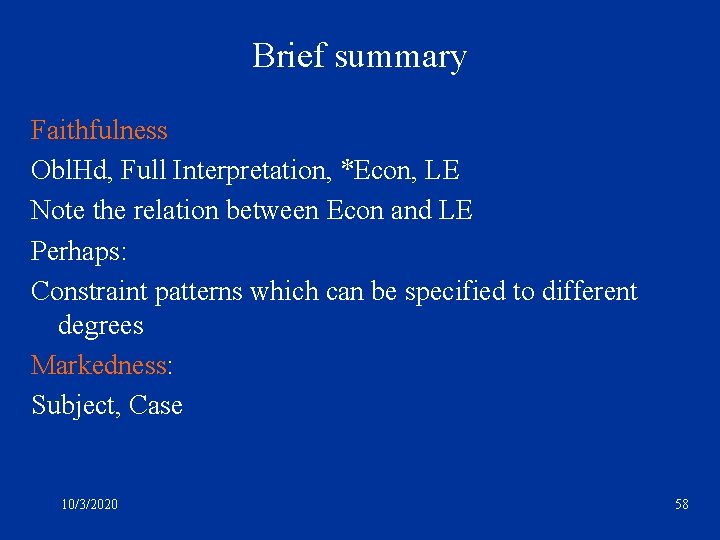
Brief summary Faithfulness Obl. Hd, Full Interpretation, *Econ, LE Note the relation between Econ and LE Perhaps: Constraint patterns which can be specified to different degrees Markedness: Subject, Case 10/3/2020 58
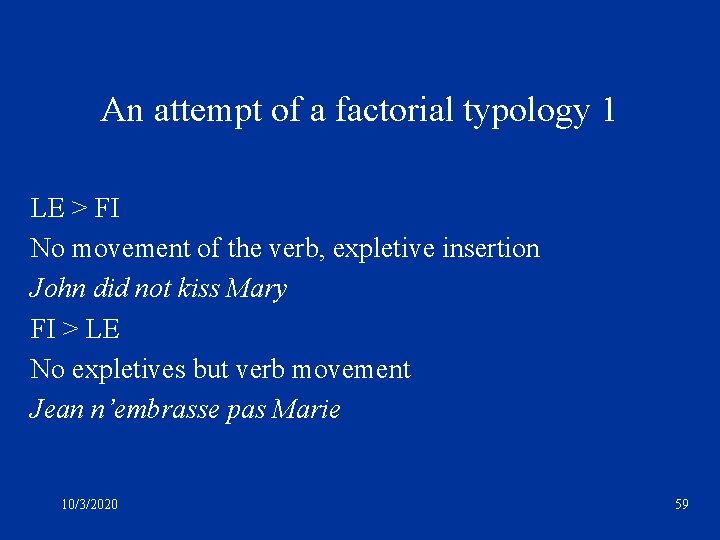
An attempt of a factorial typology 1 LE > FI No movement of the verb, expletive insertion John did not kiss Mary FI > LE No expletives but verb movement Jean n’embrasse pas Marie 10/3/2020 59
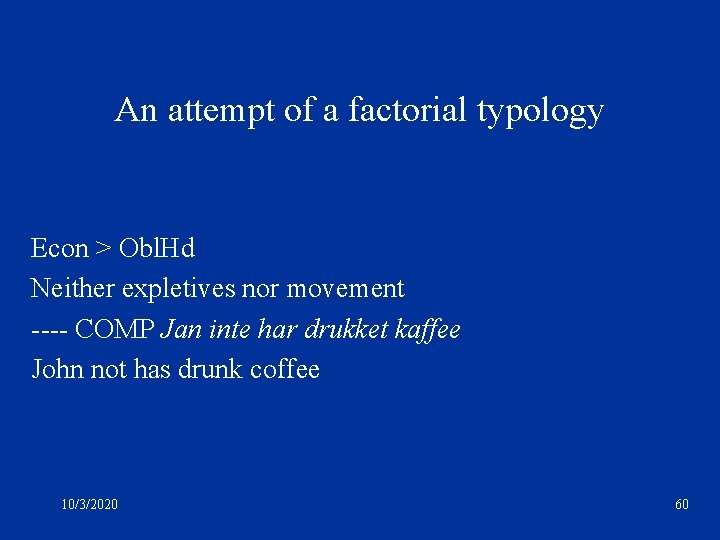
An attempt of a factorial typology Econ > Obl. Hd Neither expletives nor movement ---- COMP Jan inte har drukket kaffee John not has drunk coffee 10/3/2020 60
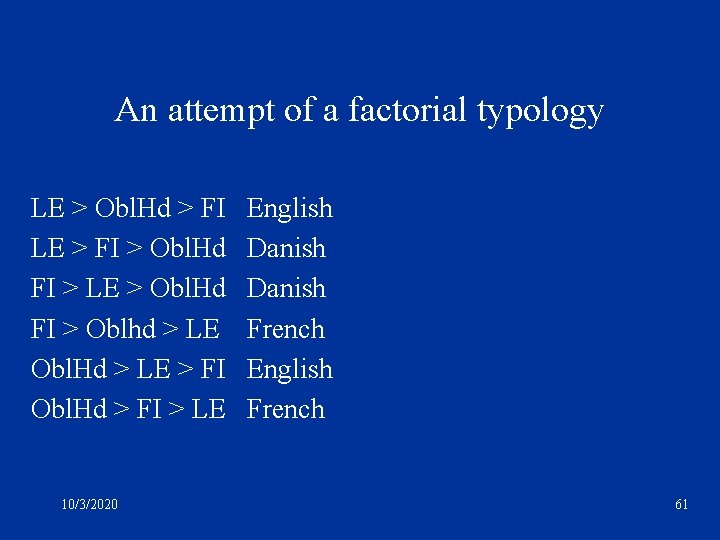
An attempt of a factorial typology LE > Obl. Hd > FI LE > FI > Obl. Hd FI > LE > Obl. Hd FI > Oblhd > LE Obl. Hd > LE > FI Obl. Hd > FI > LE 10/3/2020 English Danish French English French 61
An attempt of a factorial typology This reasoning presupposes that we have an IP, and not a Neg. P If Case is Low. . . 10/3/2020 62
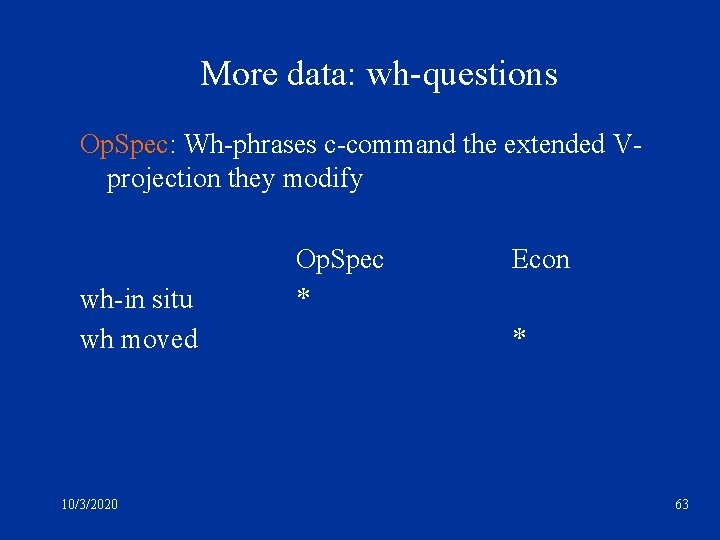
More data: wh-questions Op. Spec: Wh-phrases c-command the extended Vprojection they modify wh-in situ wh moved 10/3/2020 Op. Spec * Econ * 63
In Situ Languages 10/3/2020 64
Do-Insertion in wh-questions We now want to check if the constraints considered so far make correct predictions concerning do-support in whquestions. No do-support in subject questions Do-support in object questions, etc. 10/3/2020 65
Subject Questions 10/3/2020 66
Object Questions 10/3/2020 67
Further faithfulness considerations FI and Econ disfavor the insertion of elements which are not in the input There should also be principles that require that input material be realized. These are principles of the Parse or MAX-family We will study them in the light of Pesetsky’s economy of pronunciation approach 10/3/2020 68
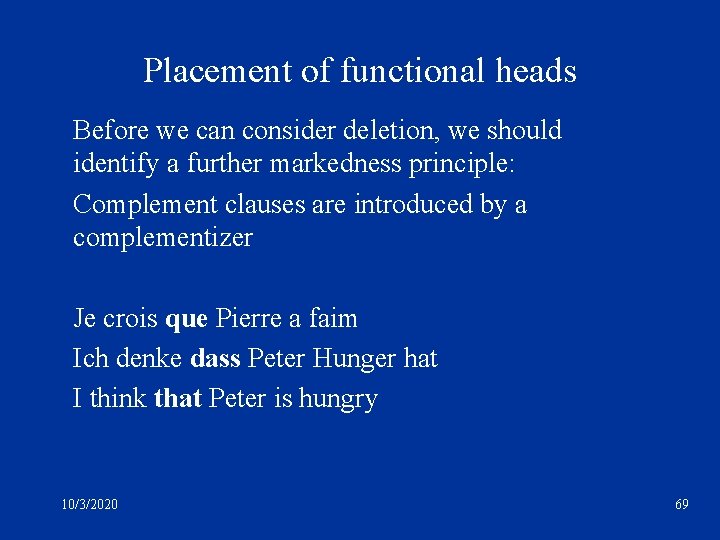
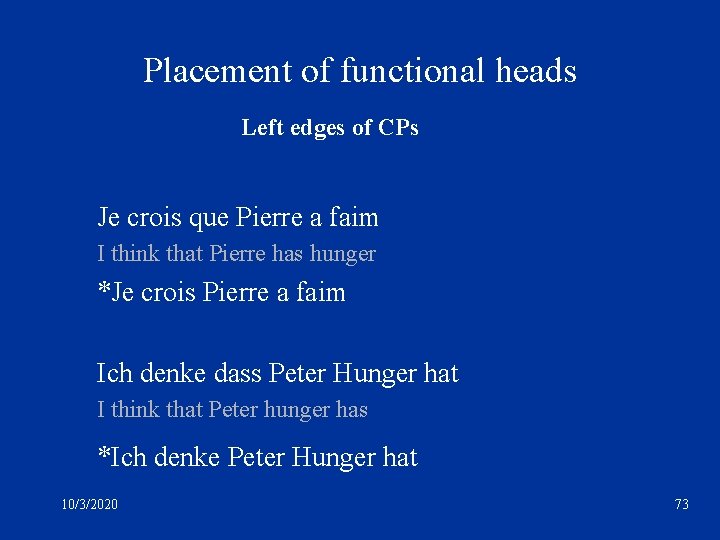
Placement of functional heads Before we can consider deletion, we should identify a further markedness principle: Complement clauses are introduced by a complementizer Je crois que Pierre a faim Ich denke dass Peter Hunger hat I think that Peter is hungry 10/3/2020 69
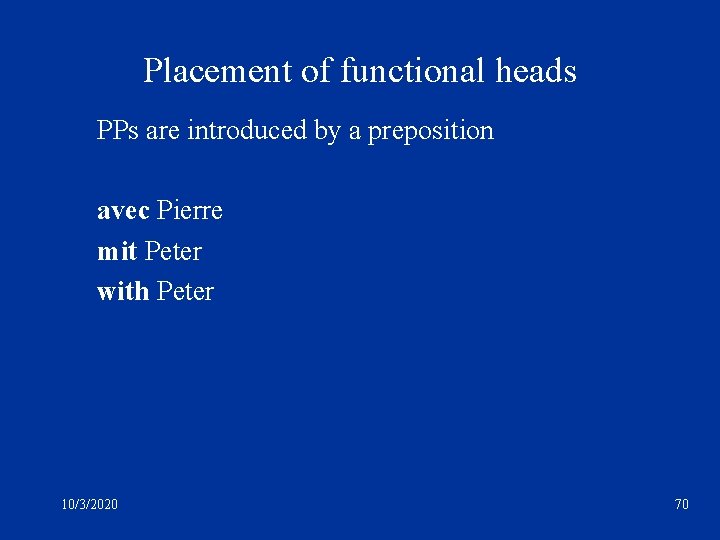
Placement of functional heads PPs are introduced by a preposition avec Pierre mit Peter with Peter 10/3/2020 70
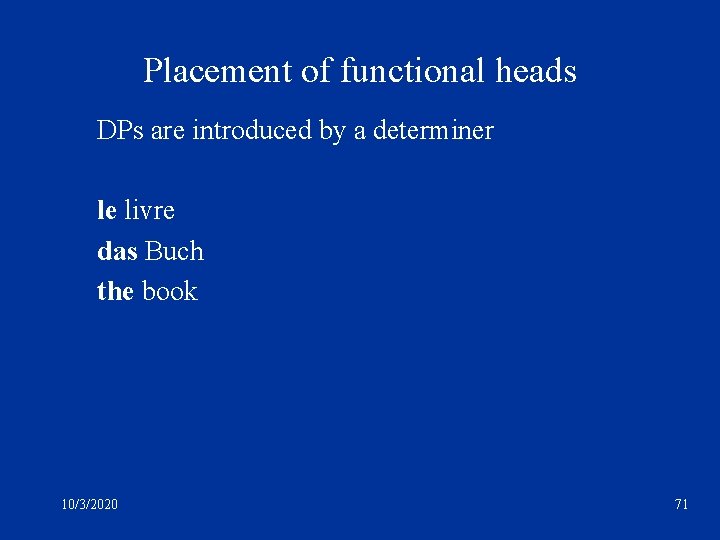
Placement of functional heads DPs are introduced by a determiner le livre das Buch the book 10/3/2020 71
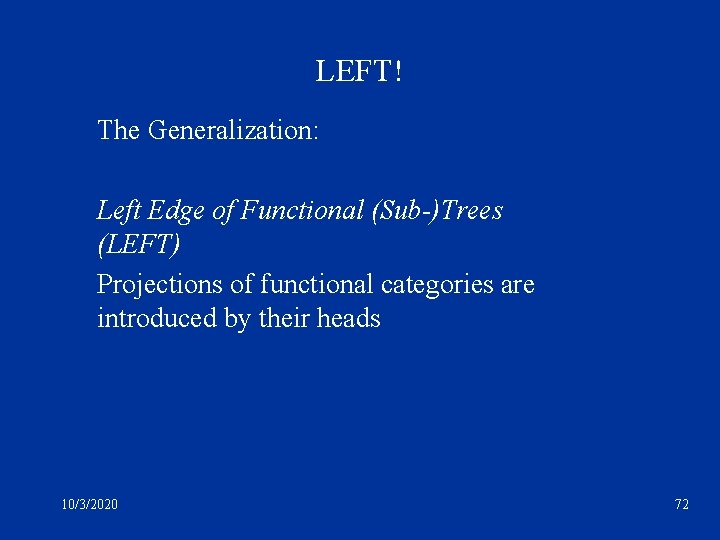
LEFT! The Generalization: Left Edge of Functional (Sub-)Trees (LEFT) Projections of functional categories are introduced by their heads 10/3/2020 72
Placement of functional heads Left edges of CPs Je crois que Pierre a faim I think that Pierre has hunger *Je crois Pierre a faim Ich denke dass Peter Hunger hat I think that Peter hunger has *Ich denke Peter Hunger hat 10/3/2020 73
Placement of functional heads 10/3/2020 74
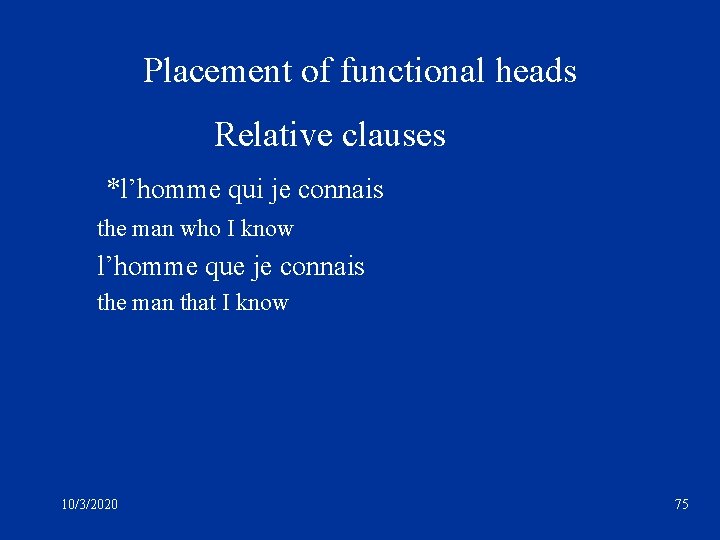
Placement of functional heads Relative clauses *l’homme qui je connais the man who I know l’homme que je connais the man that I know 10/3/2020 75
Relative clauses 10/3/2020 76
Rec disfavors deletion BUT: l'homme avec qui j'ai dansé *l'homme que j'ai dansé REC (Pesetsky): A unit with semantic content must be pronounced unless it has a sufficiently local antecedent 10/3/2020 77
Some Optimality Effects in Syntax REC belongs to the family of faithfulness constraints Rec > Left > Tel What is recoverable and what not is dealt with differently in different languages 10/3/2020 78
No deletion with PP-relatives 10/3/2020 79
Deletion with NP-relatives 10/3/2020 80
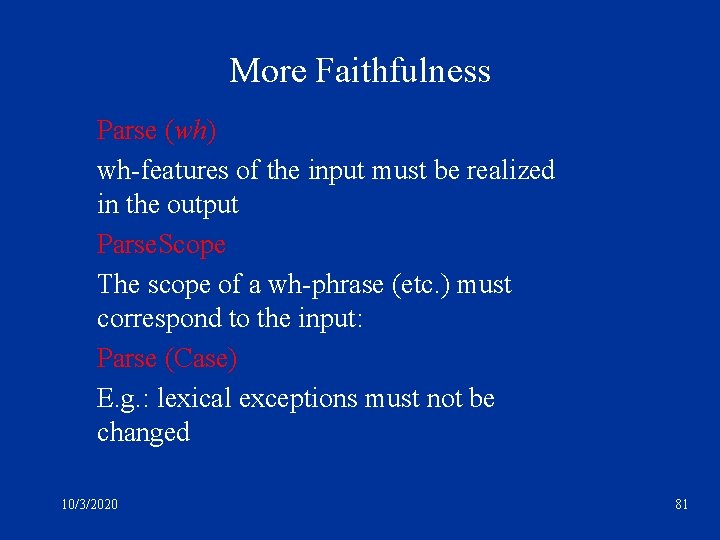
More Faithfulness Parse (wh) wh-features of the input must be realized in the output Parse. Scope The scope of a wh-phrase (etc. ) must correspond to the input: Parse (Case) E. g. : lexical exceptions must not be changed 10/3/2020 81
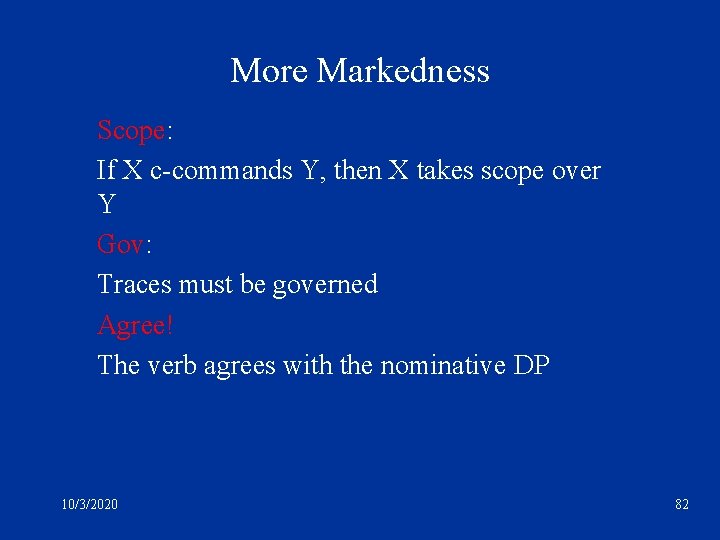
More Markedness Scope: If X c-commands Y, then X takes scope over Y Gov: Traces must be governed Agree! The verb agrees with the nominative DP 10/3/2020 82
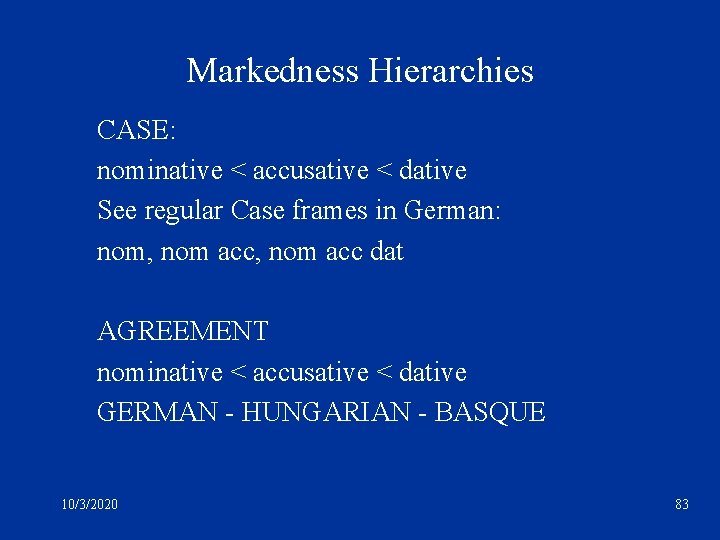
Markedness Hierarchies CASE: nominative < accusative < dative See regular Case frames in German: nom, nom acc dat AGREEMENT nominative < accusative < dative GERMAN - HUNGARIAN - BASQUE 10/3/2020 83
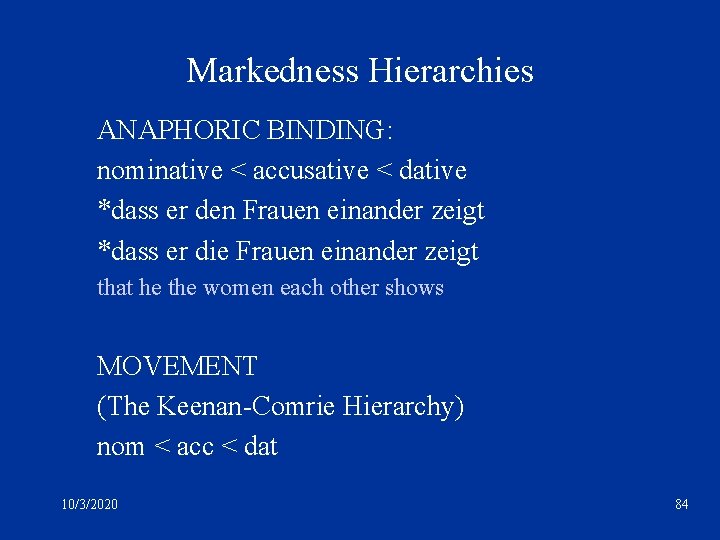
Markedness Hierarchies ANAPHORIC BINDING: nominative < accusative < dative *dass er den Frauen einander zeigt *dass er die Frauen einander zeigt that he the women each other shows MOVEMENT (The Keenan-Comrie Hierarchy) nom < acc < dat 10/3/2020 84
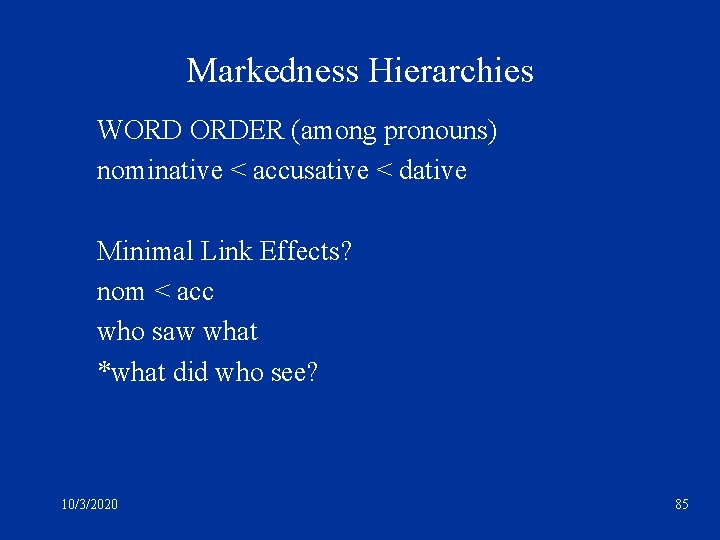
Markedness Hierarchies WORD ORDER (among pronouns) nominative < accusative < dative Minimal Link Effects? nom < acc who saw what *what did who see? 10/3/2020 85
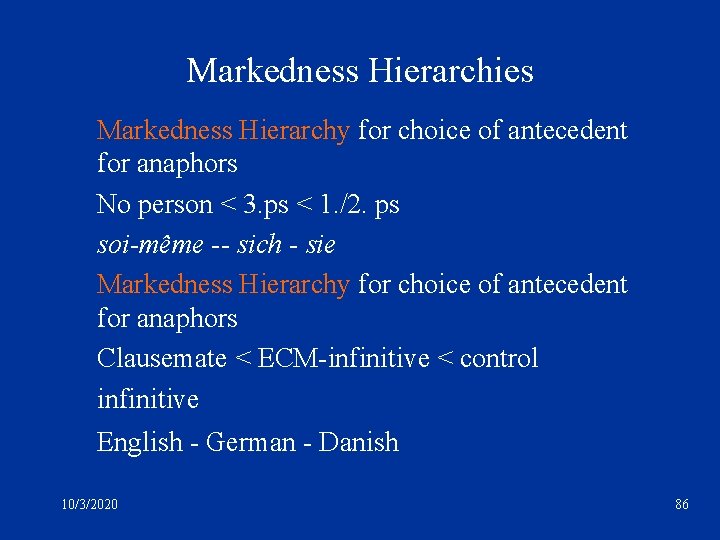
Markedness Hierarchies Markedness Hierarchy for choice of antecedent for anaphors No person < 3. ps < 1. /2. ps soi-même -- sich - sie Markedness Hierarchy for choice of antecedent for anaphors Clausemate < ECM-infinitive < control infinitive English - German - Danish 10/3/2020 86
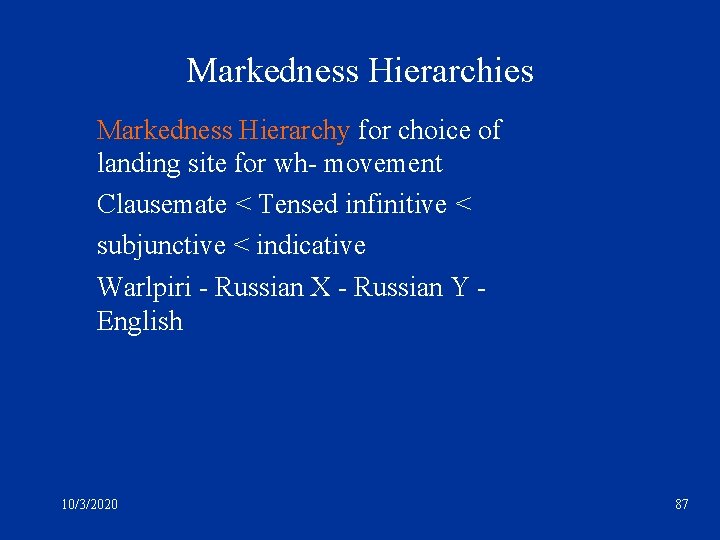
Markedness Hierarchies Markedness Hierarchy for choice of landing site for wh- movement Clausemate < Tensed infinitive < subjunctive < indicative Warlpiri - Russian X - Russian Y English 10/3/2020 87