
FAITHBASED COFFEE MODEL ENGAGING THE FAITH COMMUNITY SOCIAL
FAITH-BASED COFFEE MODEL: ENGAGING THE FAITH COMMUNITY & SOCIAL SERVICE AGENCIES The National Association for the Education of Homeless Children and Youth Conference October 2017

Presented by Peggy Carlson, District Liaison for Students In Transition & Melanie Green, Administrator of Family Engagement & Family & Community Resource Centers Vancouver, Washington
Thank you for joining us! Raise your hand… ◦ Homeless Liaison ◦ School Administrator ◦ Educator/Counselor-Social Worker ◦ Service Provider ◦ Government Agency ◦ Member of a Church Community ◦ Other
Goals & Objectives: Participants will… ◦ be introduced to the Faith-Based Coffee (FBC) Model. ◦ understand the impact of the FBC Model on students and families in transition. ◦ learn the benefits, outcomes and be given examples of successful programs that were implemented because of FBC. ◦ receive tools and practical application steps to replicate FBC in their community. ◦ explore the benefits and challenges of working alongside faith communities and how to successfully navigate the separation of church and state.
Our Community – Vancouver, WA Evergreen Public Schools ◦ 26, 178 Students ◦ 46% Free/Reduced meals participation ◦ 84% Graduation rate ◦ 16% students are chronically absent §Absent 18+ days of school each year
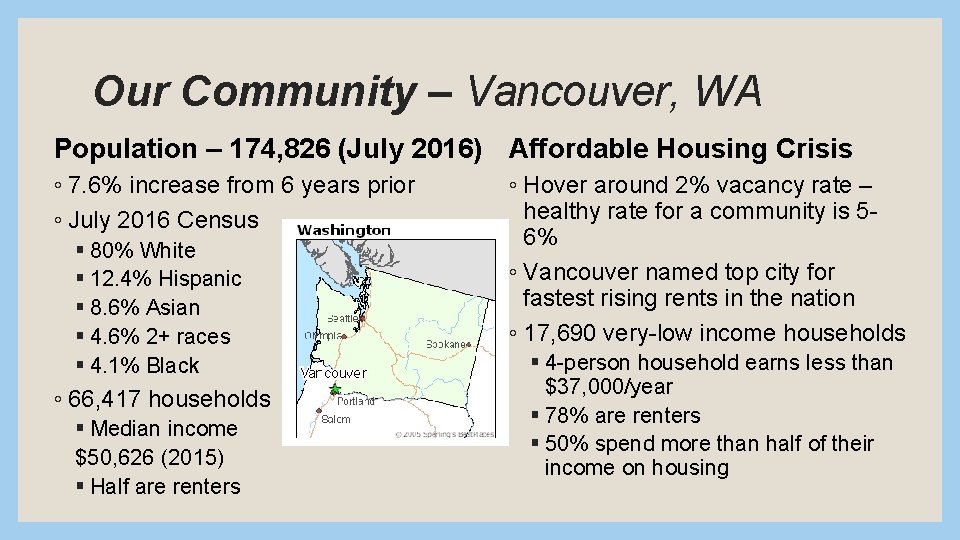
Our Community – Vancouver, WA Population – 174, 826 (July 2016) Affordable Housing Crisis ◦ 7. 6% increase from 6 years prior ◦ July 2016 Census § 80% White § 12. 4% Hispanic § 8. 6% Asian § 4. 6% 2+ races § 4. 1% Black ◦ 66, 417 households § Median income $50, 626 (2015) § Half are renters ◦ Hover around 2% vacancy rate – healthy rate for a community is 56% ◦ Vancouver named top city for fastest rising rents in the nation ◦ 17, 690 very-low income households § 4 -person household earns less than $37, 000/year § 78% are renters § 50% spend more than half of their income on housing
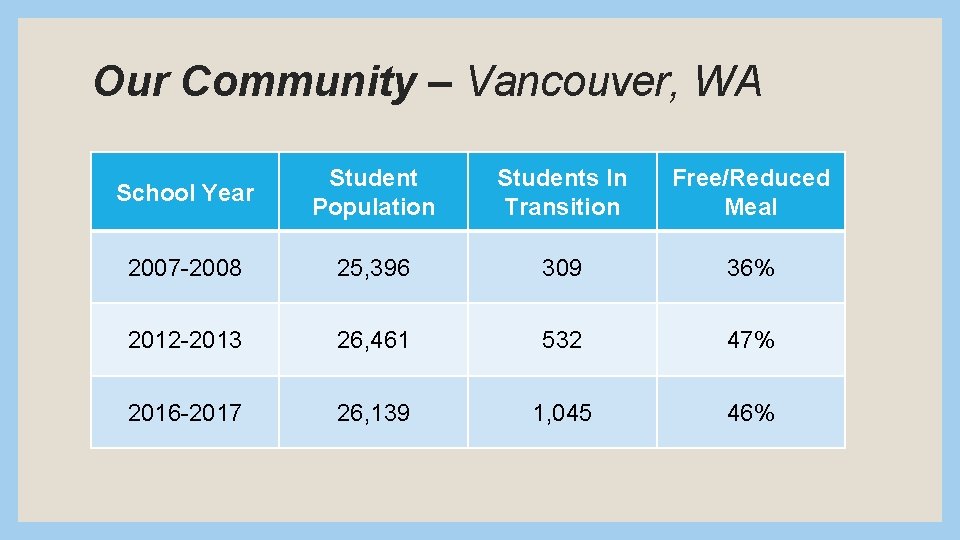
Our Community – Vancouver, WA School Year Student Population Students In Transition Free/Reduced Meal 2007 -2008 25, 396 309 36% 2012 -2013 26, 461 532 47% 2016 -2017 26, 139 1, 045 46%
Discussion Questions ◦ What do you see as the greatest needs of your community? ◦ Are there agencies/organizations/groups working together to address the needs of the community?
Our Community – Vancouver, WA ◦ Many schools have had long-standing partnerships with church/faith organizations that provide support to students and families ◦ Many of our faith communities are actively engaged in our community – WHO, after school clubs, holiday support, emergency response to needs, etc. ◦ Opportunity presented itself to formalize, support and encourage partnerships between schools and churches
Undivided ◦ Undivided documents the true story of how a suburban church unites with at-risk Roosevelt High School—once Portland, Oregon’s most outstanding but now failing and slated for closure—to create a beautiful transformation for students, the school and the volunteers serving it. ◦ https: //vimeo. com/45585846
A brief history of FBC: Originally started as a network between DSHS and faith communities to support youth in foster care Clark County Public Health issued 2011 Community Health Assessment ◦ It found children in central Vancouver had a greater risk for poor health due to poor birth outcomes, high rates of chronic disease, poor SES factors, lack of school readiness, and high risk for neglect and abuse. ◦ CCPH focused on improving conditions and building community and family resiliency. ◦ Identified faith communities and brought them together to find out how they could engage with larger community around them. Vancouver (west-side) Faith-Based Coffee launched in March 2012
Evergreen (east-side) Faith-Based Coffee launched in February 2015 ◦ Superintendent hosted first Faith-School Partnership Breakfast in January 2015 which provided an opportunity to “kick-off” the Evergreen FBC Meetings ◦ Clear message that our district was supportive and encouraging of these partnerships ◦ Personal invitation was key to bringing them to the table
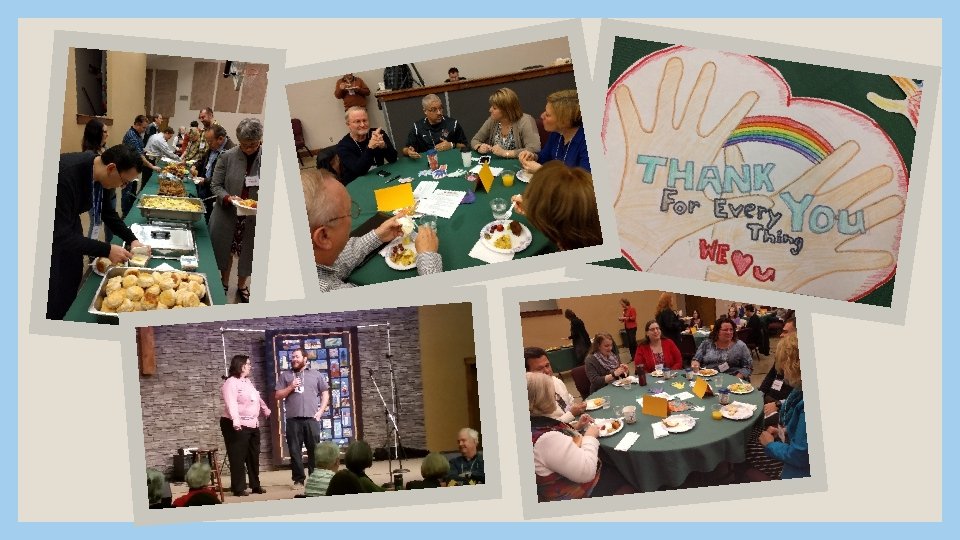
Faith-School Partnership Breakfast ◦ Annual event brings together church and school leadership to celebrate partnerships, accomplishments and strengthen existing relationships ◦ Highlight church-school partnerships and share stories of success ◦ Seating chart by geographical areas allows churches and schools connect to those closest to them ◦ Discussion questions for table talk during breakfast that provided an opportunity to share needs and resources
Evergreen Public Schools partners with Evergreen Faith. Based Coffee to share information about the needs of the children and families we serve. Each month faith and community partners gather to: Support community resiliency Serve children, individuals and families Learn about needs related to those we serve Share information in a safe and inclusive environment Build new relationships and partnerships Communicate stories of impact Encourage purposeful engagement and respectful conversation
FBC Video ◦ https: //vimeo. com/186485450/7 e 089 b 122 a
FBC: Getting started… ◦ Identify key stakeholders in your community to participate ◦ Establish a planning committee that can help identify a church host, sponsors for coffee and snacks, and develop a plan for topics to cover at meetings ◦ Needs assessment – what is important and relevant to your community? ◦ Educate faith partners by sharing data and about the needs and concerns of students and families in your district
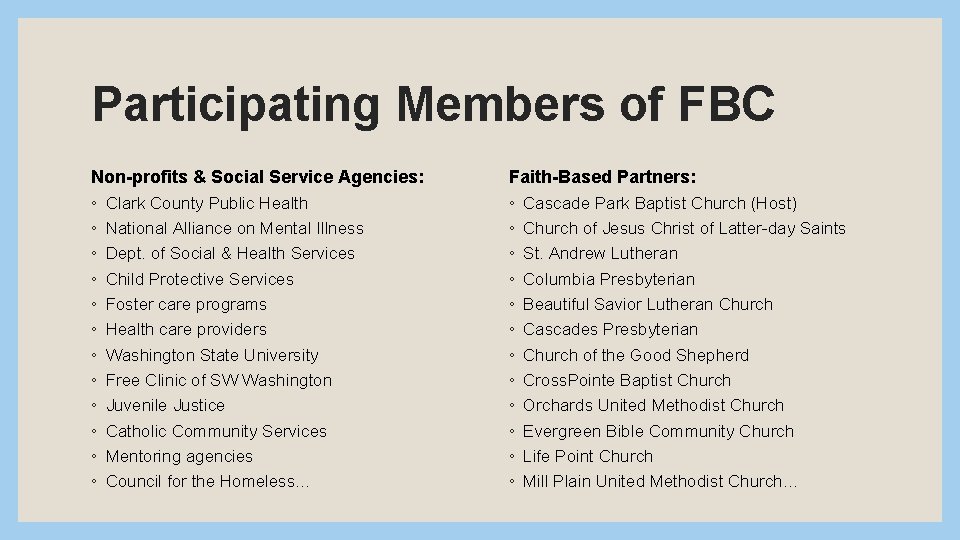
Participating Members of FBC Non-profits & Social Service Agencies: ◦ Clark County Public Health ◦ National Alliance on Mental Illness ◦ Dept. of Social & Health Services ◦ Child Protective Services ◦ Foster care programs ◦ Health care providers ◦ Washington State University ◦ Free Clinic of SW Washington ◦ Juvenile Justice ◦ Catholic Community Services ◦ Mentoring agencies ◦ Council for the Homeless… Faith-Based Partners: ◦ Cascade Park Baptist Church (Host) ◦ Church of Jesus Christ of Latter-day Saints ◦ St. Andrew Lutheran ◦ Columbia Presbyterian ◦ Beautiful Savior Lutheran Church ◦ Cascades Presbyterian ◦ Church of the Good Shepherd ◦ Cross. Pointe Baptist Church ◦ Orchards United Methodist Church ◦ Evergreen Bible Community Church ◦ Life Point Church ◦ Mill Plain United Methodist Church…
Discussion Questions ◦ Who would you identify as a key stakeholder that could help with the implementation of FBC? ◦ Who would you select to be on a planning committee? ◦ Who would benefit from this type of collaboration?
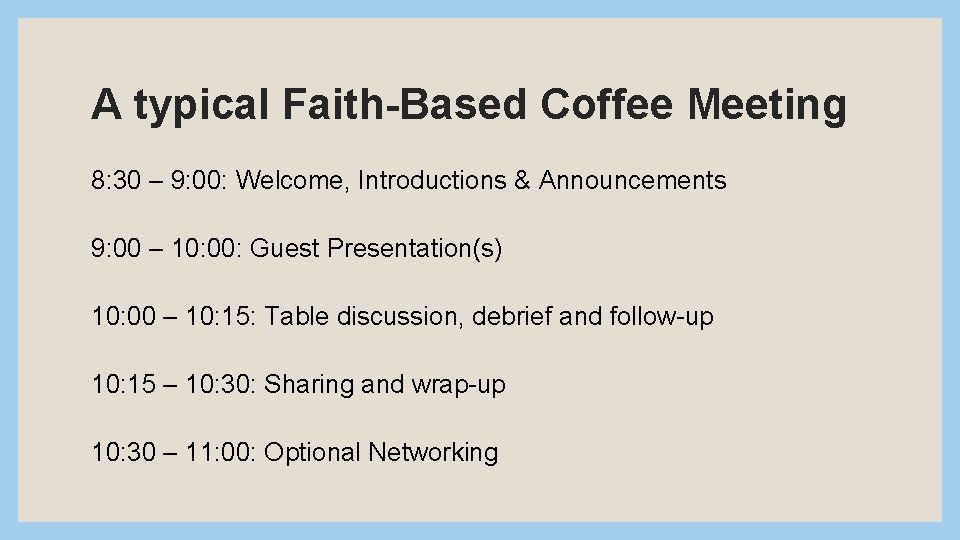
A typical Faith-Based Coffee Meeting 8: 30 – 9: 00: Welcome, Introductions & Announcements 9: 00 – 10: 00: Guest Presentation(s) 10: 00 – 10: 15: Table discussion, debrief and follow-up 10: 15 – 10: 30: Sharing and wrap-up 10: 30 – 11: 00: Optional Networking
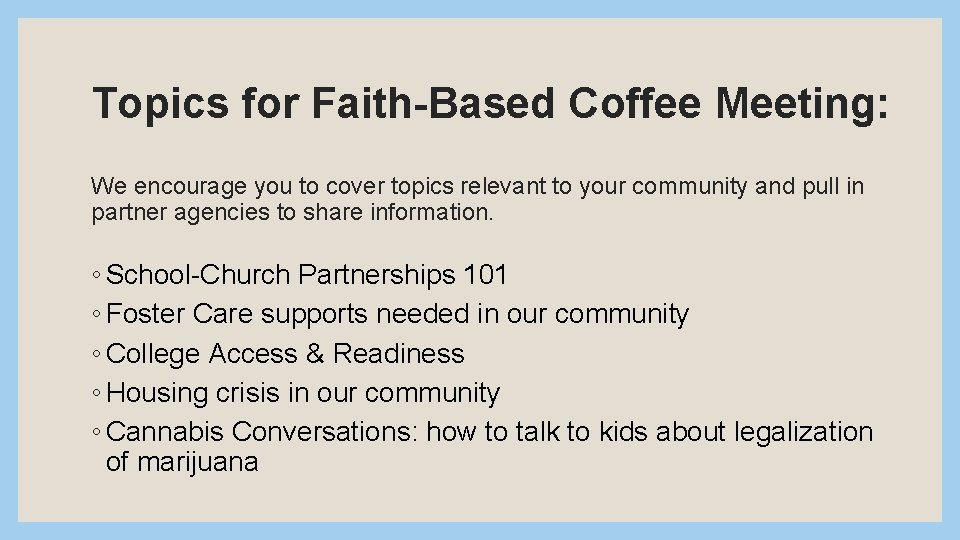
Topics for Faith-Based Coffee Meeting: We encourage you to cover topics relevant to your community and pull in partner agencies to share information. ◦ School-Church Partnerships 101 ◦ Foster Care supports needed in our community ◦ College Access & Readiness ◦ Housing crisis in our community ◦ Cannabis Conversations: how to talk to kids about legalization of marijuana
Topics for Faith-Based Coffee Meeting: ◦ National Alliance of Mental Illness – SEE ME Presentation ◦ Sex Trafficking ◦ Screening and discussion of Paper Tigers & Undivided ◦ Adverse Childhood Experiences (ACEs) ◦ YWCA “Where We Live Presentation” focusing on keeping kids safe from sexual violence ◦ Mentoring Programs/Opportunities to engage in schools ◦ FBC Debrief and planning session
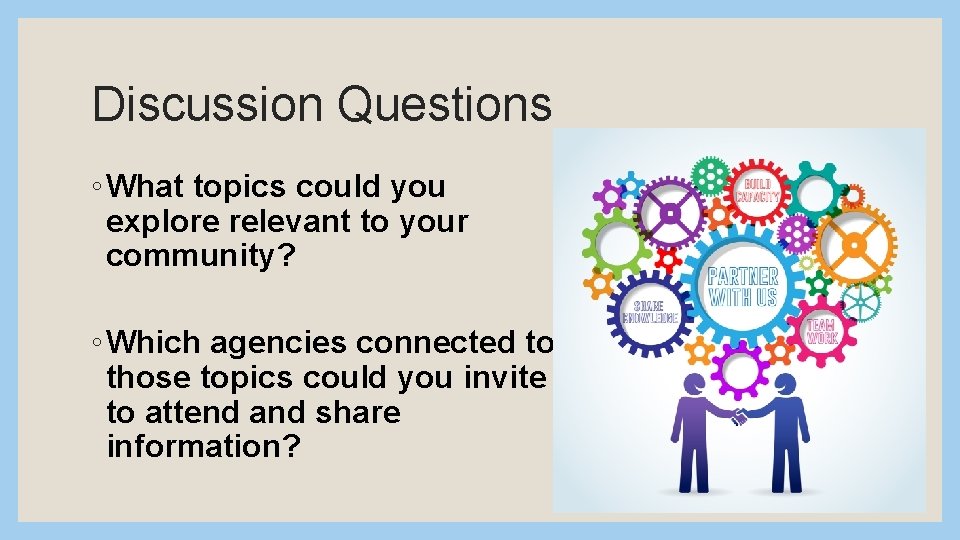
Discussion Questions ◦ What topics could you explore relevant to your community? ◦ Which agencies connected to those topics could you invite to attend and share information?
Benefits of FBC & Keys to Success ◦ Representation from schools, faith partners and community agencies ◦ Opportunity to build relationships between schools-faith partnerscommunity agencies ◦ Break down walls that separate the faith community and educational systems – shared community ◦ Shared learning provides opportunity for collaborative thinking, followed by structure and supports as partnerships mature ◦ Leverage resources and supports ◦ Minimal costs – Church partner hosts meeting, coffee donations, faith partner provides snacks
Impact of FBC on students and families in transition ◦ Church support for food and clothing pantry at high schools ◦ Mentoring programs support: ◦ Volunteers and students play basketball during lunch at high school ◦ Support for Lunch & Reading Buddy Program at elementary schools ◦ Teach One to Lead One Mentoring Program for 4 th and 5 th grade students ◦ After school barbeque for students and families to enjoy prior to sporting events – entrance to game is free ◦ Church volunteers picked up lost and found at the end of the school year and washed, folded and sorted items
Impact of FBC on students and families in transition ◦ Fundraising supports ◦ Clark County Quilters Guild auction to benefit SIT Program ◦ Fresh Start Clothing Drive – new school clothes for students in transition ◦ Family Assistance – rental support, utilities assistance ◦ Clark County Connect – email alert system to fill emergency family needs ◦ Church partners teaching English language classes ◦ Community advocacy for policy change
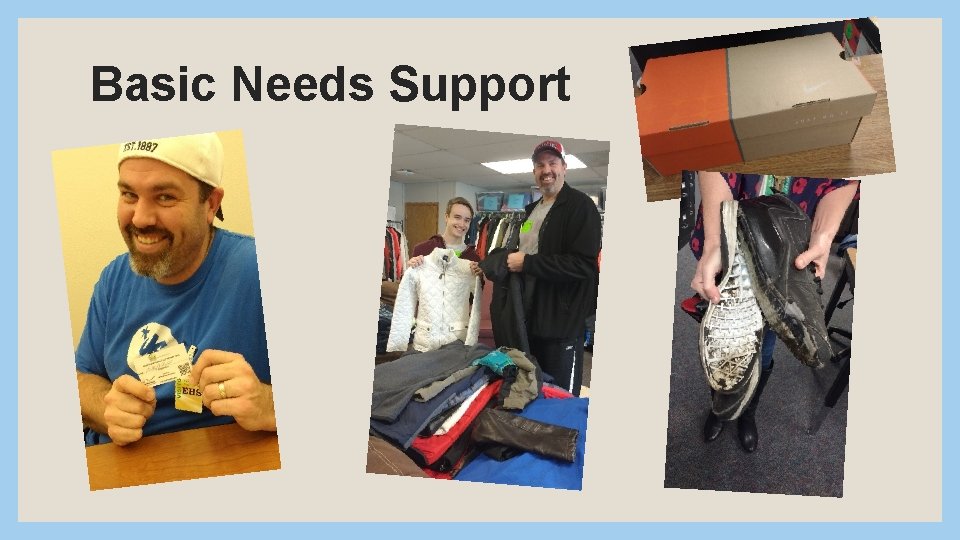
Basic Needs Support
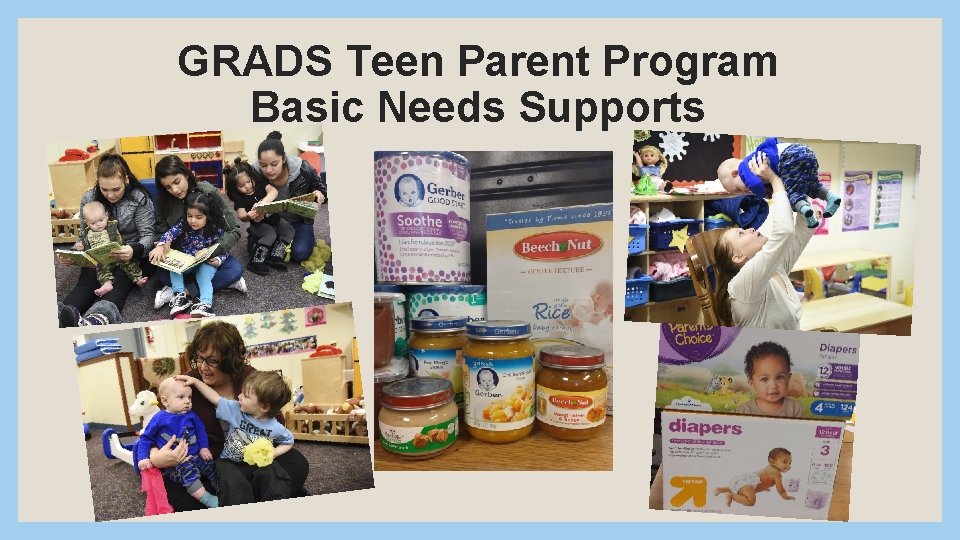
GRADS Teen Parent Program Basic Needs Supports
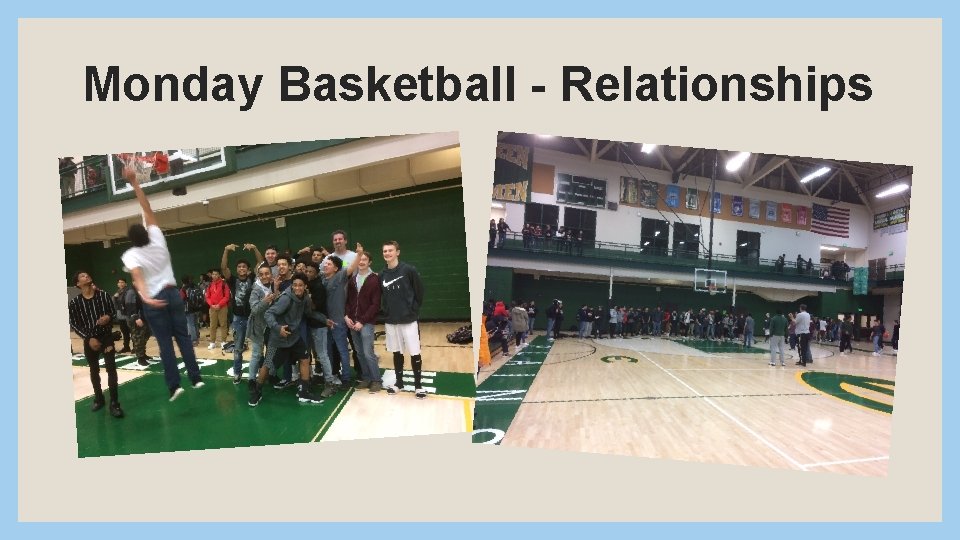
Monday Basketball - Relationships
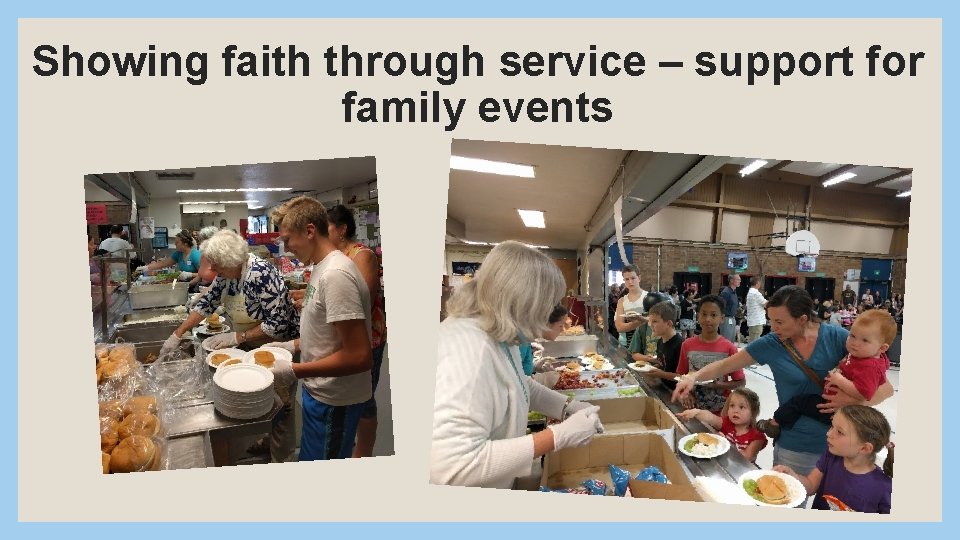
Showing faith through service – support for family events
Challenges & Suggestions: ◦ Data collection and capturing the outcomes of partnerships formed through FBC ◦ Churches tend to want to support their neighborhood school ◦ Separation of church and state must be clearly defined and discussed – full transparency ◦ Matching needs of community/schools with resources available through faith partners ◦ On-going coordination of meetings – who can take the lead?
Challenges & Suggestions: ◦ Create “Address Book” with a point person at each school that can be the liaison between the two agencies ◦ Diversity in faith representation ◦ Maintaining faith partners participation at monthly meetings ◦ Communication between meeting to maintain engagement ◦ Mail. Chimp Newsletter - Includes meeting notes, upcoming events, reminders, and agenda for next meeting ◦ Social Media (Facebook, Twitter, website, etc. )
Discussion Question ◦ What do you see as the barriers and challenges of implementing the Faith-Based Coffee Model in your community?
National Association of County and City Health Officials recognized Faith-Based Coffee with a Promising Practice Award ◦ Together, these organizations and individuals support a collaborative mission to build and support the development of protective community factors such as parent/family resilience, social connectedness, concrete supports, the social/emotional competence of children, nurturing/attachment, and improved parenting skills and their knowledge about child development for families and children who lived in this area.
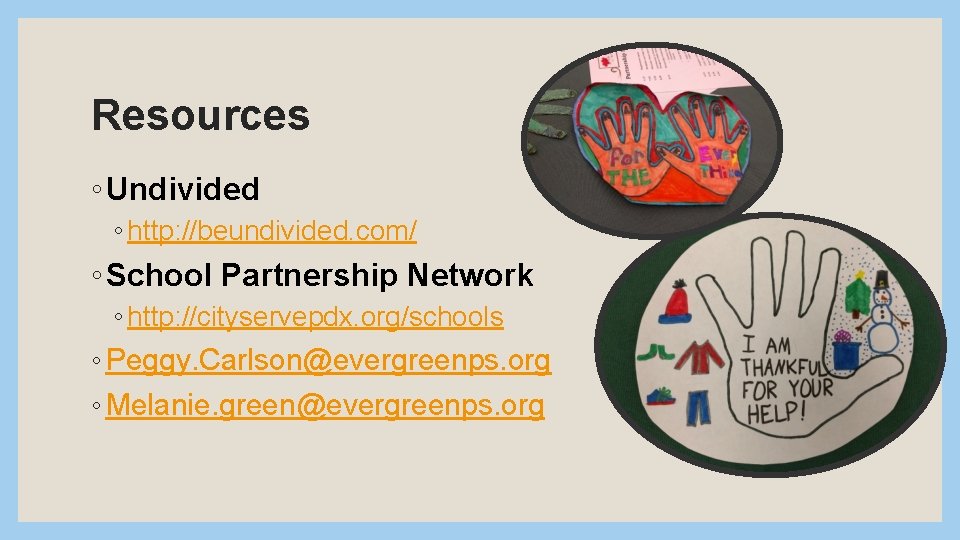
Resources ◦ Undivided ◦ http: //beundivided. com/ ◦ School Partnership Network ◦ http: //cityservepdx. org/schools ◦ Peggy. Carlson@evergreenps. org ◦ Melanie. green@evergreenps. org
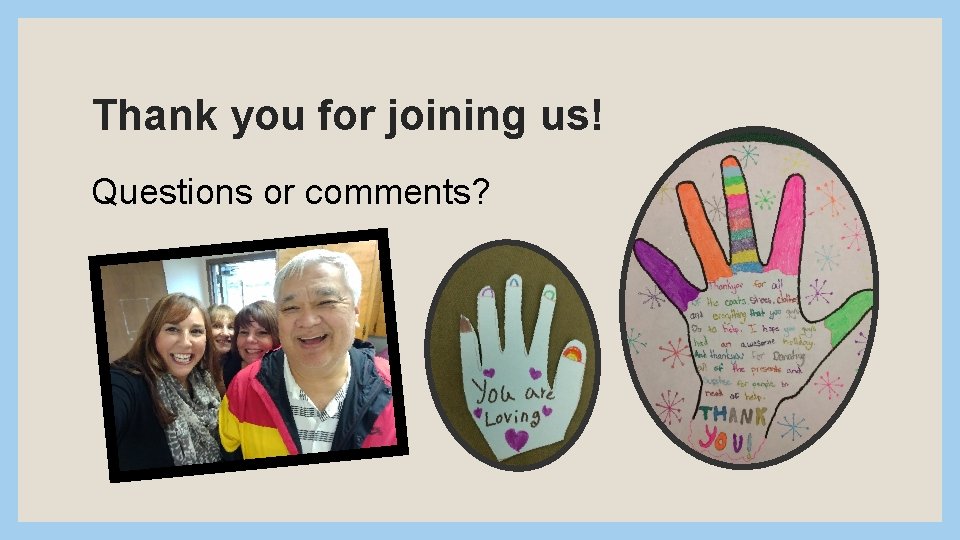
Thank you for joining us! Questions or comments?
- Slides: 37